Photosynthesis
Introduced| English | Meaning |
|---|---|
| photosynthesis/ˌfəʊtəʊˈsɪnθəsɪs/ | The process by which plants and other organisms use light energy to make organic substances from carbon dioxide and water. |
| glucose/ˈɡluːkəʊs/ | A simple sugar with molecular formula C₆H₁₂O₆, used by cells as a source of energy. |
| chlorophyll/ˌklɔːrəʊˈfɪl/ | A green pigment that absorbs light energy for photosynthesis. |
| starch/stɑːtʃ/ | A storage polysaccharide in plants, made from glucose units. |
| limiting factor/ˈlɪmɪtɪŋ ˈfæktə/ | A condition that restricts a process under the current conditions; changing it can allow the rate to rise. |
Where does a growing plant get its food?
- A seedling becomes a larger plant without eating another organism. Photosynthesis 光合作用 builds carbohydrates from carbon dioxide and water using light energy; mineral ions from soil are not the plant's food.
- Plants also respire, in light and darkness. Photosynthesis stores energy in chemicals; respiration releases energy for cell processes.
A green plant stops respiring whenever it photosynthesises.
Difficulty 1/5 · 100 coins + a small bonus on first completion today
Respiration occurs in light and darkness. Photosynthesis can occur at the same time in suitable light.
Separate materials from the energy source
- The word equation is carbon dioxide + water → glucose + oxygen. Glucose 葡萄糖 is a carbohydrate; oxygen is another product.
- Chlorophyll 叶绿素 is the green pigment in chloroplasts. It absorbs light and transfers energy into chemicals made during photosynthesis. Light supplies energy; it is not a material converted into glucose.

The animation summarises the overall process; the equation represents many reactions.
The products of photosynthesis are:
Difficulty 1/5 · 100 coins + a small bonus on first completion today
CO₂ + water → glucose + oxygen.
The green pigment that absorbs light for photosynthesis is:
Difficulty 1/5 · 100 coins + a small bonus on first completion today
Chlorophyll in chloroplasts traps light energy.
Which are raw materials consumed in the photosynthesis word equation? Select all that apply.
Difficulty 2/5 · 140 coins + a small bonus on first completion today
Carbon dioxide and water are raw materials. Light supplies energy; chlorophyll is the pigment absorbing it.
What is the role of light in photosynthesis?
Difficulty 1/5 · 100 coins + a small bonus on first completion today
Carbon comes from carbon dioxide; light supplies energy for carbohydrate synthesis.
Balance the chemical equation
- For Extended study, write the balanced equation with light and chlorophyll as conditions:
- Check atoms on both sides: 6 carbon, 12 hydrogen and 18 oxygen atoms. Change the numbers before formulae when balancing; do not change the formula of water or glucose.
For every glucose molecule represented, six carbon dioxide molecules supply its six carbon atoms. The equation gives a 6:1 ratio, not equal numbers of carbon dioxide and glucose molecules. It summarises chemical change, not particle sizes.
The balanced equation represents six carbon dioxide molecules for one glucose molecule. How many carbon dioxide molecules are represented for two glucose molecules?
Difficulty 2/5 · 140 coins + a small bonus on first completion today
6 × 2 = 12 carbon dioxide molecules. The molecule ratio is 6:1.
Glucose has several possible uses
- Glucose can be used in respiration or converted into starch 淀粉 for storage. Plants also use carbohydrates to make cell walls and transport sugars to other parts.
- “All glucose becomes starch” is too narrow. The companion lesson on carbohydrates and minerals explains storage, transport, growth and nectar production separately.

Keep the inputs to photosynthesis separate from the later uses of its carbohydrate products.
Glucose made in photosynthesis is often stored as ______.
Difficulty 1/5 · 100 coins + a small bonus on first completion today
Starch is the plant's storage carbohydrate.
Match each item to its role.
Difficulty 2/5 · 140 coins + a small bonus on first completion today
Separate the pigment, raw material, store and energy-releasing process.
Identify a limiting factor by changing it
- A limiting factor 限制因素 prevents a faster rate under the current conditions. Increasing light intensity raises the rate only while light is limiting; a plateau shows that more light alone no longer raises the rate.
- Carbon dioxide concentration and temperature can also limit the rate. Temperature is a condition, not a substance “in shortest supply”: warming may help below the optimum, whereas excessive heat reduces enzyme activity.
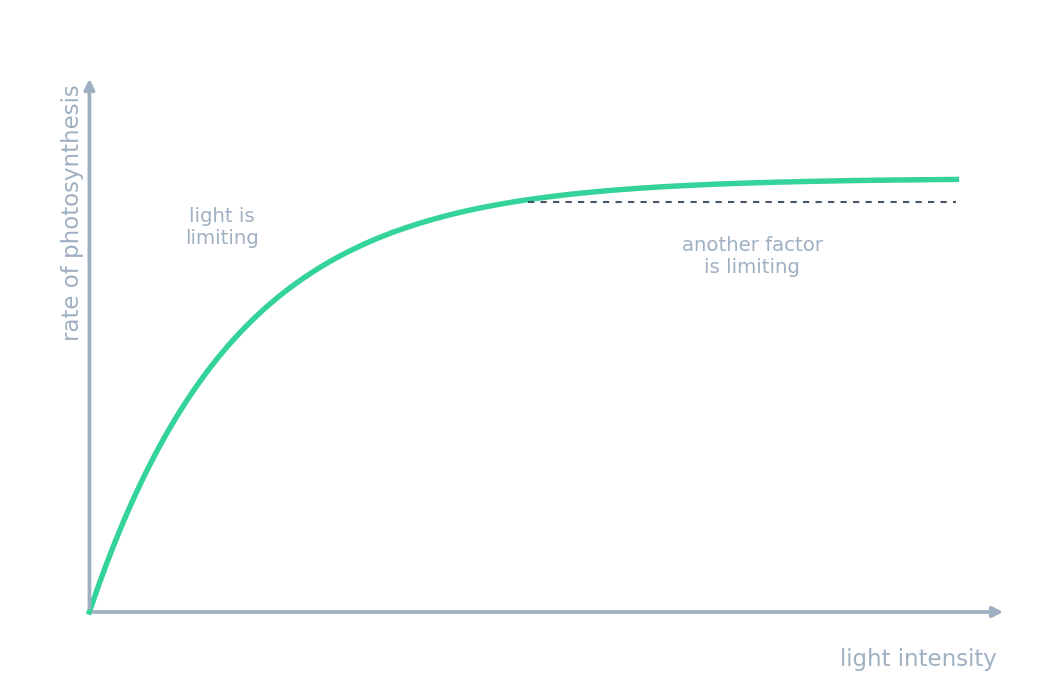
The flat part alone does not identify which other factor is limiting. Change another factor while controlling the rest.
A model light-response curve
rate rises, then plateaus
Distinguish a rising rate from a non-zero plateau. The CO₂ / temperature slider represents a simplified ceiling, not the full response to temperature above an optimum.
Which observation best supports light being limiting in the tested range?
Difficulty 1/5 · 100 coins + a small bonus on first completion today
A controlled response to more light supports light limitation in that range.
Use paired results to test a claim
- At a fixed temperature, increasing light from level 2 to level 4 raises the rate from 3 to 6 arbitrary units. Increasing it from 4 to 6 leaves the rate at 6. Light limits the first comparison, but more light alone does not help in the second.
- At light level 6, adding carbon dioxide then raises the rate to 9. This supports carbon dioxide limitation in that tested condition; it does not establish that carbon dioxide limits every plant at every light level.
A plateau does not mean photosynthesis has stopped. It means the measured rate is no longer increasing. The graph's rate remains above zero, and a different treatment may raise it.
At fixed temperature and high light, raising carbon dioxide increases rate from 6 to 9 arbitrary units. What does this support, and why would a plateau before the treatment not be enough to reach that conclusion?
The controlled increase supports carbon dioxide being limiting under the initial high-light condition. A plateau in a light-response graph shows that additional light alone does not increase rate, but cannot by itself identify carbon dioxide rather than temperature or another constraint.
Explain a greenhouse result
- A grower adds carbon dioxide in dim light, but measures no increase in photosynthesis. Increasing light while keeping the other conditions suitable does raise the rate.
- Explain what the results support. Then predict why simply making the greenhouse hotter and hotter would not guarantee further increases.
A grower adds carbon dioxide in dim light and measures no increase in photosynthesis. More light, with other conditions suitable, does raise it. Explain what the results support and why continued heating is not guaranteed to improve the rate.
The response to increased light supports light being limiting in the initial conditions. Extra carbon dioxide alone did not remove that limit. Warming may increase enzyme activity below an optimum, but excessive heat can reduce photosynthesis through enzyme damage. A plateau still represents an ongoing rate.
Check materials, energy and evidence
- Photosynthesis makes carbohydrates from carbon dioxide and water using light absorbed by chlorophyll. Glucose and oxygen appear in the word equation.
- Plants respire in both light and darkness, and carbohydrates have several uses besides starch storage.
- Identify a limiting factor using a controlled change. A plateau is a steady rate, not necessarily a zero rate or proof of a particular limiting factor.
A light-response graph has a horizontal section above zero. What does it show?
Difficulty 1/5 · 100 coins + a small bonus on first completion today
A positive plateau is a steady, non-zero rate. Another factor may now limit it.
Which statement about carbohydrate made by a plant is justified?
Difficulty 1/5 · 100 coins + a small bonus on first completion today
Carbohydrates support several roles; starch storage is one possible use.