Leaf structure
Introduced| English | Meaning |
|---|---|
| adaptation/ˌædæpˈteɪʃn/ | A feature of a structure that helps it perform its function in its environment. |
| stomata/ˈstəʊmətə/ | Small pores in plant epidermis, controlled by guard cells, through which gases and water vapour pass. |
| cuticle/ˈkjuːtɪkl/ | A protective surface layer; on a leaf it is a waxy covering that helps reduce water loss. |
| palisade/ˈpælɪseɪd/ | palisade |
| chloroplasts/ˈklɔːrəʊplæsts/ | Organelles in plants and algae that contain photosynthetic pigments and carry out photosynthesis. |
| spongy mesophyll/ˈspʌndʒi ˈmesəfɪl/ | spongy mesophyll |
| leaf veins/liːf veɪnz/ | Vascular bundles in a leaf containing xylem for water and mineral ions and phloem for transported sugars and amino acids. |
| xylem/ˈzaɪləm/ | Plant vascular tissue that transports water and mineral ions and helps support the plant. |
| phloem/ˈfləʊɪm/ | Plant vascular tissue that transports sugars and other organic substances between sources and sinks. |
| guard cells/ɡɑːd selz/ | One of a pair of specialised cells whose changes in shape control the opening of a stoma. |
Why is a leaf thin rather than a thick green block?
- A typical broad leaf receives light over a large surface and gives gases a short route to its living cells. Each adaptation 适应 links a structure to a useful function.
- This lesson uses a typical dicotyledonous leaf. Leaf structures vary; “every plant has stomata only underneath” is not a safe general rule.
Trace light through the upper surface
- A broad, flat surface intercepts light. A thin cuticle 角质层 reduces water loss, while the transparent upper epidermis allows light to reach the cells below.
- Beneath it, palisade 栅栏组织 mesophyll cells contain many chloroplasts 叶绿体. Chlorophyll inside the chloroplasts absorbs light for photosynthesis.
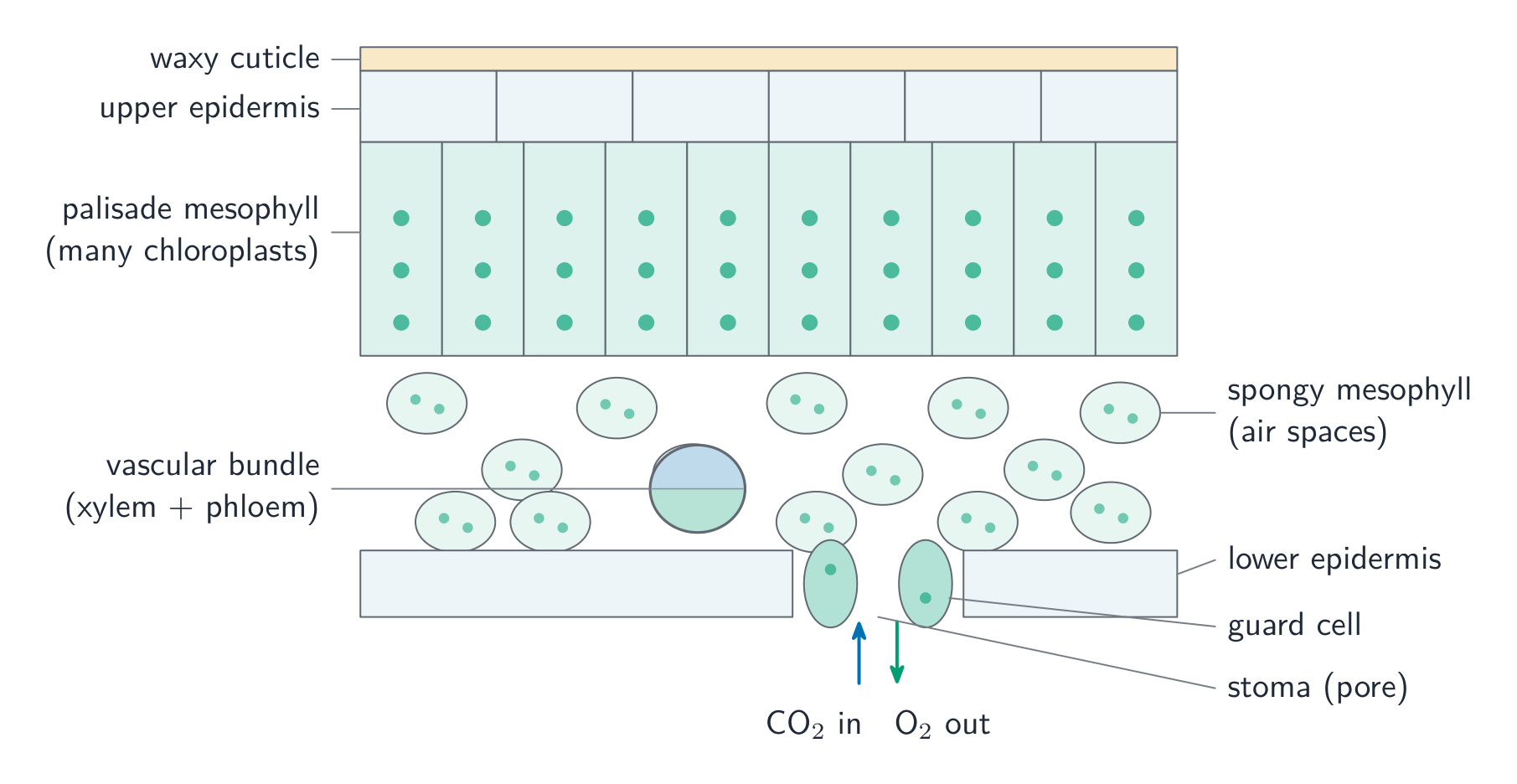
The gas arrows illustrate net exchange when photosynthesis exceeds respiration. They are not fixed directions at all times.
A leaf is broad and flat mainly to:
Difficulty 1/5 · 100 coins + a small bonus on first completion today
Large surface area maximises light capture.
Which leaf layer contains the most chloroplasts?
Difficulty 1/5 · 100 coins + a small bonus on first completion today
The palisade layer near the top absorbs the most light.
Trace carbon dioxide to a photosynthetic cell
- Stomata 气孔 are pores in the epidermis. Air spaces between the loosely arranged spongy mesophyll 海绵叶肉 cells connect these openings to internal gas-exchange surfaces. These spaces expose a large internal cell surface for gas exchange.
- Carbon dioxide diffuses through the air spaces, dissolves in the moist cell-wall surface and then enters cells. A thin leaf gives a short diffusion distance; spongy mesophyll cells also contain chloroplasts and can photosynthesise.
A student says, “The air spaces make light.” Replace that claim with a structure–function link: connected air spaces allow carbon dioxide to diffuse through the leaf to mesophyll cells, supplying a raw material for photosynthesis.
Stomata are pores that allow:
Difficulty 1/5 · 100 coins + a small bonus on first completion today
The pores connect the surrounding air to internal air spaces. Net direction depends on each gas gradient.
A leaf is ______ so that gases can diffuse in and out over short distances.
Difficulty 1/5 · 100 coins + a small bonus on first completion today
Thinness shortens the diffusion distance.
Which statement about spongy mesophyll is correct?
Difficulty 1/5 · 100 coins + a small bonus on first completion today
The cells can photosynthesise; spaces between them provide an internal diffusion route.
Order this simplified route for carbon dioxide entering a leaf.
Difficulty 3/5 · 200 coins + a small bonus on first completion today
Carbon dioxide diffuses into the leaf through pores and air spaces, dissolves at the moist surface and enters a cell.
Keep water delivery separate from sugar transport
- Leaf veins 叶脉 contain vascular bundles. Xylem 木质部 supplies water and mineral ions to the leaf; water is a raw material for photosynthesis.
- Phloem 韧皮部 transports sucrose and amino acids between sources and sinks. A photosynthesising leaf can supply sucrose to growing or storage regions. Leaf veins are not animal blood veins.
Match each structure to its role.
Difficulty 2/5 · 140 coins + a small bonus on first completion today
Use a specific structure–function link, rather than saying every structure makes food.
A stoma is a pore; guard cells control it
- Guard cells 保卫细胞 surround each stoma and change the size of its opening. Opening allows gas exchange but also permits water vapour loss; closure reduces both.
- Many terrestrial dicot leaves have more stomata on the lower surface. The lower epidermis is a cell layer, the stoma is an opening, and guard cells are the pair that controls it.
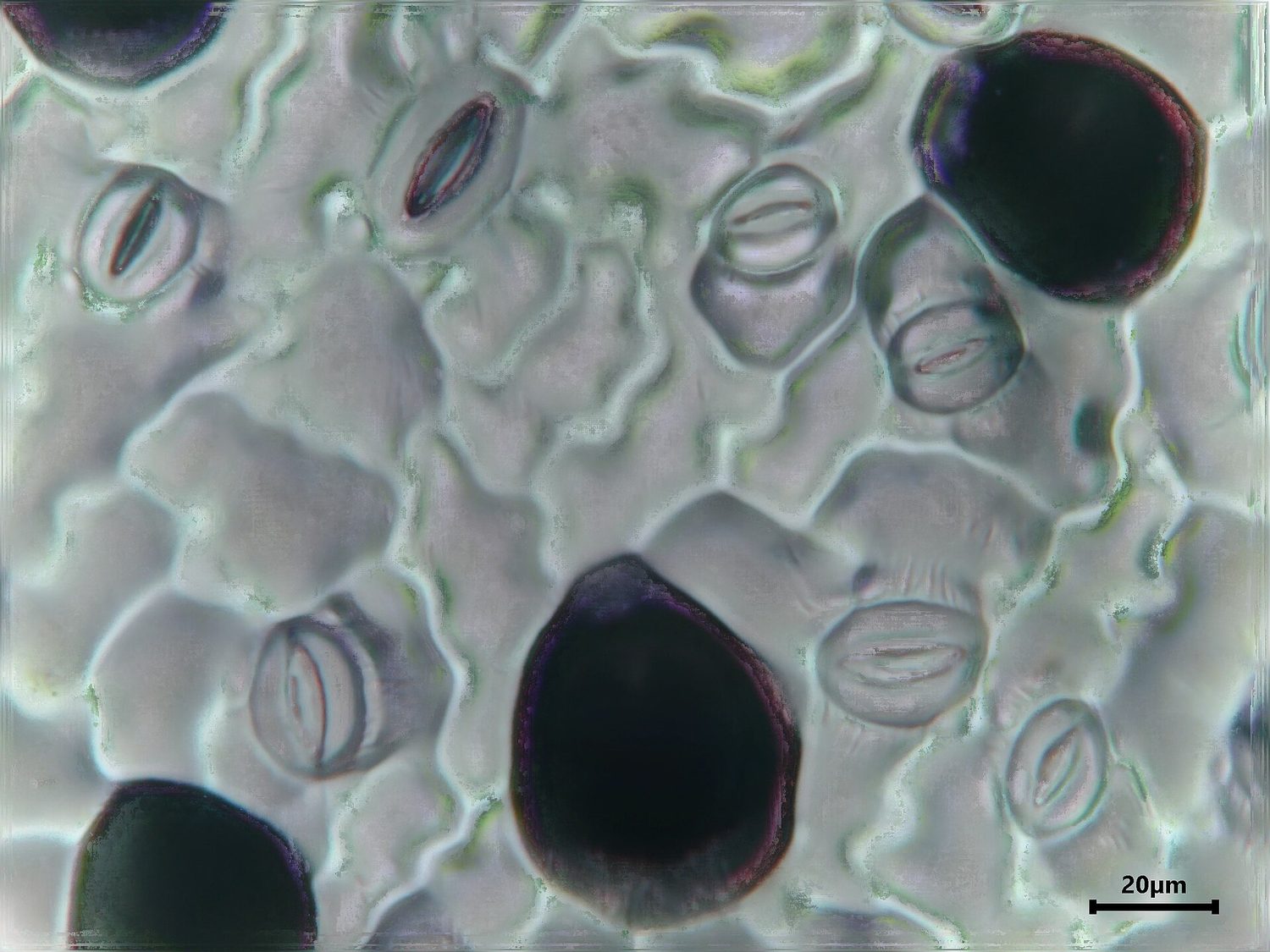
Identify the opening separately from the two cells around it. A cross-section and a surface micrograph show different views.
Inside a leaf
Connect light entry, air spaces, vascular tissues and stomatal control in a typical dicot leaf. Gas movement depends on the current gradients.
Root hair cells open and close the stomata.
Difficulty 1/5 · 100 coins + a small bonus on first completion today
False. Guard cells on either side of each stoma open and close it, controlling gas exchange and water loss.
Gas-exchange direction depends on the rates
- When photosynthesis is faster than respiration, the leaf has net carbon dioxide uptake and net oxygen release. Respiration still uses some oxygen and produces some carbon dioxide.
- In darkness, photosynthesis stops but respiration continues, giving net oxygen uptake and carbon dioxide release where exchange can occur. At equal rates, net exchange can be zero while both processes continue.
Stomata are not one-way valves for carbon dioxide and oxygen. Diffusion follows each gas's concentration gradient; the balance of photosynthesis and respiration helps determine that gradient.
Stomata are one-way valves that always let oxygen out.
Difficulty 1/5 · 100 coins + a small bonus on first completion today
A stoma is a pore. Gas movement depends on gradients; respiration gives oxygen uptake when photosynthesis is absent.
A transparent coating blocks a leaf's stomata but leaves much light transmission unchanged. Predict two possible consequences and explain why transparency does not remove both problems.
Water-vapour loss can decrease because diffusion through stomata is restricted. Carbon dioxide supply can also decrease, limiting photosynthesis. Transparency helps light reach chloroplasts, but does not replace a gas-diffusion route.
Predict a cost of closing stomata
- A well-lit leaf closes many stomata during dry conditions. It still contains chlorophyll, and its xylem remains intact.
- Explain why water loss may decrease and why photosynthesis may also decrease. Trace carbon dioxide from outside air to the mesophyll rather than simply saying that the leaf “cannot breathe”.
A well-lit leaf closes many stomata in dry conditions. Its chlorophyll and xylem remain intact. Explain why water loss may decrease and photosynthesis may also decrease.
Closing stomata reduces the openings through which water vapour diffuses out, reducing water loss. It also restricts carbon dioxide entry through the pores and air spaces to mesophyll cells. Carbon dioxide can become limiting, reducing photosynthesis despite available chlorophyll and water transport.
Make each structure earn its explanation
- Transparent outer layers and chloroplast-rich palisade cells support light capture; thinness and air spaces support gas diffusion.
- Xylem supplies water and mineral ions; phloem transports sucrose and amino acids. The two tissues have different roles.
- Guard cells control stomatal openings. Gas direction depends on concentration gradients and the balance of photosynthesis and respiration.
In darkness, which statement about a living leaf is correct?
Difficulty 1/5 · 100 coins + a small bonus on first completion today
Photosynthesis needs light, but respiration continues. Net diffusion follows the resulting gradients where exchange can occur.