Skip to content · ⁨Pular para o conteúdo⁩

Poesia II

Literatura e Composição Inglesas do AP · Topic 5 · ⁨Tópico 5⁩

Train · ⁨Treinar⁩
Video lesson for this topic · ⁨Videoaula para este tópico⁩ Open the video page · ⁨Abrir a página do vídeo⁩
9:03

Unidade 5: Poesia II

A Unidade 5 é a segunda unidade de poesia, e faz duas coisas: nomeia as formas que um poema pode assumir, e completa o kit de ferramentas figurativo. Formas fechadas incluem…

English narration · English + 中文 subtitles burned in · ⁨Narração em inglês · Legendas em inglês + 中文 gravadas⁩

5.1

The Function of Structure in a Text · ⁨A Função da Estrutura em um Texto⁩

Syllabus · ⁨Programa⁩
English

Enduring Understanding (STR-1): The arrangement of the parts and sections of a text, the relationship of the parts to each other, and the sequence in which the text reveals information are all structural choices made by a writer that contribute to the reader’s interpretation of a text.

Learning Objective 3.C: Explain the function of structure in a text.

  • STR-1.U Closed forms of poetry include predictable patterns in the structure of lines, stanzas, meter, and rhyme, which develop relationships among ideas in the poem. Note: The AP Exam will not require students to label or identify specific rhyme schemes, metrical patterns, or forms of poetry.
  • STR-1.V Open forms of poetry may not follow expected or predictable patterns in the structure of their lines or stanzas, but they may still have structures that develop relationships between ideas in the poem.
  • STR-1.W Structures combine in texts to emphasize certain ideas and concepts.
Português

Compreensão Permanente (STR-1): A disposição das partes e seções de um texto, a relação das partes entre si e a sequência em que o texto revela informações são todas escolhas estruturais feitas por um escritor que contribuem para a interpretação do leitor de um texto.

Objetivo de Aprendizagem 3.C: Explicar a função da estrutura em um texto.

  • STR-1.U Formas fechadas de poesia incluem padrões previsíveis na estrutura de linhas, estrofes, métrica e rima, que desenvolvem relações entre ideias no poema. Nota: O Exame AP não exigirá que os alunos rotulem ou identifiquem esquemas de rima específicos, padrões métricos ou formas de poesia.
  • STR-1.V Formas abertas de poesia podem não seguir padrões esperados ou previsíveis na estrutura de suas linhas ou estrofes, mas ainda podem ter estruturas que desenvolvem relações entre ideias no poema.
  • STR-1.W Estruturas combinam em textos para enfatizar certas ideias e conceitos.

Source: College Board AP Course and Exam Description · ⁨Fonte: College Board AP Course and Exam Description⁩

English

Unit 5 is the second poetry unit, and it does two things: it names the forms a poem can take, and it completes the figurative toolkit.

  • Closed forms 格律诗体 include predictable patterns in lines, stanzas, metre, and rhyme.
  • Open forms 自由诗体 may not follow expected or predictable patterns.
  • Structures combine in texts to emphasise certain ideas.

The examinable question is never "which form is this?" but what the form does. In a closed form, the interesting moment is the departure - the line that runs long, the rhyme that fails to arrive. In an open form, the interesting moment is the imposition - the sudden regularity in a poem that has refused it.

Português

A Unidade 5 é a segunda unidade de poesia, e ela faz duas coisas: nomeia as formas que um poema pode assumir e completa a caixa de ferramentas figurativa.

  • Formas fechadas 格律诗体 incluem padrões previsíveis em versos, estrofes, metro e rima.
  • Formas abertas 自由诗体 podem não seguir padrões esperados ou previsíveis.
  • Estruturas combinam-se nos textos para enfatizar certas ideias.

A questão examinável nunca é "de qual forma é esta?" mas o que a forma faz. Em uma forma fechada, o momento interessante é a saída - o verso que corre longo, a rima que não chega. Em uma forma aberta, o momento interessante é a imposição - a regularidade súbita em um poema que a recusou.

5.2

Literal and Figurative Meaning · ⁨Significado Literal E Figurativo⁩

Syllabus · ⁨Programa⁩
English

Enduring Understanding (FIG-1): Comparisons, representations, and associations shift meaning from the literal to the figurative and invite readers to interpret a text.

Learning Objective 5.A: Distinguish between the literal and figurative meanings of words and phrases.

  • FIG-1.L Words with multiple meanings or connotations add nuance or complexity that can contribute to interpretations of a text.
Português

Compreensão Permanente (FIG-1): Comparações, representações e associações mudam o significado do literal para o figurado e convida os leitores a interpretar um texto.

Objetivo de Aprendizagem 5.A: Distinguir entre os significados literais e figurativos de palavras e frases.

  • FIG-1.L Palavras com múltiplos significados ou conotações adicionam nuances ou complexidade que podem contribuir para interpretações de um texto.

Source: College Board AP Course and Exam Description · ⁨Fonte: College Board AP Course and Exam Description⁩

English

Words with multiple meanings or connotations add nuance or complexity that can contribute to interpretation.

In poetry, a word that could mean two things frequently means both. Resist choosing.

Português

Palavras com múltiplos significados ou conotações adicionam nuance ou complexidade que podem contribuir para a interpretação.

Na poesia, uma palavra que poderia significar duas coisas frequentemente significa ambas. Resista a escolher.

5.3

The Function of Specific Words and Phrases · ⁨A Função de Palavras e Frases Específicas⁩

Syllabus · ⁨Programa⁩
English

Enduring Understanding (FIG-1): Comparisons, representations, and associations shift meaning from the literal to the figurative and invite readers to interpret a text.

Learning Objective 5.B: Explain the function of specific words and phrases in a text.

  • FIG-1.M Descriptive words, such as adjectives and adverbs, qualify or modify the things they describe and affect readers’ interaction with the text.
  • FIG-1.N Hyperbole exaggerates while understatement minimizes. Exaggerating or minimizing an aspect of an object focuses attention on that trait and conveys a perspective about the object.
Português

Compreensão Permanente (FIG-1): Comparações, representações e associações mudam o significado do literal para o figurado e convida os leitores a interpretar um texto.

Objetivo de Aprendizagem 5.B: Explicar a função de palavras e frases específicas em um texto.

  • FIG-1.M Palavras descritivas, como adjetivos e advérbios, qualificam ou modificam as coisas que descrevem e afetam a interação dos leitores com o texto.
  • FIG-1.N A hipérbole exagera, enquanto a litotes minimiza. Exagerar ou minimizar um aspecto de um objeto foca a atenção nesse traço e transmite uma perspectiva sobre o objeto.

Source: College Board AP Course and Exam Description · ⁨Fonte: College Board AP Course and Exam Description⁩

English
  • Descriptive words qualify or modify what they describe and affect how the reader perceives it.
  • Hyperbole 夸张 exaggerates while understatement 低调陈述 minimises. Exaggerating or minimising an aspect of a thing has an effect on how it is understood.

Understatement is the more powerful of the pair and the more often missed by second-language readers. A poem that describes a catastrophe as inconvenient is not being calm; the gap between the event and the word is the poem's whole comment on it.

Português
  • Palavras descritivas qualificam ou modificam o que descrevem e afetam como o leitor percebe isso.
  • Hipérbole 夸张 exagera enquanto subestimação 低调陈述 minimiza. Exagerar ou minimizar um aspecto de uma coisa tem um efeito em como ela é compreendida.

A subestimação é a mais poderosa do par e a mais frequentemente perdida por leitores de língua não nativa. Um poema que descreve uma catástrofe como inconveniente não está sendo calmo; a lacuna entre o evento e a palavra é todo o comentário do poema sobre ele.

5.4

The Function of an Image or Imagery · ⁨A Função De Uma Imagem Ou Imagética⁩

Syllabus · ⁨Programa⁩
English

Enduring Understanding (FIG-1): Comparisons, representations, and associations shift meaning from the literal to the figurative and invite readers to interpret a text.

Learning Objective 5.D: Identify and explain the function of an image or imagery.

  • FIG-1.O Descriptive words, such as adjectives and adverbs, contribute to sensory imagery.
  • FIG-1.P An image can be literal or it can be a form of a comparison that represents something in a text through associations with the senses.
  • FIG-1.Q A collection of images, known as imagery, may emphasize ideas in parts of or throughout a text.
Português

Compreensão Permanente (FIG-1): Comparações, representações e associações mudam o significado do literal para o figurado e convida os leitores a interpretar um texto.

Objetivo de Aprendizagem 5.D: Identificar e explicar a função de uma imagem ou imaginação.

  • FIG-1.O Palavras descritivas, como adjetivos e advérbios, contribuem para a imaginação sensorial.
  • FIG-1.P Uma imagem pode ser literal ou pode ser uma forma de comparação que representa algo em um texto através de associações com os sentidos.
  • FIG-1.Q Um conjunto de imagens, conhecido como imaginação, pode enfatizar ideias em partes ou ao longo de todo um texto.

Source: College Board AP Course and Exam Description · ⁨Fonte: College Board AP Course and Exam Description⁩

English
  • Descriptive words contribute to sensory imagery 感官意象.
  • An image can be literal, or a form of comparison representing something through another thing.
  • A collection of images - imagery - may emphasise ideas in parts of, or throughout, a text.

The plural matters. A single image is a detail; a pattern of images running through a poem is a claim the poem is making without stating it.

Português
Os dispositivos da Poesia II, classificados pelo que cada um faz ao leitor
Nomear um dispositivo não gera pontos. Dizer o que ele faz ao leitor é a análise
  • Palavras descritivas contribuem para a imagética sensorial 感官意象.
  • Uma imagem pode ser literal, ou uma forma de comparação representando algo através de outra coisa.
  • Uma coleção de imagens - imagética - pode enfatizar ideias em partes de, ou através de, um texto.

O plural importa. Uma única imagem é um detalhe; um padrão de imagens correndo através de um poema é uma tese que o poema está fazendo sem declará-la.

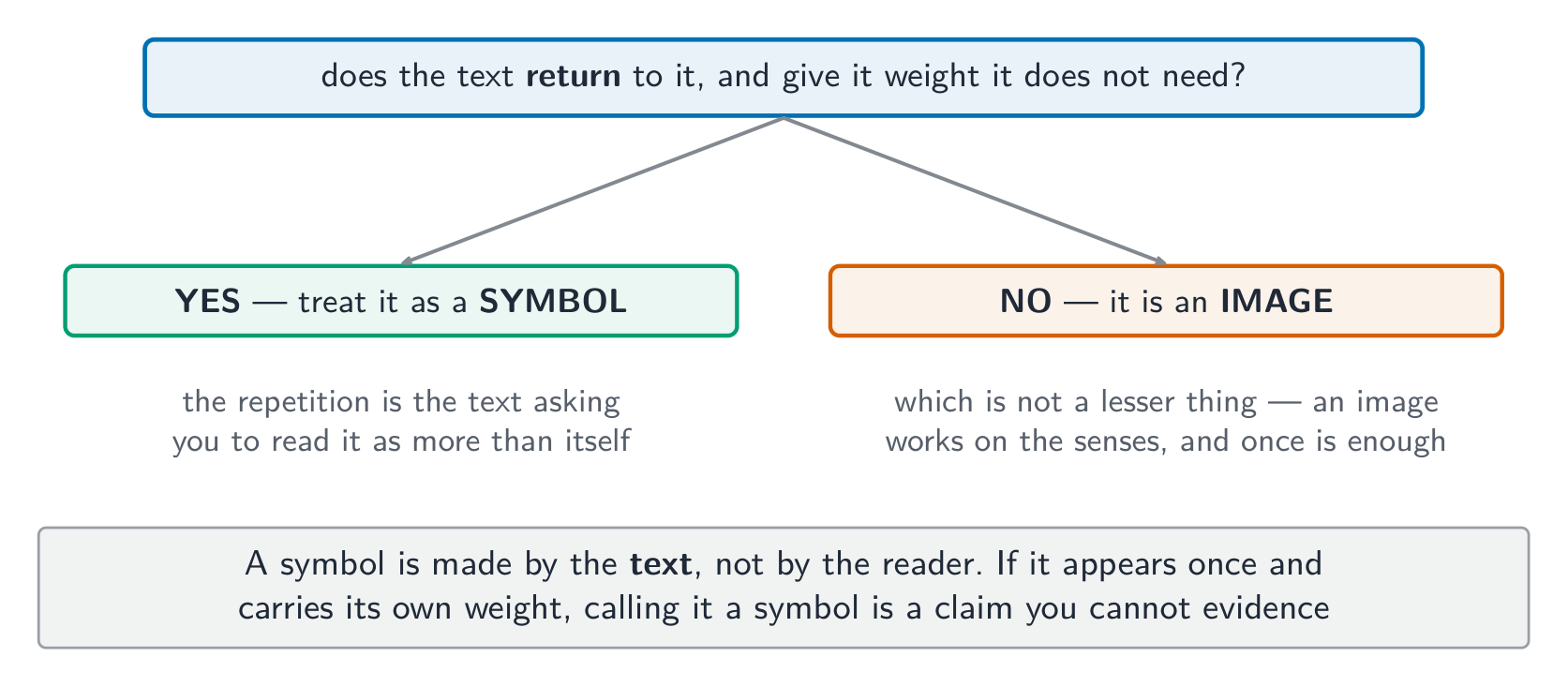
Um símbolo é feito pelo texto, não pelo leitor
Explore · ⁨Explorar⁩

Imagem ou símbolo? Aplique o teste

Um símbolo é feito pelo texto, não pelo leitor: o teste é se o texto volta a ele e dá a ele um peso que não precisa.

5.5

The Function of a Metaphor · ⁨A Função de uma Metáfora⁩

Syllabus · ⁨Programa⁩
English

Enduring Understanding (FIG-1): Comparisons, representations, and associations shift meaning from the literal to the figurative and invite readers to interpret a text.

Learning Objective 6.B: Identify and explain the function of a metaphor.

  • FIG-1.R Metaphorical comparisons do not focus solely on the objects being compared; they focus on the particular traits, qualities, or characteristics of the things being compared.
  • FIG-1.S Comparisons not only communicate literal meaning but may also convey figurative meaning or transmit a perspective.
  • FIG-1.T An extended metaphor is created when the comparison of a main subject and comparison subject persists through parts of or an entire text, and when the comparison is expanded through additional details, similes, and images.
  • FIG-1.U Interpretation of an extended metaphor may depend on the context of its use; that is, what is happening in a text may determine what is transferred in the comparison.
Português

Compreensão Permanente (FIG-1): Comparações, representações e associações mudam o significado do literal para o figurado e convida os leitores a interpretar um texto.

Objetivo de Aprendizagem 6.B: Identificar e explicar a função de uma metáfora.

  • FIG-1.R Comparações metafóricas não se concentram apenas nos objetos sendo comparados; elas se concentram nos traços, qualidades ou características particulares das coisas sendo comparadas.
  • FIG-1.S Comparações não apenas comunicam significado literal, mas também podem transmitir significado figurativo ou uma perspectiva.
  • FIG-1.T Uma metáfora prolongada é criada quando a comparação entre um sujeito principal e um sujeito de comparação persiste por partes ou por todo um texto, e quando a comparação é expandida por meio de detalhes adicionais, símiles e imagens.
  • FIG-1.U A interpretação de uma metáfora prolongada pode depender do contexto de seu uso; ou seja, o que está acontecendo em um texto pode determinar o que é transferido na comparação.

Source: College Board AP Course and Exam Description · ⁨Fonte: College Board AP Course and Exam Description⁩

English
  • Metaphorical comparisons do not focus solely on the objects compared; they focus on the particular qualities the comparison brings out.
  • Comparisons communicate literal meaning and may also convey figurative meaning.
  • An extended metaphor 延伸隐喻 is created when the comparison of a main subject and comparison subject persists across a passage or a whole text.
  • Interpretation of an extended metaphor may depend on the context of its use.

An extended metaphor is the most rewarding thing to find in an unseen poem, because it gives you structure and meaning at once: you can trace how the comparison develops, and a comparison that changes as it extends is the poem's argument in motion.

Português
  • Comparações metafóricas não focam exclusivamente nos objetos comparados; elas focam nas qualidades particulares que a comparação destaca.
  • Comparações comunicam significado literal e também podem transmitir significado figurativo.
  • Uma metáfora estendida 延伸隐喻 é criada quando a comparação de um sujeito principal e um sujeito da comparação persiste através de uma passagem ou de todo o texto.
  • A interpretação de uma metáfora estendida pode depender do contexto de seu uso.

Uma metáfora estendida é a coisa mais recompensadora de se encontrar em um poema inédito, porque ela dá estrutura e significado ao mesmo tempo: você pode rastrear como a comparação se desenvolve, e uma comparação que muda conforme se estende é o argumento do poema em movimento.

5.6

The Function of Personification · ⁨A Função Da Personificação⁩

Syllabus · ⁨Programa⁩
English

Enduring Understanding (FIG-1): Comparisons, representations, and associations shift meaning from the literal to the figurative and invite readers to interpret a text.

Learning Objective 6.C: Identify and explain the function of personification.

  • FIG-1.V Personification is a type of comparison that assigns a human trait or quality to a nonhuman object, entity, or idea, thus characterizing that object, entity, or idea.
Português

Compreensão Permanente (FIG-1): Comparações, representações e associações mudam o significado do literal para o figurado e convida os leitores a interpretar um texto.

Objetivo de Aprendizagem 6.C: Identificar e explicar a função da personificação.

  • FIG-1.V A personificação é um tipo de comparação que atribui um traço ou qualidade humana a um objeto, entidade ou ideia não humana, caracterizando assim esse objeto, entidade ou ideia.

Source: College Board AP Course and Exam Description · ⁨Fonte: College Board AP Course and Exam Description⁩

English

Personification 拟人 is a type of comparison that assigns a human trait or quality to a nonhuman object, animal, or idea.

Treat it as a comparison with the same parts as any other: the main subject is the nonhuman thing, the comparison subject is a person, and the transferred quality is the human trait. Then ask the useful question - what does granting this thing agency do? A wind that decides is not the same claim as a wind that blows.

Português

Personificação 拟人 é um tipo de comparação que atribui um traço ou qualidade humana a um objeto, animal ou ideia não humanos.

Trate-a como uma comparação com as mesmas partes que qualquer outra: o sujeito principal é a coisa não humana, o sujeito da comparação é uma pessoa, e a qualidade transferida é o traço humano. Então pergunte a pergunta útil - o que conceder essa agência faz? Um vento que decide não é a mesma afirmação que um vento que sopra.

'Ele traz o objeto à vida' é a definição - a terceira coluna é o comentário
Vocabulary · ⁨Vocabulário⁩ Train · ⁨Treinar⁩
English · ⁨Inglês⁩ Chinese · ⁨Chinês⁩ Pinyin
Closed forms/kləʊzd fɔːmz/ 格律诗体 gé lǜ shī tǐ
Open forms/ˈəʊpən fɔːmz/ 自由诗体 zì yóu shī tǐ
Hyperbole/haɪˈpɜːbəli/ 夸张 kuā zhāng
understatement/ˌʌndəˈsteɪtmənt/ 低调陈述 dī diào chén shù
contribute to sensory imagery/kənˈtrɪbjuːt tə ˈsensəri ˈɪmɪdʒri/ 感官意象 gǎn guān yì xiàng
extended metaphor/ekˈstendɪd ˈmetəfɔː/ 延伸隐喻 yán shēn yǐn yù
Personification/pɜːˈsɒnɪfɪkeɪʃn/ 拟人 nǐ rén
Allusions/əˈluːʒnz/ 典故 diǎn gù
5.7

The Function of an Allusion · ⁨A Função De Uma Alusão⁩

Syllabus · ⁨Programa⁩
English

Enduring Understanding (FIG-1): Comparisons, representations, and associations shift meaning from the literal to the figurative and invite readers to interpret a text.

Learning Objective 6.D: Identify and explain the function of an allusion.

  • FIG-1.W Allusions in a text can reference literary works including myths and sacred texts; other works of art including paintings and music; or people, places, or events outside the text.
Português

Compreensão Permanente (FIG-1): Comparações, representações e associações mudam o significado do literal para o figurado e convida os leitores a interpretar um texto.

Objetivo de Aprendizagem 6.D: Identificar e explicar a função de uma alusão.

  • FIG-1.W Alusões em um texto podem referenciar obras literárias, incluindo mitos e textos sagrados; outras obras de arte, incluindo pinturas e música; ou pessoas, lugares ou eventos fora do texto.

Source: College Board AP Course and Exam Description · ⁨Fonte: College Board AP Course and Exam Description⁩

English

Allusions 典故 may reference literary works including myths and sacred texts, other works of art, and historical events.

An allusion imports meaning the poem has not written. That is its efficiency and its risk: it works only for readers who recognise it. When you meet one you do not know, say what the poem does with it structurally - where it is placed, what it interrupts - rather than pretending to a recognition you lack.

Português

Alições 典故 podem referenciar obras literárias incluindo mitos e textos sagrados, outras obras de arte e eventos históricos.

Uma alusão importa significado que o poema não escreveu. Essa é sua eficiência e seu risco: funciona apenas para leitores que o reconhecem. Quando você encontra uma que não conhece, diga o que o poema faz com ela estruturalmente - onde ela está posicionada, o que interrompe - em vez de fingir um reconhecimento que lhe falta.

Uma alusão importa uma situação e um julgamento - e ela também custa algo
Explore · ⁨Explorar⁩

Leve uma alusão além da fonte

Nomear a fonte não é a análise. Uma alusão importa uma situação e um julgamento, e também custa algo.

5.8

Developing a Literary Thesis Statement · ⁨Desenvolvendo uma Tese Literária⁩

Syllabus · ⁨Programa⁩
English

Enduring Understanding (LAN-1): Readers establish and communicate their interpretations of literature through arguments supported by textual evidence.

Learning Objective 7.B: Develop a thesis statement that conveys a defensible claim about an interpretation of literature and that may establish a line of reasoning.

  • LAN-1.D A thesis statement expresses an interpretation of a literary text, and requires a defense, through use of textual evidence and a line of reasoning, both of which are explained in an essay through commentary.
  • LAN-1.E A thesis statement may preview the development or line of reasoning of an interpretation. This is not to say that a thesis statement must list the points of an interpretation, literary elements to be analyzed, or specific evidence to be used in the argument.
Português

Compreensão Permanente (LAN-1): Os leitores estabelecem e comunicam suas interpretações da literatura através de argumentos apoiados por evidências textuais.

Objetivo de Aprendizagem 7.B: Desenvolver uma tese que expresse uma afirmação defendível sobre uma interpretação literária e que possa estabelecer uma linha de raciocínio.

  • LAN-1.D Uma tese expressa uma interpretação de um texto literário e requer defesa, por meio do uso de evidências textuais e de uma linha de raciocínio, ambas explicadas em um ensaio através de comentários.
  • LAN-1.E Uma tese pode antecipar o desenvolvimento ou linha de raciocínio de uma interpretação. Isso não significa que uma tese deve listar os pontos de uma interpretação, elementos literários a serem analisados ou evidências específicas a serem usadas no argumento.

Source: College Board AP Course and Exam Description · ⁨Fonte: College Board AP Course and Exam Description⁩

English

Unchanged: an interpretation requiring textual defence, which may preview the line of reasoning.

Português

Inalterado: uma interpretação que requer defesa textual, que pode antecipar a linha de raciocínio.

5.9

Developing Commentary · ⁨Desenvolvendo Comentários⁩

Syllabus · ⁨Programa⁩
English

Enduring Understanding (LAN-1): Readers establish and communicate their interpretations of literature through arguments supported by textual evidence.

Learning Objective 7.C: Develop commentary that establishes and explains relationships among textual evidence, the line of reasoning, and the thesis.

  • LAN-1.F A line of reasoning is the logical sequence of claims that work together to defend the overarching thesis statement.
  • LAN-1.G A line of reasoning is communicated through commentary that explains the logical relationship between the overarching thesis statement and the claims/evidence within the body of an essay.
Português

Compreensão Permanente (LAN-1): Os leitores estabelecem e comunicam suas interpretações da literatura através de argumentos apoiados por evidências textuais.

Objetivo de Aprendizagem 7.C: Desenvolver comentários que estabeleçam e expliquem relações entre evidências textuais, a linha de raciocínio e a tese.

  • LAN-1.F Uma linha de raciocínio é a sequência lógica de afirmações que trabalham juntas para defender a tese geral.
  • LAN-1.G Uma linha de raciocínio é comunicada através de comentários que explicam a relação lógica entre a tese geral e as afirmações/evidências dentro do corpo de um ensaio.

Source: College Board AP Course and Exam Description · ⁨Fonte: College Board AP Course and Exam Description⁩

English

A line of reasoning is the logical sequence of claims defending the thesis, communicated through commentary explaining the relationship between evidence and claim.

Português

Uma linha de raciocínio é a sequência lógica de teses defendendo a tese central, comunicada através de comentários explicando a relação entre evidência e tese.

5.10

Selecting Relevant and Sufficient Evidence · ⁨Selecionando Evidências Relevantes e Suficientes⁩

Syllabus · ⁨Programa⁩
English

Enduring Understanding (LAN-1): Readers establish and communicate their interpretations of literature through arguments supported by textual evidence.

Learning Objective 7.D: Select and use relevant and sufficient evidence to both develop and support a line of reasoning.

  • LAN-1.H Writers use evidence strategically and purposefully to illustrate, clarify, exemplify, associate, amplify, or qualify a point.
  • LAN-1.I Evidence is effective when the writer of the essay uses commentary to explain a logical relationship between the evidence and the claim.
  • LAN-1.J Evidence is sufficient when its quantity and quality provide apt support for the line of reasoning.
  • LAN-1.K Developing and supporting an interpretation of a text is a recursive process; an interpretation can emerge from analyzing evidence and then forming a line of reasoning, or the interpretation can emerge from forming a line of reasoning and then identifying relevant evidence to support that line of reasoning.
Português

Compreensão Permanente (LAN-1): Os leitores estabelecem e comunicam suas interpretações da literatura através de argumentos apoiados por evidências textuais.

Objetivo de Aprendizagem 7.D: Selecionar e usar evidências relevantes e suficientes tanto para desenvolver quanto para apoiar uma linha de raciocínio.

  • LAN-1.H Escritores usam evidências estrategicamente e com propósito para ilustrar, esclarecer, exemplificar, associar, amplificar ou qualificar um ponto.
  • LAN-1.I Evidência é eficaz quando o escritor do ensaio usa comentários para explicar uma relação lógica entre a evidência e a afirmação.
  • LAN-1.J Evidência é suficiente quando sua quantidade e qualidade fornecem apoio adequado à linha de raciocínio.
  • LAN-1.K Desenvolver e sustentar uma interpretação de um texto é um processo recursivo; uma interpretação pode emergir da análise de evidências e, em seguida, formar uma linha de raciocínio, ou a interpretação pode emergir da formação de uma linha de raciocínio e, em seguida, identificar evidências relevantes para sustentar essa linha de raciocínio.

Source: College Board AP Course and Exam Description · ⁨Fonte: College Board AP Course and Exam Description⁩

English

Evidence used strategically, effective with commentary, sufficient in quantity and quality, and interpretation as a recursive process.

Português

Evidência usada estrategicamente, eficaz com comentários, suficiente em quantidade e qualidade, e interpretação como um processo recursivo.

5.11

Control Over the Elements of Composition · ⁨Controle sobre os Elementos da Composição⁩

Syllabus · ⁨Programa⁩
English

Enduring Understanding (LAN-1): Readers establish and communicate their interpretations of literature through arguments supported by textual evidence.

Learning Objective 7.E: Demonstrate control over the elements of composition to communicate clearly.

  • LAN-1.Q Transitional elements are words or other elements (phrases, clauses, sentences, or paragraphs) that assist in creating coherence between sentences and paragraphs by showing relationships between ideas.
Português

Compreensão Permanente (LAN-1): Os leitores estabelecem e comunicam suas interpretações da literatura através de argumentos apoiados por evidências textuais.

Objetivo de Aprendizagem 7.E: Demonstrar controle sobre os elementos de composição para comunicar claramente.

  • LAN-1.Q Elementos transitórios são palavras ou outros elementos (frases, orações, sentenças ou parágrafos) que auxiliam na criação de coerência entre sentenças e parágrafos ao mostrar relações entre ideias.

Source: College Board AP Course and Exam Description · ⁨Fonte: College Board AP Course and Exam Description⁩

English

Transitional elements - words, phrases, clauses, sentences, or paragraphs - assist in creating coherence.

Worked example (a real AP exam task). A poetry-analysis prompt asks how the poet's use of figurative language conveys the speaker's attitude. A weak answer catalogues: "The poet uses personification, imagery, and a metaphor." A scoring answer traces one device developing: "The extended comparison of the tide to a creditor runs the length of the poem, but the terms change: in the first stanza it 'asks', by the third it 'takes what was always owed'. The comparison subject stays constant while the speaker's account of the relationship hardens - so the attitude the poem conveys is not fear of loss but the recognition that the loss was never hers to prevent." One device, traced, with the attitude it produces.

Português

Elementos de transição - palavras, frases, orações, sentenças ou parágrafos - auxiliam na criação de coerência.

Exemplo resolvido (uma tarefa real do exame AP). Um prompt de análise de poesia pergunta como o uso de linguagem figurativa pelo poeta transmite a atitude do locutor. Uma resposta fraca cataloga: "O poeta usa personificação, imagética e uma metáfora." Uma pontuável rastreia um dispositivo se desenvolvendo: "A comparação estendida da maré a um credor percorre o comprimento do poema, mas os termos mudam: na primeira estrofe ela 'pergunta', na terceira ela 'toma o que sempre era devido'. O sujeito da comparação permanece constante enquanto a conta do locutor sobre o relacionamento endurece - então a atitude que o poema transmite não é medo da perda, mas o reconhecimento de que a perda nunca foi dela para prevenir." Um dispositivo, rastreado, com a atitude que produz.

5.11

Exam tips · ⁨Dicas de prova⁩

English
  • Never ask "which form is this?" Ask what the form does - and look for the departure or the imposition.
  • A word with two meanings often means both. Do not choose prematurely.
  • Understatement is the more powerful half of the pair, and the more often missed. The gap is the comment.
  • A pattern of images is a claim the poem makes without stating it. A single image is only a detail.
  • An extended metaphor that changes as it extends is the poem's argument in motion. Trace it.
  • Cataloguing devices earns nothing. One device traced beats four devices named.
Português
  • Nunca pergunte "de qual forma é esta?" Pergunte o que a forma faz - e procure a saída ou a imposição.
  • Uma palavra com dois significados frequentemente significa ambos. Não escolha prematuramente.
  • Subestimação é a metade mais poderosa do par, e a mais frequentemente perdida. A lacuna é o comentário.
  • Um padrão de imagens é uma tese que o poema faz sem declará-la. Uma única imagem é apenas um detalhe.
  • Uma metáfora estendida que muda conforme se estende é o argumento do poema em movimento. Rastreie-a.
  • Catalogar dispositivos não gera pontos. Um dispositivo rastreado vence quatro dispositivos nomeados.

Interactive lessons on this topic · ⁨Aulas interativas sobre este tópico⁩

Work through it step by step, with instant-check exercises. · ⁨Passe por ele passo a passo, com exercícios de verificação instantânea.⁩

Past Papers · ⁨Provas Anteriores⁩

More topics in Literatura e Composição Inglesas do AP · ⁨Mais tópicos em Literatura e Composição Inglesas do AP⁩

Log in or create account · ⁨Entrar ou criar conta⁩

IGCSE, A-Level & AP