Skip to content · ⁨Pular para o conteúdo⁩
Subjects · ⁨Matérias⁩

Literatura e Composição Inglesas do AP

Tips · ⁨Dicas⁩

AP English Literature and Composition ensina leitura atenta e argumento literário em três tipos de texto, cada um visitado três vezes: ficção curta, poesia e ficção longa ou drama. As unidades espiralam, então as mesmas habilidades retornam com maior profundidade.

O curso é organizado por elemento literário: personagem, cenário, estrutura, narração, linguagem figurativa e argumentação literária. Cada elemento tem suas próprias habilidades, e cada um faz a mesma pergunta subjacente - o que esta escolha *faz* no texto?

"A função de" é a frase a notar. O framework repetidamente pede a função de um símbolo, um contraste, uma mudança na narração. Identificar um dispositivo é o primeiro passo; explicar o trabalho que ele desempenha é a resposta.

A interpretação deve ser defensável, não meramente pessoal. Uma leitura ganha crédito quando é apoiada por detalhes do texto e desenvolvida através de raciocínio, é por isso que a argumentação literária corre junto com cada elemento.

As notas abaixo seguem as nove unidades na ordem que o College Board define, então ficção curta, poesia e obras longas alternam exatamente como o curso faz.

  • 1

    Ficção Curta I

    Watch lesson · ⁨Assistir aula⁩
    1.1

    What Textual Details Reveal About a Character · ⁨O Que Detalhes Textuais Revelam Sobre um Personagem⁩

    Syllabus · ⁨Programa⁩
    English

    Enduring Understanding (CHR-1): Characters in literature allow readers to study and explore a range of values, beliefs, assumptions, biases, and cultural norms represented by those characters.

    Learning Objective 1.A: Identify and describe what specific textual details reveal about a character, that character’s perspective, and that character’s motives.

    • CHR-1.A Description, dialogue, and behavior reveal characters to readers.
    • CHR-1.B Descriptions of characters may come from a speaker, narrator, other characters, or the characters themselves.
    • CHR-1.C Perspective is how narrators, characters, or speakers understand their circumstances, and is informed by background, personality traits, biases, and relationships.
    • CHR-1.D A character’s perspective is both shaped and revealed by relationships with other characters, the environment, the events of the plot, and the ideas expressed in the text.
    Português

    Compreensão Duradoura (CHR-1): Personagens em literatura permitem que os leitores estudem e explorem uma gama de valores, crenças, pressupostos, vieses e normas culturais representados por esses personagens.

    Objetivo de Aprendizagem 1.A: Identificar e descrever quais detalhes textuais específicos revelam sobre um personagem, a perspectiva desse personagem e os motivos desse personagem.

    • CHR-1.A Descrições, diálogos e comportamento revelam personagens aos leitores.
    • CHR-1.B As descrições de personagens podem vir de um falante, narrador, outros personagens ou dos próprios personagens.
    • CHR-1.C A perspectiva é como narradores, personagens ou falantes compreendem suas circunstâncias, e é informada por contexto histórico, traços de personalidade, vieses e relacionamentos.
    • CHR-1.D A perspectiva de um personagem é tanto moldada quanto revelada por relacionamentos com outros personagens, o ambiente, os eventos do enredo e as ideias expressas no texto.

    Source: College Board AP Course and Exam Description · ⁨Fonte: College Board AP Course and Exam Description⁩

    English

    AP English Literature reads texts in three genres across nine units - short fiction, poetry, and longer fiction or drama, each visited three times at increasing difficulty. Unit 1 installs the tools for all of them.

    Character 人物 is revealed by three things, and the CED names them exactly:

    • Description, dialogue, and behaviour 描写、对话与行为 reveal characters to readers.
    • Descriptions may come from a speaker, narrator, other characters, or the characters themselves - so who is describing is part of the evidence.
    • Perspective 视角 is how narrators, characters, or speakers understand their circumstances, informed by background, experience, and values.
    • A character's perspective is both shaped and revealed by relationships with other characters, the environment, and events.

    That last point is the one that turns character notes into analysis. A character is not a list of adjectives; a character is a way of seeing, which becomes visible in what they notice, what they misread, and how they respond.

    Português

    AP English Literature lê textos em três gêneros através de nove unidades - ficção curta, poesia e ficção ou drama mais longos, cada um visitado três vezes com dificuldade crescente. A Unidade 1 instala as ferramentas para todas elas.

    Personagem 人物 é revelado por três coisas, e o CED os nomeia exatamente:

    • Descrição, diálogo e comportamento 描写、对话与行为 revelam personagens aos leitores.
    • Descrições podem vir de um falante, narrador, outros personagens ou os próprios personagens - então quem descreve faz parte da evidência.
    • Perspectiva 视角 é como narradores, personagens ou falantes entendem suas circunstâncias, informada por fundo, experiência e valores.
    • A perspectiva de um personagem é tanto moldada quanto revelada por relações com outros personagens, o ambiente e eventos.

    Esse último ponto é o que transforma anotações de personagens em análise. Um personagem não é uma lista de adjetivos; um personagem é uma maneira de ver, que se torna visível no que eles notam, no que interpretam mal e como respondem.

    Diga o que o detalhe estabelece, e pare onde a evidência termina
    Explore · ⁨Explorar⁩

    Leve um detalhe exatamente até onde ele vai

    Ler demais perde tantos pontos quanto ler de menos: diga o que o detalhe estabelece e pare onde a evidência termina.

    1.2

    Textual Details That Convey Setting · ⁨Detalhes Textuais Que Transmitem Cenário⁩

    Syllabus · ⁨Programa⁩
    English

    Enduring Understanding (SET-1): Setting and the details associated with it not only depict a time and place, but also convey values associated with that setting.

    Learning Objective 2.A: Identify and describe specific textual details that convey or reveal a setting.

    • SET-1.A Setting includes the time and place during which the events of the text occur.
    Português

    Compreensão Permanente (SET-1): O cenário e os detalhes associados a ele não apenas retratam um tempo e lugar, mas também transmitem valores associados a esse cenário.

    Objetivo de Aprendizagem 2.A: Identificar e descrever detalhes textuais específicos que transmitem ou revelam um cenário.

    • SET-1.A O cenário inclui o tempo e o lugar em que os eventos do texto ocorrem.

    Source: College Board AP Course and Exam Description · ⁨Fonte: College Board AP Course and Exam Description⁩

    English

    Setting 背景 includes the time and place during which the events of the text occur.

    The CED's definition is deliberately minimal, and that is the trap. Setting earns marks not when it is described but when it is shown doing something - constraining a character, explaining a value, or contrasting with an interior state. A paragraph that establishes where a story happens has not yet made a claim.

    Português

    Cenário 背景 inclui o tempo e o lugar durante os quais os eventos do texto ocorrem.

    A definição do CED é deliberadamente minimalista, e esse é o armadilha. Cenário ganha pontos não quando é descrito, mas quando é mostrado fazendo algo - restringindo um personagem, explicando um valor ou contrastando com um estado interior. Um parágrafo que estabelece onde uma história acontece ainda não fez uma reivindicação.

    1.3

    How Plot Orders Events · ⁨Como a Trama Ordena Eventos⁩

    Syllabus · ⁨Programa⁩
    English

    Enduring Understanding (STR-1): The arrangement of the parts and sections of a text, the relationship of the parts to each other, and the sequence in which the text reveals information are all structural choices made by a writer that contribute to the reader’s interpretation of a text.

    Learning Objective 3.A: Identify and describe how plot orders events in a narrative.

    • STR-1.A Plot is the sequence of events in a narrative; events throughout a narrative are connected, with each event building on the others, often with a cause-and-effect relationship.
    • STR-1.B The dramatic situation of a narrative includes the setting and action of the plot and how that narrative develops to place characters in conflict(s), and often involves the rising or falling fortunes of a main character or set of characters.
    Português

    Compreensão Permanente (STR-1): A disposição das partes e seções de um texto, a relação das partes entre si e a sequência em que o texto revela informações são todas escolhas estruturais feitas por um escritor que contribuem para a interpretação do leitor de um texto.

    Objetivo de Aprendizagem 3.A: Identificar e descrever como o enredo ordena os eventos em uma narrativa.

    • STR-1.A O enredo é a sequência de eventos em uma narrativa; os eventos ao longo de uma narrativa estão conectados, com cada evento construindo sobre os outros, frequentemente com uma relação de causa e efeito.
    • STR-1.B A situação dramática de uma narrativa inclui o cenário e a ação do enredo e como essa narrativa se desenvolve para colocar personagens em conflito(s), e frequentemente envolve as ascensões ou declínios da sorte de um personagem principal ou conjunto de personagens.

    Source: College Board AP Course and Exam Description · ⁨Fonte: College Board AP Course and Exam Description⁩

    English
    • Plot 情节 is the sequence of events in a narrative; events are connected, each building on those before it.
    • The dramatic situation 戏剧情境 includes the setting and action of the plot and how the narrative develops to place characters in conflict.

    The word sequence is doing work. Plot is not the events but their order - and an author who reveals something late that happened early has made a choice you can analyse.

    Português
    • Trama 情节 é a sequência de eventos em uma narrativa; eventos são conectados, cada um construindo sobre os anteriores.
    • A situação dramática 戏剧情境 inclui o cenário e a ação da trama e como a narrativa se desenvolve para colocar personagens em conflito.

    A palavra sequência está fazendo trabalho. Trama não são os eventos, mas sua ordem - e um autor que revela algo tarde que aconteceu cedo fez uma escolha que você pode analisar.

    A ordem em que os eventos aconteceram contra a ordem em que foram contados - a diferença é uma escolha
    Vocabulary · ⁨Vocabulário⁩ Train · ⁨Treinar⁩
    English · ⁨Inglês⁩ Chinese · ⁨Chinês⁩ Pinyin
    Character/ˈkærɪktə/ 人物 rén wù
    Description, dialogue, and behaviour/dɪˈskrɪpʃn ˈdaɪəlɒɡ ænd bɪˈheɪvjə/ 描写、对话与行为 miáo xiě 、 duì huà yǔ xíng wéi
    Perspective/pəˈspektɪv/ 视角 shì jiǎo
    Setting/ˈsetɪŋ/ 背景 bèi jǐng
    Plot/plɒt/ 情节 qíng jié
    dramatic situation/drəˈmætɪk ˌsɪtʃuːˈeɪʃn/ 戏剧情境 xì jù qíng jìng
    1.4

    The Function of a Sequence of Events · ⁨A Função de uma Sequência de Eventos⁩

    Syllabus · ⁨Programa⁩
    English

    Enduring Understanding (STR-1): The arrangement of the parts and sections of a text, the relationship of the parts to each other, and the sequence in which the text reveals information are all structural choices made by a writer that contribute to the reader’s interpretation of a text.

    Learning Objective 3.B: Explain the function of a particular sequence of events in a plot.

    • STR-1.C Plot and the exposition that accompanies it focus readers’ attention on the parts of the narrative that matter most to its development, including characters, their relationships, and their roles in the narrative, as well as setting and the relationship between characters and setting.
    Português

    Compreensão Permanente (STR-1): A disposição das partes e seções de um texto, a relação das partes entre si e a sequência em que o texto revela informações são todas escolhas estruturais feitas por um escritor que contribuem para a interpretação do leitor de um texto.

    Objetivo de Aprendizagem 3.B: Explicar a função de uma sequência específica de eventos em um enredo.

    • STR-1.C O enredo e a exposição que o acompanha focam a atenção dos leitores nas partes da narrativa que mais importam para seu desenvolvimento, incluindo personagens, seus relacionamentos e seus papéis na narrativa, bem como o cenário e a relação entre personagens e cenário.

    Source: College Board AP Course and Exam Description · ⁨Fonte: College Board AP Course and Exam Description⁩

    English

    Plot and the exposition that accompanies it focus readers' attention on the parts of the narrative that matter most to the text's meaning.

    That sentence is the whole method for prose analysis: proportion is evidence. What the text lingers over, and what it passes in a clause, is the author telling you where to look.

    Português

    Trama e a exposição que a acompanha focam a atenção dos leitores nas partes da narrativa que importam mais para o significado do texto.

    Essa frase é todo o método para análise de prosa: proporção é evidência. O que o texto demora, e o que passa em uma oração, é o autor dizendo onde olhar.

    1.5

    Identifying the Narrator or Speaker · ⁨Identificando o Narrador ou Falante⁩

    Syllabus · ⁨Programa⁩
    English

    Enduring Understanding (NAR-1): A narrator’s or speaker’s perspective controls the details and emphases that affect how readers experience and interpret a text.

    Learning Objective 4.A: Identify and describe the narrator or speaker of a text.

    • NAR-1.A Narrators or speakers relate accounts to readers and establish a relationship between the text and the reader.
    • NAR-1.B Perspective refers to how narrators, characters, or speakers see their circumstances, while point of view refers to the position from which a narrator or speaker relates the events of a narrative.
    • NAR-1.C A speaker or narrator is not necessarily the author.
    Português

    Compreensão Permanente (NAR-1): A perspectiva de um narrador ou falante controla os detalhes e ênfases que afetam como os leitores experimentam e interpretam um texto.

    Objetivo de Aprendizagem 4.A: Identificar e descrever o narrador ou falante de um texto.

    • NAR-1.A Narradores ou falantes relatam contos aos leitores e estabelecem uma relação entre o texto e o leitor.
    • NAR-1.B Perspectiva refere-se a como narradores, personagens ou falantes veem suas circunstâncias, enquanto ponto de vista refere-se à posição a partir da qual um narrador ou falante relata os eventos de uma narrativa.
    • NAR-1.C Um falante ou narrador não é necessariamente o autor.

    Source: College Board AP Course and Exam Description · ⁨Fonte: College Board AP Course and Exam Description⁩

    English
    • Narrators or speakers relate accounts and establish a relationship between the text and the reader.
    • Perspective refers to how narrators, characters, or speakers see their circumstances; point of view 叙述视点 refers to the position from which they relate the account.
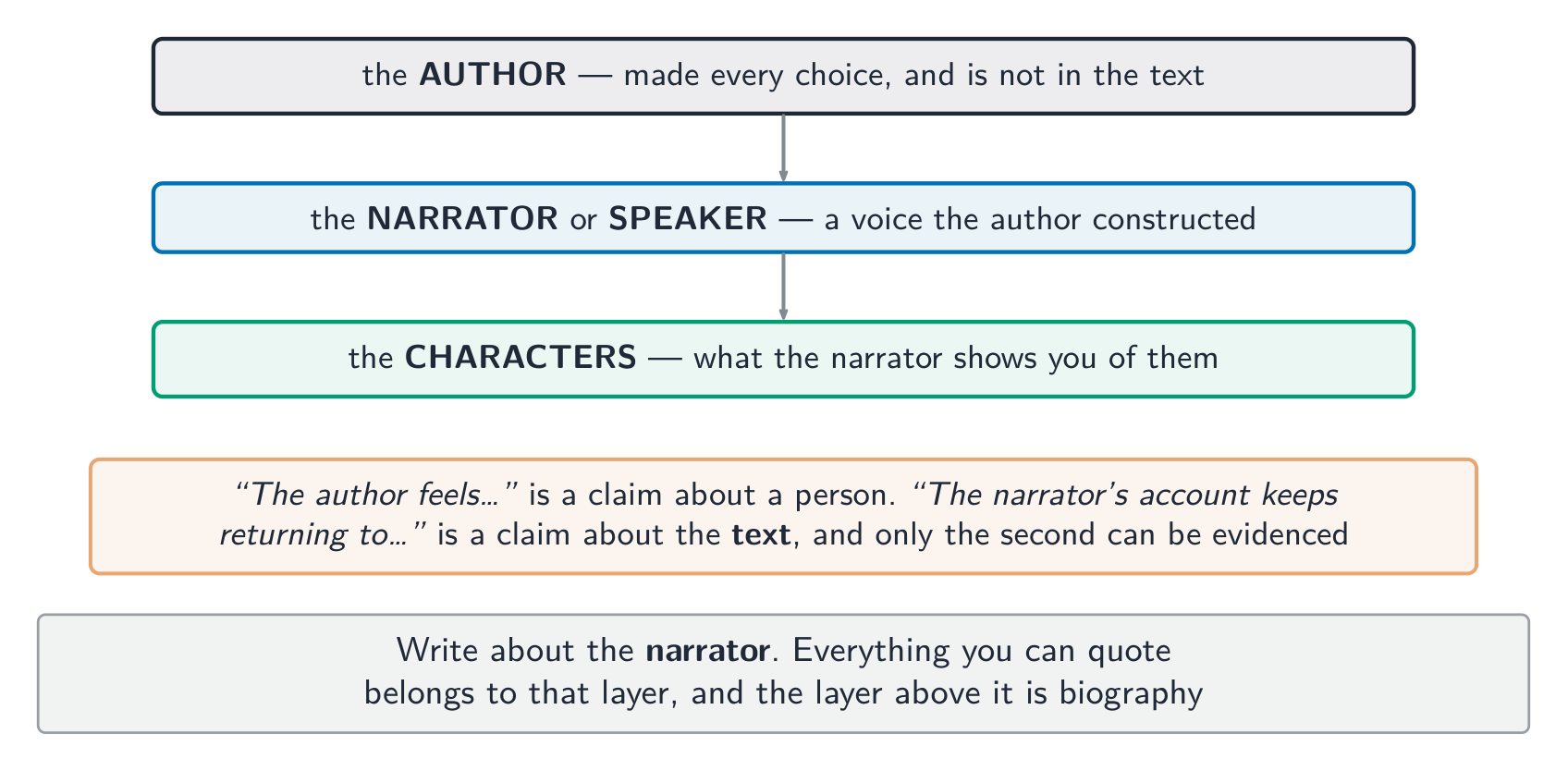
    • A speaker or narrator is not necessarily the author. Never write "the author feels" about a first-person narrator.
    Português
    O que cada ponto de vista pode e não pode te dar - e esse limite é a análise
    Perspectiva é como veem; ponto de vista é onde ficam. O CED os separa, e você também deve
    • Narradores ou falantes relatam contas e estabelecem uma relação entre o texto e o leitor.
    • Perspectiva refere-se a como narradores, personagens ou falantes veem suas circunstâncias; ponto de vista 叙述视点 refere-se a a posição a partir da qual eles relatam a conta.
    • Um falante ou narrador não é necessariamente o autor. Nunca escreva "o autor sente" sobre um narrador em primeira pessoa.
    Escreva sobre o narrador: tudo o que você pode citar pertence a essa camada
    Explore · ⁨Explorar⁩

    Classifique cada declaração pela camada à qual pertence

    Tudo o que você pode citar pertence à camada do narrador. A camada acima dela é a biografia.

    Vocabulary · ⁨Vocabulário⁩ Train · ⁨Treinar⁩
    English · ⁨Inglês⁩ Chinese · ⁨Chinês⁩ Pinyin
    point of view/pɔɪnt ɒv vjuː/ 叙述视点 xù shù shì diǎn
    observational to all-knowing/ɒbzəˈveɪʃənl tʊ ɔːl ˈnəʊɪŋ/ 全知 quán zhī
    1.6

    The Function of Point of View · ⁨A Função do Ponto de Vista⁩

    Syllabus · ⁨Programa⁩
    English

    Enduring Understanding (NAR-1): A narrator’s or speaker’s perspective controls the details and emphases that affect how readers experience and interpret a text.

    Learning Objective 4.B: Identify and explain the function of point of view in a narrative.

    • NAR-1.D The point of view contributes to what narrators, characters, or speakers can and cannot provide in a text based on their level of involvement and intimacy with the details, events, or characters.
    • NAR-1.E Narrators may also be characters, and their role as characters may influence their perspective.
    • NAR-1.F First-person narrators are involved in the narrative; their relationship to the events of the plot and the other characters shapes their perspective.
    • NAR-1.G Third-person narrators are outside observers.
    • NAR-1.H Third-person narrators’ knowledge about events and characters may range from observational to all-knowing, which shapes their perspective.
    • NAR-1.I The outside perspective of third-person narrators may not be affected by the events of the narrative.
    Português

    Compreensão Permanente (NAR-1): A perspectiva de um narrador ou falante controla os detalhes e ênfases que afetam como os leitores experimentam e interpretam um texto.

    Objetivo de Aprendizagem 4.B: Identificar e explicar a função do ponto de vista em uma narrativa.

    • NAR-1.D O ponto de vista contribui para o que narradores, personagens ou falantes podem e não podem fornecer em um texto com base em seu nível de envolvimento e intimidade com os detalhes, eventos ou personagens.
    • NAR-1.E Narradores também podem ser personagens, e seu papel como personagens pode influenciar sua perspectiva.
    • NAR-1.F Narradores em primeira pessoa estão envolvidos na narrativa; seu relacionamento com os eventos do enredo e os outros personagens molda sua perspectiva.
    • NAR-1.G Narradores em terceira pessoa são observadores externos.
    • NAR-1.H O conhecimento dos narradores em terceira pessoa sobre eventos e personagens pode variar de observacional a omnisciente, o que molda sua perspectiva.
    • NAR-1.I A perspectiva externa dos narradores em terceira pessoa pode não ser afetada pelos eventos da narrativa.

    Source: College Board AP Course and Exam Description · ⁨Fonte: College Board AP Course and Exam Description⁩

    English
    • Point of view contributes to what narrators can and cannot provide in a text, based on their position.
    • Narrators may also be characters, and that role may influence their perspective.
    • First-person narrators are involved in the narrative; their relationship to events and to other characters shapes what they can tell you.
    • Third-person narrators are outside observers, and their knowledge may range from observational to all-knowing 全知.
    • The outside perspective of a third-person narrator may not be affected by the events of the narrative.

    The analytical payoff is the cannot. A first-person narrator cannot report what they did not witness or will not admit, and every gap is meaningful. A limited third-person narrator confines you to one consciousness, which is a choice about whose experience counts.

    Português
    • O ponto de vista contribui para o que narradores podem e não podem fornecer em um texto, baseado em sua posição.
    • Narradores também podem ser personagens, e esse papel pode influenciar sua perspectiva.
    • Narradores em primeira pessoa estão envolvidos na narrativa; sua relação com eventos e outros personagens molda o que podem dizer.
    • Narradores em terceira pessoa são observadores externos, e seu conhecimento pode variar de observacional a onisciente 全知.
    • A perspectiva externa de um narrador em terceira pessoa pode não ser afetada pelos eventos da narrativa.

    O retorno analítico é o não poder. Um narrador em primeira pessoa não pode relatar o que não presenciou ou não admitirá, e cada lacuna é significativa. Um narrador de terceira pessoa limitado confina você a uma consciência, que é uma escolha sobre cuja experiência importa.

    1.7

    Developing a Paragraph with Claim and Evidence · ⁨Desenvolvendo um Parágrafo com Afirmação e Evidência⁩

    Syllabus · ⁨Programa⁩
    English

    Enduring Understanding (LAN-1): Readers establish and communicate their interpretations of literature through arguments supported by textual evidence.

    Learning Objective 7.A: Develop a paragraph that includes 1) a claim that requires defense with evidence from the text and 2) the evidence itself.

    • LAN-1.A In literary analysis, writers read a text closely to identify details that, in combination, enable them to make and defend a claim about an aspect of the text.
    • LAN-1.B A claim is a statement that requires defense with evidence from the text.
    • LAN-1.C In literary analysis, the initial components of a paragraph are the claim and textual evidence that defends the claim.
    Português

    Compreensão Permanente (LAN-1): Os leitores estabelecem e comunicam suas interpretações da literatura através de argumentos apoiados por evidências textuais.

    Objetivo de Aprendizagem 7.A: Desenvolver um parágrafo que inclua 1) uma afirmação que requer defesa com evidências do texto e 2) as próprias evidências.

    • LAN-1.A Na análise literária, os leitores leem um texto atentamente para identificar detalhes que, em combinação, permitem-lhes formular e defender uma afirmação sobre um aspecto do texto.
    • LAN-1.B Uma afirmação é uma declaração que requer defesa com evidências do texto.
    • LAN-1.C Na análise literária, os componentes iniciais de um parágrafo são a afirmação e as evidências textuais que defendem a afirmação.

    Source: College Board AP Course and Exam Description · ⁨Fonte: College Board AP Course and Exam Description⁩

    English
    • In literary analysis, writers read a text closely to identify details that, in combination, enable them to make and defend a claim.
    • A claim is a statement that requires defence with evidence from the text.
    • The initial components of a paragraph are the claim and the textual evidence that defends it.

    Note in combination. A single detail rarely supports an interpretive claim; two or three details that point the same way do.

    Worked example (a real AP exam task). The AP Literature free-response section has three questions - poetry analysis, prose fiction analysis, and a literary argument on a work you choose - all marked on a six-point rubric: thesis 1, evidence and commentary 4, sophistication 1. For a prose fiction prompt asking how the author uses narrative techniques to reveal a character's attitude, a weak answer writes "the narrator is first-person, which makes it personal." A scoring answer uses the cannot: "Because the narrator is a participant recounting events years later, the account gives us his present judgement of his younger self and withholds what the other characters thought - so the reader receives his self-criticism as the only available evidence, and must decide whether the harshness of it is accuracy or performance." Point of view, its limit, and the effect on the reader.

    Português
    • Na análise literária, os escritores leem um texto atentamente para identificar detalhes que, em combinação, permitem-lhes formular e defender uma afirmação.
    • Uma afirmação (claim) é uma declaração que requer defesa com evidências do texto.
    • Os componentes iniciais de um parágrafo são a afirmação e a evidência textual que a defende.

    Note em combinação. Um único detalhe raramente suporta uma afirmação interpretativa; dois ou três detalhes que apontam na mesma direção sim.

    Exemplo resolvido (uma tarefa real do exame AP). A seção de resposta livre da literatura AP tem três perguntas - análise de poesia, análise de ficção em prosa e um argumento literário sobre uma obra de sua escolha - todas avaliadas por uma rubrica de seis pontos: tese 1, evidência e comentário 4, sofisticação 1. Para um prompt de ficção em prosa perguntando como o autor usa técnicas narrativas para revelar a atitude de um personagem, uma resposta fraca escreve "o narrador é de primeira pessoa, o que o torna pessoal." Uma pontuação boa usa o cannot: "Como o narrador é um participante que relata eventos anos depois, o relato nos dá seu julgamento presente sobre seu eu mais jovem e omite o que os outros personagens pensaram - então o leitor recebe sua autocrítica como a única evidência disponível, e deve decidir se a dureza disso é precisão ou performance." Ponto de vista, seu limite e o efeito no leitor.

    1.7

    Exam tips · ⁨Dicas de prova⁩

    English
    • Character is a way of seeing, not a list of adjectives. Analyse what they notice and misread.
    • Setting must do something. Describing where a story happens is not yet a claim.
    • Plot is the order of events. A late revelation of an early event is an authorial choice worth analysing.
    • Proportion is evidence. What the text lingers over is where the meaning is.
    • The narrator is not the author. Never write "the author feels" about a first-person narrator.
    • The analytical gold in point of view is what the narrator cannot provide.
    Português
    • O caráter é uma maneira de ver, não uma lista de adjetivos. Analise o que eles notam e o que interpretam mal.
    • O cenário deve fazer algo. Descrever onde uma história acontece ainda não é uma afirmação.
    • O enredo é a ordem dos eventos. Uma revelação tardia de um evento inicial é uma escolha autoral que vale a pena analisar.
    • A proporção é evidência. Onde o texto demora é onde está o significado.
    • O narrador não é o autor. Nunca escreva "o autor sente" sobre um narrador de primeira pessoa.
    • O ouro analítico no ponto de vista é o que o narrador não pode fornecer.
  • 2

    Poesia I

    Watch lesson · ⁨Assistir aula⁩
    2.1

    What Textual Details Reveal About a Character · ⁨O Que Detalhes Textuais Revelam Sobre um Personagem⁩

    Syllabus · ⁨Programa⁩
    English

    Enduring Understanding (CHR-1): Characters in literature allow readers to study and explore a range of values, beliefs, assumptions, biases, and cultural norms represented by those characters.

    Learning Objective 1.A: Identify and describe what specific textual details reveal about a character, that character’s perspective, and that character’s motives.

    • CHR-1.E Characters reveal their perspectives and biases through the words they use, the details they provide in the text, the organization of their thinking, the decisions they make, and the actions they take.
    Português

    Compreensão Duradoura (CHR-1): Personagens em literatura permitem que os leitores estudem e explorem uma gama de valores, crenças, pressupostos, vieses e normas culturais representados por esses personagens.

    Objetivo de Aprendizagem 1.A: Identificar e descrever quais detalhes textuais específicos revelam sobre um personagem, a perspectiva desse personagem e os motivos desse personagem.

    • CHR-1.E Personagens revelam suas perspectivas e vieses através das palavras que usam, os detalhes que fornecem no texto, a organização de seu pensamento, as decisões que tomam e as ações que realizam.

    Source: College Board AP Course and Exam Description · ⁨Fonte: College Board AP Course and Exam Description⁩

    English

    Unit 2 is the course's first poetry unit, and it adds two things to Unit 1's toolkit: structure as an object of analysis, and figurative language 比喻性语言 handled precisely rather than by name-dropping.

    One addition on character first: characters reveal their perspectives and biases through the words they use, the details they provide, and the details they omit.

    That last item is the analytical opening. What a speaker does not mention, in a poem where everything is chosen, is evidence.

    Português

    A Unidade 2 é a primeira unidade de poesia do curso, e adiciona duas coisas à ferramenta da Unidade 1: estrutura como objeto de análise, e linguagem figurativa 比喻性语言 tratada com precisão em vez de apenas citando nomes.

    Uma adição sobre o caráter primeiro: os personagens revelam suas perspectivas e vieses através das palavras que usam, dos detalhes que fornecem e dos detalhes que omitem.

    Este último item é a abertura analítica. O que um falante não menciona, em um poema onde tudo é escolhido, é evidência.

    2.2

    The Function of Structure in a Text · ⁨A Função da Estrutura em um Texto⁩

    Syllabus · ⁨Programa⁩
    English

    Enduring Understanding (STR-1): The arrangement of the parts and sections of a text, the relationship of the parts to each other, and the sequence in which the text reveals information are all structural choices made by a writer that contribute to the reader’s interpretation of a text.

    Learning Objective 3.C: Explain the function of structure in a text.

    • STR-1.D Line and stanza breaks contribute to the development and relationship of ideas in a poem.
    • STR-1.E The arrangement of lines and stanzas contributes to the development and relationship of ideas in a poem.
    • STR-1.F A text’s structure affects readers’ reactions and expectations by presenting the relationships among the ideas of the text via their relative positions and their placement within the text as a whole.
    Português

    Compreensão Permanente (STR-1): A disposição das partes e seções de um texto, a relação das partes entre si e a sequência em que o texto revela informações são todas escolhas estruturais feitas por um escritor que contribuem para a interpretação do leitor de um texto.

    Objetivo de Aprendizagem 3.C: Explicar a função da estrutura em um texto.

    • STR-1.D Quebras de linha e estrofe contribuem para o desenvolvimento e relação de ideias em um poema.
    • STR-1.E A disposição de linhas e estrofes contribui para o desenvolvimento e relação de ideias em um poema.
    • STR-1.F A estrutura de um texto afeta as reações e expectativas dos leitores ao apresentar as relações entre as ideias do texto por meio de suas posições relativas e sua colocação dentro do texto como um todo.

    Source: College Board AP Course and Exam Description · ⁨Fonte: College Board AP Course and Exam Description⁩

    English
    • Line and stanza breaks 行与诗节的断开 contribute to the development and relationship of ideas in a poem.
    • The arrangement of lines and stanzas contributes to that development.
    • A text's structure affects readers' reactions and expectations by presenting the relationships among ideas.

    Structure in poetry is not decoration; it is punctuation for thought. Where a line breaks decides which words sit at the ends of lines, and the end of a line is the most emphatic position available. A sentence that runs past a line break asks the reader to hold something unresolved; one that stops at the break closes it.

    Português
    • Quebras de verso e estrofe 行与诗节的断开 contribuem para o desenvolvimento e relacionamento de ideias em um poema.
    • O arranjo de versos e estrofes contribui para esse desenvolvimento.
    • A estrutura de um texto afeta as reações e expectativas dos leitores apresentando as relações entre as ideias.

    A estrutura na poesia não é decoração; é pontuação para o pensamento. Onde um verso termina decide quais palavras ficam no final dos versos, e o fim de um verso é a posição mais enfática disponível. Uma frase que passa além de uma quebra de verso pede ao leitor que segure algo não resolvido; uma que para na quebra o fecha.

    Descrever a forma não é nomear a função - diga o que se faz o leitor fazer
    Uma página carregando seu próprio comentário nas margens - leitura atenta, vários séculos antes
    Explore · ⁨Explorar⁩

    Corresponda cada escolha estrutural à sua função

    Descrever a forma não é nomear a função. Diga o que o leitor é levado a fazer e onde.

    2.3

    The Function of Contrasts Within a Text · ⁨A Função dos Contrastes Dentro de um Texto⁩

    Syllabus · ⁨Programa⁩
    English

    Enduring Understanding (STR-1): The arrangement of the parts and sections of a text, the relationship of the parts to each other, and the sequence in which the text reveals information are all structural choices made by a writer that contribute to the reader’s interpretation of a text.

    Learning Objective 3.D: Explain the function of contrasts within a text.

    • STR-1.G Contrast can be introduced through focus; tone; point of view; character, narrator, or speaker perspective; dramatic situation or moment; settings or time; or imagery.
    • STR-1.H Contrasts are the result of shifts or juxtapositions or both.
    • STR-1.I Shifts may be signaled by a word, a structural convention, or punctuation.
    • STR-1.J Shifts may emphasize contrasts between particular segments of a text.
    Português

    Compreensão Permanente (STR-1): A disposição das partes e seções de um texto, a relação das partes entre si e a sequência em que o texto revela informações são todas escolhas estruturais feitas por um escritor que contribuem para a interpretação do leitor de um texto.

    Objetivo de Aprendizagem 3.D: Explicar a função de contrastes dentro de um texto.

    • STR-1.G O contraste pode ser introduzido através do foco; tom; ponto de vista; perspectiva de personagem, narrador ou falante; situação dramática ou momento; cenários ou tempo; ou imagens.
    • STR-1.H Contrastes são o resultado de mudanças ou justaposições ou ambas.
    • STR-1.I Mudanças podem ser sinalizadas por uma palavra, uma convenção estrutural ou pontuação.
    • STR-1.J Mudanças podem enfatizar contrastes entre segmentos particulares de um texto.

    Source: College Board AP Course and Exam Description · ⁨Fonte: College Board AP Course and Exam Description⁩

    English
    • Contrast 对照 can be introduced through focus, tone, point of view, character or speaker perspective, and dramatic situation.
    • Contrasts are the result of shifts or juxtapositions or both.
    • Shifts may be signalled by a word, a structural convention, or punctuation.
    • Shifts may emphasise contrasts between particular segments of a text.

    This is the most reliable route into an unseen poem. Find the shift - a but, a stanza break, a change of tense or address - and the poem divides into a before and an after. What changed, and what the change costs or gains, is very often the poem's argument.

    Português
    • O contraste 对照 pode ser introduzido através de foco, tom, ponto de vista, perspectiva de personagem ou falante, e situação dramática.
    • Os contrastes são o resultado de mudanças ou justaposições ou ambas.
    • Mudanças podem ser sinalizadas por uma palavra, uma convenção estrutural ou pontuação.
    • As mudanças podem enfatizar contrastes entre segmentos particulares de um texto.

    Esta é a rota mais confiável para entrar em um poema desconhecido. Encontre a mudança - um mas, uma quebra de estrofe, uma mudança de tempo verbal ou endereço - e o poema se divide em um antes e um depois. O que mudou, e o que a mudança custa ou ganha, é frequentemente o argumento do poema.

    Quatro lugares para procurar contraste, não um
    Explore · ⁨Explorar⁩

    Encontre o contraste em quatro lugares, não em um

    Os alunos encontram o pareamento óbvio e param — e o contraste dentro de um personagem geralmente carrega a questão de complexidade.

    Vocabulary · ⁨Vocabulário⁩ Train · ⁨Treinar⁩
    English · ⁨Inglês⁩ Chinese · ⁨Chinês⁩ Pinyin
    figurative language/ˈfɪɡjərətɪv ˈlæŋɡwɪdʒ/ 比喻性语言 bǐ yù xìng yǔ yán
    Line and stanza breaks/laɪn ænd ˈstænzə breɪks/ 行与诗节的断开 xíng yǔ shī jié de duàn kāi
    Contrast/ˈkɒntræst/ 对照 duì zhào
    2.4

    The Function of Specific Words and Phrases · ⁨A Função de Palavras e Frases Específicas⁩

    Syllabus · ⁨Programa⁩
    English

    Enduring Understanding (FIG-1): Comparisons, representations, and associations shift meaning from the literal to the figurative and invite readers to interpret a text.

    Learning Objective 5.B: Explain the function of specific words and phrases in a text.

    • FIG-1.A An antecedent is a word, phrase, or clause that precedes its referent. Referents may include pronouns, nouns, phrases, or clauses.
    • FIG-1.B Referents are ambiguous if they can refer to more than one antecedent, which affects interpretation.
    • FIG-1.C Words or phrases may be repeated to emphasize ideas or associations.
    • FIG-1.D Alliteration is the repetition of the same letter sound at the beginning of adjacent or nearby words to emphasize those words and their associations or representations.
    Português

    Compreensão Permanente (FIG-1): Comparações, representações e associações mudam o significado do literal para o figurado e convida os leitores a interpretar um texto.

    Objetivo de Aprendizagem 5.B: Explicar a função de palavras e frases específicas em um texto.

    • FIG-1.A Um antecedente é uma palavra, frase ou oração que precede seu referente. Referentes podem incluir pronomes, substantivos, frases ou orações.
    • FIG-1.B Referentes são ambíguos se podem se referir a mais de um antecedente, o que afeta a interpretação.
    • FIG-1.C Palavras ou frases podem ser repetidas para enfatizar ideias ou associações.
    • FIG-1.D Aliteração é a repetição do mesmo som de letra no início de palavras adjacentes ou próximas para enfatizar essas palavras e suas associações ou representações.

    Source: College Board AP Course and Exam Description · ⁨Fonte: College Board AP Course and Exam Description⁩

    English
    • An antecedent 先行词 is a word, phrase, or clause that precedes its referent.
    • Referents are ambiguous if they can refer to more than one antecedent, which affects interpretation 影响阐释.
    • Words or phrases may be repeated to emphasise ideas or associations.
    • Alliteration 头韵 is the repetition of the same initial sound in adjacent or nearby words, emphasising those words.

    Ambiguous reference is worth special attention. In prose it is usually a fault; in poetry it is often a device, and a pronoun that could point two ways may be holding both meanings deliberately.

    Português
    • Um antecedente 先行词 é uma palavra, frase ou oração que precede seu referente.
    • Referentes são ambíguos se puderem se referir a mais de um antecedente, o que afeta a interpretação 影响阐释.
    • Palavras ou frases podem ser repetidas para enfatizar ideias ou associações.
    • Aliteração 头韵 é a repetição do mesmo som inicial em palavras adjacentes ou próximas, enfatizando essas palavras.

    Referência ambígua merece atenção especial. Em prosa, geralmente é uma falha; em poesia, muitas vezes é um dispositivo, e um pronome que poderia apontar para dois caminhos pode estar segurando ambos os significados deliberadamente.

    Uma palavra escolhida está fazendo até quatro coisas - 'poderoso' não é uma delas
    Vocabulary · ⁨Vocabulário⁩ Train · ⁨Treinar⁩
    English · ⁨Inglês⁩ Chinese · ⁨Chinês⁩ Pinyin
    antecedent/ˌæntɪˈsiːdənt/ 先行词 xiān xíng cí
    affects interpretation/əˈfekts ɪnˌtɜːprɪˈteɪʃn/ 影响阐释 yǐng xiǎng chǎn shì
    Alliteration/əˌlɪtəˈreɪʃn/ 头韵 tóu yùn
    2.5

    The Function of a Simile · ⁨A Função de uma Metáfora Comparativa (Símile)⁩

    Syllabus · ⁨Programa⁩
    English

    Enduring Understanding (FIG-1): Comparisons, representations, and associations shift meaning from the literal to the figurative and invite readers to interpret a text.

    Learning Objective 6.A: Identify and explain the function of a simile.

    • FIG-1.E A simile uses the words “like” or “as” to liken two objects or concepts to each other.
    • FIG-1.F Similes liken two different things to transfer the traits or qualities of one to the other.
    • FIG-1.G In a simile, the thing being compared is the main subject; the thing to which it is being compared is the comparison subject.
    Português

    Compreensão Permanente (FIG-1): Comparações, representações e associações mudam o significado do literal para o figurado e convida os leitores a interpretar um texto.

    Objetivo de Aprendizagem 6.A: Identificar e explicar a função de um símile.

    • FIG-1.E Um símile usa as palavras "como" ou "tal" para semelhar dois objetos ou conceitos uns aos outros.
    • FIG-1.F Símiles semelham duas coisas diferentes para transferir as características ou qualidades de uma para a outra.
    • FIG-1.G Em um símile, a coisa sendo comparada é o sujeito principal; a coisa com a qual está sendo comparada é o sujeito de comparação.

    Source: College Board AP Course and Exam Description · ⁨Fonte: College Board AP Course and Exam Description⁩

    English
    • A simile 明喻 uses "like" or "as" to liken two objects or concepts.
    • Similes liken two different things to transfer the traits or qualities of one to the other.
    • In a simile, the thing being compared is the main subject; the thing to which it is compared is the comparison subject.

    Those two terms are the whole method. A scoring answer names the main subject, names the comparison subject, and then says which quality was transferred - because that quality is the claim the poem is making.

    Português
    Os próprios termos do CED - e a transferência ocorre apenas em uma direção
    Nomeie o assunto principal, nomeie o assunto da comparação, então diga qual qualidade cruzou
    • Uma símile 明喻 usa "como" ou "assim como" para comparar dois objetos ou conceitos.
    • Sílices comparam duas coisas diferentes para transferir os traços ou qualidades de uma para a outra.
    • Em uma símile, a coisa sendo comparada é o assunto principal; a coisa à qual é comparada é o assunto da comparação.

    Esses dois termos são todo o método. Uma resposta pontuada nomeia o assunto principal, nomeia o assunto da comparação, e então diz qual qualidade foi transferida - porque essa qualidade é a afirmação que o poema está fazendo.

    Vocabulary · ⁨Vocabulário⁩ Train · ⁨Treinar⁩
    English · ⁨Inglês⁩ Chinese · ⁨Chinês⁩ Pinyin
    simile/ˈsɪmɪlɪ/ 明喻 míng yù
    metaphor/ˈmetəfɔː/ 隐喻 yǐn yù
    2.6

    The Function of a Metaphor · ⁨A Função de uma Metáfora⁩

    Syllabus · ⁨Programa⁩
    English

    Enduring Understanding (FIG-1): Comparisons, representations, and associations shift meaning from the literal to the figurative and invite readers to interpret a text.

    Learning Objective 6.B: Identify and explain the function of a metaphor.

    • FIG-1.H A metaphor implies similarities between two (usually unrelated) concepts or objects in order to reveal or emphasize one or more things about one of them, though the differences between the two may also be revealing.
    • FIG-1.I In a metaphor, as in a simile, the thing being compared is the main subject; the thing to which it is being compared is the comparison subject.
    • FIG-1.J Comparisons between objects or concepts draw on the experiences and associations readers already have with those objects and concepts.
    • FIG-1.K Interpretation of a metaphor may depend on the context of its use; that is, what is happening in a text may determine what is transferred in the comparison.
    Português

    Compreensão Permanente (FIG-1): Comparações, representações e associações mudam o significado do literal para o figurado e convida os leitores a interpretar um texto.

    Objetivo de Aprendizagem 6.B: Identificar e explicar a função de uma metáfora.

    • FIG-1.H Uma metáfora implica semelhanças entre dois (geralmente não relacionados) conceitos ou objetos para revelar ou enfatizar uma ou mais coisas sobre uma delas, embora as diferenças entre as duas também possam ser reveladoras.
    • FIG-1.I Em uma metáfora, assim como em um símile, a coisa sendo comparada é o sujeito principal; a coisa com a qual está sendo comparada é o sujeito de comparação.
    • FIG-1.J Comparações entre objetos ou conceitos baseiam-se nas experiências e associações que os leitores já têm com esses objetos e conceitos.
    • FIG-1.K A interpretação de uma metáfora pode depender do contexto de seu uso; isto é, o que está acontecendo em um texto pode determinar o que é transferido na comparação.

    Source: College Board AP Course and Exam Description · ⁨Fonte: College Board AP Course and Exam Description⁩

    English
    • A metaphor 隐喻 implies similarities between two usually unrelated concepts to reveal or emphasise qualities of the main subject.
    • The same main-subject and comparison-subject structure applies.
    • Comparisons draw on the experiences and associations readers already have with the comparison subject - which is why a metaphor can fail with an audience that lacks those associations.
    • Interpretation of a metaphor may depend on the context of its use: what is happening in the text may determine which of the comparison subject's qualities is meant.

    That last point protects you from the commonest error, which is importing every association a word has. If a poem calls grief a house, the relevant quality might be shelter, or confinement, or the fact that one must live inside it. The text decides which.

    Português
    • Uma metáfora 隐喻 implica semelhanças entre dois conceitos geralmente não relacionados para revelar ou enfatizar qualidades do assunto principal.
    • A mesma estrutura de assunto principal e assunto da comparação se aplica.
    • As comparações se baseiam nas experiências e associações que os leitores já têm com o assunto da comparação - razão pela qual uma metáfora pode falhar com um público que não possui essas associações.
    • A interpretação de uma metáfora pode depender do contexto de seu uso: o que está acontecendo no texto pode determinar qual das qualidades do assunto da comparação é pretendida.

    Esse último ponto protege você do erro mais comum, que é importar todas as associações que uma palavra tem. Se um poema chama a tristeza de uma casa, a qualidade relevante pode ser abrigo, confinamento, ou o fato de que se deve viver dentro dela. O texto decide qual.

    2.7

    Developing a Paragraph with Claim and Evidence · ⁨Desenvolvendo um Parágrafo com Afirmação e Evidência⁩

    Syllabus · ⁨Programa⁩
    English

    Enduring Understanding (LAN-1): Readers establish and communicate their interpretations of literature through arguments supported by textual evidence.

    Learning Objective 7.A: Develop a paragraph that includes 1) a claim that requires defense with evidence from the text and 2) the evidence itself.

    • LAN-1.A In literary analysis, writers read a text closely to identify details that, in combination, enable them to make and defend a claim about an aspect of the text.
    • LAN-1.B A claim is a statement that requires defense with evidence from the text.
    • LAN-1.C In literary analysis, the initial components of a paragraph are the claim and textual evidence that defends the claim.
    Português

    Compreensão Permanente (LAN-1): Os leitores estabelecem e comunicam suas interpretações da literatura através de argumentos apoiados por evidências textuais.

    Objetivo de Aprendizagem 7.A: Desenvolver um parágrafo que inclua 1) uma afirmação que requer defesa com evidências do texto e 2) as próprias evidências.

    • LAN-1.A Na análise literária, os leitores leem um texto atentamente para identificar detalhes que, em combinação, permitem-lhes formular e defender uma afirmação sobre um aspecto do texto.
    • LAN-1.B Uma afirmação é uma declaração que requer defesa com evidências do texto.
    • LAN-1.C Na análise literária, os componentes iniciais de um parágrafo são a afirmação e as evidências textuais que defendem a afirmação.

    Source: College Board AP Course and Exam Description · ⁨Fonte: College Board AP Course and Exam Description⁩

    English

    Same three components as Unit 1: a claim requiring textual defence, the textual evidence, and details identified in combination.

    Worked example (a real AP exam task). A poetry-analysis prompt asks how the speaker's use of comparison conveys their attitude. A weak answer: "The poet uses a metaphor comparing memory to a house, which is effective." A scoring answer uses the CED's terms and the context rule: "The main subject is memory and the comparison subject a house, but the poem withholds warmth from the comparison: the house has 'rooms she no longer enters'. The quality transferred is therefore not shelter but confinement by a structure one built oneself - so the speaker's attitude to her own past is presented as inhabiting something she can neither leave nor fully occupy." Main subject, comparison subject, transferred quality, and the attitude it conveys.

    Português

    Mesmos três componentes da Unidade 1: uma afirmação (claim) exigindo defesa textual, a evidência textual, e detalhes identificados em combinação.

    Exemplo resolvido (uma tarefa real do exame AP). Um prompt de análise de poesia pergunta como o uso de comparação pelo falante transmite sua atitude. Uma resposta fraca: "O poeta usa uma metáfora comparando memória a uma casa, o que é eficaz." Uma resposta pontuada usa os termos do CED e a regra de contexto: "O assunto principal é memória e o assunto da comparação uma casa, mas o poema retira o calor da comparação: a casa tem 'quartos que ela não entra mais'. A qualidade transferida é portanto não abrigo, mas confinamento por uma estrutura construída por si mesmo - então a atitude do falante em relação ao seu próprio passado é apresentada como habitar algo que ela nem pode deixar nem ocupar totalmente." Assunto principal, assunto da comparação, qualidade transferida, e a atitude que ela transmite.

    2.7

    Exam tips · ⁨Dicas de prova⁩

    English
    • What a speaker omits is evidence. In a poem, everything present was chosen.
    • Find the shift first. A but, a stanza break, a change of tense - the poem divides there.
    • Line endings are the emphatic position. Say which words the poet put there.
    • An ambiguous referent in poetry is usually a device, not an error.
    • Always name main subject and comparison subject, then the quality transferred. That quality is the claim.
    • Context decides which quality a metaphor imports. Do not list every association the word has.
    Português
    • O que um falante omite é evidência. Em um poema, tudo o que está presente foi escolhido.
    • Encontre a mudança primeiro. Um mas, uma quebra de estrofe, uma mudança de tempo verbal - o poema se divide ali.
    • Os finais de verso são a posição enfática. Diga quais palavras o poeta colocou lá.
    • Um referente ambíguo na poesia é geralmente um dispositivo, não um erro.
    • Nomeie sempre o sujeito principal e o sujeito da comparação, depois a qualidade transferida. Essa qualidade é a tese.
    • O contexto decide qual qualidade uma metáfora traz. Não liste todas as associações que a palavra possui.
  • 3

    Ficção Longa ou Drama I

    Watch lesson · ⁨Assistir aula⁩
    3.1

    What Textual Details Reveal About a Character · ⁨O Que Detalhes Textuais Revelam Sobre um Personagem⁩

    Syllabus · ⁨Programa⁩
    English

    Enduring Understanding (CHR-1): Characters in literature allow readers to study and explore a range of values, beliefs, assumptions, biases, and cultural norms represented by those characters.

    Learning Objective 1.A: Identify and describe what specific textual details reveal about a character, that character’s perspective, and that character’s motives.

    • CHR-1.F The description of a character creates certain expectations for that character’s behaviors; how a character does or does not meet those expectations affects a reader’s interpretation of that character.
    • CHR-1.G Details associated with a character and/or used to describe a character contribute to a reader’s interpretation of that character.
    • CHR-1.H Readers’ understanding of a character’s perspective may depend on the perspective of the narrator or speaker.
    • CHR-1.I A character’s perspective may shift during the course of a narrative.
    • CHR-1.J When narrators, characters, or speakers compare another character to something or someone else, they reveal their perspective on the compared character and may also reveal something innate about the compared character.
    • CHR-1.K Readers can infer a character’s motives from that character’s actions or inactions.
    Português

    Compreensão Duradoura (CHR-1): Personagens em literatura permitem que os leitores estudem e explorem uma gama de valores, crenças, pressupostos, vieses e normas culturais representados por esses personagens.

    Objetivo de Aprendizagem 1.A: Identificar e descrever quais detalhes textuais específicos revelam sobre um personagem, a perspectiva desse personagem e os motivos desse personagem.

    • CHR-1.F A descrição de um personagem cria certas expectativas para o comportamento desse personagem; como um personagem faz ou não atende a essas expectativas afeta a interpretação do leitor sobre esse personagem.
    • CHR-1.G Detalhes associados a um personagem e/ou usados para descrever um personagem contribuem para a interpretação do leitor sobre esse personagem.
    • CHR-1.H A compreensão dos leitores sobre a perspectiva de um personagem pode depender da perspectiva do narrador ou falante.
    • CHR-1.I A perspectiva de um personagem pode mudar durante o curso de uma narrativa.
    • CHR-1.J Quando narradores, personagens ou falantes comparam outro personagem a algo ou alguém, eles revelam sua perspectiva sobre o personagem comparado e podem também revelar algo inerente ao personagem comparado.
    • CHR-1.K Os leitores podem inferir os motivos de um personagem a partir das ações ou inações desse personagem.

    Source: College Board AP Course and Exam Description · ⁨Fonte: College Board AP Course and Exam Description⁩

    English

    Unit 3 is the first longer-fiction-or-drama unit, and the length changes what is analysable: characters can now change, conflicts can intersect, and setting acquires a social and historical dimension.

    The CED's additions on character:

    • The description of a character creates expectations for that character's behaviour, and how a character meets or fails those expectations is meaningful.
    • Details associated with a character contribute to a reader's interpretation of them.
    • A reader's understanding of a character's perspective may depend on the perspective of the narrator.
    • A character's perspective may shift during the narrative.
    • When narrators or characters compare another character to something else, they reveal their own perspective as much as the compared character's.
    • Readers can infer motive from a character's actions or inactions.

    That last word - inactions - is the one worth keeping. What a character declines to do is evidence, and it is usually more revealing than what they do.

    Português

    A Unidade 3 é a primeira unidade de ficção longa ou drama, e o comprimento altera o que pode ser analisado: os personagens agora podem mudar, os conflitos podem cruzar-se e o cenário adquire uma dimensão social e histórica.

    As adições do CED sobre personagem:

    • A descrição de um personagem cria expectativas para o comportamento desse personagem, e como um personagem atende ou falha nessas expectativas é significativo.
    • Os detalhes associados a um personagem contribuem para a interpretação do leitor sobre ele.
    • A compreensão do leitor da perspectiva de um personagem pode depender da perspectiva do narrador.
    • A perspectiva de um personagem pode mudar durante a narrativa.
    • Quando narradores ou personagens comparam outro personagem a algo mais, eles revelam sua própria perspectiva tanto quanto a do personagem comparado.
    • Os leitores podem inferir motivação a partir das ações ou inações de um personagem.

    Essa última palavra - inações - é a que vale a pena manter. O que um personagem se recusa a fazer é evidência, e geralmente é mais revelador do que o que ele faz.

    3.2

    Characters Who Change or Remain Unchanged · ⁨Personagens Que Mudam Ou Permanecem Inalterados⁩

    Syllabus · ⁨Programa⁩
    English

    Enduring Understanding (CHR-1): Characters in literature allow readers to study and explore a range of values, beliefs, assumptions, biases, and cultural norms represented by those characters.

    Learning Objective 1.B: Explain the function of a character changing or remaining unchanged.

    • CHR-1.L A dynamic character who develops over the course of the narrative often makes choices that directly or indirectly affect the climax and/or the resolution of that narrative.
    • CHR-1.M Character changes can be visible and external, such as changes to health or wealth, or can be internal, psychological, or emotional changes; external changes can lead to internal changes, and vice versa.
    • CHR-1.N Some characters remain unchanged or are largely unaffected by the events of the narrative.
    Português

    Compreensão Duradoura (CHR-1): Personagens em literatura permitem que os leitores estudem e explorem uma gama de valores, crenças, pressupostos, vieses e normas culturais representados por esses personagens.

    Objetivo de Aprendizagem 1.B: Explicar a função de um personagem mudando ou permanecendo inalterado.

    • CHR-1.L Um personagem dinâmico que se desenvolve ao longo da narrativa frequentemente faz escolhas que afetam direta ou indiretamente o clímax e/ou a resolução dessa narrativa.
    • CHR-1.M As mudanças de personagem podem ser visíveis e externas, como alterações na saúde ou riqueza, ou podem ser internas, psicológicas ou emocionais; mudanças externas podem levar a mudanças internas, e vice-versa.
    • CHR-1.N Alguns personagens permanecem inalterados ou são pouco afetados pelos eventos da narrativa.

    Source: College Board AP Course and Exam Description · ⁨Fonte: College Board AP Course and Exam Description⁩

    English
    • A dynamic character 动态人物 develops over the narrative and often makes choices that directly or indirectly cause change.
    • Character change can be visible and external - health, wealth, circumstance - or internal, in belief, value, or understanding.
    • Some characters remain unchanged 静态人物 or are largely unaffected by events.

    The unchanged character is not a failure of characterisation; it is often the measure by which the change in others is visible.

    Português
    • Um personagem dinâmico 动态人物 desenvolve-se ao longo da narrativa e frequentemente faz escolhas que direta ou indiretamente causam mudança.
    • A mudança de personagem pode ser visível e externa - saúde, riqueza, circunstância - ou interna, em crença, valor ou compreensão.
    • Alguns personagens permanecem inalterados 静态人物 ou são amplamente afetados pelos eventos.

    O personagem inalterado não é uma falha na caracterização; é frequentemente a medida pela qual a mudança nos outros se torna visível.

    Três citações, e a do meio é aquela que os alunos omitem
    Explore · ⁨Explorar⁩

    Prove uma mudança com três citações

    Antes, ponto-chave, depois — e o ponto-chave é aquele que os alunos omitem, o que deixa a mudança apenas afirmada.

    3.3

    Textual Details That Convey Setting · ⁨Detalhes Textuais Que Transmitem Cenário⁩

    Syllabus · ⁨Programa⁩
    English

    Enduring Understanding (SET-1): Setting and the details associated with it not only depict a time and place, but also convey values associated with that setting.

    Learning Objective 2.A: Identify and describe specific textual details that convey or reveal a setting.

    • SET-1.B Setting includes the social, cultural, and historical situation during which the events of the text occur.
    Português

    Compreensão Permanente (SET-1): O cenário e os detalhes associados a ele não apenas retratam um tempo e lugar, mas também transmitem valores associados a esse cenário.

    Objetivo de Aprendizagem 2.A: Identificar e descrever detalhes textuais específicos que transmitem ou revelam um cenário.

    • SET-1.B O cenário inclui a situação social, cultural e histórica durante a qual os eventos do texto ocorrem.

    Source: College Board AP Course and Exam Description · ⁨Fonte: College Board AP Course and Exam Description⁩

    English

    Setting now includes the social, cultural, and historical situation in which the events occur - not only time and place.

    This widens what setting can do. A social setting supplies the constraints a character must act within, and constraint is what turns a choice into a revealing one.

    Português

    O cenário agora inclui a situação social, cultural e histórica na qual os eventos ocorrem - não apenas tempo e lugar.

    Isso amplia o que o cenário pode fazer. Um cenário social fornece as restrições dentro das quais um personagem deve agir, e a restrição é o que transforma uma escolha em uma reveladora.

    3.4

    Significant Events in a Plot · ⁨Eventos Significativos Em Um Enredo⁩

    Syllabus · ⁨Programa⁩
    English

    Enduring Understanding (STR-1): The arrangement of the parts and sections of a text, the relationship of the parts to each other, and the sequence in which the text reveals information are all structural choices made by a writer that contribute to the reader’s interpretation of a text.

    Learning Objective 3.E: Explain the function of a significant event or related set of significant events in a plot.

    • STR-1.K A story, or narrative, is delivered through a series of events that relate to a conflict.
    • STR-1.L Events include episodes, encounters, and scenes in a narrative that can introduce and develop a plot.
    • STR-1.M The significance of an event depends on its relationship to the narrative, the conflict, and the development of characters.
    Português

    Compreensão Permanente (STR-1): A disposição das partes e seções de um texto, a relação das partes entre si e a sequência em que o texto revela informações são todas escolhas estruturais feitas por um escritor que contribuem para a interpretação do leitor de um texto.

    Objetivo de Aprendizagem 3.E: Explicar a função de um evento significativo ou conjunto relacionado de eventos significativos em uma trama.

    • STR-1.K Uma história, ou narrativa, é apresentada através de uma série de eventos relacionados a um conflito.
    • STR-1.L Eventos incluem episódios, encontros e cenas em uma narrativa que podem introduzir e desenvolver uma trama.
    • STR-1.M A importância de um evento depende de sua relação com a narrativa, o conflito e o desenvolvimento dos personagens.

    Source: College Board AP Course and Exam Description · ⁨Fonte: College Board AP Course and Exam Description⁩

    English
    • A narrative is delivered through a series of events that relate to a conflict.
    • Events include episodes, encounters, and scenes that introduce and develop plot.
    • The significance of an event depends on its relationship to the narrative, the conflict, and character development.

    That third statement is the test for essay selection: an event matters to your argument only if you can say what it does to the conflict or to a character. Retelling a striking scene that does neither is plot summary, which earns nothing.

    Português
    • Uma narrativa é entregue através de uma série de eventos que se relacionam com um conflito.
    • Os eventos incluem episódios, encontros e cenas que introduzem e desenvolvem o enredo.
    • A importância de um evento depende de sua relação com a narrativa, o conflito e o desenvolvimento dos personagens.

    Aquela terceira afirmação é o teste para a seleção de eventos em uma redação: um evento importa para seu argumento apenas se você puder dizer o que ele faz ao conflito ou a um personagem. Recontar uma cena marcante que não faça nenhuma das duas coisas é resumo de enredo, o que não vale nada.

    3.5

    The Function of Conflict in a Text · ⁨A Função do Conflito em um Texto⁩

    Syllabus · ⁨Programa⁩
    English

    Enduring Understanding (STR-1): The arrangement of the parts and sections of a text, the relationship of the parts to each other, and the sequence in which the text reveals information are all structural choices made by a writer that contribute to the reader’s interpretation of a text.

    Learning Objective 3.F: Explain the function of conflict in a text.

    • STR-1.N Conflict is tension between competing values either within a character, known as internal or psychological conflict, or with outside forces that obstruct a character in some way, known as external conflict.
    • STR-1.O A text may contain multiple conflicts. Often two or more conflicts in a text intersect.
    • STR-1.P A primary conflict can be heightened by the presence of additional conflicts that intersect with it.
    • STR-1.Q Inconsistencies in a text may create contrasts that represent conflicts of values or perspectives.
    Português

    Compreensão Permanente (STR-1): A disposição das partes e seções de um texto, a relação das partes entre si e a sequência em que o texto revela informações são todas escolhas estruturais feitas por um escritor que contribuem para a interpretação do leitor de um texto.

    Objetivo de Aprendizagem 3.F: Explicar a função do conflito em um texto.

    • STR-1.N Conflito é a tensão entre valores concorrentes, seja dentro de um personagem, conhecido como conflito interno ou psicológico, ou com forças externas que obstruem um personagem de alguma forma, conhecido como conflito externo.
    • STR-1.O Um texto pode conter múltiplos conflitos. Frequentemente, dois ou mais conflitos em um texto se cruzam.
    • STR-1.P Um conflito primário pode ser intensificado pela presença de conflitos adicionais que se cruzam com ele.
    • STR-1.Q Inconsistências em um texto podem criar contrastes que representam conflitos de valores ou perspectivas.

    Source: College Board AP Course and Exam Description · ⁨Fonte: College Board AP Course and Exam Description⁩

    English
    • Conflict 冲突 is tension between competing values, either within a character - internal or psychological conflict - or between a character and an external force.
    • A text may contain multiple conflicts, and often two or more intersect 交叉.
    • A primary conflict can be heightened by additional conflicts that intersect with it.
    • Inconsistencies in a text may create contrasts that represent conflicts of values or perspectives.

    Note the definition: conflict is between competing values, not merely between people. Two characters who want the same object are in a dispute; two characters who want incompatible goods are in a conflict, and only the second produces meaning.

    Português
    O conflito tem duas localizações e elas se acumulam - o que torna a ficção longa analisável
    Um conflito primário intensificado por um conflito interseccionante é a forma padrão de um romance ou peça
    • Conflito 冲突 is tensão entre valores em competição, seja dentro de um personagem - conflito interno ou psicológico - ou entre um personagem e uma força externa.
    • Um texto pode conter múltiplos conflitos, e frequentemente dois ou mais se intersectam 交叉.
    • Um conflito primário pode ser intensificado por conflitos adicionais que se intersectam com ele.
    • Inconsistências em um texto podem criar contrastes que representam conflitos de valores ou perspectivas.

    Note a definição: o conflito é entre valores em competição, não meramente entre pessoas. Dois personagens que querem o mesmo objeto estão em uma disputa; dois personagens que querem bens incompatíveis estão em um conflito, e apenas o segundo produz sentido.

    Vocabulary · ⁨Vocabulário⁩ Train · ⁨Treinar⁩
    English · ⁨Inglês⁩ Chinese · ⁨Chinês⁩ Pinyin
    dynamic character/daɪˈnæmɪk ˈkærɪktə/ 动态人物 dòng tài rén wù
    Some characters remain unchanged/sʌm ˈkærɪktəz rɪˈmeɪn ʌnˈtʃeɪndʒd/ 静态人物 jìng tài rén wù
    Conflict/ˈkɒnflɪkt/ 冲突 chōng tū
    intersect/ˌɪntəˈsekt/ 交叉 jiāo chā
    line of reasoning/laɪn ɒv ˈriːzənɪŋ/ 推理线索 tuī lǐ xiàn suǒ
    3.6

    Developing a Paragraph with Claim and Evidence · ⁨Desenvolvendo um Parágrafo com Afirmação e Evidência⁩

    Syllabus · ⁨Programa⁩
    English

    Enduring Understanding (LAN-1): Readers establish and communicate their interpretations of literature through arguments supported by textual evidence.

    Learning Objective 7.A: Develop a paragraph that includes 1) a claim that requires defense with evidence from the text and 2) the evidence itself.

    • LAN-1.A In literary analysis, writers read a text closely to identify details that, in combination, enable them to make and defend a claim about an aspect of the text.
    • LAN-1.B A claim is a statement that requires defense with evidence from the text.
    • LAN-1.C In literary analysis, the initial components of a paragraph are the claim and textual evidence that defends the claim.
    Português

    Compreensão Permanente (LAN-1): Os leitores estabelecem e comunicam suas interpretações da literatura através de argumentos apoiados por evidências textuais.

    Objetivo de Aprendizagem 7.A: Desenvolver um parágrafo que inclua 1) uma afirmação que requer defesa com evidências do texto e 2) as próprias evidências.

    • LAN-1.A Na análise literária, os leitores leem um texto atentamente para identificar detalhes que, em combinação, permitem-lhes formular e defender uma afirmação sobre um aspecto do texto.
    • LAN-1.B Uma afirmação é uma declaração que requer defesa com evidências do texto.
    • LAN-1.C Na análise literária, os componentes iniciais de um parágrafo são a afirmação e as evidências textuais que defendem a afirmação.

    Source: College Board AP Course and Exam Description · ⁨Fonte: College Board AP Course and Exam Description⁩

    English

    Unchanged from Units 1 and 2: a claim requiring textual defence, textual evidence, and details identified in combination.

    Português

    Inalterado das Unidades 1 e 2: uma afirmação exigindo defesa textual, evidência textual e detalhes identificados em combinação.

    3.7

    Developing a Literary Thesis Statement · ⁨Desenvolvendo uma Tese Literária⁩

    Syllabus · ⁨Programa⁩
    English

    Enduring Understanding (LAN-1): Readers establish and communicate their interpretations of literature through arguments supported by textual evidence.

    Learning Objective 7.B: Develop a thesis statement that conveys a defensible claim about an interpretation of literature and that may establish a line of reasoning.

    • LAN-1.D A thesis statement expresses an interpretation of a literary text and requires a defense through use of textual evidence and a line of reasoning, both of which are explained in an essay through commentary.
    • LAN-1.E A thesis statement may preview the development or line of reasoning of an interpretation. This is not to say that a thesis statement must list the points of an interpretation, literary elements to be analyzed, or specific evidence to be used in the argument.
    Português

    Compreensão Permanente (LAN-1): Os leitores estabelecem e comunicam suas interpretações da literatura através de argumentos apoiados por evidências textuais.

    Objetivo de Aprendizagem 7.B: Desenvolver uma tese que expresse uma afirmação defendível sobre uma interpretação literária e que possa estabelecer uma linha de raciocínio.

    • LAN-1.D Uma tese expressa uma interpretação de um texto literário e requer defesa por meio do uso de evidências textuais e de uma linha de raciocínio, ambos explicados em um ensaio através de comentários.
    • LAN-1.E Uma tese pode antecipar o desenvolvimento ou linha de raciocínio de uma interpretação. Isso não significa que uma tese deve listar os pontos de uma interpretação, elementos literários a serem analisados ou evidências específicas a serem usadas no argumento.

    Source: College Board AP Course and Exam Description · ⁨Fonte: College Board AP Course and Exam Description⁩

    English
    • A thesis statement expresses an interpretation of a literary text and requires defence through textual evidence.
    • It may preview the development or line of reasoning of that interpretation - but is not required to list the reasons.

    The key word is interpretation. A thesis that states what happens in the text is not a thesis; it is a summary. A thesis must say what the text means or does, which is by definition arguable.

    Português
    • Uma tese expressa uma interpretação de um texto literário e exige defesa através de evidências textuais.
    • Ela pode antever o desenvolvimento ou linha de raciocínio dessa interpretação - mas não é obrigatório listar as razões.

    A palavra-chave é interpretação. Uma tese que diz o que acontece no texto não é uma tese; é um resumo. Uma tese deve dizer o que o texto significa ou faz, o que é, por definição, discutível.

    Uma tese literária trata do que o texto faz, não do que ele contém
    Explore · ⁨Explorar⁩

    Classifique resumo de uma tese literária

    Uma tese literária é sobre o que o texto faz, não sobre o que ele contém — o que também impede que uma redação derivé para o resumo.

    3.8

    Developing Commentary · ⁨Desenvolvendo Comentários⁩

    Syllabus · ⁨Programa⁩
    English

    Enduring Understanding (LAN-1): Readers establish and communicate their interpretations of literature through arguments supported by textual evidence.

    Learning Objective 7.C: Develop commentary that establishes and explains relationships among textual evidence, the line of reasoning, and the thesis.

    • LAN-1.F A line of reasoning is the logical sequence of claims that work together to defend the overarching thesis statement.
    • LAN-1.G A line of reasoning is communicated through commentary that explains the logical relationship between the overarching thesis statement and the claims/evidence within the body of an essay.
    Português

    Compreensão Permanente (LAN-1): Os leitores estabelecem e comunicam suas interpretações da literatura através de argumentos apoiados por evidências textuais.

    Objetivo de Aprendizagem 7.C: Desenvolver comentários que estabeleçam e expliquem relações entre evidências textuais, a linha de raciocínio e a tese.

    • LAN-1.F Uma linha de raciocínio é a sequência lógica de afirmações que trabalham juntas para defender a tese geral.
    • LAN-1.G Uma linha de raciocínio é comunicada através de comentários que explicam a relação lógica entre a tese geral e as afirmações/evidências dentro do corpo de um ensaio.

    Source: College Board AP Course and Exam Description · ⁨Fonte: College Board AP Course and Exam Description⁩

    English
    • A line of reasoning 推理线索 is the logical sequence of claims that together defend the overarching thesis.
    • It is communicated through commentary explaining the logical relationship between evidence and claim.
    Português
    • Uma linha de raciocínio 推理线索 is a sequência lógica de afirmações que, juntas, defendem a tese geral.
    • Ela é comunicada através de comentários explicando a relação lógica entre a evidência e a afirmação.
    3.9

    Selecting Relevant and Sufficient Evidence · ⁨Selecionando Evidências Relevantes e Suficientes⁩

    Syllabus · ⁨Programa⁩
    English

    Enduring Understanding (LAN-1): Readers establish and communicate their interpretations of literature through arguments supported by textual evidence.

    Learning Objective 7.D: Select and use relevant and sufficient evidence to both develop and support a line of reasoning.

    • LAN-1.H Writers use evidence strategically and purposefully to illustrate, clarify, exemplify, associate, amplify, or qualify a point.
    • LAN-1.I Evidence is effective when the writer of the essay uses commentary to explain a logical relationship between the evidence and the claim.
    • LAN-1.J Evidence is sufficient when its quantity and quality provide apt support for the line of reasoning.
    • LAN-1.K Developing and supporting an interpretation of a text is a recursive process; an interpretation can emerge from analyzing evidence and then forming a line of reasoning, or the interpretation can emerge from forming a line of reasoning and then identifying relevant evidence to support that line of reasoning.
    Português

    Compreensão Permanente (LAN-1): Os leitores estabelecem e comunicam suas interpretações da literatura através de argumentos apoiados por evidências textuais.

    Objetivo de Aprendizagem 7.D: Selecionar e usar evidências relevantes e suficientes tanto para desenvolver quanto para apoiar uma linha de raciocínio.

    • LAN-1.H Escritores usam evidências estrategicamente e com propósito para ilustrar, esclarecer, exemplificar, associar, amplificar ou qualificar um ponto.
    • LAN-1.I Evidência é eficaz quando o escritor do ensaio usa comentários para explicar uma relação lógica entre a evidência e a afirmação.
    • LAN-1.J Evidência é suficiente quando sua quantidade e qualidade fornecem apoio adequado à linha de raciocínio.
    • LAN-1.K Desenvolver e sustentar uma interpretação de um texto é um processo recursivo; uma interpretação pode emergir da análise de evidências e, em seguida, formar uma linha de raciocínio, ou a interpretação pode emergir da formação de uma linha de raciocínio e, em seguida, identificar evidências relevantes para sustentar essa linha de raciocínio.

    Source: College Board AP Course and Exam Description · ⁨Fonte: College Board AP Course and Exam Description⁩

    English
    • Writers use evidence strategically - to illustrate, clarify, exemplify, associate, or amplify.
    • Evidence is effective when commentary explains its logical relationship to the claim.
    • Evidence is sufficient when its quantity and quality provide apt support.
    • Developing an interpretation is a recursive process: an interpretation can emerge, and change, as you read and write.

    That last point is permission worth taking. If your reading changes while you draft, revise the thesis to match it.

    Português
    • Os escritores usam evidências estrategicamente - para ilustrar, esclarecer, exemplificar, associar ou amplificar.
    • A evidência é eficaz quando comentários explicam sua relação lógica com a afirmação.
    • A evidência é suficiente quando sua quantidade e qualidade fornecem suporte adequado.
    • Desenvolver uma interpretação é um processo recursivo: uma interpretação pode emergir e mudar à medida que você lê e escreve.

    Esse último ponto é permissão para se aproveitar. Se sua leitura mudar enquanto você rascunha, revise a tese para correspondê-la.

    Duas falhas com dois conselhos opostos: uma citação diferente, ou uma mais rica
    3.10

    Control Over the Elements of Composition · ⁨Controle sobre os Elementos da Composição⁩

    Syllabus · ⁨Programa⁩
    English

    Enduring Understanding (LAN-1): Readers establish and communicate their interpretations of literature through arguments supported by textual evidence.

    Learning Objective 7.E: Demonstrate control over the elements of composition to communicate clearly.

    • LAN-1.L Grammar and mechanics that follow established conventions of language allow writers to clearly communicate their interpretation of a text.
    Português

    Compreensão Permanente (LAN-1): Os leitores estabelecem e comunicam suas interpretações da literatura através de argumentos apoiados por evidências textuais.

    Objetivo de Aprendizagem 7.E: Demonstrar controle sobre os elementos de composição para comunicar claramente.

    • LAN-1.L Gramática e mecânica que seguem convenções estabelecidas da linguagem permitem que escritores comuniquem claramente sua interpretação de um texto.

    Source: College Board AP Course and Exam Description · ⁨Fonte: College Board AP Course and Exam Description⁩

    English

    Grammar and mechanics that follow established conventions allow writers to communicate clearly. On this exam, control of language is not a separate mark but a condition of the others: an unclear sentence cannot deliver commentary a reader can credit.

    Worked example (a real AP exam task). A Question 3 literary-argument prompt asks you to choose a work and analyse how a character's conflict contributes to an interpretation of the work as a whole. A weak answer narrates the plot around the conflict. A scoring answer identifies competing values and lets them intersect: "The protagonist's external conflict with his family over the inheritance is heightened by an internal one: he wants the independence the money would buy, and he wants to remain the son who never asked for it. Because the two conflicts share a single object, resolving either resolves neither - which is why the novel ends with a choice that satisfies no one, including him." Two conflicts, named as values, and an interpretation of the whole.

    Português

    Gramática e mecânica que seguem convenções estabelecidas permitem que os escritores comuniquem-se claramente. Nesta prova, o controle da linguagem não é uma nota separada, mas uma condição das outras: uma frase confusa não pode entregar comentários que um leitor possa validar.

    Exemplo resolvido (uma tarefa real do exame AP). Um prompt de argumentação literária Questão 3 pede para escolher uma obra e analisar como o conflito de um personagem contribui para uma interpretação da obra como um todo. Uma resposta fraca narra o enredo em torno do conflito. Uma resposta bem pontuada identifica valores em competição e os deixa se intersectar: “O conflito externo do protagonista com sua família sobre a herança é intensificado por um interno: ele quer a independência que o dinheiro compraria, e quer permanecer sendo o filho que nunca pediu isso. Como os dois conflitos compartilham um único objeto, resolver qualquer um resolve nenhum - é por isso que o romance termina com uma escolha que satisfaz ninguém, incluindo ele.” Dois conflitos, nomeados como valores, e uma interpretação do todo.

    3.10

    Exam tips · ⁨Dicas de prova⁩

    English
    • Inactions reveal motive. What a character declines to do is often the strongest evidence available.
    • The unchanged character is the measure by which change in others becomes visible.
    • Setting now includes the social and historical situation - it supplies the constraint that makes choices meaningful.
    • Conflict is between competing values, not merely between people. Name the values.
    • An event matters only if you can say what it does to the conflict or to a character. Otherwise it is plot summary.
    • A thesis must state an interpretation, not what happens. Summary cannot be defended.
    Português
    • A inação revela motivação. O que um personagem se recusa a fazer é frequentemente a melhor evidência disponível.
    • O personagem inalterado é a medida pela qual a mudança nos outros se torna visível.
    • O cenário agora inclui a situação social e histórica - ele fornece a restrição que torna as escolhas significativas.
    • O conflito é entre valores em competição, não meramente entre pessoas. Nomeie os valores.
    • Um evento importa apenas se você puder dizer o que ele faz ao conflito ou a um personagem. Caso contrário, é resumo de enredo.
    • Uma tese deve declarar uma interpretação, não o que acontece. Um resumo não pode ser defendido.
  • 4

    Ficção Curta II

    Watch lesson · ⁨Assistir aula⁩
    4.1

    What Textual Details Reveal About a Character · ⁨O Que Detalhes Textuais Revelam Sobre um Personagem⁩

    Syllabus · ⁨Programa⁩
    English

    Enduring Understanding (CHR-1): Characters in literature allow readers to study and explore a range of values, beliefs, assumptions, biases, and cultural norms represented by those characters.

    Learning Objective 1.A: Identify and describe what specific textual details reveal about a character, that character’s perspective, and that character’s motives.

    • CHR-1.O The significance of characters is often revealed through their agency and through nuanced descriptions.
    • CHR-1.P Characters’ choices—in speech, action, and inaction— reveal what they value.
    Português

    Compreensão Duradoura (CHR-1): Personagens em literatura permitem que os leitores estudem e explorem uma gama de valores, crenças, pressupostos, vieses e normas culturais representados por esses personagens.

    Objetivo de Aprendizagem 1.A: Identificar e descrever quais detalhes textuais específicos revelam sobre um personagem, a perspectiva desse personagem e os motivos desse personagem.

    • CHR-1.O A importância dos personagens é muitas vezes revelada por meio de sua agência e de descrições matizadas.
    • CHR-1.P As escolhas dos personagens — em fala, ação e inação — revelam o que eles valorizam.

    Source: College Board AP Course and Exam Description · ⁨Fonte: College Board AP Course and Exam Description⁩

    English

    Unit 4 returns to short fiction with a much larger toolkit. Its two most valuable additions are narrative distance and the idea that choices reveal values.

    • The significance of characters is often revealed through their agency 能动性 and through nuanced descriptions.
    • Characters' choices - in speech, action, and inaction - reveal what they value.

    That second statement is the most practical sentence in the whole course for essay-writing. Whenever you need a claim about a character, look at a choice and ask what it must be true for that choice to have made sense to them.

    Português

    A Unidade 4 retorna à ficção curta com um toolkit muito maior. Suas duas maiores adições são distância narrativa e a ideia de que escolhas revelam valores.

    • A importância dos personagens é frequentemente revelada através de sua agentividade 能动性 e através de descrições matizadas.
    • As escolhas dos personagens - na fala, ação e inação - revelam o que eles valorizam.

    Aquela segunda afirmação é a frase mais prática de todo o curso para escrita de ensaios. Sempre que precisar de uma afirmação sobre um personagem, olhe para uma escolha e pergunte o que deve ser verdade para que aquela escolha fizesse sentido para eles.

    4.2

    The Function of Contrasting Characters · ⁨A Função de Personagens Contrastantes⁩

    Syllabus · ⁨Programa⁩
    English

    Enduring Understanding (CHR-1): Characters in literature allow readers to study and explore a range of values, beliefs, assumptions, biases, and cultural norms represented by those characters.

    Learning Objective 1.C: Explain the function of contrasting characters.

    • CHR-1.Q The main character in a narrative is the protagonist; the antagonist in the narrative opposes the protagonist and may be another character, the internal conflicts of the protagonist, a collective (such as society), or nature.
    • CHR-1.R Protagonists and antagonists may represent contrasting values.
    Português

    Compreensão Duradoura (CHR-1): Personagens em literatura permitem que os leitores estudem e explorem uma gama de valores, crenças, pressupostos, vieses e normas culturais representados por esses personagens.

    Objetivo de Aprendizagem 1.C: Explicar a função de personagens contrastantes.

    • CHR-1.Q O personagem principal em uma narrativa é o protagonista; o antagonista na narrativa se opõe ao protagonista e pode ser outro personagem, os conflitos internos do protagonista, um coletivo (como a sociedade) ou a natureza.
    • CHR-1.R Protagonistas e antagonistas podem representar valores contrastantes.

    Source: College Board AP Course and Exam Description · ⁨Fonte: College Board AP Course and Exam Description⁩

    English
    • The main character is the protagonist 主人公; the antagonist 对立者 opposes them.
    • Protagonists and antagonists may represent contrasting values.

    The word may is doing careful work. An antagonist is not necessarily a villain; the strongest antagonists hold a value the reader can also recognise as good, which is why the conflict is a conflict rather than a rout.

    Português
    • O personagem principal é o protagonista 主人公; o antagonista 对立者 se opõe a eles.
    • Protagonistas e antagonistas podem representar valores contrastantes.

    A palavra pode está fazendo trabalho cuidadoso. Um antagonista não é necessariamente um vilão; os melhores antagonistas detêm um valor que o leitor também pode reconhecer como bom, é por isso que o conflito é um conflito e não uma derrota esmagadora.

    Um contraste não revela nada sem a metade compartilhada - nomeie-a primeiro
    Vocabulary · ⁨Vocabulário⁩ Train · ⁨Treinar⁩
    English · ⁨Inglês⁩ Chinese · ⁨Chinês⁩ Pinyin
    agency/ˈeɪdʒənsi/ 能动性 néng dòng xìng
    protagonist/ˈprəʊtəɡənɪst/ 主人公 zhǔ rén gōng
    antagonist/ænˈtæɡənɪst/ 对立者 duì lì zhě
    archetypes/ˈɑːkɪtaɪps/ 原型 yuán xíng
    4.3

    Nuances in Characters' Relationships · ⁨Matizes nas Relações dos Personagens⁩

    Syllabus · ⁨Programa⁩
    English

    Enduring Understanding (CHR-1): Characters in literature allow readers to study and explore a range of values, beliefs, assumptions, biases, and cultural norms represented by those characters.

    Learning Objective 1.D: Describe how textual details reveal nuances and complexities in characters’ relationships with one another.

    • CHR-1.S Conflict among characters often arises from tensions generated by their different value systems.
    Português

    Compreensão Duradoura (CHR-1): Personagens em literatura permitem que os leitores estudem e explorem uma gama de valores, crenças, pressupostos, vieses e normas culturais representados por esses personagens.

    Objetivo de Aprendizagem 1.D: Descrever como detalhes textuais revelam matizes e complexidades nas relações dos personagens entre si.

    • CHR-1.S Conflitos entre personagens muitas vezes surgem de tensões geradas por seus diferentes sistemas de valores.

    Source: College Board AP Course and Exam Description · ⁨Fonte: College Board AP Course and Exam Description⁩

    English

    Conflict among characters often arises from tensions generated by their different value systems.

    This is Unit 3's definition applied to relationships. Two characters in a long-running disagreement usually disagree about something prior to the argument they are having.

    Português

    O conflito entre personagens muitas vezes surge de tensões geradas por seus diferentes sistemas de valores.

    Esta é a definição da Unidade 3 aplicada às relações. Dois personagens em uma discussão prolongada geralmente discordam de algo anterior à discussão que estão tendo.

    4.4

    The Function of Setting in a Narrative · ⁨A Função do Cenário em uma Narrativa⁩

    Syllabus · ⁨Programa⁩
    English

    Enduring Understanding (SET-1): Setting and the details associated with it not only depict a time and place, but also convey values associated with that setting.

    Learning Objective 2.B: Explain the function of setting in a narrative.

    • SET-1.C A setting may help establish the mood and atmosphere of a narrative.
    Português

    Compreensão Permanente (SET-1): O cenário e os detalhes associados a ele não apenas retratam um tempo e lugar, mas também transmitem valores associados a esse cenário.

    Objetivo de Aprendizagem 2.B: Explicar a função do cenário em uma narrativa.

    • SET-1.C Um cenário pode ajudar a estabelecer o clima e a atmosfera de uma narrativa.

    Source: College Board AP Course and Exam Description · ⁨Fonte: College Board AP Course and Exam Description⁩

    English

    A setting may help establish the mood and atmosphere of a narrative.

    Mood is the reader's feeling; atmosphere is the quality the text creates around events. Both are produced by selection - which details of a place the text mentions, and which it does not.

    Português

    Um cenário pode ajudar a estabelecer o clima e a atmosfera de uma narrativa.

    Clima é o sentimento do leitor; atmosfera é a qualidade que o texto cria em torno dos eventos. Ambos são produzidos por seleção - quais detalhes de um lugar o texto menciona, e quais não menciona.

    O cenário faz quatro trabalhos, e a fileira inferior faz trabalho de enredo
    Explore · ⁨Explorar⁩

    Classifique cada cenário pela tarefa que está cumprindo

    Os dois inferiores fazem trabalho de trama: um cenário que restringe ou se opõe a um personagem não é cenário decorativo.

    4.5

    The Relationship Between Character and Setting · ⁨A Relação entre Personagem e Cenário⁩

    Syllabus · ⁨Programa⁩
    English

    Enduring Understanding (SET-1): Setting and the details associated with it not only depict a time and place, but also convey values associated with that setting.

    Learning Objective 2.C: Describe the relationship between a character and a setting.

    • SET-1.D The environment a character inhabits provides information about that character.
    Português

    Compreensão Permanente (SET-1): O cenário e os detalhes associados a ele não apenas retratam um tempo e lugar, mas também transmitem valores associados a esse cenário.

    Objetivo de Aprendizagem 2.C: Descrever a relação entre um personagem e um cenário.

    • SET-1.D O ambiente que um personagem habita fornece informações sobre esse personagem.

    Source: College Board AP Course and Exam Description · ⁨Fonte: College Board AP Course and Exam Description⁩

    English

    The environment a character inhabits provides information about that character.

    This is a second route into character that avoids the trap of psychologising. A room described through its neglect, its order, or its borrowed furniture tells you about the person who lives there, and it is textual evidence rather than speculation.

    Português

    O ambiente que um personagem habita fornece informações sobre esse personagem.

    Esta é uma segunda rota para entender o personagem que evita a armadilha de psicologizar. Uma sala descrita através de seu abandono, sua ordem ou seus móveis emprestados conta sobre a pessoa que vive lá, e é evidência textual em vez de especulação.

    4.6

    How Plot Orders Events · ⁨Como a Trama Ordena Eventos⁩

    Syllabus · ⁨Programa⁩
    English

    Enduring Understanding (STR-1): The arrangement of the parts and sections of a text, the relationship of the parts to each other, and the sequence in which the text reveals information are all structural choices made by a writer that contribute to the reader’s interpretation of a text.

    Learning Objective 3.A: Identify and describe how plot orders events in a narrative.

    • STR-1.R Some patterns in dramatic situations are so common that they are considered archetypes, and these archetypes create certain expectations for how the dramatic situations will progress and be resolved. Note: For the exam, students are not expected to identify or label archetypes.
    Português

    Compreensão Permanente (STR-1): A disposição das partes e seções de um texto, a relação das partes entre si e a sequência em que o texto revela informações são todas escolhas estruturais feitas por um escritor que contribuem para a interpretação do leitor de um texto.

    Objetivo de Aprendizagem 3.A: Identificar e descrever como o enredo ordena os eventos em uma narrativa.

    • STR-1.R Alguns padrões em situações dramáticas são tão comuns que são considerados arquétipos, e esses arquétipos criam certas expectativas sobre como as situações dramáticas progredirão e serão resolvidas. Nota: Para o exame, os alunos não são esperados a identificar ou rotular arquétipos.

    Source: College Board AP Course and Exam Description · ⁨Fonte: College Board AP Course and Exam Description⁩

    English

    Some patterns in dramatic situations are so common that they are considered archetypes 原型, and these archetypes carry associations readers bring with them.

    Use archetypes carefully: recognising one is a starting point, and the interesting analysis is almost always where a text departs from the pattern it invoked.

    Português

    Alguns padrões em situações dramáticas são tão comuns que são considerados arquétipos 原型, e esses arquétipos carregam associações que os leitores trazem consigo.

    Use arquétipos com cuidado: reconhecer um é um ponto de partida, e a análise interessante quase sempre está onde um texto se afasta do padrão que invocou.

    4.7

    The Function of Contrasts Within a Text · ⁨A Função dos Contrastes Dentro de um Texto⁩

    Syllabus · ⁨Programa⁩
    English

    Enduring Understanding (STR-1): The arrangement of the parts and sections of a text, the relationship of the parts to each other, and the sequence in which the text reveals information are all structural choices made by a writer that contribute to the reader’s interpretation of a text.

    Learning Objective 3.D: Explain the function of contrasts within a text.

    • STR-1.S The differences highlighted by a contrast emphasize the particular traits, aspects, or characteristics important for comparison of the things being contrasted.
    • STR-1.T Contrasts often represent conflicts in values related to character, narrator, or speaker perspectives on ideas represented by a text.
    Português

    Compreensão Permanente (STR-1): A disposição das partes e seções de um texto, a relação das partes entre si e a sequência em que o texto revela informações são todas escolhas estruturais feitas por um escritor que contribuem para a interpretação do leitor de um texto.

    Objetivo de Aprendizagem 3.D: Explicar a função de contrastes dentro de um texto.

    • STR-1.S As diferenças destacadas por um contraste enfatizam os traços, aspectos ou características particulares importantes para a comparação das coisas sendo contrastadas.
    • STR-1.T Contrastes muitas vezes representam conflitos de valores relacionados a perspectivas de personagens, narradores ou falantes sobre ideias representadas por um texto.

    Source: College Board AP Course and Exam Description · ⁨Fonte: College Board AP Course and Exam Description⁩

    English
    • The differences highlighted by a contrast emphasise particular traits or characteristics in the things contrasted.
    • Contrasts often represent conflicts in values related to character, narrator, or speaker perspectives.
    Português
    • As diferenças destacadas por um contraste enfatizam traços ou características particulares nas coisas contrastadas.
    • Contrastes frequentemente representam conflitos de valores relacionados a perspectivas de personagens, narrador ou falante.
    4.8

    Identifying the Narrator or Speaker · ⁨Identificando o Narrador ou Falante⁩

    Syllabus · ⁨Programa⁩
    English

    Enduring Understanding (NAR-1): A narrator’s or speaker’s perspective controls the details and emphases that affect how readers experience and interpret a text.

    Learning Objective 4.A: Identify and describe the narrator or speaker of a text.

    • NAR-1.J Narrators may function as characters in the narrative who directly address readers and either recall events or describe them as they occur.
    Português

    Compreensão Permanente (NAR-1): A perspectiva de um narrador ou falante controla os detalhes e ênfases que afetam como os leitores experimentam e interpretam um texto.

    Objetivo de Aprendizagem 4.A: Identificar e descrever o narrador ou falante de um texto.

    • NAR-1.J Narradores podem funcionar como personagens na narrativa que endirecitamente addressam leitores e ou recordam eventos ou descrevem-nos conforme ocorrem.

    Source: College Board AP Course and Exam Description · ⁨Fonte: College Board AP Course and Exam Description⁩

    English

    Narrators may function as characters who directly address readers, and who either recall events or relate them as they occur.

    That distinction - recalling versus relating as they occur - is the first axis of narrative distance below.

    Português

    Narradores podem funcionar como personagens que endireitamente addressam os leitores, e que recordam eventos ou os relatam conforme ocorrem.

    Essa distinção - recordar versus relatar conforme ocorre - é o primeiro eixo de distância narrativa abaixo.

    4.9

    The Function of Point of View · ⁨A Função do Ponto de Vista⁩

    Syllabus · ⁨Programa⁩
    English

    Enduring Understanding (NAR-1): A narrator’s or speaker’s perspective controls the details and emphases that affect how readers experience and interpret a text.

    Learning Objective 4.B: Identify and explain the function of point of view in a narrative.

    • NAR-1.K Narrative distance refers to the physical distance, chronological distance, relationships, or emotional investment of the narrator to the events or characters of the narrative.
    • NAR-1.L Stream of consciousness is a type of narration in which a character’s thoughts are related through a continuous dialogue or description.
    Português

    Compreensão Permanente (NAR-1): A perspectiva de um narrador ou falante controla os detalhes e ênfases que afetam como os leitores experimentam e interpretam um texto.

    Objetivo de Aprendizagem 4.B: Identificar e explicar a função do ponto de vista em uma narrativa.

    • NAR-1.K Distância narrativa refere-se à distância física, distância cronológica, relacionamentos ou investimento emocional do narrador nos eventos ou personagens da narrativa.
    • NAR-1.L Fluxo de consciência é um tipo de narração em que os pensamentos de um personagem são relatados através de um diálogo contínuo ou descrição.

    Source: College Board AP Course and Exam Description · ⁨Fonte: College Board AP Course and Exam Description⁩

    English
    • Narrative distance 叙述距离 refers to the physical distance, chronological distance, relationships, or emotional distance between the narrator and the events or characters.
    • Stream of consciousness 意识流 is narration in which a character's thoughts are related through a continuous flow, often with little conventional ordering.

    Narrative distance is the most powerful and least-used tool in this course. A narrator recounting their childhood forty years later is chronologically distant, and that distance supplies irony the child could not have had. Reduce the distance - a narrator relating events as they occur - and the irony vanishes, replaced by immediacy and unreliability.

    Português
    Quatro distâncias entre o narrador e os eventos - e cada uma é uma escolha
    A posição de um narrador não é um fato, mas quatro, e qualquer uma delas pode ser a análise
    • Distância narrativa 叙述距离 refere-se à distância física, distância cronológica, relacionamentos ou distância emocional entre o narrador e os eventos ou personagens.
    • Fluxo de consciência 意识流 é uma narração em que os pensamentos de um personagem são relatados através de um fluxo contínuo, muitas vezes com pouca ordenação convencional.

    A distância narrativa é a ferramenta mais poderosa e menos usada neste curso. Um narrador recontando sua infância quarenta anos depois está cronologicamente distante, e essa distância fornece ironia que a criança não poderia ter. Reduzir a distância - um narrador relatando eventos conforme ocorrem - elimina a ironia, substituindo-a por imediatismo e falta de confiabilidade.

    Vocabulary · ⁨Vocabulário⁩ Train · ⁨Treinar⁩
    English · ⁨Inglês⁩ Chinese · ⁨Chinês⁩ Pinyin
    Narrative distance/ˈnærətɪv ˈdɪstəns/ 叙述距离 xù shù jù lí
    Stream of consciousness/striːm ɒv ˈkɒnʃəsnəs/ 意识流 yì shí liú
    topic sentences/ˈtɒpɪk ˈsentənsɪz/ 主题句 zhǔ tí jù
    4.10

    Details, Diction, and Syntax Reveal Perspective · ⁨Detalhes, Dicionário e Sintaxe Revelam Perspectiva⁩

    Syllabus · ⁨Programa⁩
    English

    Enduring Understanding (NAR-1): A narrator’s or speaker’s perspective controls the details and emphases that affect how readers experience and interpret a text.

    Learning Objective 4.C: Identify and describe details, diction, or syntax in a text that reveal a narrator’s or speaker’s perspective.

    • NAR-1.M The narrators’, characters’, or speakers’ backgrounds and perspectives shape the tone they convey about subjects or events in the text.
    • NAR-1.N Descriptive words, such as adjectives and adverbs, not only qualify or modify the things they describe but also convey a perspective toward those things.
    • NAR-1.O The attitude of narrators, characters, or speakers toward an idea, character, or situation emerges from their perspective and may be referred to as tone.
    Português

    Compreensão Permanente (NAR-1): A perspectiva de um narrador ou falante controla os detalhes e ênfases que afetam como os leitores experimentam e interpretam um texto.

    Objetivo de Aprendizagem 4.C: Identificar e descrever detalhes, dicção ou sintaxe em um texto que revelam a perspectiva de um narrador ou falante.

    • NAR-1.M Os fundos e perspectivas dos narradores, personagens ou falantes moldam o tom que eles transmitem sobre assuntos ou eventos no texto.
    • NAR-1.N Palavras descritivas, como adjetivos e advérbios, não apenas qualificam ou modificam as coisas que descrevem, mas também transmitem uma perspectiva sobre essas coisas.
    • NAR-1.O A atitude de narradores, personagens ou falantes em relação a uma ideia, personagem ou situação emerge de sua perspectiva e pode ser referida como tom.

    Source: College Board AP Course and Exam Description · ⁨Fonte: College Board AP Course and Exam Description⁩

    English
    • Narrators' and characters' backgrounds and perspectives shape the tone they convey.
    • Descriptive words not only qualify what they describe but convey a perspective toward it.
    • The attitude of a narrator or speaker toward an idea, character, or situation emerges from these choices.
    Português
    • Fundamentos e perspectivas de narradores e personagens moldam o tom que transmitem.
    • Palavras descritivas não apenas qualificam o que descrevem, mas transmitem uma perspectiva em relação a elas.
    • A atitude de um narrador ou falante em relação a uma ideia, personagem ou situação emerge dessas escolhas.
    Perspectiva é construída a partir de três coisas observáveis - e o que não é notado conta
    Explore · ⁨Explorar⁩

    Construa uma perspectiva a partir de três observáveis

    O que não é notado também é evidência: um narrador que nunca descreve um rosto lhe disse algo.

    4.11

    Developing a Literary Thesis Statement · ⁨Desenvolvendo uma Tese Literária⁩

    Syllabus · ⁨Programa⁩
    English

    Enduring Understanding (LAN-1): Readers establish and communicate their interpretations of literature through arguments supported by textual evidence.

    Learning Objective 7.B: Develop a thesis statement that conveys a defensible claim about an interpretation of literature and that may establish a line of reasoning.

    • LAN-1.D A thesis statement expresses an interpretation of a literary text, and requires a defense, through use of textual evidence and a line of reasoning, both of which are explained in an essay through commentary.
    • LAN-1.E A thesis statement may preview the development or line of reasoning of an interpretation. This is not to say that a thesis statement must list the points of an interpretation, literary elements to be analyzed, or specific evidence to be used in the argument.
    Português

    Compreensão Permanente (LAN-1): Os leitores estabelecem e comunicam suas interpretações da literatura através de argumentos apoiados por evidências textuais.

    Objetivo de Aprendizagem 7.B: Desenvolver uma tese que expresse uma afirmação defendível sobre uma interpretação literária e que possa estabelecer uma linha de raciocínio.

    • LAN-1.D Uma tese expressa uma interpretação de um texto literário e requer defesa, por meio do uso de evidências textuais e de uma linha de raciocínio, ambas explicadas em um ensaio através de comentários.
    • LAN-1.E Uma tese pode antecipar o desenvolvimento ou linha de raciocínio de uma interpretação. Isso não significa que uma tese deve listar os pontos de uma interpretação, elementos literários a serem analisados ou evidências específicas a serem usadas no argumento.

    Source: College Board AP Course and Exam Description · ⁨Fonte: College Board AP Course and Exam Description⁩

    English

    Unchanged: a thesis expresses an interpretation and requires textual defence; it may preview the line of reasoning.

    Português

    Inalterado: uma tese expressa uma interpretação e exige defesa textual; ela pode antever a linha de raciocínio.

    4.12

    Developing Commentary · ⁨Desenvolvendo Comentários⁩

    Syllabus · ⁨Programa⁩
    English

    Enduring Understanding (LAN-1): Readers establish and communicate their interpretations of literature through arguments supported by textual evidence.

    Learning Objective 7.C: Develop commentary that establishes and explains relationships among textual evidence, the line of reasoning, and the thesis.

    • LAN-1.F A line of reasoning is the logical sequence of claims that work together to defend the overarching thesis statement.
    • LAN-1.G A line of reasoning is communicated through commentary that explains the logical relationship between the overarching thesis statement and the claims/evidence within the body of an essay.
    • LAN-1.M The body paragraphs of a written argument develop the reasoning and justify claims using evidence and providing commentary that links the evidence to the overall thesis.
    • LAN-1.N Effective paragraphs are cohesive and often use topic sentences to state a claim and explain the reasoning that connects the various claims and evidence that make up the body of an essay.
    Português

    Compreensão Permanente (LAN-1): Os leitores estabelecem e comunicam suas interpretações da literatura através de argumentos apoiados por evidências textuais.

    Objetivo de Aprendizagem 7.C: Desenvolver comentários que estabeleçam e expliquem relações entre evidências textuais, a linha de raciocínio e a tese.

    • LAN-1.F Uma linha de raciocínio é a sequência lógica de afirmações que trabalham juntas para defender a tese geral.
    • LAN-1.G Uma linha de raciocínio é comunicada através de comentários que explicam a relação lógica entre a tese geral e as afirmações/evidências dentro do corpo de um ensaio.
    • LAN-1.M Os parágrafos do corpo de um argumento escrito desenvolvem o raciocínio e justificam afirmações usando evidências e fornecendo comentários que ligam as evidências à tese geral.
    • LAN-1.N Parágrafos eficazes são coesos e frequentemente usam frases-tópicas para afirmar uma afirmação e explicar o raciocínio que conecta as várias afirmações e evidências que compõem o corpo de um ensaio.

    Source: College Board AP Course and Exam Description · ⁨Fonte: College Board AP Course and Exam Description⁩

    English
    • A line of reasoning is the logical sequence of claims defending the thesis, communicated through commentary.
    • Body paragraphs develop the reasoning and justify claims using evidence.
    • Effective paragraphs are cohesive and often use topic sentences 主题句 to state a claim and explain the reasoning.
    Português
    • Uma linha de raciocínio é a sequência lógica de afirmações defendendo a tese, comunicada através de comentários.
    • Parágrafos de corpo desenvolvem o raciocínio e justificam afirmações usando evidências.
    • Parágrafos eficazes são coerentes e muitas vezes usam frases tema 主题句 para declarar uma afirmação e explicar o raciocínio.
    4.13

    Selecting Relevant and Sufficient Evidence · ⁨Selecionando Evidências Relevantes e Suficientes⁩

    Syllabus · ⁨Programa⁩
    English

    Enduring Understanding (LAN-1): Readers establish and communicate their interpretations of literature through arguments supported by textual evidence.

    Learning Objective 7.D: Select and use relevant and sufficient evidence to both develop and support a line of reasoning.

    • LAN-1.H Writers use evidence strategically and purposefully to illustrate, clarify, exemplify, associate, amplify, or qualify a point.
    • LAN-1.I Evidence is effective when the writer of the essay uses commentary to explain a logical relationship between the evidence and the claim.
    • LAN-1.J Evidence is sufficient when its quantity and quality provide apt support for the line of reasoning.
    • LAN-1.K Developing and supporting an interpretation of a text is a recursive process; an interpretation can emerge from analyzing evidence and then forming a line of reasoning, or the interpretation can emerge from forming a line of reasoning and then identifying relevant evidence to support that line of reasoning.
    Português

    Compreensão Permanente (LAN-1): Os leitores estabelecem e comunicam suas interpretações da literatura através de argumentos apoiados por evidências textuais.

    Objetivo de Aprendizagem 7.D: Selecionar e usar evidências relevantes e suficientes tanto para desenvolver quanto para apoiar uma linha de raciocínio.

    • LAN-1.H Escritores usam evidências estrategicamente e com propósito para ilustrar, esclarecer, exemplificar, associar, amplificar ou qualificar um ponto.
    • LAN-1.I Evidência é eficaz quando o escritor do ensaio usa comentários para explicar uma relação lógica entre a evidência e a afirmação.
    • LAN-1.J Evidência é suficiente quando sua quantidade e qualidade fornecem apoio adequado à linha de raciocínio.
    • LAN-1.K Desenvolver e sustentar uma interpretação de um texto é um processo recursivo; uma interpretação pode emergir da análise de evidências e, em seguida, formar uma linha de raciocínio, ou a interpretação pode emergir da formação de uma linha de raciocínio e, em seguida, identificar evidências relevantes para sustentar essa linha de raciocínio.

    Source: College Board AP Course and Exam Description · ⁨Fonte: College Board AP Course and Exam Description⁩

    English

    Same four points as Unit 3: evidence used strategically; effective when commentary explains the relationship; sufficient in quantity and quality; and interpretation as a recursive process.

    Português

    Mesmos quatro pontos da Unidade 3: evidência usada estrategicamente; eficaz quando comentários explicam a relação; suficiente em quantidade e qualidade; e interpretação como um processo recursivo.

    4.14

    Control Over the Elements of Composition · ⁨Controle sobre os Elementos da Composição⁩

    Syllabus · ⁨Programa⁩
    English

    Enduring Understanding (LAN-1): Readers establish and communicate their interpretations of literature through arguments supported by textual evidence.

    Learning Objective 7.E: Demonstrate control over the elements of composition to communicate clearly.

    • LAN-1.O Coherence occurs at different levels in a piece of writing. In a sentence, the idea in one clause logically links to an idea in the next. In a paragraph, the idea in one sentence logically links to an idea in the next. In a text, the ideas in one paragraph logically link to the ideas in the next.
    • LAN-1.P Writers achieve coherence when the arrangement and organization of reasons, evidence, ideas, or details is logical. Writers may use transitions, repetition, synonyms, pronoun references, or parallel structure to indicate relationships between and among those reasons, evidence, ideas, or details.
    Português

    Compreensão Permanente (LAN-1): Os leitores estabelecem e comunicam suas interpretações da literatura através de argumentos apoiados por evidências textuais.

    Objetivo de Aprendizagem 7.E: Demonstrar controle sobre os elementos de composição para comunicar claramente.

    • LAN-1.O A coerência ocorre em diferentes níveis em uma peça escrita. Em uma frase, a ideia em uma oração liga-se logicamente a uma ideia na próxima. Em um parágrafo, a ideia em uma frase liga-se logicamente a uma ideia na próxima. Em um texto, as ideias em um parágrafo ligam-se logicamente às ideias no próximo.
    • LAN-1.P Escritores alcançam coerência quando o arranjo e a organização de razões, evidências, ideias ou detalhes são lógicos. Escritores podem usar transições, repetição, sinônimos, referências pronominais ou estrutura paralela para indicar relações entre e entre essas razões, evidências, ideias ou detalhes.

    Source: College Board AP Course and Exam Description · ⁨Fonte: College Board AP Course and Exam Description⁩

    English

    Coherence occurs at different levels - within a sentence, between sentences, across the essay - and writers achieve it when the arrangement of reasons, evidence, and details makes the line of reasoning followable.

    Worked example (a real AP exam task). A prose fiction prompt asks how the author's narrative choices convey the narrator's attitude to a remembered event. A weak answer: "The narrator is nostalgic and uses descriptive language." A scoring answer uses narrative distance: "The narrator relates a single afternoon from a distance of decades, and the distance is doing the work: he describes his own excitement in the third person - 'the boy ran' - before returning to 'I' for the disappointment. Choosing where to close the chronological gap lets him withhold sympathy from his younger self while claiming the loss as his own." Distance, its variation, and the attitude it produces.

    Português

    Coerência ocorre em diferentes níveis - dentro de uma frase, entre frases, ao longo do ensaio - e escritores a alcançam quando a arrumação de razões, evidências e detalhes torna a linha de raciocínio acompanhável.

    Exemplo resolvido (uma tarefa real do exame AP). Um prompt de ficção em prosa pergunta como as escolhas narrativas do autor transmitem a atitude do narrador em relação a um evento lembrado. Uma resposta fraca: "O narrador sente nostalgia e usa linguagem descritiva." Uma pontuável usa distância narrativa: "O narrador relata uma única tarde à distância de décadas, e a distância está fazendo o trabalho: ele descreve sua própria excitação na terceira pessoa - 'o menino correu' - antes de retornar ao 'eu' para a decepção. Escolher onde fechar a lacuna cronológica permite-lhe withholding sympathy from his younger self while claiming the loss as his own." Distância, sua variação e a atitude que produz.

    4.14

    Exam tips · ⁨Dicas de prova⁩

    English
    • Choices reveal values. Ask what must have been true for the choice to make sense to that character.
    • An antagonist is not a villain. The strongest hold a value the reader can also recognise as good.
    • The environment tells you about the character - and it is textual evidence, not speculation.
    • Archetypes are a starting point. The analysis is where the text departs from the pattern.
    • Narrative distance has four kinds - physical, chronological, relational, emotional. It is the most underused tool here.
    • A narrator who closes or opens the distance mid-text has made a choice. Say what it produces.
    Português
    • Escolhas revelam valores. Pergunte o que deveria ter sido verdadeiro para que a escolha fizesse sentido para esse personagem.
    • Um antagonista não é um vilão. Os melhores mantêm um valor que o leitor também pode reconhecer como bom.
    • O ambiente diz sobre o personagem - e isso é evidência textual, não especulação.
    • Arquétipos são um ponto de partida. A análise é onde o texto se afasta do padrão.
    • Distância narrativa tem quatro tipos - física, cronológica, relacional, emocional. É a ferramenta menos usada aqui.
    • Um narrador que fecha ou abre a distância no meio do texto fez uma escolha. Diga o que ela produz.
  • 5

    Poesia II

    Watch lesson · ⁨Assistir aula⁩
    5.1

    The Function of Structure in a Text · ⁨A Função da Estrutura em um Texto⁩

    Syllabus · ⁨Programa⁩
    English

    Enduring Understanding (STR-1): The arrangement of the parts and sections of a text, the relationship of the parts to each other, and the sequence in which the text reveals information are all structural choices made by a writer that contribute to the reader’s interpretation of a text.

    Learning Objective 3.C: Explain the function of structure in a text.

    • STR-1.U Closed forms of poetry include predictable patterns in the structure of lines, stanzas, meter, and rhyme, which develop relationships among ideas in the poem. Note: The AP Exam will not require students to label or identify specific rhyme schemes, metrical patterns, or forms of poetry.
    • STR-1.V Open forms of poetry may not follow expected or predictable patterns in the structure of their lines or stanzas, but they may still have structures that develop relationships between ideas in the poem.
    • STR-1.W Structures combine in texts to emphasize certain ideas and concepts.
    Português

    Compreensão Permanente (STR-1): A disposição das partes e seções de um texto, a relação das partes entre si e a sequência em que o texto revela informações são todas escolhas estruturais feitas por um escritor que contribuem para a interpretação do leitor de um texto.

    Objetivo de Aprendizagem 3.C: Explicar a função da estrutura em um texto.

    • STR-1.U Formas fechadas de poesia incluem padrões previsíveis na estrutura de linhas, estrofes, métrica e rima, que desenvolvem relações entre ideias no poema. Nota: O Exame AP não exigirá que os alunos rotulem ou identifiquem esquemas de rima específicos, padrões métricos ou formas de poesia.
    • STR-1.V Formas abertas de poesia podem não seguir padrões esperados ou previsíveis na estrutura de suas linhas ou estrofes, mas ainda podem ter estruturas que desenvolvem relações entre ideias no poema.
    • STR-1.W Estruturas combinam em textos para enfatizar certas ideias e conceitos.

    Source: College Board AP Course and Exam Description · ⁨Fonte: College Board AP Course and Exam Description⁩

    English

    Unit 5 is the second poetry unit, and it does two things: it names the forms a poem can take, and it completes the figurative toolkit.

    • Closed forms 格律诗体 include predictable patterns in lines, stanzas, metre, and rhyme.
    • Open forms 自由诗体 may not follow expected or predictable patterns.
    • Structures combine in texts to emphasise certain ideas.

    The examinable question is never "which form is this?" but what the form does. In a closed form, the interesting moment is the departure - the line that runs long, the rhyme that fails to arrive. In an open form, the interesting moment is the imposition - the sudden regularity in a poem that has refused it.

    Português

    A Unidade 5 é a segunda unidade de poesia, e ela faz duas coisas: nomeia as formas que um poema pode assumir e completa a caixa de ferramentas figurativa.

    • Formas fechadas 格律诗体 incluem padrões previsíveis em versos, estrofes, metro e rima.
    • Formas abertas 自由诗体 podem não seguir padrões esperados ou previsíveis.
    • Estruturas combinam-se nos textos para enfatizar certas ideias.

    A questão examinável nunca é "de qual forma é esta?" mas o que a forma faz. Em uma forma fechada, o momento interessante é a saída - o verso que corre longo, a rima que não chega. Em uma forma aberta, o momento interessante é a imposição - a regularidade súbita em um poema que a recusou.

    5.2

    Literal and Figurative Meaning · ⁨Significado Literal E Figurativo⁩

    Syllabus · ⁨Programa⁩
    English

    Enduring Understanding (FIG-1): Comparisons, representations, and associations shift meaning from the literal to the figurative and invite readers to interpret a text.

    Learning Objective 5.A: Distinguish between the literal and figurative meanings of words and phrases.

    • FIG-1.L Words with multiple meanings or connotations add nuance or complexity that can contribute to interpretations of a text.
    Português

    Compreensão Permanente (FIG-1): Comparações, representações e associações mudam o significado do literal para o figurado e convida os leitores a interpretar um texto.

    Objetivo de Aprendizagem 5.A: Distinguir entre os significados literais e figurativos de palavras e frases.

    • FIG-1.L Palavras com múltiplos significados ou conotações adicionam nuances ou complexidade que podem contribuir para interpretações de um texto.

    Source: College Board AP Course and Exam Description · ⁨Fonte: College Board AP Course and Exam Description⁩

    English

    Words with multiple meanings or connotations add nuance or complexity that can contribute to interpretation.

    In poetry, a word that could mean two things frequently means both. Resist choosing.

    Português

    Palavras com múltiplos significados ou conotações adicionam nuance ou complexidade que podem contribuir para a interpretação.

    Na poesia, uma palavra que poderia significar duas coisas frequentemente significa ambas. Resista a escolher.

    5.3

    The Function of Specific Words and Phrases · ⁨A Função de Palavras e Frases Específicas⁩

    Syllabus · ⁨Programa⁩
    English

    Enduring Understanding (FIG-1): Comparisons, representations, and associations shift meaning from the literal to the figurative and invite readers to interpret a text.

    Learning Objective 5.B: Explain the function of specific words and phrases in a text.

    • FIG-1.M Descriptive words, such as adjectives and adverbs, qualify or modify the things they describe and affect readers’ interaction with the text.
    • FIG-1.N Hyperbole exaggerates while understatement minimizes. Exaggerating or minimizing an aspect of an object focuses attention on that trait and conveys a perspective about the object.
    Português

    Compreensão Permanente (FIG-1): Comparações, representações e associações mudam o significado do literal para o figurado e convida os leitores a interpretar um texto.

    Objetivo de Aprendizagem 5.B: Explicar a função de palavras e frases específicas em um texto.

    • FIG-1.M Palavras descritivas, como adjetivos e advérbios, qualificam ou modificam as coisas que descrevem e afetam a interação dos leitores com o texto.
    • FIG-1.N A hipérbole exagera, enquanto a litotes minimiza. Exagerar ou minimizar um aspecto de um objeto foca a atenção nesse traço e transmite uma perspectiva sobre o objeto.

    Source: College Board AP Course and Exam Description · ⁨Fonte: College Board AP Course and Exam Description⁩

    English
    • Descriptive words qualify or modify what they describe and affect how the reader perceives it.
    • Hyperbole 夸张 exaggerates while understatement 低调陈述 minimises. Exaggerating or minimising an aspect of a thing has an effect on how it is understood.

    Understatement is the more powerful of the pair and the more often missed by second-language readers. A poem that describes a catastrophe as inconvenient is not being calm; the gap between the event and the word is the poem's whole comment on it.

    Português
    • Palavras descritivas qualificam ou modificam o que descrevem e afetam como o leitor percebe isso.
    • Hipérbole 夸张 exagera enquanto subestimação 低调陈述 minimiza. Exagerar ou minimizar um aspecto de uma coisa tem um efeito em como ela é compreendida.

    A subestimação é a mais poderosa do par e a mais frequentemente perdida por leitores de língua não nativa. Um poema que descreve uma catástrofe como inconveniente não está sendo calmo; a lacuna entre o evento e a palavra é todo o comentário do poema sobre ele.

    5.4

    The Function of an Image or Imagery · ⁨A Função De Uma Imagem Ou Imagética⁩

    Syllabus · ⁨Programa⁩
    English

    Enduring Understanding (FIG-1): Comparisons, representations, and associations shift meaning from the literal to the figurative and invite readers to interpret a text.

    Learning Objective 5.D: Identify and explain the function of an image or imagery.

    • FIG-1.O Descriptive words, such as adjectives and adverbs, contribute to sensory imagery.
    • FIG-1.P An image can be literal or it can be a form of a comparison that represents something in a text through associations with the senses.
    • FIG-1.Q A collection of images, known as imagery, may emphasize ideas in parts of or throughout a text.
    Português

    Compreensão Permanente (FIG-1): Comparações, representações e associações mudam o significado do literal para o figurado e convida os leitores a interpretar um texto.

    Objetivo de Aprendizagem 5.D: Identificar e explicar a função de uma imagem ou imaginação.

    • FIG-1.O Palavras descritivas, como adjetivos e advérbios, contribuem para a imaginação sensorial.
    • FIG-1.P Uma imagem pode ser literal ou pode ser uma forma de comparação que representa algo em um texto através de associações com os sentidos.
    • FIG-1.Q Um conjunto de imagens, conhecido como imaginação, pode enfatizar ideias em partes ou ao longo de todo um texto.

    Source: College Board AP Course and Exam Description · ⁨Fonte: College Board AP Course and Exam Description⁩

    English
    • Descriptive words contribute to sensory imagery 感官意象.
    • An image can be literal, or a form of comparison representing something through another thing.
    • A collection of images - imagery - may emphasise ideas in parts of, or throughout, a text.

    The plural matters. A single image is a detail; a pattern of images running through a poem is a claim the poem is making without stating it.

    Português
    Os dispositivos da Poesia II, classificados pelo que cada um faz ao leitor
    Nomear um dispositivo não gera pontos. Dizer o que ele faz ao leitor é a análise
    • Palavras descritivas contribuem para a imagética sensorial 感官意象.
    • Uma imagem pode ser literal, ou uma forma de comparação representando algo através de outra coisa.
    • Uma coleção de imagens - imagética - pode enfatizar ideias em partes de, ou através de, um texto.

    O plural importa. Uma única imagem é um detalhe; um padrão de imagens correndo através de um poema é uma tese que o poema está fazendo sem declará-la.

    Um símbolo é feito pelo texto, não pelo leitor
    Explore · ⁨Explorar⁩

    Imagem ou símbolo? Aplique o teste

    Um símbolo é feito pelo texto, não pelo leitor: o teste é se o texto volta a ele e dá a ele um peso que não precisa.

    5.5

    The Function of a Metaphor · ⁨A Função de uma Metáfora⁩

    Syllabus · ⁨Programa⁩
    English

    Enduring Understanding (FIG-1): Comparisons, representations, and associations shift meaning from the literal to the figurative and invite readers to interpret a text.

    Learning Objective 6.B: Identify and explain the function of a metaphor.

    • FIG-1.R Metaphorical comparisons do not focus solely on the objects being compared; they focus on the particular traits, qualities, or characteristics of the things being compared.
    • FIG-1.S Comparisons not only communicate literal meaning but may also convey figurative meaning or transmit a perspective.
    • FIG-1.T An extended metaphor is created when the comparison of a main subject and comparison subject persists through parts of or an entire text, and when the comparison is expanded through additional details, similes, and images.
    • FIG-1.U Interpretation of an extended metaphor may depend on the context of its use; that is, what is happening in a text may determine what is transferred in the comparison.
    Português

    Compreensão Permanente (FIG-1): Comparações, representações e associações mudam o significado do literal para o figurado e convida os leitores a interpretar um texto.

    Objetivo de Aprendizagem 6.B: Identificar e explicar a função de uma metáfora.

    • FIG-1.R Comparações metafóricas não se concentram apenas nos objetos sendo comparados; elas se concentram nos traços, qualidades ou características particulares das coisas sendo comparadas.
    • FIG-1.S Comparações não apenas comunicam significado literal, mas também podem transmitir significado figurativo ou uma perspectiva.
    • FIG-1.T Uma metáfora prolongada é criada quando a comparação entre um sujeito principal e um sujeito de comparação persiste por partes ou por todo um texto, e quando a comparação é expandida por meio de detalhes adicionais, símiles e imagens.
    • FIG-1.U A interpretação de uma metáfora prolongada pode depender do contexto de seu uso; ou seja, o que está acontecendo em um texto pode determinar o que é transferido na comparação.

    Source: College Board AP Course and Exam Description · ⁨Fonte: College Board AP Course and Exam Description⁩

    English
    • Metaphorical comparisons do not focus solely on the objects compared; they focus on the particular qualities the comparison brings out.
    • Comparisons communicate literal meaning and may also convey figurative meaning.
    • An extended metaphor 延伸隐喻 is created when the comparison of a main subject and comparison subject persists across a passage or a whole text.
    • Interpretation of an extended metaphor may depend on the context of its use.

    An extended metaphor is the most rewarding thing to find in an unseen poem, because it gives you structure and meaning at once: you can trace how the comparison develops, and a comparison that changes as it extends is the poem's argument in motion.

    Português
    • Comparações metafóricas não focam exclusivamente nos objetos comparados; elas focam nas qualidades particulares que a comparação destaca.
    • Comparações comunicam significado literal e também podem transmitir significado figurativo.
    • Uma metáfora estendida 延伸隐喻 é criada quando a comparação de um sujeito principal e um sujeito da comparação persiste através de uma passagem ou de todo o texto.
    • A interpretação de uma metáfora estendida pode depender do contexto de seu uso.

    Uma metáfora estendida é a coisa mais recompensadora de se encontrar em um poema inédito, porque ela dá estrutura e significado ao mesmo tempo: você pode rastrear como a comparação se desenvolve, e uma comparação que muda conforme se estende é o argumento do poema em movimento.

    5.6

    The Function of Personification · ⁨A Função Da Personificação⁩

    Syllabus · ⁨Programa⁩
    English

    Enduring Understanding (FIG-1): Comparisons, representations, and associations shift meaning from the literal to the figurative and invite readers to interpret a text.

    Learning Objective 6.C: Identify and explain the function of personification.

    • FIG-1.V Personification is a type of comparison that assigns a human trait or quality to a nonhuman object, entity, or idea, thus characterizing that object, entity, or idea.
    Português

    Compreensão Permanente (FIG-1): Comparações, representações e associações mudam o significado do literal para o figurado e convida os leitores a interpretar um texto.

    Objetivo de Aprendizagem 6.C: Identificar e explicar a função da personificação.

    • FIG-1.V A personificação é um tipo de comparação que atribui um traço ou qualidade humana a um objeto, entidade ou ideia não humana, caracterizando assim esse objeto, entidade ou ideia.

    Source: College Board AP Course and Exam Description · ⁨Fonte: College Board AP Course and Exam Description⁩

    English

    Personification 拟人 is a type of comparison that assigns a human trait or quality to a nonhuman object, animal, or idea.

    Treat it as a comparison with the same parts as any other: the main subject is the nonhuman thing, the comparison subject is a person, and the transferred quality is the human trait. Then ask the useful question - what does granting this thing agency do? A wind that decides is not the same claim as a wind that blows.

    Português

    Personificação 拟人 é um tipo de comparação que atribui um traço ou qualidade humana a um objeto, animal ou ideia não humanos.

    Trate-a como uma comparação com as mesmas partes que qualquer outra: o sujeito principal é a coisa não humana, o sujeito da comparação é uma pessoa, e a qualidade transferida é o traço humano. Então pergunte a pergunta útil - o que conceder essa agência faz? Um vento que decide não é a mesma afirmação que um vento que sopra.

    'Ele traz o objeto à vida' é a definição - a terceira coluna é o comentário
    Vocabulary · ⁨Vocabulário⁩ Train · ⁨Treinar⁩
    English · ⁨Inglês⁩ Chinese · ⁨Chinês⁩ Pinyin
    Closed forms/kləʊzd fɔːmz/ 格律诗体 gé lǜ shī tǐ
    Open forms/ˈəʊpən fɔːmz/ 自由诗体 zì yóu shī tǐ
    Hyperbole/haɪˈpɜːbəli/ 夸张 kuā zhāng
    understatement/ˌʌndəˈsteɪtmənt/ 低调陈述 dī diào chén shù
    contribute to sensory imagery/kənˈtrɪbjuːt tə ˈsensəri ˈɪmɪdʒri/ 感官意象 gǎn guān yì xiàng
    extended metaphor/ekˈstendɪd ˈmetəfɔː/ 延伸隐喻 yán shēn yǐn yù
    Personification/pɜːˈsɒnɪfɪkeɪʃn/ 拟人 nǐ rén
    Allusions/əˈluːʒnz/ 典故 diǎn gù
    5.7

    The Function of an Allusion · ⁨A Função De Uma Alusão⁩

    Syllabus · ⁨Programa⁩
    English

    Enduring Understanding (FIG-1): Comparisons, representations, and associations shift meaning from the literal to the figurative and invite readers to interpret a text.

    Learning Objective 6.D: Identify and explain the function of an allusion.

    • FIG-1.W Allusions in a text can reference literary works including myths and sacred texts; other works of art including paintings and music; or people, places, or events outside the text.
    Português

    Compreensão Permanente (FIG-1): Comparações, representações e associações mudam o significado do literal para o figurado e convida os leitores a interpretar um texto.

    Objetivo de Aprendizagem 6.D: Identificar e explicar a função de uma alusão.

    • FIG-1.W Alusões em um texto podem referenciar obras literárias, incluindo mitos e textos sagrados; outras obras de arte, incluindo pinturas e música; ou pessoas, lugares ou eventos fora do texto.

    Source: College Board AP Course and Exam Description · ⁨Fonte: College Board AP Course and Exam Description⁩

    English

    Allusions 典故 may reference literary works including myths and sacred texts, other works of art, and historical events.

    An allusion imports meaning the poem has not written. That is its efficiency and its risk: it works only for readers who recognise it. When you meet one you do not know, say what the poem does with it structurally - where it is placed, what it interrupts - rather than pretending to a recognition you lack.

    Português

    Alições 典故 podem referenciar obras literárias incluindo mitos e textos sagrados, outras obras de arte e eventos históricos.

    Uma alusão importa significado que o poema não escreveu. Essa é sua eficiência e seu risco: funciona apenas para leitores que o reconhecem. Quando você encontra uma que não conhece, diga o que o poema faz com ela estruturalmente - onde ela está posicionada, o que interrompe - em vez de fingir um reconhecimento que lhe falta.

    Uma alusão importa uma situação e um julgamento - e ela também custa algo
    Explore · ⁨Explorar⁩

    Leve uma alusão além da fonte

    Nomear a fonte não é a análise. Uma alusão importa uma situação e um julgamento, e também custa algo.

    5.8

    Developing a Literary Thesis Statement · ⁨Desenvolvendo uma Tese Literária⁩

    Syllabus · ⁨Programa⁩
    English

    Enduring Understanding (LAN-1): Readers establish and communicate their interpretations of literature through arguments supported by textual evidence.

    Learning Objective 7.B: Develop a thesis statement that conveys a defensible claim about an interpretation of literature and that may establish a line of reasoning.

    • LAN-1.D A thesis statement expresses an interpretation of a literary text, and requires a defense, through use of textual evidence and a line of reasoning, both of which are explained in an essay through commentary.
    • LAN-1.E A thesis statement may preview the development or line of reasoning of an interpretation. This is not to say that a thesis statement must list the points of an interpretation, literary elements to be analyzed, or specific evidence to be used in the argument.
    Português

    Compreensão Permanente (LAN-1): Os leitores estabelecem e comunicam suas interpretações da literatura através de argumentos apoiados por evidências textuais.

    Objetivo de Aprendizagem 7.B: Desenvolver uma tese que expresse uma afirmação defendível sobre uma interpretação literária e que possa estabelecer uma linha de raciocínio.

    • LAN-1.D Uma tese expressa uma interpretação de um texto literário e requer defesa, por meio do uso de evidências textuais e de uma linha de raciocínio, ambas explicadas em um ensaio através de comentários.
    • LAN-1.E Uma tese pode antecipar o desenvolvimento ou linha de raciocínio de uma interpretação. Isso não significa que uma tese deve listar os pontos de uma interpretação, elementos literários a serem analisados ou evidências específicas a serem usadas no argumento.

    Source: College Board AP Course and Exam Description · ⁨Fonte: College Board AP Course and Exam Description⁩

    English

    Unchanged: an interpretation requiring textual defence, which may preview the line of reasoning.

    Português

    Inalterado: uma interpretação que requer defesa textual, que pode antecipar a linha de raciocínio.

    5.9

    Developing Commentary · ⁨Desenvolvendo Comentários⁩

    Syllabus · ⁨Programa⁩
    English

    Enduring Understanding (LAN-1): Readers establish and communicate their interpretations of literature through arguments supported by textual evidence.

    Learning Objective 7.C: Develop commentary that establishes and explains relationships among textual evidence, the line of reasoning, and the thesis.

    • LAN-1.F A line of reasoning is the logical sequence of claims that work together to defend the overarching thesis statement.
    • LAN-1.G A line of reasoning is communicated through commentary that explains the logical relationship between the overarching thesis statement and the claims/evidence within the body of an essay.
    Português

    Compreensão Permanente (LAN-1): Os leitores estabelecem e comunicam suas interpretações da literatura através de argumentos apoiados por evidências textuais.

    Objetivo de Aprendizagem 7.C: Desenvolver comentários que estabeleçam e expliquem relações entre evidências textuais, a linha de raciocínio e a tese.

    • LAN-1.F Uma linha de raciocínio é a sequência lógica de afirmações que trabalham juntas para defender a tese geral.
    • LAN-1.G Uma linha de raciocínio é comunicada através de comentários que explicam a relação lógica entre a tese geral e as afirmações/evidências dentro do corpo de um ensaio.

    Source: College Board AP Course and Exam Description · ⁨Fonte: College Board AP Course and Exam Description⁩

    English

    A line of reasoning is the logical sequence of claims defending the thesis, communicated through commentary explaining the relationship between evidence and claim.

    Português

    Uma linha de raciocínio é a sequência lógica de teses defendendo a tese central, comunicada através de comentários explicando a relação entre evidência e tese.

    5.10

    Selecting Relevant and Sufficient Evidence · ⁨Selecionando Evidências Relevantes e Suficientes⁩

    Syllabus · ⁨Programa⁩
    English

    Enduring Understanding (LAN-1): Readers establish and communicate their interpretations of literature through arguments supported by textual evidence.

    Learning Objective 7.D: Select and use relevant and sufficient evidence to both develop and support a line of reasoning.

    • LAN-1.H Writers use evidence strategically and purposefully to illustrate, clarify, exemplify, associate, amplify, or qualify a point.
    • LAN-1.I Evidence is effective when the writer of the essay uses commentary to explain a logical relationship between the evidence and the claim.
    • LAN-1.J Evidence is sufficient when its quantity and quality provide apt support for the line of reasoning.
    • LAN-1.K Developing and supporting an interpretation of a text is a recursive process; an interpretation can emerge from analyzing evidence and then forming a line of reasoning, or the interpretation can emerge from forming a line of reasoning and then identifying relevant evidence to support that line of reasoning.
    Português

    Compreensão Permanente (LAN-1): Os leitores estabelecem e comunicam suas interpretações da literatura através de argumentos apoiados por evidências textuais.

    Objetivo de Aprendizagem 7.D: Selecionar e usar evidências relevantes e suficientes tanto para desenvolver quanto para apoiar uma linha de raciocínio.

    • LAN-1.H Escritores usam evidências estrategicamente e com propósito para ilustrar, esclarecer, exemplificar, associar, amplificar ou qualificar um ponto.
    • LAN-1.I Evidência é eficaz quando o escritor do ensaio usa comentários para explicar uma relação lógica entre a evidência e a afirmação.
    • LAN-1.J Evidência é suficiente quando sua quantidade e qualidade fornecem apoio adequado à linha de raciocínio.
    • LAN-1.K Desenvolver e sustentar uma interpretação de um texto é um processo recursivo; uma interpretação pode emergir da análise de evidências e, em seguida, formar uma linha de raciocínio, ou a interpretação pode emergir da formação de uma linha de raciocínio e, em seguida, identificar evidências relevantes para sustentar essa linha de raciocínio.

    Source: College Board AP Course and Exam Description · ⁨Fonte: College Board AP Course and Exam Description⁩

    English

    Evidence used strategically, effective with commentary, sufficient in quantity and quality, and interpretation as a recursive process.

    Português

    Evidência usada estrategicamente, eficaz com comentários, suficiente em quantidade e qualidade, e interpretação como um processo recursivo.

    5.11

    Control Over the Elements of Composition · ⁨Controle sobre os Elementos da Composição⁩

    Syllabus · ⁨Programa⁩
    English

    Enduring Understanding (LAN-1): Readers establish and communicate their interpretations of literature through arguments supported by textual evidence.

    Learning Objective 7.E: Demonstrate control over the elements of composition to communicate clearly.

    • LAN-1.Q Transitional elements are words or other elements (phrases, clauses, sentences, or paragraphs) that assist in creating coherence between sentences and paragraphs by showing relationships between ideas.
    Português

    Compreensão Permanente (LAN-1): Os leitores estabelecem e comunicam suas interpretações da literatura através de argumentos apoiados por evidências textuais.

    Objetivo de Aprendizagem 7.E: Demonstrar controle sobre os elementos de composição para comunicar claramente.

    • LAN-1.Q Elementos transitórios são palavras ou outros elementos (frases, orações, sentenças ou parágrafos) que auxiliam na criação de coerência entre sentenças e parágrafos ao mostrar relações entre ideias.

    Source: College Board AP Course and Exam Description · ⁨Fonte: College Board AP Course and Exam Description⁩

    English

    Transitional elements - words, phrases, clauses, sentences, or paragraphs - assist in creating coherence.

    Worked example (a real AP exam task). A poetry-analysis prompt asks how the poet's use of figurative language conveys the speaker's attitude. A weak answer catalogues: "The poet uses personification, imagery, and a metaphor." A scoring answer traces one device developing: "The extended comparison of the tide to a creditor runs the length of the poem, but the terms change: in the first stanza it 'asks', by the third it 'takes what was always owed'. The comparison subject stays constant while the speaker's account of the relationship hardens - so the attitude the poem conveys is not fear of loss but the recognition that the loss was never hers to prevent." One device, traced, with the attitude it produces.

    Português

    Elementos de transição - palavras, frases, orações, sentenças ou parágrafos - auxiliam na criação de coerência.

    Exemplo resolvido (uma tarefa real do exame AP). Um prompt de análise de poesia pergunta como o uso de linguagem figurativa pelo poeta transmite a atitude do locutor. Uma resposta fraca cataloga: "O poeta usa personificação, imagética e uma metáfora." Uma pontuável rastreia um dispositivo se desenvolvendo: "A comparação estendida da maré a um credor percorre o comprimento do poema, mas os termos mudam: na primeira estrofe ela 'pergunta', na terceira ela 'toma o que sempre era devido'. O sujeito da comparação permanece constante enquanto a conta do locutor sobre o relacionamento endurece - então a atitude que o poema transmite não é medo da perda, mas o reconhecimento de que a perda nunca foi dela para prevenir." Um dispositivo, rastreado, com a atitude que produz.

    5.11

    Exam tips · ⁨Dicas de prova⁩

    English
    • Never ask "which form is this?" Ask what the form does - and look for the departure or the imposition.
    • A word with two meanings often means both. Do not choose prematurely.
    • Understatement is the more powerful half of the pair, and the more often missed. The gap is the comment.
    • A pattern of images is a claim the poem makes without stating it. A single image is only a detail.
    • An extended metaphor that changes as it extends is the poem's argument in motion. Trace it.
    • Cataloguing devices earns nothing. One device traced beats four devices named.
    Português
    • Nunca pergunte "de qual forma é esta?" Pergunte o que a forma faz - e procure a saída ou a imposição.
    • Uma palavra com dois significados frequentemente significa ambos. Não escolha prematuramente.
    • Subestimação é a metade mais poderosa do par, e a mais frequentemente perdida. A lacuna é o comentário.
    • Um padrão de imagens é uma tese que o poema faz sem declará-la. Uma única imagem é apenas um detalhe.
    • Uma metáfora estendida que muda conforme se estende é o argumento do poema em movimento. Rastreie-a.
    • Catalogar dispositivos não gera pontos. Um dispositivo rastreado vence quatro dispositivos nomeados.
  • 6

    Ficção Longa ou Drama II

    Watch lesson · ⁨Assistir aula⁩
    6.1

    What Textual Details Reveal About a Character · ⁨O Que Detalhes Textuais Revelam Sobre um Personagem⁩

    Syllabus · ⁨Programa⁩
    English

    Enduring Understanding (CHR-1): Characters in literature allow readers to study and explore a range of values, beliefs, assumptions, biases, and cultural norms represented by those characters.

    Learning Objective 1.A: Identify and describe what specific textual details reveal about a character, that character’s perspective, and that character’s motives.

    • CHR-1.T Different character, narrator, or speaker perspectives often reveal different information, develop different attitudes, and influence different interpretations of a text and the ideas in it.
    Português

    Compreensão Duradoura (CHR-1): Personagens em literatura permitem que os leitores estudem e explorem uma gama de valores, crenças, pressupostos, vieses e normas culturais representados por esses personagens.

    Objetivo de Aprendizagem 1.A: Identificar e descrever quais detalhes textuais específicos revelam sobre um personagem, a perspectiva desse personagem e os motivos desse personagem.

    • CHR-1.T Perspectivas diferentes de personagens, narradores ou falantes frequentemente revelam informações diferentes, desenvolvem atitudes diferentes e influenciam interpretações diferentes de um texto e das ideias nele contidas.

    Source: College Board AP Course and Exam Description · ⁨Fonte: College Board AP Course and Exam Description⁩

    English

    Unit 6 is the second longer-fiction-or-drama unit and it adds the two most sophisticated tools in the course: narrator reliability and the symbol.

    Different character, narrator, or speaker perspectives often reveal different information and develop different interpretations of the same events.

    In a long work with several perspectives, the discrepancies between them are not a problem to reconcile. They are the text's method.

    Português

    A Unidade 6 é a segunda unidade de ficção longa ou drama e adiciona as duas ferramentas mais sofisticadas do curso: confiabilidade do narrador e o símbolo.

    Perspectivas diferentes de personagem, narrador ou locutor frequentemente revelam informações diferentes e desenvolvem interpretações diferentes dos mesmos eventos.

    Em uma obra longa com várias perspectivas, as discrepâncias entre elas não são um problema a ser reconciliado. Elas são o método do texto.

    6.2

    The Function of Contrasting Characters · ⁨A Função de Personagens Contrastantes⁩

    Syllabus · ⁨Programa⁩
    English

    Enduring Understanding (CHR-1): Characters in literature allow readers to study and explore a range of values, beliefs, assumptions, biases, and cultural norms represented by those characters.

    Learning Objective 1.C: Explain the function of contrasting characters.

    • CHR-1.U Foil characters (foils) serve to illuminate, through contrast, the traits, attributes, or values of another character.
    Português

    Compreensão Duradoura (CHR-1): Personagens em literatura permitem que os leitores estudem e explorem uma gama de valores, crenças, pressupostos, vieses e normas culturais representados por esses personagens.

    Objetivo de Aprendizagem 1.C: Explicar a função de personagens contrastantes.

    • CHR-1.U Personagens de contraste (contrapontos) servem para iluminar, por contraste, os traços, atributos ou valores de outro personagem.

    Source: College Board AP Course and Exam Description · ⁨Fonte: College Board AP Course and Exam Description⁩

    English

    Foil characters 陪衬人物 serve to illuminate, through contrast, the traits, attributes, or values of another character.

    A foil is not an antagonist. A foil may be an ally, a sibling, a friend - what makes them a foil is that they are similar enough for the difference to be visible. The useful question is always: what does this character have that the protagonist lacks, and what does the text do with that gap?

    Português

    Personagens de contraste 陪衬人物 servem para iluminar, através do contraste, os traços, atributos ou valores de outro personagem.

    Um personagem de contraste não é um antagonista. Um personagem de contraste pode ser um aliado, um irmão, um amigo - o que os torna um personagem de contraste é que eles são semelhantes o suficiente para que a diferença seja visível. A pergunta útil é sempre: o que esse personagem tem que o protagonista não tem, e o que o texto faz com essa lacuna?

    6.3

    Choices, Actions, and Speech Reveal Complexity · ⁨Escolhas, Ações E Fala Revelam Complexidade⁩

    Syllabus · ⁨Programa⁩
    English

    Enduring Understanding (CHR-1): Characters in literature allow readers to study and explore a range of values, beliefs, assumptions, biases, and cultural norms represented by those characters.

    Learning Objective 1.E: Explain how a character’s own choices, actions, and speech reveal complexities in that character, and explain the function of those complexities.

    • CHR-1.V Inconsistencies between the private thoughts of characters and their actual behavior reveal tensions and complexities between private and professed values.
    • CHR-1.W A character’s competing, conflicting, or inconsistent choices or actions contribute to complexity in a text.
    Português

    Compreensão Duradoura (CHR-1): Personagens em literatura permitem que os leitores estudem e explorem uma gama de valores, crenças, pressupostos, vieses e normas culturais representados por esses personagens.

    Objetivo de Aprendizagem 1.E: Explicar como as próprias escolhas, ações e fala de um personagem revelam complexidades nesse personagem, e explicar a função dessas complexidades.

    • CHR-1.V Inconsistências entre os pensamentos privados de personagens e seu comportamento real revelam tensões e complexidades entre valores privados e declarados.
    • CHR-1.W As escolhas ou ações concorrentes, conflitantes ou inconsistentes de um personagem contribuem para a complexidade em um texto.

    Source: College Board AP Course and Exam Description · ⁨Fonte: College Board AP Course and Exam Description⁩

    English
    • Inconsistencies between the private thoughts of characters and their actual behaviour reveal tensions.
    • A character's competing, conflicting, or inconsistent choices contribute to complexity.

    This is where AP Literature parts company with simpler reading. Inconsistency is not a flaw in a character; it is the evidence that the character has an interior. A character who always acts on what they think is a position, not a person.

    Português
    • Inconsistências entre os pensamentos privados dos personagens e seu comportamento real revelam tensões.
    • As escolhas competitivas, conflitantes ou inconsistentes de um personagem contribuem para a complexidade.

    É aqui que a Literatura AP se separa da leitura mais simples. Inconsistência não é uma falha em um personagem; é a evidência de que o personagem tem um interior. Um personagem que sempre age de acordo com o que pensa é uma posição, não uma pessoa.

    Quatro padrões citáveis - a rubrica marca a demonstração, não a afirmação
    Explore · ⁨Explorar⁩

    Encontre o sinal citável de complexidade

    A rubrica marca a demonstração, não a afirmação — e cada uma dessas é algo que você pode citar.

    6.4

    How Plot Orders Events · ⁨Como a Trama Ordena Eventos⁩

    Syllabus · ⁨Programa⁩
    English

    Enduring Understanding (STR-1): The arrangement of the parts and sections of a text, the relationship of the parts to each other, and the sequence in which the text reveals information are all structural choices made by a writer that contribute to the reader’s interpretation of a text.

    Learning Objective 3.A: Identify and describe how plot orders events in a narrative.

    • STR-1.X Some narrative structures interrupt the chronology of a plot; such structures include flashback, foreshadowing, in medias res, and stream of consciousness.
    Português

    Compreensão Permanente (STR-1): A disposição das partes e seções de um texto, a relação das partes entre si e a sequência em que o texto revela informações são todas escolhas estruturais feitas por um escritor que contribuem para a interpretação do leitor de um texto.

    Objetivo de Aprendizagem 3.A: Identificar e descrever como o enredo ordena os eventos em uma narrativa.

    • STR-1.X Algumas estruturas narrativas interrompem a cronologia de uma trama; tais estruturas incluem flashbacks, presságios, in medias res e fluxo de consciência.

    Source: College Board AP Course and Exam Description · ⁨Fonte: College Board AP Course and Exam Description⁩

    English

    Some narrative structures interrupt the chronology of a plot: flashback 倒叙, foreshadowing 伏笔, and in medias res 从中间开始.

    Português

    Algumas estruturas narrativas interrompem a cronologia de um enredo: flashback 倒叙, premonição 伏笔 e in medias res 从中间开始.

    Vocabulary · ⁨Vocabulário⁩ Train · ⁨Treinar⁩
    English · ⁨Inglês⁩ Chinese · ⁨Chinês⁩ Pinyin
    Foil characters/fɔɪl ˈkærɪktəz/ 陪衬人物 péi chèn rén wù
    flashback/ˈflæʃbæk/ 倒叙 dào xù
    in medias res/ɪn ˈmiːdiːəz rez/ 从中间开始 cóng zhōng jiān kāi shǐ
    6.5

    The Function of a Sequence of Events · ⁨A Função de uma Sequência de Eventos⁩

    Syllabus · ⁨Programa⁩
    English

    Enduring Understanding (STR-1): The arrangement of the parts and sections of a text, the relationship of the parts to each other, and the sequence in which the text reveals information are all structural choices made by a writer that contribute to the reader’s interpretation of a text.

    Learning Objective 3.B: Explain the function of a particular sequence of events in a plot.

    • STR-1.Y Narrative structures that interrupt the chronology of a plot, such as flashback, foreshadowing, in medias res, and stream of consciousness, can directly affect readers’ experiences with a text by creating anticipation or suspense or building tension.
    Português

    Compreensão Permanente (STR-1): A disposição das partes e seções de um texto, a relação das partes entre si e a sequência em que o texto revela informações são todas escolhas estruturais feitas por um escritor que contribuem para a interpretação do leitor de um texto.

    Objetivo de Aprendizagem 3.B: Explicar a função de uma sequência específica de eventos em um enredo.

    • STR-1.Y Estruturas narrativas que interrompem a cronologia de uma trama, como flashbacks, presságios, in medias res e fluxo de consciência, podem afetar diretamente as experiências dos leitores com um texto criando antecipação ou suspense ou construindo tensão.

    Source: College Board AP Course and Exam Description · ⁨Fonte: College Board AP Course and Exam Description⁩

    English

    Those interrupting structures affect the reader's experience of the narrative - what is known when, and therefore what is felt when.

    The analytical move is always to ask what the reader knows at that moment. Foreshadowing gives the reader knowledge the characters lack, which converts suspense into dread. A flashback withholds until a later point, so the earlier scenes are read twice - once in ignorance and once in retrospect.

    Português

    Essas estruturas interruptoras afetam a experiência do leitor da narrativa - o que é conhecido e, portanto, o que é sentido em cada momento.

    A movimentação analítica consiste sempre em perguntar o que o leitor sabe naquele momento. A antecipação (foreshadowing) concede ao leitor conhecimento que os personagens não têm, convertendo suspense em dread. Um flashback retém informações até um ponto posterior, de modo que as cenas anteriores são lidas duas vezes - uma vez na ignorância e outra em retrospectiva.

    Resposta na terceira coluna: o que um leitor sabe, e quando
    Explore · ⁨Explorar⁩

    Corresponda cada dispositivo ao que o leitor então faz

    Uma questão sobre sequências trata do que o leitor sabe e quando, não da ordem dos eventos.

    Vocabulary · ⁨Vocabulário⁩ Train · ⁨Treinar⁩
    English · ⁨Inglês⁩ Chinese · ⁨Chinês⁩ Pinyin
    foreshadowing/fɔːˈʃædəʊɪŋ/ 伏笔 fú bǐ
    6.6

    The Function of Contrasts Within a Text · ⁨A Função dos Contrastes Dentro de um Texto⁩

    Syllabus · ⁨Programa⁩
    English

    Enduring Understanding (STR-1): The arrangement of the parts and sections of a text, the relationship of the parts to each other, and the sequence in which the text reveals information are all structural choices made by a writer that contribute to the reader’s interpretation of a text.

    Learning Objective 3.D: Explain the function of contrasts within a text.

    • STR-1.Z Contrasts often represent contradictions or inconsistencies that introduce nuance, ambiguity, or contradiction into a text. As a result, contrasts make texts more complex.
    Português

    Compreensão Permanente (STR-1): A disposição das partes e seções de um texto, a relação das partes entre si e a sequência em que o texto revela informações são todas escolhas estruturais feitas por um escritor que contribuem para a interpretação do leitor de um texto.

    Objetivo de Aprendizagem 3.D: Explicar a função de contrastes dentro de um texto.

    • STR-1.Z Contrastes frequentemente representam contradições ou inconsistências que introduzem nuances, ambiguidades ou contradições em um texto. Como resultado, contrastes tornam os textos mais complexos.

    Source: College Board AP Course and Exam Description · ⁨Fonte: College Board AP Course and Exam Description⁩

    English

    Contrasts often represent contradictions or inconsistencies that introduce nuance, ambiguity, or contradictory interpretations.

    Note the last phrase. The CED explicitly permits a text to support more than one reading. An essay that acknowledges a competing interpretation and shows why its own is better is doing exactly what the sophistication point rewards.

    Português

    Os contrastes frequentemente representam contradições ou inconsistências que introduzem nuances, ambiguidade ou interpretações contraditórias.

    Observe a última frase. O CED permite explicitamente que um texto sustente mais de uma leitura. Uma redação que reconhece uma interpretação concorrente e demonstra por que a sua própria é melhor está fazendo exatamente o que o ponto de sofisticação recompensa.

    6.7

    Details, Diction, and Syntax Reveal Perspective · ⁨Detalhes, Dicionário e Sintaxe Revelam Perspectiva⁩

    Syllabus · ⁨Programa⁩
    English

    Enduring Understanding (NAR-1): A narrator’s or speaker’s perspective controls the details and emphases that affect how readers experience and interpret a text.

    Learning Objective 4.C: Identify and describe details, diction, or syntax in a text that reveal a narrator’s or speaker’s perspective.

    • NAR-1.P The narrator’s or speaker’s tone toward events or characters in a text influences readers’ interpretation of the ideas associated with those things.
    • NAR-1.Q The syntactical arrangement of phrases and clauses in a sentence can emphasize details or ideas and convey a narrator’s or speaker’s tone.
    • NAR-1.R Information included and/or not included in a text conveys the perspective of characters, narrators, and/ or speakers.
    • NAR-1.S A narrator’s or speaker’s perspective may influence the details and amount of detail in a text and may reveal biases, motivations, or understandings.
    Português

    Compreensão Permanente (NAR-1): A perspectiva de um narrador ou falante controla os detalhes e ênfases que afetam como os leitores experimentam e interpretam um texto.

    Objetivo de Aprendizagem 4.C: Identificar e descrever detalhes, dicção ou sintaxe em um texto que revelam a perspectiva de um narrador ou falante.

    • NAR-1.P O tom do narrador ou falante em relação a eventos ou personagens em um texto influencia a interpretação dos leitores das ideias associadas a essas coisas.
    • NAR-1.Q A disposição sintática de frases e orações em uma frase pode enfatizar detalhes ou ideias e transmitir o tom de um narrador ou falante.
    • NAR-1.R Informações incluídas e/ou não incluídas em um texto transmitem a perspectiva de personagens, narradores e/ou falantes.
    • NAR-1.S A perspectiva de um narrador ou falante pode influenciar os detalhes e a quantidade de detalhes em um texto e pode revelar viéses, motivações ou compreensões.

    Source: College Board AP Course and Exam Description · ⁨Fonte: College Board AP Course and Exam Description⁩

    English
    • A narrator's or speaker's tone toward events or characters influences readers' interpretations.
    • The syntactical arrangement of phrases and clauses can emphasise details or ideas.
    • Information included and not included conveys the perspective of characters and narrators.
    • A narrator's perspective may influence the details and the amount of detail in a text.
    Português
    • O tom de um narrador ou falante em relação aos eventos ou personagens influencia as interpretações dos leitores.
    • A disposição sintática de frases e orações pode enfatizar detalhes ou ideias.
    • As informações incluídas e excluídas transmitem a perspectiva dos personagens e narradores.
    • A perspectiva de um narrador pode influenciar os detalhes e a quantidade de detalhes em um texto.
    6.8

    How a Narrator's Reliability Affects a Narrative · ⁨Como a Confiabilidade do Narrador Afeta uma Narrativa⁩

    Syllabus · ⁨Programa⁩
    English

    Enduring Understanding (NAR-1): A narrator’s or speaker’s perspective controls the details and emphases that affect how readers experience and interpret a text.

    Learning Objective 4.D: Explain how a narrator’s reliability affects a narrative.

    • NAR-1.T Readers can infer narrators’ biases by noting which details they choose to include in a narrative and which they choose to omit.
    • NAR-1.U Readers who detect bias in a narrator may find that narrator less reliable.
    • NAR-1.V The reliability of a narrator may influence a reader’s understanding of a character’s motives.
    Português

    Compreensão Permanente (NAR-1): A perspectiva de um narrador ou falante controla os detalhes e ênfases que afetam como os leitores experimentam e interpretam um texto.

    Objetivo de Aprendizagem 4.D: Explicar como a confiabilidade de um narrador afeta uma narrativa.

    • NAR-1.T Os leitores podem inferir viéses de narradores observando quais detalhes eles escolhem incluir em uma narrativa e quais escolhem omitir.
    • NAR-1.U Leitores que detectam viés em um narrador podem encontrar esse narrador menos confiável.
    • NAR-1.V A confiabilidade de um narrador pode influenciar a compreensão de um leitor sobre os motivos de um personagem.

    Source: College Board AP Course and Exam Description · ⁨Fonte: College Board AP Course and Exam Description⁩

    English
    • Readers can infer narrators' biases by noting which details they choose to include and which they omit.
    • Readers who detect bias in a narrator may find that narrator less reliable.
    • The reliability of a narrator may influence a reader's understanding of a character's motives.

    The CED gives this as a chain, and reproducing the chain is what makes an answer analytical rather than impressionistic. You do not assert that a narrator is unreliable; you show the pattern of inclusion and omission, name the bias it implies, and then say what that bias prevents you from concluding.

    Português
    Como a confiabilidade é julgada - e é julgada pelo texto, não por um sentimento
    Viés é inferido do que é incluído e omitido. O viés detectado reduz a confiabilidade. A confiabilidade reduzida altera o que se pode concluir sobre motivos
    • Leitores podem inferir os vieses dos narradores notando quais detalhes eles escolhem incluir e quais omitem.
    • Leitores que detectam viés em um narrador podem achar esse narrador menos confiável.
    • A confiabilidade de um narrador pode influenciar a compreensão de um leitor sobre os motivos de um personagem.

    O CED apresenta isso como uma cadeia, e reproduzir essa cadeia é o que torna uma resposta analítica em vez de impressionista. Você não afirma que um narrador é confiável; você mostra o padrão de inclusão e omissão, nomeia o viés que isso implica e, em seguida, diz o que esse viés impede que você conclua.

    6.9

    The Function of a Symbol · ⁨A Função de um Símbolo⁩

    Syllabus · ⁨Programa⁩
    English

    Enduring Understanding (FIG-1): Comparisons, representations, and associations shift meaning from the literal to the figurative and invite readers to interpret a text.

    Learning Objective 5.C: Identify and explain the function of a symbol.

    • FIG-1.AA When a character comes to represent, or stand for, an idea or concept, that character becomes symbolic; some symbolic characters have become so common they are archetypal. Note: The AP Exam will not require students to identify or label archetypes.
    • FIG-1.X When a material object comes to represent, or stand for, an idea or concept, it becomes a symbol.
    • FIG-1.Y A symbol is an object that represents a meaning, so it is said to be symbolic or representative of that meaning. A symbol can represent different things depending on the experiences of a reader or the context of its use in a text.
    • FIG-1.Z Certain symbols are so common and recurrent that many readers have associations with them prior to reading a text. Other symbols are more contextualized and only come to represent certain things through their use in a particular text.
    Português

    Compreensão Permanente (FIG-1): Comparações, representações e associações mudam o significado do literal para o figurado e convida os leitores a interpretar um texto.

    Objetivo de Aprendizagem 5.C: Identificar e explicar a função de um símbolo.

    • FIG-1.AA Quando um personagem passa a representar, ou simbolizar, uma ideia ou conceito, esse personagem torna-se simbólico; alguns personagens simbólicos tornaram-se tão comuns que são arquetípicos. Nota: O exame AP não exigirá que os alunos identifiquem ou rotulem arquétipos.
    • FIG-1.X Quando um objeto material passa a representar, ou simbolizar, uma ideia ou conceito, ele torna-se um símbolo.
    • FIG-1.Y Um símbolo é um objeto que representa um significado, portanto, diz-se que é simbólico ou representativo desse significado. Um símbolo pode representar coisas diferentes dependendo das experiências de um leitor ou do contexto de seu uso em um texto.
    • FIG-1.Z Certos símbolos são tão comuns e recorrentes que muitos leitores têm associações com eles antes de ler um texto. Outros símbolos são mais contextualizados e só passam a representar certas coisas através de seu uso em um texto particular.

    Source: College Board AP Course and Exam Description · ⁨Fonte: College Board AP Course and Exam Description⁩

    English
    • When a material object comes to represent an idea or concept, it becomes a symbol 象征.
    • When a character comes to represent an idea, that character becomes symbolic.
    • A symbol is an object that represents a meaning, so it is said to be symbolic or representative of that meaning.
    • Certain symbols are so common and recurrent that readers bring associations to them before reading.

    The last point is a warning. A conventional symbol arrives with meanings attached, and the text may be using them, refusing them, or inverting them. Check what the text does before importing the convention.

    Português
    • Quando um objeto material passa a representar uma ideia ou conceito, ele se torna um símbolo 象征。
    • Quando um personagem passa a representar uma ideia, esse personagem torna-se simbólico.
    • Um símbolo é um objeto que representa um significado, portanto diz-se que ele é simbólico ou representativo desse significado.
    • Certos símbolos são tão comuns e recorrentes que os leitores trazem associações para eles antes mesmo de ler.

    O último ponto é um aviso. Um símbolo convencional chega com significados anexados, e o texto pode estar usando-os, rejeitando-os ou invertendo-os. Verifique o que o texto faz antes de importar a convenção.

    Escreva a faixa intermediária - 'é associado a' é defensável onde 'representa' não é
    Vocabulary · ⁨Vocabulário⁩ Train · ⁨Treinar⁩
    English · ⁨Inglês⁩ Chinese · ⁨Chinês⁩ Pinyin
    symbol/ˈsɪmbl/ 象征 xiàng zhēng
    6.10 6.11 6.12

    Developing a Literary Thesis, Commentary, and Evidence · ⁨Desenvolvendo uma Tese Literária, Comentário e Evidência⁩

    Syllabus · ⁨Programa⁩
    English

    Enduring Understanding (LAN-1): Readers establish and communicate their interpretations of literature through arguments supported by textual evidence.

    Learning Objective 7.B: Develop a thesis statement that conveys a defensible claim about an interpretation of literature and that may establish a line of reasoning.

    • LAN-1.D A thesis statement expresses an interpretation of a literary text, and requires a defense, through use of textual evidence and a line of reasoning, both of which are explained in an essay through commentary.
    • LAN-1.E A thesis statement may preview the development or line of reasoning of an interpretation. This is not to say that a thesis statement must list the points of an interpretation, literary elements to be analyzed, or specific evidence to be used in the argument.
    Português

    Compreensão Permanente (LAN-1): Os leitores estabelecem e comunicam suas interpretações da literatura através de argumentos apoiados por evidências textuais.

    Objetivo de Aprendizagem 7.B: Desenvolver uma tese que expresse uma afirmação defendível sobre uma interpretação literária e que possa estabelecer uma linha de raciocínio.

    • LAN-1.D Uma tese expressa uma interpretação de um texto literário e requer defesa, por meio do uso de evidências textuais e de uma linha de raciocínio, ambas explicadas em um ensaio através de comentários.
    • LAN-1.E Uma tese pode antecipar o desenvolvimento ou linha de raciocínio de uma interpretação. Isso não significa que uma tese deve listar os pontos de uma interpretação, elementos literários a serem analisados ou evidências específicas a serem usadas no argumento.
    English

    Enduring Understanding (LAN-1): Readers establish and communicate their interpretations of literature through arguments supported by textual evidence.

    Learning Objective 7.C: Develop commentary that establishes and explains relationships among textual evidence, the line of reasoning, and the thesis.

    • LAN-1.F A line of reasoning is the logical sequence of claims that work together to defend the overarching thesis statement.
    • LAN-1.G A line of reasoning is communicated through commentary that explains the logical relationship between the overarching thesis statement and the claims/evidence within the body of an essay.
    Português

    Compreensão Permanente (LAN-1): Os leitores estabelecem e comunicam suas interpretações da literatura através de argumentos apoiados por evidências textuais.

    Objetivo de Aprendizagem 7.C: Desenvolver comentários que estabeleçam e expliquem relações entre evidências textuais, a linha de raciocínio e a tese.

    • LAN-1.F Uma linha de raciocínio é a sequência lógica de afirmações que trabalham juntas para defender a tese geral.
    • LAN-1.G Uma linha de raciocínio é comunicada através de comentários que explicam a relação lógica entre a tese geral e as afirmações/evidências dentro do corpo de um ensaio.
    English

    Enduring Understanding (LAN-1): Readers establish and communicate their interpretations of literature through arguments supported by textual evidence.

    Learning Objective 7.D: Select and use relevant and sufficient evidence to both develop and support a line of reasoning.

    • LAN-1.H Writers use evidence strategically and purposefully to illustrate, clarify, exemplify, associate, amplify, or qualify a point.
    • LAN-1.I Evidence is effective when the writer of the essay uses commentary to explain a logical relationship between the evidence and the claim.
    • LAN-1.J Evidence is sufficient when its quantity and quality provide apt support for the line of reasoning.
    • LAN-1.K Developing and supporting an interpretation of a text is a recursive process; an interpretation can emerge from analyzing evidence and then forming a line of reasoning, or the interpretation can emerge from forming a line of reasoning and then identifying relevant evidence to support that line of reasoning.
    Português

    Compreensão Permanente (LAN-1): Os leitores estabelecem e comunicam suas interpretações da literatura através de argumentos apoiados por evidências textuais.

    Objetivo de Aprendizagem 7.D: Selecionar e usar evidências relevantes e suficientes tanto para desenvolver quanto para apoiar uma linha de raciocínio.

    • LAN-1.H Escritores usam evidências estrategicamente e com propósito para ilustrar, esclarecer, exemplificar, associar, amplificar ou qualificar um ponto.
    • LAN-1.I Evidência é eficaz quando o escritor do ensaio usa comentários para explicar uma relação lógica entre a evidência e a afirmação.
    • LAN-1.J Evidência é suficiente quando sua quantidade e qualidade fornecem apoio adequado à linha de raciocínio.
    • LAN-1.K Desenvolver e sustentar uma interpretação de um texto é um processo recursivo; uma interpretação pode emergir da análise de evidências e, em seguida, formar uma linha de raciocínio, ou a interpretação pode emergir da formação de uma linha de raciocínio e, em seguida, identificar evidências relevantes para sustentar essa linha de raciocínio.

    Source: College Board AP Course and Exam Description · ⁨Fonte: College Board AP Course and Exam Description⁩

    English

    Unchanged from Units 3-5: an interpretation requiring textual defence; a line of reasoning of claims communicated through commentary; evidence used strategically, effective with commentary, sufficient in quantity and quality, developed recursively.

    Português

    Inalterado das Unidades 3-5: uma interpretação que requer defesa textual; uma linha de raciocínio de reivindicações comunicadas através de comentários; evidências usadas estrategicamente, efetivas com comentários, suficientes em quantidade e qualidade, desenvolvidas recursivamente.

    6.13

    Control Over the Elements of Composition · ⁨Controle sobre os Elementos da Composição⁩

    Syllabus · ⁨Programa⁩
    English

    Enduring Understanding (LAN-1): Readers establish and communicate their interpretations of literature through arguments supported by textual evidence.

    Learning Objective 7.E: Demonstrate control over the elements of composition to communicate clearly.

    • LAN-1.R Writers convey their ideas in a sentence through strategic selection and placement of phrases and clauses. Writers may use coordination to illustrate a balance or equality between ideas or subordination to illustrate an imbalance or inequality.
    • LAN-1.S Writers use words that enhance the clear communication of an interpretation.
    • LAN-1.T Punctuation conveys relationships between and among parts of a sentence.
    Português

    Compreensão Permanente (LAN-1): Os leitores estabelecem e comunicam suas interpretações da literatura através de argumentos apoiados por evidências textuais.

    Objetivo de Aprendizagem 7.E: Demonstrar controle sobre os elementos de composição para comunicar claramente.

    • LAN-1.R Escritores transmitem suas ideias em uma frase através da seleção estratégica e posicionamento de frases e orações. Escritores podem usar coordenação para ilustrar um equilíbrio ou igualdade entre ideias, ou subordinação para ilustrar um desequilíbrio ou desigualdade.
    • LAN-1.S Escritores usam palavras que melhoram a comunicação clara de uma interpretação.
    • LAN-1.T Pontuação comunica relações entre e entre partes de uma frase.

    Source: College Board AP Course and Exam Description · ⁨Fonte: College Board AP Course and Exam Description⁩

    English
    • Writers convey ideas through the strategic selection and placement of phrases and clauses.
    • Writers use words that enhance the clear communication of an interpretation.
    • Punctuation conveys relationships between parts of a sentence.

    Worked example (a real AP exam task). A Question 3 literary-argument prompt asks how an unreliable narrator contributes to an interpretation of a work as a whole. A weak answer asserts: "The narrator is unreliable because he lies." A scoring answer runs the CED's chain: "The narrator records every slight he received in exact detail and summarises his own conduct in a clause - 'there was an argument, and I left'. The asymmetry of detail implies a bias toward self-exculpation, which means his account of the other characters' motives cannot be taken at face value. The novel therefore asks the reader to reconstruct a story the narrator is committed to not telling, and its subject is less the events than his need to arrange them." Inclusion and omission, the bias inferred, and what that bias prevents.

    Português
    • Escritores transmitem ideias através da seleção estratégica e posicionamento de frases e orações.
    • Escritores usam palavras que melhoram a comunicação clara de uma interpretação.
    • A pontuação transmite relações entre partes de uma frase.

    Exemplo resolvido (uma tarefa real de exame AP). Um prompt de argumento literário Questão 3 pergunta como um narrador não confiável contribui para uma interpretação de uma obra como um todo. Uma resposta fraca afirma: *

    6.13

    Exam tips · ⁨Dicas de prova⁩

    English
    • Discrepancies between perspectives are the method, not a problem to reconcile.
    • A foil is similar enough for the difference to show. Ask what they have that the protagonist lacks.
    • Inconsistency is evidence of an interior. A perfectly consistent character is a position, not a person.
    • For any structural interruption, ask what the reader knows at that moment. That is the effect.
    • Reliability is a chain: inclusion and omission, then bias, then what you cannot conclude. Show all three.
    • With a conventional symbol, check whether the text uses, refuses, or inverts the association before importing it.
    Português
    • As discrepâncias entre perspectivas são o método, não um problema a ser resolvido.
    • Um foil (personagem complementar/oposto) é suficientemente semelhante para que a diferença se destaque. Pergunte-se o que ele tem que o protagonista não tem.
    • A inconsistência é evidência de um interior. Um personagem perfeitamente consistente é uma posição, não uma pessoa.
    • Para qualquer interrupção estrutural, pergunte o que o leitor sabe naquele momento. Esse é o efeito.
    • A confiabilidade é uma cadeia: inclusão e omissão, depois viés, e então o que você não pode concluir. Mostre os três elementos.
    • Com um símbolo convencional, verifique se o texto usa, recusa ou inverte a associação antes de importá-la.
  • 7

    Ficção Curta III

    Watch lesson · ⁨Assistir aula⁩
    7.1

    Characters Who Change or Remain Unchanged · ⁨Personagens Que Mudam Ou Permanecem Inalterados⁩

    Syllabus · ⁨Programa⁩
    English

    Enduring Understanding (CHR-1): Characters in literature allow readers to study and explore a range of values, beliefs, assumptions, biases, and cultural norms represented by those characters.

    Learning Objective 1.B: Explain the function of a character changing or remaining unchanged.

    • CHR-1.AA An epiphany may affect the plot by causing a character to act on his or her sudden realization.
    • CHR-1.X Often the change in a character emerges directly from a conflict of values represented in the narrative.
    • CHR-1.Y Changes in a character’s circumstances may lead to changes in that character.
    • CHR-1.Z While characters can change gradually over the course of a narrative, they can also change suddenly as the result of a moment of realization, known as an epiphany. An epiphany allows a character to see things in a new light and is often directly related to a central conflict of the narrative.
    Português

    Compreensão Duradoura (CHR-1): Personagens em literatura permitem que os leitores estudem e explorem uma gama de valores, crenças, pressupostos, vieses e normas culturais representados por esses personagens.

    Objetivo de Aprendizagem 1.B: Explicar a função de um personagem mudando ou permanecendo inalterado.

    • CHR-1.AA Uma epifania pode afetar a trama causando a um personagem agir sobre sua súbita percepção.
    • CHR-1.X Frequentemente, a mudança em um personagem emerge diretamente de um conflito de valores representado na narrativa.
    • CHR-1.Y Mudanças nas circunstâncias de um personagem podem levar a mudanças nesse personagem.
    • CHR-1.Z Embora personagens possam mudar gradualmente ao longo de uma narrativa, eles também podem mudar repentinamente como resultado de um momento de percepção, conhecido como epifania. Uma epifania permite que um personagem veja as coisas sob uma nova luz e está frequentemente diretamente relacionada a um conflito central da narrativa.

    Source: College Board AP Course and Exam Description · ⁨Fonte: College Board AP Course and Exam Description⁩

    English

    Unit 7 is the last short-fiction unit, and it sharpens two things: how change happens in a character, and pacing as a deliberate manipulation of time.

    • Often the change in a character emerges directly from a conflict of values represented in the narrative.
    • Changes in a character's circumstances may lead to changes in that character.
    • Characters can change gradually, but they can also change suddenly 骤然.
    • An epiphany 顿悟 may affect the plot by causing a character to act on a sudden realisation.

    The two axes are independent, which is what makes them useful. A change caused by a conflict of values can arrive gradually or in an instant, and an epiphany is only examinable when the character acts on it - a realisation that changes nothing has not affected the plot.

    Português

    A Unidade 7 é a última unidade de ficção curta, e ela afina dois aspectos: como a mudança acontece em um personagem, e o ritmo (pacing) como manipulação deliberada do tempo.

    • Frequentemente, a mudança em um personagem emerge diretamente de um conflito de valores representado na narrativa.
    • Mudanças nas circunstâncias de um personagem podem levar a mudanças naquele personagem.
    • Os personagens podem mudar gradualmente, mas também podem mudar subitamente 骤然.
    • Uma epifania 顿悟 pode afetar o plotage causando ao personagem agir com base numa súbita percepção.
    De onde vem uma mudança, e quão rápido ela chega - duas perguntas independentes
    Uma mudança sem fonte é uma afirmação; uma mudança sem consequência no enredo é decoração

    Os dois eixos são independentes, o que os torna úteis. Uma mudança causada por um conflito de valores pode chegar gradualmente ou num instante, e uma epifania só é examinável quando o personagem age sobre ela - uma percepção que nada muda não afetou o enredo.

    Vocabulary · ⁨Vocabulário⁩ Train · ⁨Treinar⁩
    English · ⁨Inglês⁩ Chinese · ⁨Chinês⁩ Pinyin
    suddenly/ˈsʌdənli/ 骤然 zhòu rán
    epiphany/ɪˈpɪfənɪ/ 顿悟 dùn wù
    Pacing/ˈpeɪsɪŋ/ 节奏 jié zòu
    7.2

    Nuances in Characters' Relationships · ⁨Matizes nas Relações dos Personagens⁩

    Syllabus · ⁨Programa⁩
    English

    Enduring Understanding (CHR-1): Characters in literature allow readers to study and explore a range of values, beliefs, assumptions, biases, and cultural norms represented by those characters.

    Learning Objective 1.D: Describe how textual details reveal nuances and complexities in characters’ relationships with one another.

    • CHR-1.AB A group or force can function as a character.
    • CHR-1.AC When readers consider a character, they should examine how that character interacts with other characters, groups, or forces and what those interactions may indicate about the character.
    • CHR-1.AD The relationship between a character and a group, including the inclusion or exclusion of that character, reveals the collective attitude of the group toward that character and possibly the character’s attitude toward the group.
    Português

    Compreensão Duradoura (CHR-1): Personagens em literatura permitem que os leitores estudem e explorem uma gama de valores, crenças, pressupostos, vieses e normas culturais representados por esses personagens.

    Objetivo de Aprendizagem 1.D: Descrever como detalhes textuais revelam matizes e complexidades nas relações dos personagens entre si.

    • CHR-1.AB Um grupo ou força pode funcionar como um personagem.
    • CHR-1.AC Quando os leitores consideram um personagem, devem examinar como esse personagem interage com outros personagens, grupos ou forças e o que essas interações podem indicar sobre o personagem.
    • CHR-1.AD A relação entre um personagem e um grupo, incluindo a inclusão ou exclusão desse personagem, revela a atitude coletiva do grupo em relação a esse personagem e possivelmente a atitude do personagem em relação ao grupo.

    Source: College Board AP Course and Exam Description · ⁨Fonte: College Board AP Course and Exam Description⁩

    English
    • A group or force can function as a character.
    • Readers should examine how a character interacts with other characters.
    • The relationship between a character and a group - including their inclusion in or exclusion from it - is significant.

    The group-as-character idea is worth taking literally. A town, a family, an institution can hold values, exert pressure, and oppose a protagonist exactly as an individual antagonist would, and reading it that way often unlocks a story with no obvious opponent.

    Português
    • Um grupo ou força pode funcionar como um personagem.
    • Os leitores devem examinar como um personagem interage com outros personagens.
    • A relação entre um personagem e um grupo - incluindo sua inclusão ou exclusão dele - é significativa.

    A ideia de grupo-como-personagem vale a pena ser levada literalmente. Uma cidade, uma família, uma instituição podem deter valores, exercer pressão e opor-se a um protagonista exatamente como um antagonista individual faria, e ler dessa forma frequentemente desbloqueia uma história sem oponente óbvio.

    Uma mudança é mostrada pela mesma coisa medida duas vezes, longe uma da outra
    7.3

    The Function of Setting in a Narrative · ⁨A Função do Cenário em uma Narrativa⁩

    Syllabus · ⁨Programa⁩
    English

    Enduring Understanding (SET-1): Setting and the details associated with it not only depict a time and place, but also convey values associated with that setting.

    Learning Objective 2.B: Explain the function of setting in a narrative.

    • SET-1.E When a setting changes, it may suggest other movements, changes, or shifts in the narrative.
    • SET-1.F Settings may be contrasted in order to establish a conflict of values or ideas associated with those settings.
    Português

    Compreensão Permanente (SET-1): O cenário e os detalhes associados a ele não apenas retratam um tempo e lugar, mas também transmitem valores associados a esse cenário.

    Objetivo de Aprendizagem 2.B: Explicar a função do cenário em uma narrativa.

    • SET-1.E Quando um cenário muda, pode sugerir outros movimentos, mudanças ou deslocamentos na narrativa.
    • SET-1.F Cenários podem ser contrastados a fim de estabelecer um conflito de valores ou ideias associados a esses cenários.

    Source: College Board AP Course and Exam Description · ⁨Fonte: College Board AP Course and Exam Description⁩

    English
    • When a setting changes, it may suggest other movements, changes, or shifts in the narrative.
    • Settings may be contrasted to establish a conflict of values or ideas associated with them.

    Two settings placed against each other are rarely just two places. They usually carry the competing value systems the plot is testing.

    Português
    • Quando um cenário muda, isso pode sugerir outros movimentos, mudanças ou deslocamentos na narrativa.
    • Cenários podem ser contrastados para estabelecer um conflito de valores ou ideias associados a eles.

    Dois cenários colocados um contra o outro raramente são apenas dois lugares. Eles geralmente carregam os sistemas de valores concorrentes que o enredo está testando.

    7.4

    The Relationship Between Character and Setting · ⁨A Relação entre Personagem e Cenário⁩

    Syllabus · ⁨Programa⁩
    English

    Enduring Understanding (SET-1): Setting and the details associated with it not only depict a time and place, but also convey values associated with that setting.

    Learning Objective 2.C: Describe the relationship between a character and a setting.

    • SET-1.G The way characters interact with their surroundings provides insights about those characters and the setting(s) they inhabit.
    • SET-1.H The way characters behave in or describe their surroundings reveals an attitude about those surroundings and contributes to the development of those characters and readers’ interpretations of them.
    Português

    Compreensão Permanente (SET-1): O cenário e os detalhes associados a ele não apenas retratam um tempo e lugar, mas também transmitem valores associados a esse cenário.

    Objetivo de Aprendizagem 2.C: Descrever a relação entre um personagem e um cenário.

    • SET-1.G A maneira como os personagens interagem com seu entorno fornece insights sobre esses personagens e o(s) cenário(s) que habitam.
    • SET-1.H A forma como os personagens se comportam ou descrevem seu entorno revela uma atitude em relação a esse ambiente e contribui para o desenvolvimento desses personagens e das interpretações dos leitores sobre eles.

    Source: College Board AP Course and Exam Description · ⁨Fonte: College Board AP Course and Exam Description⁩

    English
    • The way characters interact with their surroundings provides insights about them.
    • The way characters behave in or describe their surroundings reveals an attitude toward those surroundings.
    Português
    • A maneira como os personagens interagem com seus arredores fornece insights sobre eles.
    • A maneira como os personagens se comportam ou descrevem seus arredores revela uma atitude em relação a esses arredores.
    7.5

    How Plot Orders Events · ⁨Como a Trama Ordena Eventos⁩

    Syllabus · ⁨Programa⁩
    English

    Enduring Understanding (STR-1): The arrangement of the parts and sections of a text, the relationship of the parts to each other, and the sequence in which the text reveals information are all structural choices made by a writer that contribute to the reader’s interpretation of a text.

    Learning Objective 3.A: Identify and describe how plot orders events in a narrative.

    • STR-1.AA Pacing is the manipulation of time in a text. Several factors contribute to the pace of a narrative, including arrangement of details, frequency of events, narrative structures, syntax, the tempo or speed at which events occur, or shifts in tense and chronology in the narrative.
    Português

    Compreensão Permanente (STR-1): A disposição das partes e seções de um texto, a relação das partes entre si e a sequência em que o texto revela informações são todas escolhas estruturais feitas por um escritor que contribuem para a interpretação do leitor de um texto.

    Objetivo de Aprendizagem 3.A: Identificar e descrever como o enredo ordena os eventos em uma narrativa.

    • STR-1.AA O ritmo é a manipulação do tempo em um texto. Vários fatores contribuem para o ritmo de uma narrativa, incluindo a disposição dos detalhes, a frequência dos eventos, as estruturas narrativas, a sintaxe, o tempo ou velocidade com que os eventos ocorrem, ou mudanças no tempo verbal e na cronologia da narrativa.

    Source: College Board AP Course and Exam Description · ⁨Fonte: College Board AP Course and Exam Description⁩

    English

    Pacing 节奏 is the manipulation of time in a text, and several factors contribute to it - the length given to an event, the compression of long periods, the interruption of chronology.

    Português

    O ritmo (pacing) 节奏 é a manipulação do tempo em um texto, e vários fatores contribuem para ele - o espaço dado a um evento, a compressão de longos períodos, a interrupção da cronologia.

    7.6

    The Function of a Sequence of Events · ⁨A Função de uma Sequência de Eventos⁩

    Syllabus · ⁨Programa⁩
    English

    Enduring Understanding (STR-1): The arrangement of the parts and sections of a text, the relationship of the parts to each other, and the sequence in which the text reveals information are all structural choices made by a writer that contribute to the reader’s interpretation of a text.

    Learning Objective 3.B: Explain the function of a particular sequence of events in a plot.

    • STR-1.AB Narrative pacing may evoke an emotional reaction in readers by the order in which information is revealed; the relationships between the information, when it is provided, and other parts of the narrative; and the significance of the revealed information to other parts of the narrative.
    Português

    Compreensão Permanente (STR-1): A disposição das partes e seções de um texto, a relação das partes entre si e a sequência em que o texto revela informações são todas escolhas estruturais feitas por um escritor que contribuem para a interpretação do leitor de um texto.

    Objetivo de Aprendizagem 3.B: Explicar a função de uma sequência específica de eventos em um enredo.

    • STR-1.AB O ritmo narrativo pode evocar uma reação emocional nos leitores pela ordem em que as informações são reveladas; pelas relações entre as informações, quando são fornecidas, e outras partes da narrativa; e pela significância das informações reveladas para outras partes da narrativa.

    Source: College Board AP Course and Exam Description · ⁨Fonte: College Board AP Course and Exam Description⁩

    English

    Narrative pacing may evoke an emotional reaction in readers by the order in which information is revealed.

    Pacing is measurable and therefore very usable as evidence. Count the pages a text gives to an afternoon and to the following decade, and the disproportion is a claim about what mattered.

    Português

    O ritmo narrativo pode evocar uma reação emocional nos leitores pela ordem em que as informações são reveladas.

    O ritmo é mensurável e, portanto, muito utilizável como evidência. Conte as páginas que um texto dedica a uma tarde e à década seguinte, e a desproporção é uma afirmação sobre o que importava.

    7.7

    How a Narrator's Reliability Affects a Narrative · ⁨Como a Confiabilidade do Narrador Afeta uma Narrativa⁩

    Syllabus · ⁨Programa⁩
    English

    Enduring Understanding (NAR-1): A narrator’s or speaker’s perspective controls the details and emphases that affect how readers experience and interpret a text.

    Learning Objective 4.D: Explain how a narrator’s reliability affects a narrative.

    • NAR-1.W Some narrators or speakers may provide details and information that others do not or cannot provide. Multiple narrators or speakers may provide contradictory information in a text.
    Português

    Compreensão Permanente (NAR-1): A perspectiva de um narrador ou falante controla os detalhes e ênfases que afetam como os leitores experimentam e interpretam um texto.

    Objetivo de Aprendizagem 4.D: Explicar como a confiabilidade de um narrador afeta uma narrativa.

    • NAR-1.W Alguns narradores ou falantes podem fornecer detalhes e informações que outros não possuem ou não conseguem fornecer. Múltiplos narradores ou falantes podem fornecer informações contraditórias em um texto.

    Source: College Board AP Course and Exam Description · ⁨Fonte: College Board AP Course and Exam Description⁩

    English

    Some narrators or speakers may provide details and information that others do not or cannot provide.

    Compare narrators where a text offers more than one. What one can say and another cannot is the clearest possible evidence of how the text is constructed.

    Português

    Alguns narradores ou falantes podem fornecer detalhes e informações que outros não podem ou não fornecem.

    Compare narradores quando um texto oferece mais de um. O que um pode dizer e outro não é a evidência mais clara possível de como o texto é construído.

    7.8

    The Function of a Symbol · ⁨A Função de um Símbolo⁩

    Syllabus · ⁨Programa⁩
    English

    Enduring Understanding (FIG-1): Comparisons, representations, and associations shift meaning from the literal to the figurative and invite readers to interpret a text.

    Learning Objective 5.C: Identify and explain the function of a symbol.

    • FIG-1.AB A setting may become symbolic when it is, or comes to be, associated with abstractions such as emotions, ideologies, and beliefs.
    • FIG-1.AC Over time, some settings have developed certain associations such that they almost universally symbolize particular concepts.
    Português

    Compreensão Permanente (FIG-1): Comparações, representações e associações mudam o significado do literal para o figurado e convida os leitores a interpretar um texto.

    Objetivo de Aprendizagem 5.C: Identificar e explicar a função de um símbolo.

    • FIG-1.AB Um cenário pode tornar-se simbólico quando é, ou passa a ser, associado a abstrações como emoções, ideologias e crenças.
    • FIG-1.AC Com o passar do tempo, alguns cenários desenvolveram certas associações de modo que quase universalmente simbolizam conceitos particulares.

    Source: College Board AP Course and Exam Description · ⁨Fonte: College Board AP Course and Exam Description⁩

    English
    • A setting may become symbolic when it is associated with abstractions - emotions, ideas, times of life.
    • Over time, some settings have developed associations so strong that they almost universally symbolise something.
    Português
    • Um cenário pode se tornar simbólico quando é associado a abstrações - emoções, ideias, fases da vida.
    • Com o tempo, alguns cenários desenvolveram associações tão fortes que quase universalmente simbolizam algo.
    Nada é um símbolo na primeira aparição - cite as recorrências
    Explore · ⁨Explorar⁩

    Observe como a repetição constrói um símbolo

    Nada é um símbolo em sua primeira aparição. Cite as recorrências e a afirmação é evidenciada pela própria estrutura do texto.

    Vocabulary · ⁨Vocabulário⁩ Train · ⁨Treinar⁩
    English · ⁨Inglês⁩ Chinese · ⁨Chinês⁩ Pinyin
    motif/məʊˈtiːf/ 母题 mǔ tí
    7.9

    The Function of an Image or Imagery · ⁨A Função De Uma Imagem Ou Imagética⁩

    Syllabus · ⁨Programa⁩
    English

    Enduring Understanding (FIG-1): Comparisons, representations, and associations shift meaning from the literal to the figurative and invite readers to interpret a text.

    Learning Objective 5.D: Identify and explain the function of an image or imagery.

    • FIG-1.AD A motif is a unified pattern of recurring objects or images used to emphasize a significant idea in large parts of or throughout a text.
    Português

    Compreensão Permanente (FIG-1): Comparações, representações e associações mudam o significado do literal para o figurado e convida os leitores a interpretar um texto.

    Objetivo de Aprendizagem 5.D: Identificar e explicar a função de uma imagem ou imaginação.

    • FIG-1.AD Um motivo é um padrão unificado de objetos ou imagens recorrentes usado para enfatizar uma ideia significativa em grandes partes ou ao longo de todo um texto.

    Source: College Board AP Course and Exam Description · ⁨Fonte: College Board AP Course and Exam Description⁩

    English

    A motif 母题 is a unified pattern of recurring objects or images used to emphasise a significant idea.

    A motif differs from a symbol in that it need not stand for one thing. It accumulates: each recurrence adds to what the pattern means, which is why noting the first and last appearance is usually more productive than listing them all.

    Português

    Um motivo 母题 é um padrão unificado de objetos ou imagens recorrentes usado para enfatizar uma ideia significativa.

    Um motivo difere de um símbolo em que não precisa representar uma única coisa. Ele se acumula: cada recorrência adiciona ao significado do padrão, razão pela qual notar a primeira e a última aparição costuma ser mais produtivo do que listá-las todas.

    7.10

    The Function of a Simile · ⁨A Função de uma Metáfora Comparativa (Símile)⁩

    Syllabus · ⁨Programa⁩
    English

    Enduring Understanding (FIG-1): Comparisons, representations, and associations shift meaning from the literal to the figurative and invite readers to interpret a text.

    Learning Objective 6.A: Identify and explain the function of a simile.

    • FIG-1.AE The function of a simile relies on the selection of the objects being compared as well as the traits of the objects.
    Português

    Compreensão Permanente (FIG-1): Comparações, representações e associações mudam o significado do literal para o figurado e convida os leitores a interpretar um texto.

    Objetivo de Aprendizagem 6.A: Identificar e explicar a função de um símile.

    • FIG-1.AE A função de um símil depende da seleção dos objetos sendo comparados, bem como dos traços desses objetos.

    Source: College Board AP Course and Exam Description · ⁨Fonte: College Board AP Course and Exam Description⁩

    English

    The function of a simile relies on the selection of the objects being compared as well as the traits transferred. Both halves are choices, and both can be analysed.

    Português

    A função de uma comparação (simile) depende da seleção dos objetos sendo comparados, bem como das características transferidas. Ambas as metades são escolhas, e ambas podem ser analisadas.

    Nomeie o fundamento - um veículo carrega muitas possíveis semelhanças
    Explore · ⁨Explorar⁩

    Nomeie o fundamento da comparação

    Um veículo carrega muitas semelhanças possíveis. Dizer qual está operando é toda a análise.

    7.11

    The Function of Personification · ⁨A Função Da Personificação⁩

    Syllabus · ⁨Programa⁩
    English

    Enduring Understanding (FIG-1): Comparisons, representations, and associations shift meaning from the literal to the figurative and invite readers to interpret a text.

    Learning Objective 6.C: Identify and explain the function of personification.

    • FIG-1.AF By assigning the qualities of a nonhuman object, entity, or idea to a person or character, the narrator, character, or speaker communicates an attitude about that person or character.
    Português

    Compreensão Permanente (FIG-1): Comparações, representações e associações mudam o significado do literal para o figurado e convida os leitores a interpretar um texto.

    Objetivo de Aprendizagem 6.C: Identificar e explicar a função da personificação.

    • FIG-1.AF Ao atribuir as qualidades de um objeto, entidade ou ideia não humana a uma pessoa ou personagem, o narrador, personagem ou falante comunica uma atitude sobre essa pessoa ou personagem.

    Source: College Board AP Course and Exam Description · ⁨Fonte: College Board AP Course and Exam Description⁩

    English

    The CED adds the reverse move here: assigning the qualities of a nonhuman object, entity, or idea to a person or character - describing a person as mechanical, as weather, as an animal.

    This is worth watching for, because it usually indicates a judgement. A character described in the vocabulary of machinery has been characterised, and by someone.

    Português

    O CED acrescenta aqui a movimentação inversa: atribuir as qualidades de um objeto, entidade ou ideia não humana a uma pessoa ou personagem - descrever uma pessoa como mecânica, como clima, como um animal.

    Isso vale a pena observar, porque geralmente indica um julgamento. Um personagem descrito no vocabulário da maquinaria foi caracterizado, e por alguém.

    7.12 7.13 7.14

    Developing a Literary Thesis, Commentary, and Evidence · ⁨Desenvolvendo uma Tese Literária, Comentário e Evidência⁩

    Syllabus · ⁨Programa⁩
    English

    Enduring Understanding (LAN-1): Readers establish and communicate their interpretations of literature through arguments supported by textual evidence.

    Learning Objective 7.B: Develop a thesis statement that conveys a defensible claim about an interpretation of literature and that may establish a line of reasoning.

    • LAN-1.D A thesis statement expresses an interpretation of a literary text, and requires a defense, through use of textual evidence and a line of reasoning, both of which are explained in an essay through commentary.
    • LAN-1.E A thesis statement may preview the development or line of reasoning of an interpretation. This is not to say that a thesis statement must list the points of an interpretation, literary elements to be analyzed, or specific evidence to be used in the argument.
    Português

    Compreensão Permanente (LAN-1): Os leitores estabelecem e comunicam suas interpretações da literatura através de argumentos apoiados por evidências textuais.

    Objetivo de Aprendizagem 7.B: Desenvolver uma tese que expresse uma afirmação defendível sobre uma interpretação literária e que possa estabelecer uma linha de raciocínio.

    • LAN-1.D Uma tese expressa uma interpretação de um texto literário e requer defesa, por meio do uso de evidências textuais e de uma linha de raciocínio, ambas explicadas em um ensaio através de comentários.
    • LAN-1.E Uma tese pode antecipar o desenvolvimento ou linha de raciocínio de uma interpretação. Isso não significa que uma tese deve listar os pontos de uma interpretação, elementos literários a serem analisados ou evidências específicas a serem usadas no argumento.
    English

    Enduring Understanding (LAN-1): Readers establish and communicate their interpretations of literature through arguments supported by textual evidence.

    Learning Objective 7.C: Develop commentary that establishes and explains relationships among textual evidence, the line of reasoning, and the thesis.

    • LAN-1.F A line of reasoning is the logical sequence of claims that work together to defend the overarching thesis statement.
    • LAN-1.G A line of reasoning is communicated through commentary that explains the logical relationship between the overarching thesis statement and the claims/evidence within the body of an essay.
    • LAN-1.U More sophisticated literary arguments may explain the significance or relevance of an interpretation within a broader context, discuss alternative interpretations of a text, or use relevant analogies to help an audience better understand an interpretation.
    Português

    Compreensão Permanente (LAN-1): Os leitores estabelecem e comunicam suas interpretações da literatura através de argumentos apoiados por evidências textuais.

    Objetivo de Aprendizagem 7.C: Desenvolver comentários que estabeleçam e expliquem relações entre evidências textuais, a linha de raciocínio e a tese.

    • LAN-1.F Uma linha de raciocínio é a sequência lógica de afirmações que trabalham juntas para defender a tese geral.
    • LAN-1.G Uma linha de raciocínio é comunicada através de comentários que explicam a relação lógica entre a tese geral e as afirmações/evidências dentro do corpo de um ensaio.
    • LAN-1.U Argumentos literários mais sofisticados podem explicar a importância ou relevância de uma interpretação dentro de um contexto mais amplo, discutir interpretações alternativas de um texto ou usar analogias relevantes para ajudar o público a compreender melhor uma interpretação.
    English

    Enduring Understanding (LAN-1): Readers establish and communicate their interpretations of literature through arguments supported by textual evidence.

    Learning Objective 7.D: Select and use relevant and sufficient evidence to both develop and support a line of reasoning.

    • LAN-1.H Writers use evidence strategically and purposefully to illustrate, clarify, exemplify, associate, amplify, or qualify a point.
    • LAN-1.I Evidence is effective when the writer of the essay uses commentary to explain a logical relationship between the evidence and the claim.
    • LAN-1.J Evidence is sufficient when its quantity and quality provide apt support for the line of reasoning.
    • LAN-1.K Developing and supporting an interpretation of a text is a recursive process; an interpretation can emerge from analyzing evidence and then forming a line of reasoning, or the interpretation can emerge from forming a line of reasoning and then identifying relevant evidence to support that line of reasoning.
    • LAN-1.V Textual evidence may require revision to an interpretation and a line of reasoning if the evidence does not sufficiently support the initial interpretation and line of reasoning.
    Português

    Compreensão Permanente (LAN-1): Os leitores estabelecem e comunicam suas interpretações da literatura através de argumentos apoiados por evidências textuais.

    Objetivo de Aprendizagem 7.D: Selecionar e usar evidências relevantes e suficientes tanto para desenvolver quanto para apoiar uma linha de raciocínio.

    • LAN-1.H Escritores usam evidências estrategicamente e com propósito para ilustrar, esclarecer, exemplificar, associar, amplificar ou qualificar um ponto.
    • LAN-1.I Evidência é eficaz quando o escritor do ensaio usa comentários para explicar uma relação lógica entre a evidência e a afirmação.
    • LAN-1.J Evidência é suficiente quando sua quantidade e qualidade fornecem apoio adequado à linha de raciocínio.
    • LAN-1.K Desenvolver e sustentar uma interpretação de um texto é um processo recursivo; uma interpretação pode emergir da análise de evidências e, em seguida, formar uma linha de raciocínio, ou a interpretação pode emergir da formação de uma linha de raciocínio e, em seguida, identificar evidências relevantes para sustentar essa linha de raciocínio.
    • LAN-1.V Evidências textuais podem exigir revisão de uma interpretação e de uma linha de raciocínio se a evidência não suportar suficientemente a interpretação e a linha de raciocínio iniciais.

    Source: College Board AP Course and Exam Description · ⁨Fonte: College Board AP Course and Exam Description⁩

    English
    • Unchanged: a thesis expresses an interpretation requiring textual defence.
    • New: more sophisticated literary arguments may explain the significance or relevance of an interpretation - why this reading matters, not only that it is supportable. This is the sophistication point stated directly.
    • New: textual evidence may require revision to an interpretation if the evidence does not support it.

    Worked example (a real AP exam task). A prose fiction prompt asks how the author's use of pacing conveys the significance of an event. A weak answer: "The story slows down at the important part." A scoring answer measures and interprets: "The story gives four pages to a conversation lasting minutes and a single sentence to the three years that follow. The disproportion refuses the reader the consolation of aftermath: we are held in the moment of the decision and then denied any account of whether it was right, so the story's subject becomes the irreversibility of the choice rather than its consequences." Pacing measured, and its effect on what the reader is allowed to know.

    Português
    • Inalterado: uma tese expressa uma interpretação que exige defesa textual.
    • Novo: argumentos literários mais sofisticados podem explicar a significância ou relevância de uma interpretação - por que essa leitura importa, não apenas que é suportável. Este é o ponto de sofisticação afirmado diretamente.
    • Novo: a evidência textual pode exigir revisão de uma interpretação se a evidência não a apoiar.

    Exemplo trabalhado (uma tarefa real do exame AP). Um prompt de ficção em prosa pergunta como o uso do ritmo pelo autor transmite a significância de um evento. Uma resposta fraca: "A história desacelera na parte importante." Uma pontuada mede e interpreta: "A história dá quatro páginas a uma conversa que dura minutos e uma única frase aos três anos que se seguem. A desproporção nega ao leitor a consolação do desfecho: somos mantidos no momento da decisão e depois negados qualquer relato sobre se foi correta, de modo que o assunto da história torna-se a irreversibilidade da escolha, e não suas consequências." Ritmo medido, e seu efeito sobre o que o leitor é permitido saber.

    7.12 7.13 7.14

    Exam tips · ⁨Dicas de prova⁩

    English
    • A change needs a source (a conflict of values, or changed circumstances) and a consequence in the plot.
    • An epiphany is examinable when the character acts on it. A realisation that changes nothing is decoration.
    • A group can function as a character. Try it on any story with no obvious antagonist.
    • Two contrasted settings usually carry the competing values the plot is testing.
    • Pacing is measurable. Count what gets space and what gets a clause; the disproportion is a claim.
    • For a motif, compare the first and last appearance rather than listing every one.
    Português
    • Uma mudança precisa de uma fonte (um conflito de valores, ou circunstâncias alteradas) e uma consequência no enredo.
    • Uma epifania é examinável quando o personagem age sobre ela. Uma percepção que nada muda é decoração.
    • Um grupo pode funcionar como um personagem. Tente isso em qualquer história sem antagonista óbvio.
    • Dois cenários contrastados geralmente carregam os valores concorrentes que o enredo está testando.
    • O ritmo é mensurável. Conte o que ganha espaço e o que ganha uma oração; a desproporção é uma afirmação.
    • Para um motivo, compare a primeira e a última aparição em vez de listar cada uma delas.
  • 8

    Poesia III

    Watch lesson · ⁨Assistir aula⁩
    8.1

    The Function of Structure in a Text · ⁨A Função da Estrutura em um Texto⁩

    Syllabus · ⁨Programa⁩
    English

    Enduring Understanding (STR-1): The arrangement of the parts and sections of a text, the relationship of the parts to each other, and the sequence in which the text reveals information are all structural choices made by a writer that contribute to the reader’s interpretation of a text.

    Learning Objective 3.C: Explain the function of structure in a text.

    • STR-1.AC Ideas and images in a poem may extend beyond a single line or stanza.
    • STR-1.AD Punctuation is often crucial to the understanding of a text.
    • STR-1.AE When structural patterns are created in a text, any interruption in the pattern creates a point of emphasis.
    Português

    Compreensão Permanente (STR-1): A disposição das partes e seções de um texto, a relação das partes entre si e a sequência em que o texto revela informações são todas escolhas estruturais feitas por um escritor que contribuem para a interpretação do leitor de um texto.

    Objetivo de Aprendizagem 3.C: Explicar a função da estrutura em um texto.

    • STR-1.AC Ideias e imagens em um poema podem se estender além de uma única linha ou estrofe.
    • STR-1.AD A pontuação é frequentemente crucial para a compreensão de um texto.
    • STR-1.AE Quando padrões estruturais são criados em um texto, qualquer interrupção no padrão cria um ponto de ênfase.

    Source: College Board AP Course and Exam Description · ⁨Fonte: College Board AP Course and Exam Description⁩

    English

    Unit 8 is the last poetry unit and it handles the hardest material in the course: the family of devices built on contradiction.

    • Ideas and images in a poem may extend beyond a single line or stanza.
    • Punctuation is often crucial to understanding a text.
    • When structural patterns are created, any interruption in the pattern creates a point of emphasis.

    That third statement is the most efficient reading tool in the course. Establish what the poem has been doing, then find the moment it stops doing it. That moment is where the poem points.

    Punctuation deserves the emphasis it gets. In a poem, a semicolon and a full stop are different claims about how tightly two statements are joined, and a poem without punctuation has made a decision about how you must read it.

    Português

    A Unidade 8 é a última unidade de poesia e lida com o material mais difícil do curso: a família de dispositivos construídos sobre a contradição.

    • Ideias e imagens em um poema podem estender-se além de uma única linha ou estrofe.
    • A pontuação é frequentemente crucial para entender um texto.
    • Quando padrões estruturais são criados, qualquer interrupção no padrão cria um ponto de ênfase.

    Essa terceira afirmação é a ferramenta de leitura mais eficiente do curso. Estabeleça o que o poema tem feito, e então encontre o momento em que ele deixa de fazê-lo. Esse momento é onde o poema aponta.

    A pontuação merece a ênfase que recebe. Em um poema, um ponto e vírgula e um ponto final são afirmações diferentes sobre quão fortemente duas declarações estão ligadas, e um poema sem pontuação tomou uma decisão sobre como você deve lê-lo.

    Quatro sinais que marcam onde um poema muda de direção
    8.2

    The Function of Contrasts Within a Text · ⁨A Função dos Contrastes Dentro de um Texto⁩

    Syllabus · ⁨Programa⁩
    English

    Enduring Understanding (STR-1): The arrangement of the parts and sections of a text, the relationship of the parts to each other, and the sequence in which the text reveals information are all structural choices made by a writer that contribute to the reader’s interpretation of a text.

    Learning Objective 3.D: Explain the function of contrasts within a text.

    • STR-1.AF Juxtaposition may create or demonstrate an antithesis.
    • STR-1.AG Situational or verbal irony is created when events or statements in a text are inconsistent with either the expectations readers bring to a text or the expectations established by the text itself.
    • STR-1.AH Paradox occurs when seemingly contradictory elements are juxtaposed, but the contradiction—which may or may not be reconciled—can reveal a hidden or unexpected idea.
    Português

    Compreensão Permanente (STR-1): A disposição das partes e seções de um texto, a relação das partes entre si e a sequência em que o texto revela informações são todas escolhas estruturais feitas por um escritor que contribuem para a interpretação do leitor de um texto.

    Objetivo de Aprendizagem 3.D: Explicar a função de contrastes dentro de um texto.

    • STR-1.AF A justaposição pode criar ou demonstrar uma antítese.
    • STR-1.AG A ironia situacional ou verbal é criada quando eventos ou declarações em um texto são inconsistentes com as expectativas que os leitores trazem para um texto ou com as expectativas estabelecidas pelo próprio texto.
    • STR-1.AH O paradoxo ocorre quando elementos aparentemente contraditórios são justapostos, mas a contradição — que pode ou não ser reconciliada — pode revelar uma ideia oculta ou inesperada.

    Source: College Board AP Course and Exam Description · ⁨Fonte: College Board AP Course and Exam Description⁩

    English
    • Juxtaposition may create or demonstrate an antithesis.
    • Situational or verbal irony 情境反讽与言语反讽 is created when events or statements are inconsistent with what is expected.
    • Paradox 悖论 occurs when seemingly contradictory elements are juxtaposed, but the contradiction - which may be at odds with ordinary logic - reveals a deeper truth.

    The distinction matters and students routinely collapse it. An antithesis places two opposed things together, and both remain true in their own terms. An irony is a gap between the expected and the actual - and someone, the writer or the reader, is aware of the gap. A paradox looks like a contradiction and survives inspection: the contradiction is the point, not an error.

    Português
    Três dispositivos construídos sobre contradição - e eles não são o mesmo dispositivo
    Antítese coloca opostos lado a lado. Ironia é um descompasso. Um paradoxo contradiz e ainda assim é verdadeiro
    • A justaposição pode criar ou demonstrar uma antítese.
    • Ironia situacional ou verbal 情境反讽与言语反讽 é criada quando eventos ou declarações são inconsistentes com o que é esperado.
    • Paradoxo 悖论 ocorre quando elementos aparentemente contraditórios são justapostos, mas a contradição - que pode estar em desacordo com a lógica comum - revela uma verdade mais profunda.

    A distinção importa e os estudantes costumam confundi-la. Uma antítese coloca duas coisas opostas juntas, e ambas permanecem verdadeiras em seus próprios termos. Uma ironia é uma lacuna entre o esperado e o real - e alguém, o escritor ou o leitor, está ciente dessa lacuna. Um paradoxo parece uma contradição e sobrevive à inspeção: a contradição é o ponto, não um erro.

    Vocabulary · ⁨Vocabulário⁩ Train · ⁨Treinar⁩
    English · ⁨Inglês⁩ Chinese · ⁨Chinês⁩ Pinyin
    Situational or verbal irony/ˌsɪtʃuːˈeɪʃənl ɔː ˈvɜːbl ˈaɪrəni/ 情境反讽与言语反讽 qíng jìng fǎn fěng yǔ yán yǔ fǎn fěng
    Paradox/ˈpærədɒks/ 悖论 bèi lùn
    8.3

    The Function of Specific Words and Phrases · ⁨A Função de Palavras e Frases Específicas⁩

    Syllabus · ⁨Programa⁩
    English

    Enduring Understanding (FIG-1): Comparisons, representations, and associations shift meaning from the literal to the figurative and invite readers to interpret a text.

    Learning Objective 5.B: Explain the function of specific words and phrases in a text.

    • FIG-1.AG Ambiguity allows for different readings and understandings of a text by different readers.
    Português

    Compreensão Permanente (FIG-1): Comparações, representações e associações mudam o significado do literal para o figurado e convida os leitores a interpretar um texto.

    Objetivo de Aprendizagem 5.B: Explicar a função de palavras e frases específicas em um texto.

    • FIG-1.AG A ambiguidade permite diferentes leituras e compreensões de um texto por diferentes leitores.

    Source: College Board AP Course and Exam Description · ⁨Fonte: College Board AP Course and Exam Description⁩

    English

    Ambiguity allows for different readings and understandings of a text by different readers.

    In this course, ambiguity is a resource. An essay that identifies a genuinely ambiguous element, explores both readings, and then argues for one is doing exactly what the sophistication point rewards - far more than an essay that pretends the text is simpler than it is.

    Português

    A ambiguidade permite leituras e entendimentos diferentes de um texto por diferentes leitores.

    Neste curso, a ambiguidade é um recurso. Uma redação que identifica um elemento genuinamente ambíguo, explora ambas as leituras e então argumenta por uma delas está fazendo exatamente o que o ponto de sofisticação recompensa - muito mais do que uma redação que finge que o texto é mais simples do que é.

    Reivindicar ambiguidade é um compromisso de mostrar ambas as leituras
    Explore · ⁨Explorar⁩

    Ambiguidade ou vaguidade?

    Afirmar ambiguidade compromete você a mostrar ambas as leituras. Sem as duas citações, lê-se como recusa em decidir.

    8.4

    The Function of a Symbol · ⁨A Função de um Símbolo⁩

    Syllabus · ⁨Programa⁩
    English

    Enduring Understanding (FIG-1): Comparisons, representations, and associations shift meaning from the literal to the figurative and invite readers to interpret a text.

    Learning Objective 5.C: Identify and explain the function of a symbol.

    • FIG-1.AH Symbols in a text and the way they are used may imply that a narrator, character, or speaker has a particular attitude or perspective.
    Português

    Compreensão Permanente (FIG-1): Comparações, representações e associações mudam o significado do literal para o figurado e convida os leitores a interpretar um texto.

    Objetivo de Aprendizagem 5.C: Identificar e explicar a função de um símbolo.

    • FIG-1.AH Símbolos em um texto e a forma como são usados podem implicar que um narrador, personagem ou falante tem uma atitude ou perspectiva particular.

    Source: College Board AP Course and Exam Description · ⁨Fonte: College Board AP Course and Exam Description⁩

    English

    Symbols in a text, and the way they are used, may imply that a narrator, character, or speaker has a particular perspective.

    A symbol is not free-floating. Someone in the text is treating that object as meaningful, and asking who attaches this meaning is often more productive than asking what the meaning is.

    Português

    Símbolos em um texto, e a maneira como são usados, podem implicar que um narrador, personagem ou falante tem uma perspectiva particular.

    Um símbolo não flutua livremente. Alguém no texto está tratando aquele objeto como significativo, e perguntar quem atribui esse significado é frequentemente mais produtivo do que perguntar qual é o significado.

    8.5

    The Function of a Metaphor · ⁨A Função de uma Metáfora⁩

    Syllabus · ⁨Programa⁩
    English

    Enduring Understanding (FIG-1): Comparisons, representations, and associations shift meaning from the literal to the figurative and invite readers to interpret a text.

    Learning Objective 6.B: Identify and explain the function of a metaphor.

    • FIG-1.AI A conceit is a form of extended metaphor that often appears in poetry. Conceits develop complex comparisons that present images, concepts, and associations in surprising or paradoxical ways.
    • FIG-1.AJ Often, conceits are used to make complex comparisons between the natural world and an individual.
    • FIG-1.AK Multiple comparisons, representations, or associations may combine to affect one another in complex ways.
    Português

    Compreensão Permanente (FIG-1): Comparações, representações e associações mudam o significado do literal para o figurado e convida os leitores a interpretar um texto.

    Objetivo de Aprendizagem 6.B: Identificar e explicar a função de uma metáfora.

    • FIG-1.AI Um conceito é uma forma de metáfora prolongada que frequentemente aparece em poesia. Conceitos desenvolvem comparações complexas que apresentam imagens, conceitos e associações de maneiras surpreendentes ou paradoxais.
    • FIG-1.AJ Frequentemente, conceitos são usados para fazer comparações complexas entre o mundo natural e um indivíduo.
    • FIG-1.AK Múltiplas comparações, representações ou associações podem combinar para afetar umas às outras de maneiras complexas.

    Source: College Board AP Course and Exam Description · ⁨Fonte: College Board AP Course and Exam Description⁩

    English
    • A conceit 奇喻 is a form of extended metaphor, common in poetry, developing complex comparisons.
    • Conceits are often used to make complex comparisons between the natural world and an individual.
    • Multiple comparisons, representations, or associations may combine to affect one another in complex ways.

    A conceit is an extended metaphor that has been pushed further than seems reasonable, and the strain is deliberate. When analysing one, follow how far the poet takes the comparison and where it starts to resist - the resistance is usually the poem's real subject.

    Português
    • Uma conceituação conceitual (conceit) 奇喻 é uma forma de metáfora extendida, comum na poesia, desenvolvendo comparações complexas.
    • Conceitos conceituais são frequentemente usados para fazer comparações complexas entre o mundo natural e um indivíduo.
    • Múltiplas comparações, representações ou associações podem combinar-se para afetar umas às outras de maneiras complexas.

    Uma conceituação conceitual é uma metáfora extendida que foi levada mais longe do que parece razoável, e a tensão é deliberada. Ao analisar uma, siga até onde o poeta leva a comparação e onde ela começa a resistir - a resistência é geralmente o verdadeiro assunto do poema.

    A ruptura é o momento examinável - um texto controlado não rompe uma moldura por acidente
    Explore · ⁨Explorar⁩

    Siga uma metáfora estendida até sua ruptura

    Uma metáfora estendida é uma metáfora com obrigações — e o lugar onde o escritor quebra o quadro é deliberado e analisável.

    Vocabulary · ⁨Vocabulário⁩ Train · ⁨Treinar⁩
    English · ⁨Inglês⁩ Chinese · ⁨Chinês⁩ Pinyin
    conceit/kənˈsiːt/ 奇喻 qí yù
    8.6

    The Function of an Allusion · ⁨A Função De Uma Alusão⁩

    Syllabus · ⁨Programa⁩
    English

    Enduring Understanding (FIG-1): Comparisons, representations, and associations shift meaning from the literal to the figurative and invite readers to interpret a text.

    Learning Objective 6.D: Identify and explain the function of an allusion.

    • FIG-1.AL Because of shared knowledge about a reference, allusions create emotional or intellectual associations and understandings.
    Português

    Compreensão Permanente (FIG-1): Comparações, representações e associações mudam o significado do literal para o figurado e convida os leitores a interpretar um texto.

    Objetivo de Aprendizagem 6.D: Identificar e explicar a função de uma alusão.

    • FIG-1.AL Devido ao conhecimento compartilhado sobre uma referência, as alusões criam associações e compreensões emocionais ou intelectuais.

    Source: College Board AP Course and Exam Description · ⁨Fonte: College Board AP Course and Exam Description⁩

    English

    Because of shared knowledge about a reference, allusions create emotional or intellectual associations in readers who recognise them.

    Note the condition: shared knowledge. An allusion is a bet on the reader's memory, and a poem that alludes heavily has chosen its audience.

    Português

    Por causa do conhecimento compartilhado sobre uma referência, alusões criam associações emocionais ou intelectuais em leitores que as reconhecem.

    Observe a condição: conhecimento compartilhado. Uma alusão é uma aposta na memória do leitor, e um poema que alude pesadamente escolheu seu público.

    8.7 8.8 8.9

    Developing a Literary Thesis, Commentary, and Evidence · ⁨Desenvolvendo uma Tese Literária, Comentário e Evidência⁩

    Syllabus · ⁨Programa⁩
    English

    Enduring Understanding (LAN-1): Readers establish and communicate their interpretations of literature through arguments supported by textual evidence.

    Learning Objective 7.B: Develop a thesis statement that conveys a defensible claim about an interpretation of literature and that may establish a line of reasoning.

    • LAN-1.D A thesis statement expresses an interpretation of a literary text, and requires a defense, through use of textual evidence and a line of reasoning, both of which are explained in an essay through commentary.
    • LAN-1.E A thesis statement may preview the development or line of reasoning of an interpretation. This is not to say that a thesis statement must list the points of an interpretation, literary elements to be analyzed, or specific evidence to be used in the argument.
    Português

    Compreensão Permanente (LAN-1): Os leitores estabelecem e comunicam suas interpretações da literatura através de argumentos apoiados por evidências textuais.

    Objetivo de Aprendizagem 7.B: Desenvolver uma tese que expresse uma afirmação defendível sobre uma interpretação literária e que possa estabelecer uma linha de raciocínio.

    • LAN-1.D Uma tese expressa uma interpretação de um texto literário e requer defesa, por meio do uso de evidências textuais e de uma linha de raciocínio, ambas explicadas em um ensaio através de comentários.
    • LAN-1.E Uma tese pode antecipar o desenvolvimento ou linha de raciocínio de uma interpretação. Isso não significa que uma tese deve listar os pontos de uma interpretação, elementos literários a serem analisados ou evidências específicas a serem usadas no argumento.
    English

    Enduring Understanding (LAN-1): Readers establish and communicate their interpretations of literature through arguments supported by textual evidence.

    Learning Objective 7.C: Develop commentary that establishes and explains relationships among textual evidence, the line of reasoning, and the thesis.

    • LAN-1.F A line of reasoning is the logical sequence of claims that work together to defend the overarching thesis statement.
    • LAN-1.G A line of reasoning is communicated through commentary that explains the logical relationship between the overarching thesis statement and the claims/evidence within the body of an essay.
    • LAN-1.U More sophisticated literary arguments may explain the significance or relevance of an interpretation within a broader context, discuss alternative interpretations of a text, or use relevant analogies to help an audience better understand an interpretation.
    Português

    Compreensão Permanente (LAN-1): Os leitores estabelecem e comunicam suas interpretações da literatura através de argumentos apoiados por evidências textuais.

    Objetivo de Aprendizagem 7.C: Desenvolver comentários que estabeleçam e expliquem relações entre evidências textuais, a linha de raciocínio e a tese.

    • LAN-1.F Uma linha de raciocínio é a sequência lógica de afirmações que trabalham juntas para defender a tese geral.
    • LAN-1.G Uma linha de raciocínio é comunicada através de comentários que explicam a relação lógica entre a tese geral e as afirmações/evidências dentro do corpo de um ensaio.
    • LAN-1.U Argumentos literários mais sofisticados podem explicar a importância ou relevância de uma interpretação dentro de um contexto mais amplo, discutir interpretações alternativas de um texto ou usar analogias relevantes para ajudar o público a compreender melhor uma interpretação.
    English

    Enduring Understanding (LAN-1): Readers establish and communicate their interpretations of literature through arguments supported by textual evidence.

    Learning Objective 7.D: Select and use relevant and sufficient evidence to both develop and support a line of reasoning.

    • LAN-1.H Writers use evidence strategically and purposefully to illustrate, clarify, exemplify, associate, amplify, or qualify a point.
    • LAN-1.I Evidence is effective when the writer of the essay uses commentary to explain a logical relationship between the evidence and the claim.
    • LAN-1.J Evidence is sufficient when its quantity and quality provide apt support for the line of reasoning.
    • LAN-1.K Developing and supporting an interpretation of a text is a recursive process; an interpretation can emerge from analyzing evidence and then forming a line of reasoning, or the interpretation can emerge from forming a line of reasoning and then identifying relevant evidence to support that line of reasoning.
    Português

    Compreensão Permanente (LAN-1): Os leitores estabelecem e comunicam suas interpretações da literatura através de argumentos apoiados por evidências textuais.

    Objetivo de Aprendizagem 7.D: Selecionar e usar evidências relevantes e suficientes tanto para desenvolver quanto para apoiar uma linha de raciocínio.

    • LAN-1.H Escritores usam evidências estrategicamente e com propósito para ilustrar, esclarecer, exemplificar, associar, amplificar ou qualificar um ponto.
    • LAN-1.I Evidência é eficaz quando o escritor do ensaio usa comentários para explicar uma relação lógica entre a evidência e a afirmação.
    • LAN-1.J Evidência é suficiente quando sua quantidade e qualidade fornecem apoio adequado à linha de raciocínio.
    • LAN-1.K Desenvolver e sustentar uma interpretação de um texto é um processo recursivo; uma interpretação pode emergir da análise de evidências e, em seguida, formar uma linha de raciocínio, ou a interpretação pode emergir da formação de uma linha de raciocínio e, em seguida, identificar evidências relevantes para sustentar essa linha de raciocínio.

    Source: College Board AP Course and Exam Description · ⁨Fonte: College Board AP Course and Exam Description⁩

    English
    • A thesis expresses an interpretation requiring textual defence.
    • More sophisticated literary arguments explain the significance or relevance of an interpretation - the sophistication point, stated by the CED.
    • Evidence: strategic, effective with commentary, sufficient in quantity and quality, developed recursively.
    Português
    • Uma tese expressa uma interpretação que exige defesa textual.
    • Argumentos literários mais sofisticados explicam a significância ou relevância de uma interpretação - o ponto de sofisticação, afirmado pelo CED.
    • Evidência: estratégica, eficaz com comentários, suficiente em quantidade e qualidade, desenvolvida recursivamente.
    8.10

    Control Over the Elements of Composition · ⁨Controle sobre os Elementos da Composição⁩

    Syllabus · ⁨Programa⁩
    English

    Enduring Understanding (LAN-1): Readers establish and communicate their interpretations of literature through arguments supported by textual evidence.

    Learning Objective 7.E: Demonstrate control over the elements of composition to communicate clearly.

    • LAN-1.W Writers must acknowledge words, ideas, images, texts, and other intellectual property of others through attribution, citation, or reference. Note: Students are not expected to use a specific attribution style (like MLA) within the timed essays on the AP Exam, but should follow such guidelines for any extended papers they develop in class through multiple revisions.
    Português

    Compreensão Permanente (LAN-1): Os leitores estabelecem e comunicam suas interpretações da literatura através de argumentos apoiados por evidências textuais.

    Objetivo de Aprendizagem 7.E: Demonstrar controle sobre os elementos de composição para comunicar claramente.

    • LAN-1.W Os escritores devem reconhecer palavras, ideias, imagens, textos e outras propriedades intelectuais de terceiros por meio de atribuição, citação ou referência. Nota: Os alunos não são esperados para usar um estilo específico de atribuição (como MLA) dentro das redações cronometradas do Exame AP, mas devem seguir tais diretrizes para quaisquer trabalhos extensos que desenvolvam em sala de aula através de múltiplas revisões.

    Source: College Board AP Course and Exam Description · ⁨Fonte: College Board AP Course and Exam Description⁩

    English

    Writers must acknowledge the words, ideas, images, texts, and intellectual property of others through attribution and citation.

    Worked example (a real AP exam task). A poetry-analysis prompt asks how the poet's use of contrast conveys a complex attitude. A weak answer calls everything irony. A scoring answer separates the devices: "The poem places the harvest against the emptied village - an antithesis, in which both are simply true. But the speaker calls the year 'generous', and the surrounding stanzas have shown what the generosity cost; that mismatch is verbal irony. The final line is neither: 'the fuller the barn, the fewer to eat from it' is a paradox, and it is the only statement the poem does not undercut - the contradiction is exactly the truth the speaker has arrived at." Three devices, correctly distinguished, and an interpretation that needs all three.

    Português

    Os escritores devem reconhecer as palavras, ideias, imagens, textos e propriedade intelectual de outros por meio de atribuição e citação.

    Exemplo resolvido (uma tarefa real da prova AP). Um prompt de análise de poesia pede como o uso do contraste pelo poeta transmite uma atitude complexa. Uma resposta fraca classifica tudo como ironia. Uma pontuação separa os dispositivos: "O poema coloca a colheita contra a aldeia vazia - uma antítese, na qual ambas são simplesmente verdadeiras. Mas o chamador chama o ano de 'generoso', e os estrofes circundantes mostraram o que essa generosidade custou; esse descompasso é ironia verbal. A última linha não é nenhuma das duas: 'quanto mais cheio o celeiro, menos para comer dele' é um paradoxo, e é a única afirmação que o poema não mina - a contradição é exatamente a verdade que o falante alcançou." Três dispositivos, corretamente distinguidos, e uma interpretação que precisa dos três.

    8.10

    Exam tips · ⁨Dicas de prova⁩

    English
    • Establish the pattern, then find the interruption. The interruption is where the poem points.
    • Punctuation is a claim about how tightly statements are joined. A poem without it has made a decision too.
    • Antithesis, irony, paradox are not synonyms. Learn the three definitions precisely; conflating them costs marks.
    • Ambiguity is a resource. Explore both readings, then argue for one. That is the sophistication point.
    • Ask who attaches the meaning to a symbol. It is usually more productive than asking what it means.
    • A conceit is a comparison pushed past comfort. Follow it to where it resists - that is the subject.
    Português
    • Estabeleça o padrão, depois encontre a interrupção. A interrupção é onde o poema aponta.
    • Pontuação é uma alegação sobre quão fortemente as declarações estão unidas. Um poema sem ela tomou uma decisão também.
    • Antítese, ironia e paradoxo não são sinônimos. Aprenda as três definições precisamente; conflá-las custa pontos.
    • A ambiguidade é um recurso. Explore ambas as leituras, depois argumente por uma. Esse é o ponto de sofisticação.
    • Pergunte quem anexa o significado a um símbolo. Geralmente é mais produtivo do que perguntar o que ele significa.
    • Um conceito é uma comparação levada além do conforto. Siga-o até onde ele resiste - esse é o assunto.
  • 9

    Ficção Longa ou Drama III

    Watch lesson · ⁨Assistir aula⁩
    9.1

    Characters Who Change or Remain Unchanged · ⁨Personagens Que Mudam Ou Permanecem Inalterados⁩

    Syllabus · ⁨Programa⁩
    English

    Enduring Understanding (CHR-1): Characters in literature allow readers to study and explore a range of values, beliefs, assumptions, biases, and cultural norms represented by those characters.

    Learning Objective 1.B: Explain the function of a character changing or remaining unchanged.

    • CHR-1.AE Minor characters often remain unchanged because the narrative doesn’t focus on them. They may only be part of the narrative to advance the plot or to interact with major characters.
    • CHR-1.AF Readers’ interpretations of a text are often affected by a character changing—or not—and the meaning conveyed by such changes or lack thereof.
    Português

    Compreensão Duradoura (CHR-1): Personagens em literatura permitem que os leitores estudem e explorem uma gama de valores, crenças, pressupostos, vieses e normas culturais representados por esses personagens.

    Objetivo de Aprendizagem 1.B: Explicar a função de um personagem mudando ou permanecendo inalterado.

    • CHR-1.AE Personagens secundários frequentemente permanecem inalterados porque a narrativa não se concentra neles. Eles podem estar apenas parte da narrativa para avançar a trama ou interagir com personagens principais.
    • CHR-1.AF As interpretações dos leitores de um texto são frequentemente afetadas por um personagem mudar — ou não — e pelo significado transmitido por tais mudanças ou falta delas.

    Source: College Board AP Course and Exam Description · ⁨Fonte: College Board AP Course and Exam Description⁩

    English

    Unit 9 is the final unit, and its subject is how texts end - and what an ending lets a reader conclude about the whole work.

    • Minor characters often remain unchanged because the narrative does not focus on them; they may serve other functions.
    • Readers' interpretations are often affected by a character changing - or not - and by the nature of that change.

    The second is the interpretive move the whole course has been building toward. Whether a character changes is not a fact to report; it is the ground on which a reading of the work stands.

    Português

    A Unidade 9 é a unidade final, e seu assunto é como os textos terminam - e o que um final permite ao leitor concluir sobre toda a obra.

    • Personagens secundários frequentemente permanecem inalterados porque a narrativa não se concentra neles; eles podem servir a outras funções.
    • As interpretações dos leitores são frequentemente afetadas por uma personagem mudar - ou não - e pela natureza dessa mudança.

    A segunda é a movimento interpretativo para o qual todo o curso tem sido construído. Se uma personagem muda não é um fato a ser relatado; é o terreno no qual uma leitura da obra se sustenta.

    Vocabulary · ⁨Vocabulário⁩ Train · ⁨Treinar⁩
    English · ⁨Inglês⁩ Chinese · ⁨Chinês⁩ Pinyin
    denouement/deɪˈnuːmɒ/ 结局 jié jú
    9.2

    Choices, Actions, and Speech Reveal Complexity · ⁨Escolhas, Ações E Fala Revelam Complexidade⁩

    Syllabus · ⁨Programa⁩
    English

    Enduring Understanding (CHR-1): Characters in literature allow readers to study and explore a range of values, beliefs, assumptions, biases, and cultural norms represented by those characters.

    Learning Objective 1.E: Explain how a character’s own choices, actions, and speech reveal complexities in that character, and explain the function of those complexities.

    • CHR-1.AG A character’s responses to the resolution of the narrative—in their words or in their actions—reveal something about that character’s own values; these responses may be inconsistent with the previously established behaviors or perspectives of that character.
    • CHR-1.AH Inconsistencies and unexpected developments in a character affect readers’ interpretation of that character; other characters; events in the plot; conflicts; the perspective of the narrator, character, or speaker; and/or setting.
    Português

    Compreensão Duradoura (CHR-1): Personagens em literatura permitem que os leitores estudem e explorem uma gama de valores, crenças, pressupostos, vieses e normas culturais representados por esses personagens.

    Objetivo de Aprendizagem 1.E: Explicar como as próprias escolhas, ações e fala de um personagem revelam complexidades nesse personagem, e explicar a função dessas complexidades.

    • CHR-1.AG As respostas de um personagem à resolução da narrativa — em suas palavras ou em suas ações — revelam algo sobre seus próprios valores; essas respostas podem ser inconsistentes com os comportamentos ou perspectivas previamente estabelecidos desse personagem.
    • CHR-1.AH Inconsistências e desenvolvimentos inesperados em um personagem afetam a interpretação dos leitores desse personagem; de outros personagens; eventos na trama; conflitos; a perspectiva do narrador, personagem ou falante; e/ou cenário.

    Source: College Board AP Course and Exam Description · ⁨Fonte: College Board AP Course and Exam Description⁩

    English
    • A character's responses to the resolution of the narrative - in words or in actions - are revealing.
    • Inconsistencies and unexpected developments in a character affect readers' interpretations.

    How a character behaves after the crisis is resolved is often the most compressed evidence in a text, and it is almost always overlooked, because by then the reader is finishing.

    Português
    • As respostas de uma personagem à resolução da narrativa - em palavras ou ações - são reveladoras.
    • Inconsistências e desenvolvimentos inesperados em uma personagem afetam as interpretações dos leitores.

    Como uma personagem se comporta depois que a crise é resolvida é frequentemente a evidência mais comprimida em um texto, e quase sempre ignorada, porque então o leitor está terminando.

    9.3

    Significant Events in a Plot · ⁨Eventos Significativos Em Um Enredo⁩

    Syllabus · ⁨Programa⁩
    English

    Enduring Understanding (STR-1): The arrangement of the parts and sections of a text, the relationship of the parts to each other, and the sequence in which the text reveals information are all structural choices made by a writer that contribute to the reader’s interpretation of a text.

    Learning Objective 3.E: Explain the function of a significant event or related set of significant events in a plot.

    • STR-1.AI Significant events often illustrate competing value systems that relate to a conflict present in the text.
    • STR-1.AJ Events in a plot collide and accumulate to create a sense of anticipation and suspense.
    Português

    Compreensão Permanente (STR-1): A disposição das partes e seções de um texto, a relação das partes entre si e a sequência em que o texto revela informações são todas escolhas estruturais feitas por um escritor que contribuem para a interpretação do leitor de um texto.

    Objetivo de Aprendizagem 3.E: Explicar a função de um evento significativo ou conjunto relacionado de eventos significativos em uma trama.

    • STR-1.AI Eventos significativos frequentemente ilustram sistemas de valores concorrentes que se relacionam com um conflito presente no texto.
    • STR-1.AJ Eventos em uma trama colidem e se acumulam para criar uma sensação de antecipação e suspense.

    Source: College Board AP Course and Exam Description · ⁨Fonte: College Board AP Course and Exam Description⁩

    English
    • Significant events often illustrate competing value systems related to a conflict in the text.
    • Events collide and accumulate to create anticipation and suspense.

    Note accumulate. Suspense is not produced by a single event but by a series that narrows what can still happen.

    Português
    • Eventos significativos frequentemente ilustram sistemas de valores competidores relacionados a um conflito no texto.
    • Eventos colidem e acumulam para criar antecipação e suspense.

    Observe acumular. O suspense não é produzido por um único evento, mas por uma série que restringe o que ainda pode acontecer.

    9.4

    The Function of Conflict in a Text · ⁨A Função do Conflito em um Texto⁩

    Syllabus · ⁨Programa⁩
    English

    Enduring Understanding (STR-1): The arrangement of the parts and sections of a text, the relationship of the parts to each other, and the sequence in which the text reveals information are all structural choices made by a writer that contribute to the reader’s interpretation of a text.

    Learning Objective 3.F: Explain the function of conflict in a text.

    • STR-1.AK The resolution of the anticipation, suspense, or central conflicts of a plot may be referred to as the moment of catharsis or emotional release.
    • STR-1.AL Sometimes things not actually shown in a narrative, such as an unseen character or a preceding action, may be in conflict with or result in conflict for a character.
    • STR-1.AM Although most plots end in resolution of the central conflicts, some have unresolved endings, and the lack of resolution may contribute to interpretations of the text.
    Português

    Compreensão Permanente (STR-1): A disposição das partes e seções de um texto, a relação das partes entre si e a sequência em que o texto revela informações são todas escolhas estruturais feitas por um escritor que contribuem para a interpretação do leitor de um texto.

    Objetivo de Aprendizagem 3.F: Explicar a função do conflito em um texto.

    • STR-1.AK A resolução da antecipação, suspense ou conflitos centrais de uma trama pode ser referida como o momento de catarse ou liberação emocional.
    • STR-1.AL Às vezes, coisas que não são realmente mostradas em uma narrativa, como um personagem invisível ou uma ação anterior, podem estar em conflito com ou resultar em conflito para um personagem.
    • STR-1.AM Embora a maioria das tramas termine com a resolução dos conflitos centrais, algumas têm finais não resolvidos, e a falta de resolução pode contribuir para as interpretações do texto.

    Source: College Board AP Course and Exam Description · ⁨Fonte: College Board AP Course and Exam Description⁩

    English
    • The resolution of the anticipation, suspense, or central conflicts of a plot may be called the denouement 结局.
    • Sometimes things not actually shown in a narrative - an unseen character, a preceding action - affect the interpretation of what is shown.
    • Although most plots end in resolution, some have unresolved endings, and those affect interpretation too.

    The middle point is the least used and often the most powerful. What a text keeps offstage - a death that happened before the first page, a character who is discussed and never appears - shapes everything the reader is shown, and is textual evidence like any other.

    Português
    Três coisas a estabelecer sobre qualquer final - e a terceira é a que a maioria das respostas perde
    O que foi resolvido, o que nunca foi mostrado, e se o texto resolve em tudo
    • A resolução da antecipação, suspense ou conflitos centrais de uma trama pode ser chamada de desenlace 结局.
    • Às vezes, coisas realmente não mostradas em uma narrativa - um personagem invisível, uma ação precedente - afetam a interpretação do que é mostrado.
    • Embora a maioria das tramas termine em resolução, algumas têm finais não resolvidos, e isso também afeta a interpretação.

    O ponto do meio é o menos usado e muitas vezes o mais poderoso. O que um texto mantém fora do palco - uma morte que aconteceu antes da primeira página, um personagem que é discutido e nunca aparece - molda tudo o que o leitor é mostrado, e é evidência textual como qualquer outra.

    Três maneiras como um conflito pode terminar, e apenas uma delas é resolução
    Explore · ⁨Explorar⁩

    Classifique cada final por como o conflito se encerra

    Apenas um dos três é resolução. Um texto que se recusa a resolver está fazendo uma afirmação sobre o tipo de problema que mostrou a você.

    9.5

    Details, Diction, and Syntax Reveal Perspective · ⁨Detalhes, Dicionário e Sintaxe Revelam Perspectiva⁩

    Syllabus · ⁨Programa⁩
    English

    Enduring Understanding (NAR-1): A narrator’s or speaker’s perspective controls the details and emphases that affect how readers experience and interpret a text.

    Learning Objective 4.C: Identify and describe details, diction, or syntax in a text that reveal a narrator’s or speaker’s perspective.

    • NAR-1.X Multiple, and even contrasting, perspectives can occur within a single text and contribute to the complexity of the text.
    • NAR-1.Y A narrator or speaker may change over the course of a text as a result of actions and interactions.
    • NAR-1.Z Changes and inconsistencies in a narrator’s or speaker’s perspective may contribute to irony or the complexity of the text.
    Português

    Compreensão Permanente (NAR-1): A perspectiva de um narrador ou falante controla os detalhes e ênfases que afetam como os leitores experimentam e interpretam um texto.

    Objetivo de Aprendizagem 4.C: Identificar e descrever detalhes, dicção ou sintaxe em um texto que revelam a perspectiva de um narrador ou falante.

    • NAR-1.X Múltiplas, e até mesmo perspectivas contrastantes, podem ocorrer dentro de um único texto e contribuir para a complexidade do texto.
    • NAR-1.Y Um narrador ou falante pode mudar ao longo do curso de um texto como resultado de ações e interações.
    • NAR-1.Z Mudanças e inconsistências na perspectiva de um narrador ou falante podem contribuir para a ironia ou a complexidade do texto.

    Source: College Board AP Course and Exam Description · ⁨Fonte: College Board AP Course and Exam Description⁩

    English
    • Multiple, and even contrasting, perspectives can occur within a single text and contribute to its complexity.
    • A narrator or speaker may change over the course of a text as a result of actions and interactions.
    • Changes and inconsistencies in a narrator's or speaker's perspective may contribute to irony or to a reader's judgement of reliability.

    A narrator who changes is doubly analysable: as a character who developed, and as a lens that altered. When the lens changes, everything seen through it before is retrospectively re-lit.

    Português
    • Múltiplas, e mesmo perspectivas contrastantes, podem ocorrer dentro de um único texto e contribuir para sua complexidade.
    • Um narrador ou falante pode mudar ao longo de um texto como resultado de ações e interações.
    • Mudanças e inconsistências na perspectiva de um narrador ou falante podem contribuir para a ironia ou para o julgamento de confiabilidade de um leitor.

    Um narrador que muda é duplamente analisável: como uma personagem que desenvolveu, e como uma lente que alterou. Quando a lente muda, tudo visto através dela antes é retrospectivamente reluzido.

    9.6

    Developing a Literary Thesis Statement · ⁨Desenvolvendo uma Tese Literária⁩

    Syllabus · ⁨Programa⁩
    English

    Enduring Understanding (LAN-1): Readers establish and communicate their interpretations of literature through arguments supported by textual evidence.

    Learning Objective 7.B: Develop a thesis statement that conveys a defensible claim about an interpretation of literature and that may establish a line of reasoning.

    • LAN-1.D A thesis statement expresses an interpretation of a literary text, and requires a defense, through use of textual evidence and a line of reasoning, both of which are explained in an essay through commentary.
    • LAN-1.E A thesis statement may preview the development or line of reasoning of an interpretation. This is not to say that a thesis statement must list the points of an interpretation, literary elements to be analyzed, or specific evidence to be used in the argument.
    Português

    Compreensão Permanente (LAN-1): Os leitores estabelecem e comunicam suas interpretações da literatura através de argumentos apoiados por evidências textuais.

    Objetivo de Aprendizagem 7.B: Desenvolver uma tese que expresse uma afirmação defendível sobre uma interpretação literária e que possa estabelecer uma linha de raciocínio.

    • LAN-1.D Uma tese expressa uma interpretação de um texto literário e requer defesa, por meio do uso de evidências textuais e de uma linha de raciocínio, ambas explicadas em um ensaio através de comentários.
    • LAN-1.E Uma tese pode antecipar o desenvolvimento ou linha de raciocínio de uma interpretação. Isso não significa que uma tese deve listar os pontos de uma interpretação, elementos literários a serem analisados ou evidências específicas a serem usadas no argumento.

    Source: College Board AP Course and Exam Description · ⁨Fonte: College Board AP Course and Exam Description⁩

    English

    Unchanged: an interpretation requiring textual defence, which may preview the line of reasoning. At this stage, the thesis you are aiming for is one that could not be written before reading the whole work - a claim about how the parts add up.

    Português

    Inalterado: uma interpretação que exige defesa textual, que pode prever a linha de raciocínio. Neste estágio, a tese que você está buscando é aquela que não poderia ser escrita antes de ler toda a obra - uma alegação sobre como as partes se somam.

    Ordene por alegação, e o resumo torna-se estruturalmente difícil
    9.7

    Developing Commentary · ⁨Desenvolvendo Comentários⁩

    Syllabus · ⁨Programa⁩
    English

    Enduring Understanding (LAN-1): Readers establish and communicate their interpretations of literature through arguments supported by textual evidence.

    Learning Objective 7.C: Develop commentary that establishes and explains relationships among textual evidence, the line of reasoning, and the thesis.

    • LAN-1.F A line of reasoning is the logical sequence of claims that work together to defend the overarching thesis statement.
    • LAN-1.G A line of reasoning is communicated through commentary that explains the logical relationship between the overarching thesis statement and the claims/evidence within the body of an essay.
    • LAN-1.U More sophisticated literary arguments may explain the significance or relevance of an interpretation within a broader context, discuss alternative interpretations of a text, or use relevant analogies to help an audience better understand an interpretation.
    Português

    Compreensão Permanente (LAN-1): Os leitores estabelecem e comunicam suas interpretações da literatura através de argumentos apoiados por evidências textuais.

    Objetivo de Aprendizagem 7.C: Desenvolver comentários que estabeleçam e expliquem relações entre evidências textuais, a linha de raciocínio e a tese.

    • LAN-1.F Uma linha de raciocínio é a sequência lógica de afirmações que trabalham juntas para defender a tese geral.
    • LAN-1.G Uma linha de raciocínio é comunicada através de comentários que explicam a relação lógica entre a tese geral e as afirmações/evidências dentro do corpo de um ensaio.
    • LAN-1.U Argumentos literários mais sofisticados podem explicar a importância ou relevância de uma interpretação dentro de um contexto mais amplo, discutir interpretações alternativas de um texto ou usar analogias relevantes para ajudar o público a compreender melhor uma interpretação.

    Source: College Board AP Course and Exam Description · ⁨Fonte: College Board AP Course and Exam Description⁩

    English
    • A line of reasoning is the sequence of claims defending the thesis, communicated through commentary.
    • More sophisticated literary arguments explain the significance or relevance of an interpretation.

    For the Question 3 literary argument in particular, the phrase in the prompt is almost always "an interpretation of the work as a whole". That phrase is a requirement: your claim must be about the whole, and the passage or character you analyse must be shown to bear on it.

    Português
    • Uma linha de raciocínio é a sequência de alegações defendendo a tese, comunicada por meio de comentários.
    • Argumentos literários mais sofisticados explicam a significância ou relevância de uma interpretação.

    Para a Questão 3 de argumento literário em particular, a frase no prompt é quase sempre "uma interpretação da obra como um todo". Essa frase é um requisito: sua alegação deve ser sobre o todo, e a passagem ou personagem que você analisa deve ser mostrada para impactá-la.

    Quatro hábitos, e a revisão que cada um se torna - nenhum precisa de nova evidência
    Explore · ⁨Explorar⁩

    Converta cada hábito perdedor em sua revisão

    Nenhum dos quatro precisa de novas evidências — apenas uma pergunta diferente feita às evidências já existentes.

    9.8

    Selecting Relevant and Sufficient Evidence · ⁨Selecionando Evidências Relevantes e Suficientes⁩

    Syllabus · ⁨Programa⁩
    English

    Enduring Understanding (LAN-1): Readers establish and communicate their interpretations of literature through arguments supported by textual evidence.

    Learning Objective 7.D: Select and use relevant and sufficient evidence to both develop and support a line of reasoning.

    • LAN-1.H Writers use evidence strategically and purposefully to illustrate, clarify, exemplify, associate, amplify, or qualify a point.
    • LAN-1.I Evidence is effective when the writer of the essay uses commentary to explain a logical relationship between the evidence and the claim.
    • LAN-1.J Evidence is sufficient when its quantity and quality provide apt support for the line of reasoning.
    • LAN-1.K Developing and supporting an interpretation of a text is a recursive process; an interpretation can emerge from analyzing evidence and then forming a line of reasoning, or the interpretation can emerge from forming a line of reasoning and then identifying relevant evidence to support that line of reasoning.
    Português

    Compreensão Permanente (LAN-1): Os leitores estabelecem e comunicam suas interpretações da literatura através de argumentos apoiados por evidências textuais.

    Objetivo de Aprendizagem 7.D: Selecionar e usar evidências relevantes e suficientes tanto para desenvolver quanto para apoiar uma linha de raciocínio.

    • LAN-1.H Escritores usam evidências estrategicamente e com propósito para ilustrar, esclarecer, exemplificar, associar, amplificar ou qualificar um ponto.
    • LAN-1.I Evidência é eficaz quando o escritor do ensaio usa comentários para explicar uma relação lógica entre a evidência e a afirmação.
    • LAN-1.J Evidência é suficiente quando sua quantidade e qualidade fornecem apoio adequado à linha de raciocínio.
    • LAN-1.K Desenvolver e sustentar uma interpretação de um texto é um processo recursivo; uma interpretação pode emergir da análise de evidências e, em seguida, formar uma linha de raciocínio, ou a interpretação pode emergir da formação de uma linha de raciocínio e, em seguida, identificar evidências relevantes para sustentar essa linha de raciocínio.

    Source: College Board AP Course and Exam Description · ⁨Fonte: College Board AP Course and Exam Description⁩

    English

    Evidence used strategically; effective with commentary; sufficient in quantity and quality; and interpretation developed recursively, revised when the evidence does not support it.

    Worked example (a real AP exam question). A Question 3 prompt asks you to select a work in which a character's response to the resolution contributes to an interpretation of the work as a whole. A weak answer describes the ending. A scoring answer uses the unresolved ending and the offstage: "The novel refuses a denouement: the trial's verdict is never given, and the brother whose death set the plot in motion never appears. What we are shown instead is the protagonist returning to work the following Monday. Because the text withholds both the verdict and the origin, that ordinary Monday becomes the only available measure of what has happened - and the interpretation the novel supports is that the loss was never going to be settled by an outcome, only absorbed." An unresolved ending, an offstage cause, and a claim about the whole.

    Português

    Evidência usada estrategicamente; eficaz com comentários; suficiente em quantidade e qualidade; e interpretação desenvolvida recursivamente, revisada quando a evidência não a apoia.

    Exemplo resolvido (uma pergunta real da prova AP). Um prompt da Questão 3 pede que você selecione uma obra em que a resposta de uma personagem à contribuição contribui para uma interpretação da obra como um todo. Uma resposta fraca descreve o final. Uma pontuação usa o final não resolvido e o offstage: "O romance recusa um desenlace: o veredito do julgamento nunca é dado, e o irmão cuja morte iniciou a trama nunca aparece. O que nos é mostrado em vez disso é o protagonista retornando ao trabalho na segunda-feira seguinte. Como o texto retém tanto o veredito quanto a origem, essa segunda-feira ordinária torna-se a única medida disponível do que aconteceu - e a interpretação que o romance suporta é que a perda nunca seria resolvida por um resultado, apenas absorvida." Um final não resolvido, uma causa offstage e uma alegação sobre o todo.

    9.8

    Exam tips · ⁨Dicas de prova⁩

    English
    • Whether a character changes is the ground of a reading, not a fact to report.
    • How a character behaves after the crisis is compressed evidence, and almost always overlooked.
    • Suspense accumulates. It comes from a series that narrows what can still happen, not from one event.
    • What is never shown - an unseen character, a prior action - is textual evidence. Use it.
    • An unresolved ending is a choice with meaning, not a failure to finish.
    • Question 3 asks for "the work as a whole". That is a requirement, and it is where most answers fall short.
    Português
    • Se uma personagem muda é o terreno de uma leitura, não um fato a ser relatado.
    • Como uma personagem se comporta após a crise é evidência comprimida, e quase sempre ignorada.
    • O suspense acumula. Vem de uma série que restringe o que ainda pode acontecer, não de um evento.
    • O que nunca é mostrado - um personagem invisível, uma ação anterior - é evidência textual. Use-o.
    • Um final não resolvido é uma escolha com significado, não uma falha em terminar.
    • A Questão 3 pede "a obra como um todo". Isso é um requisito, e é onde a maioria das respostas falha.

Log in or create account · ⁨Entrar ou criar conta⁩

IGCSE, A-Level & AP