Skip to content · ⁨Pular para o conteúdo⁩

Ficção Curta I

Literatura e Composição Inglesas do AP · Topic 1 · ⁨Tópico 1⁩

Train · ⁨Treinar⁩
Video lesson for this topic · ⁨Videoaula para este tópico⁩ Open the video page · ⁨Abrir a página do vídeo⁩
6:43

Unidade 1: Ficção Curta I

A AP English Literature lê textos em três gêneros através de nove unidades — ficção curta, poesia e ficção longa ou drama — cada um visitado três vezes em…

English narration · English + 中文 subtitles burned in · ⁨Narração em inglês · Legendas em inglês + 中文 gravadas⁩

1.1

What Textual Details Reveal About a Character · ⁨O Que Detalhes Textuais Revelam Sobre um Personagem⁩

Syllabus · ⁨Programa⁩
English

Enduring Understanding (CHR-1): Characters in literature allow readers to study and explore a range of values, beliefs, assumptions, biases, and cultural norms represented by those characters.

Learning Objective 1.A: Identify and describe what specific textual details reveal about a character, that character’s perspective, and that character’s motives.

  • CHR-1.A Description, dialogue, and behavior reveal characters to readers.
  • CHR-1.B Descriptions of characters may come from a speaker, narrator, other characters, or the characters themselves.
  • CHR-1.C Perspective is how narrators, characters, or speakers understand their circumstances, and is informed by background, personality traits, biases, and relationships.
  • CHR-1.D A character’s perspective is both shaped and revealed by relationships with other characters, the environment, the events of the plot, and the ideas expressed in the text.
Português

Compreensão Duradoura (CHR-1): Personagens em literatura permitem que os leitores estudem e explorem uma gama de valores, crenças, pressupostos, vieses e normas culturais representados por esses personagens.

Objetivo de Aprendizagem 1.A: Identificar e descrever quais detalhes textuais específicos revelam sobre um personagem, a perspectiva desse personagem e os motivos desse personagem.

  • CHR-1.A Descrições, diálogos e comportamento revelam personagens aos leitores.
  • CHR-1.B As descrições de personagens podem vir de um falante, narrador, outros personagens ou dos próprios personagens.
  • CHR-1.C A perspectiva é como narradores, personagens ou falantes compreendem suas circunstâncias, e é informada por contexto histórico, traços de personalidade, vieses e relacionamentos.
  • CHR-1.D A perspectiva de um personagem é tanto moldada quanto revelada por relacionamentos com outros personagens, o ambiente, os eventos do enredo e as ideias expressas no texto.

Source: College Board AP Course and Exam Description · ⁨Fonte: College Board AP Course and Exam Description⁩

English

AP English Literature reads texts in three genres across nine units - short fiction, poetry, and longer fiction or drama, each visited three times at increasing difficulty. Unit 1 installs the tools for all of them.

Character 人物 is revealed by three things, and the CED names them exactly:

  • Description, dialogue, and behaviour 描写、对话与行为 reveal characters to readers.
  • Descriptions may come from a speaker, narrator, other characters, or the characters themselves - so who is describing is part of the evidence.
  • Perspective 视角 is how narrators, characters, or speakers understand their circumstances, informed by background, experience, and values.
  • A character's perspective is both shaped and revealed by relationships with other characters, the environment, and events.

That last point is the one that turns character notes into analysis. A character is not a list of adjectives; a character is a way of seeing, which becomes visible in what they notice, what they misread, and how they respond.

Português

AP English Literature lê textos em três gêneros através de nove unidades - ficção curta, poesia e ficção ou drama mais longos, cada um visitado três vezes com dificuldade crescente. A Unidade 1 instala as ferramentas para todas elas.

Personagem 人物 é revelado por três coisas, e o CED os nomeia exatamente:

  • Descrição, diálogo e comportamento 描写、对话与行为 revelam personagens aos leitores.
  • Descrições podem vir de um falante, narrador, outros personagens ou os próprios personagens - então quem descreve faz parte da evidência.
  • Perspectiva 视角 é como narradores, personagens ou falantes entendem suas circunstâncias, informada por fundo, experiência e valores.
  • A perspectiva de um personagem é tanto moldada quanto revelada por relações com outros personagens, o ambiente e eventos.

Esse último ponto é o que transforma anotações de personagens em análise. Um personagem não é uma lista de adjetivos; um personagem é uma maneira de ver, que se torna visível no que eles notam, no que interpretam mal e como respondem.

Diga o que o detalhe estabelece, e pare onde a evidência termina
Explore · ⁨Explorar⁩

Leve um detalhe exatamente até onde ele vai

Ler demais perde tantos pontos quanto ler de menos: diga o que o detalhe estabelece e pare onde a evidência termina.

1.2

Textual Details That Convey Setting · ⁨Detalhes Textuais Que Transmitem Cenário⁩

Syllabus · ⁨Programa⁩
English

Enduring Understanding (SET-1): Setting and the details associated with it not only depict a time and place, but also convey values associated with that setting.

Learning Objective 2.A: Identify and describe specific textual details that convey or reveal a setting.

  • SET-1.A Setting includes the time and place during which the events of the text occur.
Português

Compreensão Permanente (SET-1): O cenário e os detalhes associados a ele não apenas retratam um tempo e lugar, mas também transmitem valores associados a esse cenário.

Objetivo de Aprendizagem 2.A: Identificar e descrever detalhes textuais específicos que transmitem ou revelam um cenário.

  • SET-1.A O cenário inclui o tempo e o lugar em que os eventos do texto ocorrem.

Source: College Board AP Course and Exam Description · ⁨Fonte: College Board AP Course and Exam Description⁩

English

Setting 背景 includes the time and place during which the events of the text occur.

The CED's definition is deliberately minimal, and that is the trap. Setting earns marks not when it is described but when it is shown doing something - constraining a character, explaining a value, or contrasting with an interior state. A paragraph that establishes where a story happens has not yet made a claim.

Português

Cenário 背景 inclui o tempo e o lugar durante os quais os eventos do texto ocorrem.

A definição do CED é deliberadamente minimalista, e esse é o armadilha. Cenário ganha pontos não quando é descrito, mas quando é mostrado fazendo algo - restringindo um personagem, explicando um valor ou contrastando com um estado interior. Um parágrafo que estabelece onde uma história acontece ainda não fez uma reivindicação.

1.3

How Plot Orders Events · ⁨Como a Trama Ordena Eventos⁩

Syllabus · ⁨Programa⁩
English

Enduring Understanding (STR-1): The arrangement of the parts and sections of a text, the relationship of the parts to each other, and the sequence in which the text reveals information are all structural choices made by a writer that contribute to the reader’s interpretation of a text.

Learning Objective 3.A: Identify and describe how plot orders events in a narrative.

  • STR-1.A Plot is the sequence of events in a narrative; events throughout a narrative are connected, with each event building on the others, often with a cause-and-effect relationship.
  • STR-1.B The dramatic situation of a narrative includes the setting and action of the plot and how that narrative develops to place characters in conflict(s), and often involves the rising or falling fortunes of a main character or set of characters.
Português

Compreensão Permanente (STR-1): A disposição das partes e seções de um texto, a relação das partes entre si e a sequência em que o texto revela informações são todas escolhas estruturais feitas por um escritor que contribuem para a interpretação do leitor de um texto.

Objetivo de Aprendizagem 3.A: Identificar e descrever como o enredo ordena os eventos em uma narrativa.

  • STR-1.A O enredo é a sequência de eventos em uma narrativa; os eventos ao longo de uma narrativa estão conectados, com cada evento construindo sobre os outros, frequentemente com uma relação de causa e efeito.
  • STR-1.B A situação dramática de uma narrativa inclui o cenário e a ação do enredo e como essa narrativa se desenvolve para colocar personagens em conflito(s), e frequentemente envolve as ascensões ou declínios da sorte de um personagem principal ou conjunto de personagens.

Source: College Board AP Course and Exam Description · ⁨Fonte: College Board AP Course and Exam Description⁩

English
  • Plot 情节 is the sequence of events in a narrative; events are connected, each building on those before it.
  • The dramatic situation 戏剧情境 includes the setting and action of the plot and how the narrative develops to place characters in conflict.

The word sequence is doing work. Plot is not the events but their order - and an author who reveals something late that happened early has made a choice you can analyse.

Português
  • Trama 情节 é a sequência de eventos em uma narrativa; eventos são conectados, cada um construindo sobre os anteriores.
  • A situação dramática 戏剧情境 inclui o cenário e a ação da trama e como a narrativa se desenvolve para colocar personagens em conflito.

A palavra sequência está fazendo trabalho. Trama não são os eventos, mas sua ordem - e um autor que revela algo tarde que aconteceu cedo fez uma escolha que você pode analisar.

A ordem em que os eventos aconteceram contra a ordem em que foram contados - a diferença é uma escolha
Vocabulary · ⁨Vocabulário⁩ Train · ⁨Treinar⁩
English · ⁨Inglês⁩ Chinese · ⁨Chinês⁩ Pinyin
Character/ˈkærɪktə/ 人物 rén wù
Description, dialogue, and behaviour/dɪˈskrɪpʃn ˈdaɪəlɒɡ ænd bɪˈheɪvjə/ 描写、对话与行为 miáo xiě 、 duì huà yǔ xíng wéi
Perspective/pəˈspektɪv/ 视角 shì jiǎo
Setting/ˈsetɪŋ/ 背景 bèi jǐng
Plot/plɒt/ 情节 qíng jié
dramatic situation/drəˈmætɪk ˌsɪtʃuːˈeɪʃn/ 戏剧情境 xì jù qíng jìng
1.4

The Function of a Sequence of Events · ⁨A Função de uma Sequência de Eventos⁩

Syllabus · ⁨Programa⁩
English

Enduring Understanding (STR-1): The arrangement of the parts and sections of a text, the relationship of the parts to each other, and the sequence in which the text reveals information are all structural choices made by a writer that contribute to the reader’s interpretation of a text.

Learning Objective 3.B: Explain the function of a particular sequence of events in a plot.

  • STR-1.C Plot and the exposition that accompanies it focus readers’ attention on the parts of the narrative that matter most to its development, including characters, their relationships, and their roles in the narrative, as well as setting and the relationship between characters and setting.
Português

Compreensão Permanente (STR-1): A disposição das partes e seções de um texto, a relação das partes entre si e a sequência em que o texto revela informações são todas escolhas estruturais feitas por um escritor que contribuem para a interpretação do leitor de um texto.

Objetivo de Aprendizagem 3.B: Explicar a função de uma sequência específica de eventos em um enredo.

  • STR-1.C O enredo e a exposição que o acompanha focam a atenção dos leitores nas partes da narrativa que mais importam para seu desenvolvimento, incluindo personagens, seus relacionamentos e seus papéis na narrativa, bem como o cenário e a relação entre personagens e cenário.

Source: College Board AP Course and Exam Description · ⁨Fonte: College Board AP Course and Exam Description⁩

English

Plot and the exposition that accompanies it focus readers' attention on the parts of the narrative that matter most to the text's meaning.

That sentence is the whole method for prose analysis: proportion is evidence. What the text lingers over, and what it passes in a clause, is the author telling you where to look.

Português

Trama e a exposição que a acompanha focam a atenção dos leitores nas partes da narrativa que importam mais para o significado do texto.

Essa frase é todo o método para análise de prosa: proporção é evidência. O que o texto demora, e o que passa em uma oração, é o autor dizendo onde olhar.

1.5

Identifying the Narrator or Speaker · ⁨Identificando o Narrador ou Falante⁩

Syllabus · ⁨Programa⁩
English

Enduring Understanding (NAR-1): A narrator’s or speaker’s perspective controls the details and emphases that affect how readers experience and interpret a text.

Learning Objective 4.A: Identify and describe the narrator or speaker of a text.

  • NAR-1.A Narrators or speakers relate accounts to readers and establish a relationship between the text and the reader.
  • NAR-1.B Perspective refers to how narrators, characters, or speakers see their circumstances, while point of view refers to the position from which a narrator or speaker relates the events of a narrative.
  • NAR-1.C A speaker or narrator is not necessarily the author.
Português

Compreensão Permanente (NAR-1): A perspectiva de um narrador ou falante controla os detalhes e ênfases que afetam como os leitores experimentam e interpretam um texto.

Objetivo de Aprendizagem 4.A: Identificar e descrever o narrador ou falante de um texto.

  • NAR-1.A Narradores ou falantes relatam contos aos leitores e estabelecem uma relação entre o texto e o leitor.
  • NAR-1.B Perspectiva refere-se a como narradores, personagens ou falantes veem suas circunstâncias, enquanto ponto de vista refere-se à posição a partir da qual um narrador ou falante relata os eventos de uma narrativa.
  • NAR-1.C Um falante ou narrador não é necessariamente o autor.

Source: College Board AP Course and Exam Description · ⁨Fonte: College Board AP Course and Exam Description⁩

English
  • Narrators or speakers relate accounts and establish a relationship between the text and the reader.
  • Perspective refers to how narrators, characters, or speakers see their circumstances; point of view 叙述视点 refers to the position from which they relate the account.
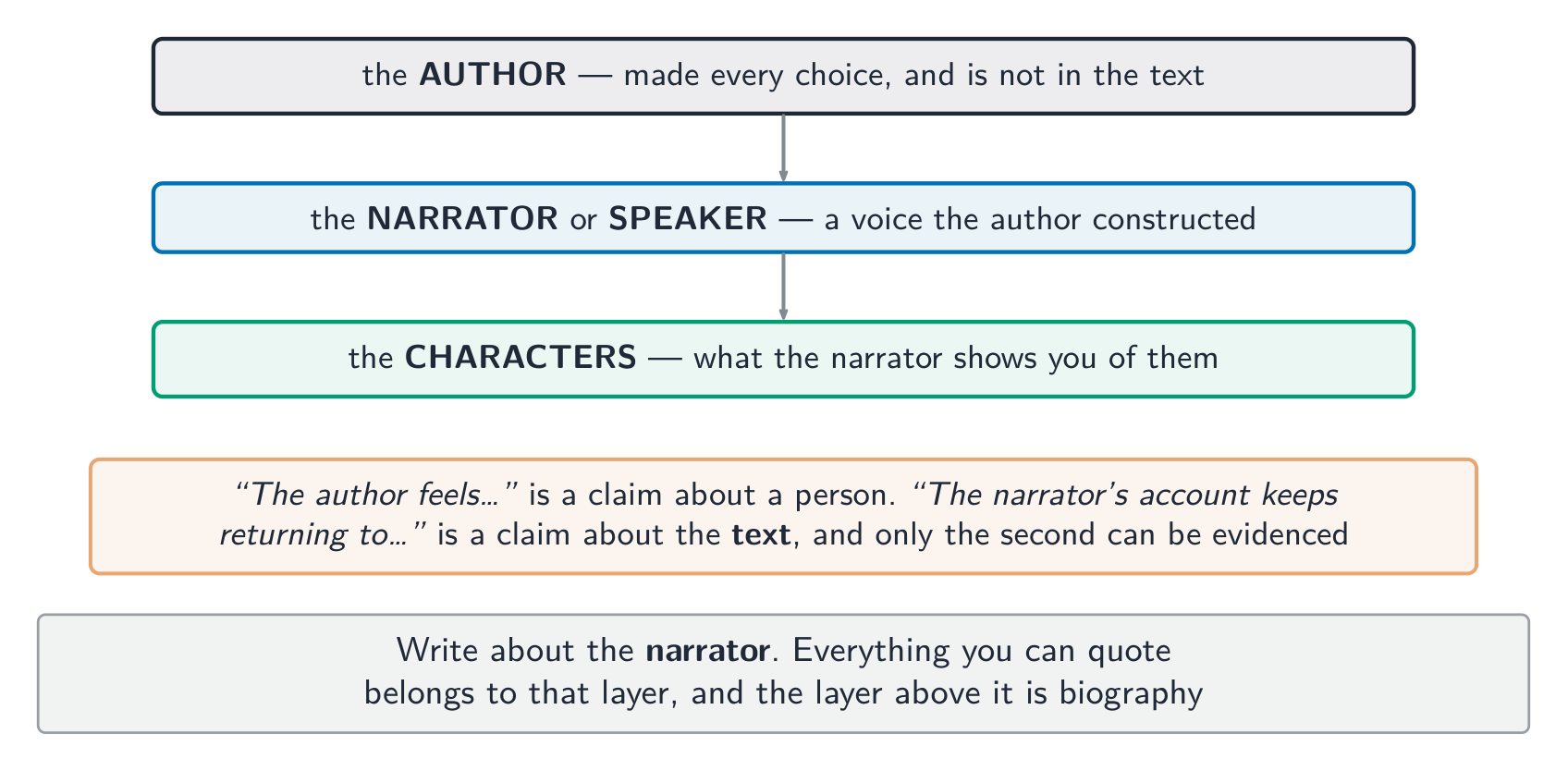
  • A speaker or narrator is not necessarily the author. Never write "the author feels" about a first-person narrator.
Português
O que cada ponto de vista pode e não pode te dar - e esse limite é a análise
Perspectiva é como veem; ponto de vista é onde ficam. O CED os separa, e você também deve
  • Narradores ou falantes relatam contas e estabelecem uma relação entre o texto e o leitor.
  • Perspectiva refere-se a como narradores, personagens ou falantes veem suas circunstâncias; ponto de vista 叙述视点 refere-se a a posição a partir da qual eles relatam a conta.
  • Um falante ou narrador não é necessariamente o autor. Nunca escreva "o autor sente" sobre um narrador em primeira pessoa.
Escreva sobre o narrador: tudo o que você pode citar pertence a essa camada
Explore · ⁨Explorar⁩

Classifique cada declaração pela camada à qual pertence

Tudo o que você pode citar pertence à camada do narrador. A camada acima dela é a biografia.

Vocabulary · ⁨Vocabulário⁩ Train · ⁨Treinar⁩
English · ⁨Inglês⁩ Chinese · ⁨Chinês⁩ Pinyin
point of view/pɔɪnt ɒv vjuː/ 叙述视点 xù shù shì diǎn
observational to all-knowing/ɒbzəˈveɪʃənl tʊ ɔːl ˈnəʊɪŋ/ 全知 quán zhī
1.6

The Function of Point of View · ⁨A Função do Ponto de Vista⁩

Syllabus · ⁨Programa⁩
English

Enduring Understanding (NAR-1): A narrator’s or speaker’s perspective controls the details and emphases that affect how readers experience and interpret a text.

Learning Objective 4.B: Identify and explain the function of point of view in a narrative.

  • NAR-1.D The point of view contributes to what narrators, characters, or speakers can and cannot provide in a text based on their level of involvement and intimacy with the details, events, or characters.
  • NAR-1.E Narrators may also be characters, and their role as characters may influence their perspective.
  • NAR-1.F First-person narrators are involved in the narrative; their relationship to the events of the plot and the other characters shapes their perspective.
  • NAR-1.G Third-person narrators are outside observers.
  • NAR-1.H Third-person narrators’ knowledge about events and characters may range from observational to all-knowing, which shapes their perspective.
  • NAR-1.I The outside perspective of third-person narrators may not be affected by the events of the narrative.
Português

Compreensão Permanente (NAR-1): A perspectiva de um narrador ou falante controla os detalhes e ênfases que afetam como os leitores experimentam e interpretam um texto.

Objetivo de Aprendizagem 4.B: Identificar e explicar a função do ponto de vista em uma narrativa.

  • NAR-1.D O ponto de vista contribui para o que narradores, personagens ou falantes podem e não podem fornecer em um texto com base em seu nível de envolvimento e intimidade com os detalhes, eventos ou personagens.
  • NAR-1.E Narradores também podem ser personagens, e seu papel como personagens pode influenciar sua perspectiva.
  • NAR-1.F Narradores em primeira pessoa estão envolvidos na narrativa; seu relacionamento com os eventos do enredo e os outros personagens molda sua perspectiva.
  • NAR-1.G Narradores em terceira pessoa são observadores externos.
  • NAR-1.H O conhecimento dos narradores em terceira pessoa sobre eventos e personagens pode variar de observacional a omnisciente, o que molda sua perspectiva.
  • NAR-1.I A perspectiva externa dos narradores em terceira pessoa pode não ser afetada pelos eventos da narrativa.

Source: College Board AP Course and Exam Description · ⁨Fonte: College Board AP Course and Exam Description⁩

English
  • Point of view contributes to what narrators can and cannot provide in a text, based on their position.
  • Narrators may also be characters, and that role may influence their perspective.
  • First-person narrators are involved in the narrative; their relationship to events and to other characters shapes what they can tell you.
  • Third-person narrators are outside observers, and their knowledge may range from observational to all-knowing 全知.
  • The outside perspective of a third-person narrator may not be affected by the events of the narrative.

The analytical payoff is the cannot. A first-person narrator cannot report what they did not witness or will not admit, and every gap is meaningful. A limited third-person narrator confines you to one consciousness, which is a choice about whose experience counts.

Português
  • O ponto de vista contribui para o que narradores podem e não podem fornecer em um texto, baseado em sua posição.
  • Narradores também podem ser personagens, e esse papel pode influenciar sua perspectiva.
  • Narradores em primeira pessoa estão envolvidos na narrativa; sua relação com eventos e outros personagens molda o que podem dizer.
  • Narradores em terceira pessoa são observadores externos, e seu conhecimento pode variar de observacional a onisciente 全知.
  • A perspectiva externa de um narrador em terceira pessoa pode não ser afetada pelos eventos da narrativa.

O retorno analítico é o não poder. Um narrador em primeira pessoa não pode relatar o que não presenciou ou não admitirá, e cada lacuna é significativa. Um narrador de terceira pessoa limitado confina você a uma consciência, que é uma escolha sobre cuja experiência importa.

1.7

Developing a Paragraph with Claim and Evidence · ⁨Desenvolvendo um Parágrafo com Afirmação e Evidência⁩

Syllabus · ⁨Programa⁩
English

Enduring Understanding (LAN-1): Readers establish and communicate their interpretations of literature through arguments supported by textual evidence.

Learning Objective 7.A: Develop a paragraph that includes 1) a claim that requires defense with evidence from the text and 2) the evidence itself.

  • LAN-1.A In literary analysis, writers read a text closely to identify details that, in combination, enable them to make and defend a claim about an aspect of the text.
  • LAN-1.B A claim is a statement that requires defense with evidence from the text.
  • LAN-1.C In literary analysis, the initial components of a paragraph are the claim and textual evidence that defends the claim.
Português

Compreensão Permanente (LAN-1): Os leitores estabelecem e comunicam suas interpretações da literatura através de argumentos apoiados por evidências textuais.

Objetivo de Aprendizagem 7.A: Desenvolver um parágrafo que inclua 1) uma afirmação que requer defesa com evidências do texto e 2) as próprias evidências.

  • LAN-1.A Na análise literária, os leitores leem um texto atentamente para identificar detalhes que, em combinação, permitem-lhes formular e defender uma afirmação sobre um aspecto do texto.
  • LAN-1.B Uma afirmação é uma declaração que requer defesa com evidências do texto.
  • LAN-1.C Na análise literária, os componentes iniciais de um parágrafo são a afirmação e as evidências textuais que defendem a afirmação.

Source: College Board AP Course and Exam Description · ⁨Fonte: College Board AP Course and Exam Description⁩

English
  • In literary analysis, writers read a text closely to identify details that, in combination, enable them to make and defend a claim.
  • A claim is a statement that requires defence with evidence from the text.
  • The initial components of a paragraph are the claim and the textual evidence that defends it.

Note in combination. A single detail rarely supports an interpretive claim; two or three details that point the same way do.

Worked example (a real AP exam task). The AP Literature free-response section has three questions - poetry analysis, prose fiction analysis, and a literary argument on a work you choose - all marked on a six-point rubric: thesis 1, evidence and commentary 4, sophistication 1. For a prose fiction prompt asking how the author uses narrative techniques to reveal a character's attitude, a weak answer writes "the narrator is first-person, which makes it personal." A scoring answer uses the cannot: "Because the narrator is a participant recounting events years later, the account gives us his present judgement of his younger self and withholds what the other characters thought - so the reader receives his self-criticism as the only available evidence, and must decide whether the harshness of it is accuracy or performance." Point of view, its limit, and the effect on the reader.

Português
  • Na análise literária, os escritores leem um texto atentamente para identificar detalhes que, em combinação, permitem-lhes formular e defender uma afirmação.
  • Uma afirmação (claim) é uma declaração que requer defesa com evidências do texto.
  • Os componentes iniciais de um parágrafo são a afirmação e a evidência textual que a defende.

Note em combinação. Um único detalhe raramente suporta uma afirmação interpretativa; dois ou três detalhes que apontam na mesma direção sim.

Exemplo resolvido (uma tarefa real do exame AP). A seção de resposta livre da literatura AP tem três perguntas - análise de poesia, análise de ficção em prosa e um argumento literário sobre uma obra de sua escolha - todas avaliadas por uma rubrica de seis pontos: tese 1, evidência e comentário 4, sofisticação 1. Para um prompt de ficção em prosa perguntando como o autor usa técnicas narrativas para revelar a atitude de um personagem, uma resposta fraca escreve "o narrador é de primeira pessoa, o que o torna pessoal." Uma pontuação boa usa o cannot: "Como o narrador é um participante que relata eventos anos depois, o relato nos dá seu julgamento presente sobre seu eu mais jovem e omite o que os outros personagens pensaram - então o leitor recebe sua autocrítica como a única evidência disponível, e deve decidir se a dureza disso é precisão ou performance." Ponto de vista, seu limite e o efeito no leitor.

1.7

Exam tips · ⁨Dicas de prova⁩

English
  • Character is a way of seeing, not a list of adjectives. Analyse what they notice and misread.
  • Setting must do something. Describing where a story happens is not yet a claim.
  • Plot is the order of events. A late revelation of an early event is an authorial choice worth analysing.
  • Proportion is evidence. What the text lingers over is where the meaning is.
  • The narrator is not the author. Never write "the author feels" about a first-person narrator.
  • The analytical gold in point of view is what the narrator cannot provide.
Português
  • O caráter é uma maneira de ver, não uma lista de adjetivos. Analise o que eles notam e o que interpretam mal.
  • O cenário deve fazer algo. Descrever onde uma história acontece ainda não é uma afirmação.
  • O enredo é a ordem dos eventos. Uma revelação tardia de um evento inicial é uma escolha autoral que vale a pena analisar.
  • A proporção é evidência. Onde o texto demora é onde está o significado.
  • O narrador não é o autor. Nunca escreva "o autor sente" sobre um narrador de primeira pessoa.
  • O ouro analítico no ponto de vista é o que o narrador não pode fornecer.

Interactive lessons on this topic · ⁨Aulas interativas sobre este tópico⁩

Work through it step by step, with instant-check exercises. · ⁨Passe por ele passo a passo, com exercícios de verificação instantânea.⁩

Past Papers · ⁨Provas Anteriores⁩

More topics in Literatura e Composição Inglesas do AP · ⁨Mais tópicos em Literatura e Composição Inglesas do AP⁩

Log in or create account · ⁨Entrar ou criar conta⁩

IGCSE, A-Level & AP