Skip to content · ⁨Pular para o conteúdo⁩

Diferenciação: Definição e Propriedades Fundamentais

Cálculo AB do AP · Topic 2 · ⁨Tópico 2⁩

Train · ⁨Treinar⁩
Video lesson for this topic · ⁨Videoaula para este tópico⁩ Open the video page · ⁨Abrir a página do vídeo⁩
7:54

Definindo a Derivada

Imagine a jornada de um carro como uma curva. Ao longo de um intervalo inteiro, podemos medir sua velocidade média — a inclinação da linha reta que une dois pontos na curva.…

English narration · English + 中文 subtitles burned in · ⁨Narração em inglês · Legendas em inglês + 中文 gravadas⁩

2.1

Average and Instantaneous Rates of Change · ⁨Taxas Médias e Instantâneas de Variação⁩

Syllabus · ⁨Programa⁩
English

Enduring Understanding (CHA-2): Derivatives allow us to determine rates of change at an instant by applying limits to knowledge about rates of change over intervals.

Learning Objective CHA-2.A: Determine average rates of change using difference quotients.

  • CHA-2.A.1 The difference quotients $\dfrac{f(a+h)-f(a)}{h}$ and $\dfrac{f(x)-f(a)}{x-a}$ express the average rate of change of a function over an interval.

Learning Objective CHA-2.B: Represent the derivative of a function as the limit of a difference quotient.

  • CHA-2.B.1 The instantaneous rate of change of a function at $x=a$ can be expressed by $\lim\limits_{h\to 0}\dfrac{f(a+h)-f(a)}{h}$ or $\lim\limits_{x\to a}\dfrac{f(x)-f(a)}{x-a}$, provided the limit exists. These are equivalent forms of the definition of the derivative and are denoted $f'(a)$.
Português

Compreensão Duradoura (CHA-2): Derivadas nos permitem determinar taxas de variação instantâneas aplicando limites ao conhecimento sobre taxas de variação em intervalos.

Objetivo de Aprendizagem CHA-2.A: Determinar taxas de variação médias usando quocientes de diferença.

  • CHA-2.A.1 Os quocientes de diferença $\dfrac{f(a+h)-f(a)}{h}$ e $\dfrac{f(x)-f(a)}{x-a}$ expressam a taxa de variação média de uma função sobre um intervalo.

Objetivo de Aprendizagem CHA-2.B: Representar a derivada de uma função como o limite de um quociente de diferença.

  • CHA-2.B.1 A taxa de variação instantânea de uma função em $x=a$ pode ser expressa por $\lim\limits_{h\to 0}\dfrac{f(a+h)-f(a)}{h}$ ou $\lim\limits_{x\to a}\dfrac{f(x)-f(a)}{x-a}$, desde que o limite exista. Estas são formas equivalentes da definição da derivada e são denotadas $f'(a)$.
Source: College Board AP Course and Exam Description · ⁨Fonte: College Board AP Course and Exam Description⁩

English
The derivative from first principles

Unit 1 built the limit. Unit 2 uses it to define the derivative 导数 – the exact rate of change at a point.

Over an interval, the average rate of change is a difference quotient 差商. Two equivalent forms appear:

$$\frac{f(a+h)-f(a)}{h} \qquad\text{and}\qquad \frac{f(x)-f(a)}{x-a}.$$
The first uses a step of size $h$ from $a$; the second uses two points $x$ and $a$. Both compute $\dfrac{\text{change in output}}{\text{change in input}}$ over the interval.

The instantaneous 瞬时 rate of change at $x=a$ is what the difference quotient approaches as the interval shrinks to zero. This limit is the derivative at $a$, written $f'(a)$:

$$f'(a) = \lim_{h\to 0}\frac{f(a+h)-f(a)}{h} = \lim_{x\to a}\frac{f(x)-f(a)}{x-a},$$
provided the limit exists.

Português
Um parque de diversões numa colina de subida: a derivada mede a taxa instantânea de variação da posição
A derivada pelos primeiros princípios

A Unidade 1 construiu o limite. A Unidade 2 o usa para definir a derivada 导数 – a taxa exata de variação em um ponto.

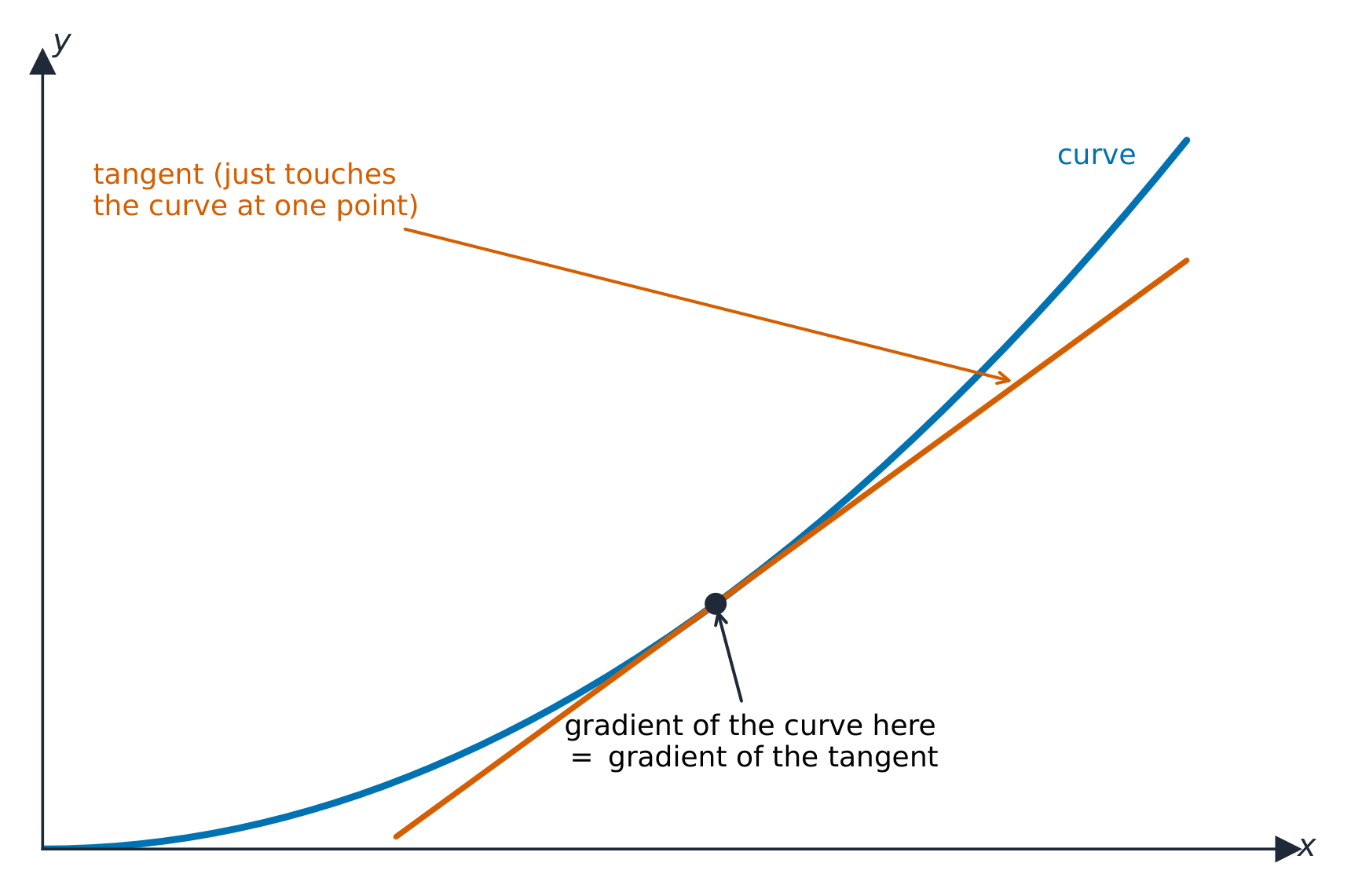
A taxa instantânea de variação é a inclinação da tangente em um ponto

Sobre um intervalo, a taxa média de variação é um quociente de diferenças 差商. Duas formas equivalentes aparecem:

$$\frac{f(a+h)-f(a)}{h} \qquad\text{and}\qquad \frac{f(x)-f(a)}{x-a}.$$
A primeira usa um passo de tamanho $h$ partindo de $a$; a segunda usa dois pontos $x$ e $a$. Ambas calculam $\dfrac{\text{change in output}}{\text{change in input}}$ sobre o intervalo.

A taxa instantânea 瞬时 de variação em $x=a$ é o que o quociente de diferenças se aproxima à medida que o intervalo diminui até zero. Este limite é a derivada em $a$, escrita $f'(a)$:

$$f'(a) = \lim_{h\to 0}\frac{f(a+h)-f(a)}{h} = \lim_{x\to a}\frac{f(x)-f(a)}{x-a},$$
desde que o limite exista.

Explore · ⁨Explorar⁩

Da taxa média à taxa instantânea

y = ax³ + bx² + cx + d

Deslize o ponto: a secante através de dois pontos próximos inclina-se em direção à tangente à medida que eles se fundem. A inclinação da tangente é a derivada — a taxa de mudança instantânea.

Vocabulary · ⁨Vocabulário⁩ Train · ⁨Treinar⁩
English · ⁨Inglês⁩ Chinese · ⁨Chinês⁩ Pinyin
derivative/dɪˈrɪvətɪv/ 导数 dǎo shù
difference quotient/ˈdɪfrəns ˈkwəʊʃənt/ 差商 chà shāng
instantaneous/ˌɪnstənˈteɪnɪəs/ 瞬时 shùn shí
first principles/fɜːst ˈprɪnsɪplz/ 用定义求导 yòng dìng yì qiú dǎo
notations/nəʊˈteɪʃnz/ 记号 jì hào
slope/sləʊp/ 斜率 xié lǜ
tangent line/ˈtændʒənt laɪn/ 切线 qiè xiàn
2.2

Defining the Derivative and Its Notation · ⁨Definindo a Derivada e Sua Notação⁩

Syllabus · ⁨Programa⁩
English

Enduring Understanding (CHA-2): Derivatives allow us to determine rates of change at an instant by applying limits to knowledge about rates of change over intervals.

Learning Objective CHA-2.B: Represent the derivative of a function as the limit of a difference quotient.

  • CHA-2.B.2 The derivative of $f$ is the function whose value at $x$ is $\lim\limits_{h\to 0}\dfrac{f(x+h)-f(x)}{h}$, provided this limit exists.
  • CHA-2.B.3 For $y=f(x)$, notations for the derivative include $\dfrac{dy}{dx}$, $f'(x)$, and $y'$.
  • CHA-2.B.4 The derivative can be represented graphically, numerically, analytically, and verbally.

Learning Objective CHA-2.C: Determine the equation of a line tangent to a curve at a given point.

  • CHA-2.C.1 The derivative of a function at a point is the slope of the line tangent to a graph of the function at that point.
Português

Compreensão Duradoura (CHA-2): Derivadas nos permitem determinar taxas de variação instantâneas aplicando limites ao conhecimento sobre taxas de variação em intervalos.

Objetivo de Aprendizagem CHA-2.B: Representar a derivada de uma função como o limite de um quociente de diferença.

  • CHA-2.B.2 A derivada de $f$ é a função cujo valor em $x$ é $\lim\limits_{h\to 0}\dfrac{f(x+h)-f(x)}{h}$, desde que este limite exista.
  • CHA-2.B.3 Para $y=f(x)$, as notações para a derivada incluem $\dfrac{dy}{dx}$, $f'(x)$ e $y'$.
  • CHA-2.B.4 A derivada pode ser representada graficamente, numericamente, analiticamente e verbalmente.

Objetivo de Aprendizagem CHA-2.C: Determinar a equação de uma reta tangente a uma curva em um ponto dado.

  • CHA-2.C.1 A derivada de uma função em um ponto é a inclinação da reta tangente ao gráfico da função naquele ponto.

Source: College Board AP Course and Exam Description · ⁨Fonte: College Board AP Course and Exam Description⁩

English

Let the point $a$ vary and the derivative becomes a new function:

$$f'(x) = \lim_{h\to 0}\frac{f(x+h)-f(x)}{h}.$$
This is the definition of the derivative (sometimes called differentiating "by first principles" 用定义求导). Its value at each $x$ is the instantaneous rate of change there.

Common notations 记号 for the derivative of $y=f(x)$ are:

$$\frac{dy}{dx}, \qquad f'(x), \qquad y'.$$
The derivative can be represented graphically, numerically, analytically, and verbally – be ready to move between them.

Geometric meaning. The derivative at a point is the slope 斜率 of the tangent line 切线 to the graph there. So the tangent line at $x=a$ passes through $\big(a, f(a)\big)$ with slope $f'(a)$:

$$y - f(a) = f'(a)\,(x-a).$$
Writing this line is a routine exam task, so keep the point-slope form ready.

Português

Deixe o ponto $a$ variar e a derivada torna-se uma nova função:

$$f'(x) = \lim_{h\to 0}\frac{f(x+h)-f(x)}{h}.$$
Esta é a definição da derivada (às vezes chamada de "derivar pelos primeiros princípios" 用定义求导). Seu valor em cada $x$ é a taxa instantânea de variação ali.

As notações 记号 comuns para a derivada de $y=f(x)$ são:

$$\frac{dy}{dx}, \qquad f'(x), \qquad y'.$$
A derivada pode ser representada graficamente, numericamente, analiticamente e verbalmente – esteja preparado para transitar entre elas.

Significado geométrico. A derivada em um ponto é a inclinação 斜率 da linha tangente 切线 ao gráfico ali. Assim, a linha tangente em $x=a$ passa por $\big(a, f(a)\big)$ com inclinação $f'(a)$:

$$y - f(a) = f'(a)\,(x-a).$$
Escrever esta linha é uma tarefa rotineira de exame, então mantenha a forma ponto-inclinação pronta.

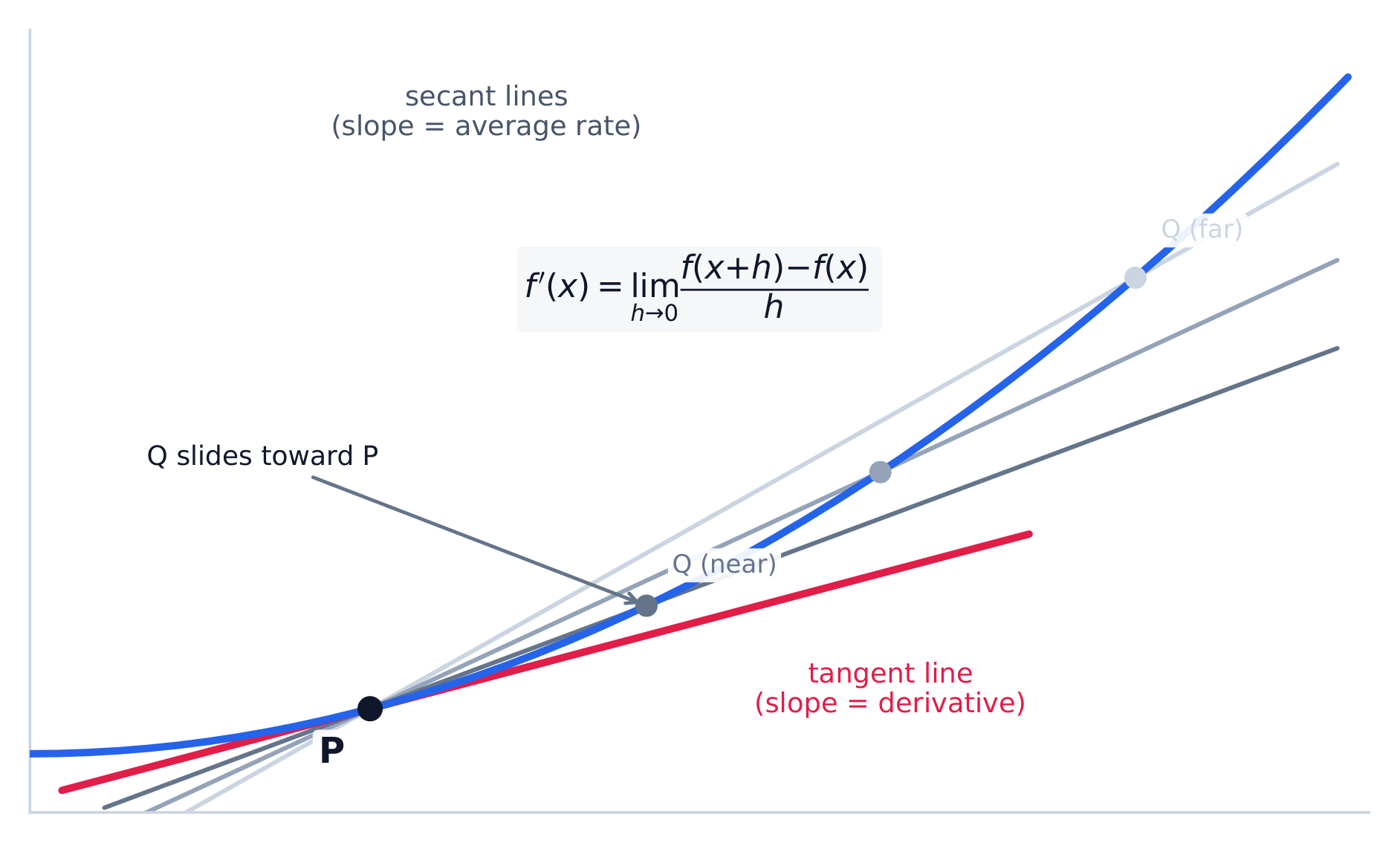
Inclinações de secantes se aproximam da inclinação da tangente: a derivada é o limite das taxas médias
Conforme $Q$ desliza em direção a $P$, a inclinação de cada secante (uma taxa média) se aproxima da inclinação da tangente – a derivada $f'(a)$.
2.3

Estimating a Derivative at a Point · ⁨Estimando uma Derivada em um Ponto⁩

Syllabus · ⁨Programa⁩
English

Enduring Understanding (CHA-2): Derivatives allow us to determine rates of change at an instant by applying limits to knowledge about rates of change over intervals.

Learning Objective CHA-2.D: Estimate derivatives.

  • CHA-2.D.1 The derivative at a point can be estimated from information given in tables or graphs.
  • CHA-2.D.2 Technology can be used to calculate or estimate the value of a derivative of a function at a point.
Português

Compreensão Duradoura (CHA-2): Derivadas nos permitem determinar taxas de variação instantâneas aplicando limites ao conhecimento sobre taxas de variação em intervalos.

Objetivo de Aprendizagem CHA-2.D: Estimar derivadas.

  • CHA-2.D.1 A derivada em um ponto pode ser estimada a partir de informações fornecidas em tabelas ou gráficos.
  • CHA-2.D.2 Tecnologia pode ser usada para calcular ou estimar o valor da derivada de uma função em um ponto.

Source: College Board AP Course and Exam Description · ⁨Fonte: College Board AP Course and Exam Description⁩

English

You do not always have a formula. When a function is given by a table 表格 or a graph, estimate the derivative $f'(a)$ with a difference quotient over a small interval around $a$. A table with values on both sides of $a$ gives the best estimate:

$$f'(a) \approx \frac{f(b)-f(c)}{b-c},\qquad \text{where } c < a < b \text{ are the closest table inputs}.$$
Technology (a calculator) can also estimate a derivative at a point.

Exam skill (appears almost every year). Questions such as "Approximate $M'(7.5)$ using the average rate of change of $M$ over the interval $5 \le t \le 10$" ask for exactly this difference quotient. Show the setup:

$$M'(7.5) \approx \frac{M(10)-M(5)}{10-5}.$$
Full credit needs the numbers plugged in and the correct units 单位 (output units per input unit), since these come from real-world models.

Português

Você nem sempre tem uma fórmula. Quando uma função é dada por uma tabela 表格 ou um gráfico, estime a derivada $f'(a)$ com um quociente de diferença sobre um pequeno intervalo em torno de $a$. Uma tabela com valores de ambos os lados de $a$ fornece a melhor estimativa:

$$f'(a) \approx \frac{f(b)-f(c)}{b-c},\qquad \text{where } c < a < b \text{ are the closest table inputs}.$$
Tecnologia (uma calculadora) também pode estimar uma derivada em um ponto.

Habilidade de prova (aparece quase todos os anos). Questões como "Aproxime $M'(7.5)$ usando a taxa média de variação de $M$ no intervalo $5 \le t \le 10$" pedem exatamente este quociente de diferença. Mostre o ajuste:

$$M'(7.5) \approx \frac{M(10)-M(5)}{10-5}.$$
Nota completa exige os números substituídos e as unidades corretas 单位 (unidades de saída por unidade de entrada), pois vêm de modelos do mundo real.

Vocabulary · ⁨Vocabulário⁩ Train · ⁨Treinar⁩
English · ⁨Inglês⁩ Chinese · ⁨Chinês⁩ Pinyin
table/ˈteɪbl/ 表格 biǎo gé
units/ˈjuːnɪts/ 单位 dān wèi
differentiable/ˈdɪfərenʃɪəbl/ 可导 kě dǎo
continuous/kənˈtɪnjuːəs/ 连续 lián xù
corner/ˈkɔːnə/ 尖点 jiān diǎn
vertical tangent/ˈvɜːtɪkl ˈtændʒənt/ 垂直切线 chuí zhí qiè xiàn
power rule/ˈpaʊə ruːl/ 幂法则 mì fǎ zé
Constant multiple/ˈkɒnstənt ˈmʌltɪpl/ 常数倍 cháng shù bèi
polynomial/ˌpɒlɪˈnəʊmɪəl/ 多项式 duō xiàng shì
2.4

When Does a Derivative Exist? · ⁨Quando uma Derivada Existe?⁩

Syllabus · ⁨Programa⁩
English

Enduring Understanding (FUN-2): Recognizing that a function's derivative may also be a function allows us to develop knowledge about the related behaviors of both.

Learning Objective FUN-2.A: Explain the relationship between differentiability and continuity.

  • FUN-2.A.1 If a function is differentiable at a point, then it is continuous at that point. In particular, if a point is not in the domain of $f$, then it is not in the domain of $f'$.
  • FUN-2.A.2 A continuous function may fail to be differentiable at a point in its domain.
    • Illustrative examples for FUN-2.A.2:
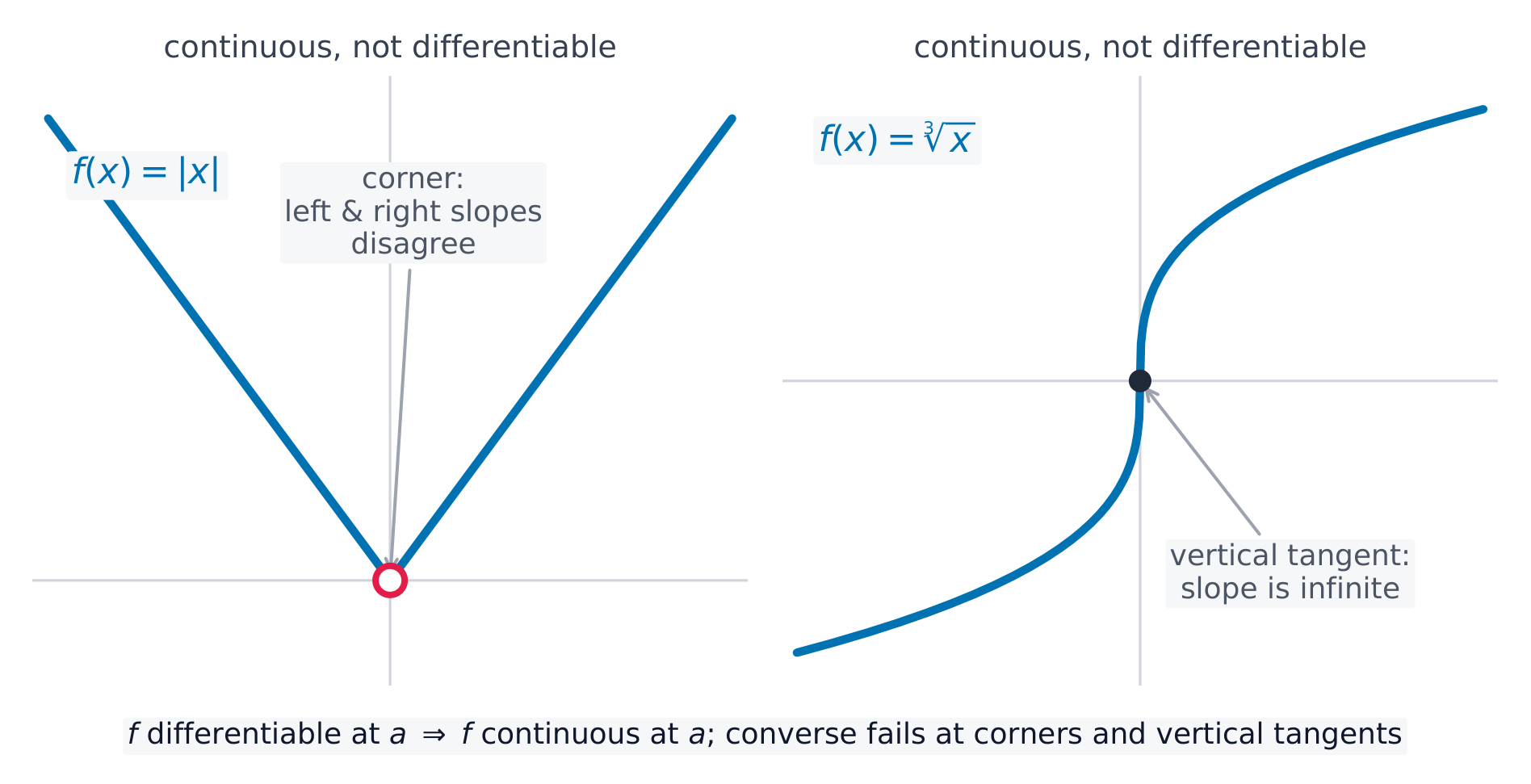
      • The left hand and right hand limits of the difference quotient are not equal, as in $f(x)=|x|$ at $x=0$.
      • The tangent line is vertical and has no slope, as in $f(x)=\sqrt[3]{x}$ at $x=0$.
Português

Compreensão Duradoura (FUN-2): Reconhecer que a derivada de uma função também pode ser uma função nos permite desenvolver conhecimento sobre os comportamentos correlacionados de ambas.

Objetivo de Aprendizagem FUN-2.A: Explicar a relação entre diferenciabilidade e continuidade.

  • FUN-2.A.1 Se uma função é diferenciável em um ponto, então ela é contínua nesse ponto. Em particular, se um ponto não está no domínio de $f$, então ele não está no domínio de $f'$.
  • FUN-2.A.2 Uma função contínua pode falhar em ser diferenciável em um ponto de seu domínio.
    • Exemplos ilustrativos para FUN-2.A.2:
      • Os limites lateral esquerdo e lateral direito do quociente de diferença não são iguais, como em $f(x)=|x|$ em $x=0$.
      • A reta tangente é vertical e não possui inclinação, como em $f(x)=\sqrt[3]{x}$ em $x=0$.

Source: College Board AP Course and Exam Description · ⁨Fonte: College Board AP Course and Exam Description⁩

English

Differentiability is stronger than continuity. The key relationship:

If $f$ is differentiable 可导 at a point, then $f$ is continuous 连续 there.

So differentiability implies continuity. The reverse is false: a continuous function can fail to be differentiable. Two ways this happens:

  • A corner 尖点: the left and right difference-quotient limits disagree, as with $f(x)=|x|$ at $x=0$.
  • A vertical tangent 垂直切线: the slope is infinite (no real number), as with $f(x)=\sqrt[3]{x}$ at $x=0$.

Also, a point outside the domain of $f$ cannot be in the domain of $f'$. Use the contrapositive on the exam: if $f$ is not continuous at $a$, then $f$ is not differentiable at $a$.

Português

Diferenciabilidade é mais forte que continuidade. A relação chave:

Se $f$ for diferenciável 可导 em um ponto, então $f$ é contínua 连续 naquele ponto.

Então diferenciabilidade implica continuidade. O inverso é falso: uma função contínua pode falhar em ser diferenciável. Duas maneiras disso acontecer:

  • Um ponto anguloso 尖点: os limites dos quocientes de diferença à esquerda e à direita discordam, como com $f(x)=|x|$ em $x=0$.
  • Uma tangente vertical 垂直切线: a inclinação é infinita (nenhum número real), como com $f(x)=\sqrt[3]{x}$ em $x=0$.
Duas maneiras de uma função contínua não ser diferenciável: um ponto anguloso e uma tangente vertical

Além disso, um ponto fora do domínio de $f$ não pode estar no domínio de $f'$. Use a contrapositiva na prova: se $f$ não é contínua em $a$, então $f$ não é diferenciável em $a$.

2.5

The Power Rule · ⁨A Regra da Potência⁩

Syllabus · ⁨Programa⁩
English

Enduring Understanding (FUN-3): Recognizing opportunities to apply derivative rules can simplify differentiation.

Learning Objective FUN-3.A: Calculate derivatives of familiar functions.

  • FUN-3.A.1 Direct application of the definition of the derivative and specific rules can be used to calculate the derivative for functions of the form $f(x)=x^{r}$.
Português

Compreensão Duradoura (FUN-3): Reconhecer oportunidades para aplicar regras de derivada pode simplificar a diferenciação.

Objetivo de Aprendizagem FUN-3.A: Calcular derivadas de funções familiares.

  • FUN-3.A.1 A aplicação direta da definição da derivada e regras específicas pode ser usada para calcular a derivada de funções da forma $f(x)=x^{r}$.

Source: College Board AP Course and Exam Description · ⁨Fonte: College Board AP Course and Exam Description⁩

English

From here we use rules instead of the limit definition each time. The power rule 幂法则 handles any power of $x$:

$$\frac{d}{dx}\,x^{r} = r\,x^{\,r-1}\qquad\text{for any real } r.$$
It works for whole-number powers, negative powers ($\tfrac{1}{x}=x^{-1}$), and roots ($\sqrt{x}=x^{1/2}$) – rewrite as a power first, then apply the rule.

Português

Daqui usamos regras em vez da definição de limite cada vez. A regra da potência 幂法则 lida com qualquer potência de $x$:

$$\frac{d}{dx}\,x^{r} = r\,x^{\,r-1}\qquad\text{for any real } r.$$
Ela funciona para potências inteiras, potências negativas ($\tfrac{1}{x}=x^{-1}$) e raízes ($\sqrt{x}=x^{1/2}$) – reescreva como uma potência primeiro, depois aplique a regra.

Explore · ⁨Explorar⁩

Uma função potência e sua inclinação acelerada

y = ax³ + bx² + cx + d

A regra da potência $\frac{d}{dx}x^n = nx^{n-1}$ abaixa o expoente como um fator. Para $x^3$, a inclinação cresce rapidamente à medida que $x$ sai de 0 — a curva se torna mais íngreme.

2.6

Constant, Sum, Difference, and Constant Multiple Rules · ⁨Regras da Constante, Soma, Diferença e Múltiplo Constante⁩

Syllabus · ⁨Programa⁩
English

Enduring Understanding (FUN-3): Recognizing opportunities to apply derivative rules can simplify differentiation.

Learning Objective FUN-3.A: Calculate derivatives of familiar functions.

  • FUN-3.A.2 Sums, differences, and constant multiples of functions can be differentiated using derivative rules.
  • FUN-3.A.3 The power rule combined with sum, difference, and constant multiple properties can be used to find the derivatives for polynomial functions.
Português

Compreensão Duradoura (FUN-3): Reconhecer oportunidades para aplicar regras de derivada pode simplificar a diferenciação.

Objetivo de Aprendizagem FUN-3.A: Calcular derivadas de funções familiares.

  • FUN-3.A.2 Somas, diferenças e múltiplos constantes de funções podem ser diferenciadas usando regras de derivada.
  • FUN-3.A.3 A regra da potência combinada com propriedades de soma, diferença e múltiplo constante pode ser usada para encontrar as derivadas de funções polinomiais.

Source: College Board AP Course and Exam Description · ⁨Fonte: College Board AP Course and Exam Description⁩

English

These rules let you differentiate term by term:

  • Constant: $\dfrac{d}{dx}\,k = 0$ (a constant does not change).
  • Constant multiple 常数倍: $\dfrac{d}{dx}\big[k\,f(x)\big] = k\,f'(x)$.
  • Sum / difference: $\dfrac{d}{dx}\big[f(x)\pm g(x)\big] = f'(x)\pm g'(x)$.

Combined with the power rule, they differentiate any polynomial 多项式 term by term. Example:

$$\frac{d}{dx}\big(4x^3 - 5x + 7\big) = 12x^2 - 5.$$

Português

Essas regras permitem diferenciar termo a termo:

  • Constante: $\dfrac{d}{dx}\,k = 0$ (uma constante não muda).
  • Múltiplo constante 常数倍: $\dfrac{d}{dx}\big[k\,f(x)\big] = k\,f'(x)$.
  • Soma / diferença: $\dfrac{d}{dx}\big[f(x)\pm g(x)\big] = f'(x)\pm g'(x)$.

Combinadas com a regra da potência, elas diferenciam qualquer termo de um polinômio 多项式 termo a termo. Exemplo:

$$\frac{d}{dx}\big(4x^3 - 5x + 7\big) = 12x^2 - 5.$$

2.7

Derivatives of sin x, cos x, e^x, and ln x · ⁨Derivadas de sin x, cos x, e^x e ln x⁩

Syllabus · ⁨Programa⁩
English

Enduring Understanding (FUN-3): Recognizing opportunities to apply derivative rules can simplify differentiation.

Learning Objective FUN-3.A: Calculate derivatives of familiar functions.

  • FUN-3.A.4 Specific rules can be used to find the derivatives for sine, cosine, exponential, and logarithmic functions.

Enduring Understanding (LIM-3): Reasoning with definitions, theorems, and properties can be used to determine a limit.

Learning Objective LIM-3.A: Interpret a limit as a definition of a derivative.

  • LIM-3.A.1 In some cases, recognizing an expression for the definition of the derivative of a function whose derivative is known offers a strategy for determining a limit.
Português

Compreensão Duradoura (FUN-3): Reconhecer oportunidades para aplicar regras de derivada pode simplificar a diferenciação.

Objetivo de Aprendizagem FUN-3.A: Calcular derivadas de funções familiares.

  • FUN-3.A.4 Regras específicas podem ser usadas para encontrar as derivadas de funções seno, cosseno, exponencial e logarítmica.

Compreensão Duradoura (LIM-3): O raciocínio com definições, teoremas e propriedades pode ser usado para determinar um limite.

Objetivo de Aprendizagem LIM-3.A: Interpretar um limite como uma definição de derivada.

  • LIM-3.A.1 Em alguns casos, reconhecer uma expressão para a definição da derivada de uma função cuja derivada é conhecida oferece uma estratégia para determinar um limite.

Source: College Board AP Course and Exam Description · ⁨Fonte: College Board AP Course and Exam Description⁩

English

Learn these four building-block derivatives by heart:

$$\frac{d}{dx}\sin x = \cos x, \qquad \frac{d}{dx}\cos x = -\sin x,$$
$$\frac{d}{dx}e^{x} = e^{x}, \qquad \frac{d}{dx}\ln x = \frac{1}{x}\ \ (x>0).$$
Note the minus sign on the derivative of cosine, and that $e^{x}$ is its own derivative.

A limit that is really a derivative (LIM-3.A.1). Sometimes a limit is secretly the definition of a known derivative. If you recognize

$$\lim_{h\to 0}\frac{f(a+h)-f(a)}{h}$$
for a function $f$ whose derivative you know, just evaluate $f'(a)$. For example, $\displaystyle \lim_{h\to 0}\frac{\sin\!\big(\tfrac{\pi}{2}+h\big)-1}{h} = \left.\frac{d}{dx}\sin x\right|_{x=\pi/2} = \cos\tfrac{\pi}{2} = 0$.

Português

Aprenda estas quatro derivadas base de coração:

$$\frac{d}{dx}\sin x = \cos x, \qquad \frac{d}{dx}\cos x = -\sin x,$$
$$\frac{d}{dx}e^{x} = e^{x}, \qquad \frac{d}{dx}\ln x = \frac{1}{x}\ \ (x>0).$$
Note o sinal negativo na derivada do cosseno, e que $e^{x}$ é sua própria derivada.

Um limite que é realmente uma derivada (LIM-3.A.1). Às vezes um limite é secretamente a definição de uma derivada conhecida. Se você reconhecer

$$\lim_{h\to 0}\frac{f(a+h)-f(a)}{h}$$
para uma função $f$ cuja derivada você conhece, basta avaliar $f'(a)$. Por exemplo, $\displaystyle \lim_{h\to 0}\frac{\sin\!\big(\tfrac{\pi}{2}+h\big)-1}{h} = \left.\frac{d}{dx}\sin x\right|_{x=\pi/2} = \cos\tfrac{\pi}{2} = 0$.

Explore · ⁨Explorar⁩

A forma de sin x (cuja inclinação é cos x)

y = asen(bx + c) + d

A derivada de $\sin x$ é $\cos x$: a inclinação da curva seno é maior onde o seno cruza zero e zero em seus picos. Observe a curva para sentir onde sua inclinação é íngreme ou plana.

2.8

The Product Rule · ⁨A Regra do Produto⁩

Syllabus · ⁨Programa⁩
English

Enduring Understanding (FUN-3): Recognizing opportunities to apply derivative rules can simplify differentiation.

Learning Objective FUN-3.B: Calculate derivatives of products and quotients of differentiable functions.

  • FUN-3.B.1 Derivatives of products of differentiable functions can be found using the product rule.
Português

Compreensão Duradoura (FUN-3): Reconhecer oportunidades para aplicar regras de derivada pode simplificar a diferenciação.

Objetivo de Aprendizagem FUN-3.B: Calcular derivadas de produtos e quocientes de funções diferenciáveis.

  • FUN-3.B.1 As derivadas de produtos de funções diferenciáveis podem ser encontradas usando a regra do produto.

Source: College Board AP Course and Exam Description · ⁨Fonte: College Board AP Course and Exam Description⁩

English
The product rule as a growing rectangle

A product of two functions is not differentiated by multiplying the derivatives. Use the product rule 乘积法则:

$$\frac{d}{dx}\big[u\,v\big] = u'v + uv'.$$
"Derivative of the first times the second, plus the first times the derivative of the second." Example:
$$\frac{d}{dx}\big(x^2 e^{x}\big) = 2x\,e^{x} + x^2 e^{x}.$$
Exam questions often build a new function from given pieces, e.g. $k'(x) = \big(f(x)\big)^2 g(x)$, and ask you to combine rules while reading values from a table.

Português
A regra do produto como um retângulo crescendo

O produto de duas funções não é diferenciado multiplicando as derivadas. Use a regra do produto 乘积法则:

$$\frac{d}{dx}\big[u\,v\big] = u'v + uv'.$$
"Derivada do primeiro vezes o segundo, mais o primeiro vezes a derivada do segundo." Exemplo:
$$\frac{d}{dx}\big(x^2 e^{x}\big) = 2x\,e^{x} + x^2 e^{x}.$$
As questões de exame frequentemente constroem uma nova função a partir de peças dadas, por exemplo, $k'(x) = \big(f(x)\big)^2 g(x)$, e pedem para combinar regras enquanto lê valores de uma tabela.

Vocabulary · ⁨Vocabulário⁩ Train · ⁨Treinar⁩
English · ⁨Inglês⁩ Chinese · ⁨Chinês⁩ Pinyin
product rule/ˈprɒdʌkt ruːl/ 乘积法则 chéng jī fǎ zé
2.9

The Quotient Rule · ⁨A Regra do Quociente⁩

Syllabus · ⁨Programa⁩
English

Enduring Understanding (FUN-3): Recognizing opportunities to apply derivative rules can simplify differentiation.

Learning Objective FUN-3.B: Calculate derivatives of products and quotients of differentiable functions.

  • FUN-3.B.2 Derivatives of quotients of differentiable functions can be found using the quotient rule.
Português

Compreensão Duradoura (FUN-3): Reconhecer oportunidades para aplicar regras de derivada pode simplificar a diferenciação.

Objetivo de Aprendizagem FUN-3.B: Calcular derivadas de produtos e quocientes de funções diferenciáveis.

  • FUN-3.B.2 As derivadas de quocientes de funções diferenciáveis podem ser encontradas usando a regra do quociente.

Source: College Board AP Course and Exam Description · ⁨Fonte: College Board AP Course and Exam Description⁩

English

For a quotient, use the quotient rule 商法则:

$$\frac{d}{dx}\!\left[\frac{u}{v}\right] = \frac{u'v - uv'}{v^{2}}.$$
"Bottom times derivative of top, minus top times derivative of bottom, all over bottom squared." The order matters because of the minus sign, so write the numerator carefully. Example:
$$\frac{d}{dx}\!\left(\frac{x}{\cos x}\right) = \frac{1\cdot\cos x - x\cdot(-\sin x)}{\cos^2 x} = \frac{\cos x + x\sin x}{\cos^2 x}.$$

Português

Para um quociente, use a regra do quociente 商法则:

$$\frac{d}{dx}\!\left[\frac{u}{v}\right] = \frac{u'v - uv'}{v^{2}}.$$
"Base vezes a derivada do numerador, menos numerador vezes a derivada da base, tudo sobre a base ao quadrado." A ordem importa devido ao sinal negativo, então escreva o numerador cuidadosamente. Exemplo:
$$\frac{d}{dx}\!\left(\frac{x}{\cos x}\right) = \frac{1\cdot\cos x - x\cdot(-\sin x)}{\cos^2 x} = \frac{\cos x + x\sin x}{\cos^2 x}.$$

2.10

Derivatives of tan x, cot x, sec x, and csc x · ⁨Derivadas de tan x, cot x, sec x e csc x⁩

Syllabus · ⁨Programa⁩
English

Enduring Understanding (FUN-3): Recognizing opportunities to apply derivative rules can simplify differentiation.

Learning Objective FUN-3.B: Calculate derivatives of products and quotients of differentiable functions.

  • FUN-3.B.3 Rearranging tangent, cotangent, secant, and cosecant functions using identities allows differentiation using derivative rules.
Português

Compreensão Duradoura (FUN-3): Reconhecer oportunidades para aplicar regras de derivada pode simplificar a diferenciação.

Objetivo de Aprendizagem FUN-3.B: Calcular derivadas de produtos e quocientes de funções diferenciáveis.

  • FUN-3.B.3 Rearranjar funções tangente, cotangente, secante e cossecante usando identidades permite a diferenciação usando regras de derivada.

Source: College Board AP Course and Exam Description · ⁨Fonte: College Board AP Course and Exam Description⁩

English
The quotient rule: differentiating a fraction

The remaining trigonometric derivatives are not memorized separately – you rewrite them with identities 恒等式 and apply the quotient (or product) rule. For instance, $\tan x = \dfrac{\sin x}{\cos x}$, so the quotient rule gives

$$\frac{d}{dx}\tan x = \frac{\cos x\cos x - \sin x(-\sin x)}{\cos^2 x} = \frac{1}{\cos^2 x} = \sec^2 x.$$
The same method (writing $\cot x=\tfrac{\cos x}{\sin x}$, $\sec x=\tfrac{1}{\cos x}$, $\csc x=\tfrac{1}{\sin x}$) gives $-\csc^2 x$, $\sec x\tan x$, and $-\csc x\cot x$.

Higher-order derivatives. Differentiating $f'$ again gives the second derivative 二阶导数 $f''(x)$ (or $\tfrac{d^2y}{dx^2}$) – the rate of change of the rate of change. An exam part like "Find $k''(3)$" just means differentiate twice, then substitute. You can also estimate a second derivative from a table by applying the average-rate-of-change method to the $f'$ values.

Worked example. Differentiate $f(x)=x^2\sin x$ with the product rule $(uv)'=u'v+uv'$: take $u=x^2$ ($u'=2x$) and $v=\sin x$ ($v'=\cos x$), giving $f'(x)=2x\sin x+x^2\cos x$. Always read the structure first — a product needs the product rule, not the power rule applied to each factor separately.

Português
A regra do quociente: diferenciando uma fração

As derivadas trigonométricas restantes não são decoradas separadamente – você as reescreve com identidades 恒等式 e aplica a regra do quociente (ou produto). Por exemplo, $\tan x = \dfrac{\sin x}{\cos x}$, então a regra do quociente dá

$$\frac{d}{dx}\tan x = \frac{\cos x\cos x - \sin x(-\sin x)}{\cos^2 x} = \frac{1}{\cos^2 x} = \sec^2 x.$$
O mesmo método (escrevendo $\cot x=\tfrac{\cos x}{\sin x}$, $\sec x=\tfrac{1}{\cos x}$, $\csc x=\tfrac{1}{\sin x}$) dá $-\csc^2 x$, $\sec x\tan x$ e $-\csc x\cot x$.

Derivadas de ordem superior. Diferenciar $f'$ novamente gera a segunda derivada 二阶导数 $f''(x)$ (ou $\tfrac{d^2y}{dx^2}$) – a taxa de variação da taxa de variação. Uma parte de prova como "Encontre $k''(3)$" significa apenas diferenciar duas vezes e substituir. Você também pode estimar uma segunda derivada a partir de uma tabela aplicando o método da taxa média de variação aos valores de $f'$.

Exemplo resolvido. Diferencie $f(x)=x^2\sin x$ com a regra do produto $(uv)'=u'v+uv'$: pegue $u=x^2$ ($u'=2x$) e $v=\sin x$ ($v'=\cos x$), resultando em $f'(x)=2x\sin x+x^2\cos x$. Sempre leia a estrutura primeiro – um produto precisa da regra do produto, não da regra da potência aplicada separadamente a cada fator.

Vocabulary · ⁨Vocabulário⁩ Train · ⁨Treinar⁩
English · ⁨Inglês⁩ Chinese · ⁨Chinês⁩ Pinyin
quotient rule/ˈkwəʊʃənt ruːl/ 商法则 shāng fǎ zé
identities/aɪˈdentɪtiz/ 恒等式 héng děng shì
second derivative/ˈsekənd dɪˈrɪvətɪv/ 二阶导数 èr jiē dǎo shù
2.10

Exam tips · ⁨Dicas de prova⁩

English
  • The derivative is the slope of the tangent — the limit of the secant slope $\tfrac{f(x+h)-f(x)}{h}$ as $h\to0$.
  • Memorise the rules: power, product, quotient, and the derivatives of $\sin$, $\cos$, $e^x$, and $\ln x$.
  • Differentiability implies continuity, but not the reverse (a corner or cusp is continuous yet not differentiable).
  • Distinguish average rate of change (secant slope over an interval) from instantaneous rate (the derivative at a point).
  • Give a tangent-line equation as $y-f(a)=f'(a)(x-a)$.
Português
  • A derivada é a inclinação da tangente – o limite da inclinação da secante $\tfrac{f(x+h)-f(x)}{h}$ quando $h\to0$.
  • Memorize as regras: potência, produto, quociente, e as derivadas de $\sin$, $\cos$, $e^x$ e $\ln x$.
  • Diferenciabilidade implica continuidade, mas não o inverso (um ponto anguloso ou cuspid é contínuo mas não diferenciável).
  • Distinga taxa média de variação (inclinação da secante sobre um intervalo) de taxa instantânea (a derivada em um ponto).
  • Forneça a equação da reta tangente como $y-f(a)=f'(a)(x-a)$.

Interactive lessons on this topic · ⁨Aulas interativas sobre este tópico⁩

Work through it step by step, with instant-check exercises. · ⁨Passe por ele passo a passo, com exercícios de verificação instantânea.⁩

Past Papers · ⁨Provas Anteriores⁩

More topics in Cálculo AB do AP · ⁨Mais tópicos em Cálculo AB do AP⁩

Log in or create account · ⁨Entrar ou criar conta⁩

IGCSE, A-Level & AP