Derivatives of cos x, sin x, eˣ, and ln x
Introduced| English | Meaning |
|---|---|
| exponential/ˌekspəˈnenʃl/ | Describing a relationship in which a variable occurs in an exponent. |
| logarithmic/ˌlɒɡəˈrɪθmɪk/ | Involving logarithms, which describe the exponents needed to obtain numbers from a given base. |
| elementary derivatives/ˌelɪˈmentəri dɪˈrɪvətɪvz/ | Standard derivatives of basic functions used as building blocks when differentiating more complicated expressions. |
Four derivatives worth memorizing
- The Power Rule stops at powers of $x$. Beyond it lie the elementary functions.
- Four of them appear constantly, so their derivatives are worth knowing cold.
- They are $\sin x$, $\cos x$, $e^x$, and $\ln x$.
- Learn these four and, with the earlier rules, you can differentiate a huge range of expressions.
The trig pair
- $\dfrac{d}{dx}[\sin x]=\cos x$.
- $\dfrac{d}{dx}[\cos x]=-\sin x$ — note the minus sign.
- A handy check: the slope of $\sin x$ at $0$ is $1$ (steepest rise), and $\cos 0=1$. ✓
- (These require $x$ in radians — the clean formulas only hold there.)
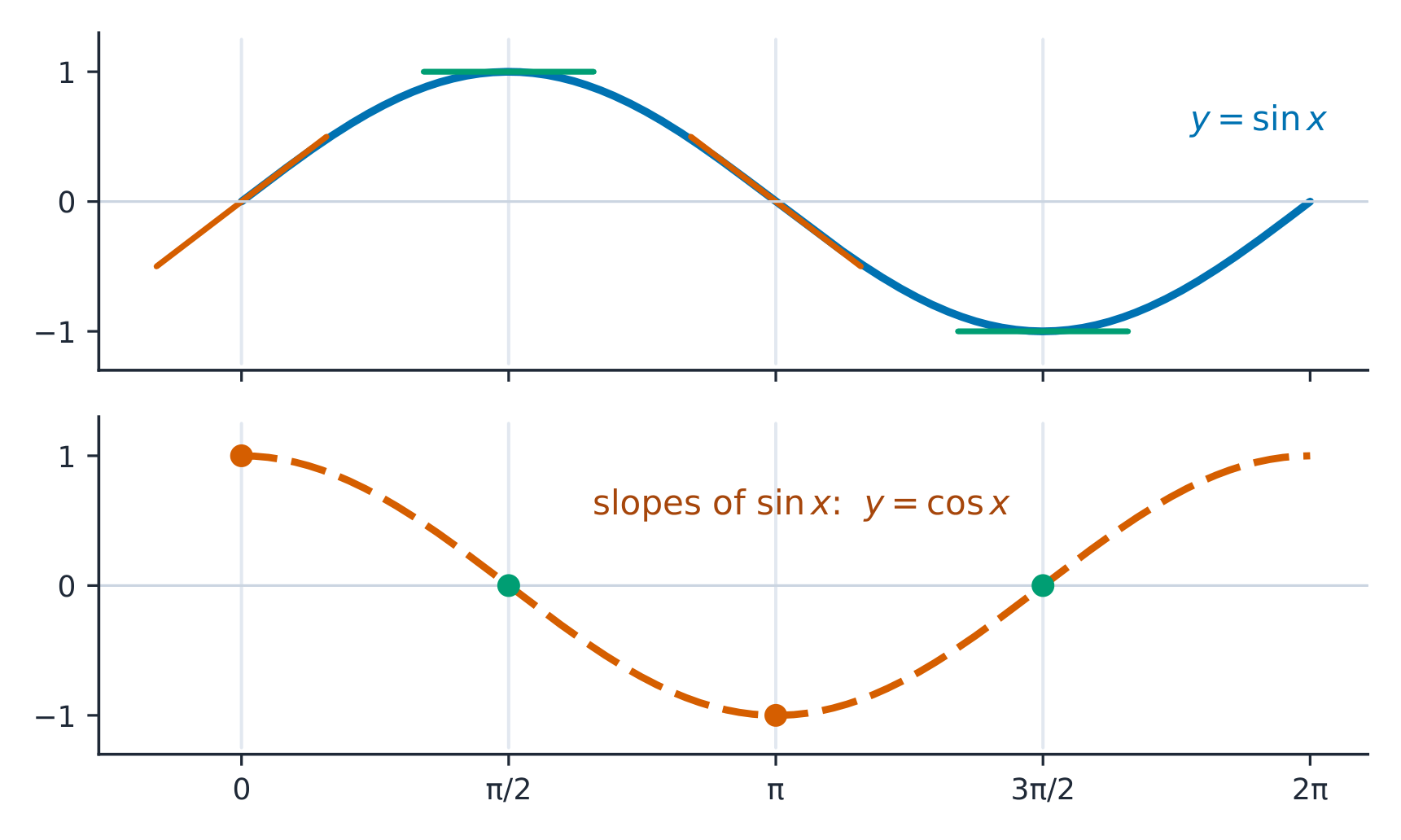
The slopes of sin x trace out cos x
The slope of sine is cosine
Where $\sin x$ is steepest (at $0$) its slope is $1$ — exactly $\cos 0$. The derivative of $\sin$ is $\cos$.
What is $\dfrac{d}{dx}[\sin x]$?
Difficulty 1/5 · 100 coins + a small bonus on first completion today
$\frac{d}{dx}[\sin x]=\cos x$.
$\dfrac{d}{dx}[\cos x]=$ ____ $\sin x$ (mind the sign).
Difficulty 1/5 · 100 coins + a small bonus on first completion today
The derivative of cosine is $-\sin x$.
The exponential and the logarithm
- $\dfrac{d}{dx}[e^x]=e^x$ — the exponential 指数函数 function is its own derivative. Its slope always equals its height.
- $\dfrac{d}{dx}[\ln x]=\dfrac{1}{x}$ — the logarithmic 对数 derivative, valid for $x>0$.
- $e^x$ is the unique function that never changes under differentiation.
- $\ln x$ turns into the simple reciprocal $\tfrac1x$ — a surprisingly tidy result.
$e^x$ is its own derivative.
Difficulty 1/5 · 100 coins + a small bonus on first completion today
$\frac{d}{dx}[e^x]=e^x$ — unique among functions.
What is $\dfrac{d}{dx}[\ln x]$ (for $x>0$)?
Difficulty 1/5 · 100 coins + a small bonus on first completion today
$\frac{d}{dx}[\ln x]=\tfrac1x$.
Mix them with the combining rules
- These elementary derivatives 基本导数 slot straight into the sum, difference, and constant-multiple rules.
- $\dfrac{d}{dx}[3\sin x-2e^x]=3\cos x-2e^x$.
- $\dfrac{d}{dx}[x^2+\ln x]=2x+\dfrac1x$.
- Differentiate each term with its own rule, then combine — nothing new to learn beyond the four facts.
Differentiate $3\sin x-2e^x$.
Difficulty 1/5 · 100 coins + a small bonus on first completion today
$3\cos x$ and $e^x$ stays $e^x$: $3\cos x-2e^x$.
Select all correct elementary derivatives.
Difficulty 2/5 · 140 coins + a small bonus on first completion today
The last is wrong — $\frac{d}{dx}[\ln x]=\tfrac1x$, not $x$.
Mind the signs and the domain. $\frac{d}{dx}[\cos x]=-\sin x$ (the minus is the top mistake). $e^x$ is its own derivative — do not apply the Power Rule to it. And $\frac{d}{dx}[\ln x]=\tfrac1x$ holds only for $x>0$, the domain of $\ln$.
Differentiate $h(x)=4\cos x+e^x-5\ln x$.
- $\dfrac{d}{dx}[4\cos x]=4(-\sin x)=-4\sin x$.
- $\dfrac{d}{dx}[e^x]=e^x$; $\quad\dfrac{d}{dx}[-5\ln x]=-\dfrac{5}{x}$.
- $h'(x)=-4\sin x+e^x-\dfrac{5}{x}$.
Memorize four elementary derivatives: $\frac{d}{dx}[\sin x]=\cos x$, $\frac{d}{dx}[\cos x]=-\sin x$, $\frac{d}{dx}[e^x]=e^x$, $\frac{d}{dx}[\ln x]=\tfrac1x$. They combine with the sum/difference/constant-multiple rules to differentiate mixed expressions. Watch the minus on $\cos$, keep $x$ in radians, and remember $e^x$ is its own derivative.
Write from sine and e to the x at 0
- f(x) = sin x + e to the x.
- The derivative is wanted at 0, with x in radians.
What is f prime of 0?
Both pieces contribute 1 at 0.
The derivative of sin x + e to the x at 0 is what?
Difficulty 1/5 · 100 coins + a small bonus on first completion today
cos 0 + e to the 0 = 2.