Absolute Entropy and Entropy Change
Introduced| English | Meaning |
|---|---|
| standard molar entropy/ˈstændəd ˈməʊlə ˈentrəpi/ | standard molar entropy |
Adding up the disorder
- Every substance has its own tabulated disorder value.
- Add up products and subtract reactants, just like enthalpy.
- The result tells you if a reaction spreads out or tightens up.
- You can even predict the sign at a glance.
Standard molar entropy
- Each substance has a standard molar entropy 标准摩尔熵 $S°$.
- Unlike formation enthalpy, even elements have a nonzero $S°$.
- Gases have large values; solids have small ones.
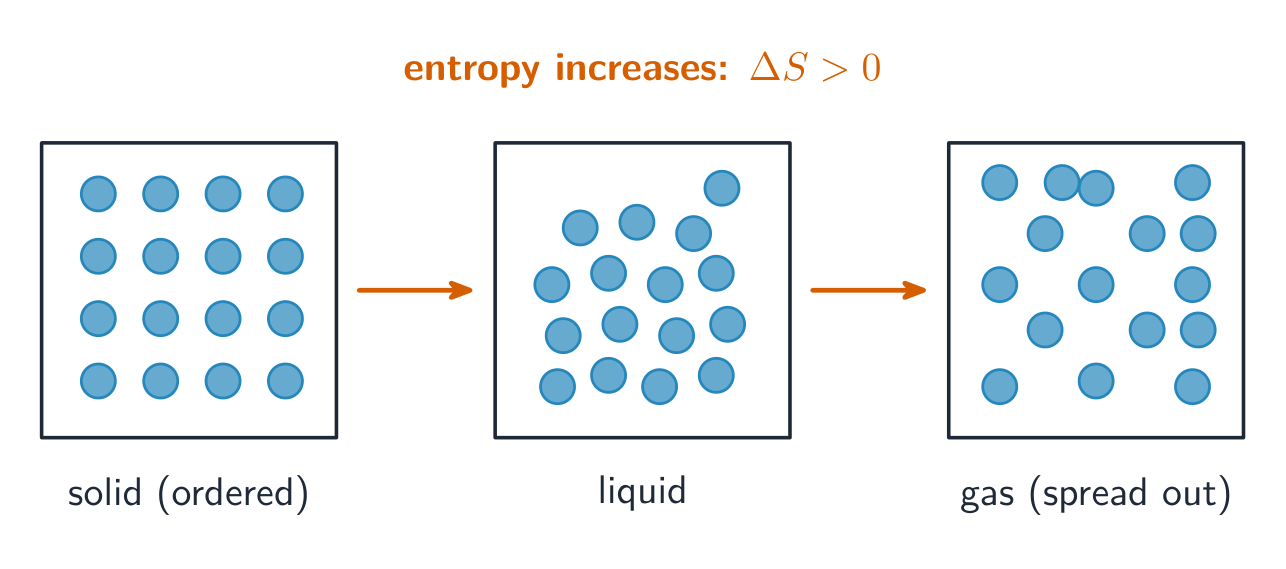
Entropy rises from solid to liquid to gas
An element in its standard state has a standard entropy of zero.
Difficulty 1/5 · 100 coins + a small bonus on first completion today
Unlike formation enthalpy, every substance has a positive $S°$.
Products minus reactants
- $\Delta S_{rxn} = \sum S°(\text{products}) - \sum S°(\text{reactants})$.
- A positive result means the reaction becomes more disordered.
- Multiply each entropy by its coefficient first.
A reaction's entropy change is...
Difficulty 1/5 · 100 coins + a small bonus on first completion today
$\Delta S = \sum S°(\text{products}) - \sum S°(\text{reactants})$.
You multiply each standard entropy by its coefficient before summing.
Difficulty 1/5 · 100 coins + a small bonus on first completion today
Coefficients scale the amount of each substance.
Predicting the sign
- More gas moles on the product side give a positive $\Delta S$.
- Fewer gas moles give a negative $\Delta S$.
- A quick glance at the gas count often settles it.
Sign of ΔS
Sort each reaction by the sign of its entropy change, using the change in moles of gas.
A reaction that consumes gas and forms only solids has $\Delta S$ that is...
Difficulty 1/5 · 100 coins + a small bonus on first completion today
Losing gas moles lowers the disorder, so $\Delta S < 0$.
Which substance typically has the largest standard entropy?
Difficulty 1/5 · 100 coins + a small bonus on first completion today
Gases are the most spread out, so they have the highest $S°$.
Forming more moles of gas gives a ____ entropy change.
Difficulty 1/5 · 100 coins + a small bonus on first completion today
More gas means more disorder, so $\Delta S > 0$.
A reaction turns 2 gas molecules into 1. What is the sign of $\Delta S$?
- Fewer gas molecules means less disorder.
- So $\Delta S$ is negative.
Unlike $\Delta H_f$, elements do not have zero standard entropy — every substance has a positive $S°$. Use products minus reactants, each times its coefficient. And you can usually predict the sign from the change in the number of gas moles.
Every substance has a positive standard molar entropy $S°$ (even elements). A reaction's entropy change is $\Delta S_{rxn} = \sum S°(\text{products}) - \sum S°(\text{reactants})$, scaled by coefficients. Its sign usually follows the change in gas moles: more gas gives positive $\Delta S$.