Periodic Trends
Introduced| English | Meaning |
|---|---|
| atomic radius/əˈtɒmɪk ˈreɪdɪəs/ | A measure of an atom's size based on a stated convention, such as half the distance between bonded identical atoms. |
| electronegativity/ɪˌlektrəʊŋɡəˈtɪvɪti/ | The tendency of an atom in a chemical bond to attract the shared electrons towards itself. |
| ionization energy/ˌaɪənaɪˈzeɪʃn ˈenədʒi/ | The energy to remove an electron. |
Patterns on the table
- Line up the elements and their properties rise and fall in waves.
- Size shrinks left to right, then jumps at the next row.
- The energy to steal an electron climbs across, drops down.
- One idea — the tug of the nucleus — explains it all.
Atomic radius
- Atomic radius 原子半径 shrinks across a period and grows down a group.
- Across: more protons pull the same shell in tighter.
- Down: each new shell sits farther out.
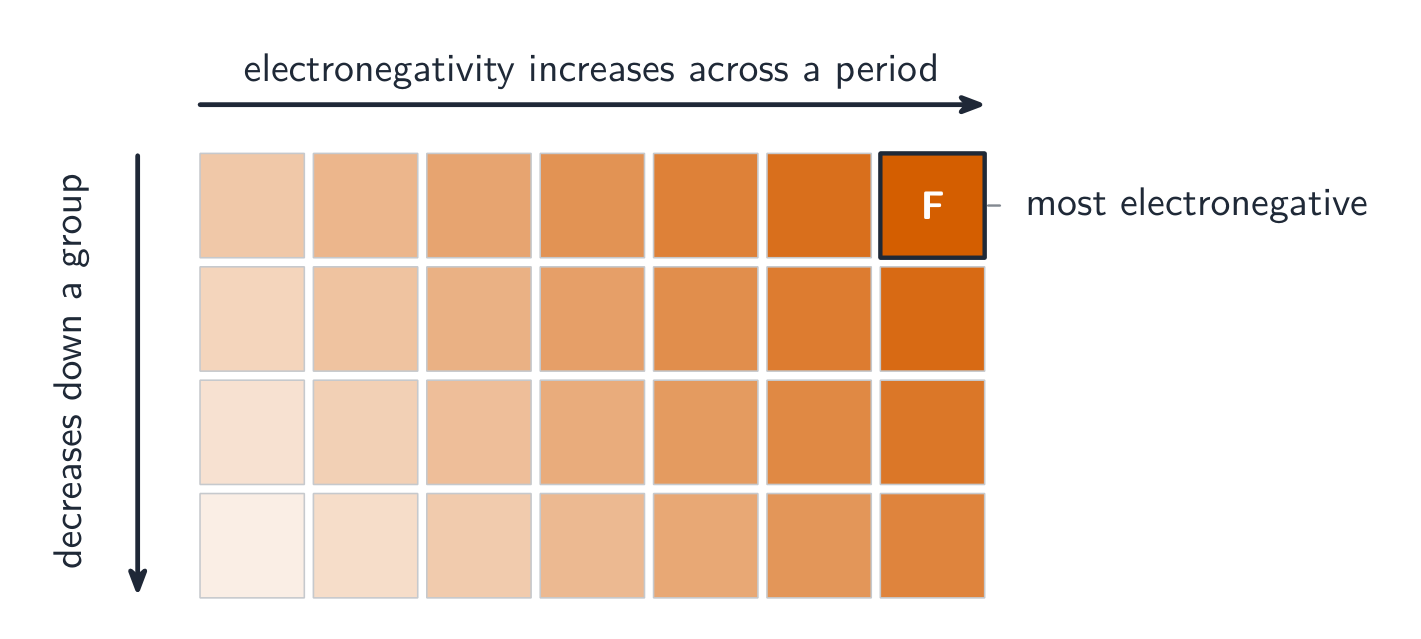
Electronegativity 电负性 rises across a period and falls down a group
Across a period from left to right, the atomic radius...
Difficulty 1/5 · 100 coins + a small bonus on first completion today
More protons pull the same shell in tighter, shrinking the atom.
Order these period-3 atoms from LARGEST to SMALLEST radius.
Difficulty 3/5 · 200 coins + a small bonus on first completion today
Radius shrinks across a period, so Na > Si > Cl.
Ionization energy
- Ionization energy 电离能 is the energy to remove an electron.
- It rises across a period (stronger pull) and falls down a group (farther out).
- This is the opposite trend to atomic radius.
Ionization energy and atomic radius follow opposite trends.
Difficulty 1/5 · 100 coins + a small bonus on first completion today
A smaller, tightly-held atom takes more energy to ionize.
Going down a group, ionization energy generally...
Difficulty 1/5 · 100 coins + a small bonus on first completion today
Outer electrons are farther out and shielded, so easier to remove.
Electronegativity
- Electronegativity is an atom's pull on the shared electrons in a bond.
- It is highest at the top right (ignoring noble gases) and lowest at the bottom left.
- Fluorine is the most electronegative element.
Across a period
Step across Period 3 and watch atomic radius, ionisation energy and melting point change.
Which element is the most electronegative?
Difficulty 1/5 · 100 coins + a small bonus on first completion today
Fluorine (top right, not a noble gas) has the strongest pull on shared electrons.
Which is smaller, sodium (Na) or chlorine (Cl)?
- Both sit in period 3, but Cl has more protons.
- The stronger pull shrinks Cl, so chlorine is smaller.
Down a group, inner electrons ____ the outer ones from the full nuclear charge.
Difficulty 1/5 · 100 coins + a small bonus on first completion today
Inner electrons shield (screen) the outer ones, weakening the effective pull.
Two competing factors drive the trends: more protons pull harder (across a period), while extra shells push electrons out and shield them (down a group). Ionization energy and atomic radius run in opposite directions. And "across" does not always beat "down" — compare two elements carefully rather than guessing.
Across a period the nucleus pulls harder, so atomic radius shrinks while ionization energy and electronegativity rise. Down a group new shells add distance and shielding, so radius grows while ionization energy and electronegativity fall. Radius runs opposite to the other two.