Environmental Effects on Phenotype
Introduced| English | Meaning |
|---|---|
| environment/enˈvaɪrənmənt/ | The surrounding conditions that affect an organism, system or activity. |
| phenotype/ˈfenətaɪp/ | The observable characteristics of an organism, resulting from its genotype and environmental influences. |
| genotype/ˈdʒenətaɪp/ | The genetic constitution of an organism, or the alleles it has at specified loci. |
Genes are not the whole story
- Your genes set out a plan, but the world you grow up in shapes the result.
- Two organisms with the same genes can end up looking different.
- Sunlight, food, and temperature all leave their mark.
- The final appearance comes from genes and environment together.
Phenotype = genotype + environment
- The phenotype 表型 is the trait you can actually see.
- It comes from the genotype 基因型 (the genes) plus the surroundings.
- Genes may set a range of possible outcomes.
- The environment 环境 then decides where within that range you land.
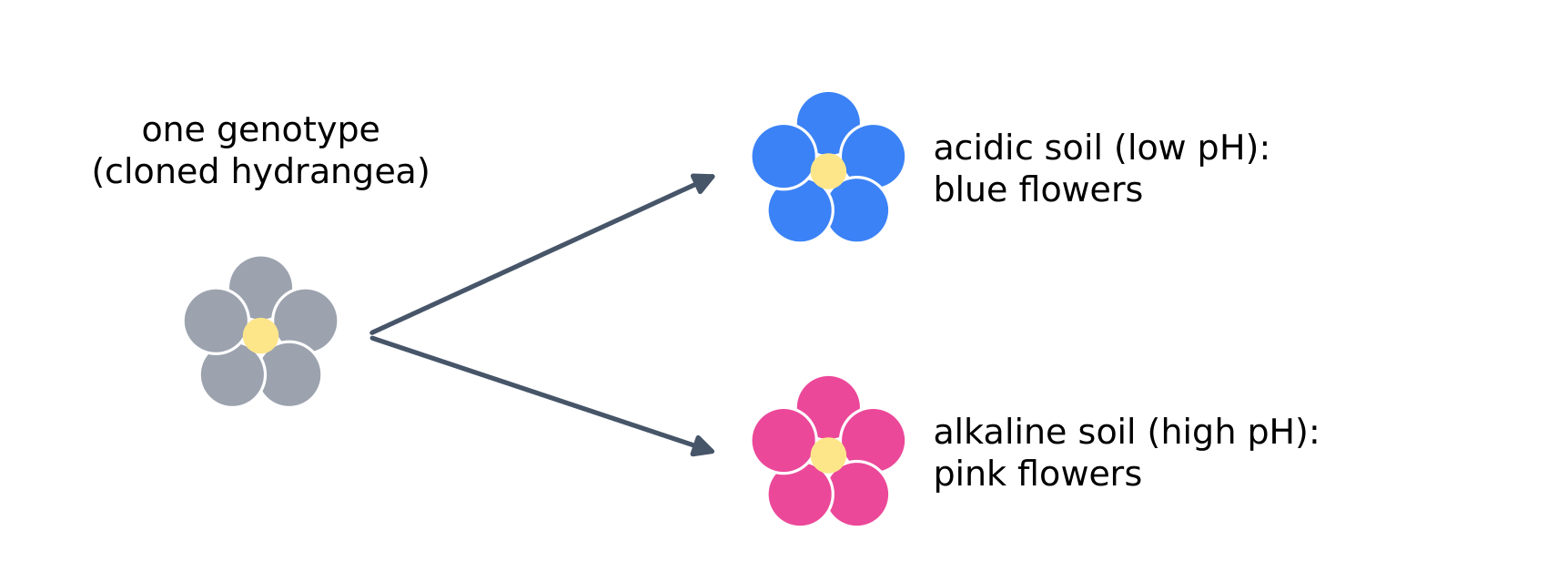
The same genotype gives different phenotypes in different environments: hydrangea flower colour depends on soil pH
An organism's phenotype is shaped by…
Difficulty 1/5 · 100 coins + a small bonus on first completion today
The phenotype is the result of the genotype and the environment working together.
Environment leaves its mark
- A suntan is caused by sunlight, not by a change in your genes.
- A plant grown in shade grows tall and spindly, chasing the light.
- Diet, temperature, and stress can all shift a phenotype.
- None of these change the DNA — they change how it is expressed.
A suntan is an example of a trait caused mainly by…
Difficulty 1/5 · 100 coins + a small bonus on first completion today
A suntan comes from sunlight, an environmental effect — not from a change in the genes.
Nature and nurture
- Many traits depend on both genes and environment.
- Height is set partly by genes and partly by nutrition.
- This teamwork is often called "nature and nurture".
- Neither alone tells the full story of an organism.
Genes, environment, or both?
Sort each trait by what most shapes it — the genotype, the environment, or a mix of both.
Human height depends on both genes and environment (such as nutrition).
Difficulty 1/5 · 100 coins + a small bonus on first completion today
Genes set a possible range for height; nutrition and health decide where within it you end up.
Identical twins have the same genes but can still differ because of their ____.
Difficulty 1/5 · 100 coins + a small bonus on first completion today
Different environments (diet, exercise, sun) give identical twins slightly different phenotypes.
Select all true statements about phenotype.
Difficulty 2/5 · 140 coins + a small bonus on first completion today
Genes do not fix every trait — the environment matters too. The other three are correct.
Identical twins share all their genes, yet they are never exactly alike. Different diets, injuries, and sun exposure give them slightly different phenotypes. Same genotype does not guarantee the same phenotype — the environment always has its say.
A hydrangea's colour depends on the soil:
- The same hydrangea plant can bloom blue or pink.
- Acidic soil turns the flowers blue; alkaline soil turns them pink.
- The genes did not change — the soil (the environment) shaped the phenotype.
An organism's phenotype is shaped by its genotype and its environment together. Genes often set a range of possibilities, and factors like sunlight, food, and temperature decide the outcome. That is why identical genes can still give different phenotypes — nature and nurture both matter.
Write from the environment changing phenotype
- Two plants have the same genotype for flower pigment.
- One is grown in acid soil and one in alkaline soil, and the colours differ.
What changed the phenotype?
Same genes and different conditions can give different phenotypes.
Why do these genetically matched plants differ in colour?
Difficulty 1/5 · 100 coins + a small bonus on first completion today
Soil pH can change the expressed colour.