Meiosis and Genetic Diversity
Introduced| English | Meaning |
|---|---|
| crossing over/ˈkrɒsɪŋ ˈəʊvə/ | Exchange of corresponding DNA segments between non-sister chromatids of homologous chromosomes during meiosis. |
| independent assortment/ˌɪndɪˈpendənt əˈsɔːtmənt/ | The independent orientation and separation of different homologous chromosome pairs during meiosis I. |
| genetic diversity/dʒɪˈnetɪk daɪˈvɜːsɪti/ | genetic diversity |
Why no two siblings are the same
- Brothers and sisters share the same parents, yet all look different.
- Sexual reproduction shuffles genes into brand-new combinations every time.
- Meiosis is where most of that shuffling happens.
- This variety is one of biology's greatest advantages.
Crossing over
- During meiosis, matching chromosomes pair up closely.
- In crossing over 交叉互换, they swap sections of DNA.
- This mixes the mother's and father's genes on a single chromosome.
- Each chromosome that results is a new blend, unlike either parent's.
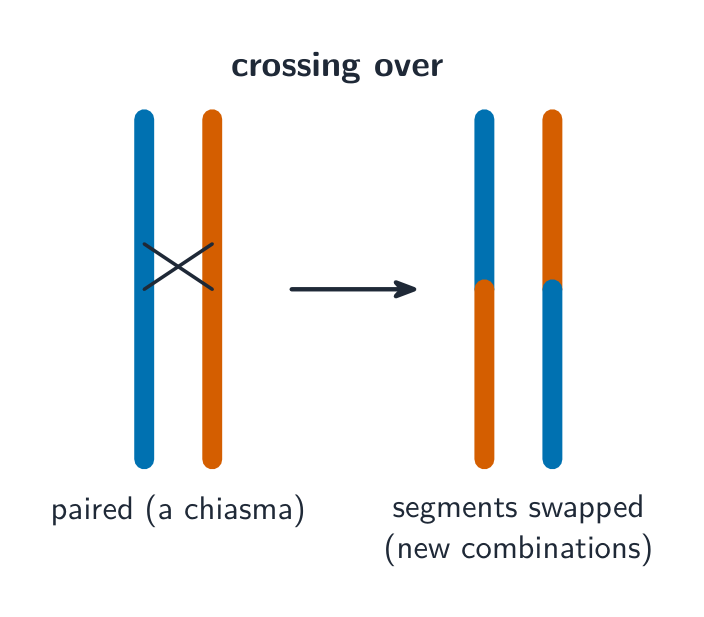
Crossing over swaps segments between homologous chromosomes

Independent assortment 自由组合 produces many gamete combinations
In crossing over, what happens?
Difficulty 1/5 · 100 coins + a small bonus on first completion today
In crossing over, homologous chromosomes exchange matching sections, creating new gene combinations.
Independent assortment
- Each pair of chromosomes lines up randomly before separating.
- This is independent assortment.
- So each gamete gets a random mix of maternal and paternal chromosomes.
- With 23 pairs, that alone gives millions of possible combinations.
Where variation comes from
Step through the ways meiosis and fertilization shuffle genes into new combinations.
Independent assortment means…
Difficulty 1/5 · 100 coins + a small bonus on first completion today
Independent assortment: each pair orients randomly, so gametes get random mixes of maternal and paternal chromosomes.
Random fertilization
- Any one of millions of sperm can fertilise the egg.
- This is random fertilization, multiplying the diversity again.
- Together, these three sources make each offspring genetically unique.
- All of this variety is the raw material for genetic diversity 遗传多样性.
Genetic diversity helps a population survive changing conditions.
Difficulty 1/5 · 100 coins + a small bonus on first completion today
Variety means some individuals may cope with a new challenge — the raw material for evolution.
The random joining of any sperm with any egg is called random ____.
Difficulty 1/5 · 100 coins + a small bonus on first completion today
Random fertilization multiplies the diversity already created within meiosis.
Select all sources of genetic diversity.
Difficulty 2/5 · 140 coins + a small bonus on first completion today
Cloning produces no diversity. The other three all shuffle genes into new combinations.
Sexual reproduction creates diversity; asexual reproduction does not. A cell dividing by mitosis makes identical clones. Only meiosis, with crossing over and independent assortment, shuffles the genes to make every offspring different.
Why a family is full of variety:
- Crossing over remixes each parent's chromosomes.
- Independent assortment deals each gamete a random hand of chromosomes.
- Random fertilization then pairs two unique gametes — so each child is a fresh combination, never seen before.
Meiosis creates genetic diversity through three shuffling steps: crossing over (matching chromosomes swap sections), independent assortment (pairs line up randomly), and random fertilization (any sperm meets any egg). Together they make every offspring genetically unique — the raw material for evolution.
Write from 8 gamete combinations
- A parent is heterozygous at 3 genes on different chromosomes.
- Ignore crossing over for this count.
How many different gamete allele combinations can independent assortment make?
Each heterozygous gene doubles the assortment combinations.
How many assortment combinations come from 3 heterozygous genes?
Difficulty 1/5 · 100 coins + a small bonus on first completion today
Two choices at each of three genes give 8.