Skip to content · ⁨Lompat ke konten⁩

Geometric Optics · ⁨Optik Geometris⁩

AP Physics 2 · ⁨AP Fisika 2⁩ · Topic 13 · ⁨Topik 13⁩

Video lesson for this topic · ⁨Pelajaran video untuk topik ini⁩ Open the video page · ⁨Buka halaman video⁩
9:32

Optik Geometris

Masukkan pensil lurus ke dalam gelas air, dan terlihat patah. Lihat mangkuk sendok mengkilap, dan wajah Anda terbalik. Tidak ada yang bengkok, dan tidak ada…

English narration · English + 中文 subtitles burned in · ⁨Narasi bahasa Inggris · Subtitle bahasa Inggris + 中文 disematkan langsung⁩

13.1

Reflection · ⁨Refleksi⁩

Syllabus · ⁨Silabus⁩
English

Learning Objective 13.1.A: Describe light as a ray.

  • 13.1.A.1 A light ray is a straight line that is perpendicular to the wavefront of a light wave and points in the direction of travel of the wave.
    • 13.1.A.1.i Light rays can be used to determine the behavior of light in geometric optics, where the wave nature of light can be neglected.
    • 13.1.A.1.ii Rays are not sufficient to understand the spreading of light. In interference and diffraction, the wave nature of the light is important.
    • 13.1.A.1.iii A laser is a common source of a single coherent, monochromatic beam of light that can be modeled as a ray. The wave nature of lasers will be considered in Unit 14.
  • 13.1.A.2 Ray diagrams depict the path of light before and after an interaction with matter.

Learning Objective 13.1.B: Describe the reflection of light from a surface.

  • 13.1.B.1 Light that is incident on a surface can be reflected.
  • 13.1.B.2 The law of reflection states that the angle between the incident ray and the normal (the line perpendicular to the surface) is equal to the angle between the reflected ray and the normal.
    • Equation: $\theta_i = \theta_r$
  • 13.1.B.3 Diffuse reflection is the reflection of light from a rough surface and results in light reflected in many different directions, because the line normal to the surface varies over the area over which the light is incident.
  • 13.1.B.4 Specular reflection is the reflection of light from a smooth surface and results in light uniformly reflected from the surface, because the line normal to the surface has an approximately constant direction over the area the light strikes.
Bahasa Indonesia

Tujuan Pembelajaran 13.1.A: Deskripsikan cahaya sebagai sinar.

  • 13.1.A.1 Sinar cahaya adalah garis lurus yang tegak lurus terhadap muka gelombang dari gelombang cahaya dan mengarah ke arah rambat gelombang tersebut.
    • 13.1.A.1.i Sinar cahaya dapat digunakan untuk menentukan perilaku cahaya dalam optik geometri, di mana sifat gelombang cahaya dapat diabaikan.
    • 13.1.A.1.ii Sinar tidak cukup untuk memahami penyebaran cahaya. Dalam interferensi dan difraksi, sifat gelombang dari cahaya sangat penting.
    • 13.1.A.1.iii Laser adalah sumber umum dari satu berkas cahaya koheren tunggal, monokromatik yang dapat dimodelkan sebagai sinar. Sifat gelombang laser akan dipertimbangkan dalam Unit 14.
  • 13.1.A.2 Diagram sinar menggambarkan lintasan cahaya sebelum dan sesudah interaksi dengan materi.

Tujuan Pembelajaran 13.1.B: Deskripsikan pemantulan cahaya dari sebuah permukaan.

  • 13.1.B.1 Cahaya yang datang pada suatu permukaan dapat dipantulkan.
  • 13.1.B.2 Hukum pemantulan menyatakan bahwa sudut antara sinar datang dan garis normal (garis tegak lurus terhadap permukaan) sama dengan sudut antara sinar pantul dan garis normal.
    • Persamaan: $\theta_i = \theta_r$
  • 13.1.B.3 Pemantulan difus adalah pemantulan cahaya dari permukaan kasar yang menghasilkan cahaya terpantul ke banyak arah yang berbeda, karena garis normal terhadap permukaan bervariasi di atas area di mana cahaya datang.
  • 13.1.B.4 Pemantulan spekular adalah pemantulan cahaya dari permukaan halus yang menghasilkan cahaya terpantul secara seragam dari permukaan, karena garis normal terhadap permukaan memiliki arah yang hampir konstan di atas area tempat cahaya mengenai.

Source: College Board AP Course and Exam Description · ⁨Sumber: Deskripsi Kursus dan Ujian College Board AP⁩

English

Geometric optics 几何光学 treats light as straight-line rays. The law of reflection 反射定律: when light bounces off a surface, the angle of incidence 入射角 equals the angle of reflection 反射角, both measured from the normal (the line perpendicular to the surface). Smooth surfaces reflect a clear image; rough surfaces scatter the rays.

Bahasa Indonesia

Optika geometri memperlakukan cahaya sebagai sinar garis lurus. Hukum pemantulan: ketika cahaya memantul dari permukaan, sudut datang sama dengan sudut pantul, keduanya diukur dari garis normal (garis tegak lurus terhadap permukaan). Permukaan halus memantulkan gambar jelas; permukaan kasar menyebarkan sinar-sinar tersebut.

Hukum pemantulan: sudut datang sama dengan sudut pantul
Watch lesson · ⁨Tonton pelajaran⁩
13.2

Images Formed by Mirrors · ⁨Citra yang Terbentuk oleh Cermin⁩

Syllabus · ⁨Silabus⁩
English

Learning Objective 13.2.A: Describe the image formed by a mirror.

  • 13.2.A.1 Incident light rays parallel to the principal axis of a concave (converging) mirror will be reflected toward a common location, called the focal point.
  • 13.2.A.2 Incident light rays parallel to the principal axis of a convex (diverging) mirror will be reflected such that they appear to have originated from a common location behind the mirror, called the focal point.
  • 13.2.A.3 The focal point of a plane mirror is an infinite distance from the mirror.
  • 13.2.A.4 The focal point of a spherical mirror may be approximated as a point located on the principal axis of the mirror halfway between the surface of the mirror and the center of the mirror's radius of curvature.
  • 13.2.A.5 A real image is formed by a mirror when light rays emanating from a common point are reflected and then intersect at a common point.
  • 13.2.A.6 A virtual image is formed by a mirror when reflected light rays diverge such that they appear to have originated from a common point.
  • 13.2.A.7 The location of an image depends on the focal length of the mirror and the distance between the object and the surface of the mirror.
    • Equation: $\dfrac{1}{s_i} + \dfrac{1}{s_o} = \dfrac{1}{f}$
    • 13.2.A.7.i The locations of a mirror's focal point, an object near the mirror, and the image of the object formed by the mirror follow sign conventions that are used to determine those locations relative to the mirror itself.
    • 13.2.A.7.ii The distance between the image formed and a plane mirror is equal to the distance between the object and the plane mirror.
  • 13.2.A.8 The magnification of an image formed by a mirror is the ratio of the size of the image produced to the size of the object itself and depends on the locations of the object and image relative to the mirror.
    • Equation: $|M| = \left| \dfrac{h_i}{h_o} \right| = \left| \dfrac{s_i}{s_o} \right|$
  • 13.2.A.9 Ray diagrams can be used to determine the location, type, size, and orientation of images formed by mirrors.
    • 13.2.A.9.i The three principal rays are typically used to find the images formed by mirrors. The principal rays are 1) the ray parallel to the principal axis, 2) the ray that reflects at the center of the mirror where the principal axis intersects the mirror, and 3) the ray that passes through the focal point of the mirror.
    • 13.2.A.9.ii Images formed by a mirror can be upright or inverted, virtual or real, and reduced, enlarged, or the same size as the object.

Boundary statement: AP Physics 2 limits the study of mirrors to plane mirrors, convex spherical mirrors, and concave spherical mirrors.

Bahasa Indonesia

Tujuan Pembelajaran 13.2.A: Deskripsikan citra yang terbentuk oleh cermin.

  • 13.2.A.1 Sinar cahaya datang yang sejajar dengan sumbu utama cermin cekung (konvergen) akan dipantulkan menuju titik persekutuan, yang disebut titik fokus.
  • 13.2.A.2 Sinar cahaya datang yang sejajar dengan sumbu utama cermin cembung (divergen) akan dipantulkan sedemikian rupa sehingga tampak berasal dari titik persekutuan di belakang cermin, yang disebut titik fokus.
  • 13.2.A.3 Titik fokus cermin datar berada pada jarak tak hingga dari cermin.
  • 13.2.A.4 Titik fokus cermin bola dapat didekati sebagai titik yang terletak pada sumbu utama cermin di tengah-tengah antara permukaan cermin dan pusat kelengkungan jari-jari cermin.
  • 13.2.A.5 Citra nyata terbentuk oleh cermin ketika sinar-sinar cahaya yang memancar dari titik persekutuan dipantulkan dan kemudian berpotongan di satu titik persekutuan.
  • 13.2.A.6 Citra maya terbentuk oleh cermin ketika sinar-sinar cahaya pantul menyimpang sedemikian rupa sehingga tampak berasal dari satu titik persekutuan.
  • 13.2.A.7 Lokasi citra bergantung pada panjang fokus cermin dan jarak antara benda dan permukaan cermin.
    • Persamaan: $\dfrac{1}{s_i} + \dfrac{1}{s_o} = \dfrac{1}{f}$
    • 13.2.A.7.i Lokasi titik fokus cermin, benda dekat cermin, dan citra benda yang dibentuk oleh cermin mengikuti konvensi tanda yang digunakan untuk menentukan lokasi-lokasi tersebut relatif terhadap cermin itu sendiri.
    • 13.2.A.7.ii Jarak antara citra yang terbentuk dan cermin datar sama dengan jarak antara benda dan cermin datar.
  • 13.2.A.8 Perbesaran citra yang dibentuk oleh cermin adalah rasio ukuran citra yang dihasilkan terhadap ukuran benda itu sendiri dan bergantung pada lokasi objek dan citra relatif terhadap cermin.
    • Persamaan: $|M| = \left| \dfrac{h_i}{h_o} \right| = \left| \dfrac{s_i}{s_o} \right|$
  • 13.2.A.9 Diagram sinar dapat digunakan untuk menentukan lokasi, jenis, ukuran, dan orientasi citra yang dibentuk oleh cermin.
    • 13.2.A.9.i Tiga sinar utama biasanya digunakan untuk menemukan citra yang dibentuk oleh cermin. Sinar-sinar utama adalah 1) sinar yang sejajar dengan sumbu utama, 2) sinar yang dipantulkan di tengah cermin di mana sumbu utama memotong cermin, dan 3) sinar yang melewati titik fokus cermin.
    • 13.2.A.9.ii Citra yang dibentuk oleh cermin dapat tegak atau terbalik, maya atau nyata, dan diperkecil, diperbesar, atau sama besar dengan benda.

Pernyataan Batas: AP Physics 2 membatasi studi cermin hanya pada cermin datar, cermin bola cembung, dan cermin bola cekung.

Source: College Board AP Course and Exam Description · ⁨Sumber: Deskripsi Kursus dan Ujian College Board AP⁩

English

A curved mirror focuses parallel rays at its focal point, a distance $f$ from the mirror. The mirror equation relates object and image distances:

$$\frac{1}{d_o}+\frac{1}{d_i}=\frac{1}{f},\qquad m=-\frac{d_i}{d_o}.$$
A concave mirror 凹面镜 (converging) can form a real image 实像 (rays actually meet, projectable, inverted); a convex mirror 凸面镜 always forms a virtual image 虚像 (rays only appear to meet, upright, reduced). The magnification $m$ gives the image's size and orientation. Sign convention matters: a negative image distance means a virtual image behind the mirror or lens.

Bahasa Indonesia

Cermin lengkung memfokuskan sinar sejajar pada titik fokus-nya, berjarak $f$ dari cermin. Persamaan cermin menghubungkan jarak benda dan jarak citra:

$$\frac{1}{d_o}+\frac{1}{d_i}=\frac{1}{f},\qquad m=-\frac{d_i}{d_o}.$$
Cermin cekung (konvergen) dapat membentuk citra nyata (sinar benar-benar bertemu, dapat diproyeksikan, terbalik); cermin cembung selalu membentuk citra maya (sinar hanya tampak bertemu, tegak, diperkecil). Perbesaran $m$ memberikan ukuran dan orientasi citra. Konvensi tanda penting: jarak citra negatif berarti citra maya di belakang cermin atau lensa.

Explore · ⁨Jelajahi⁩

Form an image with a curved mirror · ⁨Bentuk bayangan dengan cermin cekung⁩

A concave mirror reflects rays through its focus. The object's distance relative to the focal length decides whether the image is real or virtual, enlarged or reduced. · ⁨Cermin cekung memantulkan sinar melalui fokusnya. Jarak benda relatif terhadap panjang fokus menentukan apakah bayangan nyata atau maya, diperbesar atau diperkecil.⁩

Watch lesson · ⁨Tonton pelajaran⁩
13.3

Refraction · ⁨Pembiakan⁩

Syllabus · ⁨Silabus⁩
English

Learning Objective 13.3.A: Describe the refraction of light between two media.

  • 13.3.A.1 Refraction is the change in direction of a light ray as the ray passes from one medium into another.
  • 13.3.A.2 Refraction is a result of the speed of light changing when light enters a new medium.
  • 13.3.A.3 The index of refraction of a given medium is inversely proportional to the speed of light in the medium.
    • Equation: $n = \dfrac{c}{v}$
  • 13.3.A.4 Snell's law relates the angles of incidence and refraction of a light ray passing from one medium into another to the indices of refraction of the two media.
    • Equation: $n_1 \sin\theta_1 = n_2 \sin\theta_2$
    • 13.3.A.4.i When a light ray travels from a medium with a higher index of refraction into a medium with a lower index of refraction, the ray refracts away from the normal.
    • 13.3.A.4.ii When a light ray travels from a medium with a lower index of refraction into a medium with a higher index of refraction, the ray refracts toward the normal.
    • 13.3.A.4.iii When a light ray is incident along the normal to a surface, the transmitted ray is not refracted.
  • 13.3.A.5 Total internal reflection may occur when light passes from one medium into another medium with a lower index of refraction.
    • 13.3.A.5.i Total internal reflection of light occurs beyond a critical angle of incidence.
      • Derived equation: $\theta_{\text{critical}} = \sin^{-1}\left( \dfrac{n_2}{n_1} \right)$
    • 13.3.A.5.ii For incident rays at the critical angle, the ray refracts at 90 degrees and travels along the surface of the material.
    • 13.3.A.5.iii For incident rays beyond the critical angle, all light is reflected (no light is transmitted into the other medium).
Bahasa Indonesia

Tujuan Pembelajaran 13.3.A: Deskripsikan pembiasan cahaya antara dua medium.

  • 13.3.A.1 Pembiasan adalah perubahan arah sinar cahaya saat sinar tersebut berpindah dari satu medium ke medium lain.
  • 13.3.A.2 Pembiasan merupakan akibat dari perubahan kecepatan cahaya ketika cahaya memasuki medium baru.
  • 13.3.A.3 Indeks bias suatu medium tertentu berbanding terbalik dengan kecepatan cahaya di dalam medium tersebut.
    • Persamaan: $n = \dfrac{c}{v}$
  • 13.3.A.4 Hukum Snellius menghubungkan sudut datang dan sudut bias sinar cahaya yang berpindah dari satu medium ke medium lain dengan indeks bias kedua medium tersebut.
    • Persamaan: $n_1 \sin\theta_1 = n_2 \sin\theta_2$
    • 13.3.A.4.i Ketika sinar cahaya merambat dari medium dengan indeks bias lebih tinggi ke medium dengan indeks bias lebih rendah, sinar tersebut membias menjauhi garis normal.
    • 13.3.A.4.ii Ketika sinar cahaya merambat dari medium dengan indeks bias lebih rendah ke medium dengan indeks bias lebih tinggi, sinar tersebut membias mendekati garis normal.
    • 13.3.A.4.iii Ketika sinar cahaya datang sepanjang garis normal terhadap permukaan, sinar transmisi tidak dibias.
  • 13.3.A.5 Pemantulan total dapat terjadi ketika cahaya melewati dari satu medium ke medium lain dengan indeks bias yang lebih rendah.
    • 13.3.A.5.i Pemantulan total cahaya terjadi pada sudut datang melebihi sudut kritis.
      • Persamaan turunan: $\theta_{\text{critical}} = \sin^{-1}\left( \dfrac{n_2}{n_1} \right)$
    • 13.3.A.5.ii Untuk sinar datang pada sudut kritis, sinar dibiaskan sebesar 90 derajat dan merambat sepanjang permukaan material.
    • 13.3.A.5.iii Untuk sinar datang melebihi sudut kritis, seluruh cahaya dipantulkan (tidak ada cahaya yang ditransmisikan ke medium lain).

Source: College Board AP Course and Exam Description · ⁨Sumber: Deskripsi Kursus dan Ujian College Board AP⁩

English

Light bends when it passes between materials because its speed changes – refraction 折射. Each material has an index of refraction 折射率 $n=\dfrac{c}{v}$ (how much it slows light). Snell's law 斯涅尔定律:

$$n_1\sin\theta_1=n_2\sin\theta_2.$$
Light entering a denser medium (larger $n$) bends toward the normal. Beyond a critical angle, light going to a less-dense medium reflects entirely – total internal reflection 全反射, used in fibre optics.

Worked example. A ray in air ($n_1=1.00$) strikes water ($n_2=1.33$) at $40^{\circ}$ to the normal. By Snell's law,

$$\sin\theta_2=\frac{n_1}{n_2}\sin\theta_1=\frac{1.00}{1.33}\sin 40^{\circ}=0.483\;\Rightarrow\;\theta_2=29^{\circ}.$$
The ray bends toward the normal, as expected going into the denser medium.

Worked example (critical angle). For light trying to leave glass ($n=1.50$) for air, total internal reflection begins at the critical angle $\theta_c$ where the refracted ray grazes the surface:

$$\sin\theta_c=\frac{1}{n}=\frac{1}{1.50}=0.667\;\Rightarrow\;\theta_c=42^{\circ}.$$
Any ray hitting the inside surface more steeply than $42^{\circ}$ is trapped – the reason optical fibres carry light for kilometres.

Bahasa Indonesia

Cahaya membelok saat melewati antar material karena kecepatannya berubah – pembiasan. Setiap material memiliki indeks bias $n=\dfrac{c}{v}$ (seberapa banyak ia memperlambat cahaya). Hukum Snell:

$$n_1\sin\theta_1=n_2\sin\theta_2.$$
Cahaya yang memasuki medium lebih padat ($n$ lebih besar) akan membengkok menuju garis normal. Melewati sudut kritis, cahaya yang menuju medium kurang padat akan dipantulkan sepenuhnya – pemantulan internal total, digunakan dalam optik serat.

Cahaya dibias, membengkok menuju garis normal saat memasuki kaca

Contoh terpecahkan. Sinar di udara ($n_1=1.00$) mengenai air ($n_2=1.33$) pada sudut $40^{\circ}$ terhadap garis normal. Berdasarkan hukum Snell,

$$\sin\theta_2=\frac{n_1}{n_2}\sin\theta_1=\frac{1.00}{1.33}\sin 40^{\circ}=0.483\;\Rightarrow\;\theta_2=29^{\circ}.$$
Sinar membengkok menuju garis normal, sesuai harapan saat memasuki medium yang lebih padat.

Contoh terpecahkan (sudut kritis). Untuk cahaya yang mencoba keluar dari kaca ($n=1.50$) menuju udara, pemantulan internal total dimulai pada sudut kritis $\theta_c$ di mana sinar bias menyentuh permukaan secara mendatar:

$$\sin\theta_c=\frac{1}{n}=\frac{1}{1.50}=0.667\;\Rightarrow\;\theta_c=42^{\circ}.$$
Setiap sinar yang mengenai permukaan bagian dalam dengan kemiringan lebih curam dari $42^{\circ}$ akan terperangkap – alasan mengapa serat optik dapat mentransmisikan cahaya selama beberapa kilometer.

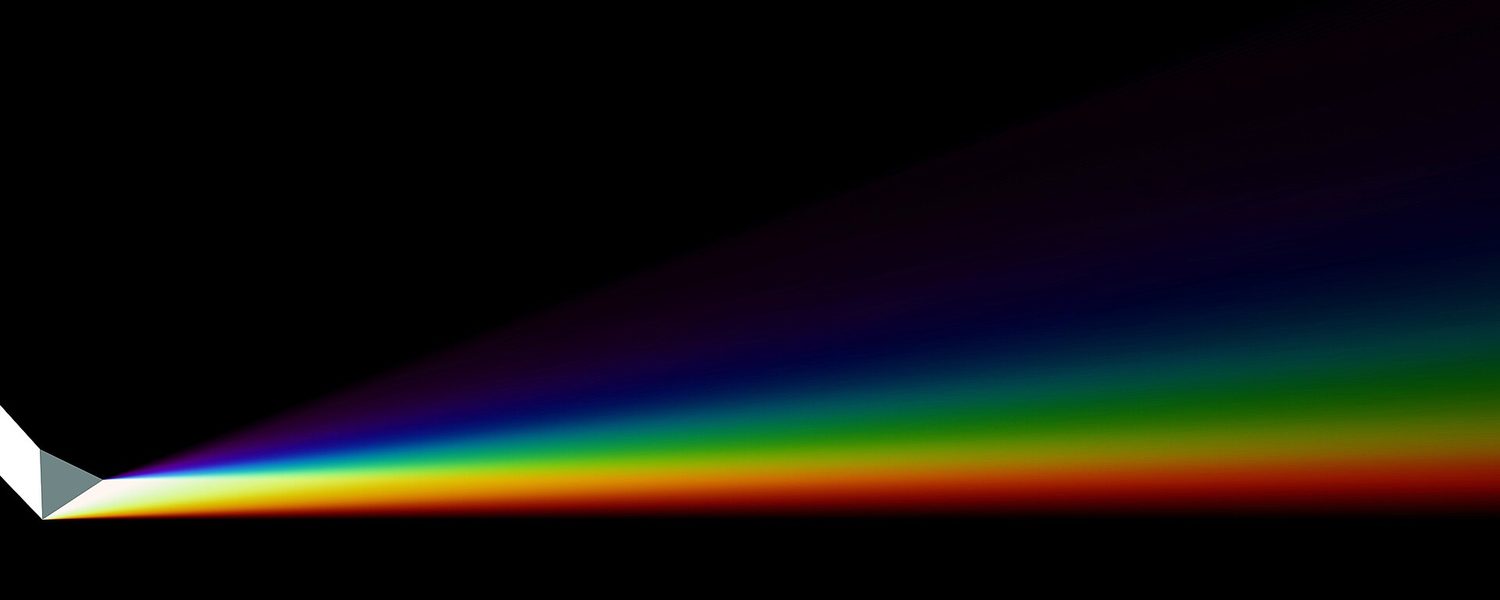
Cahaya putih terurai menjadi spektrum melalui prisma kaca
Pembiasan membengkokkan setiap warna dengan jumlah berbeda, sehingga prisma menyebarkan cahaya putih menjadi pelangi
Explore · ⁨Jelajahi⁩

Bend light as it enters glass · ⁨Belokkan cahaya saat memasuki kaca⁩

Light refracts (bends) when it changes speed between media, following Snell's law. The denser the medium, the more it bends toward the normal. · ⁨Cahaya dibiaskan (membengkok) saat mengubah kecepatan antar media, mengikuti hukum Snell. Semakin padat medium, semakin banyak ia membengkok ke arah normal.⁩

Vocabulary · ⁨Kosa kata⁩ Train · ⁨Latih⁩
English Bahasa Indonesia
Geometric optics/ˌdʒiːəʊˈmetrɪk ˈɒptɪks/ Optika geometri
law of reflection/lɔː ɒv rɪˈflekʃn/ hukum pemantulan
angle of incidence/ˈæŋɡl ɒv ˈɪnsɪdəns/ sudut datang
angle of reflection/ˈæŋɡl ɒv rɪˈflekʃn/ sudut pantul
concave mirror/kɒnˈkeɪv ˈmɪrə/ Cermin cekung
real image/rɪəl ˈɪmɪdʒ/ bayangan nyata
convex mirror/kɒnˈveks ˈmɪrə/ Cermin cembung
virtual image/ˈvɜːtʃuːəl ˈɪmɪdʒ/ bayangan maya
refraction/rɪˈfrækʃn/ pembiasan
index of refraction/ˈɪndeks ɒv rɪˈfrækʃn/ Indeks bias
Snell's law/snelz lɔː/ Hukum Snell
total internal reflection/ˈtəʊtl ɪnˈtɜːnl rɪˈflekʃn/ pemantulan internal total
Watch lesson · ⁨Tonton pelajaran⁩
13.4

Images Formed by Lenses · ⁨Gambar yang Terbentuk oleh Lensa⁩

Syllabus · ⁨Silabus⁩
English

Learning Objective 13.4.A: Describe the image formed by a lens.

  • 13.4.A.1 Incident light rays parallel to the principal axis of a thin convex (converging) lens will be refracted and converge toward a common location on the transmitted side of the lens, called the focal point.
  • 13.4.A.2 Incident light rays parallel to the principal axis of a thin concave (diverging) lens will be refracted and diverge as if they originated from a focal point on the incident side of the lens.
  • 13.4.A.3 A real image is formed by a lens when light rays originating from a common point are refracted such that they intersect at another common point.
  • 13.4.A.4 A virtual image is formed by a lens when refracted light rays diverge such that they appear to have originated from a common point.
  • 13.4.A.5 For a thin lens, the location of an image depends on the focal length of the lens and the distance between the object and the midline of the lens, as given by the thin-lens equation:
    • Equation: $\dfrac{1}{s_i} + \dfrac{1}{s_o} = \dfrac{1}{f}$
    • 13.4.A.5.i The locations of a lens's focal point, an object, and the image of the object formed by the lens follow sign conventions that are used to determine those locations relative to the lens itself.
    • 13.4.A.5.ii Lenses have a focal point on both sides of the lens that depends on the shape of the respective side of the lens.
  • 13.4.A.6 For a thin lens, the magnification of an image is the ratio of the size of the image produced to the size of the object itself and depends on the locations of the object and image relative to the lens.
    • Equation: $|M| = \left| \dfrac{h_i}{h_o} \right| = \left| \dfrac{s_i}{s_o} \right|$
  • 13.4.A.7 Ray diagrams can be used to determine the location, type, size, and orientation of images formed by lenses.
    • 13.4.A.7.i The three principal rays are typically used to find the images formed by lenses. The principal rays are 1) the ray parallel to the principal axis, 2) the ray that passes through the center of the lens where the principal axis intersects the lens, and 3) the ray that passes through the focal point of the lens.
    • 13.4.A.7.ii Images formed by a lens can be upright or inverted, virtual or real, and reduced, enlarged, or the same size as the object.
Bahasa Indonesia

Tujuan Pembelajaran 13.4.A: Deskripsikan gambar yang terbentuk oleh sebuah lensa.

  • 13.4.A.1 Sinar datang sejajar dengan sumbu utama lensa cembung tipis (konvergen) akan dibiaskan dan konvergen menuju titik bersama di sisi transmisi lensa, yang disebut titik fokus.
  • 13.4.A.2 Sinar datang sejajar dengan sumbu utama lensa cekung tipis (divergen) akan dibiaskan dan divergen seolah-olah berasal dari titik fokus di sisi datang lensa.
  • 13.4.A.3 Gambar nyata terbentuk oleh lensa ketika sinar-sinar yang berasal dari titik bersama dibiaskan sehingga berpotongan di titik bersama lainnya.
  • 13.4.A.4 Gambar maya terbentuk oleh lensa ketika sinar-sinar yang dibiaskan divergen sehingga tampak berasal dari titik bersama.
  • 13.4.A.5 Untuk lensa tipis, posisi gambar bergantung pada panjang fokus lensa dan jarak antara objek dengan garis tengah lensa, seperti yang diberikan oleh persamaan lensa tipis:
    • Persamaan: $\dfrac{1}{s_i} + \dfrac{1}{s_o} = \dfrac{1}{f}$
    • 13.4.A.5.i Posisi titik fokus lensa, objek, dan gambar objek yang dibentuk oleh lensa mengikuti konvensi tanda yang digunakan untuk menentukan posisi-posisi tersebut relatif terhadap lensa itu sendiri.
    • 13.4.A.5.ii Lensa memiliki titik fokus di kedua sisinya yang bergantung pada bentuk masing-masing sisi lensa.
  • 13.4.A.6 Untuk lensa tipis, perbesaran gambar adalah rasio ukuran gambar yang dihasilkan terhadap ukuran objek itu sendiri dan bergantung pada posisi objek dan gambar relatif terhadap lensa.
    • Persamaan: $|M| = \left| \dfrac{h_i}{h_o} \right| = \left| \dfrac{s_i}{s_o} \right|$
  • 13.4.A.7 Diagram sinar dapat digunakan untuk menentukan posisi, jenis, ukuran, dan orientasi gambar yang dibentuk oleh lensa.
    • 13.4.A.7.i Tiga sinar utama biasanya digunakan untuk menemukan gambar yang dibentuk oleh lensa. Sinar-sinar utama tersebut adalah 1) sinar sejajar dengan sumbu utama, 2) sinar yang melalui pusat lensa di mana sumbu utama berpotongan dengan lensa, dan 3) sinar yang melalui titik fokus lensa.
    • 13.4.A.7.ii Gambar yang dibentuk oleh lensa dapat tegak atau terbalik, maya atau nyata, serta diperkecil, diperbesar, atau sama ukurannya dengan objek.

Source: College Board AP Course and Exam Description · ⁨Sumber: Deskripsi Kursus dan Ujian College Board AP⁩

English
A converging lens forms a real image

A lens bends light through refraction. The thin-lens equation has the same form as the mirror equation:

$$\frac{1}{d_o}+\frac{1}{d_i}=\frac{1}{f},\qquad m=-\frac{d_i}{d_o}.$$
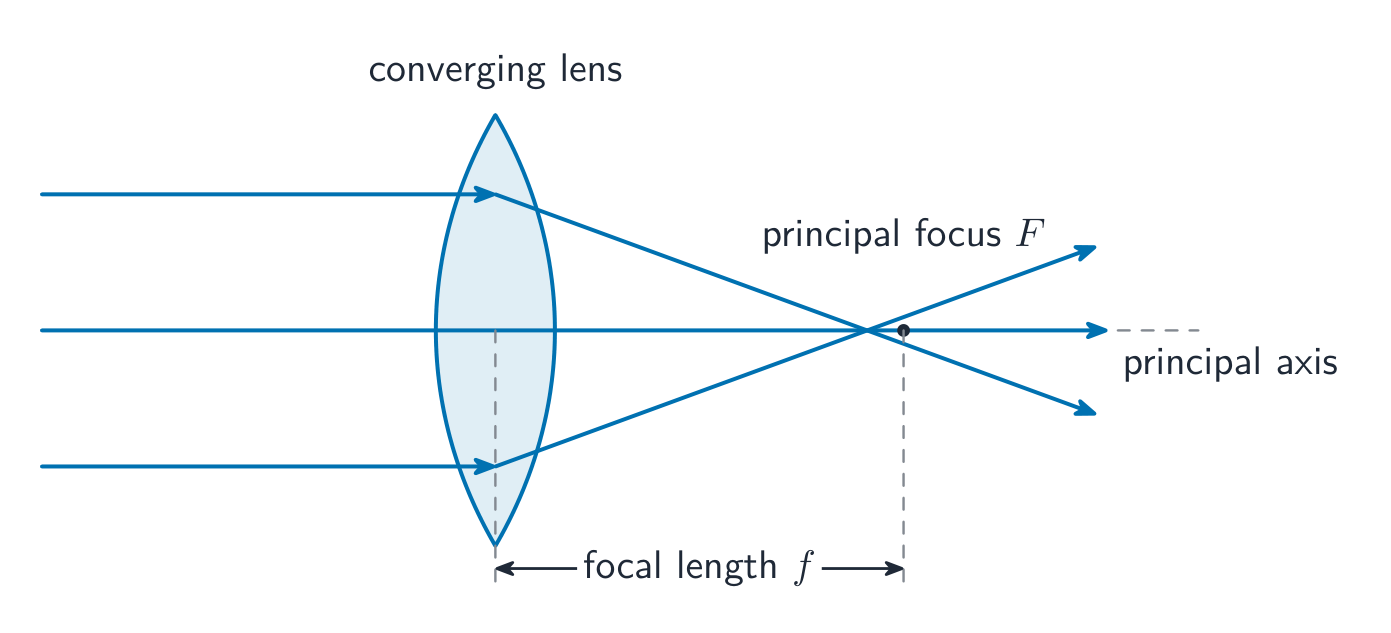
A converging 会聚 (convex) lens can form a real, inverted image or, for a close object, a virtual, upright, enlarged image (a magnifying glass). A diverging 发散 (concave) lens always forms a virtual, upright, reduced image. Ray diagrams locate the image quickly using two easy rays: one parallel to the axis that bends to pass through the far focus, and one straight through the centre of the lens (undeviated).

Worked example. An object sits $30\ \text{cm}$ from a converging lens of focal length $f=10\ \text{cm}$. Find the image. From the thin-lens equation,

$$\frac{1}{d_i}=\frac{1}{f}-\frac{1}{d_o}=\frac{1}{10}-\frac{1}{30}=\frac{2}{30}\;\Rightarrow\;d_i=15\ \text{cm},$$
and the magnification is $m=-d_i/d_o=-15/30=-0.5$. The image is real (positive $d_i$), inverted (negative $m$), and half the object's size – just what a camera lens does.

Bahasa Indonesia
Lensa konvergen membentuk bayangan nyata

Sebuah lensa membengkokkan cahaya melalui pembiasan. Persamaan lensa tipis memiliki bentuk yang sama dengan persamaan cermin:

$$\frac{1}{d_o}+\frac{1}{d_i}=\frac{1}{f},\qquad m=-\frac{d_i}{d_o}.$$
Sebuah konvergen (cembung) lensa dapat membentuk bayangan nyata, terbalik atau, untuk objek dekat, bayangan semu, tegak, diperbesar (kaca pembesar). Sebuah divergen (cekung) lensa selalu membentuk bayangan semu, tegak, dan diperkecil. Diagram sinar melokalisasi bayangan dengan cepat menggunakan dua sinar mudah: satu sejajar dengan sumbu yang membengkok untuk melewati fokus jauh, dan satu lurus melalui pusat lensa (tidak terdeviasi).

Dua sinar melokalisasi bayangan: paralel-lalu-fokus, dan lurus melalui pusat
Lensa konvergen membawa sinar sejajar ke fokus utamanya

Contoh terpecahkan. Sebuah objek berada $30\ \text{cm}$ dari sebuah lensa konvergen dengan panjang fokus $f=10\ \text{cm}$. Temukan bayangannya. Dari persamaan lensa tipis,

$$\frac{1}{d_i}=\frac{1}{f}-\frac{1}{d_o}=\frac{1}{10}-\frac{1}{30}=\frac{2}{30}\;\Rightarrow\;d_i=15\ \text{cm},$$
dan perbesaran adalah $m=-d_i/d_o=-15/30=-0.5$. Bayangannya adalah nyata (positif $d_i$), terbalik (negatif $m$), dan setengah ukuran objek – persis seperti yang dilakukan lensa kamera.

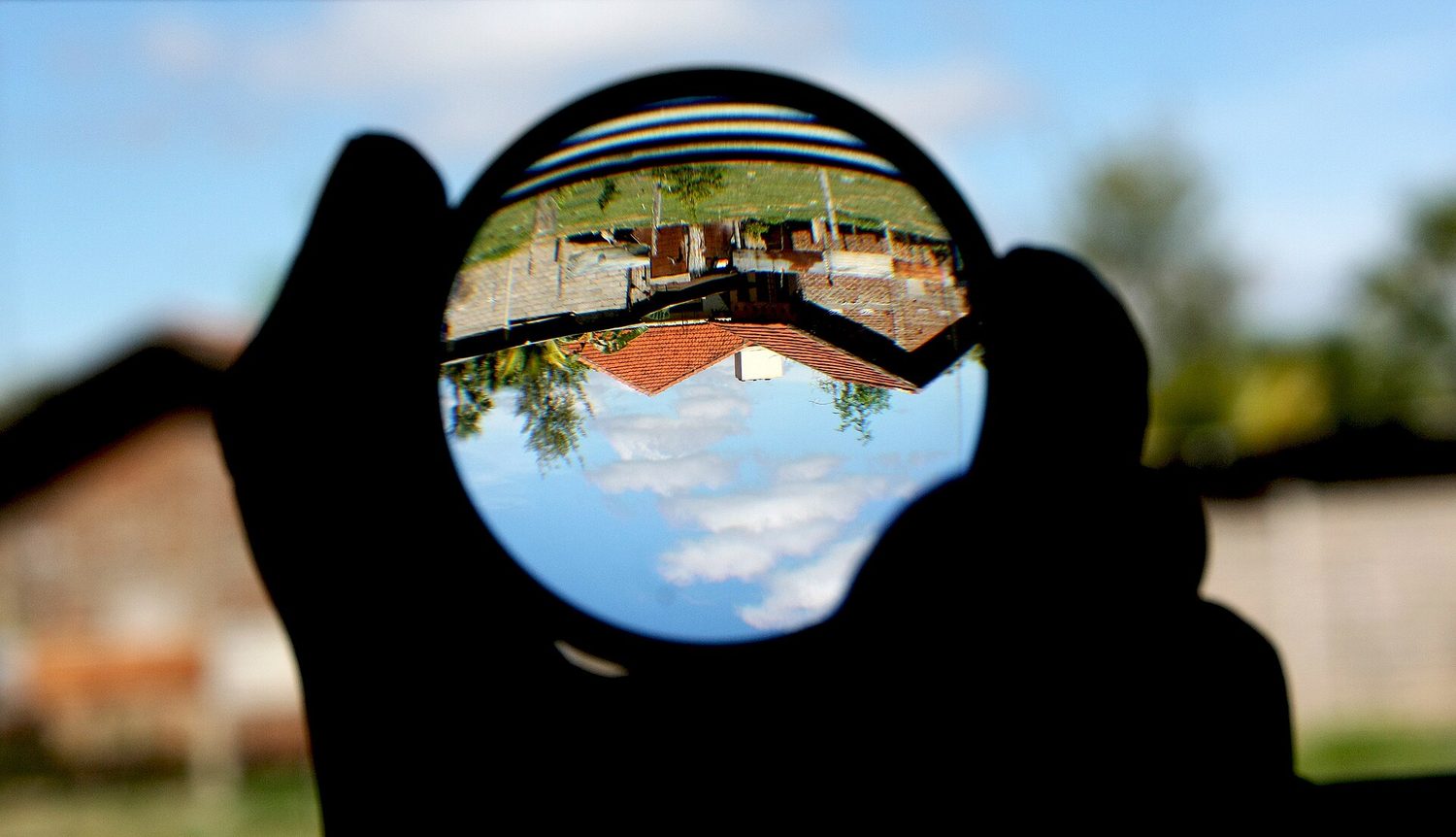
Kaca pembesar menunjukkan gambar terbalik di belakangnya *Lensa cembung membentuk bayangan nyata, terbalik dari pemandangan jauh, tepat seperti yang diprediksi diagram sinar

Explore · ⁨Jelajahi⁩

Form an image with a converging lens · ⁨Bentuk bayangan dengan lensa konvergen⁩

A converging lens bends parallel rays to its focal point. Move the object and watch the image change from large and inverted to virtual and upright inside the focal length. · ⁨Lensa konvergen membengkokkan sinar sejajar ke titik fokusnya. Gerakkan benda dan saksikan bayangan berubah dari besar dan terbalik menjadi maya dan tegak di dalam panjang fokus.⁩

Vocabulary · ⁨Kosa kata⁩ Train · ⁨Latih⁩
English Bahasa Indonesia
converging/kənˈvɜːdʒɪŋ/ Konvergen
diverging/daɪˈvɜːdʒɪŋ/ Divergen
Watch lesson · ⁨Tonton pelajaran⁩
13.4

Exam tips · ⁨Tips ujian⁩

English
  • Measure all angles from the normal, not the surface.
  • Light entering a denser medium (larger $n$) bends toward the normal; use Snell's law $n_1\sin\theta_1=n_2\sin\theta_2$.
  • Total internal reflection happens only going into a less dense medium, beyond the critical angle ($\sin\theta_c=1/n$).
  • For mirrors and lenses use $\tfrac1{d_o}+\tfrac1{d_i}=\tfrac1f$ and $m=-d_i/d_o$: a positive $d_i$ is a real image, negative is virtual.
  • $n=c/v$, so a bigger index means a slower speed of light in the material.
Bahasa Indonesia
  • Ukur semua sudut dari garis normal, bukan permukaannya.
  • Cahaya masuk ke medium yang lebih padat (indeks $n$ lebih besar) membengkok menuju garis normal; gunakan hukum Snell $n_1\sin\theta_1=n_2\sin\theta_2$.
  • Pemantulan internal total hanya terjadi saat memasuki medium yang kurang padat, melebihi sudut kritis ($\sin\theta_c=1/n$).
  • Untuk cermin dan lensa gunakan $\tfrac1{d_o}+\tfrac1{d_i}=\tfrac1f$ dan $m=-d_i/d_o$: positif $d_i$ adalah bayangan nyata, negatif adalah bayangan semu.
  • $n=c/v$, sehingga indeks yang lebih besar berarti kecepatan cahaya yang lebih lambat dalam material tersebut.

Interactive lessons on this topic · ⁨Pelajaran interaktif untuk topik ini⁩

Work through it step by step, with instant-check exercises. · ⁨Kerjakan langkah demi langkah, dengan latihan pengecekan instan.⁩

Past Papers · ⁨Soal-Soil Masa Lalu⁩

More topics in AP Physics 2 · ⁨AP Fisika 2⁩ · ⁨Topik lain dalam AP Physics 2 · ⁨AP Fisika 2⁩⁩

Log in or create account · ⁨Masuk atau buat akun⁩

IGCSE, A-Level & AP