Enduring Understanding (POL-2): Perfectly competitive markets allocate resources efficiently, but imperfect competition often results in market inefficiencies.
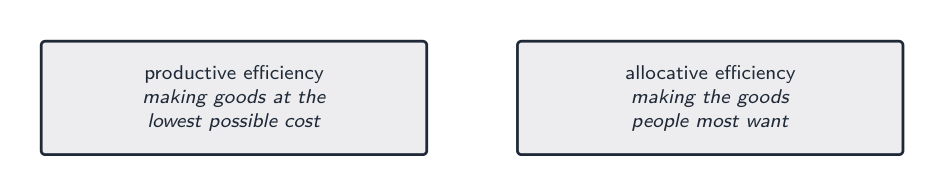
Learning Objective POL-2.A: a. Define social efficiency. b. Explain (using graphs where appropriate) why resource allocation in perfectly competitive markets is socially efficient.
- POL-2.A.1 The optimal quantity of a good occurs where the marginal benefit of consuming the last unit equals the marginal cost of producing that last unit, thus maximizing total economic surplus.
- POL-2.A.2 The market equilibrium quantity is equal to the socially optimal quantity only when all social benefits and costs are internalized by individuals in the market. Total economic surplus is maximized at that quantity. [See also PRD-3 and POL-3.]
Learning Objective POL-2.B: Explain (using graphs where appropriate) how private incentives can lead to actions by rational agents that are socially undesirable (inefficient) market outcomes.
- POL-2.B.1 Rational agents can pursue private actions to exploit or exercise market characteristics known as market power.
- POL-2.B.2 Rational agents make optimal decisions by equating private marginal benefits and private marginal costs that can result in market inefficiencies.
- POL-2.B.3 Policymakers use cost-benefit analysis to evaluate different actions to reduce or eliminate market inefficiencies.
- POL-2.B.4 Market inefficiencies can be eliminated by designing policies that equate marginal social benefit with marginal social cost.
Learning Objective POL-2.C: a. Explain equilibrium allocations in imperfect markets relative to efficient allocations (using graphs where appropriate) and why these markets are inefficient. b. Calculate (using graphs where appropriate) the deadweight loss resulting from the production of a non-efficient quantity.
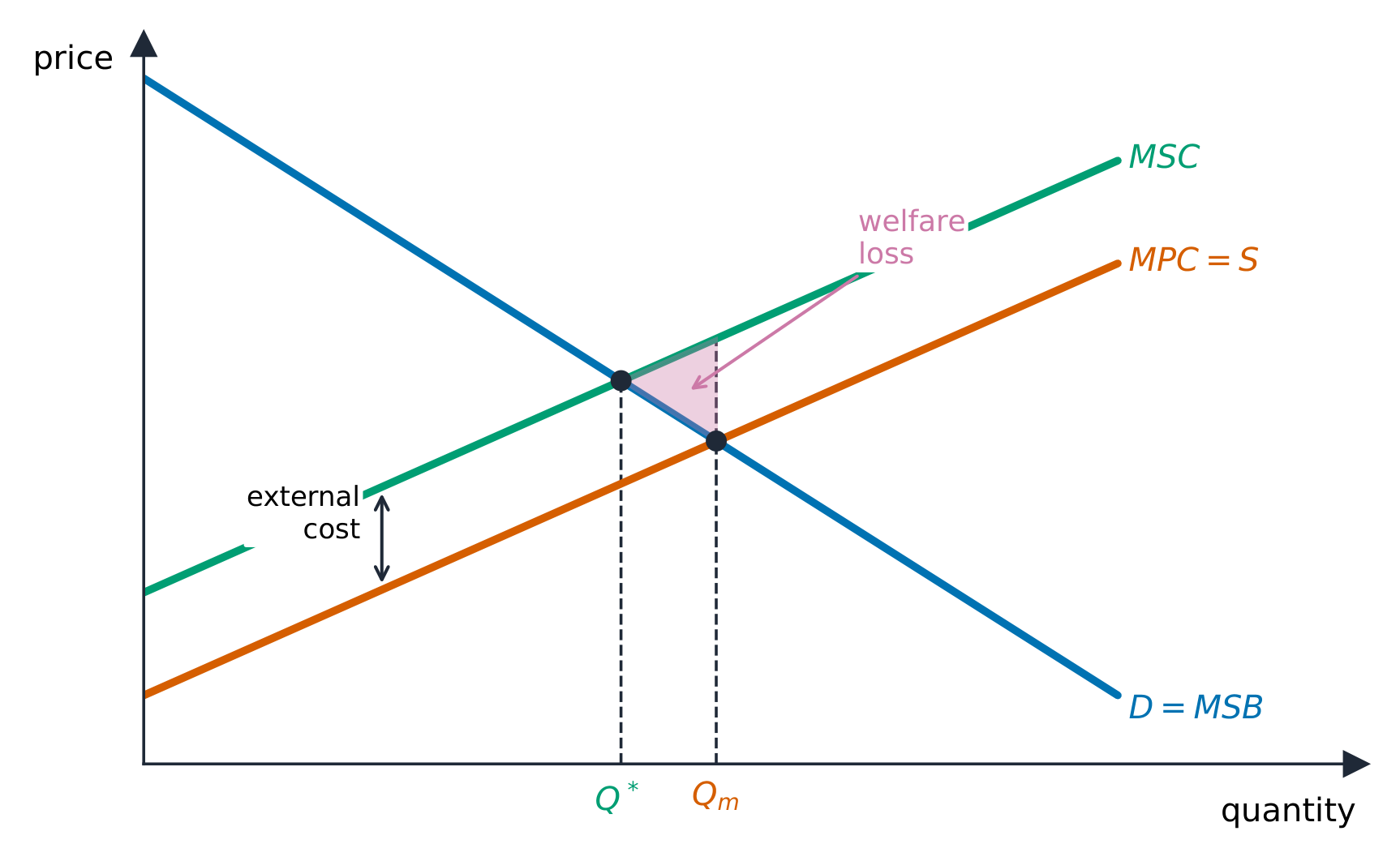
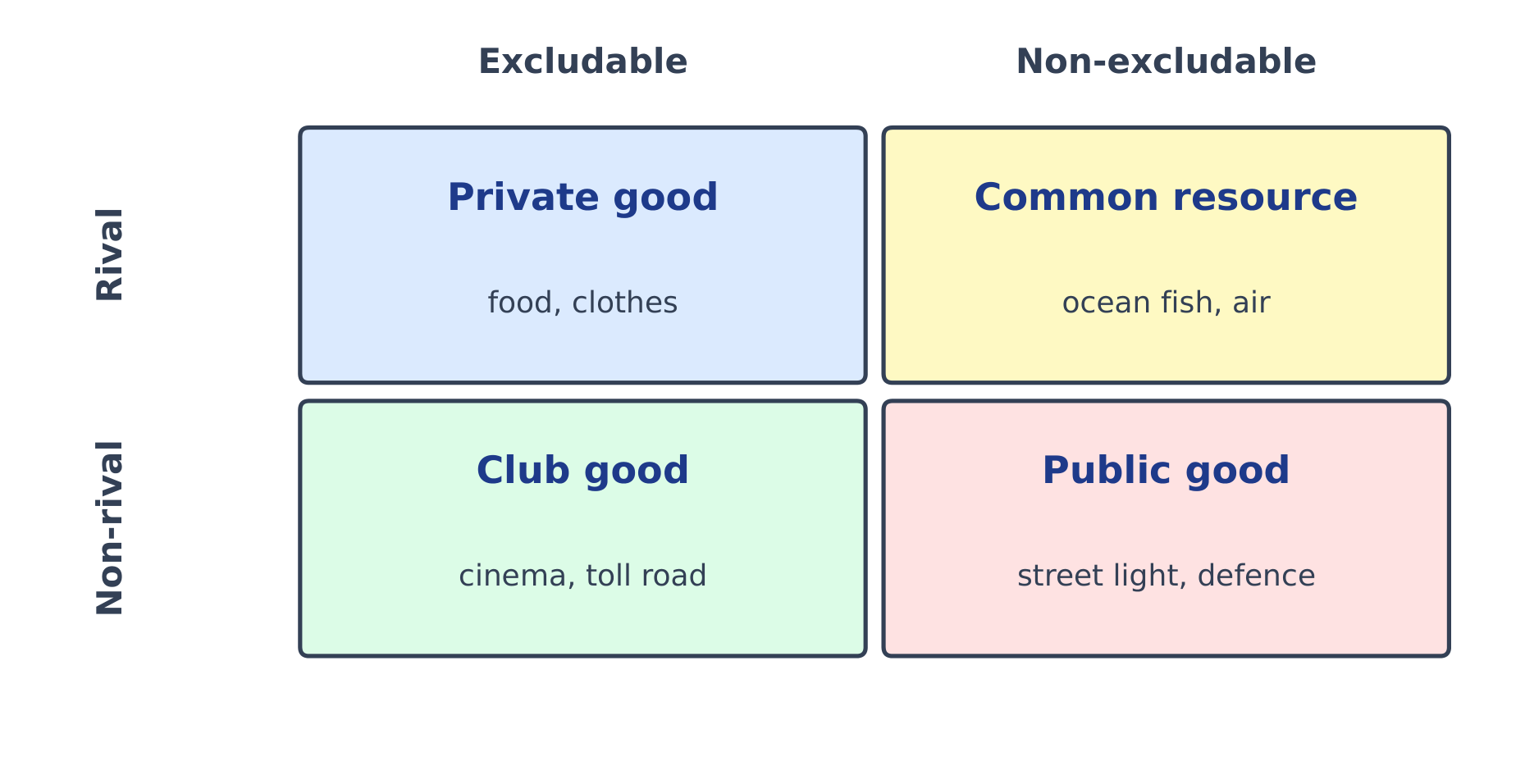
- POL-2.C.1 Equilibrium allocations can deviate from efficient allocations due to situations such as monopoly; oligopoly; monopolistic competition; negative and positive externalities in production or consumption; asymmetric information; and insufficient production of public goods.
- POL-2.C.2 Producing any non-efficient quantity results in deadweight loss.
Compréhension Fondamentale (POL-2): Les marchés parfaitement concurrentiels allouent efficacement les ressources, mais la concurrence imparfaite entraîne souvent des inefficacités de marché.
Objectif d'apprentissage POL-2.A : a. Définir l'efficacité sociale. b. Expliquer (en utilisant des graphiques le cas échéant) pourquoi l'allocation des ressources dans les marchés parfaitement concurrentiels est socialement efficace.
- POL-2.A.1 La quantité optimale d'un bien se situe là où le bénéfice marginal de consommation de la dernière unité est égal au coût marginal de production de cette dernière unité, maximisant ainsi l'excédent économique total.
- POL-2.A.2 La quantité d'équilibre de marché est égale à la quantité socialement optimale uniquement lorsque tous les bénéfices et coûts sociaux sont internalisés par les individus sur le marché. L'excédent économique total est maximisé à cette quantité. [Voir aussi PRD-3 et POL-3.]
Objectif d'apprentissage POL-2.B: Expliquer (en utilisant des graphiques le cas échéant) comment les incitations privées peuvent conduire des agents rationnels à adopter des actions menant à des résultats de marché socialement indésirables (inefficients).
- POL-2.B.1 Les agents rationnels peuvent poursuivre des actions privées pour exploiter ou exercer des caractéristiques de marché appelées pouvoir de marché.
- POL-2.B.2 Les agents rationnels prennent des décisions optimales en égalisant les bénéfices marginaux privés et les coûts marginaux privés, ce qui peut entraîner des inefficacités de marché.
- POL-2.B.3 Les décideurs politiques utilisent l'analyse coûts-avantages pour évaluer différentes actions visant à réduire ou éliminer les inefficacités de marché.
- POL-2.B.4 Les inefficacités de marché peuvent être éliminées en concevant des politiques qui égalisent le bénéfice social marginal avec le coût social marginal.
Objectif d'apprentissage POL-2.C: a. Expliquer les allocations d'équilibre dans les marchés imparfaits par rapport aux allocations efficaces (en utilisant des graphiques le cas échéant) et pourquoi ces marchés sont inefficaces. b. Calculer (en utilisant des graphiques le cas échéant) la perte sèche résultant de la production d'une quantité non efficace.
- POL-2.C.1 Les allocations d'équilibre peuvent s'écarter des allocations efficaces en raison de situations telles que le monopole ; l'oligopole ; la concurrence monopolistique ; les externalités négatives et positives dans la production ou la consommation ; l'information asymétrique ; et la production insuffisante de biens publics.
- POL-2.C.2 Produire n'importe quelle quantité non efficace entraîne une perte sèche.