Inequality
Introduced| English | Meaning |
|---|---|
| Lorenz curve/ˈlɒrənts kɜːv/ | A graph comparing the cumulative share of income or wealth with the cumulative share of the population, ordered from poorest to richest. |
| income inequality/ˈɪŋkʌm ɪniːˈkwɒlɪti/ | Differences in how income received over a period is distributed among people or households. |
| wealth inequality/welθ ɪniːˈkwɒlɪti/ | Differences in the distribution of accumulated assets net of liabilities among people or households. |
| Gini coefficient/ˈdʒiːni ˌkəʊɪˈfɪʃənt/ | A numerical measure of inequality in a distribution, with zero representing complete equality. |
| human capital/ˈhjuːmən ˈkæpɪtl/ | The knowledge, skills, experience and health that contribute to people's productive ability. |
| progressive/prəˈɡresɪv/ | Describing a tax whose average rate increases as the taxable income increases. |
| proportional/prəˈpɔːʃənl/ | Describing a tax that takes the same proportion of the tax base, such as income, at different levels of that base. |
| regressive/rɪˈɡresɪv/ | Describing a tax whose burden falls as a proportion of income as income rises. |
Efficient, but is it fair?
- A market can reach the efficient quantity and still leave some people far richer than others.
- Efficiency is about the size of the pie; fairness is about how it's sliced.
- Economists measure that slicing carefully, without judging it.
- The starting point is the gap between two ideas of inequality.
Income, wealth, and the Lorenz curve
- Income inequality 收入不平等 is differences in what people earn each year.
- Wealth inequality 财富不平等 is differences in the total assets people own — usually far more unequal than income.
- The Lorenz curve 洛伦兹曲线 plots the cumulative share of income against the cumulative share of people, poorest first.
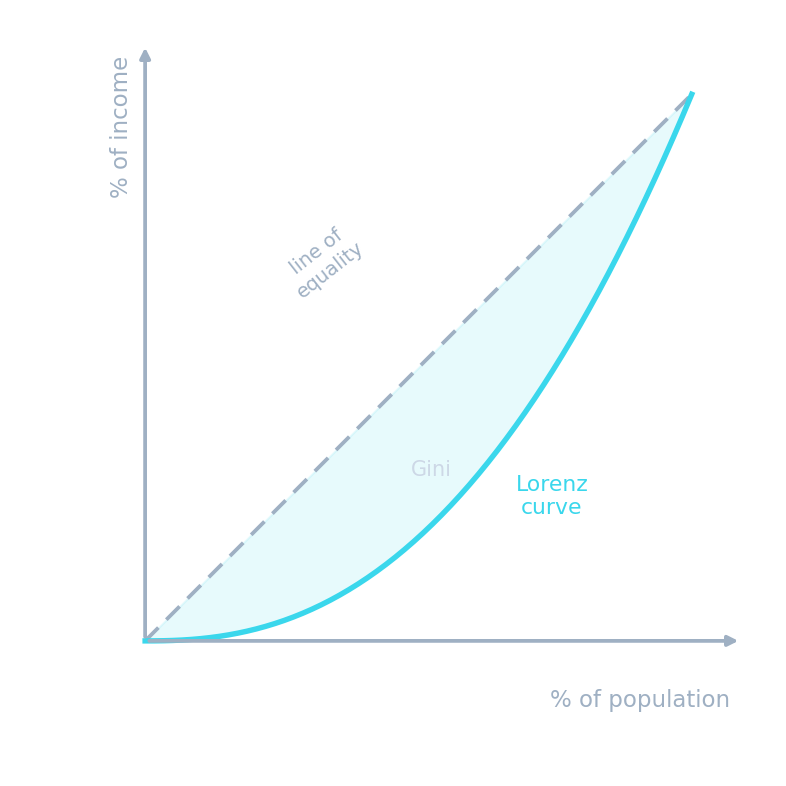
Draw the Lorenz curve
The Lorenz curve plots the cumulative income share against the population share. The more it sags below the 45° line, the higher the Gini coefficient.
Which is usually more unequal?
Difficulty 1/5 · 100 coins + a small bonus on first completion today
Wealth (accumulated assets) is typically distributed far more unequally than yearly income.
The Lorenz curve plots the cumulative share of income against:
Difficulty 1/5 · 100 coins + a small bonus on first completion today
It runs from poorest to richest, comparing income share with population share.
The poorest 50% of people earn 20% of all income. As a decimal, what is the income share (y-value) at population share 0.5?
Difficulty 2/5 · 140 coins + a small bonus on first completion today
The Lorenz curve passes through (0.5, 0.2) — well below the equal-share point (0.5, 0.5).
The Gini coefficient
- The Gini coefficient 基尼系数 summarises the gap in one number: $\text{Gini} = \dfrac{A}{A + B}$.
- Here $A$ is the area between the equality line and the Lorenz curve, and $B$ is the area under the curve.
- It runs from 0 (perfect equality) to 1 (one person has everything) — bigger means more unequal.
A Gini coefficient of 0 means:
Difficulty 1/5 · 100 coins + a small bonus on first completion today
Gini runs 0 (perfect equality) to 1 (one person has all income).
Sources and the tax response
- Inequality comes from differences in human capital 人力资本 (skills and education), discrimination, and inherited wealth.
- A progressive 累进 tax takes a higher percentage from higher incomes (it reduces inequality).
- A proportional 比例 tax takes the same percentage from everyone.
- A regressive 累退 tax takes a higher percentage from lower incomes (it widens inequality).
A tax that takes a higher percentage from higher incomes is called a ______ tax.
Difficulty 1/5 · 100 coins + a small bonus on first completion today
A progressive tax reduces inequality; a regressive tax widens it.
Match each tax type to how it treats incomes.
Difficulty 2/5 · 140 coins + a small bonus on first completion today
Progressive narrows inequality, proportional is flat, regressive widens it.
Income and wealth inequality are pictured by the Lorenz curve and summarised by the Gini coefficient (0 = equal, 1 = one person has all). Inequality flows from human capital, discrimination, and inheritance; a progressive tax narrows it, a regressive tax widens it.
Write from a Lorenz income share of 0.1
- The poorest 40 percent of people earn 10 percent of income.
- State the Lorenz point.
The poorest 40 percent of people earn 10 percent of all income. What Lorenz point is that, as decimals?
40 percent is 0.4 and 10 percent is 0.1.
What is the income share at that point?
Difficulty 1/5 · 100 coins + a small bonus on first completion today
10 percent of income is the share 0.1. Other options — 0.2 (the lesson share for the poorest half); 0.4 (the population share).