Externalities
Introduced| English | Meaning |
|---|---|
| externality/ekˈstɜːnælɪti/ | A cost or benefit of an activity affecting third parties that is not fully reflected in the decision-maker's private costs or benefits. |
| negative externality/ˈneɡətɪv ekˈstɜːnælɪti/ | A cost imposed on others by production or consumption that is not fully reflected in the decision-maker's private costs. |
| third party/θɜːd ˈpɑːti/ | A person or group affected by a decision or transaction despite not being one of its direct participants. |
| marginal private cost/ˈmɑːdʒɪnl ˈpraɪvət kɒst/ | The additional cost borne by the decision-maker from producing or consuming one extra unit. |
| overproduces/ˌəʊvəprəˈdjuːsɪz/ | Produces more than the socially efficient quantity, as can occur when external costs are ignored. |
| positive externality/ˈpɒzɪtɪv ekˈstɜːnælɪti/ | A benefit received by others from production or consumption that is not fully reflected in the decision-maker's private benefits. |
| marginal private benefit/ˈmɑːdʒɪnl ˈpraɪvət ˈbenɪfɪt/ | The additional benefit received by the person or organisation making a decision when one more unit is consumed or produced, excluding external benefits. |
| underproduces/ˌʌndəprəˈdjuːsɪz/ | Produces less than the socially efficient quantity, as can occur when external benefits are ignored. |
| Pigouvian tax/pɪˈɡuːvɪən tæks/ | A corrective tax intended to make decision-makers face the external costs their activity imposes on others. |
| subsidy/ˈsʌbsɪdi/ | Financial assistance, usually from government, that reduces costs or supports a particular activity. |
| tradable permits/ˈtreɪdəbl ˈpɜːmɪts/ | Transferable authorisations allowing specified quantities of an activity, such as pollution emissions. |
The cost you don't pay
- A factory's smoke drifts over a neighbourhood the owner never meets.
- A vaccine protects not just you, but everyone you don't infect.
- These spillovers land on people outside the deal — and the market ignores them.
- Each one is an externality 外部性, and it makes the market produce the wrong amount.
An externality is a cost or benefit that falls on:
Difficulty 1/5 · 100 coins + a small bonus on first completion today
The spillover lands on someone outside the buyer-seller deal.
Negative and positive externalities
- A negative externality 负外部性 (pollution) imposes a cost on a third party 第三方. Marginal social cost sits above the marginal private cost 边际私人成本, so the market overproduces 过度生产.
- A positive externality 正外部性 (vaccination) gives others a benefit. Marginal social benefit sits above the marginal private benefit 边际私人收益, so the market underproduces 生产不足.
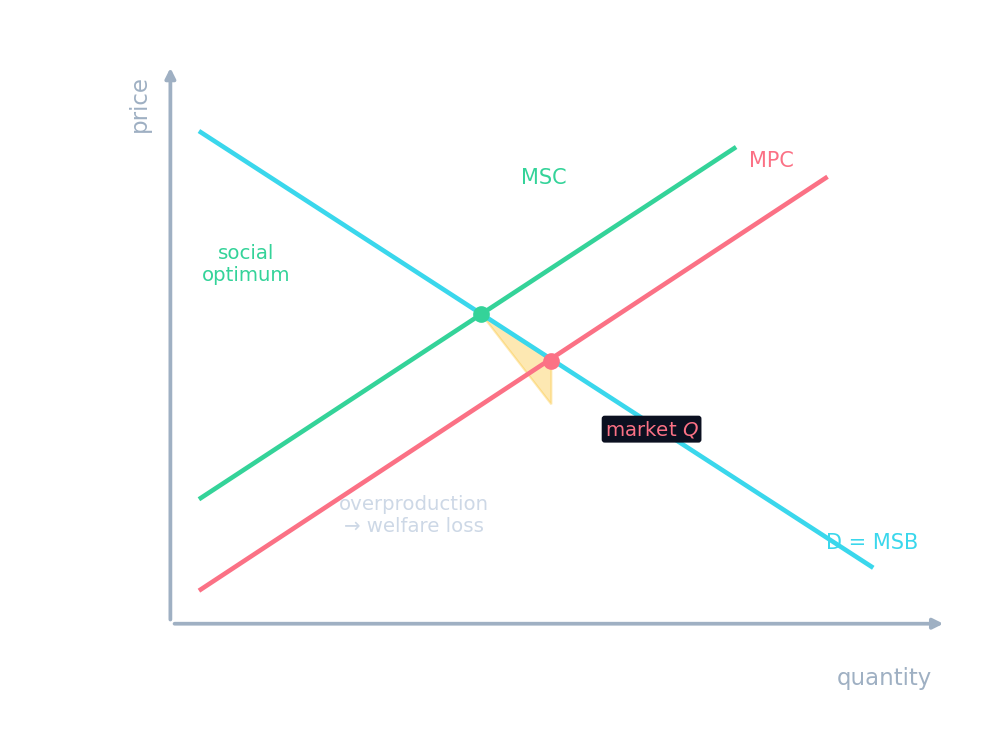
An externality
A negative externality puts social cost above private cost, so the market overproduces. A tax equal to the external cost restores the efficient quantity.
A good with a negative externality (like pollution) is:
Difficulty 1/5 · 100 coins + a small bonus on first completion today
The firm ignores the extra social cost, so it makes more than the efficient quantity.
A good with a positive externality (like vaccination) is underproduced by the market.
Difficulty 1/5 · 100 coins + a small bonus on first completion today
Buyers ignore the benefit to others, so the market makes too little.
How governments correct them
- A Pigouvian tax 庇古税 equal to the external cost raises the polluter's private cost to the social cost, cutting output to the efficient level.
- A subsidy 补贴 equal to the external benefit encourages more of a good thing (like education).
- Tradable permits 可交易许可证 cap total pollution and let firms trade the right to pollute, so cuts happen where they are cheapest.
A tax set equal to the external cost of pollution is called a ______ tax.
Difficulty 1/5 · 100 coins + a small bonus on first completion today
A Pigouvian tax internalises the externality, cutting output to the efficient level.
Select all tools a government can use to correct externalities.
Difficulty 2/5 · 140 coins + a small bonus on first completion today
Taxes, subsidies and permits all make people face the full social cost or benefit.
A worked case
- A factory's private cost of a tonne of steel is 200, but its smoke does 30 of harm to residents.
- So the true social cost is $200 + 30 = 230$; left alone, the factory ignores the 30 and overproduces.
- A Pigouvian tax of exactly 30 makes the factory pay the full 230.
- The tax "internalises" the externality, cutting output to the efficient amount.
A tonne of steel has a private cost of 200 and does 30 of harm to others. What per-tonne Pigouvian tax makes the firm face the full social cost?
Difficulty 2/5 · 140 coins + a small bonus on first completion today
The tax equals the external cost, 30, so the firm pays the full social cost of 230.
An externality spills a cost or benefit onto a third party. A negative one (social cost above private) causes overproduction; a positive one (social benefit above private) causes underproduction. Governments fix them with a Pigouvian tax, a subsidy, or tradable permits.
Write from a social cost of 95
- Private cost of a unit is 80. Smoke does 15 of harm to neighbours.
- Find social cost and the Pigouvian tax.
A unit costs the firm 80 and does 15 of harm to neighbours. What is the social cost, and what per-unit Pigouvian tax makes the firm face it?
80 plus 15 is 95, and the tax equals the external 15.
What per-unit tax matches the external harm?
Difficulty 1/5 · 100 coins + a small bonus on first completion today
The external harm is 15, so the tax is 15. Other options — 30 (the lesson tax); 95 (the whole social cost charged again).