English
7.1 Contextualizing 19th-Century Perspectives and Political Developments
Learning Objective Unit 7.A: Explain the context in which nationalistic and imperialistic sentiments developed in Europe from 1815 to 1914.
- KC-3.4 European states struggled to maintain international stability in an age of nationalism and revolutions.
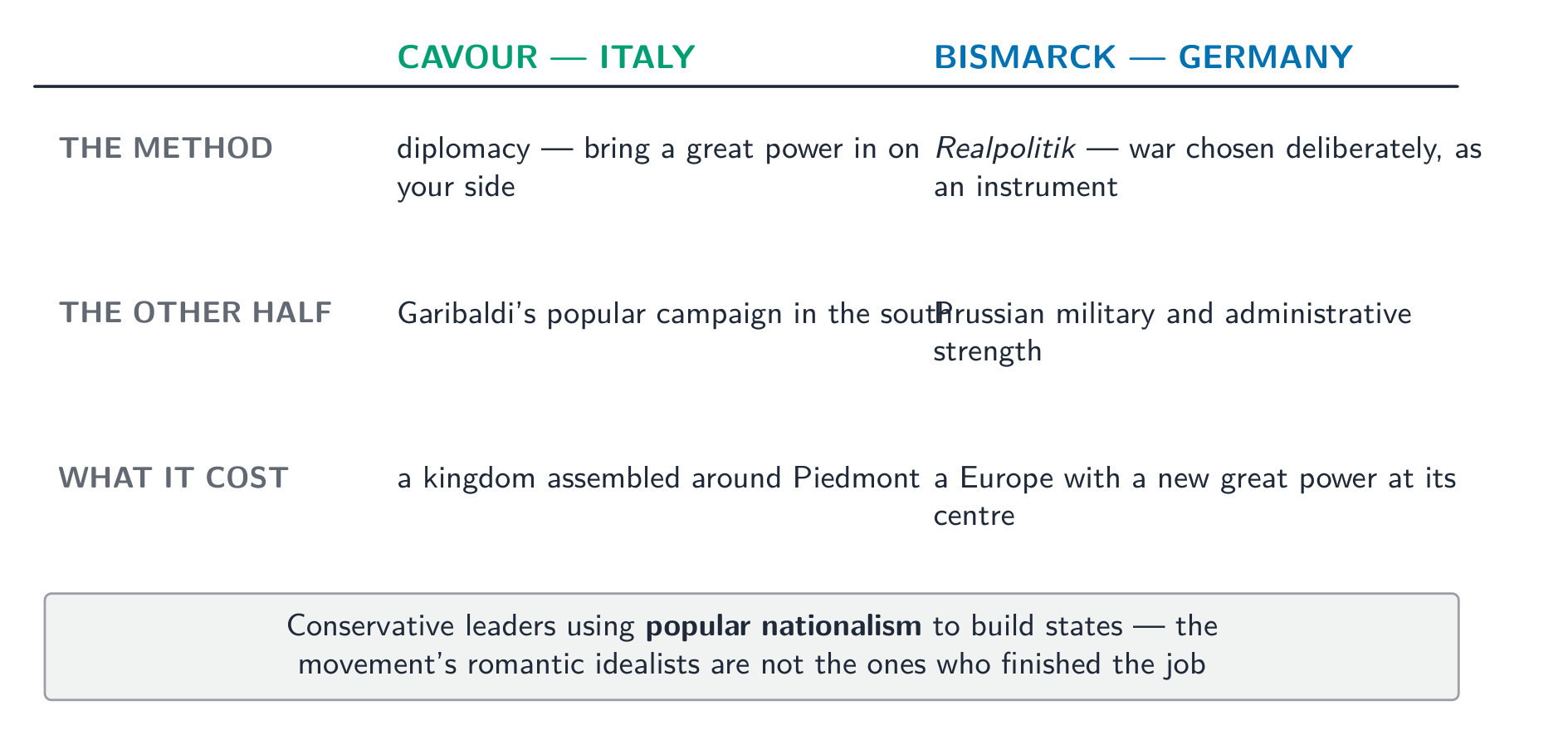
- KC-3.4.II The breakdown of the Concert of Europe opened the door for movements of national unification in Italy and Germany as well as liberal reforms elsewhere.
- KC-3.4.III The unification of Italy and Germany transformed the European balance of power and led to efforts to construct a new diplomatic order.
- KC-3.5 A variety of motives and methods led to the intensification of European global control and increased tensions among the Great Powers.
- KC-3.5.II Industrial and technological developments (e.g., the second industrial revolution) facilitated European control of global empires.
- KC-3.6 European ideas and culture expressed a tension between objectivity and scientific realism on one hand, and subjectivity and individual expression on the other.
- KC-3.6.II Following the revolutions of 1848, Europe turned toward a realist and materialist worldview.
Français
7.1 Contextualiser les perspectives et développements politiques du 19e siècle
Objectif d'apprentissage Unité 7.A : Expliquer le contexte dans lequel se sont développés les sentiments nationalistes et impérialistes en Europe de 1815 à 1914.
- KC-3.4 Les États européens ont lutté pour maintenir la stabilité internationale à une ère de nationalisme et de révolutions.
- KC-3.4.II L'effondrement du Concert de l'Europe a ouvert la porte aux mouvements d'unification nationale en Italie et en Allemagne ainsi qu'aux réformes libérales ailleurs.
- KC-3.4.III L'unification de l'Italie et de l'Allemagne a transformé l'équilibre des puissances européennes et conduit à des efforts pour construire un nouvel ordre diplomatique.
- KC-3.5 Une variété de motifs et de méthodes ont conduit à l'intensification du contrôle global européen et à une augmentation des tensions parmi les Grandes Puissances.
- KC-3.5.II Les développements industriels et technologiques (par exemple, la deuxième révolution industrielle) ont facilité le contrôle européen des empires mondiaux.
- KC-3.6 Les idées et la culture européennes exprimaient une tension entre l'objectivité et le réalisme scientifique d'une part, et la subjectivité et l'expression individuelle d'autre part.
- KC-3.6.II Après les révolutions de 1848, l'Europe s'est tournée vers une vision du monde réaliste et matérialiste.