Skip to content · ⁨Saltar al contenido⁩

Integración y Acumulación de Cambio

AP Cálculo AB · Topic 6 · ⁨Tema 6⁩

Train · ⁨Entrenar⁩
Video lesson for this topic · ⁨Lección de video para este tema⁩ Open the video page · ⁨Abrir la página de video⁩
10:18

Acumulación e Integración

La diferenciación encontró tasas de cambio. La integración lo hace al revés: dada una tasa, encuentra el cambio acumulado total. Aquí está la imagen clave. Agua…

English narration · English + 中文 subtitles burned in · ⁨Narración en inglés · Subtítulos en inglés + 中文 quemados en pantalla⁩

6.1

Exploring Accumulations of Change · ⁨Explorando acumulaciones de cambio⁩

Syllabus
English

Enduring Understanding (CHA-4): Definite integrals allow us to solve problems involving the accumulation of change over an interval.

Learning Objective CHA-4.A: Interpret the meaning of areas associated with the graph of a rate of change in context.

  • CHA-4.A.1 The area of the region between the graph of a rate of change function and the $x$ axis gives the accumulation of change.
  • CHA-4.A.2 In some cases, accumulation of change can be evaluated by using geometry.
  • CHA-4.A.3 If a rate of change is positive (negative) over an interval, then the accumulated change is positive (negative).
  • CHA-4.A.4 The unit for the area of a region defined by rate of change is the unit for the rate of change multiplied by the unit for the independent variable.
Español

Comprensión duradera (CHA-4): Las integrales definidas nos permiten resolver problemas que involucran la acumulación de cambio sobre un intervalo.

Objetivo de aprendizaje CHA-4.A: Interpretar el significado de las áreas asociadas con la gráfica de una tasa de cambio en su contexto.

  • CHA-4.A.1 El área de la región entre la gráfica de una función de tasa de cambio y el eje $x$ representa la acumulación de cambio.
  • CHA-4.A.2 En algunos casos, la acumulación de cambio puede evaluarse utilizando geometría.
  • CHA-4.A.3 Si una tasa de cambio es positiva (negativa) sobre un intervalo, entonces el cambio acumulado es positivo (negativo).
  • CHA-4.A.4 La unidad para el área de una región definida por una tasa de cambio es la unidad de la tasa de cambio multiplicada por la unidad de la variable independiente.
Source: College Board AP Course and Exam Description · ⁨Fuente: College Board AP Course and Exam Description⁩

English

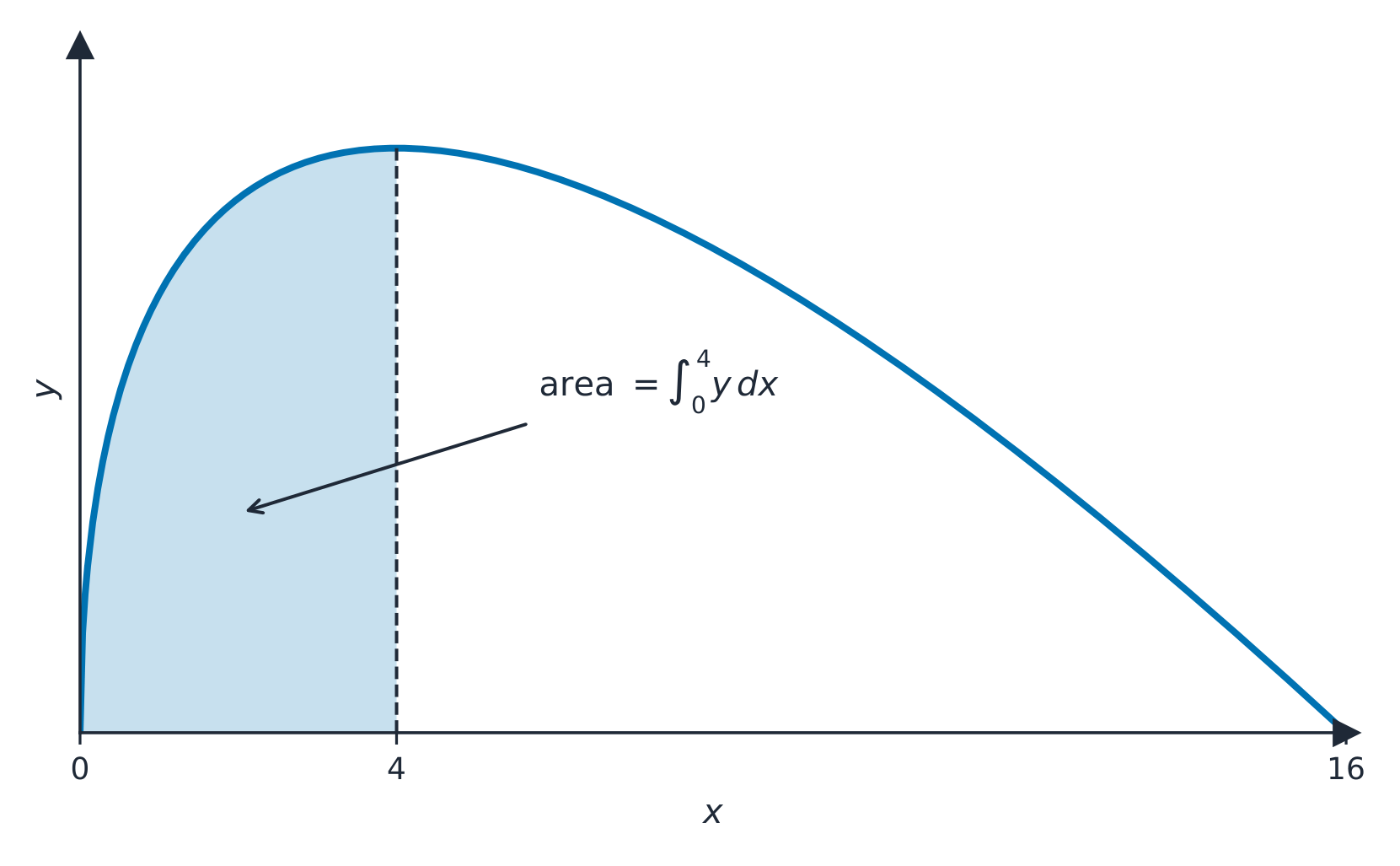
Differentiation found rates. Integration runs the idea in reverse: given a rate of change, it finds the accumulated change 累积变化. The key picture: the area between the graph of a rate function and the $x$-axis gives the total accumulation.

  • If the rate is positive over an interval, the accumulated change is positive; if negative, negative. Area below the axis counts as negative.
  • Simple regions (triangles, rectangles) can be found with geometry 几何.
  • Units: the area's unit is the rate's unit times the input's unit. A rate in vehicles-per-hour times hours gives vehicles.
Español
Un tanque de agua: la integración acumula el cambio: volumen total a partir de una tasa de flujo

La diferenciación encontró tasas. La integración invierte esta idea: dada una tasa de cambio, encuentra el cambio acumulado. La imagen clave: el área entre la gráfica de una función de tasa y el eje $x$ da la acumulación total.

  • Si la tasa es positiva durante un intervalo, el cambio acumulado es positivo; si es negativa, negativo. El área bajo el eje cuenta como negativa.
  • Las regiones simples (triángulos, rectángulos) pueden encontrarse con geometría.
  • Unidades: la unidad del área es la unidad de la tasa multiplicada por la unidad de entrada. Una tasa en vehículos por hora multiplicada por horas da vehículos.
6.2

Approximating Areas with Riemann Sums · ⁨Aproximación de áreas con sumas de Riemann⁩

Syllabus
English

Enduring Understanding (LIM-5): Definite integrals can be approximated using geometric and numerical methods.

Learning Objective LIM-5.A: Approximate a definite integral using geometric and numerical methods.

  • LIM-5.A.1 Definite integrals can be approximated for functions that are represented graphically, numerically, analytically, and verbally.
  • LIM-5.A.2 Definite integrals can be approximated using a left Riemann sum, a right Riemann sum, a midpoint Riemann sum, or a trapezoidal sum; approximations can be computed using either uniform or nonuniform partitions.
  • LIM-5.A.3 Definite integrals can be approximated using numerical methods, with or without technology.
  • LIM-5.A.4 Depending on the behavior of a function, it may be possible to determine whether an approximation for a definite integral is an underestimate or overestimate for the value of the definite integral.
Español

Comprensión perdurable (LIM-5): Las integrales definidas pueden aproximarse utilizando métodos geométricos y numéricos.

Objetivo de aprendizaje LIM-5.A: Aproximar una integral definida mediante métodos geométricos y numéricos.

  • LIM-5.A.1 Las integrales definidas pueden aproximarse para funciones representadas gráficamente, numéricamente, analíticamente y verbalmente.
  • LIM-5.A.2 Las integrales definidas pueden aproximarse mediante una suma de Riemann izquierda, una suma de Riemann derecha, una suma de Riemann del punto medio o una suma trapezoidal; las aproximaciones pueden calcularse utilizando particiones uniformes o no uniformes.
  • LIM-5.A.3 Las integrales definidas pueden aproximarse mediante métodos numéricos, con o sin el uso de tecnología.
  • LIM-5.A.4 Según el comportamiento de una función, puede ser posible determinar si una aproximación para una integral definida es una subestimación o una sobreestimación del valor de la integral definida.

Source: College Board AP Course and Exam Description · ⁨Fuente: College Board AP Course and Exam Description⁩

English
The integral as area (Riemann sums)
Trapezoidal sums approximate area

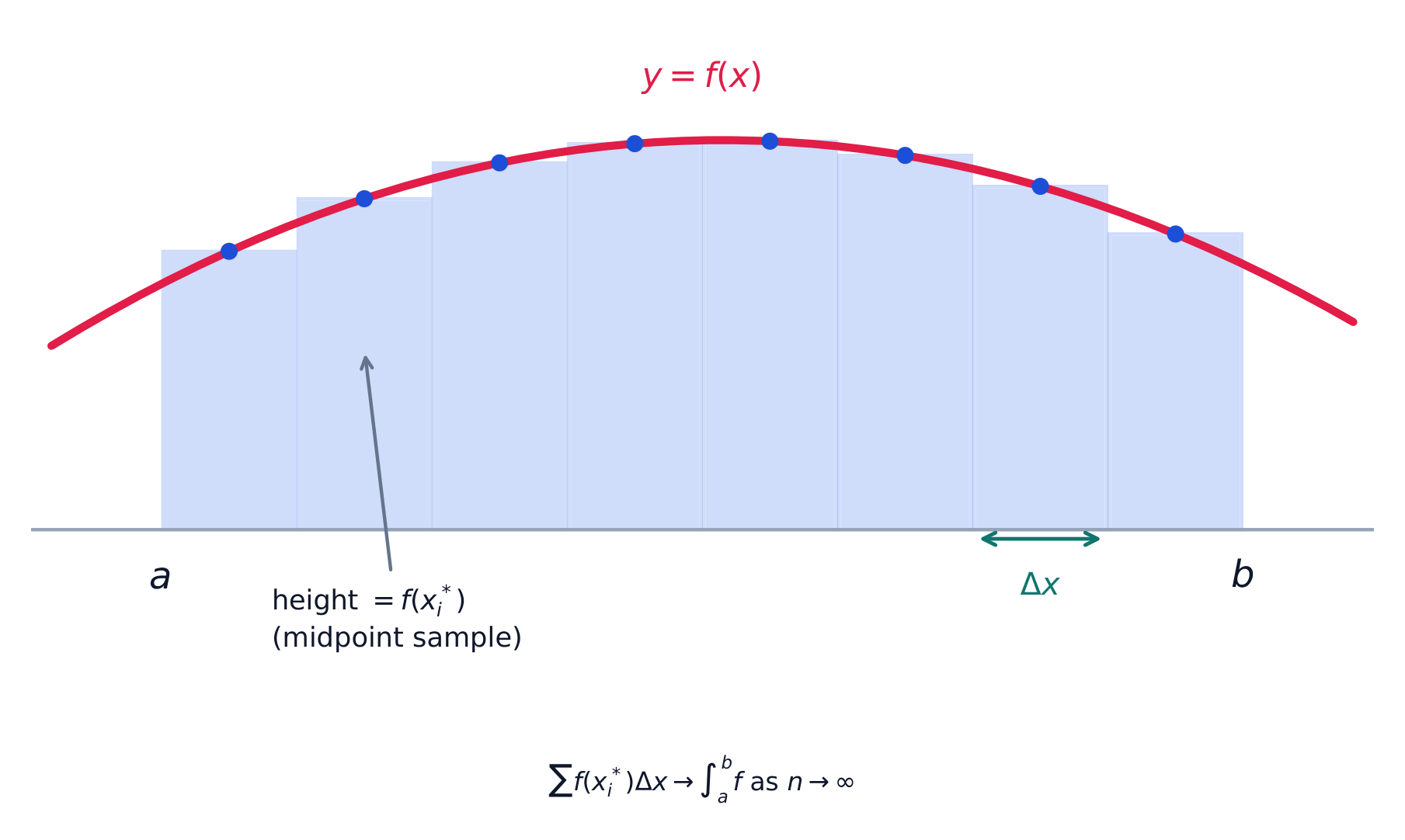
When exact area is hard, approximate it with a Riemann sum 黎曼和 – split the interval into subintervals and add up rectangle (or trapezoid) areas. The four standard estimates:

  • Left Riemann sum – rectangle height from the left endpoint of each subinterval.
  • Right Riemann sum – height from the right endpoint.
  • Midpoint Riemann sum – height from the midpoint 中点.
  • Trapezoidal sum 梯形法 – average the two endpoint heights (a trapezoid).

Subintervals may be uniform (equal width) or nonuniform – read widths from the table.

Over- or underestimate? Judge from the behavior of the function: for an increasing function, a left sum underestimates and a right sum overestimates; a trapezoidal sum overestimates when the function is concave up and underestimates when concave down. Exam parts ask you to state which and why.

Worked example. A table gives $f(0)=3$, $f(2)=5$, $f(4)=8$, $f(6)=9$. Estimate $\int_0^6 f(x)\,dx$ with a right Riemann sum of three equal subintervals ($\Delta x=2$). Use the right endpoint of each strip:

$$2\big(f(2)+f(4)+f(6)\big)=2(5+8+9)=44.$$
Since $f$ is increasing, this right sum is an overestimate; the left sum $2(3+5+8)=32$ would be an underestimate.

Español
La integral como área (sumas de Riemann)
Las sumas trapezoidales aproximan el área

Cuando el área exacta es difícil de calcular, approxímala con una suma de Riemann: divide el intervalo en subintervalos y suma las áreas de los rectángulos (o trapecios). Las cuatro estimaciones estándar:

Una suma de Riemann: rectángulos de ancho dx aproximan el área bajo una curva
Cada rectángulo tiene un área $f(x)\,\Delta x$; sumarlos estima el área y, a medida que las tiras se estrechan, la suma se aproxima a la integral definida.
  • Suma de Riemann Izquierda – la altura del rectángulo proviene del extremo izquierdo de cada subintervalo.
  • Suma de Riemann Derecha – la altura proviene del extremo derecho.
  • Suma de Riemann de Punto Medio – la altura proviene del punto medio 中点.
  • Suma Trapezoidal 梯形法 – promedia las dos alturas de los extremos (un trapecio).

Los subintervalos pueden ser uniformes (ancho igual) o no uniformes – lee los anchos de la tabla.

¿Sobreestimación o subestimación? Juzga según el comportamiento de la función: para una función creciente, una suma izquierda subestima y una suma derecha sobreestima; una suma trapezoidal sobreestima cuando la función es cóncava hacia arriba y subestima cuando es cóncava hacia abajo. Las partes del examen te piden indicar cuál es y por qué.

Ejemplo resuelto. Una tabla proporciona $f(0)=3$, $f(2)=5$, $f(4)=8$, $f(6)=9$. Estima $\int_0^6 f(x)\,dx$ con una suma de Riemann derecha de tres subintervalos iguales ($\Delta x=2$). Usa el extremo derecho de cada tira:

$$2\big(f(2)+f(4)+f(6)\big)=2(5+8+9)=44.$$
Dado que $f$ es creciente, esta suma derecha es una sobreestimación; la suma izquierda $2(3+5+8)=32$ sería una subestimación.

Explore · ⁨Explorar⁩

Aproximar el área con rectángulos

y = ax³ + bx² + cx + d

Una suma de Riemann aproxima el área bajo una curva con rectángulos. Añade más rectángulos, más delgados, y la estimación converge hacia el integral definido exacto.

Vocabulary · ⁨Vocabulario⁩ Train · ⁨Entrenar⁩
English · ⁨Inglés⁩ Chinese · ⁨Chino⁩ Pinyin
accumulated change/əˈkjuːmjʊleɪtɪd tʃeɪndʒ/ 累积变化 lěi jī biàn huà
geometry/dʒiˈɒmətri/ 几何 jǐ hé
Riemann sum/ˈriːmən sʌm/ 黎曼和 lí màn hé
midpoint/ˈmɪdpɔɪnt/ 中点 zhōng diǎn
Trapezoidal sum/ˈtræpɪzɔɪdl sʌm/ 梯形法 tī xíng fǎ
definite integral/ˈdefɪnət ˈɪntɪɡrəl/ 定积分 dìng jī fēn
6.3

Riemann Sums and Integral Notation · ⁨Sumas de Riemann y Notación Integral⁩

Syllabus
English

Enduring Understanding (LIM-5): Definite integrals can be approximated using geometric and numerical methods.

Learning Objective LIM-5.B: Interpret the limiting case of the Riemann sum as a definite integral.

  • LIM-5.B.1 The limit of an approximating Riemann sum can be interpreted as a definite integral.
  • LIM-5.B.2 A Riemann sum, which requires a partition of an interval $I$, is the sum of products, each of which is the value of the function at a point in a subinterval multiplied by the length of that subinterval of the partition.

Learning Objective LIM-5.C: Represent the limiting case of the Riemann sum as a definite integral.

  • LIM-5.C.1 The definite integral of a continuous function $f$ over the interval $[a, b]$, denoted by $\int_{a}^{b} f(x)\,dx$, is the limit of Riemann sums as the widths of the subintervals approach 0. That is, $\int_{a}^{b} f(x)\,dx = \lim_{\max \Delta x_i \to 0} \sum_{i=1}^{n} f(x_i^{*})\Delta x_i$, where $n$ is the number of subintervals, $\Delta x_i$ is the width of the $i$th subinterval, and $x_i^{*}$ is a value in the $i$th subinterval.
  • LIM-5.C.2 A definite integral can be translated into the limit of a related Riemann sum, and the limit of a Riemann sum can be written as a definite integral.
Español

Comprensión Duradera (LIM-5): Las integrales definidas pueden aproximarse mediante métodos geométricos y numéricos.

Objetivo de Aprendizaje LIM-5.B: Interpretar el caso límite de la suma de Riemann como una integral definida.

  • LIM-5.B.1 El límite de una suma de Riemana aproximante puede interpretarse como una integral definida.
  • LIM-5.B.2 Una suma de Riemann, que requiere una partición de un intervalo $I$, es la suma de productos, cada uno de los cuales es el valor de la función en un punto de un subintervalo multiplicado por la longitud de dicho subintervalo de la partición.

Objetivo de Aprendizaje LIM-5.C: Representar el caso límite de la suma de Riemann como una integral definida.

  • LIM-5.C.1 La integral definida de una función continua $f$ sobre el intervalo $[a, b]$, denotada por $\int_{a}^{b} f(x)\,dx$, es el límite de las sumas de Riemann cuando los anchos de los subintervalos se acercan a 0. Es decir, $\int_{a}^{b} f(x)\,dx = \lim_{\max \Delta x_i \to 0} \sum_{i=1}^{n} f(x_i^{*})\Delta x_i$, donde $n$ es el número de subintervalos, $\Delta x_i$ es el ancho del $i$-ésimo subintervalo y $x_i^{*}$ es un valor dentro del $i$-ésimo subintervalo.
  • LIM-5.C.2 Una integral definida puede traducirse al límite de una suma de Riemann relacionada, y el límite de una suma de Riemann puede escribirse como una integral definida.

Source: College Board AP Course and Exam Description · ⁨Fuente: College Board AP Course and Exam Description⁩

English

As the subinterval widths shrink to zero, the Riemann sum approaches an exact value – the definite integral 定积分:

$$\int_a^b f(x)\,dx = \lim_{\max \Delta x_i \to 0}\sum_{i=1}^{n} f(x_i^{*})\,\Delta x_i.$$
Here $\Delta x_i$ is the width of the $i$th subinterval and $x_i^{*}$ a point inside it. So a definite integral is the limit of a Riemann sum, and you should be able to translate each into the other.

Español

A medida que los anchos de los subintervalos se reducen a cero, la suma de Riemann se aproxima a un valor exacto – la integral definida 定积分:

$$\int_a^b f(x)\,dx = \lim_{\max \Delta x_i \to 0}\sum_{i=1}^{n} f(x_i^{*})\,\Delta x_i.$$
Aquí $\Delta x_i$ es el ancho del subintervalo $i$ y $x_i^{*}$ un punto dentro de él. Por lo tanto, una integral definida es el límite de una suma de Riemann, y deberías poder traducir una en la otra.

6.4

The Fundamental Theorem of Calculus and Accumulation Functions · ⁨El Teorema Fundamental del Cálculo y Funciones de Acumulación⁩

Syllabus
English

Enduring Understanding (FUN-5): The Fundamental Theorem of Calculus connects differentiation and integration.

Learning Objective FUN-5.A: Represent accumulation functions using definite integrals.

  • FUN-5.A.1 The definite integral can be used to define new functions.
    • Illustrative examples for FUN-5.A.1: $f(x) = \int_{0}^{x} e^{-t^2}\,dt$.
  • FUN-5.A.2 If $f$ is a continuous function on an interval containing $a$, then $\dfrac{d}{dx}\left( \int_{a}^{x} f(t)\,dt \right) = f(x)$, where $x$ is in the interval.
Español

Comprensión Duradera (FUN-5): El Teorema Fundamental del Cálculo conecta la diferenciación y la integración.

Objetivo de Aprendizaje FUN-5.A: Representar funciones de acumulación mediante integrales definidas.

  • FUN-5.A.1 La integral definida puede utilizarse para definir nuevas funciones.
    • Ejemplos ilustrativos para FUN-5.A.1: $f(x) = \int_{0}^{x} e^{-t^2}\,dt$.
  • FUN-5.A.2 Si $f$ es una función continua en un intervalo que contiene a $a$, entonces $\dfrac{d}{dx}\left( \int_{a}^{x} f(t)\,dt \right) = f(x)$, donde $x$ está en el intervalo.

Source: College Board AP Course and Exam Description · ⁨Fuente: College Board AP Course and Exam Description⁩

English
The Fundamental Theorem of Calculus

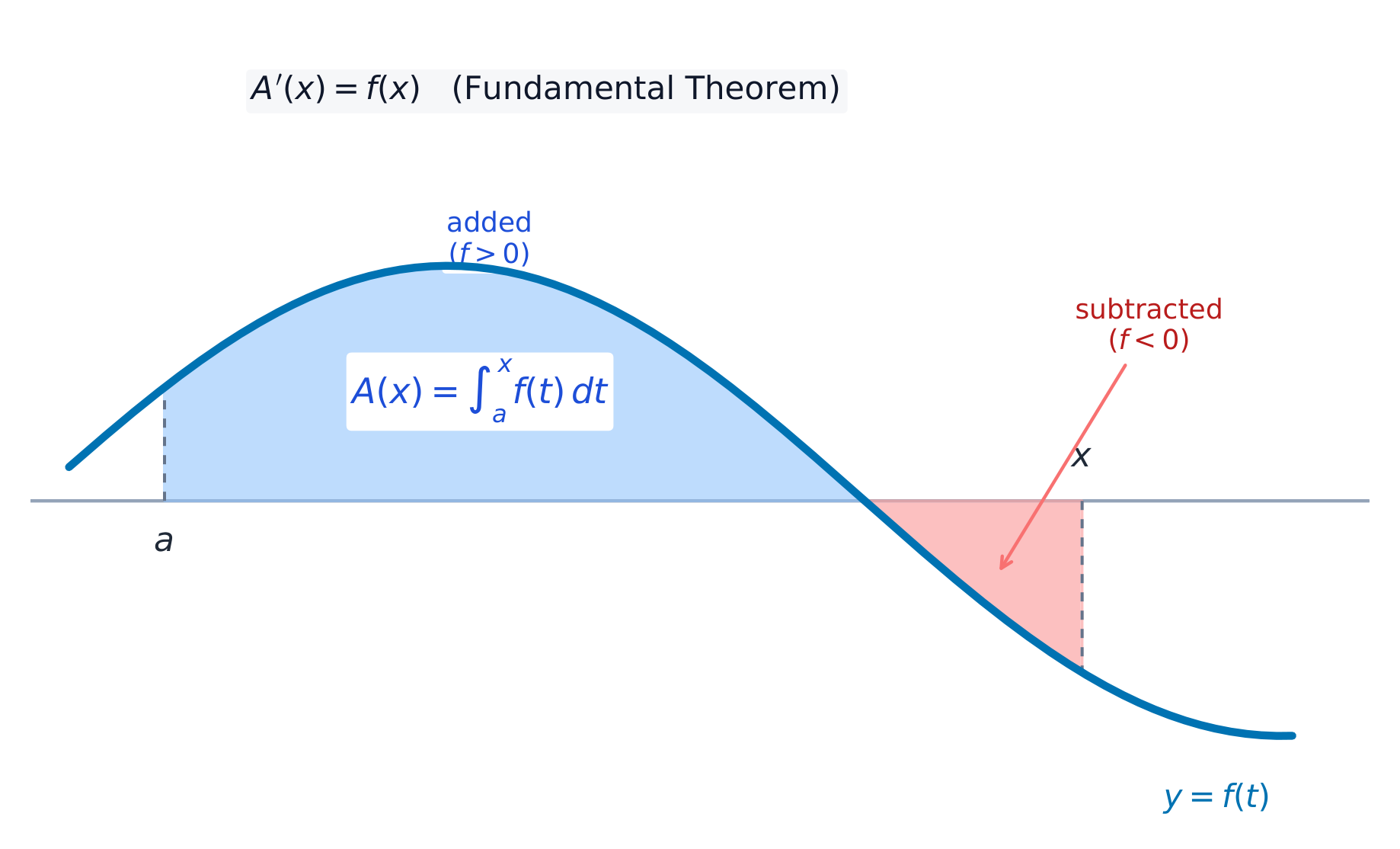
A definite integral with a variable upper limit defines a new accumulation function 累积函数. The Fundamental Theorem of Calculus 微积分基本定理 (first part) says differentiation undoes this accumulation: if $f$ is continuous, then

$$\frac{d}{dx}\int_a^x f(t)\,dt = f(x).$$
So if $g(x)=\int_a^x f(t)\,dt$, then $g'(x)=f(x)$ and $g''(x)=f'(x)$. This is the engine behind the very common "let $g(x)=\int_a^x f(t)\,dt$" questions.

Español
El Teorema Fundamental del Cálculo

Una integral definida con un límite superior variable define una nueva función de acumulación 累积函数. El Teorema Fundamental del Cálculo 微积分基本定理 (primera parte) dice que la diferenciación deshace esta acumulación: si $f$ es continua, entonces

$$\frac{d}{dx}\int_a^x f(t)\,dt = f(x).$$
Así que si $g(x)=\int_a^x f(t)\,dt$, entonces $g'(x)=f(x)$ y $g''(x)=f'(x)$. Este es el motor detrás de las preguntas muy comunes "sea $g(x)=\int_a^x f(t)\,dt$".

La función de acumulación añade área firmada; el FTC dice que su derivada es f
Explore · ⁨Explorar⁩

Acumular el área como una integral

y = ax³ + bx² + cx + d

Una función de acumulación $\int_a^x f(t)\,dt$ construye área firmada a medida que $x$ se mueve. El Teorema Fundamental dice que su derivada es simplemente $f(x)$.

Vocabulary · ⁨Vocabulario⁩ Train · ⁨Entrenar⁩
English · ⁨Inglés⁩ Chinese · ⁨Chino⁩ Pinyin
accumulation function/əˌkjuːmjʊˈleɪʃn ˈfʌŋkʃn/ 累积函数 lěi jī hán shù
Fundamental Theorem of Calculus/ˌfʌndəˈmentl ˈθɪərəm ɒv ˈkælkjʊləs/ 微积分基本定理 wēi jī fēn jī běn dìng lǐ
antiderivative/ˌæntɪdɪˈrɪvətɪv/ 原函数 yuán hán shù
indefinite integral/ɪnˈdefɪnət ˈɪntɪɡrəl/ 不定积分 bù dìng jī fēn
constant of integration/ˈkɒnstənt ɒv ˌɪntɪˈɡreɪʃn/ 积分常数 jī fēn cháng shù
u-substitution/juː ˌsʌbstɪˈtjuːʃn/ 换元积分法 huàn yuán jī fēn fǎ
polynomial long division/ˌpɒlɪˈnəʊmɪəl lɒŋ dɪˈvɪʒn/ 多项式长除法 duō xiàng shì zhǎng chú fǎ
completing the square/kəmˈpliːtɪŋ ðə skweə/ 配方法 pèi fāng fǎ
6.5

Behavior of Accumulation Functions · ⁨Comportamiento de las Funciones de Acumulación⁩

Syllabus
English

Enduring Understanding (FUN-5): The Fundamental Theorem of Calculus connects differentiation and integration.

Learning Objective FUN-5.A: Represent accumulation functions using definite integrals.

  • FUN-5.A.3 Graphical, numerical, analytical, and verbal representations of a function $f$ provide information about the function $g$ defined as $g(x) = \int_{a}^{x} f(t)\,dt$.
Español

Comprensión duradera (FUN-5): El Teorema Fundamental del Cálculo conecta la diferenciación y la integración.

Objetivo de aprendizaje FUN-5.A: Representar funciones de acumulación mediante integrales definidas.

  • FUN-5.A.3 Las representaciones gráficas, numéricas, analíticas y verbales de una función $f$ proporcionan información sobre la función $g$ definida como $g(x) = \int_{a}^{x} f(t)\,dt$.

Source: College Board AP Course and Exam Description · ⁨Fuente: College Board AP Course and Exam Description⁩

English

Because $g'(x)=f(x)$, everything from Unit 5 applies to an accumulation function using the graph of $f$:

  • $g$ is increasing where $f>0$ and decreasing where $f<0$;
  • $g$ has a local extremum where $f$ crosses zero (with a sign change);
  • $g$ is concave up where $f$ is increasing; inflection points of $g$ occur where $f$ has a local extremum.

To get a value of $g$, compute the signed area: $g(x)=\int_a^x f(t)\,dt$, adding areas above the axis and subtracting areas below.

Español

Porque $g'(x)=f(x)$, todo lo del Unidad 5 se aplica a una función de acumulación usando la gráfica de $f$:

  • $g$ es creciente donde $f>0$ y decreciente donde $f<0$;
  • $g$ tiene un extremo local donde $f$ cruza cero (con un cambio de signo);
  • $g$ es cóncava hacia arriba donde $f$ es creciente; los puntos de inflexión de $g$ ocurren donde $f$ tiene un extremo local.

Para obtener un valor de $g$, calcula el área firmada: $g(x)=\int_a^x f(t)\,dt$, sumando las áreas por encima del eje y restando las áreas por debajo.

6.6

Properties of Definite Integrals · ⁨Propiedades de las Integrales Definidas⁩

Syllabus
English

Enduring Understanding (FUN-6): Recognizing opportunities to apply knowledge of geometry and mathematical rules can simplify integration.

Learning Objective FUN-6.A: Calculate a definite integral using areas and properties of definite integrals.

  • FUN-6.A.1 In some cases, a definite integral can be evaluated by using geometry and the connection between the definite integral and area.
  • FUN-6.A.2 Properties of definite integrals include the integral of a constant times a function, the integral of the sum of two functions, reversal of limits of integration, and the integral of a function over adjacent intervals.
  • FUN-6.A.3 The definition of the definite integral may be extended to functions with removable or jump discontinuities.
Español

Comprensión perdurable (FUN-6): Reconocer oportunidades para aplicar conocimientos de geometría y reglas matemáticas puede simplificar la integración.

Objetivo de aprendizaje FUN-6.A: Calcular una integral definida utilizando áreas y propiedades de las integrales definidas.

  • FUN-6.A.1 En algunos casos, una integral definida puede evaluarse mediante el uso de geometría y la conexión entre la integral definida y el área.
  • FUN-6.A.2 Las propiedades de las integrales definidas incluyen la integral de una constante por una función, la integral de la suma de dos funciones, la inversión de los límites de integración y la integral de una función sobre intervalos adyacentes.
  • FUN-6.A.3 La definición de la integral definida puede extenderse a funciones con discontinuidades evitables o de salto.

Source: College Board AP Course and Exam Description · ⁨Fuente: College Board AP Course and Exam Description⁩

English

These properties simplify computation and appear constantly:

$$\int_a^a f = 0,\qquad \int_b^a f = -\int_a^b f,\qquad \int_a^b \big(f\pm g\big) = \int_a^b f \pm \int_a^b g,$$
$$\int_a^b k\,f = k\int_a^b f,\qquad \int_a^c f + \int_c^b f = \int_a^b f.$$
The last (splitting at an interior point $c$) lets you build a total integral from pieces read off a graph.

Español

Estas propiedades simplifican el cálculo y aparecen constantemente:

$$\int_a^a f = 0,\qquad \int_b^a f = -\int_a^b f,\qquad \int_a^b \big(f\pm g\big) = \int_a^b f \pm \int_a^b g,$$
$$\int_a^b k\,f = k\int_a^b f,\qquad \int_a^c f + \int_c^b f = \int_a^b f.$$
La última (dividir en un punto interior $c$) te permite construir una integral total a partir de piezas leídas en una gráfica.

6.7

The Fundamental Theorem and Evaluating Integrals · ⁨El Teorema Fundamental y Evaluación de Integrales⁩

Syllabus
English

Enduring Understanding (FUN-6): Recognizing opportunities to apply knowledge of geometry and mathematical rules can simplify integration.

Learning Objective FUN-6.B: Evaluate definite integrals analytically using the Fundamental Theorem of Calculus.

  • FUN-6.B.1 An antiderivative of a function $f$ is a function $g$ whose derivative is $f$.
  • FUN-6.B.2 If a function $f$ is continuous on an interval containing $a$, the function defined by $F(x) = \int_{a}^{x} f(t)\,dt$ is an antiderivative of $f$ for $x$ in the interval.
  • FUN-6.B.3 If $f$ is continuous on the interval $[a, b]$ and $F$ is an antiderivative of $f$, then $\int_{a}^{b} f(x)\,dx = F(b) - F(a)$.
Español

Comprensión Duradera (FUN-6): Reconocer oportunidades para aplicar conocimientos de geometría y reglas matemáticas puede simplificar la integración.

Objetivo de Aprendizaje FUN-6.B: Evaluar integrales definidas analíticamente mediante el Teorema Fundamental del Cálculo.

  • FUN-6.B.1 Una primitiva (antiderivada) de una función $f$ es una función $g$ cuya derivada es $f$.
  • FUN-6.B.2 Si una función $f$ es continua en un intervalo que contiene a $a$, la función definida por $F(x) = \int_{a}^{x} f(t)\,dt$ es una primitiva de $f$ para $x$ en el intervalo.
  • FUN-6.B.3 Si $f$ es continua en el intervalo $[a, b]$ y $F$ es una primitiva de $f$, entonces $\int_{a}^{b} f(x)\,dx = F(b) - F(a)$.

Source: College Board AP Course and Exam Description · ⁨Fuente: College Board AP Course and Exam Description⁩

English

The second part of the Fundamental Theorem evaluates a definite integral using an antiderivative 原函数. If $F'=f$, then

$$\int_a^b f(x)\,dx = F(b)-F(a).$$
So: find any antiderivative $F$, then subtract its values at the two limits. This is how most exact integrals are computed. It also gives the net change view: $\int_a^b g'(t)\,dt = g(b)-g(a)$, so a starting value plus accumulated change gives a later value, e.g. $g(5)=g(0)+\int_0^5 g'(t)\,dt$.

Worked example. Evaluate $\int_1^3 (2x+1)\,dx$. An antiderivative is $F(x)=x^2+x$, so

$$\int_1^3(2x+1)\,dx=F(3)-F(1)=(9+3)-(1+1)=12-2=10.$$

Español

La segunda parte del Teorema Fundamental evalúa una integral definida utilizando una antiderivada 原函数. Si $F'=f$, entonces

$$\int_a^b f(x)\,dx = F(b)-F(a).$$
Así que: encuentra cualquier antiderivada $F$, luego resta sus valores en los dos límites. Así es como se calculan la mayoría de las integrales exactas. También da la visión del cambio neto: $\int_a^b g'(t)\,dt = g(b)-g(a)$, por lo que un valor inicial más el cambio acumulado da un valor posterior, por ejemplo $g(5)=g(0)+\int_0^5 g'(t)\,dt$.

Ejemplo resuelto. Evalúa $\int_1^3 (2x+1)\,dx$. Una antiderivada es $F(x)=x^2+x$, así que

$$\int_1^3(2x+1)\,dx=F(3)-F(1)=(9+3)-(1+1)=12-2=10.$$

Una integral definida es el área firmada entre la curva y el eje x
6.8

Antiderivatives and Indefinite Integrals · ⁨Antiderivadas e Integrales Indefinidas⁩

Syllabus
English

Enduring Understanding (FUN-6): Recognizing opportunities to apply knowledge of geometry and mathematical rules can simplify integration.

Learning Objective FUN-6.C: Determine antiderivatives of functions and indefinite integrals, using knowledge of derivatives.

  • FUN-6.C.1 $\int f(x)\,dx$ is an indefinite integral of the function $f$ and can be expressed as $\int f(x)\,dx = F(x) + C$, where $F'(x) = f(x)$ and $C$ is any constant.
  • FUN-6.C.2 Differentiation rules provide the foundation for finding antiderivatives.
  • FUN-6.C.3 Many functions do not have closed-form antiderivatives.
Español

Comprensión perdurable (FUN-6): Reconocer oportunidades para aplicar conocimientos de geometría y reglas matemáticas puede simplificar la integración.

Objetivo de aprendizaje FUN-6.C: Determinar antiderivadas de funciones e integrales indefinidas, utilizando conocimientos sobre derivadas.

  • FUN-6.C.1 $\int f(x)\,dx$ es una integral indefinida de la función $f$ y se puede expresar como $\int f(x)\,dx = F(x) + C$, donde $F'(x) = f(x)$ y $C$ es cualquier constante.
  • FUN-6.C.2 Las reglas de diferenciación proporcionan la base para encontrar antiderivadas.
  • FUN-6.C.3 Muchas funciones no poseen antiderivadas en forma cerrada.

Source: College Board AP Course and Exam Description · ⁨Fuente: College Board AP Course and Exam Description⁩

English

An indefinite integral 不定积分 is the family of all antiderivatives, written with a constant of integration 积分常数:

$$\int f(x)\,dx = F(x)+C.$$
Reverse each derivative rule to build the basic antiderivatives:
$$\int x^n\,dx = \frac{x^{n+1}}{n+1}+C\ (n\neq -1),\quad \int \frac{1}{x}\,dx = \ln|x|+C,\quad \int e^x\,dx = e^x+C,$$
$$\int \cos x\,dx = \sin x + C,\quad \int \sin x\,dx = -\cos x + C.$$

Español

Una integral indefinida 不定积分 es la familia de todas las antiderivadas, escrita con una constante de integración 积分常数:

$$\int f(x)\,dx = F(x)+C.$$
Invierte cada regla de derivación para construir las antiderivadas básicas:
$$\int x^n\,dx = \frac{x^{n+1}}{n+1}+C\ (n\neq -1),\quad \int \frac{1}{x}\,dx = \ln|x|+C,\quad \int e^x\,dx = e^x+C,$$
$$\int \cos x\,dx = \sin x + C,\quad \int \sin x\,dx = -\cos x + C.$$

6.9

Integrating Using Substitution · ⁨Integración por Sustitución⁩

Syllabus
English

Enduring Understanding (FUN-6): Recognizing opportunities to apply knowledge of geometry and mathematical rules can simplify integration.

Learning Objective FUN-6.D: For integrands requiring substitution or rearrangements into equivalent forms: (a) Determine indefinite integrals. (b) Evaluate definite integrals.

  • FUN-6.D.1 Substitution of variables is a technique for finding antiderivatives.
  • FUN-6.D.2 For a definite integral, substitution of variables requires corresponding changes to the limits of integration.
Español

Comprensión duradera (FUN-6): Reconocer oportunidades para aplicar conocimientos de geometría y reglas matemáticas puede simplificar la integración.

Objetivo de aprendizaje FUN-6.D: Para integrandos que requieren sustitución o reordenamientos en formas equivalentes: (a) Determinar integrales indefinidas. (b) Evaluar integrales definidas.

  • FUN-6.D.1 La sustitución de variables es una técnica para encontrar primitivas.
  • FUN-6.D.2 Para una integral definida, la sustitución de variables requiere cambios correspondientes en los límites de integración.

Source: College Board AP Course and Exam Description · ⁨Fuente: College Board AP Course and Exam Description⁩

English

$u$-substitution 换元积分法 reverses the chain rule. Choose an inside function $u=g(x)$, so $du=g'(x)\,dx$, and rewrite the integral entirely in $u$:

$$\int f\big(g(x)\big)g'(x)\,dx = \int f(u)\,du.$$
Look for a function and its derivative both present. For a definite integral, either change the limits to $u$-values or convert back to $x$ before substituting the original limits.

Worked example. Evaluate $\int 2x\cos(x^2)\,dx$. The inside function is $u=x^2$, whose derivative $2x\,dx=du$ is present, so

$$\int 2x\cos(x^2)\,dx=\int \cos u\,du=\sin u + C=\sin(x^2)+C.$$
Spotting that $2x$ is exactly $\dfrac{du}{dx}$ is the whole trick.

Español

$u$-sustitución 换元积分法 invierte la regla de la cadena. Elige una función interna $u=g(x)$, así que $du=g'(x)\,dx$, y reescribe la integral completamente en términos de $u$:

$$\int f\big(g(x)\big)g'(x)\,dx = \int f(u)\,du.$$
Busca una función y su derivada presentes ambas. Para una integral definida, cambia los límites a valores $u$ o convierte de nuevo a $x$ antes de sustituir los límites originales.

Ejemplo resuelto. Evalúa $\int 2x\cos(x^2)\,dx$. La función interna es $u=x^2$, cuya derivada $2x\,dx=du$ está presente, así que

$$\int 2x\cos(x^2)\,dx=\int \cos u\,du=\sin u + C=\sin(x^2)+C.$$
Detectar que $2x$ es exactamente $\dfrac{du}{dx}$ es todo el truco.

6.10

Long Division and Completing the Square · ⁨División Larga y Completar el Cuadrado⁩

Syllabus
English

Enduring Understanding (FUN-6): Recognizing opportunities to apply knowledge of geometry and mathematical rules can simplify integration.

Learning Objective FUN-6.D: For integrands requiring substitution or rearrangements into equivalent forms: (a) Determine indefinite integrals. (b) Evaluate definite integrals.

  • FUN-6.D.3 Techniques for finding antiderivatives include rearrangements into equivalent forms, such as long division and completing the square.
Español

Comprensión duradera (FUN-6): Reconocer oportunidades para aplicar conocimientos de geometría y reglas matemáticas puede simplificar la integración.

Objetivo de aprendizaje FUN-6.D: Para integrandos que requieren sustitución o reordenamiento en formas equivalentes: (a) Determinar integrales indefinidas. (b) Evaluar integrales definidas.

  • FUN-6.D.3 Las técnicas para encontrar antiderivadas incluyen reordenamientos en formas equivalentes, como la división larga y la completación del cuadrado.

Source: College Board AP Course and Exam Description · ⁨Fuente: College Board AP Course and Exam Description⁩

English

Two algebraic set-up moves let more integrals fit the basic forms: polynomial long division 多项式长除法 when the top degree is $\ge$ the bottom degree of a rational function, and completing the square 配方法 to turn a quadratic denominator into a form that integrates to an arctangent or logarithm.

Español

Dos movimientos algebraicos de preparación permiten que más integrales se ajusten a las formas básicas: división polinomial larga 多项式长除法 cuando el grado superior es $\ge$ el grado inferior de una función racional, y completar el cuadrado 配方法 para convertir un denominador cuadrático en una forma que se integra en una arcotangente o logaritmo.

6.14

Selecting Techniques for Antidifferentiation · ⁨Selección de Técnicas para la Antidiferenciación⁩

Syllabus
English

This topic is intended to focus on the skill of selecting an appropriate procedure for antidifferentiation. Students should be given opportunities to practice when and how to apply all learning objectives relating to antidifferentiation.

Español

Este tema tiene como objetivo centrarse en la habilidad de seleccionar un procedimiento adecuado para la antiderivación. Se debe brindar a los estudiantes oportunidades para practicar cuándo y cómo aplicar todos los objetivos de aprendizaje relacionados con la antiderivación.

Source: College Board AP Course and Exam Description · ⁨Fuente: College Board AP Course and Exam Description⁩

English

A skill topic: match the integral to a method. Try a basic antiderivative first; look for a $u$-substitution (an inside function whose derivative is also present); use algebra (division, completing the square, splitting a fraction) to reshape the integrand into a standard form. Naming the structure first prevents wasted effort.

Español

Un tema de habilidad: empareja la integral con un método. Prueba primero una antiderivada básica; busca una sustitución $u$ (una función interna cuya derivada también esté presente); usa álgebra (división, completar el cuadrado, dividir una fracción) para remodelar el integrando en una forma estándar. Nombrar la estructura primero evita esfuerzos desperdiciados.

6.14

Exam tips · ⁨Consejos para el examen⁩

English
  • Integration is antidifferentiation; use the power rule $\int x^n\,dx=\tfrac{x^{n+1}}{n+1}+C$ and don't forget the $+C$.
  • The Fundamental Theorem links the two: $\int_a^b f'(x)\,dx=f(b)-f(a)$, and $\tfrac{d}{dx}\int_a^x f(t)\,dt=f(x)$.
  • Approximate a definite integral with Riemann sums or the trapezoidal rule from a table of values.
  • A definite integral is a signed area (below the axis counts negative); split at sign changes for total area.
  • Use u-substitution and remember to change the limits (or back-substitute) accordingly.
Español
  • La integración es antidiferenciación; usa la regla de potencia $\int x^n\,dx=\tfrac{x^{n+1}}{n+1}+C$ y no olvides el $+C$.
  • El Teorema Fundamental conecta los dos: $\int_a^b f'(x)\,dx=f(b)-f(a)$, y $\tfrac{d}{dx}\int_a^x f(t)\,dt=f(x)$.
  • Aproxima una integral definida con sumas de Riemann o la regla trapezoidal a partir de una tabla de valores.
  • Una integral definida es un área firmada (por debajo del eje cuenta como negativa); divide en cambios de signo para el área total.
  • Usa sustitución u y recuerda cambiar los límites (o back-substitute) en consecuencia.

Interactive lessons on this topic · ⁨Lecciones interactivas sobre este tema⁩

Work through it step by step, with instant-check exercises. · ⁨Trátalo paso a paso, con ejercicios de verificación instantánea.⁩

Past Papers · ⁨Exámenes Anteriores⁩

More topics in AP Cálculo AB · ⁨Más temas en AP Cálculo AB⁩

Log in or create account · ⁨Iniciar sesión o crear cuenta⁩

IGCSE, A-Level & AP