Approximating Areas with Riemann Sums
Introduced| English | Meaning |
|---|---|
| Riemann sum/ˈriːmən sʌm/ | A sum of function values multiplied by subinterval widths, used to approximate a definite integral. |
| left/left/ | The left endpoint of a subinterval, whose function value supplies the rectangle height in a left Riemann sum. |
| right/raɪt/ | The right endpoint of a subinterval, whose function value supplies the rectangle height in a right Riemann sum. |
| midpoint/ˈmɪdpɔɪnt/ | The point halfway between the endpoints of a line segment. |
| trapezoid/ˈtræpɪzɔɪd/ | In the convention used here, a quadrilateral with at least one pair of parallel sides. |
| trapezoidal rule/ˈtræpɪzɔɪdl ruːl/ | A numerical method approximating a definite integral by adding areas of trapezoids under straight-line segments. |
Estimate a curvy area with rectangles
- The area under a curve is rarely a neat rectangle — so approximate it with many thin rectangles.
- Slice the interval into strips, build a rectangle on each, and add up their areas.
- This sum of rectangle areas is a Riemann sum 黎曼和.
- More, thinner rectangles → a better estimate of the true area.
The area we approximate
y = x²
Rectangles or trapezoids fill the shaded area under the curve — more, thinner strips estimate it better.
Using more, thinner rectangles generally improves a Riemann-sum estimate.
Difficulty 1/5 · 100 coins + a small bonus on first completion today
Thinner strips hug the curve better.
Left, right, and midpoint rectangles
- Each rectangle's height comes from the function — but where in the strip do you measure it?
- Left 左端 sum: height from the left edge of each strip.
- Right 右端 sum: height from the right edge.
- Midpoint 中点 sum: height from the middle — usually the most accurate of the three.
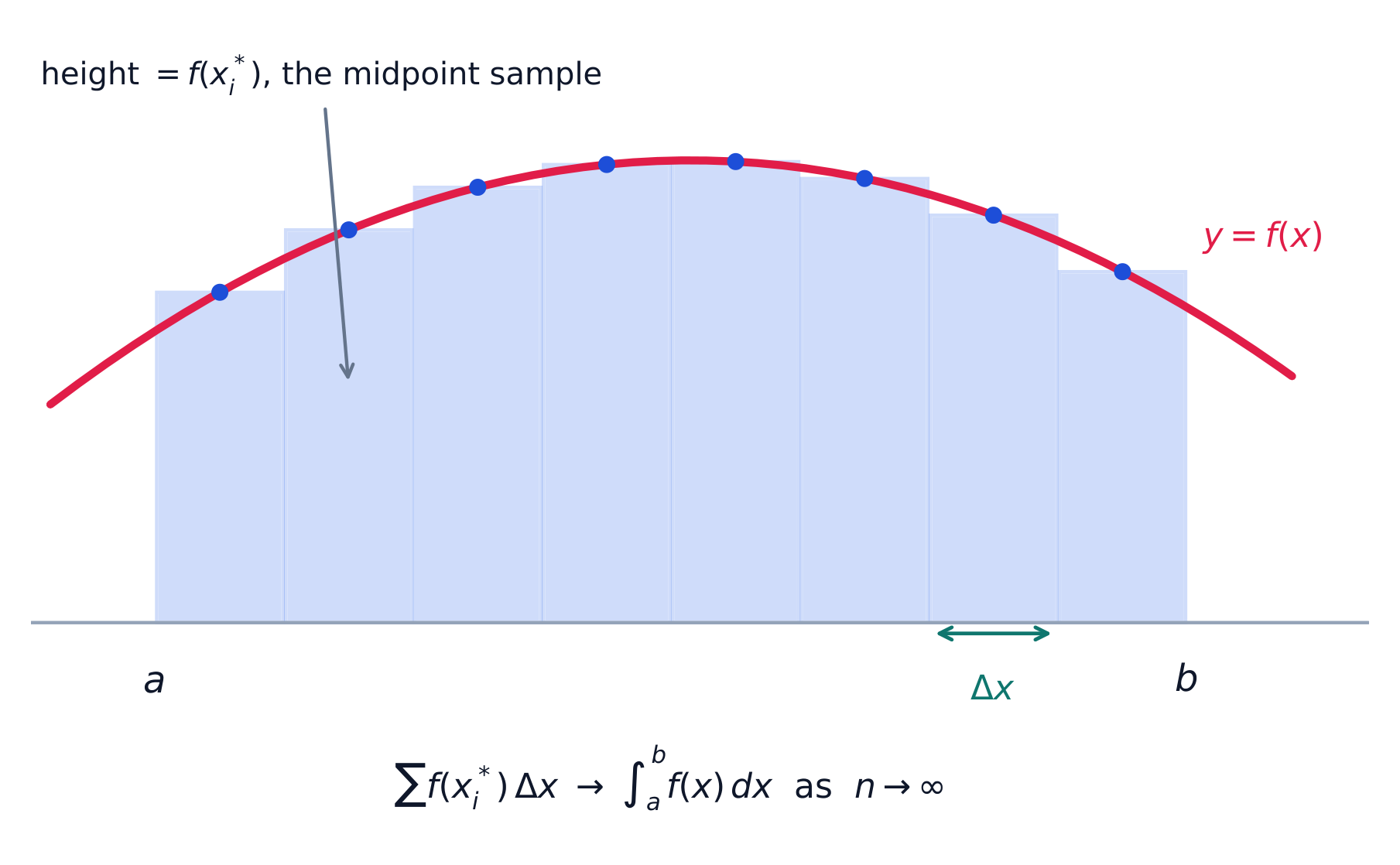
A midpoint Riemann sum: rectangles approximate the area under y = f(x)
For $f(x)=x^2$ on $[0,2]$ with $2$ right rectangles (width $1$): heights $f(1)=1$, $f(2)=4$. Find the right Riemann sum.
Difficulty 2/5 · 140 coins + a small bonus on first completion today
$1\cdot1+4\cdot1=5$.
Same setup, but a left Riemann sum: heights $f(0)=0$, $f(1)=1$. Find it.
Difficulty 2/5 · 140 coins + a small bonus on first completion today
$0\cdot1+1\cdot1=1$.
Which are standard ways to pick a rectangle's height in a Riemann sum?
Difficulty 2/5 · 140 coins + a small bonus on first completion today
Left, right, and midpoint are the standard choices.
Trapezoids fit even better
- Instead of a flat-topped rectangle, connect the two edge heights with a slanted top: a trapezoid 梯形.
- The trapezoidal rule 梯形法则 averages the left and right heights on each strip.
- It hugs a smooth curve more closely than rectangles, so it's usually more accurate.
- Area of each trapezoid $=\tfrac12(\text{left height}+\text{right height})\times\text{width}$.
The ____ rule uses slanted tops (average of edge heights) for a closer fit than rectangles.
Difficulty 1/5 · 100 coins + a small bonus on first completion today
Each trapezoid averages the left and right heights.
Over- or underestimate?
- On an increasing function: left sums underestimate, right sums overestimate.
- On a decreasing function: it's the reverse — left over, right under.
- The trapezoidal rule's error depends on concavity (over on concave-up, under on concave-down).
- Knowing the direction of the error lets you bound the true area.
For an increasing function, a left Riemann sum gives an...
Difficulty 1/5 · 100 coins + a small bonus on first completion today
Left heights are the smaller edge on an increasing curve → underestimate.
The three rectangle rules can give quite different answers for a small number of strips — they are approximations, not the exact area. And whether a left or right sum over- or under-estimates depends on whether the function is increasing or decreasing, not on the rule alone. Always check the function's behavior.
Estimate the area under $f(x)=x^2$ on $[0,2]$ with $2$ right rectangles (width $1$).
- Right heights: $f(1)=1$ and $f(2)=4$.
- Right sum $=1\cdot1+4\cdot1=5$.
- (The true area is $\tfrac83\approx2.67$; since $x^2$ is increasing, the right sum overestimates — as expected.)
A Riemann sum approximates area with rectangles: left, right, or midpoint heights. The trapezoidal rule uses slanted tops (averaging edge heights) for a closer fit. For an increasing function, left sums underestimate and right sums overestimate; more strips → a better approximation.
Write from a left sum of 1
- f(x) = x on [0, 2], which is increasing.
- Two left rectangles of width 1 are used.
What is the left sum, and how does it compare with the exact area?
Left heights on a rising graph are too short.
Two left rectangles for y = x on [0, 2] add to what?
Difficulty 1/5 · 100 coins + a small bonus on first completion today
0 times 1 plus 1 times 1 = 1.