Skip to content · ⁨Saltar al contenido⁩

Límites y Continuidad

AP Cálculo AB · Topic 1 · ⁨Tema 1⁩

Train · ⁨Entrenar⁩
Video lesson for this topic · ⁨Lección de video para este tema⁩ Open the video page · ⁨Abrir la página de video⁩
16:16

Límites y Continuidad

Aquí hay un acertijo. El velocímetro de un coche marca sesenta kilómetros por hora. Pero, ¿qué significa la velocidad en un instante único? La velocidad es distancia dividida por tiempo. Sin embargo, en…

English narration · English + 中文 subtitles burned in · ⁨Narración en inglés · Subtítulos en inglés + 中文 quemados en pantalla⁩

1.1

Introducing Calculus: Can Change Occur at an Instant? · ⁨Presentando el Cálculo: ¿Puede ocurrir un cambio en un instante?⁩

Syllabus
English

Enduring Understanding (CHA-1): Calculus allows us to generalize knowledge about motion to diverse problems involving change.

Learning Objective CHA-1.A: Interpret the rate of change at an instant in terms of average rates of change over intervals containing that instant.

  • CHA-1.A.1 Calculus uses limits to understand and model dynamic change.
  • CHA-1.A.2 Because an average rate of change divides the change in one variable by the change in another, the average rate of change is undefined at a point where the change in the independent variable would be zero.
  • CHA-1.A.3 The limit concept allows us to define instantaneous rate of change in terms of average rates of change.
Español

Comprensión duradera (CHA-1): El cálculo nos permite generalizar el conocimiento sobre el movimiento a una variedad de problemas que involucran cambios.

Objetivo de aprendizaje CHA-1.A: Interpretar la tasa de cambio en un instante en términos de las tasas de cambio promedio sobre intervalos que contienen dicho instante.

  • CHA-1.A.1 El cálculo utiliza los límites para comprender y modelar cambios dinámicos.
  • CHA-1.A.2 Dado que una tasa de cambio promedio divide el cambio en una variable por el cambio en otra, la tasa de cambio promedio no está definida en un punto donde el cambio en la variable independiente sería cero.
  • CHA-1.A.3 El concepto de límite nos permite definir la tasa de cambio instantánea en términos de las tasas de cambio promedio.

Source: College Board AP Course and Exam Description · ⁨Fuente: College Board AP Course and Exam Description⁩

English

Calculus is the mathematics of change 变化 and of accumulation 累积. It answers two big questions: how fast is something changing right now, and how much has piled up so far? Unit 1 builds the one tool both questions rest on – the limit 极限.

Start with a puzzle. A car's speedometer reads $60$ km/h. What does that mean at a single instant 瞬间? Speed is distance over time. But at one instant no time passes and no distance is covered, so the fraction looks like $\tfrac{0}{0}$ – undefined.

  • The average rate of change 平均变化率 uses a whole interval 区间: the change in one quantity divided by the change in another. It divides by zero, and so is undefined, when the change in the input would be zero.
  • The instantaneous rate of change 瞬时变化率 is what we want at a point. It is the value the average rate approaches 趋近 as the interval shrinks toward zero length.

The clever move is not to plug in zero (undefined), but to watch what the average rate approaches as the interval gets smaller and smaller. That approaching value is a limit. So calculus lets us describe change at an instant – as a limit of average rates over ever-shorter intervals. This one idea powers the derivative 导数 (Unit 2) and, run in reverse, the integral 积分 (Unit 6). Everything else in this unit defines limits carefully and computes them reliably.

Español

El cálculo es la matemática del cambio 变化和 del acumulación 累积. Responde dos grandes preguntas: qué tan rápido está cambiando algo ahora mismo, y cuánto se ha acumulado hasta ahora. La Unidad 1 construye la única herramienta sobre la que descansan ambas preguntas: el límite 极限.

Comienza con un acertijo. El velocímetro de un coche marca $60$ km/h. ¿Qué significa eso en un único instante 瞬间? La velocidad es distancia sobre tiempo. Pero en un solo instante no pasa tiempo ni se recorre distancia, por lo que la fracción parece $\tfrac{0}{0}$ – indefinida.

  • La tasa promedio de cambio 平均变化率 utiliza todo un intervalo 区间: el cambio en una cantidad dividido por el cambio en otra. Se divide por cero, y por tanto es indefinida, cuando el cambio en la entrada sería cero.
  • La tasa instantánea de cambio 瞬时变化rate es lo que queremos en un punto. Es el valor al que la tasa promedio se aproxima 趋近 a medida que el intervalo se encoge hacia una longitud cero.

El movimiento astuto no es sustituir cero (indefinido), sino observar hacia qué se aproxima la tasa promedio a medida que el intervalo se hace cada vez más pequeño. Ese valor al que se aproxima es un límite. Así, el cálculo nos permite describir el cambio en un instante – como un límite de tasas promedios sobre intervalos cada vez más cortos. Esta idea impulsa la derivada 导数 (Unidad 2) y, ejecutada al revés, la integral 积分 (Unidad 6). Todo lo demás en esta unidad define límites cuidadosamente y los calcula de manera confiable.

Explore · ⁨Explorar⁩

Explorar la tasa de cambio en un instante

y = ax³ + bx² + cx + d

Desliza el punto a lo largo de la curva. La línea tangente es el límite de tasas promedio cada vez más cortas — su pendiente es la tasa de cambio instantánea $\frac{dy}{dx}$ en ese punto.

Vocabulary · ⁨Vocabulario⁩ Train · ⁨Entrenar⁩
English · ⁨Inglés⁩ Chinese · ⁨Chino⁩ Pinyin
interval/ˈɪntəvl/ 区间 qū jiān
instantaneous rate of change/ˌɪnstənˈteɪnɪəs reɪt ɒv tʃeɪndʒ/ 瞬时变化率 shùn shí biàn huà lǜ
approaches/əˈprəʊtʃɪz/ 趋近 qū jìn
derivative/dɪˈrɪvətɪv/ 导数 dǎo shù
integral/ˈɪntɪɡrəl/ 积分 jī fēn
arbitrarily/ˌɑːbɪˈtrerɪli/ 任意地 rèn yì dì
sufficiently/səˈfɪʃəntli/ 足够 zú gòu
behavior/bɪˈheɪvjə/ 行为 xíng wéi
graphically/ˈɡræfɪkli/ 用图象 yòng tú xiàng
numerically/njuːˈmerɪkli/ 用数值 yòng shù zhí
analytically/ˌænəˈlɪtɪkli/ 用解析式 yòng jiě xī shì
left-hand limit/left hænd ˈlɪmɪt/ 左极限 zuǒ jí xiàn
right-hand limit/raɪt hænd ˈlɪmɪt/ 右极限 yòu jí xiàn
one-sided limits/wʌn ˈsaɪdɪd ˈlɪmɪts/ 单侧极限 dān cè jí xiàn
open circle/ˈəʊpən ˈsɜːkl/ 空心圆 kōng xīn yuán
1.2

Defining Limits and Using Limit Notation · ⁨Definiendo Límites y Usando la Notación de Límites⁩

Syllabus
English

Enduring Understanding (LIM-1): Reasoning with definitions, theorems, and properties can be used to justify claims about limits.

Learning Objective LIM-1.A: Represent limits analytically using correct notation.

  • LIM-1.A.1 Given a function $f$, the limit of $f(x)$ as $x$ approaches $c$ is a real number $R$ if $f(x)$ can be made arbitrarily close to $R$ by taking $x$ sufficiently close to $c$ (but not equal to $c$). If the limit exists and is a real number, then the common notation is $\lim_{x \to c} f(x) = R$.
    • Exclusion statement: The epsilon-delta definition of a limit is not assessed on the AP Calculus AB or BC Exam. However, teachers may include this topic in the course if time permits.

Learning Objective LIM-1.B: Interpret limits expressed in analytic notation.

  • LIM-1.B.1 A limit can be expressed in multiple ways, including graphically, numerically, and analytically.
Español

Comprensión duradera (LIM-1): El razonamiento basado en definiciones, teoremas y propiedades puede utilizarse para justificar afirmaciones sobre límites.

Objetivo de aprendizaje LIM-1.A: Representar límites analíticamente utilizando la notación correcta.

  • LIM-1.A.1 Dada una función $f$, el límite de $f(x)$ cuando $x$ se acerca a $c$ es un número real $R$ si $f(x)$ puede hacerse arbitrariamente cercano a $R$ al tomar $x$ suficientemente cercano a $c$ (pero no igual a $c$). Si el límite existe y es un número real, la notación común es $\lim_{x \to c} f(x) = R$.
    • Afirmación de exclusión: La definición epsilon-delta de un límite no se evalúa en el Examen AP de Cálculo AB o BC. Sin embargo, los docentes pueden incluir este tema en el curso si el tiempo lo permite.

Objetivo de aprendizaje LIM-1.B: Interpretar límites expresados en notación analítica.

  • LIM-1.B.1 Un límite puede expresarse de múltiples formas, incluyendo gráficamente, numéricamente y analíticamente.

Source: College Board AP Course and Exam Description · ⁨Fuente: College Board AP Course and Exam Description⁩

English

Given a function $f$, the limit of $f(x)$ as $x$ approaches $c$ is a real number $R$ if $f(x)$ can be made arbitrarily 任意地 close to $R$ by taking $x$ sufficiently 足够 close to $c$ – but not equal to $c$. We write

$$\lim_{x \to c} f(x) = R$$
and read it: "the limit of $f(x)$, as $x$ approaches $c$, equals $R$."

The last words are the heart of a limit: it describes the behavior 行为 of $f$ near $c$, not the value at $c$. The function may be undefined at $c$, or defined but equal to something else – the limit does not care.

A limit can be shown in three ways: graphically 用图象, numerically 用数值 (a table), and analytically 用解析式 (algebra). Learning to move between these representations is a core skill.

(Note: the epsilon-delta definition of a limit is not tested on the AP Exam, so this handout does not use it.)

Español
Una curva de puente suave: los límites describen el valor al que se acerca una gráfica al hacer zoom

Dada una función $f$, el límite de $f(x)$ cuando $x$ se acerca a $c$ es un número real $R$ si $f(x)$ puede hacerse arbitrariamente 任意地 cercano a $R$ tomando $x$ suficientemente 足够 cerca de $c$ – pero no igual a $c$. Escribimos

$$\lim_{x \to c} f(x) = R$$
y lo leemos: "el límite de $f(x)$, cuando $x$ se acerca a $c$, es igual a $R$".

Las últimas palabras son el corazón de un límite: describe el comportamiento 行为 de $f$ cerca de $c$, no el valor en $c$. La función puede estar indefinida en $c$, o definida pero igual a algo diferente; al límite no le importa.

Un límite puede mostrarse de tres formas: gráficamente 用图象, numéricamente 用数值 (una tabla), y analíticamente 用解析式 (álgebra). Aprender a transitar entre estas representaciones es una habilidad fundamental.

(Nota: la definición epsilon-delta de un límite no se evalúa en el Examen AP, por lo que este folleto no la utiliza.)

1.3

Estimating Limit Values from Graphs · ⁨Estimando Valores de Límites desde Gráficas⁩

Syllabus
English

Enduring Understanding (LIM-1): Reasoning with definitions, theorems, and properties can be used to justify claims about limits.

Learning Objective LIM-1.C: Estimate limits of functions.

  • LIM-1.C.1 The concept of a limit includes one sided limits.
  • LIM-1.C.2 Graphical information about a function can be used to estimate limits.
  • LIM-1.C.3 Because of issues of scale, graphical representations of functions may miss important function behavior.
  • LIM-1.C.4 A limit might not exist for some functions at particular values of $x$. Some ways that the limit might not exist are if the function is unbounded, if the function is oscillating near this value, or if the limit from the left does not equal the limit from the right.
    • Illustrative examples for LIM-1.C.4:
      • $\lim_{x \to 0} \dfrac{1}{x^2} = \infty$
      • $\lim_{x \to 0} \dfrac{|x|}{x}$ does not exist.
      • $\lim_{x \to 0} \sin\left(\dfrac{1}{x}\right)$ does not exist.
      • $\lim_{x \to 0} \dfrac{1}{x}$ does not exist.
Español

Comprensión duradera (LIM-1): El razonamiento basado en definiciones, teoremas y propiedades puede utilizarse para justificar afirmaciones sobre límites.

Objetivo de aprendizaje LIM-1.C: Estimar límites de funciones.

  • LIM-1.C.1 El concepto de límite incluye los límites laterales.
  • LIM-1.C.2 La información gráfica de una función puede usarse para estimar límites.
  • LIM-1.C.3 Debido a problemas de escala, las representaciones gráficas de funciones pueden omitir comportamientos importantes de la misma.
  • LIM-1.C.4 Un límite podría no existir para ciertas funciones en valores específicos de $x$. Algunas razones por las que el límite podría no existir son: si la función está acotada sin límite, si la función oscila cerca de este valor o si el límite por la izquierda no es igual al límite por la derecha.
    • Ejemplos ilustrativos para LIM-1.C.4:
      • $\lim_{x \to 0} \dfrac{1}{x^2} = \infty$
      • $\lim_{x \to 0} \dfrac{|x|}{x}$ no existe.
      • $\lim_{x \to 0} \sin\left(\dfrac{1}{x}\right)$ no existe.
      • $\lim_{x \to 0} \dfrac{1}{x}$ no existe.

Source: College Board AP Course and Exam Description · ⁨Fuente: College Board AP Course and Exam Description⁩

English

A graph is often the fastest way to read a limit. To find $\displaystyle \lim_{x \to c} f(x)$, run your finger along the curve toward $x = c$ from each side and ask: what height is the curve heading for?

  • Trace from the left (inputs smaller than $c$): this gives the left-hand limit 左极限, $\displaystyle \lim_{x \to c^-} f(x)$.
  • Trace from the right (inputs larger than $c$): this gives the right-hand limit 右极限, $\displaystyle \lim_{x \to c^+} f(x)$.
  • These are the one-sided limits 单侧极限. If both head to the same height $R$, then the two-sided limit exists and $\displaystyle \lim_{x \to c} f(x) = R$.

Crucially, ignore the point itself. Graphs mark the difference between the limit and the value:

  • An open circle 空心圆 marks a height the curve approaches but does not reach – a "hole" 空洞.
  • A closed circle 实心圆 marks the actual value $f(c)$.

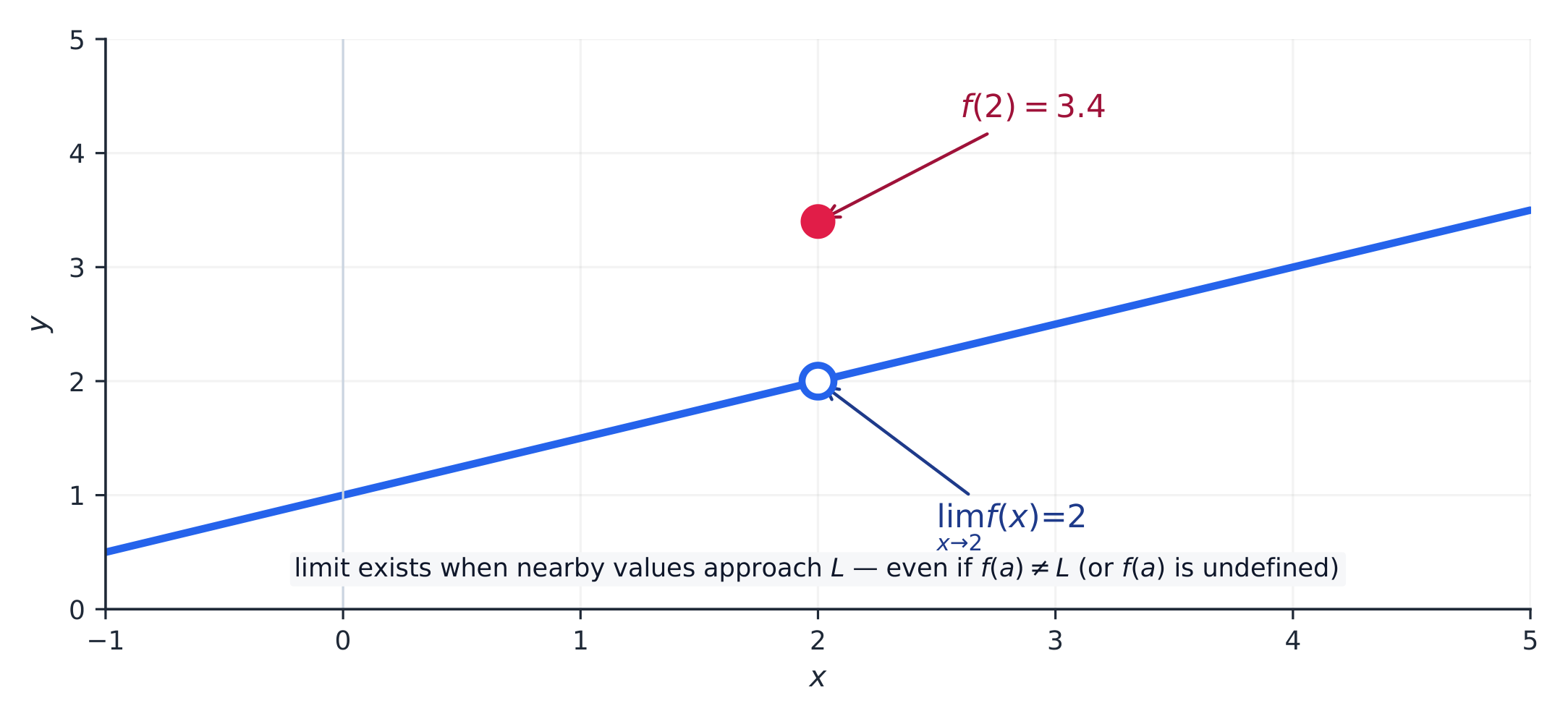
So a curve may approach $R = 3$ from both sides (limit is $3$) while a filled dot sits at height $5$ (value $f(c) = 5$). The limit is $3$; the two need not match.

A limit does not exist (often written DNE) when the two sides disagree (a jump 跳跃), when the function is unbounded 无界 (grows without limit), or when it oscillates 振荡 forever near $c$. For example:

$$\lim_{x \to 0} \frac{1}{x^2} = \infty, \qquad \lim_{x \to 0} \frac{|x|}{x}\ \text{DNE}, \qquad \lim_{x \to 0} \sin\!\left(\frac{1}{x}\right)\ \text{DNE}.$$

Watch the scale 比例 of a graph: a zoomed-out picture can hide important behavior near a point, so confirm with algebra when you can.

Español

Una gráfica es a menudo la forma más rápida de leer un límite. Para encontrar $\displaystyle \lim_{x \to c} f(x)$, desliza tu dedo a lo largo de la curva hacia $x = c$ desde ambos lados y pregunta: ¿hacia qué altura se dirige la curva?

  • Traza desde la izquierda (entradas menores que $c$): esto da el límite lateral izquierdo 左极限, $\displaystyle \lim_{x \to c^-} f(x)$.
  • Traza desde la derecha (entradas mayores que $c$): esto da el límite lateral derecho 右极限, $\displaystyle \lim_{x \to c^+} f(x)$.
  • Estos son los límites laterales 单侧极限. Si ambos se dirigen a la misma altura $R$, entonces el límite bidireccional existe y $\displaystyle \lim_{x \to c} f(x) = R$.

Crucialmente, ignora el propio punto. Las gráficas marcan la diferencia entre el límite y el valor:

  • Un círculo abierto 空心圆 marca una altura a la que la curva se acerca pero no alcanza – un "agujero" 空洞.
  • Un círculo cerrado 实心圆 marca el valor real $f(c)$.

Así, una curva puede acercarse a $R = 3$ desde ambos lados (límite es $3$) mientras un punto relleno se encuentra a una altura de $5$ (valor $f(c) = 5$). El límite es $3$; no es necesario que coincidan.

Un límite existe en x=2 aunque el valor de la función f(2) sea diferente
El círculo abierto es la altura a la que se acerca la curva (el límite); el punto relleno es el valor real $f(2)$ – no necesitan coincidir.

Un límite no existe (escrito frecuentemente como DNE) cuando los dos lados discrepan (un salto 跳跃), cuando la función es ilimitada 无界 (crece sin límite), o cuando oscila 振荡 para siempre cerca de $c$. Por ejemplo:

$$\lim_{x \to 0} \frac{1}{x^2} = \infty, \qquad \lim_{x \to 0} \frac{|x|}{x}\ \text{DNE}, \qquad \lim_{x \to 0} \sin\!\left(\frac{1}{x}\right)\ \text{DNE}.$$

Observa la escala 比例 de una gráfica: una imagen alejada puede ocultar un comportamiento importante cerca de un punto, así que confirma con álgebra cuando puedas.

Explore · ⁨Explorar⁩

Leer un límite desde el gráfico

y = ax² + bx + c

El límite cuando $x\to c$ es la altura hacia la cual se dirige la curva desde ambos lados — trata sobre hacia dónde va la función, no su valor en $c$. Sigue la curva hacia un $x$ y lee el $y$ al que se aproxima.

Vocabulary · ⁨Vocabulario⁩ Train · ⁨Entrenar⁩
English · ⁨Inglés⁩ Chinese · ⁨Chino⁩ Pinyin
limit/ˈlɪmɪt/ 极限 jí xiàn
at a single instant/ætə ˈsɪŋɡl ˈɪnstənt/ 瞬间 shùn jiān
average rate of change/ˈævrɪdʒ reɪt ɒv tʃeɪndʒ/ 平均变化率 píng jūn biàn huà lǜ
hole/həʊl/ 空洞 kōng dòng
closed circle/kləʊzd ˈsɜːkl/ 实心圆 shí xīn yuán
jump/dʒʌmp/ 跳跃 tiào yuè
unbounded/ʌnˈbaʊndɪd/ 无界 wú jiè
oscillates/ˈɒsɪleɪts/ 振荡 zhèn dàng
scale/skeɪl/ 比例 bǐ lì
1.4

Estimating Limit Values from Tables · ⁨Estimando Valores de Límites desde Tablas⁩

Syllabus
English

Enduring Understanding (LIM-1): Reasoning with definitions, theorems, and properties can be used to justify claims about limits.

Learning Objective LIM-1.C: Estimate limits of functions.

  • LIM-1.C.5 Numerical information can be used to estimate limits.
Español

Comprensión duradera (LIM-1): El razonamiento basado en definiciones, teoremas y propiedades puede utilizarse para justificar afirmaciones sobre límites.

Objetivo de aprendizaje LIM-1.C: Estimar límites de funciones.

  • LIM-1.C.5 La información numérica puede emplearse para estimar límites.

Source: College Board AP Course and Exam Description · ⁨Fuente: College Board AP Course and Exam Description⁩

English

When you have data or a formula but no picture, a table 表格 of values estimates a limit numerically. Choose inputs that creep toward $c$ from both sides and watch the outputs.

For example, to estimate $\displaystyle \lim_{x \to 2} \frac{x^2 - 4}{x - 2}$ (which is $\tfrac{0}{0}$ at $x=2$):

$x$ $1.9$ $1.99$ $1.999$ $\to 2 \leftarrow$ $2.001$ $2.01$ $2.1$
$f(x)$ $3.9$ $3.99$ $3.999$ ? $4.001$ $4.01$ $4.1$

Both sides march toward $4$, so we estimate the limit is $4$. A table only suggests a value – it is a numerical estimate, not a proof.

Español

Cuando tienes datos o una fórmula pero no una imagen, una tabla 表格 de valores estima un límite numéricamente. Elige entradas que se acerquen a $c$ desde ambos lados y observa las salidas.

Por ejemplo, para estimar $\displaystyle \lim_{x \to 2} \frac{x^2 - 4}{x - 2}$ (que es $\tfrac{0}{0}$ en $x=2$):

$x$ $1.9$ $1.99$ $1.999$ $\to 2 \leftarrow$ $2.001$ $2.01$ $2.1$
$f(x)$ $3.9$ $3.99$ $3.999$ ? $4.001$ $4.01$ $4.1$

Ambos lados marchan hacia $4$, así que estimamos que el límite es $4$. Una tabla solo sugiere un valor; es una estimación numérica, no una prueba.

1.5

Determining Limits Using Algebraic Properties of Limits · ⁨Determinando Límites Usando Propiedades Algebraicas de Límites⁩

Syllabus
English

Enduring Understanding (LIM-1): Reasoning with definitions, theorems, and properties can be used to justify claims about limits.

Learning Objective LIM-1.D: Determine the limits of functions using limit theorems.

  • LIM-1.D.1 One-sided limits can be determined analytically or graphically.
  • LIM-1.D.2 Limits of sums, differences, products, quotients, and composite functions can be found using limit theorems.
Español

Comprensión duradera (LIM-1): El razonamiento basado en definiciones, teoremas y propiedades puede utilizarse para justificar afirmaciones sobre límites.

Objetivo de aprendizaje LIM-1.D: Determinar los límites de funciones utilizando teoremas de límites.

  • LIM-1.D.1 Los límites laterales pueden determinarse analítica o gráficamente.
  • LIM-1.D.2 Los límites de sumas, diferencias, productos, cocientes y funciones compuestas se pueden encontrar utilizando teoremas de límites.

Source: College Board AP Course and Exam Description · ⁨Fuente: College Board AP Course and Exam Description⁩

English

Most limits are found analytically using limit theorems 极限定理. If $\lim_{x\to c} f(x)$ and $\lim_{x\to c} g(x)$ both exist, the limit of a combination is the same combination of the limits:

  • Sum / difference: $\displaystyle \lim_{x\to c}\big[f(x)\pm g(x)\big] = \lim_{x\to c}f(x) \pm \lim_{x\to c}g(x)$
  • Product: $\displaystyle \lim_{x\to c}\big[f(x)\,g(x)\big] = \lim_{x\to c}f(x)\cdot\lim_{x\to c}g(x)$
  • Quotient: $\displaystyle \lim_{x\to c}\frac{f(x)}{g(x)} = \frac{\lim_{x\to c}f(x)}{\lim_{x\to c}g(x)}$, provided the bottom limit is not $0$.
  • Composite 复合函数: if $g$ is continuous at $\lim_{x\to c} f(x)$, then $\displaystyle \lim_{x\to c} g\big(f(x)\big) = g\!\left(\lim_{x\to c} f(x)\right)$.

The practical rule: for a function built from polynomials, roots, and the like, first try direct substitution 直接代入 – put $x = c$ in. If you get a real number, that is the limit. One-sided limits obey the same theorems, read from one direction only.

Español

La mayoría de los límites se encuentran analíticamente usando teoremas de límite 极限定理. Si $\lim_{x\to c} f(x)$ y $\lim_{x\to c} g(x)$ existen, el límite de una combinación es la misma combinación de los límites:

  • Suma / resta: $\displaystyle \lim_{x\to c}\big[f(x)\pm g(x)\big] = \lim_{x\to c}f(x) \pm \lim_{x\to c}g(x)$
  • Producto: $\displaystyle \lim_{x\to c}\big[f(x)\,g(x)\big] = \lim_{x\to c}f(x)\cdot\lim_{x\to c}g(x)$
  • Cociente: $\displaystyle \lim_{x\to c}\frac{f(x)}{g(x)} = \frac{\lim_{x\to c}f(x)}{\lim_{x\to c}g(x)}$, siempre que el límite del denominador no sea $0$.
  • Función compuesta 复合函数: si $g$ es continua en $\lim_{x\to c} f(x)$, entonces $\displaystyle \lim_{x\to c} g\big(f(x)\big) = g\!\left(\lim_{x\to c} f(x)\right)$.

La regla práctica: para una función construida a partir de polinomios, raíces y similares, primero intenta la sustitución directa 直接代入 – pon $x = c$ dentro. Si obtienes un número real, ese es el límite. Los límites laterales obedecen los mismos teoremas, leídos desde una sola dirección.

1.6

Determining Limits Using Algebraic Manipulation · ⁨Determinando Límites Usando Manipulación Algebraica⁩

Syllabus
English

Enduring Understanding (LIM-1): Reasoning with definitions, theorems, and properties can be used to justify claims about limits.

Learning Objective LIM-1.E: Determine the limits of functions using equivalent expressions for the function or the squeeze theorem.

  • LIM-1.E.1 It may be necessary or helpful to rearrange expressions into equivalent forms before evaluating limits.
    • Illustrative examples for LIM-1.E.1:
      • Factoring and dividing common factors of rational functions
      • Multiplying by an expression involving the conjugate of a sum or difference in order to simplify functions involving radicals
      • Using alternate forms of trigonometric functions
Español

Comprensión duradera (LIM-1): El razonamiento basado en definiciones, teoremas y propiedades puede utilizarse para justificar afirmaciones sobre límites.

Objetivo de aprendizaje LIM-1.E: Determinar los límites de funciones utilizando expresiones equivalentes de la función o el teorema del emparedado (o teorema del sándwich).

  • LIM-1.E.1 Puede ser necesario o conveniente reorganizar las expresiones en formas equivalentes antes de evaluar los límites.
    • Ejemplos ilustrativos para LIM-1.E.1:
      • Factorización y división de factores comunes en funciones racionales
      • Multiplicación por una expresión que involucre el conjugado de una suma o diferencia con el fin de simplificar funciones que contienen radicales
      • Uso de formas alternativas de funciones trigonométricas

Source: College Board AP Course and Exam Description · ⁨Fuente: College Board AP Course and Exam Description⁩

English

Direct substitution sometimes gives the indeterminate form 未定式 $\tfrac{0}{0}$. This does not mean the limit fails – it means you must rewrite the function into an equivalent form 等价形式 that removes the trouble, then substitute. Three standard moves:

  • Factor and cancel 因式分解并约分 a rational function 有理函数. Example: $\displaystyle \lim_{x\to 2}\frac{x^2-4}{x-2} = \lim_{x\to 2}\frac{(x-2)(x+2)}{x-2} = \lim_{x\to 2}(x+2) = 4$.
  • Multiply by the conjugate 共轭 to simplify a radical 根式. Example: $\displaystyle \lim_{x\to 0}\frac{\sqrt{x+1}-1}{x} = \lim_{x\to 0}\frac{x}{x\big(\sqrt{x+1}+1\big)} = \frac{1}{2}$.
  • Use alternate forms of trigonometric functions (identities) to simplify.

The cancelled factor is why the original graph had a hole: the two functions agree everywhere except at $x=c$, so they share the same limit there.

Español

La sustitución directa a veces da la forma indeterminada 未定式 $\tfrac{0}{0}$. Esto no significa que el límite falle; significa que debes reescribir la función en una forma equivalente 等价形式 que elimine el problema, y luego sustituir. Tres movimientos estándar:

  • Factorizar y cancelar 因式分解并约分 una función racional 有理函数. Ejemplo: $\displaystyle \lim_{x\to 2}\frac{x^2-4}{x-2} = \lim_{x\to 2}\frac{(x-2)(x+2)}{x-2} = \lim_{x\to 2}(x+2) = 4$.
  • Multiplicar por el conjugado 共轭 para simplificar una radical 根式. Ejemplo: $\displaystyle \lim_{x\to 0}\frac{\sqrt{x+1}-1}{x} = \lim_{x\to 0}\frac{x}{x\big(\sqrt{x+1}+1\big)} = \frac{1}{2}$.
  • Usar formas alternativas de funciones trigonométricas (identidades) para simplificar.

El factor cancelado es la razón por la que la gráfica original tenía un agujero: las dos funciones coinciden en todas partes excepto en $x=c$, por lo que comparten el mismo límite allí.

Vocabulary · ⁨Vocabulario⁩ Train · ⁨Entrenar⁩
English · ⁨Inglés⁩ Chinese · ⁨Chino⁩ Pinyin
radical/ˈrædɪkl/ 根式 gēn shì
1.7

Selecting Procedures for Determining Limits · ⁨Seleccionando Procedimientos para Determinar Límites⁩

Syllabus
English

This topic is intended to focus on the skill of selecting an appropriate procedure for determining limits. Students should be given opportunities to practice when and how to apply all learning objectives relating to determining limits.

Español

Este tema tiene como objetivo centrarse en la habilidad de seleccionar un procedimiento adecuado para determinar límites. Se debe brindar a los estudiantes oportunidades para practicar cuándo y cómo aplicar todos los objetivos de aprendizaje relacionados con la determinación de límites.

Source: College Board AP Course and Exam Description · ⁨Fuente: College Board AP Course and Exam Description⁩

English

This is a skill topic, not new content: choose the right tool for the limit in front of you.

  1. Try direct substitution first. A real answer means you are done.
  2. Getting $\tfrac{0}{0}$? Rewrite – factor and cancel, or use the conjugate, or a trig identity – then substitute.
  3. A non-zero number over $0$ (like $\tfrac{5}{0}$)? The limit is infinite or DNE – check the sign from each side (see vertical asymptotes below).
  4. As $x\to\pm\infty$? Compare the dominant 主导 terms (see limits at infinity).
  5. Trapped between two functions? The squeeze theorem may apply.
Español

Este es un tema de habilidades, no nuevo contenido: elige la herramienta correcta para el límite frente a ti.

  1. Intenta la sustitución directa primero. Una respuesta real significa que has terminado.
  2. ¿Obtienes $\tfrac{0}{0}$? Reescribe – factoriza y cancela, usa el conjugado, o una identidad trigonométrica – y luego sustituye.
  3. ¿Un número distinto de cero sobre $0$ (como $\tfrac{5}{0}$)? El límite es infinito o DNE – verifica el signo desde cada lado (mira las asíntotas verticales abajo).
  4. Cuando $x\to\pm\infty$? Compara los términos dominantes 主导 (mira los límites en el infinito).
  5. ¿Atrapado entre dos funciones? Puede aplicarse el teorema del emparedado 夹逼定理.
Vocabulary · ⁨Vocabulario⁩ Train · ⁨Entrenar⁩
English · ⁨Inglés⁩ Chinese · ⁨Chino⁩ Pinyin
dominant/ˈdɒmɪnənt/ 主导 zhǔ dǎo
1.8

Determining Limits Using the Squeeze Theorem · ⁨Determinando Límites Usando el Teorema del Emparedado⁩

Syllabus
English

Enduring Understanding (LIM-1): Reasoning with definitions, theorems, and properties can be used to justify claims about limits.

Learning Objective LIM-1.E: Determine the limits of functions using equivalent expressions for the function or the squeeze theorem.

  • LIM-1.E.2 The limit of a function may be found by using the squeeze theorem.
    • Illustrative examples for LIM-1.E.2: The squeeze theorem can be used to show $\lim_{x \to 0} \dfrac{\sin x}{x} = 1$ and $\lim_{x \to 0} \dfrac{1 - \cos x}{x} = 0$.
Español

Comprensión duradera (LIM-1): El razonamiento con definiciones, teoremas y propiedades puede utilizarse para justificar afirmaciones sobre límites.

Objetivo de aprendizaje LIM-1.E: Determinar los límites de funciones utilizando expresiones equivalentes para la función o el teorema del emparedado.

  • LIM-1.E.2 El límite de una función puede encontrarse utilizando el teorema del emparedado.
    • Ejemplos ilustrativos para LIM-1.E.2: El teorema del emparedado puede usarse para demostrar que $\lim_{x \to 0} \dfrac{\sin x}{x} = 1$ y $\lim_{x \to 0} \dfrac{1 - \cos x}{x} = 0$.

Source: College Board AP Course and Exam Description · ⁨Fuente: College Board AP Course and Exam Description⁩

English

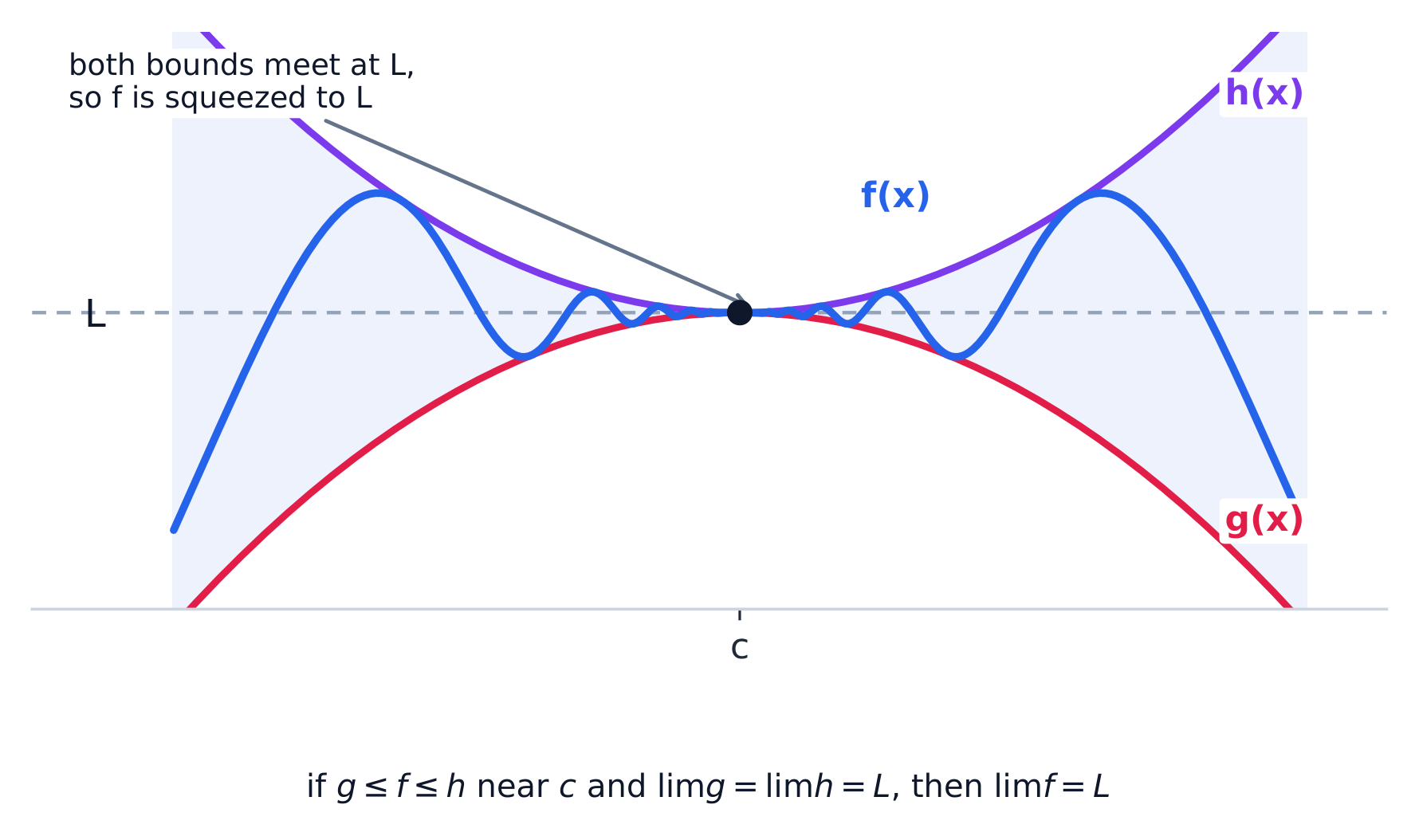
The squeeze theorem 夹逼定理 (also called the sandwich theorem) finds a limit by trapping the function between two others. If $g(x) \le f(x) \le h(x)$ near $c$, and

$$\lim_{x\to c} g(x) = \lim_{x\to c} h(x) = L,$$
then $f$ is squeezed to the same place: $\displaystyle \lim_{x\to c} f(x) = L$.

The two famous results proved this way, both used throughout calculus, are:

$$\lim_{x\to 0}\frac{\sin x}{x} = 1 \qquad\text{and}\qquad \lim_{x\to 0}\frac{1-\cos x}{x} = 0.$$

Español

El teorema del emparedado 夹逼定理 (también llamado teorema del sándwich) encuentra un límite atrapando la función entre otras dos. Si $g(x) \le f(x) \le h(x)$ cerca de $c$, y

$$\lim_{x\to c} g(x) = \lim_{x\to c} h(x) = L,$$
entonces $f$ está empaquetada hacia el mismo lugar: $\displaystyle \lim_{x\to c} f(x) = L$.

Los dos resultados famosos demostrados de esta manera, usados a lo largo del cálculo, son:

$$\lim_{x\to 0}\frac{\sin x}{x} = 1 \qquad\text{and}\qquad \lim_{x\to 0}\frac{1-\cos x}{x} = 0.$$

El teorema del emparedado: si g y h se aproximan a L en c, la función atrapada f se ve forzada a ir a L
La ondulada $f$ está atrapada entre $g$ y $h$. Como ambos límites se encuentran en $L$, $f$ no tiene adónde ir más que hacia $L$.
Vocabulary · ⁨Vocabulario⁩ Train · ⁨Entrenar⁩
English · ⁨Inglés⁩ Chinese · ⁨Chino⁩ Pinyin
squeeze theorem/skwiːz ˈθɪərəm/ 夹逼定理 jiā bī dìng lǐ
discontinuous/dɪskənˈtɪnjuːəs/ 间断 jiàn duàn
Removable discontinuity/rɪˈmuːvəbl dɪskɒntɪˈnjuːɪti/ 可去间断 kě qù jiàn duàn
Jump discontinuity/dʒʌmp dɪskɒntɪˈnjuːɪti/ 跳跃间断 tiào yuè jiàn duàn
Infinite discontinuity/ˈɪnfɪnət dɪskɒntɪˈnjuːɪti/ 无穷间断 wú qióng jiàn duàn
1.9

Connecting Multiple Representations of Limits · ⁨Conectando Múltiples Representaciones de Límites⁩

Syllabus
English

This topic is intended to focus on connecting representations. Students should be given opportunities to practice when and how to apply all learning objectives relating to limits and translating mathematical information from a single representation or across multiple representations.

Español

Este tema tiene como objetivo centrarse en la conexión entre representaciones. Se debe brindar a los estudiantes oportunidades para practicar cuándo y cómo aplicar todos los objetivos de aprendizaje relacionados con los límites, así como para traducir información matemática desde una única representación o a través de múltiples representaciones.

Source: College Board AP Course and Exam Description · ⁨Fuente: College Board AP Course and Exam Description⁩

English

Another skill topic: the same limit lives in a graph, a table, and an algebraic form, and you should be able to translate between them. A graph shows the shape and any holes or jumps; a table gives numerical evidence; algebra gives an exact value and a reason. Strong answers use one representation to confirm another.

Español

Otro tema de habilidades: el mismo límite vive en una gráfica, una tabla y una forma algebraica, y deberías poder traducir entre ellas. Una gráfica muestra la forma y cualquier agujero o salto; una tabla da evidencia numérica; el álgebra da un valor exacto y una razón. Las respuestas sólidas usan una representación para confirmar otra.

1.10

Exploring Types of Discontinuities · ⁨Explorando Tipos de Discontinuidades⁩

Syllabus
English

Enduring Understanding (LIM-2): Reasoning with definitions, theorems, and properties can be used to justify claims about continuity.

Learning Objective LIM-2.A: Justify conclusions about continuity at a point using the definition.

  • LIM-2.A.1 Types of discontinuities include removable discontinuities, jump discontinuities, and discontinuities due to vertical asymptotes.
Español

Comprensión duradera (LIM-2): El razonamiento basado en definiciones, teoremas y propiedades puede utilizarse para justificar afirmaciones sobre la continuidad.

Objetivo de aprendizaje LIM-2.A: Justificar conclusiones sobre la continuidad en un punto utilizando la definición.

  • LIM-2.A.1 Los tipos de discontinuidades incluyen discontinuidades evitables, saltos de discontinuidad y discontinuidades debidas a asíntotas verticales.

Source: College Board AP Course and Exam Description · ⁨Fuente: College Board AP Course and Exam Description⁩

English

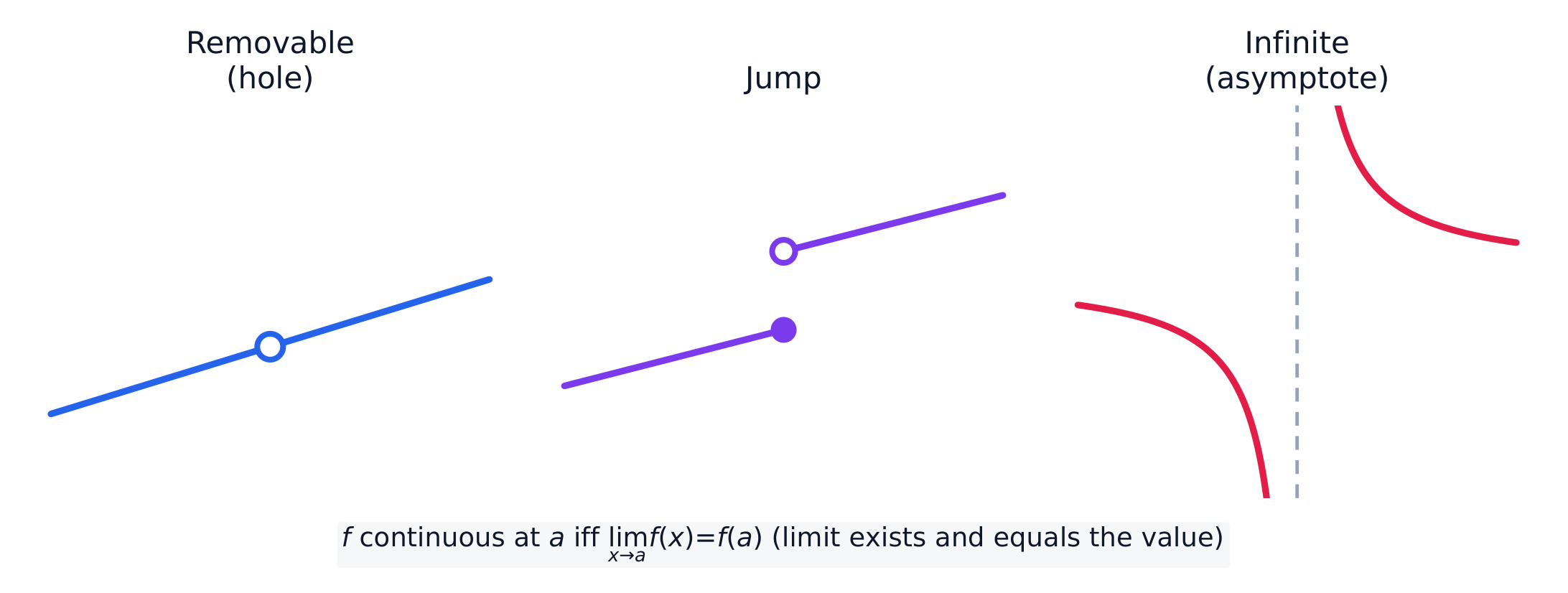
A function is discontinuous 间断 at $c$ when its graph "breaks" there. There are three types:

  • Removable discontinuity 可去间断 – a single hole. The two-sided limit exists, but the point is missing or misplaced.
  • Jump discontinuity 跳跃间断 – the two one-sided limits exist but disagree, so the curve jumps.
  • Infinite discontinuity 无穷间断 – the function blows up to $\pm\infty$ at a vertical asymptote 垂直渐近线.
Español

Una función es discontinua 间断 en $c$ cuando su gráfica "se rompe" allí. Hay tres tipos:

  • Discontinuidad evitable 可去间断 – un solo agujero. El límite bidireccional existe, pero el punto falta o está mal colocado.
  • Discontinuidad de salto 跳跃间断 – los dos límites laterales existen pero discrepan, por lo que la curva salta.
  • Discontinuidad infinita 无穷间断 – la función explota hacia $\pm\infty$ en una asíntota vertical 垂直渐近线.
Los tres tipos de discontinuidad: agujero evitable, salto e infinito
Tres formas en que una gráfica puede romperse: un agujero evitable, un salto y una discontinuidad infinita (asíntota).
Vocabulary · ⁨Vocabulario⁩ Train · ⁨Entrenar⁩
English · ⁨Inglés⁩ Chinese · ⁨Chino⁩ Pinyin
table/ˈteɪbl/ 表格 biǎo gé
limit theorems/ˈlɪmɪt ˈθɪərəmz/ 极限定理 jí xiàn dìng lǐ
Composite/ˈkɒmpəzɪt/ 复合函数 fù hé hán shù
direct substitution/daɪˈrekt ˌsʌbstɪˈtjuːʃn/ 直接代入 zhí jiē dài rù
indeterminate form/ˌɪndɪˈtɜːmɪnət fɔːm/ 未定式 wèi dìng shì
equivalent form/ɪˈkwɪvələnt fɔːm/ 等价形式 děng jià xíng shì
Factor and cancel/ˈfæktə ænd ˈkænsl/ 因式分解并约分 yīn shì fēn jiě bìng yuē fēn
rational function/ˈræʃənl ˈfʌŋkʃn/ 有理函数 yǒu lǐ hán shù
conjugate/ˈkɒndʒuːɡeɪt/ 共轭 gòng è
1.11

Defining Continuity at a Point · ⁨Definiendo la Continuidad en un Punto⁩

Syllabus
English

Enduring Understanding (LIM-2): Reasoning with definitions, theorems, and properties can be used to justify claims about continuity.

Learning Objective LIM-2.A: Justify conclusions about continuity at a point using the definition.

  • LIM-2.A.2 A function $f$ is continuous at $x = c$ provided that $f(c)$ exists, $\lim_{x \to c} f(x)$ exists, and $\lim_{x \to c} f(x) = f(c)$.
Español

Comprensión duradera (LIM-2): El razonamiento con definiciones, teoremas y propiedades puede utilizarse para justificar afirmaciones sobre la continuidad.

Objetivo de aprendizaje LIM-2.A: Justificar conclusiones sobre la continuidad en un punto utilizando la definición.

  • LIM-2.A.2 Una función $f$ es continua en $x = c$ si se cumplen las siguientes condiciones: $f(c)$ existe, $\lim_{x \to c} f(x)$ existe y $\lim_{x \to c} f(x) = f(c)$.

Source: College Board AP Course and Exam Description · ⁨Fuente: College Board AP Course and Exam Description⁩

English

Continuity is defined by a three-part test. A function $f$ is continuous 连续 at $x=c$ exactly when all three hold:

$$\boxed{\;f(c)\text{ exists}\quad\text{and}\quad \lim_{x\to c} f(x)\text{ exists}\quad\text{and}\quad \lim_{x\to c} f(x) = f(c)\;}$$

In words: the point is there, the limit is there, and the two agree. If any one fails, $f$ is discontinuous at $c$. This test is the backbone of nearly every continuity question, so learn it as a checklist.

Español

La continuidad se define mediante una prueba de tres partes. Una función $f$ es continua 连续 en $x=c$ exactamente cuando se cumplen las tres condiciones:

$$\boxed{\;f(c)\text{ exists}\quad\text{and}\quad \lim_{x\to c} f(x)\text{ exists}\quad\text{and}\quad \lim_{x\to c} f(x) = f(c)\;}$$

En palabras: el punto está ahí, el límite está ahí, y ambos coinciden. Si alguna falla, $f$ es discontinua en $c$. Esta prueba es la columna vertebral de casi toda pregunta de continuidad, así que apréndela como una lista de verificación.

1.12

Confirming Continuity over an Interval · ⁨Confirmando la Continuidad en un Intervalo⁩

Syllabus
English

Enduring Understanding (LIM-2): Reasoning with definitions, theorems, and properties can be used to justify claims about continuity.

Learning Objective LIM-2.B: Determine intervals over which a function is continuous.

  • LIM-2.B.1 A function is continuous on an interval if the function is continuous at each point in the interval.
  • LIM-2.B.2 Polynomial, rational, power, exponential, logarithmic, and trigonometric functions are continuous on all points in their domains.
Español

Comprensión Duradera (LIM-2): El razonamiento con definiciones, teoremas y propiedades puede utilizarse para justificar afirmaciones sobre la continuidad.

Objetivo de Aprendizaje LIM-2.B: Determinar los intervalos en los que una función es continua.

  • LIM-2.B.1 Una función es continua en un intervalo si es continua en cada punto del intervalo.
  • LIM-2.B.2 Las funciones polinómicas, racionales, potenciales, exponenciales, logarítmicas y trigonométricas son continuas en todos los puntos de sus dominios.

Source: College Board AP Course and Exam Description · ⁨Fuente: College Board AP Course and Exam Description⁩

English

A function is continuous on an interval 在区间上连续 if it is continuous at every point of that interval. You rarely check point by point, because whole families are continuous on their domains:

Polynomial, rational, power, exponential 指数, logarithmic 对数, and trigonometric 三角 functions are continuous at every point of their domains.

So a rational function is continuous everywhere except where its denominator is zero; $\ln x$ is continuous for $x>0$; and so on. Knowing this lets you declare continuity quickly and correctly.

Español

Una función es continua en un intervalo 在区间上 continuo si es continua en cada punto de ese intervalo. Rara vez verificamos punto por punto, porque familias enteras son continuas en sus dominios:

Las funciones polinómicas, racionales, potenciales, exponenciales 指数, logarítmicas 对数和 trigonométricas 三角 son continuas en cada punto de sus dominios.

Así, una función racional es continua en todas partes excepto donde su denominador es cero; $\ln x$ es continua para $x>0$; etc. Conocer esto te permite declarar la continuidad rápidamente y correctamente.

1.13

Removing Discontinuities · ⁨Eliminando Discontinuidades⁩

Syllabus
English

Enduring Understanding (LIM-2): Reasoning with definitions, theorems, and properties can be used to justify claims about continuity.

Learning Objective LIM-2.C: Determine values of $x$ or solve for parameters that make discontinuous functions continuous, if possible.

  • LIM-2.C.1 If the limit of a function exists at a discontinuity in its graph, then it is possible to remove the discontinuity by defining or redefining the value of the function at that point, so it equals the value of the limit of the function as $x$ approaches that point.
  • LIM-2.C.2 In order for a piecewise-defined function to be continuous at a boundary to the partition of its domain, the value of the expression defining the function on one side of the boundary must equal the value of the expression defining the other side of the boundary, as well as the value of the function at the boundary.
Español

Comprensión duradera (LIM-2): El razonamiento basado en definiciones, teoremas y propiedades puede utilizarse para justificar afirmaciones sobre la continuidad.

Objetivo de aprendizaje LIM-2.C: Determinar valores de $x$ o resolver parámetros que hagan continuas funciones discontinuas, si es posible.

  • LIM-2.C.1 Si el límite de una función existe en una discontinuidad de su gráfica, entonces es posible eliminar dicha discontinuidad definiendo o redefiniendo el valor de la función en ese punto, de modo que sea igual al valor del límite de la función cuando $x$ se acerca a dicho punto.
  • LIM-2.C.2 Para que una función definida por partes sea continua en un límite de la partición de su dominio, el valor de la expresión que define la función en un lado del límite debe ser igual al valor de la expresión que define el otro lado del límite, así como al valor de la función en el límite mismo.

Source: College Board AP Course and Exam Description · ⁨Fuente: College Board AP Course and Exam Description⁩

English

If the limit exists at a hole, the discontinuity is removable: redefine the function at that one point to equal the limit, and the graph is repaired. Formally, set the missing value to $\displaystyle \lim_{x\to c} f(x)$.

For a piecewise-defined function 分段函数, continuity at a boundary $x=c$ needs the two pieces to meet: the left piece's value, the right piece's value, and $f(c)$ must all be equal. This is a common exam setup – you solve for a parameter 参数 (an unknown constant) that makes the pieces match:

$$\lim_{x\to c^-} f(x) = \lim_{x\to c^+} f(x) = f(c).$$

Español

Si el límite existe en un agujero, la discontinuidad es evitable: redefine la función en ese único punto para que sea igual al límite, y la gráfica se repara. Formalmente, establece el valor faltante como $\displaystyle \lim_{x\to c} f(x)$.

Para una función definida a trozos 分段函数, la continuidad en un límite $x=c$ requiere que las dos piezas se encuentren: el valor de la pieza izquierda, el valor de la pieza derecha y $f(c)$ deben ser todos iguales. Este es un escenario común en exámenes: resuelves para un parámetro 参数 (una constante desconocida) que hace que las piezas coincidan:

$$\lim_{x\to c^-} f(x) = \lim_{x\to c^+} f(x) = f(c).$$

1.14

Connecting Infinite Limits and Vertical Asymptotes · ⁨Conectando Límites Infinitos y Asíntotas Verticales⁩

Syllabus
English

Enduring Understanding (LIM-2): Reasoning with definitions, theorems, and properties can be used to justify claims about continuity.

Learning Objective LIM-2.D: Interpret the behavior of functions using limits involving infinity.

  • LIM-2.D.1 The concept of a limit can be extended to include infinite limits.
  • LIM-2.D.2 Asymptotic and unbounded behavior of functions can be described and explained using limits.
Español

Comprensión duradera (LIM-2): El razonamiento basado en definiciones, teoremas y propiedades puede utilizarse para justificar afirmaciones sobre la continuidad.

Objetivo de aprendizaje LIM-2.D: Interpretar el comportamiento de las funciones mediante límites que involucran el infinito.

  • LIM-2.D.1 El concepto de límite puede extenderse para incluir límites infinitos.
  • LIM-2.D.2 El comportamiento asintótico e ilimitado de las funciones puede describirse y explicarse utilizando límites.

Source: College Board AP Course and Exam Description · ⁨Fuente: College Board AP Course and Exam Description⁩

English

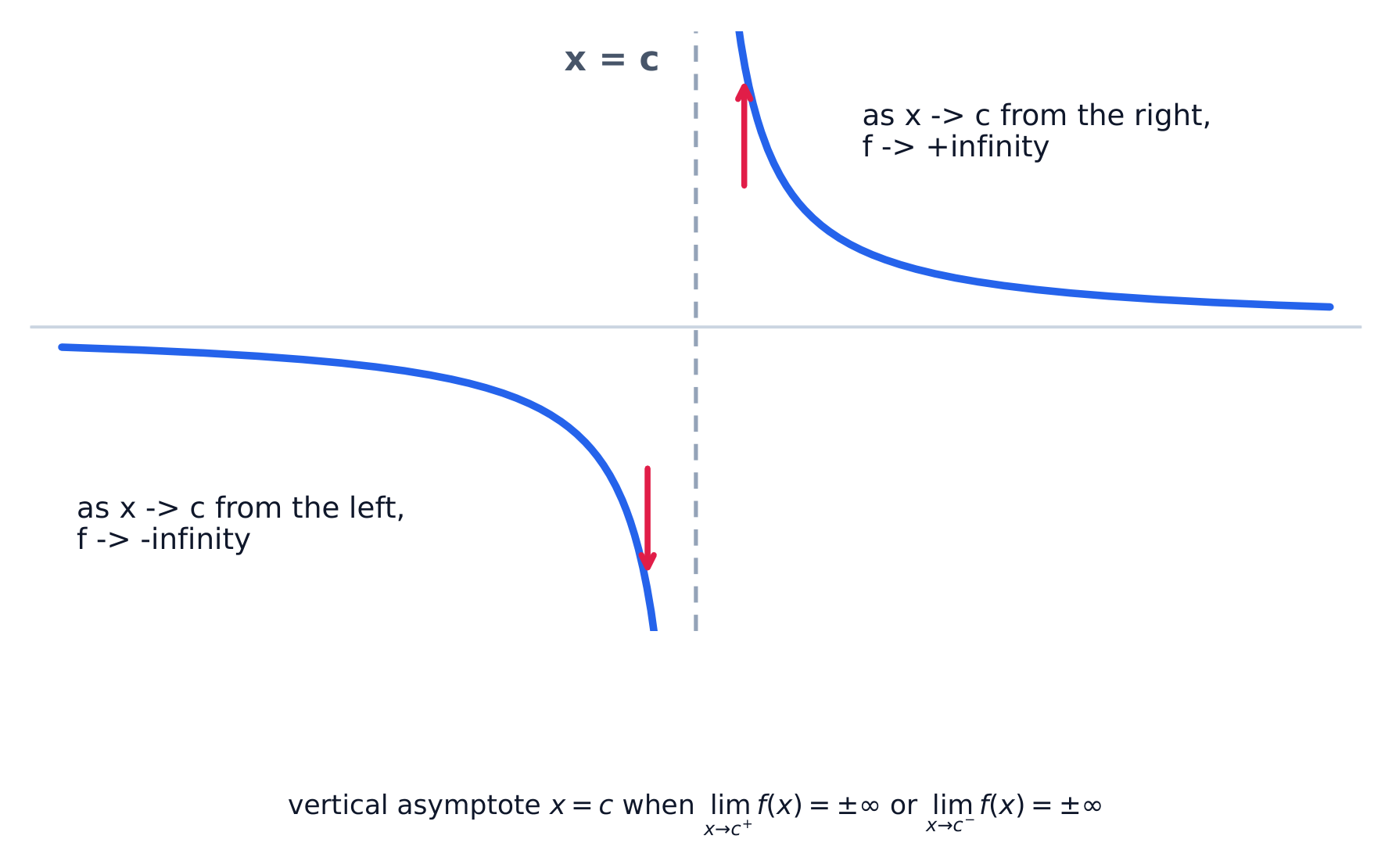
The idea of a limit extends to infinite limits 无穷极限. When a function grows without bound near $x=c$, we write $\lim_{x\to c} f(x) = \pm\infty$. This describes a vertical asymptote at $x=c$: the graph hugs the vertical line $x=c$ and shoots off toward $\pm\infty$.

This happens where a non-zero number is divided by something approaching $0$, such as at a zero of a denominator that does not cancel. Always check each side separately – the two sides can shoot opposite ways (one to $+\infty$, one to $-\infty$).

Español

La idea de límite se extiende a límites infinitos 无穷极限. Cuando una función crece sin cerca cerca de $x=c$, escribimos $\lim_{x\to c} f(x) = \pm\infty$. Esto describe una asíntota vertical en $x=c$: la gráfica abraza la línea vertical $x=c$ y se dispara hacia $\pm\infty$.

Esto sucede donde un número distinto de cero se divide por algo que se acerca a $0$, como en un cero de un denominador que no se cancela. Siempre verifica cada lado por separado – los dos lados pueden dispararse en direcciones opuestas (uno a $+\infty$, otro a $-\infty$).

Un límite infinito en una asíntota vertical x = c, donde los dos lados se disparan hacia infinidades opuestas
Cerca de una asíntota vertical, la gráfica abraza la línea $x=c$. Aquí el lado izquierdo cae a $-\infty$ y el lado derecho asciende a $+\infty$, por lo que el límite bidireccional no existe.
Explore · ⁨Explorar⁩

Explorar límites infinitos y asíntotas verticales

y = a/(x − b) + c

Con $y=\dfrac{a}{x-b}+c$, observa cómo la curva se dispara hacia $\pm\infty$ cerca de $x=b$. La asíntota vertical es la línea $x=b$ donde reside el límite infinito — los dos lados pueden dispararse en direcciones opuestas.

Vocabulary · ⁨Vocabulario⁩ Train · ⁨Entrenar⁩
English · ⁨Inglés⁩ Chinese · ⁨Chino⁩ Pinyin
vertical asymptote/ˈvɜːtɪkl ˈæsɪmptəʊt/ 垂直渐近线 chuí zhí jiàn jìn xiàn
continuous/kənˈtɪnjuːəs/ 连续 lián xù
continuous on an interval/kənˈtɪnjuːəs ɒn ən ˈɪntəvl/ 在区间上连续 zài qū jiān shàng lián xù
exponential/ˌekspəˈnenʃl/ 指数 zhǐ shù
logarithmic/ˌlɒɡəˈrɪθmɪk/ 对数 duì shù
trigonometric/ˌtrɪɡənəʊˈmetrɪk/ 三角 sān jiǎo
piecewise-defined function/ˈpiːswaɪz dɪˈfaɪnd ˈfʌŋkʃn/ 分段函数 fēn duàn hán shù
parameter/pəˈræmɪtə/ 参数 cān shù
infinite limits/ˈɪnfɪnət ˈlɪmɪts/ 无穷极限 wú qióng jí xiàn
limits at infinity/ˈlɪmɪts æt ɪnˈfɪnɪti/ 无穷远处的极限 wú qióng yuǎn chù de jí xiàn
end behavior/end bɪˈheɪvjə/ 末端行为 mò duān xíng wéi
1.15

Connecting Limits at Infinity and Horizontal Asymptotes · ⁨Conectando Límites en el Infinito y Asíntotas Horizontales⁩

Syllabus
English

Enduring Understanding (LIM-2): Reasoning with definitions, theorems, and properties can be used to justify claims about continuity.

Learning Objective LIM-2.D: Interpret the behavior of functions using limits involving infinity.

  • LIM-2.D.3 The concept of a limit can be extended to include limits at infinity.
  • LIM-2.D.4 Limits at infinity describe end behavior.
  • LIM-2.D.5 Relative magnitudes of functions and their rates of change can be compared using limits.
Español

Comprensión duradera (LIM-2): El razonamiento con definiciones, teoremas y propiedades puede utilizarse para justificar afirmaciones sobre la continuidad.

Objetivo de aprendizaje LIM-2.D: Interpretar el comportamiento de las funciones mediante límites que involucran el infinito.

  • LIM-2.D.3 El concepto de límite puede ampliarse para incluir límites en el infinito.
  • LIM-2.D.4 Los límites en el infinito describen el comportamiento al extremo.
  • LIM-2.D.5 Las magnitudes relativas de las funciones y sus tasas de cambio pueden compararse utilizando límites.

Source: College Board AP Course and Exam Description · ⁨Fuente: College Board AP Course and Exam Description⁩

English

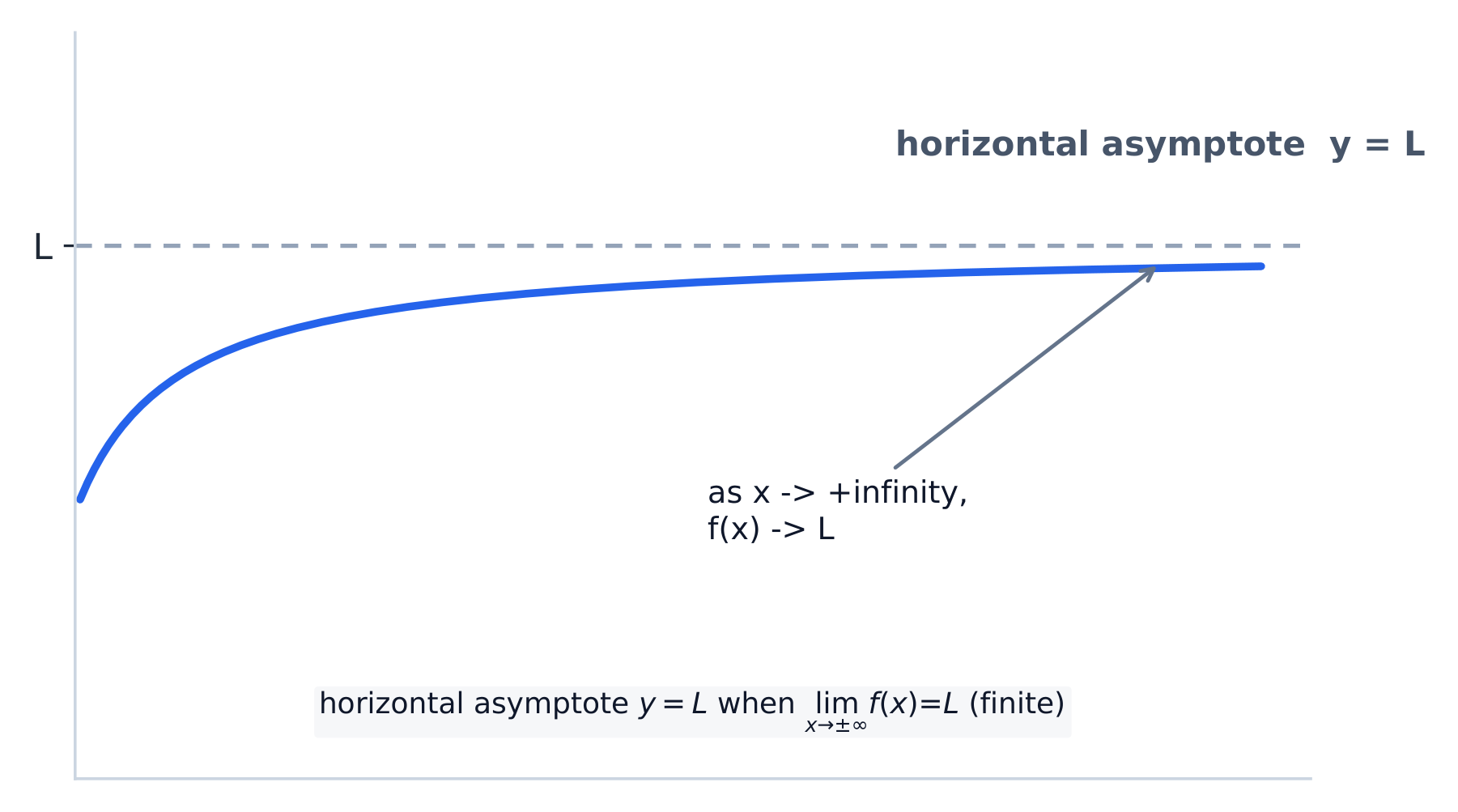
We can also let the input grow: limits at infinity 无穷远处的极限 describe the end behavior 末端行为 of a function as $x\to\pm\infty$. If the outputs settle toward a finite value $L$, then $y=L$ is a horizontal asymptote 水平渐近线.

For a rational function, compare the degrees 次数 of the top and bottom:

  • top degree < bottom degree $\Rightarrow$ limit is $0$ (asymptote $y=0$);
  • top degree = bottom degree $\Rightarrow$ limit is the ratio of the leading coefficients 首项系数之比;
  • top degree > bottom degree $\Rightarrow$ the function is unbounded (no horizontal asymptote).

More generally, we compare the relative magnitudes 相对大小 (relative growth rates) of functions: far out, an exponential beats any polynomial, and a polynomial beats any logarithm. On the exam, "as $t\to\infty$, which quantity is larger/where does the rate settle?" is answered with a limit at infinity.

Español

También podemos dejar que la entrada crezca: los límites en el infinito 无穷远处的极限 describen el comportamiento final 末端行为 de una función cuando $x\to\pm\infty$. Si las salidas se estabilizan hacia un valor finito $L$, entonces $y=L$ es una asíntota horizontal 水平渐近线.

Un límite en el infinito: a medida que x crece, las salidas se estabilizan hacia una asíntota horizontal y = L
Cuando $x\to+\infty$, la curva se aplanará hacia la línea $y=L$. La asíntota horizontal registra este comportamiento final.

Para una función racional, compara los grados 次数 del numerador y el denominador:

  • grado superior < grado inferior $\Rightarrow$ el límite es $0$ (asíntota $y=0$);
  • grado superior = grado inferior $\Rightarrow$ el límite es la razón de los coeficientes principales 首项系数之比;
  • grado superior > grado inferior $\Rightarrow$ la función es ilimitada (sin asíntota horizontal).

De manera más general, comparamos las magnitudes relativas 相对大小 (tasas de crecimiento relativo) de las funciones: muy lejos, una exponencial supera a cualquier polinomio, y un polinomio supera a cualquier logaritmo. En el examen, "cuando $t\to\infty$, ¿qué cantidad es mayor/dónde se asienta la tasa?" se responde con un límite en el infinito.

Explore · ⁨Explorar⁩

Explorar límites al infinito y asíntotas horizontales

y = a/(x − b) + c

Sigue la curva muy lejos hacia la derecha e izquierda. Cuando $x\to\pm\infty$, las salidas se asientan hacia $c$, por lo que $y=c$ es una asíntota horizontal — el valor finito del límite al infinito.

Vocabulary · ⁨Vocabulario⁩ Train · ⁨Entrenar⁩
English · ⁨Inglés⁩ Chinese · ⁨Chino⁩ Pinyin
horizontal asymptote/ˌhɒrɪˈzɒntl ˈæsɪmptəʊt/ 水平渐近线 shuǐ píng jiàn jìn xiàn
degrees/dɪˈɡriːz/ 次数 cì shù
ratio of the leading coefficients/ˈreɪʃɪəʊ ɒvðə ˈliːdɪŋ ˌkəʊɪˈfɪʃənts/ 首项系数之比 shǒu xiàng xì shù zhī bǐ
relative magnitudes/ˈrelətɪv ˈmæɡnɪtjuːdz/ 相对大小 xiāng duì dà xiǎo
Intermediate Value Theorem/ˌɪntəˈmiːdɪət ˈvæljuː ˈθɪərəm/ 介值定理 jiè zhí dìng lǐ
existence theorem/eɡˈzɪstəns ˈθɪərəm/ 存在性定理 cún zài xìng dìng lǐ
1.16

Working with the Intermediate Value Theorem (IVT) · ⁨Trabajando con el Teorema del Valor Intermedio (TVI)⁩

Syllabus
English

Enduring Understanding (FUN-1): Existence theorems allow us to draw conclusions about a function's behavior on an interval without precisely locating that behavior.

Learning Objective FUN-1.A: Explain the behavior of a function on an interval using the Intermediate Value Theorem.

  • FUN-1.A.1 If $f$ is a continuous function on the closed interval $[a, b]$ and $d$ is a number between $f(a)$ and $f(b)$, then the Intermediate Value Theorem guarantees that there is at least one number $c$ between $a$ and $b$, such that $f(c) = d$.
Español

Comprensión duradera (FUN-1): Los teoremas de existencia nos permiten extraer conclusiones sobre el comportamiento de una función en un intervalo sin precisar su ubicación exacta.

Objetivo de aprendizaje FUN-1.A: Explicar el comportamiento de una función en un intervalo utilizando el Teorema del Valor Intermedio.

  • FUN-1.A.1 Si $f$ es una función continua en el intervalo cerrado $[a, b]$ y $d$ es un número entre $f(a)$ y $f(b)$, entonces el Teorema del Valor Intermedio garantiza que existe al menos un número $c$ entre $a$ y $b$, tal que $f(c) = d$.

Source: College Board AP Course and Exam Description · ⁨Fuente: College Board AP Course and Exam Description⁩

English

The Intermediate Value Theorem 介值定理 is an existence theorem 存在性定理 – it guarantees a value exists without telling you where:

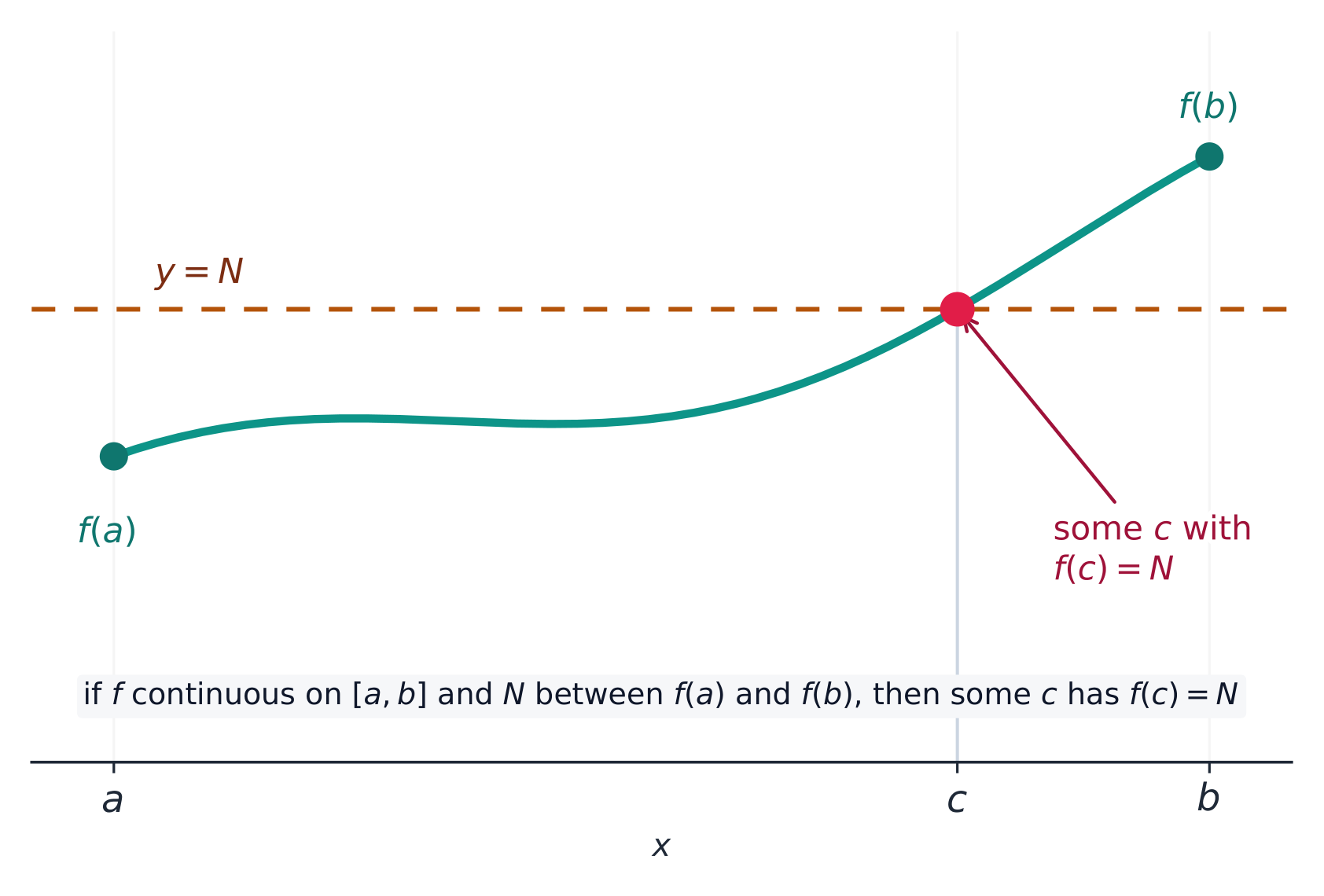
If $f$ is continuous on the closed interval $[a,b]$, and $d$ is any number between $f(a)$ and $f(b)$, then there is at least one number $c$ in $(a,b)$ with $f(c)=d$.

An unbroken curve cannot skip a height between its endpoints – it must pass through every one.

Exam skill – how to justify with the IVT. These questions appear almost every year (for example, "Must there be a value $c$ with $R(c)=155$?" or "Is there a time when $r'(t)=-6$?"). A full-credit justification has three moves:

  1. State continuity. Say the function is continuous on $[a,b]$ (often because it is differentiable, or given continuous).
  2. Show $d$ is trapped. Compute the two endpoint values and show the target $d$ lies between them, e.g. $f(a) < d < f(b)$.
  3. Conclude by name. "By the Intermediate Value Theorem, there is a $c$ in $(a,b)$ with $f(c)=d$."

Skipping the continuity statement, or not showing $d$ is between the endpoints, loses the point – the theorem requires both conditions.

Worked example. Evaluate $\lim_{x\to 3}\dfrac{x^2-9}{x-3}$. Direct substitution gives $\tfrac{0}{0}$ (indeterminate), so factor: $\dfrac{(x-3)(x+3)}{x-3}=x+3$ for $x\ne 3$. Then $\lim_{x\to 3}(x+3)=6$. The graph has a removable discontinuity (a hole) at $x=3$ — the limit exists even though the function is undefined there.

Español

El Teorema del Valor Intermedio 介值定理 es un teorema de existencia 存在性定理 – garantiza que existe un valor sin decirte dónde:

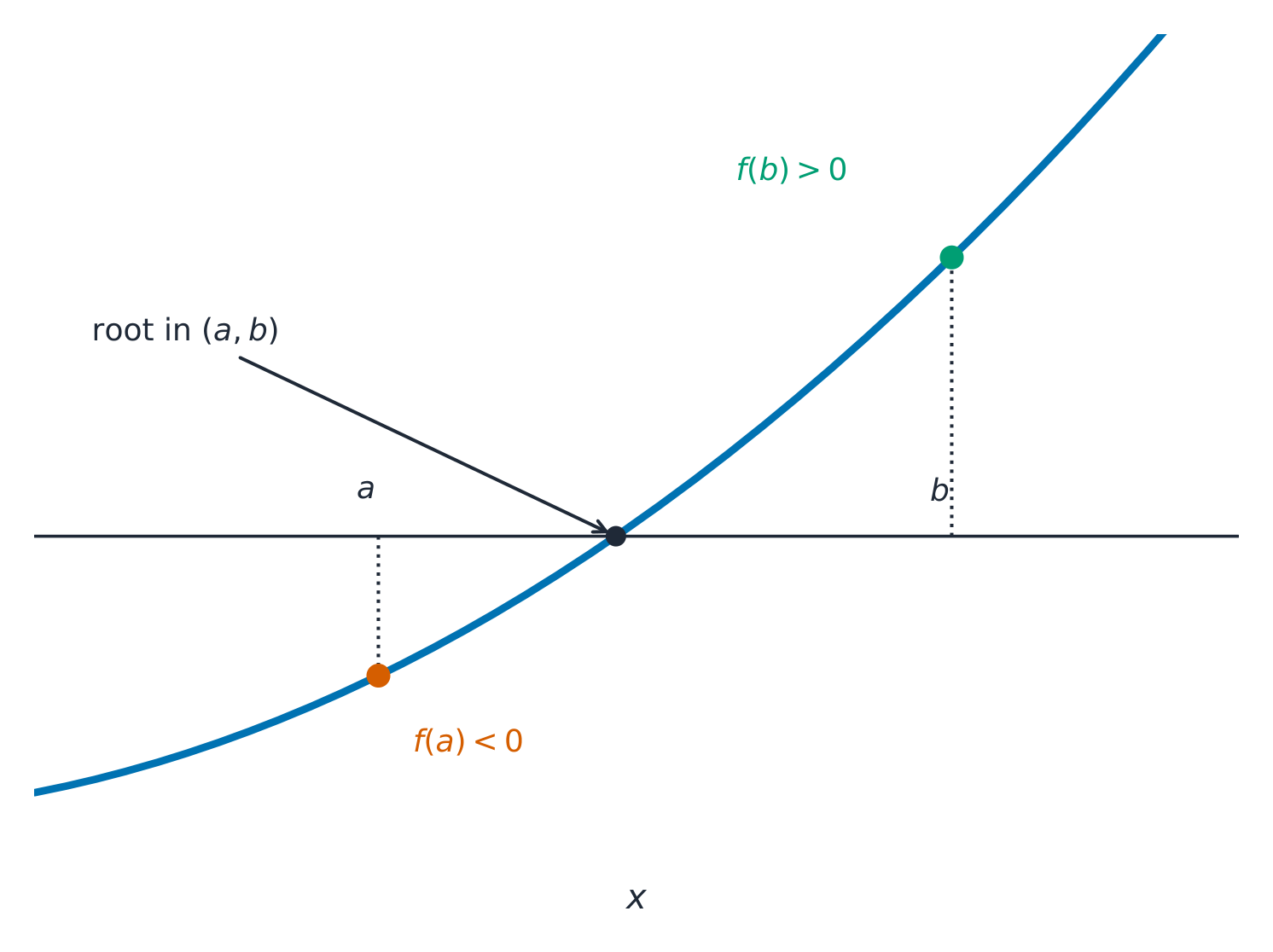
Signos opuestos de f(a) y f(b) atrapan una raíz entre a y b

Si $f$ es continua en el intervalo cerrado $[a,b]$, y $d$ es cualquier número entre $f(a)$ y $f(b)$, entonces hay al menos un número $c$ en $(a,b)$ tal que $f(c)=d$.

Una curva ininterrumpida no puede saltarse una altura entre sus extremos – debe pasar por cada una de ellas.

El Teorema del Valor Intermedio: una curva continua toca cada altura entre f(a) y f(b)
Una curva continua desde $(a,f(a))$ hasta $(b,f(b))$ debe cruzar cada altura $d$ intermedia al menos una vez.

Habilidad de examen – cómo justificar con el TVI. Estas preguntas aparecen casi cada año (por ejemplo, "¿Debe haber un valor $c$ con $R(c)=155$?" o "¿Existe un momento en que $r'(t)=-6$?"). Una justificación de crédito completo tiene tres movimientos:

  1. Declara la continuidad. Di que la función es continua en $[a,b]$ (a menudo porque es diferenciable, o se da como continua).
  2. Muestra que $d$ está atrapado. Calcula los dos valores en los extremos y muestra que el objetivo $d$ se encuentra entre ellos, p. ej. $f(a) < d < f(b)$.
  3. Concluye por nombre. "Por el Teorema del Valor Intermedio, hay un $c$ en $(a,b)$ tal que $f(c)=d$."

Saltarse la declaración de continuidad, o no mostrar que $d$ está entre los extremos, pierde el punto – el teorema requiere ambas condiciones.

Ejemplo resuelto. Evalúa $\lim_{x\to 3}\dfrac{x^2-9}{x-3}$. La sustitución directa da $\tfrac{0}{0}$ (indeterminado), así que factoriza: $\dfrac{(x-3)(x+3)}{x-3}=x+3$ para $x\ne 3$. Entonces $\lim_{x\to 3}(x+3)=6$. La gráfica tiene una discontinuidad evitable (un agujero) en $x=3$ — el límite existe aunque la función esté indefinida allí.

Explore · ⁨Explorar⁩

Por qué una curva continua no puede saltar un valor

y = ax³ + bx² + cx + d

El Teorema del Valor Intermedio: una función continua en $[a,b]$ toma cada $y$ entre $f(a)$ y $f(b)$ en algún punto interior. Una curva ininterrumpida no puede saltar sobre una altura — debe pasar a través de ella.

Vocabulary · ⁨Vocabulario⁩ Train · ⁨Entrenar⁩
English · ⁨Inglés⁩ Chinese · ⁨Chino⁩ Pinyin
change/tʃeɪndʒ/ 变化 biàn huà
accumulation/əˌkjuːmjʊˈleɪʃn/ 累积 lěi jī
1.16

Exam tips · ⁨Consejos para el examen⁩

English
  • A limit describes what $f(x)$ approaches, which need not equal $f(a)$ — the two-sided limit exists only if both sides agree.
  • Try direct substitution first; for a $\tfrac00$ form, factor and cancel or rationalise before substituting.
  • A function is continuous at $a$ when the limit exists, $f(a)$ is defined, and they are equal.
  • Use the Intermediate Value Theorem to guarantee a root: a continuous function that changes sign on $[a,b]$ takes every value between.
  • Read horizontal asymptotes from end behaviour (limits at $\pm\infty$) and vertical asymptotes where the denominator (not the numerator) is zero.
Español
  • Un límite describe hacia qué $f(x)$ se acerca, lo cual no necesita ser igual a $f(a)$ — el límite bidireccional existe solo si ambos lados coinciden.
  • Intenta la sustitución directa primero; para una forma $\tfrac00$, factoriza y cancela o racionaliza antes de sustituir.
  • Una función es continua en $a$ cuando el límite existe, $f(a)$ está definida y son iguales.
  • Usa el Teorema del Valor Intermedio para garantizar una raíz: una función continua que cambia de signo en $[a,b]$ toma todos los valores intermedios.
  • Lee las asíntotas horizontales del comportamiento final (límites en $\pm\infty$) y las asíntotas verticales donde el denominador (no el numerador) es cero.

Interactive lessons on this topic · ⁨Lecciones interactivas sobre este tema⁩

Work through it step by step, with instant-check exercises. · ⁨Trátalo paso a paso, con ejercicios de verificación instantánea.⁩

Past Papers · ⁨Exámenes Anteriores⁩

More topics in AP Cálculo AB · ⁨Más temas en AP Cálculo AB⁩

Log in or create account · ⁨Iniciar sesión o crear cuenta⁩

IGCSE, A-Level & AP