Skip to content · ⁨Saltar al contenido⁩

Diferenciación: Definición y Propiedades Fundamentales

AP Cálculo AB · Topic 2 · ⁨Tema 2⁩

Train · ⁨Entrenar⁩
Video lesson for this topic · ⁨Lección de video para este tema⁩ Open the video page · ⁨Abrir la página de video⁩
7:54

Definición de la Derivada

Imagina el viaje de un coche como una curva. En todo un intervalo, podemos medir su velocidad promedio — la pendiente de la línea recta que une dos puntos en la curva.…

English narration · English + 中文 subtitles burned in · ⁨Narración en inglés · Subtítulos en inglés + 中文 quemados en pantalla⁩

2.1

Average and Instantaneous Rates of Change · ⁨Tasas promedio e instantáneas de cambio⁩

Syllabus
English

Enduring Understanding (CHA-2): Derivatives allow us to determine rates of change at an instant by applying limits to knowledge about rates of change over intervals.

Learning Objective CHA-2.A: Determine average rates of change using difference quotients.

  • CHA-2.A.1 The difference quotients $\dfrac{f(a+h)-f(a)}{h}$ and $\dfrac{f(x)-f(a)}{x-a}$ express the average rate of change of a function over an interval.

Learning Objective CHA-2.B: Represent the derivative of a function as the limit of a difference quotient.

  • CHA-2.B.1 The instantaneous rate of change of a function at $x=a$ can be expressed by $\lim\limits_{h\to 0}\dfrac{f(a+h)-f(a)}{h}$ or $\lim\limits_{x\to a}\dfrac{f(x)-f(a)}{x-a}$, provided the limit exists. These are equivalent forms of the definition of the derivative and are denoted $f'(a)$.
Español

Comprensión duradera (CHA-2): Las derivadas nos permiten determinar tasas de cambio en un instante aplicando límites al conocimiento sobre tasas de cambio en intervalos.

Objetivo de aprendizaje CHA-2.A: Determinar tasas de cambio promedio utilizando cocientes de diferencias.

  • CHA-2.A.1 Los cocientes de diferencias $\dfrac{f(a+h)-f(a)}{h}$ y $\dfrac{f(x)-f(a)}{x-a}$ expresan la tasa de cambio promedio de una función sobre un intervalo.

Objetivo de aprendizaje CHA-2.B: Representar la derivada de una función como el límite de un cociente de diferencias.

  • CHA-2.B.1 La tasa de cambio instantánea de una función en $x=a$ puede expresarse mediante $\lim\limits_{h\to 0}\dfrac{f(a+h)-f(a)}{h}$ o $\lim\limits_{x\to a}\dfrac{f(x)-f(a)}{x-a}$, siempre que el límite exista. Estas son formas equivalentes de la definición de la derivada y se denotan como $f'(a)$.
Source: College Board AP Course and Exam Description · ⁨Fuente: College Board AP Course and Exam Description⁩

English
The derivative from first principles

Unit 1 built the limit. Unit 2 uses it to define the derivative 导数 – the exact rate of change at a point.

Over an interval, the average rate of change is a difference quotient 差商. Two equivalent forms appear:

$$\frac{f(a+h)-f(a)}{h} \qquad\text{and}\qquad \frac{f(x)-f(a)}{x-a}.$$
The first uses a step of size $h$ from $a$; the second uses two points $x$ and $a$. Both compute $\dfrac{\text{change in output}}{\text{change in input}}$ over the interval.

The instantaneous 瞬时 rate of change at $x=a$ is what the difference quotient approaches as the interval shrinks to zero. This limit is the derivative at $a$, written $f'(a)$:

$$f'(a) = \lim_{h\to 0}\frac{f(a+h)-f(a)}{h} = \lim_{x\to a}\frac{f(x)-f(a)}{x-a},$$
provided the limit exists.

Español
Una montaña rusa en una colina de elevación: la derivada mide la tasa instantánea de cambio de posición
La derivada desde los primeros principios

La Unidad 1 construyó el límite. La Unidad 2 lo utiliza para definir la derivada – la tasa de cambio exacta en un punto.

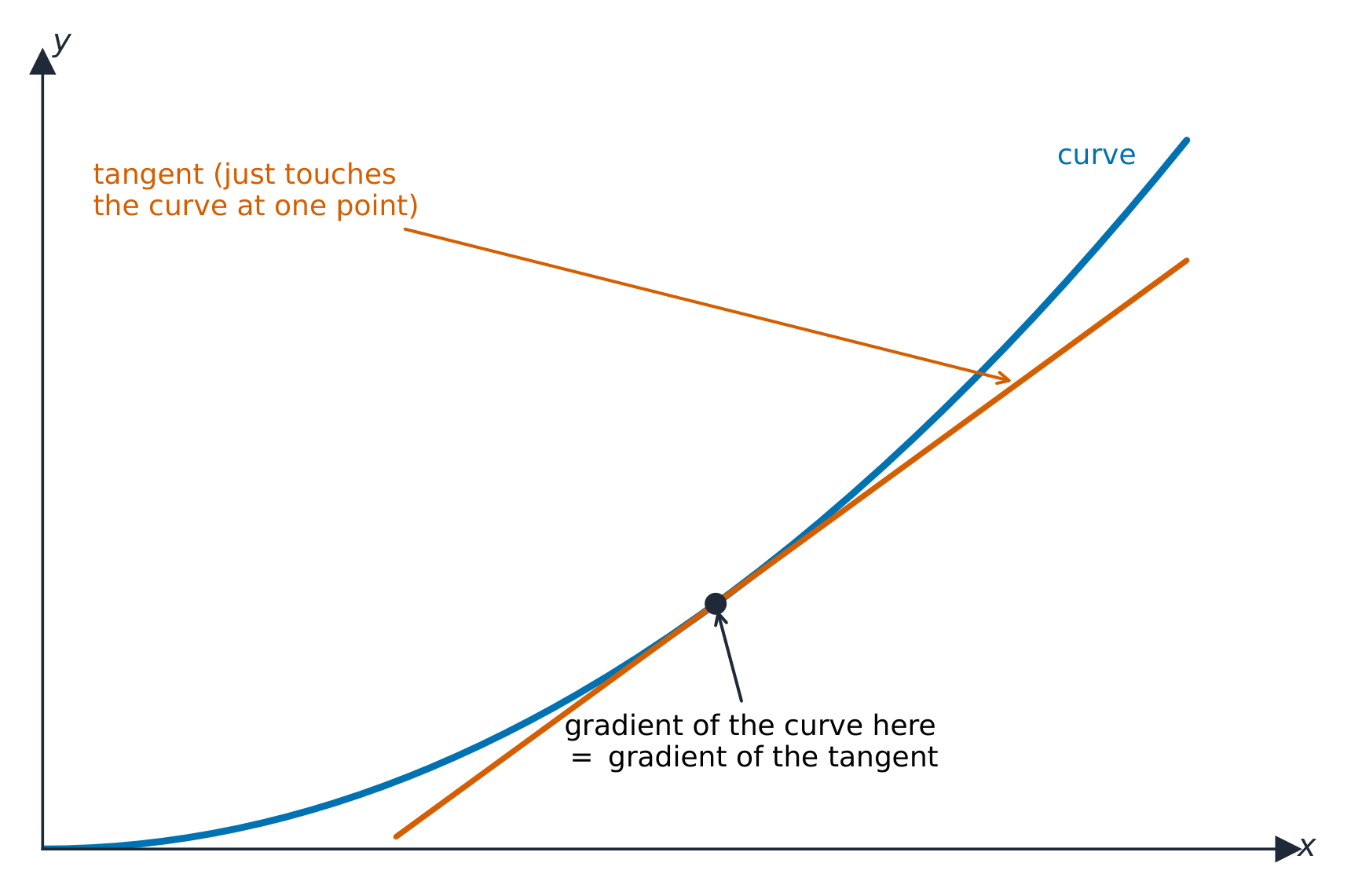
La tasa instantánea de cambio es la pendiente de la tangente en un punto
La tasa de cambio instantánea es la pendiente de la recta tangente en un punto

Sobre un intervalo, la tasa de cambio promedio es un cociente de diferencias. Aparecen dos formas equivalentes:

$$\frac{f(a+h)-f(a)}{h} \qquad\text{and}\qquad \frac{f(x)-f(a)}{x-a}.$$
La primera usa un paso de tamaño $h$ desde $a$; la segunda usa dos puntos $x$ y $a$. Ambas calculan $\dfrac{\text{change in output}}{\text{change in input}}$ sobre el intervalo.

La tasa de cambio instantánea en $x=a$ es hacia lo que se aproxima el cociente de diferencias cuando el intervalo se reduce a cero. Este límite es la derivada en $a$, escrita como $f'(a)$:

$$f'(a) = \lim_{h\to 0}\frac{f(a+h)-f(a)}{h} = \lim_{x\to a}\frac{f(x)-f(a)}{x-a},$$
siempre que el límite exista.

Explore · ⁨Explorar⁩

De la tasa promedio a la tasa instantánea

y = ax³ + bx² + cx + d

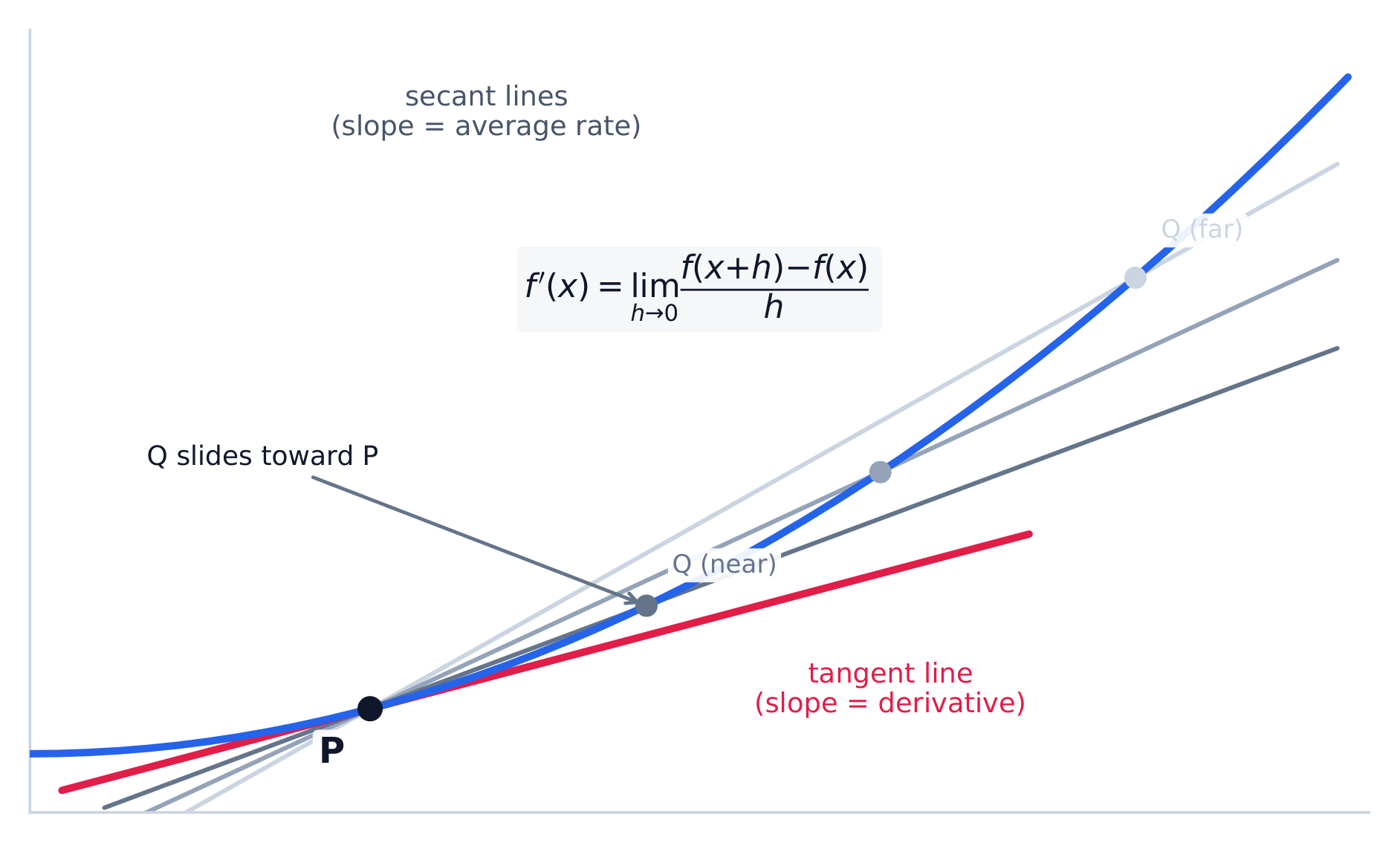
Desliza el punto: la secante a través de dos puntos cercanos se inclina hacia la tangente a medida que se fusionan. La pendiente de la tangente es la derivada — la tasa de cambio instantánea.

Vocabulary · ⁨Vocabulario⁩ Train · ⁨Entrenar⁩
English · ⁨Inglés⁩ Chinese · ⁨Chino⁩ Pinyin
derivative/dɪˈrɪvətɪv/ 导数 dǎo shù
difference quotient/ˈdɪfrəns ˈkwəʊʃənt/ 差商 chà shāng
instantaneous/ˌɪnstənˈteɪnɪəs/ 瞬时 shùn shí
first principles/fɜːst ˈprɪnsɪplz/ 用定义求导 yòng dìng yì qiú dǎo
notations/nəʊˈteɪʃnz/ 记号 jì hào
slope/sləʊp/ 斜率 xié lǜ
tangent line/ˈtændʒənt laɪn/ 切线 qiè xiàn
2.2

Defining the Derivative and Its Notation · ⁨Definición de la derivada y su notación⁩

Syllabus
English

Enduring Understanding (CHA-2): Derivatives allow us to determine rates of change at an instant by applying limits to knowledge about rates of change over intervals.

Learning Objective CHA-2.B: Represent the derivative of a function as the limit of a difference quotient.

  • CHA-2.B.2 The derivative of $f$ is the function whose value at $x$ is $\lim\limits_{h\to 0}\dfrac{f(x+h)-f(x)}{h}$, provided this limit exists.
  • CHA-2.B.3 For $y=f(x)$, notations for the derivative include $\dfrac{dy}{dx}$, $f'(x)$, and $y'$.
  • CHA-2.B.4 The derivative can be represented graphically, numerically, analytically, and verbally.

Learning Objective CHA-2.C: Determine the equation of a line tangent to a curve at a given point.

  • CHA-2.C.1 The derivative of a function at a point is the slope of the line tangent to a graph of the function at that point.
Español

Comprensión Duradera (CHA-2): Las derivadas nos permiten determinar las tasas de cambio instantáneas aplicando límites al conocimiento sobre las tasas de cambio en intervalos.

Objetivo de Aprendizaje CHA-2.B: Representar la derivada de una función como el límite de un cociente de diferencias.

  • CHA-2.B.2 La derivada de $f$ es la función cuyo valor en $x$ es $\lim\limits_{h\to 0}\dfrac{f(x+h)-f(x)}{h}$, siempre que este límite exista.
  • CHA-2.B.3 Para $y=f(x)$, las notaciones para la derivada incluyen $\dfrac{dy}{dx}$, $f'(x)$ y $y'$.
  • CHA-2.B.4 La derivada puede representarse gráfica, numéricamente, analítica y verbalmente.

Objetivo de Aprendizaje CHA-2.C: Determinar la ecuación de una recta tangente a una curva en un punto dado.

  • CHA-2.C.1 La derivada de una función en un punto es la pendiente de la recta tangente a la gráfica de la función en ese punto.

Source: College Board AP Course and Exam Description · ⁨Fuente: College Board AP Course and Exam Description⁩

English

Let the point $a$ vary and the derivative becomes a new function:

$$f'(x) = \lim_{h\to 0}\frac{f(x+h)-f(x)}{h}.$$
This is the definition of the derivative (sometimes called differentiating "by first principles" 用定义求导). Its value at each $x$ is the instantaneous rate of change there.

Common notations 记号 for the derivative of $y=f(x)$ are:

$$\frac{dy}{dx}, \qquad f'(x), \qquad y'.$$
The derivative can be represented graphically, numerically, analytically, and verbally – be ready to move between them.

Geometric meaning. The derivative at a point is the slope 斜率 of the tangent line 切线 to the graph there. So the tangent line at $x=a$ passes through $\big(a, f(a)\big)$ with slope $f'(a)$:

$$y - f(a) = f'(a)\,(x-a).$$
Writing this line is a routine exam task, so keep the point-slope form ready.

Español

Deje que el punto $a$ varíe y la derivada se convierte en una nueva función:

$$f'(x) = \lim_{h\to 0}\frac{f(x+h)-f(x)}{h}.$$
Esta es la definición de la derivada (a veces llamada derivar "por definición" o por primeros principios). Su valor en cada $x$ es la tasa de cambio instantánea allí.

Las notaciones comunes para la derivada de $y=f(x)$ son:

$$\frac{dy}{dx}, \qquad f'(x), \qquad y'.$$
La derivada puede representarse gráfica, numérica, analítica y verbalmente; esté preparado para moverse entre ellas.

Significado geométrico. La derivada en un punto es la pendiente de la recta tangente a la gráfica allí. Así, la recta tangente en $x=a$ pasa por $\big(a, f(a)\big)$ con pendiente $f'(a)$:

$$y - f(a) = f'(a)\,(x-a).$$
Escribir esta recta es una tarea rutinaria en los exámenes, así que mantenga la forma punto-pendiente lista.

Las pendientes de las secantes se acercan a la pendiente de la tangente: la derivada es el límite de las tasas promedio
A medida que $Q$ se acerca a $P$, la pendiente de cada secante (una tasa promedio) se acerca a la pendiente de la tangente: la derivada $f'(a)$.
2.3

Estimating a Derivative at a Point · ⁨Estimación de una Derivada en un Punto⁩

Syllabus
English

Enduring Understanding (CHA-2): Derivatives allow us to determine rates of change at an instant by applying limits to knowledge about rates of change over intervals.

Learning Objective CHA-2.D: Estimate derivatives.

  • CHA-2.D.1 The derivative at a point can be estimated from information given in tables or graphs.
  • CHA-2.D.2 Technology can be used to calculate or estimate the value of a derivative of a function at a point.
Español

Comprensión duradera (CHA-2): Las derivadas nos permiten determinar tasas de cambio instantáneas aplicando límites al conocimiento sobre las tasas de cambio en intervalos.

Objetivo de aprendizaje CHA-2.D: Estimar derivadas.

  • CHA-2.D.1 La derivada en un punto puede estimarse a partir de información proporcionada en tablas o gráficos.
  • CHA-2.D.2 Se puede utilizar tecnología para calcular o estimar el valor de la derivada de una función en un punto.

Source: College Board AP Course and Exam Description · ⁨Fuente: College Board AP Course and Exam Description⁩

English

You do not always have a formula. When a function is given by a table 表格 or a graph, estimate the derivative $f'(a)$ with a difference quotient over a small interval around $a$. A table with values on both sides of $a$ gives the best estimate:

$$f'(a) \approx \frac{f(b)-f(c)}{b-c},\qquad \text{where } c < a < b \text{ are the closest table inputs}.$$
Technology (a calculator) can also estimate a derivative at a point.

Exam skill (appears almost every year). Questions such as "Approximate $M'(7.5)$ using the average rate of change of $M$ over the interval $5 \le t \le 10$" ask for exactly this difference quotient. Show the setup:

$$M'(7.5) \approx \frac{M(10)-M(5)}{10-5}.$$
Full credit needs the numbers plugged in and the correct units 单位 (output units per input unit), since these come from real-world models.

Español

No siempre tiene una fórmula. Cuando una función está dada por una tabla o una gráfica, estime la derivada $f'(a)$ con un cociente de diferencias sobre un intervalo pequeño alrededor de $a$. Una tabla con valores a ambos lados de $a$ proporciona la mejor estimación:

$$f'(a) \approx \frac{f(b)-f(c)}{b-c},\qquad \text{where } c < a < b \text{ are the closest table inputs}.$$
La tecnología (una calculadora) también puede estimar una derivada en un punto.

Habilidad de examen (aparece casi todos los años). Preguntas como "Aproxime $M'(7.5)$ usando la tasa de cambio promedio de $M$ sobre el intervalo $5 \le t \le 10$" piden exactamente este cociente de diferencias. Muestre la configuración:

$$M'(7.5) \approx \frac{M(10)-M(5)}{10-5}.$$
Se requiere crédito completo si se sustituyen los números y se incluyen las unidades correctas (unidades de salida por unidad de entrada), ya que provienen de modelos del mundo real.

Vocabulary · ⁨Vocabulario⁩ Train · ⁨Entrenar⁩
English · ⁨Inglés⁩ Chinese · ⁨Chino⁩ Pinyin
table/ˈteɪbl/ 表格 biǎo gé
units/ˈjuːnɪts/ 单位 dān wèi
differentiable/ˈdɪfərenʃɪəbl/ 可导 kě dǎo
continuous/kənˈtɪnjuːəs/ 连续 lián xù
corner/ˈkɔːnə/ 尖点 jiān diǎn
vertical tangent/ˈvɜːtɪkl ˈtændʒənt/ 垂直切线 chuí zhí qiè xiàn
power rule/ˈpaʊə ruːl/ 幂法则 mì fǎ zé
Constant multiple/ˈkɒnstənt ˈmʌltɪpl/ 常数倍 cháng shù bèi
polynomial/ˌpɒlɪˈnəʊmɪəl/ 多项式 duō xiàng shì
2.4

When Does a Derivative Exist? · ⁨¿Cuándo existe una derivada?⁩

Syllabus
English

Enduring Understanding (FUN-2): Recognizing that a function's derivative may also be a function allows us to develop knowledge about the related behaviors of both.

Learning Objective FUN-2.A: Explain the relationship between differentiability and continuity.

  • FUN-2.A.1 If a function is differentiable at a point, then it is continuous at that point. In particular, if a point is not in the domain of $f$, then it is not in the domain of $f'$.
  • FUN-2.A.2 A continuous function may fail to be differentiable at a point in its domain.
    • Illustrative examples for FUN-2.A.2:
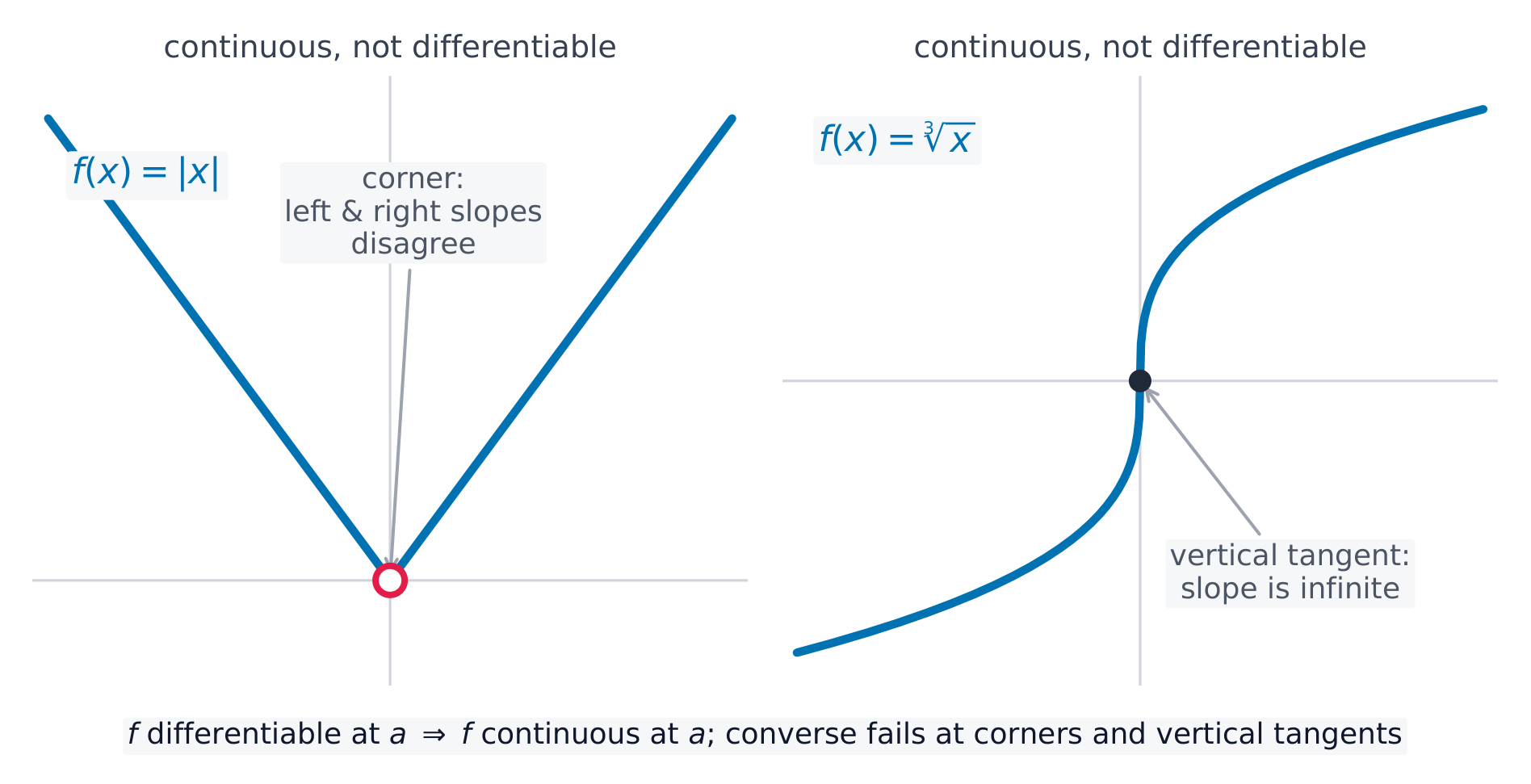
      • The left hand and right hand limits of the difference quotient are not equal, as in $f(x)=|x|$ at $x=0$.
      • The tangent line is vertical and has no slope, as in $f(x)=\sqrt[3]{x}$ at $x=0$.
Español

Comprensión duradera (FUN-2): Reconocer que la derivada de una función también puede ser una función nos permite desarrollar conocimiento sobre los comportamientos relacionados de ambas.

Objetivo de aprendizaje FUN-2.A: Explicar la relación entre diferenciabilidad y continuidad.

  • FUN-2.A.1 Si una función es diferenciable en un punto, entonces es continua en ese punto. En particular, si un punto no pertenece al dominio de $f$, entonces tampoco pertenece al dominio de $f'$.
  • FUN-2.A.2 Una función continua puede dejar de ser diferenciable en un punto de su dominio.
    • Ejemplos ilustrativos para FUN-2.A.2:
      • Los límites laterales del cociente diferencial no son iguales, como en $f(x)=|x|$ en $x=0$.
      • La recta tangente es vertical y no tiene pendiente, como en $f(x)=\sqrt[3]{x}$ en $x=0$.

Source: College Board AP Course and Exam Description · ⁨Fuente: College Board AP Course and Exam Description⁩

English

Differentiability is stronger than continuity. The key relationship:

If $f$ is differentiable 可导 at a point, then $f$ is continuous 连续 there.

So differentiability implies continuity. The reverse is false: a continuous function can fail to be differentiable. Two ways this happens:

  • A corner 尖点: the left and right difference-quotient limits disagree, as with $f(x)=|x|$ at $x=0$.
  • A vertical tangent 垂直切线: the slope is infinite (no real number), as with $f(x)=\sqrt[3]{x}$ at $x=0$.

Also, a point outside the domain of $f$ cannot be in the domain of $f'$. Use the contrapositive on the exam: if $f$ is not continuous at $a$, then $f$ is not differentiable at $a$.

Español

La diferenciabilidad es más fuerte que la continuidad. La relación clave:

Si $f$ es diferenciable en un punto, entonces $f$ es continua allí.

Así, la diferenciabilidad implica continuidad. Lo contrario es falso: una función continua puede dejar de ser diferenciable. Dos formas en que esto ocurre:

  • Un punto anguloso: los límites del cociente de diferencias izquierdo y derecho no coinciden, como con $f(x)=|x|$ en $x=0$.
  • Una tangente vertical: la pendiente es infinita (sin número real), como con $f(x)=\sqrt[3]{x}$ en $x=0$.
Dos formas en que una función continua no es diferenciable: una esquina y una tangente vertical
Dos formas en que una función continua no es diferenciable: un punto anguloso y una tangente vertical

Además, un punto fuera del dominio de $f$ no puede estar en el dominio de $f'$. Use la contrapositiva en el examen: si $f$ no es continua en $a$, entonces $f$ no es diferenciable en $a$.

2.5

The Power Rule · ⁨Regla de la Potencia⁩

Syllabus
English

Enduring Understanding (FUN-3): Recognizing opportunities to apply derivative rules can simplify differentiation.

Learning Objective FUN-3.A: Calculate derivatives of familiar functions.

  • FUN-3.A.1 Direct application of the definition of the derivative and specific rules can be used to calculate the derivative for functions of the form $f(x)=x^{r}$.
Español

Comprensión duradera (FUN-3): Reconocer oportunidades para aplicar las reglas de derivación puede simplificar el proceso de diferenciación.

Objetivo de aprendizaje FUN-3.A: Calcular derivadas de funciones conocidas.

  • FUN-3.A.1 La aplicación directa de la definición de derivada y de reglas específicas puede utilizarse para calcular la derivada de funciones de la forma $f(x)=x^{r}$.

Source: College Board AP Course and Exam Description · ⁨Fuente: College Board AP Course and Exam Description⁩

English

From here we use rules instead of the limit definition each time. The power rule 幂法则 handles any power of $x$:

$$\frac{d}{dx}\,x^{r} = r\,x^{\,r-1}\qquad\text{for any real } r.$$
It works for whole-number powers, negative powers ($\tfrac{1}{x}=x^{-1}$), and roots ($\sqrt{x}=x^{1/2}$) – rewrite as a power first, then apply the rule.

Español

Desde aquí usamos reglas en lugar de la definición de límite cada vez. La regla de la potencia maneja cualquier potencia de $x$:

$$\frac{d}{dx}\,x^{r} = r\,x^{\,r-1}\qquad\text{for any real } r.$$
Funciona para potencias enteras, potencias negativas ($\tfrac{1}{x}=x^{-1}$) y raíces ($\sqrt{x}=x^{1/2}$): reescriba primero como una potencia, luego aplique la regla.

Explore · ⁨Explorar⁩

Una función potencia y su pendiente creciente

y = ax³ + bx² + cx + d

La regla de la potencia $\frac{d}{dx}x^n = nx^{n-1}$ baja el exponente como factor. Para $x^3$, la pendiente crece rápidamente a medida que $x$ se aleja de 0 — la curva se vuelve más pronunciada.

2.6

Constant, Sum, Difference, and Constant Multiple Rules · ⁨Reglas de Constante, Suma, Diferencia y Múltiplo Constante⁩

Syllabus
English

Enduring Understanding (FUN-3): Recognizing opportunities to apply derivative rules can simplify differentiation.

Learning Objective FUN-3.A: Calculate derivatives of familiar functions.

  • FUN-3.A.2 Sums, differences, and constant multiples of functions can be differentiated using derivative rules.
  • FUN-3.A.3 The power rule combined with sum, difference, and constant multiple properties can be used to find the derivatives for polynomial functions.
Español

Comprensión Duradera (FUN-3): Reconocer oportunidades para aplicar reglas de derivación puede simplificar el proceso de diferenciación.

Objetivo de Aprendizaje FUN-3.A: Calcular derivadas de funciones familiares.

  • FUN-3.A.2 Las sumas, diferencias y múltiplos constantes de funciones pueden derivarse utilizando las reglas de derivación.
  • FUN-3.A.3 La regla de la potencia combinada con las propiedades de suma, diferencia y múltiplo constante se puede utilizar para encontrar las derivadas de funciones polinómicas.

Source: College Board AP Course and Exam Description · ⁨Fuente: College Board AP Course and Exam Description⁩

English

These rules let you differentiate term by term:

  • Constant: $\dfrac{d}{dx}\,k = 0$ (a constant does not change).
  • Constant multiple 常数倍: $\dfrac{d}{dx}\big[k\,f(x)\big] = k\,f'(x)$.
  • Sum / difference: $\dfrac{d}{dx}\big[f(x)\pm g(x)\big] = f'(x)\pm g'(x)$.

Combined with the power rule, they differentiate any polynomial 多项式 term by term. Example:

$$\frac{d}{dx}\big(4x^3 - 5x + 7\big) = 12x^2 - 5.$$

Español

Estas reglas le permiten derivar término a término:

  • Constante: $\dfrac{d}{dx}\,k = 0$ (una constante no cambia).
  • Múltiplo constante: $\dfrac{d}{dx}\big[k\,f(x)\big] = k\,f'(x)$.
  • Suma / diferencia: $\dfrac{d}{dx}\big[f(x)\pm g(x)\big] = f'(x)\pm g'(x)$.

Combinadas con la regla de la potencia, derivan cualquier polinomio término a término. Ejemplo:

$$\frac{d}{dx}\big(4x^3 - 5x + 7\big) = 12x^2 - 5.$$

2.7

Derivatives of sin x, cos x, e^x, and ln x · ⁨Derivadas de sin x, cos x, e^x y ln x⁩

Syllabus
English

Enduring Understanding (FUN-3): Recognizing opportunities to apply derivative rules can simplify differentiation.

Learning Objective FUN-3.A: Calculate derivatives of familiar functions.

  • FUN-3.A.4 Specific rules can be used to find the derivatives for sine, cosine, exponential, and logarithmic functions.

Enduring Understanding (LIM-3): Reasoning with definitions, theorems, and properties can be used to determine a limit.

Learning Objective LIM-3.A: Interpret a limit as a definition of a derivative.

  • LIM-3.A.1 In some cases, recognizing an expression for the definition of the derivative of a function whose derivative is known offers a strategy for determining a limit.
Español

Comprensión Duradera (FUN-3): Reconocer oportunidades para aplicar reglas de derivación puede simplificar el proceso de diferenciación.

Objetivo de Aprendizaje FUN-3.A: Calcular derivadas de funciones conocidas.

  • FUN-3.A.4 Pueden utilizarse reglas específicas para encontrar las derivadas de las funciones seno, coseno, exponencial y logarítmica.

Comprensión Duradera (LIM-3): El razonamiento basado en definiciones, teoremas y propiedades puede emplearse para determinar un límite.

Objetivo de Aprendizaje LIM-3.A: Interpretar un límite como una definición de la derivada.

  • LIM-3.A.1 En algunos casos, reconocer una expresión correspondiente a la definición de la derivada de una función cuya derivada se conoce ofrece una estrategia para determinar un límite.

Source: College Board AP Course and Exam Description · ⁨Fuente: College Board AP Course and Exam Description⁩

English

Learn these four building-block derivatives by heart:

$$\frac{d}{dx}\sin x = \cos x, \qquad \frac{d}{dx}\cos x = -\sin x,$$
$$\frac{d}{dx}e^{x} = e^{x}, \qquad \frac{d}{dx}\ln x = \frac{1}{x}\ \ (x>0).$$
Note the minus sign on the derivative of cosine, and that $e^{x}$ is its own derivative.

A limit that is really a derivative (LIM-3.A.1). Sometimes a limit is secretly the definition of a known derivative. If you recognize

$$\lim_{h\to 0}\frac{f(a+h)-f(a)}{h}$$
for a function $f$ whose derivative you know, just evaluate $f'(a)$. For example, $\displaystyle \lim_{h\to 0}\frac{\sin\!\big(\tfrac{\pi}{2}+h\big)-1}{h} = \left.\frac{d}{dx}\sin x\right|_{x=\pi/2} = \cos\tfrac{\pi}{2} = 0$.

Español

Aprenda estas cuatro derivadas fundamentales de memoria:

$$\frac{d}{dx}\sin x = \cos x, \qquad \frac{d}{dx}\cos x = -\sin x,$$
$$\frac{d}{dx}e^{x} = e^{x}, \qquad \frac{d}{dx}\ln x = \frac{1}{x}\ \ (x>0).$$
Note el signo negativo en la derivada del coseno, y que $e^{x}$ es su propia derivada.

Un límite que es realmente una derivada (LIM-3.A.1). A veces un límite es secretamente la definición de una derivada conocida. Si reconoce

$$\lim_{h\to 0}\frac{f(a+h)-f(a)}{h}$$
para una función $f$ cuya derivada conoce, simplemente evalúe $f'(a)$. Por ejemplo, $\displaystyle \lim_{h\to 0}\frac{\sin\!\big(\tfrac{\pi}{2}+h\big)-1}{h} = \left.\frac{d}{dx}\sin x\right|_{x=\pi/2} = \cos\tfrac{\pi}{2} = 0$.

Explore · ⁨Explorar⁩

La forma de sen x (cuya pendiente es cos x)

y = asen(bx + c) + d

La derivada de $\sin x$ es $\cos x$: la pendiente de la curva seno es máxima donde el seno cruza cero y cero en sus picos. Observa la curva para sentir dónde su pendiente es pronunciada o plana.

2.8

The Product Rule · ⁨Regla del Producto⁩

Syllabus
English

Enduring Understanding (FUN-3): Recognizing opportunities to apply derivative rules can simplify differentiation.

Learning Objective FUN-3.B: Calculate derivatives of products and quotients of differentiable functions.

  • FUN-3.B.1 Derivatives of products of differentiable functions can be found using the product rule.
Español

Comprensión Duradera (FUN-3): Reconocer oportunidades para aplicar reglas de derivación puede simplificar el proceso de diferenciación.

Objetivo de Aprendizaje FUN-3.B: Calcular derivadas de productos y cocientes de funciones diferenciables.

  • FUN-3.B.1 Las derivadas de productos de funciones diferenciables se pueden encontrar utilizando la regla del producto.

Source: College Board AP Course and Exam Description · ⁨Fuente: College Board AP Course and Exam Description⁩

English
The product rule as a growing rectangle

A product of two functions is not differentiated by multiplying the derivatives. Use the product rule 乘积法则:

$$\frac{d}{dx}\big[u\,v\big] = u'v + uv'.$$
"Derivative of the first times the second, plus the first times the derivative of the second." Example:
$$\frac{d}{dx}\big(x^2 e^{x}\big) = 2x\,e^{x} + x^2 e^{x}.$$
Exam questions often build a new function from given pieces, e.g. $k'(x) = \big(f(x)\big)^2 g(x)$, and ask you to combine rules while reading values from a table.

Español
La regla del producto como un rectángulo en crecimiento

El producto de dos funciones no se deriva multiplicando las derivadas. Use la regla del producto:

$$\frac{d}{dx}\big[u\,v\big] = u'v + uv'.$$
"Derivada del primero por el segundo, más el primero por la derivada del segundo." Ejemplo:
$$\frac{d}{dx}\big(x^2 e^{x}\big) = 2x\,e^{x} + x^2 e^{x}.$$
Las preguntas de examen a menudo construyen una nueva función a partir de piezas dadas, p. ej., $k'(x) = \big(f(x)\big)^2 g(x)$, y le piden combinar reglas mientras leen valores de una tabla.

Vocabulary · ⁨Vocabulario⁩ Train · ⁨Entrenar⁩
English · ⁨Inglés⁩ Chinese · ⁨Chino⁩ Pinyin
product rule/ˈprɒdʌkt ruːl/ 乘积法则 chéng jī fǎ zé
2.9

The Quotient Rule · ⁨Regla del Cociente⁩

Syllabus
English

Enduring Understanding (FUN-3): Recognizing opportunities to apply derivative rules can simplify differentiation.

Learning Objective FUN-3.B: Calculate derivatives of products and quotients of differentiable functions.

  • FUN-3.B.2 Derivatives of quotients of differentiable functions can be found using the quotient rule.
Español

Comprensión Duradera (FUN-3): Reconocer oportunidades para aplicar las reglas de derivación puede simplificar el proceso de diferenciación.

Objetivo de Aprendizaje FUN-3.B: Calcular derivadas de productos y cocientes de funciones diferenciables.

  • FUN-3.B.2 Las derivadas de cocientes de funciones diferenciables se pueden encontrar utilizando la regla del cociente.

Source: College Board AP Course and Exam Description · ⁨Fuente: College Board AP Course and Exam Description⁩

English

For a quotient, use the quotient rule 商法则:

$$\frac{d}{dx}\!\left[\frac{u}{v}\right] = \frac{u'v - uv'}{v^{2}}.$$
"Bottom times derivative of top, minus top times derivative of bottom, all over bottom squared." The order matters because of the minus sign, so write the numerator carefully. Example:
$$\frac{d}{dx}\!\left(\frac{x}{\cos x}\right) = \frac{1\cdot\cos x - x\cdot(-\sin x)}{\cos^2 x} = \frac{\cos x + x\sin x}{\cos^2 x}.$$

Español

Para un cociente, use la regla del cociente:

$$\frac{d}{dx}\!\left[\frac{u}{v}\right] = \frac{u'v - uv'}{v^{2}}.$$
"Por abajo por la derivada de arriba, menos arriba por la derivada de por abajo, todo dividido por el cuadrado de por abajo." El orden importa debido al signo negativo, así que escriba el numerador con cuidado. Ejemplo:
$$\frac{d}{dx}\!\left(\frac{x}{\cos x}\right) = \frac{1\cdot\cos x - x\cdot(-\sin x)}{\cos^2 x} = \frac{\cos x + x\sin x}{\cos^2 x}.$$

2.10

Derivatives of tan x, cot x, sec x, and csc x · ⁨Derivadas de tan x, cot x, sec x y csc x⁩

Syllabus
English

Enduring Understanding (FUN-3): Recognizing opportunities to apply derivative rules can simplify differentiation.

Learning Objective FUN-3.B: Calculate derivatives of products and quotients of differentiable functions.

  • FUN-3.B.3 Rearranging tangent, cotangent, secant, and cosecant functions using identities allows differentiation using derivative rules.
Español

Comprensión perdurable (FUN-3): Reconocer oportunidades para aplicar reglas de derivación puede simplificar el proceso de diferenciación.

Objetivo de aprendizaje FUN-3.B: Calcular derivadas de productos y cocientes de funciones diferenciables.

  • FUN-3.B.3 Reorganizar las funciones tangente, cotangente, secante y cosecante mediante identidades permite la diferenciación utilizando las reglas de derivación.

Source: College Board AP Course and Exam Description · ⁨Fuente: College Board AP Course and Exam Description⁩

English
The quotient rule: differentiating a fraction

The remaining trigonometric derivatives are not memorized separately – you rewrite them with identities 恒等式 and apply the quotient (or product) rule. For instance, $\tan x = \dfrac{\sin x}{\cos x}$, so the quotient rule gives

$$\frac{d}{dx}\tan x = \frac{\cos x\cos x - \sin x(-\sin x)}{\cos^2 x} = \frac{1}{\cos^2 x} = \sec^2 x.$$
The same method (writing $\cot x=\tfrac{\cos x}{\sin x}$, $\sec x=\tfrac{1}{\cos x}$, $\csc x=\tfrac{1}{\sin x}$) gives $-\csc^2 x$, $\sec x\tan x$, and $-\csc x\cot x$.

Higher-order derivatives. Differentiating $f'$ again gives the second derivative 二阶导数 $f''(x)$ (or $\tfrac{d^2y}{dx^2}$) – the rate of change of the rate of change. An exam part like "Find $k''(3)$" just means differentiate twice, then substitute. You can also estimate a second derivative from a table by applying the average-rate-of-change method to the $f'$ values.

Worked example. Differentiate $f(x)=x^2\sin x$ with the product rule $(uv)'=u'v+uv'$: take $u=x^2$ ($u'=2x$) and $v=\sin x$ ($v'=\cos x$), giving $f'(x)=2x\sin x+x^2\cos x$. Always read the structure first — a product needs the product rule, not the power rule applied to each factor separately.

Español
La regla del cociente: derivar una fracción

Las derivadas trigonométricas restantes no se memorizan por separado: las reescribe con identidades y aplica la regla del cociente (o del producto). Por ejemplo, $\tan x = \dfrac{\sin x}{\cos x}$, así que la regla del cociente da

$$\frac{d}{dx}\tan x = \frac{\cos x\cos x - \sin x(-\sin x)}{\cos^2 x} = \frac{1}{\cos^2 x} = \sec^2 x.$$
El mismo método (escribir $\cot x=\tfrac{\cos x}{\sin x}$, $\sec x=\tfrac{1}{\cos x}$, $\csc x=\tfrac{1}{\sin x}$) da $-\csc^2 x$, $\sec x\tan x$ y $-\csc x\cot x$.

Derivadas de orden superior. Derivar $f'$ nuevamente da la segunda derivada $f''(x)$ (o $\tfrac{d^2y}{dx^2}$) – la tasa de cambio de la tasa de cambio. Una parte de examen como "Encuentre $k''(3)$" solo significa derivar dos veces y luego sustituir. También puede estimar una segunda derivada a partir de una tabla aplicando el método de tasa de cambio promedio a los valores de $f'$.

Ejemplo resuelto. Diferencia $f(x)=x^2\sin x$ usando la regla del producto $(uv)'=u'v+uv'$: toma $u=x^2$ ($u'=2x$) y $v=\sin x$ ($v'=\cos x$), dando como resultado $f'(x)=2x\sin x+x^2\cos x$. Lee siempre primero la estructura: un producto requiere la regla del producto, no la regla de la potencia aplicada por separado a cada factor.

Vocabulary · ⁨Vocabulario⁩ Train · ⁨Entrenar⁩
English · ⁨Inglés⁩ Chinese · ⁨Chino⁩ Pinyin
quotient rule/ˈkwəʊʃənt ruːl/ 商法则 shāng fǎ zé
identities/aɪˈdentɪtiz/ 恒等式 héng děng shì
second derivative/ˈsekənd dɪˈrɪvətɪv/ 二阶导数 èr jiē dǎo shù
2.10

Exam tips · ⁨Consejos para el examen⁩

English
  • The derivative is the slope of the tangent — the limit of the secant slope $\tfrac{f(x+h)-f(x)}{h}$ as $h\to0$.
  • Memorise the rules: power, product, quotient, and the derivatives of $\sin$, $\cos$, $e^x$, and $\ln x$.
  • Differentiability implies continuity, but not the reverse (a corner or cusp is continuous yet not differentiable).
  • Distinguish average rate of change (secant slope over an interval) from instantaneous rate (the derivative at a point).
  • Give a tangent-line equation as $y-f(a)=f'(a)(x-a)$.
Español
  • La derivada es la pendiente de la tangente – el límite de la pendiente de la secante $\tfrac{f(x+h)-f(x)}{h}$ cuando $h\to0$.
  • Memorice las reglas: potencia, producto, cociente, y las derivadas de $\sin$, $\cos$, $e^x$ y $\ln x$.
  • La diferenciabilidad implica continuidad, pero no al revés (un punto anguloso o cúspide es continuo pero no diferenciable).
  • Distinga la tasa de cambio promedio (pendiente de la secante sobre un intervalo) de la tasa de cambio instantánea (la derivada en un punto).
  • Escriba la ecuación de la recta tangente como $y-f(a)=f'(a)(x-a)$.

Interactive lessons on this topic · ⁨Lecciones interactivas sobre este tema⁩

Work through it step by step, with instant-check exercises. · ⁨Trátalo paso a paso, con ejercicios de verificación instantánea.⁩

Past Papers · ⁨Exámenes Anteriores⁩

More topics in AP Cálculo AB · ⁨Más temas en AP Cálculo AB⁩

Log in or create account · ⁨Iniciar sesión o crear cuenta⁩

IGCSE, A-Level & AP