| Learning Objective | Essential Knowledge |
|---|---|
12.1.A |
|
12.1.B |
|
12.1.C |
|
Magnetism and Electromagnetism · Từ tính và điện từ
AP Physics 2 · AP Vật lý 2 · Topic 12 · Chủ đề 12
 9:21
9:21
Từ tính và điện từ
Trên cao vùng Bắc Cực, bầu trời đêm glowing xanh lá. Những rèm đèn này không phải là lửa. Đó là các hạt mang điện từ Mặt Trời, đến với tốc độ triệu…
English narration · English + 中文 subtitles burned in · Giọng đọc tiếng Anh · phụ đề tiếng Anh + 中文 được ghi trực tiếp
12.1
Magnetic Fields · Từ Trường

Syllabus · Chương trình
Source: College Board AP Course and Exam Description · Nguồn: Mô tả Khóa học và Bài thi College Board AP
English
Different materials respond very differently to a magnetic field, and the course names three. Ferromagnetic 铁磁性 materials (iron, nickel, cobalt) have dipoles that align strongly and stay aligned, so they can be permanent magnets. Paramagnetic 顺磁性 materials (aluminium, titanium) align only weakly and do not stay aligned. Diamagnetic 抗磁性 materials - in fact all materials have some diamagnetism - align weakly opposite the field. This behaviour comes from a material property, the permeability 磁导率: free space has a fixed permeability of free space $\mu_0$, while the permeability of matter differs from it and is not even constant for a given material.
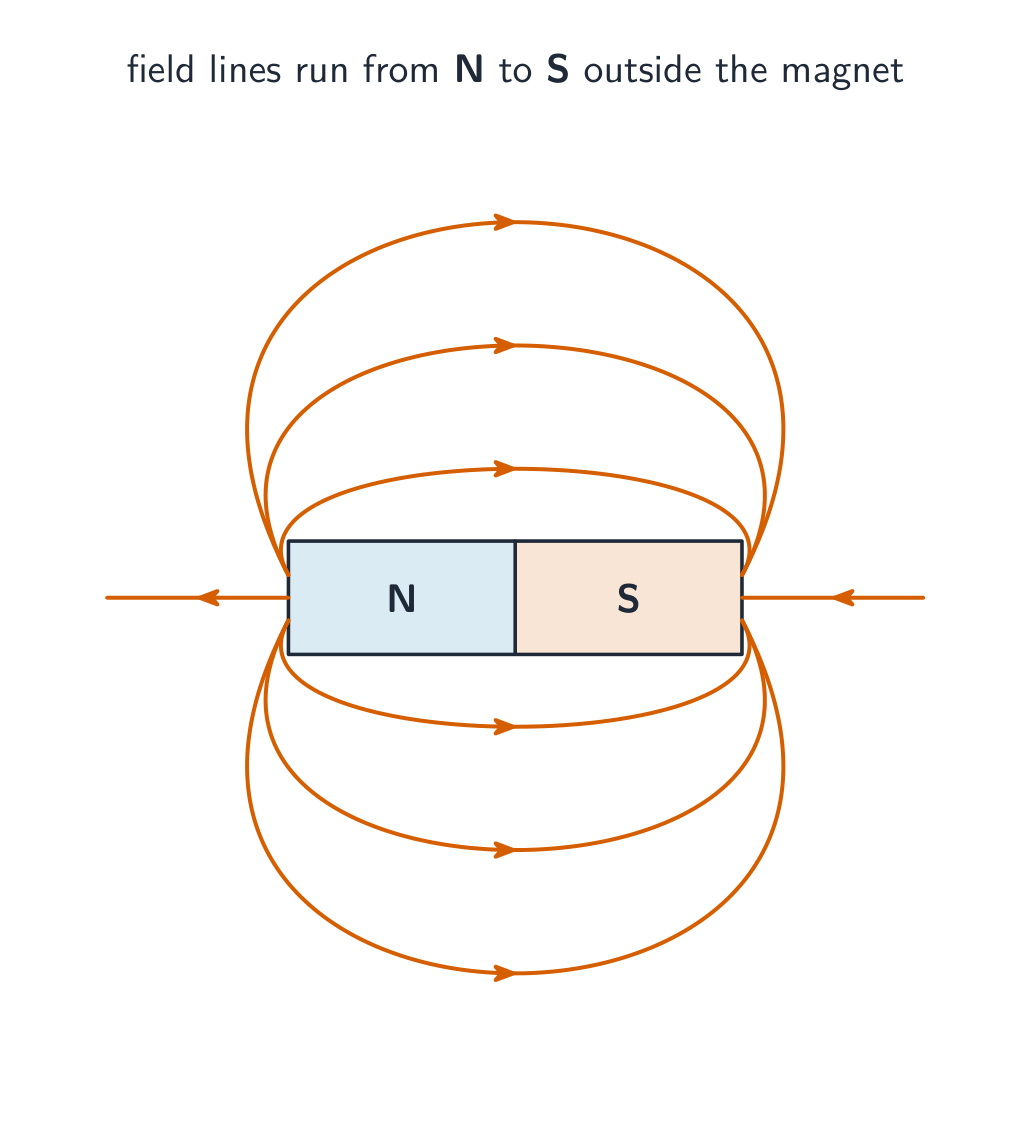
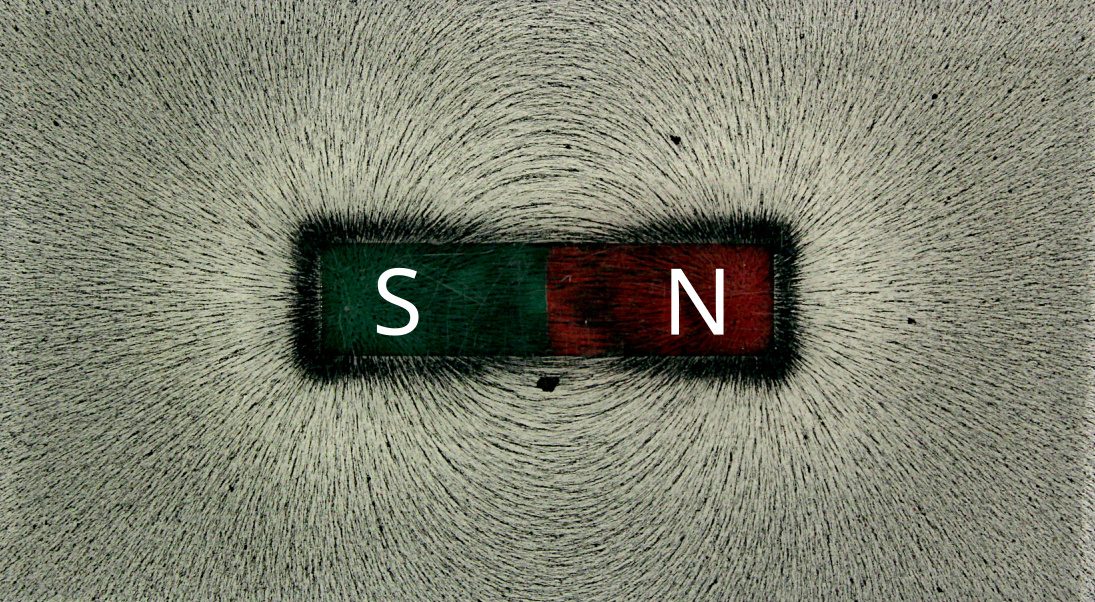
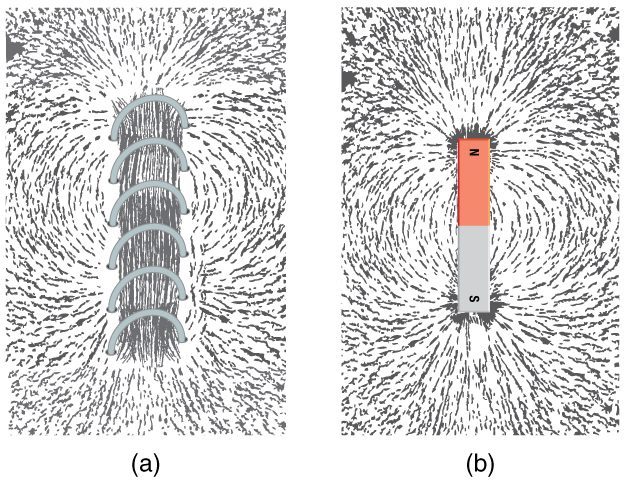
A magnetic field 磁场 $\vec{B}$ surrounds magnets and moving charges. Field lines run from a magnet's north pole to its south pole outside the magnet, and denser lines mean a stronger field. Magnetic poles always come in pairs – cutting a magnet in half makes two smaller magnets, never an isolated pole.
Tiếng Việt
Các vật liệu khác nhau phản ứng rất khác nhau với từ trường, và khóa học nêu ba loại. Sắt từ (sắt, niken, cobalt) có các dipole sắp xếp mạnh và giữ nguyên trạng thái sắp xếp, nên có thể thành nam châm vĩnh cửu. Thuận từ (nhôm, titanium) chỉ sắp xếp yếu và không giữ nguyên. Nghị từ - thực tế tất cả các vật liệu đều có một chút nghịch từ - sắp xếp yếu ngược chiều với từ trường. Hành vi này đến từ một thuộc tính vật liệu, là độ từ thẩm: chân không có độ từ thẩm cố định là độ từ thẩm chân không $\mu_0$, trong khi độ từ thẩm của vật chất khác biệt với nó và thậm chí không phải hằng số đối với một vật liệu cụ thể.
Một từ trường $\vec{B}$ bao quanh nam châm và các điện tích chuyển động. Các đường sức từ chạy từ cực Bắc sang cực Nam bên ngoài nam châm, và các đường dày đặc hơn nghĩa là từ trường mạnh hơn. Các cực từ luôn xuất hiện thành cặp – cắt đôi một nam châm sẽ tạo ra hai nam châm nhỏ hơn, không bao giờ tạo ra một cực đơn lẻ.
Explore · Khám phá
See a magnet's field lines · Quan sát các đường sức từ của nam châm
Magnetic field lines run from the north pole to the south pole outside the magnet. Where the lines crowd together the field is strongest. · Đường sức từ chạy từ cực bắc sang cực nam bên ngoài nam châm. Nơi các đường sức tập trung密集 thì trường mạnh nhất.
Vocabulary · Từ vựng
Train · Luyện tập
| English | Tiếng Việt |
|---|---|
| Ferromagnetic/ˌferəməɡˈnetɪk/ | Sắt từ |
| Paramagnetic/ˌpærəməɡˈnetɪk/ | Từ tính |
| Diamagnetic/ˌdaɪəməɡˈnetɪk/ | Chống từ |
| permeability/ˌpɜːməˈbɪlɪti/ | độ từ thẩm |
| magnetic field/mæɡˈnetɪk fiːld/ | từ trường |
12.2
Magnetism and Moving Charges · Từ Tính và Điện Tích Chuyển Động
Syllabus · Chương trình
English
Learning Objective 12.2.A: Describe the magnetic field produced by moving charged objects.
- 12.2.A.1 A single moving charged object produces a magnetic field.
- 12.2.A.1.i The magnetic field at a particular point produced by a moving charged object depends on the object's velocity and the distance between the point and the object.
- 12.2.A.1.ii At a point in space, the direction of the magnetic field produced by a moving charged object is perpendicular to both the velocity of the object and the position vector from the object to that point in space and can be determined using the right-hand rule.
- 12.2.A.1.iii The magnitude of the magnetic field is a maximum when the velocity vector and the position vector from the object to that point in space are perpendicular.
Learning Objective 12.2.B: Describe the force exerted on moving charged objects by a magnetic field.
- 12.2.B.1 Magnetic forces describe interactions between moving charged objects.
- 12.2.B.2 A magnetic field may exert a force on a charged object moving in that field.
- 12.2.B.2.i The magnitude of the force exerted by a magnetic field on a moving charged object is proportional to the magnitude of the charge, the magnitude of the charged object's velocity, and the magnitude of the magnetic field and also depends on the angle between the velocity and magnetic field vectors.
- Equation: $F_B = qvB\sin\theta$
- 12.2.B.2.ii The direction of the force exerted by a magnetic field on a moving charged object is perpendicular to both the direction of the magnetic field and the velocity of the charge, as defined by the right-hand rule.
- 12.2.B.2.i The magnitude of the force exerted by a magnetic field on a moving charged object is proportional to the magnitude of the charge, the magnitude of the charged object's velocity, and the magnitude of the magnetic field and also depends on the angle between the velocity and magnetic field vectors.
- 12.2.B.3 In a region containing both a magnetic field and an electric field, a moving charged object will experience independent forces from each field.
- 12.2.B.4 The Hall effect describes the potential difference created in a conductor by an external magnetic field that has a component perpendicular to the direction of charges moving in the conductor.
Boundary statement: Quantitative treatment of the magnitude of the magnetic force exerted by a magnetic field on a moving charge is limited to angles of 0, 90, and 180 degrees between the velocity and the magnetic field. Qualitative analysis of other angles is permitted.
Tiếng Việt
Mục tiêu học tập 12.2.A: Mô tả từ trường sinh ra bởi các vật mang điện chuyển động.
- 12.2.A.1 Một vật mang điện đơn lẻ khi chuyển động sẽ sinh ra từ trường.
- 12.2.A.1.i Từ trường tại một điểm cụ thể sinh ra bởi vật mang điện chuyển động phụ thuộc vào vận tốc của vật và khoảng cách giữa điểm đó và vật.
- 12.2.A.1.ii Tại một điểm trong không gian, phương của từ trường sinh ra bởi vật mang điện chuyển động vuông góc với cả vận tốc của vật và vectơ vị trí từ vật đến điểm đó trong không gian; có thể xác định bằng quy tắc bàn tay phải.
- 12.2.A.1.iii Độ lớn của từ trường đạt cực đại khi vectơ vận tốc và vectơ vị trí từ vật đến điểm đó trong không gian vuông góc với nhau.
Mục tiêu học tập 12.2.B: Mô tả lực tác dụng lên các vật mang điện chuyển động bởi từ trường.
- 12.2.B.1 Lực từ mô tả sự tương tác giữa các vật mang điện chuyển động.
- 12.2.B.2 Từ trường có thể tác dụng lực lên một vật mang điện đang chuyển động trong trường đó.
- 12.2.B.2.i Độ lớn của lực do từ trường tác dụng lên vật mang điện chuyển động tỷ lệ thuận với độ lớn của điện tích, độ lớn của vận tốc vật mang điện và độ lớn của từ trường, đồng thời phụ thuộc vào góc giữa vectơ vận tốc và vectơ từ trường.
- Phương trình: $F_B = qvB\sin\theta$
- 12.2.B.2.ii Phương của lực do từ trường tác dụng lên vật mang điện chuyển động vuông góc với cả phương của từ trường và vận tốc của điện tích, được xác định bởi quy tắc bàn tay phải.
- 12.2.B.2.i Độ lớn của lực do từ trường tác dụng lên vật mang điện chuyển động tỷ lệ thuận với độ lớn của điện tích, độ lớn của vận tốc vật mang điện và độ lớn của từ trường, đồng thời phụ thuộc vào góc giữa vectơ vận tốc và vectơ từ trường.
- 12.2.B.3 Trong vùng chứa cả từ trường và điện trường, một vật mang điện chuyển động sẽ chịu tác dụng của các lực độc lập từ mỗi trường.
- 12.2.B.4 Hiệu ứng Hall mô tả hiệu điện thế sinh ra trong vật dẫn bởi từ trường ngoài có thành phần vuông góc với phương chuyển động của các điện tích trong vật dẫn.
Tuyên bố biên: Việc xử lý định lượng độ lớn của lực từ do từ trường tác dụng lên điện tích chuyển động chỉ giới hạn ở các góc 0, 90 và 180 độ giữa vận tốc và từ trường. Phân tích định tính cho các góc khác được phép.
Source: College Board AP Course and Exam Description · Nguồn: Mô tả Khóa học và Bài thi College Board AP
English
A charge moving through a magnetic field feels a magnetic force 磁力:
$$F=qvB\sin\theta,$$
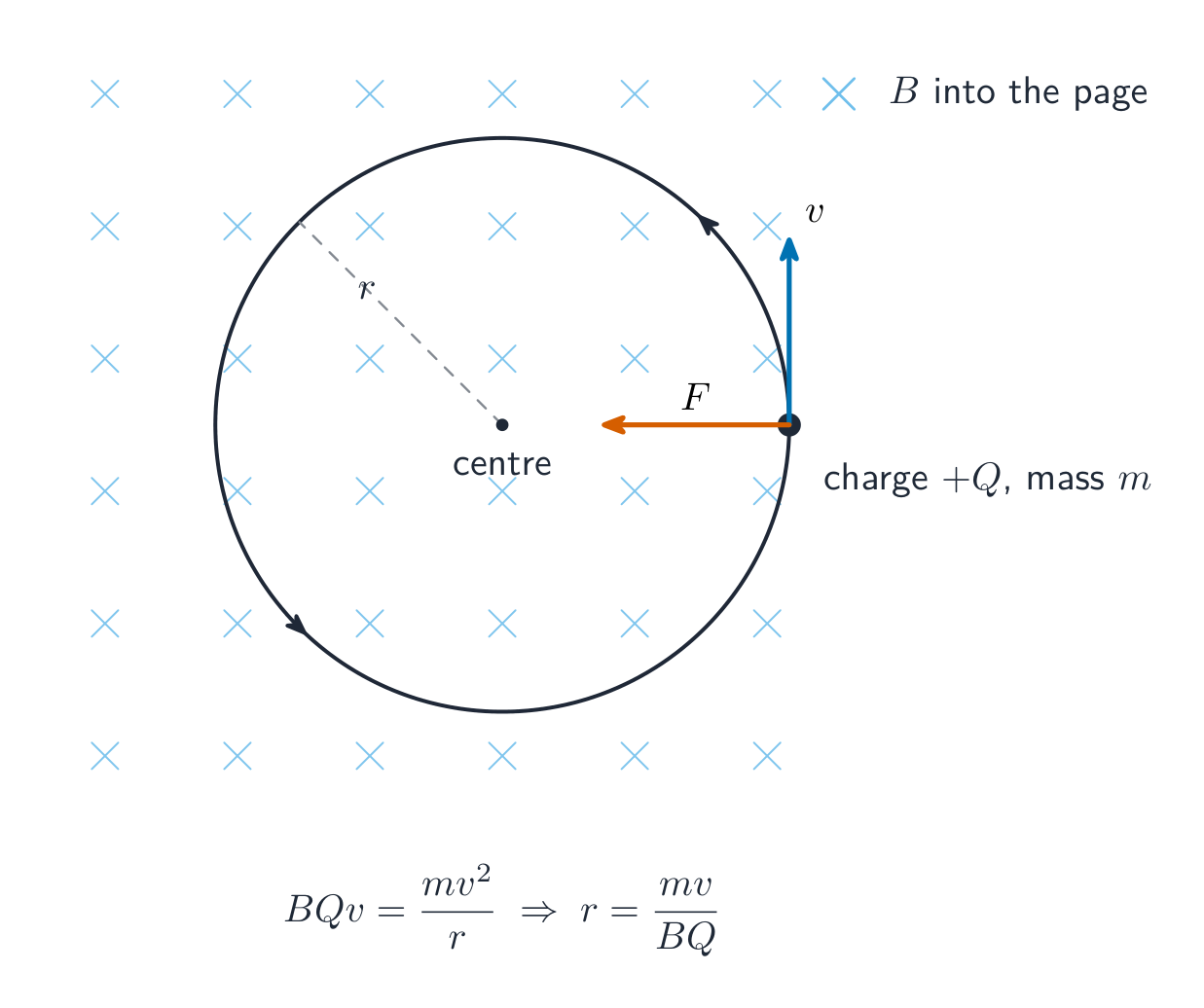
where $\theta$ is the angle between the velocity and the field. The force is perpendicular to both $\vec{v}$ and $\vec{B}$ (use the right-hand rule), so it changes direction but not speed – a charge moving perpendicular to a uniform field travels in a circle. A stationary charge, or one moving parallel to the field, feels no magnetic force.
Worked example. A proton ($q=1.6\times10^{-19}\ \text{C}$, $m=1.67\times10^{-27}\ \text{kg}$) enters a $0.50\ \text{T}$ field at $2.0\times10^{5}\ \text{m/s}$, at right angles to the field. The magnetic force is
$$F=qvB=1.6\times10^{-19}\times2.0\times10^{5}\times0.50=1.6\times10^{-14}\ \text{N}.$$
This force is the centripetal force, so it bends the proton into a circle of radius
$$r=\frac{mv}{qB}=\frac{1.67\times10^{-27}\times2.0\times10^{5}}{1.6\times10^{-19}\times0.50}=4.2\times10^{-3}\ \text{m}.$$
Setting $qvB=\dfrac{mv^2}{r}$ and cancelling gives that neat $r=mv/(qB)$ – the principle behind mass spectrometers.
Tiếng Việt
Một điện tích di chuyển trong từ trường sẽ chịu một lực từ:
$$F=qvB\sin\theta,$$
trong đó $\theta$ là góc giữa vận tốc và từ trường. Lực này vuông góc với cả $\vec{v}$ và $\vec{B}$ (áp dụng quy tắc bàn tay phải), do đó làm thay đổi hướng nhưng không làm thay đổi tốc độ – một điện tích di chuyển vuông góc với từ trường đều sẽ chuyển động theo hình tròn. Điện tích đứng yên hoặc di chuyển song song với từ trường sẽ không chịu lực từ.
Ví dụ có lời giải. Một proton ($q=1.6\times10^{-19}\ \text{C}$, $m=1.67\times10^{-27}\ \text{kg}$) đi vào từ trường $0.50\ \text{T}$ với vận tốc $2.0\times10^{5}\ \text{m/s}$, vuông góc với từ trường. Lực từ tác dụng lên nó là
$$F=qvB=1.6\times10^{-19}\times2.0\times10^{5}\times0.50=1.6\times10^{-14}\ \text{N}.$$
Lực này chính là lực hướng tâm, khiến proton chuyển động theo hình tròn có bán kính
$$r=\frac{mv}{qB}=\frac{1.67\times10^{-27}\times2.0\times10^{5}}{1.6\times10^{-19}\times0.50}=4.2\times10^{-3}\ \text{m}.$$
Đặt $qvB=\dfrac{mv^2}{r}$ và triệt tiêu các đại lượng giống nhau, ta thu được công thức gọn gàng $r=mv/(qB)$ – nguyên lý cơ bản của máy phân tử khối.
Vocabulary · Từ vựng
Train · Luyện tập
| English | Tiếng Việt |
|---|---|
| magnetic force/mæɡˈnetɪk fɔːs/ | Lực từ |
12.3
Magnetism and Current-Carrying Wires · Từ tính và Dây dẫn mang dòng điện
Syllabus · Chương trình
English
Learning Objective 12.3.A: Describe the magnetic field produced by a current-carrying wire.
- 12.3.A.1 A current-carrying wire produces a magnetic field.
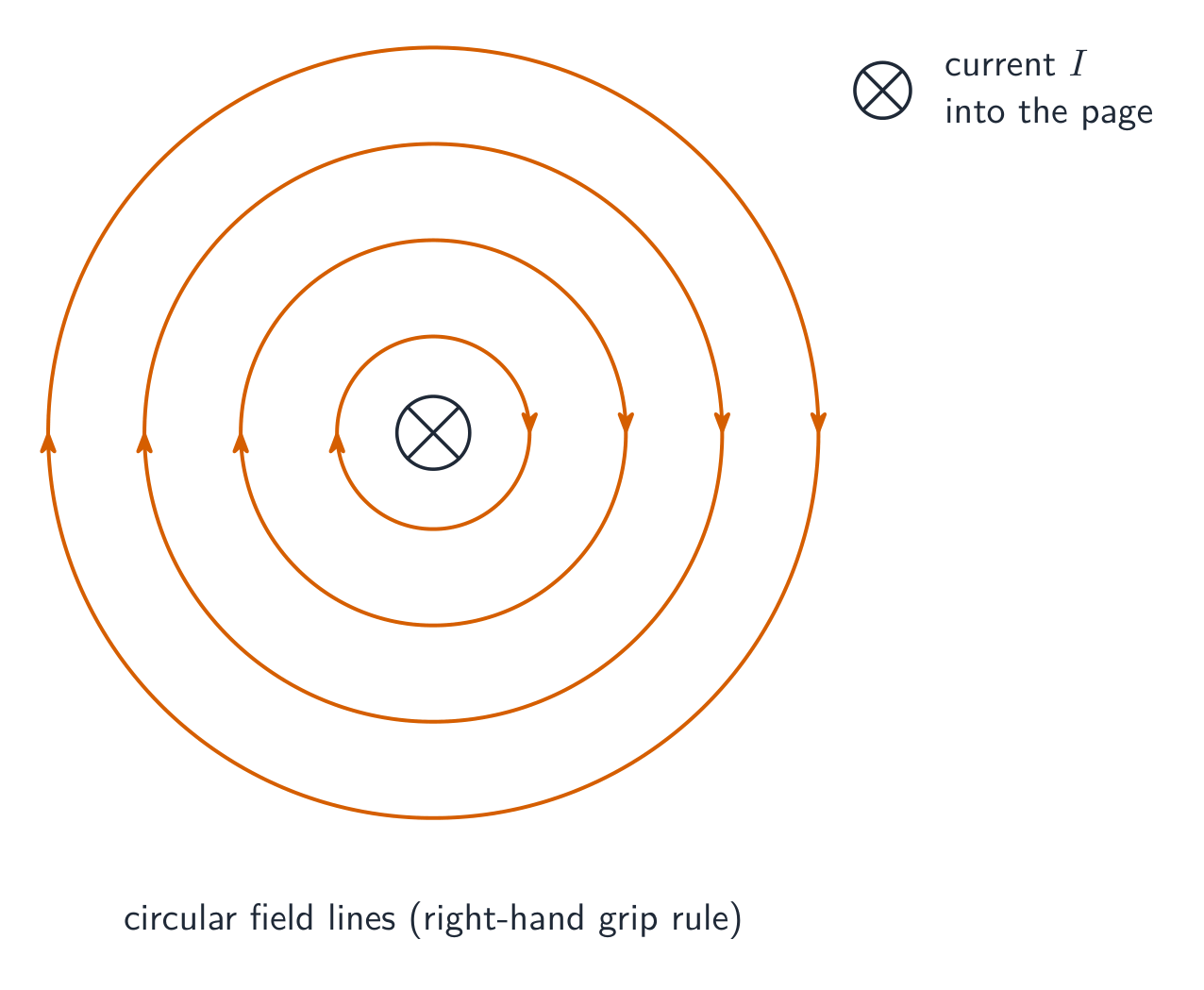
- 12.3.A.1.i The magnetic field vectors around a long, straight, current-carrying wire are tangent to concentric circles centered on that wire. The field has no component toward, away from, or parallel to the long, straight, current-carrying wire.
- 12.3.A.1.ii At a point in space, the magnitude of the magnetic field due to a long, straight, current-carrying wire is proportional to the magnitude of the current in the wire and inversely proportional to the perpendicular distance from the central axis of the wire to the point.
- Equation: $B = \dfrac{\mu_0}{2\pi}\dfrac{I}{r}$
- 12.3.A.1.iii The direction of the magnetic field created by a current-carrying wire is determined with the right-hand rule.
- 12.3.A.1.iv The direction of the magnetic field at the center of a current-carrying loop is directed along the axis of the loop and can be found using the right-hand rule.
- 12.3.A.1.v The magnetic field at a location near two or more current-carrying wires can be determined using vector addition principles.
Learning Objective 12.3.B: Describe the force exerted on a current-carrying wire by a magnetic field.
- 12.3.B.1 A magnetic field may exert a force on a current-carrying wire.
- 12.3.B.1.i The magnitude of the force exerted by a magnetic field on a current-carrying wire is proportional to the current, the length of the portion of the wire within the magnetic field, and the magnitude of the magnetic field, and also depends on the angle between the direction of the current in the wire and the direction of the magnetic field.
- Equation: $F_B = I\ell B\sin\theta$
- 12.3.B.1.ii The direction of the force exerted by the magnetic field on a current-carrying wire is determined by the right-hand rule.
- 12.3.B.1.i The magnitude of the force exerted by a magnetic field on a current-carrying wire is proportional to the current, the length of the portion of the wire within the magnetic field, and the magnitude of the magnetic field, and also depends on the angle between the direction of the current in the wire and the direction of the magnetic field.
Tiếng Việt
Mục tiêu học tập 12.3.A: Mô tả từ trường sinh ra bởi dây dẫn mang điện.
- 12.3.A.1 Dây dẫn mang điện sinh ra từ trường.
- 12.3.A.1.i Các vectơ từ trường xung quanh một dây dẫn dài, thẳng mang điện tiếp xúc với các vòng tròn đồng tâm có tâm tại dây dẫn đó. Từ trường không có thành phần hướng về phía, ra xa hoặc song song với dây dẫn dài, thẳng mang điện.
- 12.3.A.1.ii Tại một điểm trong không gian, độ lớn của từ trường do một dây dẫn dài, thẳng mang điện sinh ra tỷ lệ thuận với độ lớn của dòng điện trong dây và nghịch đảo với khoảng cách vuông góc từ trục trung tâm của dây đến điểm đó.
- Phương trình: $B = \dfrac{\mu_0}{2\pi}\dfrac{I}{r}$
- 12.3.A.1.iii Phương của từ trường tạo bởi dây dẫn mang điện được xác định bằng quy tắc bàn tay phải.
- 12.3.A.1.iv Phương của từ trường tại tâm của vòng dây mang điện hướng dọc theo trục của vòng dây và có thể tìm thấy bằng quy tắc bàn tay phải.
- 12.3.A.1.v Từ trường tại một vị trí gần hai hoặc nhiều dây dẫn mang điện có thể được xác định bằng nguyên cộng vectơ.
Mục tiêu học tập 12.3.B: Mô tả lực tác dụng lên dây dẫn mang điện bởi từ trường.
- 12.3.B.1 Từ trường có thể tác dụng lực lên dây dẫn mang điện.
- 12.3.B.1.i Độ lớn của lực do từ trường tác dụng lên dây dẫn mang điện tỷ lệ thuận với cường độ dòng điện, chiều dài đoạn dây nằm trong từ trường và độ lớn của từ trường, đồng thời phụ thuộc vào góc giữa phương dòng điện trong dây và phương của từ trường.
- Phương trình: $F_B = I\ell B\sin\theta$
- 12.3.B.1.ii Phương của lực do từ trường tác dụng lên dây dẫn mang điện được xác định bằng quy tắc bàn tay phải.
- 12.3.B.1.i Độ lớn của lực do từ trường tác dụng lên dây dẫn mang điện tỷ lệ thuận với cường độ dòng điện, chiều dài đoạn dây nằm trong từ trường và độ lớn của từ trường, đồng thời phụ thuộc vào góc giữa phương dòng điện trong dây và phương của từ trường.
Source: College Board AP Course and Exam Description · Nguồn: Mô tả Khóa học và Bài thi College Board AP
English
Because a current is moving charge, a magnetic field pushes on a current-carrying wire:
$$F=BIL\sin\theta.$$
A current also creates its own magnetic field: circular field lines wrap around a straight wire (right-hand rule), and a coil (solenoid) makes a field like a bar magnet. This is how electromagnets and motors work.
Worked example. A $0.30\ \text{m}$ length of wire carries $4.0\ \text{A}$ at right angles to a $0.20\ \text{T}$ field. The force on it is $F=BIL=0.20\times4.0\times0.30=0.24\ \text{N}$ – the push that turns a motor's coil.
Tiếng Việt
Vì dòng điện là sự di chuyển của các điện tích, từ trường sẽ tác dụng lực lên một dây dẫn mang dòng điện:
$$F=BIL\sin\theta.$$
Dòng điện cũng tạo ra từ trường riêng của nó: các đường sức từ dạng vòng tròn bao quanh dây dẫn thẳng (quy tắc bàn tay phải), và cuộn dây (cuộn cảm) tạo ra từ trường giống như nam châm thanh. Đây là nguyên lý hoạt động của nam châm điện và động cơ điện.
Ví dụ minh họa. Một đoạn dây dài $0.30\ \text{m}$ mang dòng điện $4.0\ \text{A}$ vuông góc với từ trường $0.20\ \text{T}$. Lực tác dụng lên nó là $F=BIL=0.20\times4.0\times0.30=0.24\ \text{N}$ – lực đẩy làm quay cuộn dây của động cơ điện.
Explore · Khám phá
Find the force on a current in a field · Tìm lực tác dụng lên dòng điện trong từ trường
A current in a magnetic field feels a force $F = BIL$, at right angles to both. Use the left-hand rule; reverse the current or field and the force flips. · Dòng điện trong từ trường chịu một lực $F = BIL$, vuông góc với cả hai. Dùng quy tắc bàn tay trái; đảo chiều dòng điện hoặc từ trường thì lực cũng đảo chiều.
12.4
Electromagnetic Induction and Faraday's Law · Cảm ứng điện từ và Định luật Faraday
Syllabus · Chương trình
English
Learning Objective 12.4.A: Describe the induced electric potential difference resulting from a change in magnetic flux.
- 12.4.A.1 Magnetic flux is a description of the amount of the component of a magnetic field that is perpendicular to a cross-sectional area.
- 12.4.A.2 Magnetic flux through a surface is proportional to the magnitude of the component of the magnetic field perpendicular to the surface and to the cross-sectional area of the surface.
- Equation: $\Phi_B = BA\cos\theta$
- 12.4.A.2.i The area vector is defined to be perpendicular to the plane of the surface and directed outward from a closed surface.
- 12.4.A.2.ii The sign of the magnetic flux indicates whether the magnetic field is parallel to or antiparallel to the area vector.
- 12.4.A.3 Faraday’s law describes the relationship between changing magnetic flux and the resulting induced emf in a system.
- Equation: $|\mathcal{E}| = \left|\dfrac{\Delta\Phi_B}{\Delta t}\right|$
- 12.4.A.4 Lenz’s law is used to determine the direction of an induced emf resulting from a changing magnetic flux.
- Equation: $\mathcal{E} = -\dfrac{\Delta\Phi_B}{\Delta t} = -\dfrac{\Delta(BA\cos\theta)}{\Delta t}$
- 12.4.A.4.i An induced emf generates a current that creates a magnetic field that opposes the change in magnetic flux.
- 12.4.A.4.ii The right-hand rule is used to determine the relationships between current, emf, and magnetic flux.
- 12.4.A.5 A common example of electromagnetic induction is a conducting rod on conducting rails in a region with a uniform magnetic field.
- Derived equation: $\mathcal{E} = B\ell v$
Tiếng Việt
Mục tiêu học tập 12.4.A: Mô tả hiệu điện thế cảm ứng sinh ra từ sự biến thiên của từ thông.
- 12.4.A.1 Từ thông là đại lượng mô tả độ lớn của thành phần từ trường vuông góc với diện tích mặt cắt ngang.
- 12.4.A.2 Từ thông qua một bề mặt tỷ lệ thuận với độ lớn của thành phần từ trường vuông góc với bề mặt và với diện tích mặt cắt ngang của bề mặt đó.
- Phương trình: $\Phi_B = BA\cos\theta$
- 12.4.A.2.i Vectơ diện tích được xác định là vuông góc với mặt phẳng của bề mặt và hướng ra bên ngoài đối với bề mặt kín.
- 12.4.A.2.ii Dấu của từ thông chỉ ra từ trường song song hay ngược hướng với vectơ diện tích.
- 12.4.A.3 Định luật Faraday mô tả mối quan hệ giữa sự biến thiên của từ thông và suất điện động cảm ứng sinh ra trong hệ thống.
- Phương trình: $|\mathcal{E}| = \left|\dfrac{\Delta\Phi_B}{\Delta t}\right|$
- 12.4.A.4 Định luật Lenz được sử dụng để xác định phương của suất điện động cảm ứng sinh ra từ sự biến thiên của từ thông.
- Phương trình: $\mathcal{E} = -\dfrac{\Delta\Phi_B}{\Delta t} = -\dfrac{\Delta(BA\cos\theta)}{\Delta t}$
- 12.4.A.4.i Suất điện động cảm ứng sinh ra dòng điện tạo ra từ trường chống lại sự biến thiên của từ thông.
- 12.4.A.4.ii Quy tắc bàn tay phải được sử dụng để xác định các mối quan hệ giữa dòng điện, suất điện động và từ thông.
- 12.4.A.5 Một ví dụ điển hình của cảm ứng điện từ là một thanh dẫn điện đặt trên các ray dẫn điện trong vùng có từ trường đều.
- Phương trình suy ra: $\mathcal{E} = B\ell v$
Source: College Board AP Course and Exam Description · Nguồn: Mô tả Khóa học và Bài thi College Board AP
English
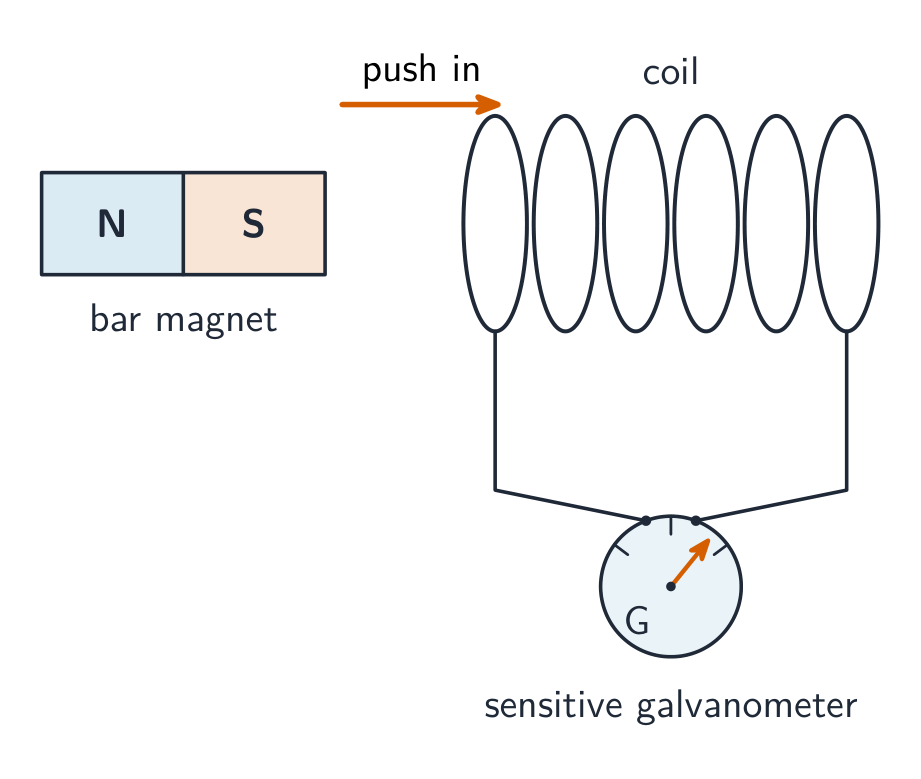
A changing magnetic field through a loop drives a current – electromagnetic induction 电磁感应. The magnetic flux 磁通量 $\Phi=BA\cos\theta$ measures how much field passes through the loop. Faraday's law 法拉第定律 gives the induced emf:
$$\varepsilon=-\frac{\Delta\Phi}{\Delta t}.$$
The flux changes if the field, the area, or the loop's orientation changes. Lenz's law 楞次定律 (the minus sign) says the induced current flows so as to oppose the change that caused it – the basis of generators.
Worked example. The magnetic flux through a single loop drops from $0.020\ \text{Wb}$ to $0.008\ \text{Wb}$ in $0.030\ \text{s}$. The average induced emf is
$$\varepsilon=\left|\frac{\Delta\Phi}{\Delta t}\right|=\frac{0.020-0.008}{0.030}=0.40\ \text{V}.$$
A coil of $N$ turns would give $N$ times this – which is why generators and transformers use many-turn coils.
Tiếng Việt
Một từ trường biến thiên xuyên qua vòng dây sẽ sinh ra dòng điện – cảm ứng điện từ. Từ thông $\Phi=BA\cos\theta$ đo lường lượng từ trường đi qua vòng dây. Định luật Faraday cho biết suất điện động cảm ứng:
$$\varepsilon=-\frac{\Delta\Phi}{\Delta t}.$$
Từ thông sẽ thay đổi nếu từ trường, diện tích hoặc hướng của vòng dây thay đổi. Định luật Lenz (dấu âm) phát biểu rằng dòng điện cảm ứng chạy sao cho chống lại sự thay đổi đã gây ra nó – đây là cơ sở của máy phát điện.
Ví dụ minh họa. Từ thông qua một vòng dẫn kín giảm từ $0.020\ \text{Wb}$ xuống $0.008\ \text{Wb}$ trong khoảng thời gian $0.030\ \text{s}$. Suất điện động cảm ứng trung bình là
$$\varepsilon=\left|\frac{\Delta\Phi}{\Delta t}\right|=\frac{0.020-0.008}{0.030}=0.40\ \text{V}.$$
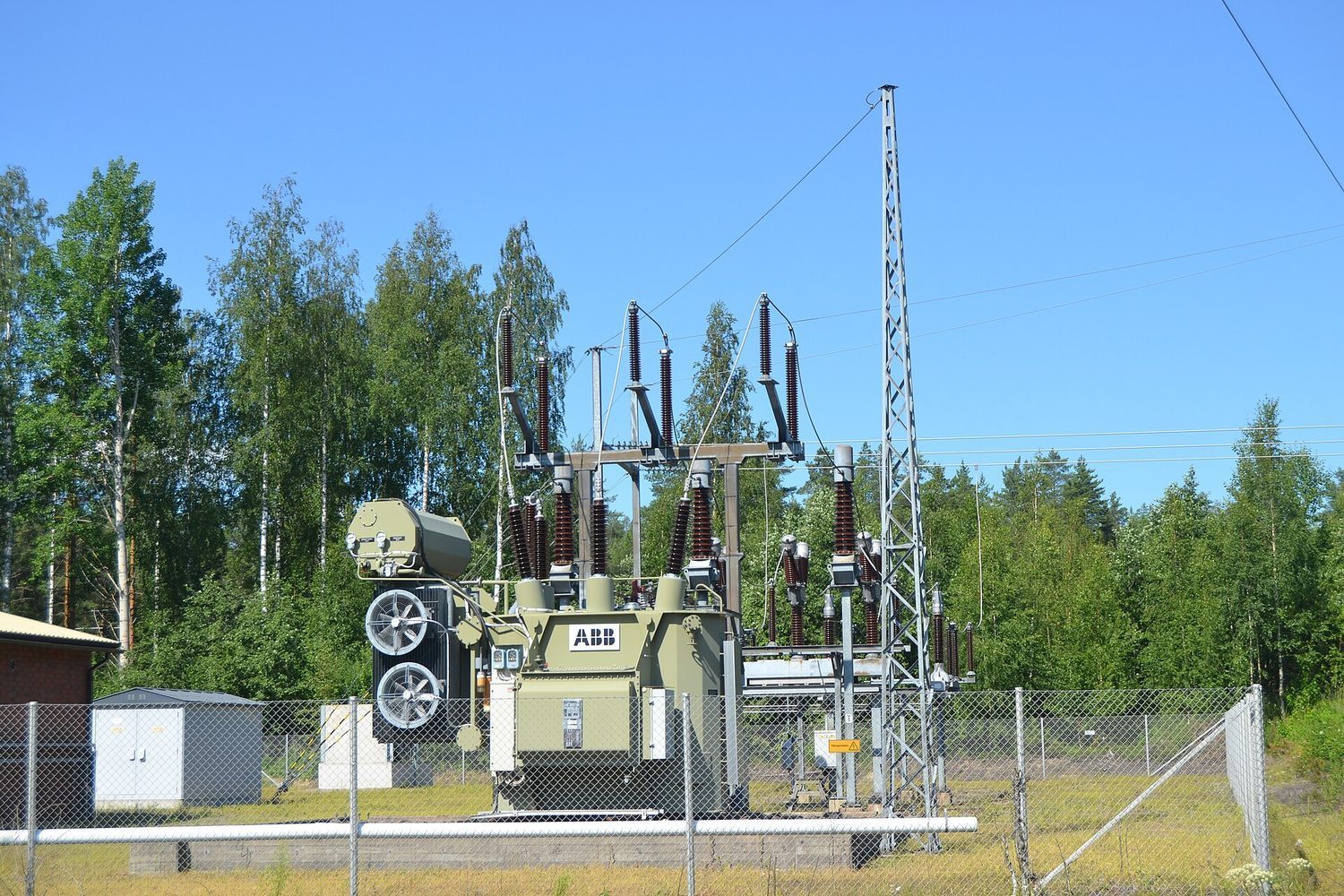
Một cuộn dây có $N$ vòng dây sẽ tạo ra suất điện động gấp $N$ lần – đó là lý do các máy phát điện và máy biến áp sử dụng cuộn dây nhiều vòng.
Explore · Khám phá
Induce a voltage by moving a magnet · Cảm ứng điện áp bằng cách di chuyển nam châm
Faraday's law: a changing magnetic flux through a coil induces a voltage. Move the magnet faster and the induced EMF grows; Lenz's law sets its direction to oppose the change. · Định luật Faraday: từ thông thay đổi qua cuộn dây cảm ứng ra điện áp. Di chuyển nam châm nhanh hơn thì suất điện động cảm ứng tăng; Định luật Lenz xác định chiều của nó oppose sự thay đổi.
Vocabulary · Từ vựng
Train · Luyện tập
| English | Tiếng Việt |
|---|---|
| electromagnetic induction/ɪˌlektrəʊməɡˈnetɪk ɪnˈdʌkʃn/ | cảm ứng điện từ |
| magnetic flux/mæɡˈnetɪk flʌks/ | từ thông |
| Faraday's law/ˈfærədeɪz lɔː/ | Định luật Faraday |
| Lenz's law/ˈlentsɪz lɔː/ | Định luật Lenz |
12.4
Exam tips · Mẹo làm bài thi
English
- The magnetic force $F=qvB\sin\theta$ is perpendicular to the velocity, so it changes direction (a circle) but not speed; a stationary charge or one moving along the field feels no force.
- Use $F=BIL$ for the force on a current-carrying wire (the motor effect).
- A current creates a magnetic field (circles around a wire; a solenoid acts like a bar magnet).
- Induction needs a changing flux $\Phi=BA$ — a stationary magnet in a coil induces nothing.
- Faraday: $\varepsilon=\Delta\Phi/\Delta t$ (times $N$ turns); Lenz: the induced current opposes the change (energy conservation).
Tiếng Việt
- Lực từ $F=qvB\sin\theta$ vuông góc với vận tốc, nên làm thay đổi hướng (thành hình tròn) mà không làm thay đổi tốc độ; điện tích đứng yên hoặc di chuyển dọc theo từ trường sẽ không chịu lực nào.
- Sử dụng $F=BIL$ để tính lực tác dụng lên dây dẫn mang dòng điện (hiệu ứng động cơ).
- Dòng điện tạo ra từ trường (vòng tròn quanh dây; cuộn cảm đóng vai trò như nam châm thanh).
- Cảm ứng yêu cầu từ thông biến thiên $\Phi=BA$ — nam châm đứng yên trong cuộn dây sẽ không sinh ra dòng điện.
- Faraday: $\varepsilon=\Delta\Phi/\Delta t$ (nhân với $N$ vòng); Lenz: dòng điện cảm ứng chống lại sự thay đổi (bảo toàn năng lượng).
Interactive lessons on this topic · Bài học tương tác về chủ đề này
Work through it step by step, with instant-check exercises. · Làm theo từng bước, kèm theo bài tập kiểm tra ngay lập tức.