บล็อกไถลเข้าไปในสปริงและบีบจนหยุด สปริง压缩了多少?Try that with a kinematic equation. You cannot — the force grows… ¿
English narration · English + 中文 subtitles burned in · การบรรยายภาษาอังกฤษ · คำบรรยายภาษาอังกฤษ + 中文 ลอยตัวบนภาพ
3.1
Translational Kinetic Energy · พลังงานจลน์เชิงแปล
Syllabus · หลักสูตร
English
Learning Objective 3.1.A: Describe the translational kinetic energy of an object in terms of the object's mass and velocity.
3.1.A.1 An object's translational kinetic energy is given by the equation
Equation:$K = \dfrac{1}{2}mv^2$
3.1.A.2 Translational kinetic energy is a scalar quantity.
3.1.A.3 Different observers may measure different values of the translational kinetic energy of an object, depending on the observer's frame of reference.
Source: College Board AP Course and Exam Description · แหล่งที่มา: คำอธิบายหลักสูตรและข้อสอบ College Board AP
English
Kinetic energy 动能 is the energy of motion, a scalar 标量 measured in joules 焦耳 (J):
$$K=\tfrac{1}{2}mv^2.$$
It grows with the square of speed – doubling the speed quadruples $K$. One subtlety worth knowing: kinetic energy depends on the observer's reference frame 参考系. A passenger walking down a train has a small $K$ measured inside the train and a huge one measured from the ground – both observers are right, each in their own frame.
Learning Objective 3.2.A: Describe the work done on an object or system by a given force or collection of forces.
3.2.A.1 Work is the amount of energy transferred into or out of a system by a force exerted on that system over a distance.
3.2.A.1.i The work done by a conservative force exerted on a system is path-independent and only depends on the initial and final configurations of that system.
3.2.A.1.ii The work done by a conservative force on a system—or the change in the potential energy of the system—will be zero if the system returns to its initial configuration.
3.2.A.1.iii Potential energies are associated only with conservative forces.
3.2.A.1.iv The work done by a nonconservative force is path-dependent.
3.2.A.1.v The most common nonconservative forces are friction and air resistance.
3.2.A.2 Work is a scalar quantity that may be positive, negative, or zero.
3.2.A.3 The work done on an object by a variable force is calculated using
Equation:$W = \displaystyle\int_a^b \vec{F}(r) \cdot d\vec{r}$, where the integral is taken over the path from point $a$ to point $b$.
3.2.A.3.i The dot product between two vectors, $\vec{A}$ and $\vec{B}$, results in a scalar quantity of magnitude $\vec{A} \cdot \vec{B} = AB\cos\theta$.
3.2.A.3.ii Only the component of the force exerted on a system that is parallel to the displacement of the point of application of the force will change the system's total energy.
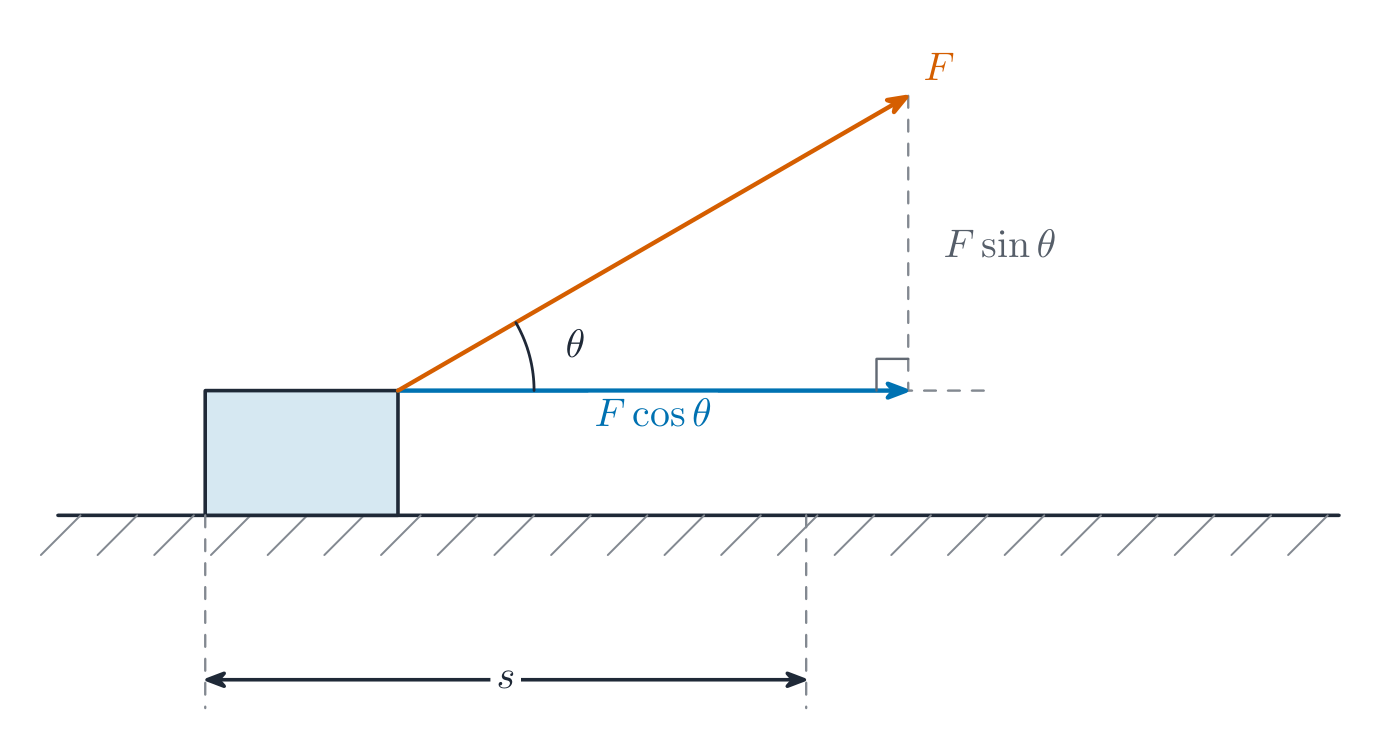
3.2.A.3.iii If the component of the force exerted on a system that is parallel to the displacement is constant, the work done on the system by the force is given by the derived equation $W = F_{\parallel}d = Fd\cos\theta$.
3.2.A.3.iv The component of the force exerted on a system perpendicular to the direction of the displacement of the system's center of mass can change the direction of the system's motion without changing the system's kinetic energy.
3.2.A.4 The work–energy theorem states that the change in an object's kinetic energy is equal to the sum of the work (net work) being done by all forces exerted on the object.
Equation:$\Delta K = \displaystyle\sum W_i = \sum F_{\parallel,i}\, d_i$
3.2.A.4.i An external force may change the configuration of a system. The component of the external force parallel to the displacement times the displacement of the point of application of the force gives the change in kinetic energy of the system.
3.2.A.4.ii If the system's center of mass and the point of application of the force move the same distance when a force is exerted on a system, then the system may be modeled as an object, and only the system's kinetic energy can change.
3.2.A.4.iii The energy dissipated by friction is typically equated to the force of friction times the length of the path over which the force is exerted.
3.2.A.5 Work is equal to the area under the curve of a graph of $F_{\parallel}$ as a function of displacement.
Boundary statement: AP Physics C: Mechanics only expects students to analyze the transfer of mechanical energy, although students should be aware that mechanical energy may be dissipated in the form of thermal energy or sound.
For a constant force this reduces to $W=Fd\cos\theta$; on a force–position graph, work is the area under the curve. Work is a scalar with a sign, and the sign is physics, not bookkeeping:
Positive – force has a component along the motion (it speeds the object up).
Negative – force opposes the motion (friction 摩擦力 and air drag do negative work).
Zero – force perpendicular to the motion (the normal force 法向力 on a sliding block, gravity on a horizontal move, tension in a circular swing).
The work–energy theorem 动能定理 collects every force's contribution: the net work equals the change in kinetic energy,
$$W_{\text{net}}=\sum W_i=\Delta K.$$
Worked example. A variable force $F(x)=3x^2\ \text{N}$ (along the motion) acts from $x=0$ to $x=2\ \text{m}$: $W=\displaystyle\int_0^2 3x^2\,dx=\big[x^3\big]_0^2=8\ \text{J}$. Acting alone on a body starting from rest, it would raise the kinetic energy to exactly $8\ \text{J}$.
Learning Objective 3.3.A: Describe the potential energy of a system.
3.3.A.1 A system composed of two or more objects has potential energy if the objects within that system only interact with each other through conservative forces.
3.3.A.2 Potential energy is a scalar quantity associated with the position of objects within a system.
3.3.A.3 The definition of zero potential energy for a given system is a decision made by the observer considering the situation to simplify or otherwise assist in analysis.
3.3.A.4 The relationship between conservative forces exerted on a system and the system's potential energy is
Equation:$\Delta U = -\displaystyle\int_a^b \vec{F}_{cf}(r) \cdot d\vec{r}$
3.3.A.5 The conservative forces exerted on a system in a single dimension can be determined using the slope of the system's potential energy with respect to position in that dimension; these forces point in the direction of decreasing potential energy.
Equation:$F_x = -\dfrac{dU(x)}{dx}$
3.3.A.6 Graphs of a system's potential energy as a function of its position can be useful in determining physical properties of that system.
3.3.A.6.i Stable equilibrium is a location at which a small displacement in an object's position results in a force exerted on the object opposite to the direction of the small displacement, accelerating the object back toward the equilibrium position.
3.3.A.6.ii Unstable equilibrium is a location at which a small displacement in an object's position results in a force exerted on the object in the same direction as the small displacement, accelerating the object away from the equilibrium position.
3.3.A.6.iii In a given dimension, stable equilibrium positions exist at locations where the potential energy as a function of position in that dimension has a local minimum.
3.3.A.6.iv In a given dimension, unstable equilibrium positions occur at locations where the potential energy as a function of position in that dimension has a local maximum.
3.3.A.7 The potential energy of common physical systems can be described using the physical properties of that system.
3.3.A.7.i The elastic potential energy of an ideal spring is given by the following equation, where $\Delta x$ is the distance the spring has been stretched or compressed from its equilibrium length.
Equation:$U_s = \dfrac{1}{2}k(\Delta x)^2$
3.3.A.7.ii The general form for the gravitational potential energy of a system consisting of two approximately spherical distributions of mass (e.g., moons, planets, or stars) is given by the equation
Equation:$U_g = -G\dfrac{m_1 m_2}{r}$
3.3.A.7.iii Because the gravitational field near the surface of a planet is nearly constant, the change in gravitational potential energy in a system consisting of an object with mass $m$ and a planet with gravitational field of magnitude $g$ when the object is near the surface of the planet may be approximated by the equation
Equation:$\Delta U_g = mg\Delta y$
3.3.A.8 The total potential energy of a system containing more than two objects is the sum of the potential energy of each pair of objects within the system.
Source: College Board AP Course and Exam Description · แหล่งที่มา: คำอธิบายหลักสูตรและข้อสอบ College Board AP
English
Potential energy 势能 is energy a system stores by the positions of its parts – it exists only for conservative forces 保守力, whose work is path independent. It is defined through work:
$$\Delta U=-\int_a^b\vec{F}\cdot d\vec{r},$$
and you are free to choose where $U=0$ – only changes in $U$ matter, so pick the zero that makes the problem simplest. The standard results:
Gravity near a surface: $\Delta U_g=mg\,\Delta y$.
Gravity in general: $U_g=-\dfrac{Gm_1m_2}{r}$ (zero at infinite separation).
Spring: $U_s=\tfrac12k(\Delta x)^2$, with $\Delta x$ measured from natural length.
For systems of several objects, add the potential energy of each pair. Turning the definition around, a conservative force is minus the derivative 导数 of its potential energy:
$$F_x=-\frac{dU}{dx}.$$
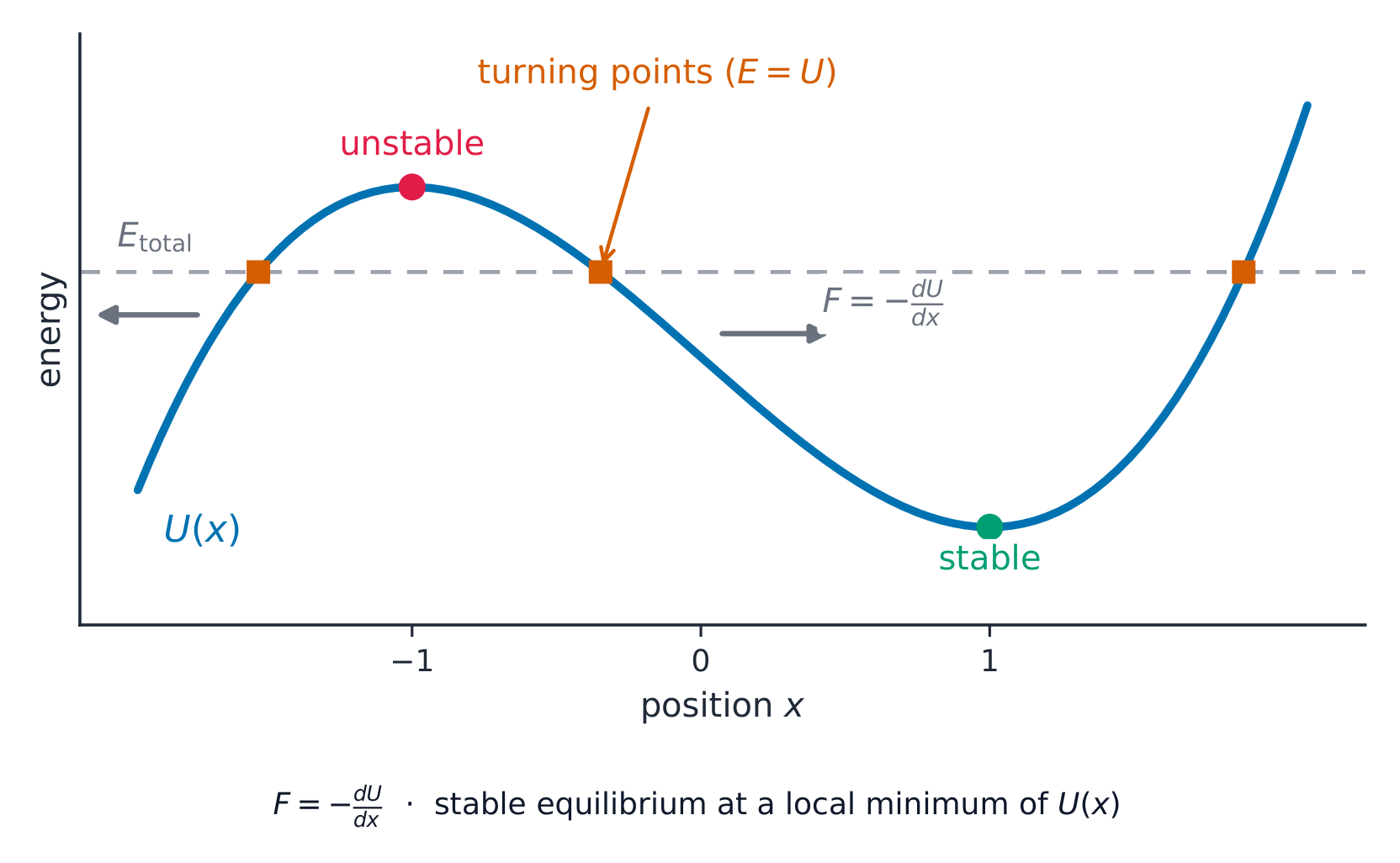
The force points "downhill" on the $U(x)$ curve. Equilibrium sits where the slope is zero: a minimum is a stable equilibrium 稳定平衡 (displaced, the force pushes back), a maximum is an unstable equilibrium 不稳定平衡 (displaced, the force pushes away).
Worked example. Given $U(x)=2x^3-6x$ (joules), the force is $F=-\dfrac{dU}{dx}=6-6x^2$. Equilibria sit at $F=0$: $x=\pm1$. Since $\dfrac{d^2U}{dx^2}=12x$ is positive at $x=+1$ (a minimum – stable) and negative at $x=-1$ (a maximum – unstable), the two points behave oppositely.
Store elastic potential energy in a spring · เก็บพลังงานศักย์ยืดหยุ่นในสปริง
Stretching a spring stores elastic potential energy$\tfrac12 kx^2$ — the area under the force-extension line. Release it and that energy becomes kinetic. · การยืดสปริงจะเก็บ พลังงานศักย์ยืดหยุ่น$\tfrac12 kx^2$ — ซึ่งเท่ากับพื้นที่ใต้เส้นแรง-การต่อ ย่อสปริงแล้ว พลังงานนี้จะเปลี่ยนเป็นพลังงานจลน์
Learning Objective 3.4.A: Describe the energies present in a system.
3.4.A.1 A system composed of only a single object can only have kinetic energy.
3.4.A.2 A system that contains objects that interact via conservative forces or that can change its shape reversibly may have both kinetic and potential energies.
Learning Objective 3.4.B: Describe the behavior of a system using conservation of mechanical energy principles.
3.4.B.1 Mechanical energy is the sum of a system's kinetic and potential energies.
3.4.B.2 Any change to a type of energy within a system must be balanced by an equivalent change of other types of energies within the system or by a transfer of energy between the system and its surroundings.
3.4.B.3 A system may be selected so that the total energy of that system is constant.
3.4.B.4 If the total energy of a system changes, that change will be equivalent to the energy transferred into or out of the system.
Learning Objective 3.4.C: Describe how the selection of a system determines whether the energy of that system changes.
3.4.C.1 Energy is conserved in all interactions.
3.4.C.2 If the work done on a selected system is zero and there are no nonconservative interactions within the system, the total mechanical energy of the system is constant.
3.4.C.3 If the work done on a selected system is nonzero, energy is transferred between the system and the environment.
Boundary statement: AP Physics C: Mechanics expects students to know that mechanical energy can be dissipated as thermal energy or sound by nonconservative forces.
ข้อความขอบเขต: AP Physics C: Mechanics ต้องการให้นักเรียนทราบว่าพลังงานกลสามารถถูกกระจาย出去เป็นพลังงานความร้อนหรือเสียงโดยแรงที่ไม่รักษาพลังงาน
Source: College Board AP Course and Exam Description · แหล่งที่มา: คำอธิบายหลักสูตรและข้อสอบ College Board AP
English
Energy conservation: KE ⇄ PE
Energy is conserved in all interactions – the question is only where it goes. Mechanical energy 机械能 is the sum $E=K+U$. If the external work on a system is zero and nothing inside it acts through nonconservative forces 非保守力, then
$$K_1+U_1=K_2+U_2.$$
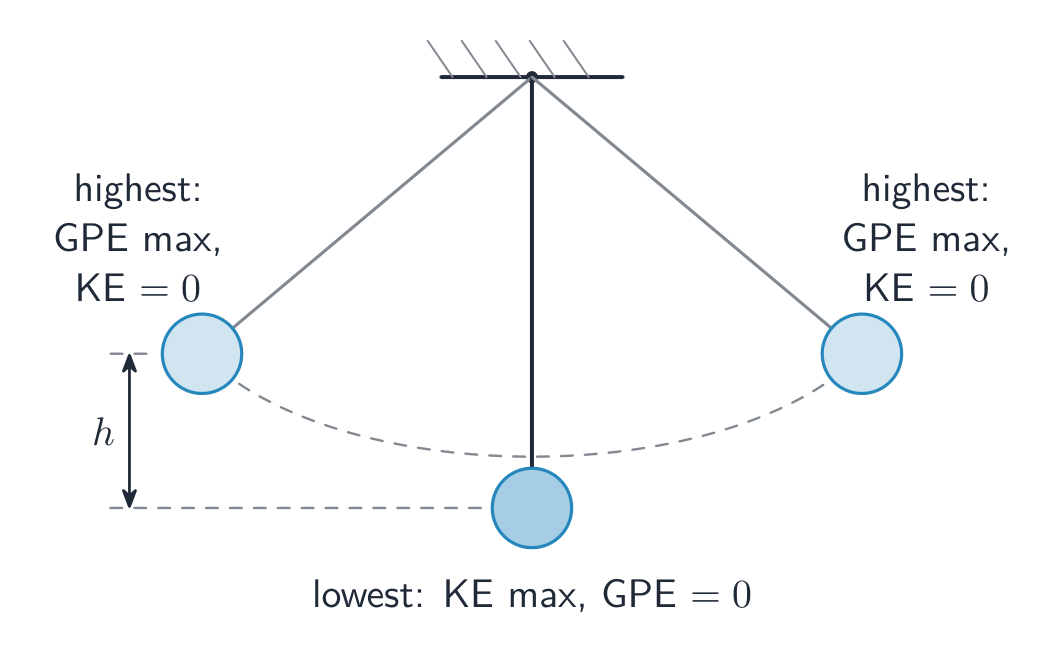
When friction or drag act, they convert mechanical energy into thermal energy 热能 ($\Delta E_{\text{mech}}=-F_fd$), and the balance must include that term. If external work is done, the system's total energy changes by exactly the energy transferred: $W_{\text{ext}}=\Delta E_{\text{sys}}$. Choosing the system is choosing the bookkeeping – a single object can only have kinetic energy; include the Earth or the spring and the system can store potential energy too.
A potential-energy graph is a complete motion map: the horizontal line at height $E$ is the total energy, the gap $E-U(x)$ is the kinetic energy at each $x$, and the crossings $E=U$ are the turning points 转折点 where the object momentarily stops and reverses.
Worked example. A $2.0\ \text{kg}$ block slides down a ramp from rest at height $1.5\ \text{m}$, arriving at the bottom at $4.0\ \text{m/s}$. Energy accounting: $mgh=29.4\ \text{J}$ available; $\tfrac12mv^2=16\ \text{J}$ arrives as kinetic energy; so friction converted $29.4-16=13\ \text{J}$ into thermal energy along the way.
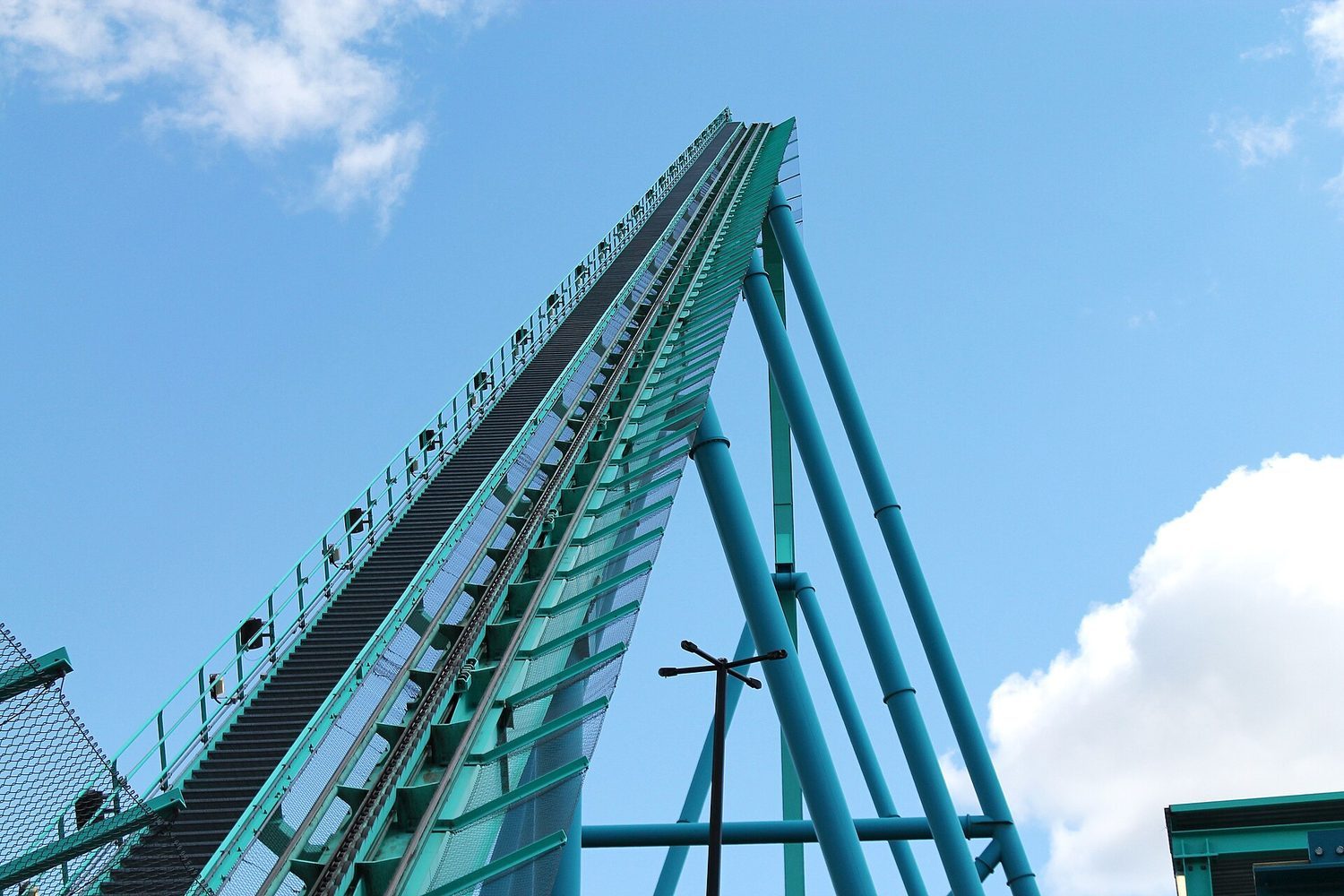
รถเหวี่ยงแลกเปลี่ยนพลังงานไปมา: สูงสุด (PE มากที่สุด) ที่ยอด, เร็วที่สุด (KE มากที่สุด) ที่ก้น
Explore · สำรวจ
Watch energy convert as an object falls · สังเกตการแปลงพลังงานขณะวัตถุตก
With no friction, mechanical energy is conserved: as an object falls, gravitational potential energy turns into kinetic energy while the total stays fixed. · เมื่อไม่มีแรงเสียดทาน พลังงานกลคงที่: ขณะวัตถุตก พลังงาน ศักย์ ของแรงโน้มถ่วงเปลี่ยนเป็นพลังงาน จลน์ โดยรวมคงที่
Learning Objective 3.5.A: Describe the transfer of energy into, out of, or within a system in terms of power.
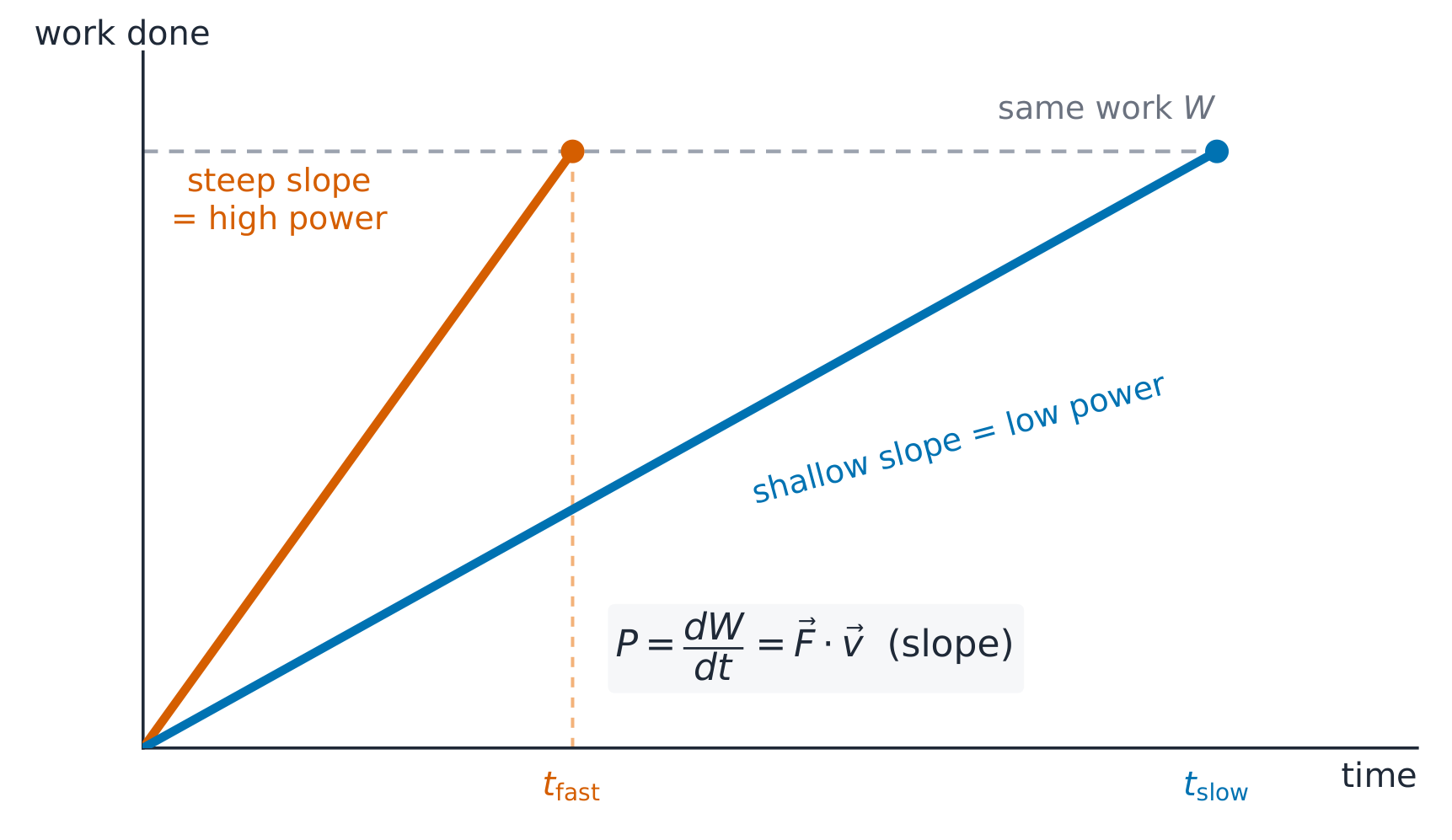
3.5.A.1 Power is the rate at which energy changes with respect to time, either by transfer into or out of a system or by conversion from one type to another within a system.
3.5.A.2 Average power is the amount of energy being transferred or converted, divided by the time it took for that transfer or conversion to occur.
3.5.A.3 Because work is the change in energy of an object or system due to a force, average power is the total work done, divided by the time during which that work was done.
Equation:$P_{\text{avg}} = \dfrac{W}{\Delta t}$
3.5.A.4 The instantaneous power delivered to an object by a force is given by the equation
Equation:$P_{\text{inst}} = \dfrac{dW}{dt}$
3.5.A.5 The instantaneous power delivered to an object by the component of a constant force parallel to the object's velocity can be described with the derived equation
It measures how fast work is done, not how much. The dot product matters: only the force component along the velocity delivers power.
Worked example. A block released from rest at the top of a frictionless $3.0\ \text{m}$-high ramp reaches the bottom at $v=\sqrt{2gh}=7.7\ \text{m/s}$ (from $mgh=\tfrac12mv^2$). A motor that then drives it at a steady $7.7\ \text{m/s}$ against a $20\ \text{N}$ resistance delivers $P=Fv=20(7.7)\approx150\ \text{W}$.
Worked example. A $1200\ \text{kg}$ car climbs a hill that rises $1.0\ \text{m}$ for every $20\ \text{m}$ of road, at a steady $15\ \text{m/s}$. The engine must supply gravity's power drain: $P=mg\,v\sin\theta=1200(9.8)(15)\big(\tfrac{1}{20}\big)\approx8.8\ \text{kW}$ – before adding air resistance.
Exam skill. Energy FRQs reward the accounting sentence: name your system, state which forces do work on it, and write the balance ($W_{\text{ext}}=\Delta K+\Delta U+\Delta E_{\text{thermal}}$) before plugging in numbers. "Friction is present, so mechanical energy is not conserved" is a scored statement.
Pick one and the site follows you — notes, papers, videos and practice all open on it. · เลือกหนึ่งตัว และเว็บจะติดตามคุณ — หมายเหตุ, ใบงาน, วิดีโอ และการฝึกฝนจะเปิดอยู่ที่นั้น
Type to search notes, lessons, code, vocabulary and past-paper questions across every subject. · พิมพ์เพื่อค้นหาบันทึก, บทเรียน, โค้ด, คำศัพท์ และคำถามข้อสอบเก่าในทุกวิชา