| Learning Objective | Essential Knowledge |
|---|---|
4.1.A |
|
Linear Momentum
AP Physics C: Mechanics · Topic 4
 7:00
Linear Momentum
A car stops in a crash. With an airbag, the driver walks away. Without one, they do not. In both cases the momentum change is exactly the same — from full…
English narration · English + 中文 subtitles burned in
4.1
Linear Momentum
Syllabus
Source: College Board AP Course and Exam Description
In 2005 NASA's Deep Impact spacecraft fired a 370 kg copper block into comet Tempel 1 at about 10 km/s. The comet has a mass of about $7\times10^{13}$ kg, so its velocity changed by only about 0.05 mm/s – yet the impact blasted out thousands of tonnes of dust and ice for scientists to study. In 2022 the DART mission went further and deliberately changed the orbit of the small asteroid Dimorphos by ramming it. Both missions were planned with one idea: momentum is conserved. This unit shows how to use it.
Linear momentum 动量 is mass 质量 times velocity 速度:
$$\vec{p}=m\vec{v}.$$
It is a vector 矢量 pointing along the velocity, and it is the quantity for analysing collisions 碰撞 and explosions 爆炸. A collection of objects can be treated as one system 系统 moving with the velocity of its center of mass 质心:
$$\vec{v}_{\text{cm}}=\frac{\sum m_i\vec{v}_i}{\sum m_i},$$
so the system's total momentum is its total mass times $\vec{v}_{\text{cm}}$ – one object's worth of bookkeeping for any number of parts. Its unit is the kilogram metre per second ($\text{kg·m/s}$), which is the same as the newton second ($\text{N·s}$).
Because momentum is a vector, direction matters. A 0.15 kg ball moving at 20 m/s toward a wall has $p=+3.0$ kg·m/s; if it bounces straight back at 20 m/s, $p=-3.0$ kg·m/s. Its speed did not change, but its momentum changed by $-6.0$ kg·m/s – twice what it would be if the ball had simply stopped.
Explore
Linear momentum
Momentum is mass times velocity - at a fixed mass, it grows in step with speed.
Vocabulary
Train
| English |
|---|
| Linear momentum/ˈlɪnɪə məʊˈmentəm/ |
| mass/mæs/ |
| velocity/vəˈlɒsɪti/ |
| vector/ˈvektə/ |
| collisions/kəˈlɪʒnz/ |
| explosions/ekˈspləʊʒnz/ |
| system/ˈsɪstəm/ |
| center of mass/ˈsentə ɒv mæs/ |
4.2
Change in Momentum and Impulse
Syllabus
| Learning Objective | Essential Knowledge |
|---|---|
4.2.A |
|
4.2.B |
|
Source: College Board AP Course and Exam Description
Newton's second law 牛顿第二定律 for a system containing the same particles is:
$$\vec{F}_{\text{net}}=\frac{d\vec{p}}{dt},$$
This reduces to $m\vec{a}$ for constant total mass. If matter crosses the chosen boundary, include the momentum it carries. Sand arriving with zero horizontal speed and leaving on a conveyor belt 传送带 at speed $v$ needs horizontal force $F=\dot{m}v$, where $\dot{m}$ is the mass arriving per second. A rocket 火箭 gains momentum as exhaust carries momentum away; applying $d(m\vec{v})/dt$ to the rocket alone without this momentum flow is incorrect. The impulse 冲量 delivered by a force is its time integral 对时间的积分, and the impulse–momentum theorem 冲量-动量定理 says it equals the change in momentum:
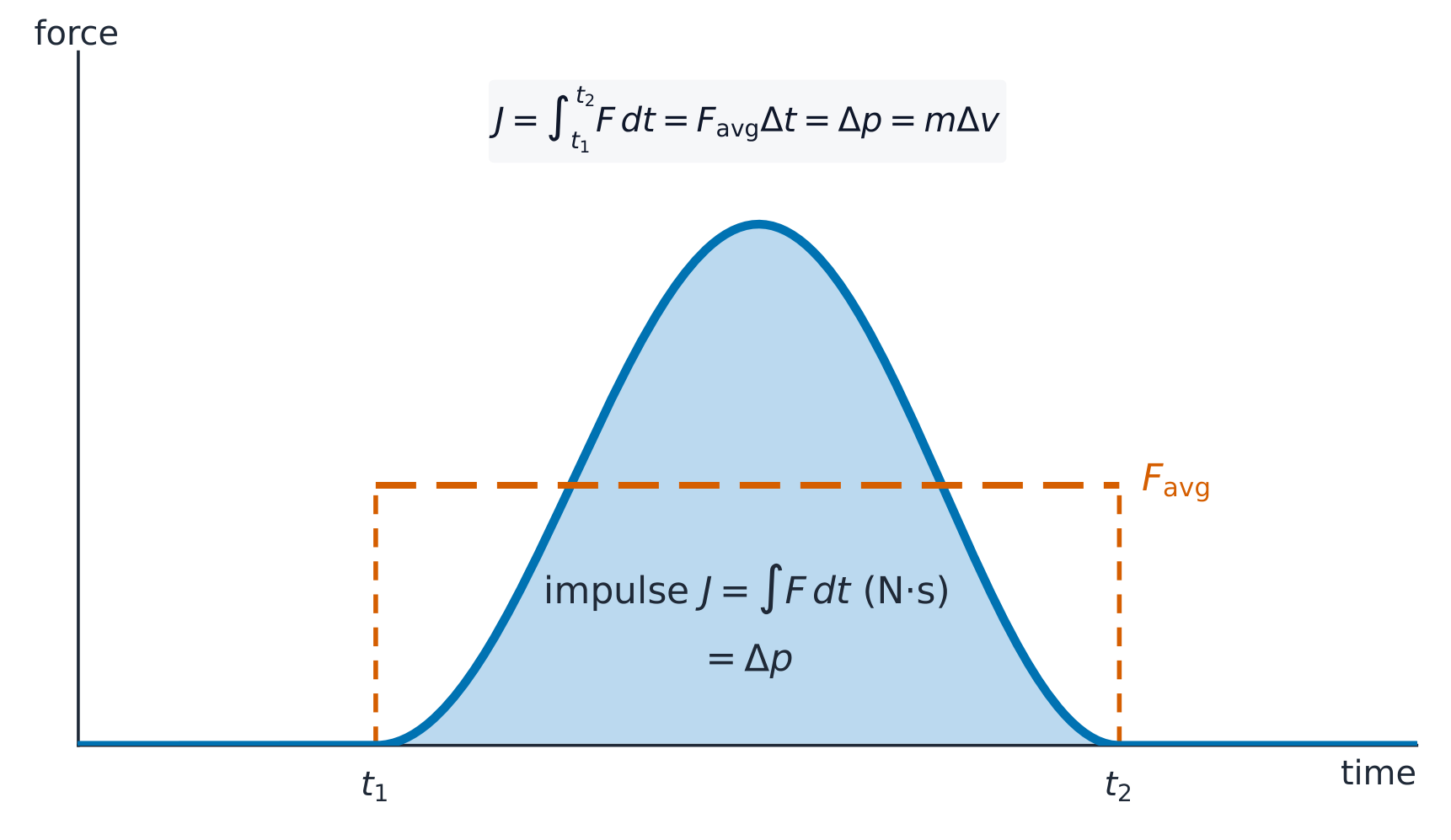
$$\vec{J}=\int_{t_1}^{t_2}\vec{F}_{\text{net}}\,dt=\Delta\vec{p}.$$
For a constant net force 合力, the impulse points in its direction. Read it off graphs both ways:
- On a force–time graph 力–时间图, impulse is the area 面积 under the curve.
- On a momentum–time graph, the net force is the slope 斜率 at each instant 时刻.
Spreading the same $\Delta p$ over a longer time lowers the force – that is why airbags 安全气囊, crumple zones 溃缩区, and soft landings work, and why you bend your knees when you land.
Worked example (impulse from a graph). A tennis racket exerts a force that rises steadily from 0 to 1500 N in 2.0 ms and falls back to 0 in another 2.0 ms on a 0.060 kg ball arriving at 30 m/s. Take the ball's outgoing direction as positive. The force–time graph is a triangle, so $J=\tfrac12(4.0\times10^{-3})(1500)=3.0$ N·s. Then $mv-mv_0=J$, so $0.060v-0.060(-30)=3.0$, which gives $v=+20$ m/s. The ball leaves at 20 m/s in the positive direction. The average force is $J/\Delta t=3.0/0.0040=750$ N – half the peak.
The slope of a momentum–time graph is the net force. If a cart's momentum rises in a straight line from 2.0 to 8.0 kg·m/s in 3.0 s, the net force on it is $\dfrac{6.0}{3.0}=2.0$ N.
Worked example (variable force). A time-varying force $F(t)=10t\ \text{N}$ acts on a $2.0\ \text{kg}$ object for $2.0\ \text{s}$. The impulse is $J=\displaystyle\int_0^2 10t\,dt=\big[5t^2\big]_0^2=20\ \text{N}\cdot\text{s}$, so the speed changes by $\Delta v=J/m=10\ \text{m/s}$.
Explore
Impulse and momentum change
Impulse is force times time, and it equals the change in momentum. Sort each case.
Vocabulary
Train
| English |
|---|
| Newton's second law/ˈnjuːtnz ˈsekənd lɔː/ |
| conveyor belt |
| rocket |
| impulse/ˈɪmpʌls/ |
| time integral |
| impulse–momentum theorem/ˈɪmpʌls məʊˈmentəm ˈθɪərəm/ |
| net force/net fɔːs/ |
| force–time graph |
| area/ˈeərɪə/ |
| slope/sləʊp/ |
| instant |
| airbags |
| crumple zones |
4.3
Conservation of Linear Momentum
Syllabus
| Learning Objective | Essential Knowledge |
|---|---|
4.3.A |
Boundary statement: AP Physics C: Mechanics only expects students to quantitatively analyze collisions and interactions in one or two dimensions. Three-dimensional collisions may be analyzed qualitatively. |
4.3.B |
|
Source: College Board AP Course and Exam Description
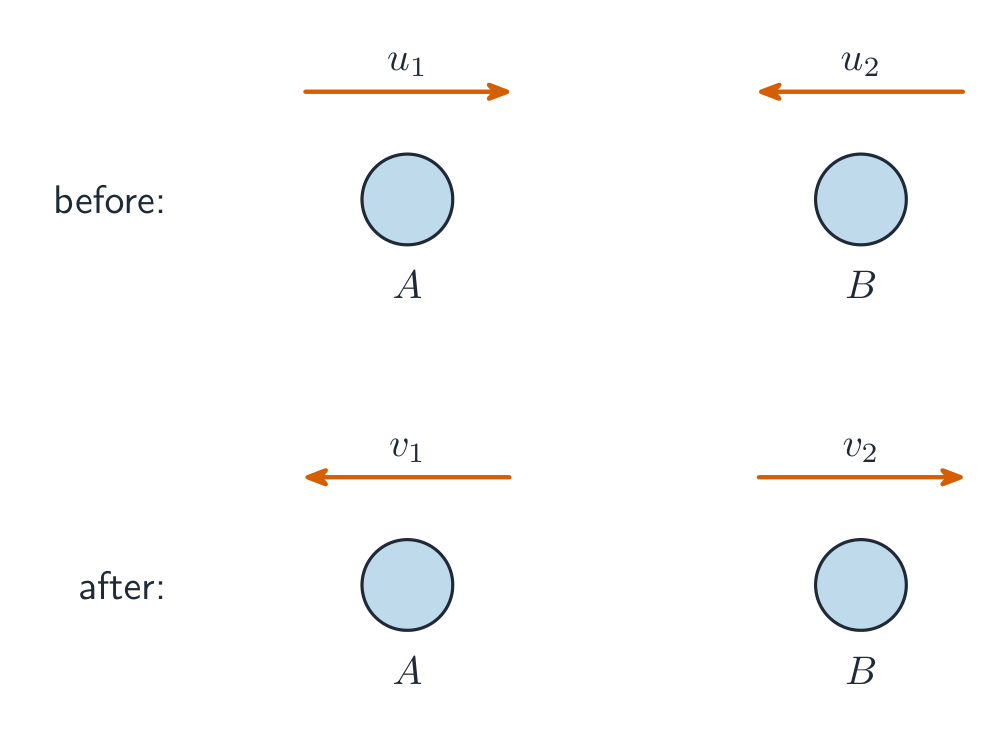
Internal forces 内力 come in Newton's-third-law pairs, so they cancel inside any system: they can shuffle momentum between parts but never change the total. For a fixed set of particles, total momentum changes only through a net external force ($\vec{J}=\Delta\vec{p}$). So, with zero net external force 合外力, total momentum is conserved 守恒:
$$\sum\vec{p}_{\text{before}}=\sum\vec{p}_{\text{after}}.$$
Strictly, momentum is conserved in all interactions: momentum is never created or destroyed, only transferred. What changes is the system you choose. If the net external force on the system is zero, the system's total momentum is constant. If it is not zero, momentum is transferred between the system and its surroundings – a ball falling toward Earth gains momentum because Earth's gravity is external to the ball; in the ball–Earth system, Earth gains an equal and opposite (and undetectably small) momentum.
Momentum is conserved over a collision when the net external impulse is negligible; choose a system containing both colliding objects. Apply conservation separately along each axis 坐标轴; AP asks for quantitative work in one or two dimensions.
Worked example (explosion). A $6.0\ \text{kg}$ shell at rest splits into a $2.0\ \text{kg}$ piece moving at $9.0\ \text{m/s}$ east and a $4.0\ \text{kg}$ piece. Total momentum stays zero, so the heavy piece moves west at $v=\dfrac{2.0(9.0)}{4.0}=4.5\ \text{m/s}$. The kinetic energy came from stored (chemical or spring) energy – momentum conservation does not require kinetic-energy conservation. The centre of mass of the two pieces stays at rest, exactly where the shell was.
Worked example (recoil). A 60 kg skater standing on ice throws a 5.0 kg ball forward at 12 m/s. Total momentum is zero before and after, so $60v=-5.0(12)$ and the skater slides backward at 1.0 m/s. The same idea drives a rocket: it pushes exhaust backward, and the exhaust pushes the rocket forward.
Explore
Collide two carts and conserve momentum
In any collision the total momentum $\sum mv$ before equals the total after. Set the masses and speeds and check the momentum bookkeeping.
Vocabulary
Train
| English |
|---|
| Internal forces/ɪnˈtɜːnl ˈfɔːsɪz/ |
| net external force/net ekˈstɜːnl fɔːs/ |
| conserved/kənˈsɜːvd/ |
| axis/ˈæksɪs/ |
4.4
Elastic and Inelastic Collisions
Syllabus
| Learning Objective | Essential Knowledge |
|---|---|
4.4.A |
|
Source: College Board AP Course and Exam Description
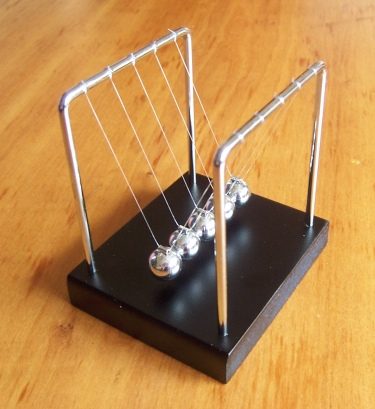
When the net external impulse is negligible, collisions conserve momentum; they differ in what happens to the kinetic energy 动能:
| type | momentum | kinetic energy |
|---|---|---|
| elastic collision 弹性碰撞 | conserved | total conserved (individual shares may change) |
| inelastic collision 非弹性碰撞 | conserved | decreases – some becomes heat, sound, deformation 形变 |
| perfectly inelastic collision 完全非弹性碰撞 | conserved | largest possible loss – the objects stick and share one velocity |
Strategy: always write momentum conservation first; add the kinetic-energy equation only when the problem says "elastic". Two useful elastic facts: equal masses in a 1D elastic collision simply exchange velocities, and in the center-of-mass frame 质心参考系 each object just reverses its velocity.
Worked example. A $1000\ \text{kg}$ car at $20\ \text{m/s}$ strikes a stationary $1500\ \text{kg}$ car and they lock together – perfectly inelastic. Momentum: $v=\dfrac{1000(20)}{2500}=8.0\ \text{m/s}$. Kinetic energy falls from $2.0\times10^5\ \text{J}$ to $\tfrac12(2500)(8.0)^2=8.0\times10^4\ \text{J}$: about $60\%$ is lost, even though momentum is exactly conserved.
Elastic collisions in one dimension. When a mass $m_1$ moving at $v_1$ hits a stationary $m_2$ elastically, solving the momentum and kinetic-energy equations together gives
$$v_1'=\frac{m_1-m_2}{m_1+m_2}\,v_1,\qquad v_2'=\frac{2m_1}{m_1+m_2}\,v_1.$$
Check the limits: equal masses exchange velocities ($v_1'=0$, $v_2'=v_1$); a light ball hitting a heavy wall bounces back with nearly its original speed; a heavy ball hitting a light one carries on almost unchanged and the light one leaves at nearly $2v_1$. In any 1D elastic collision the relative speed of approach equals the relative speed of separation: $v_1-v_2=-(v_1'-v_2')$, a quicker equation to use than kinetic energy.
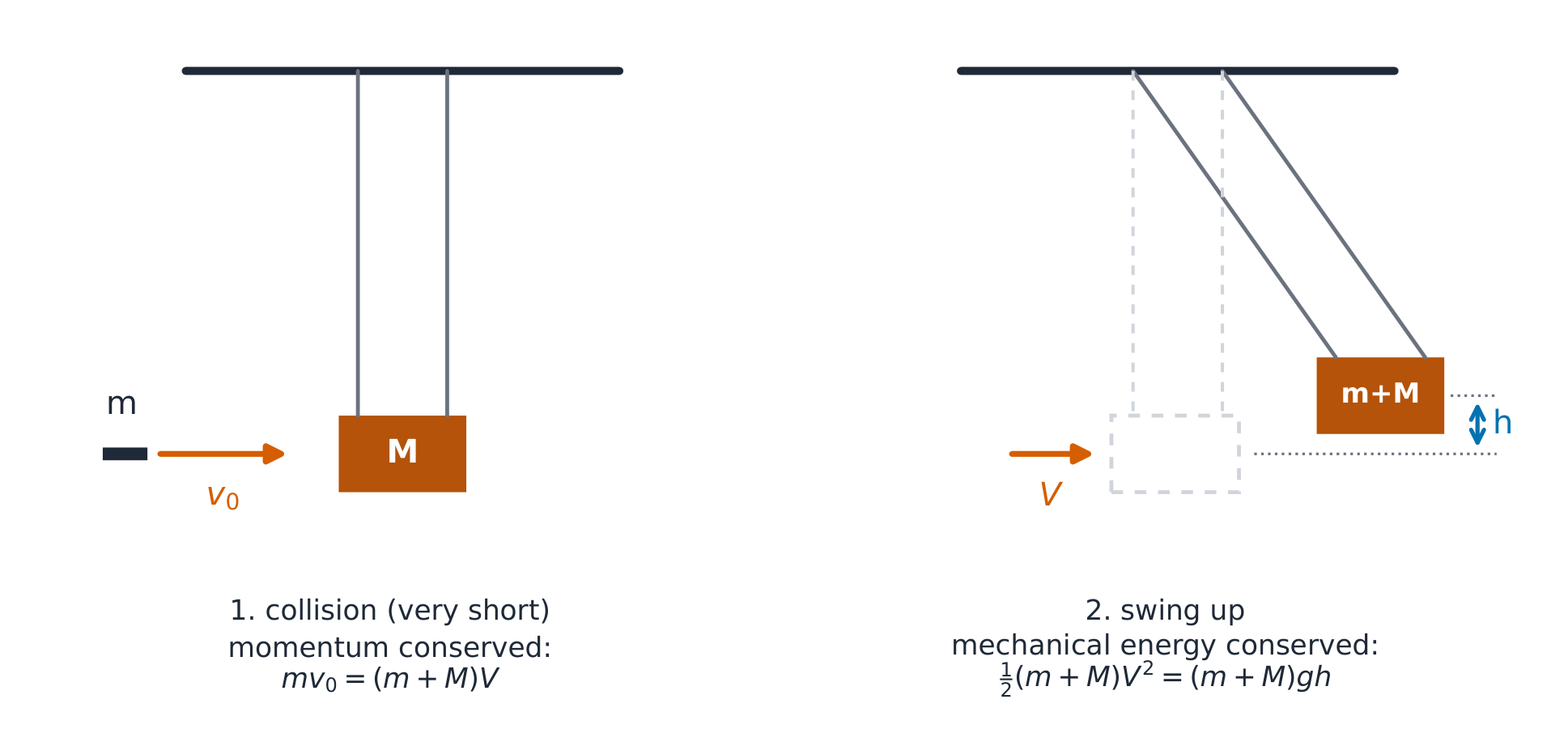
Worked example (ballistic pendulum). A 0.010 kg bullet embeds in a 2.0 kg wooden block hanging on strings, and the block swings up 0.20 m. Find the bullet's speed. The problem has two stages, and each needs a different conservation law. Swing (energy): $\tfrac12(m+M)V^2=(m+M)gh$, so $V=\sqrt{2gh}=\sqrt{2(10)(0.20)}=2.0$ m/s. Collision (momentum): $mv_0=(m+M)V$, so $v_0=\dfrac{2.01(2.0)}{0.010}\approx400$ m/s. Only $\tfrac{0.5(2.01)(2.0)^2}{0.5(0.010)(400)^2}\approx0.5\%$ of the bullet's kinetic energy remains after the collision; the rest became heat and deformation of the wood.
Worked example (2D). A puck moving east at $4.0\ \text{m/s}$ strikes an identical puck at rest; after the glancing hit, one moves at $2.0\ \text{m/s}$ at $60^\circ$ north of east. Conserve each axis: east–west, $m(4.0)=m(2.0)\cos60^\circ+mv_x$, so $v_x=3.0\ \text{m/s}$; north–south, $0=m(2.0)\sin60^\circ-mv_y$, so $v_y=1.7\ \text{m/s}$. The second puck moves at $\sqrt{3.0^2+1.7^2}=3.5\ \text{m/s}$, about $30^\circ$ south of east.
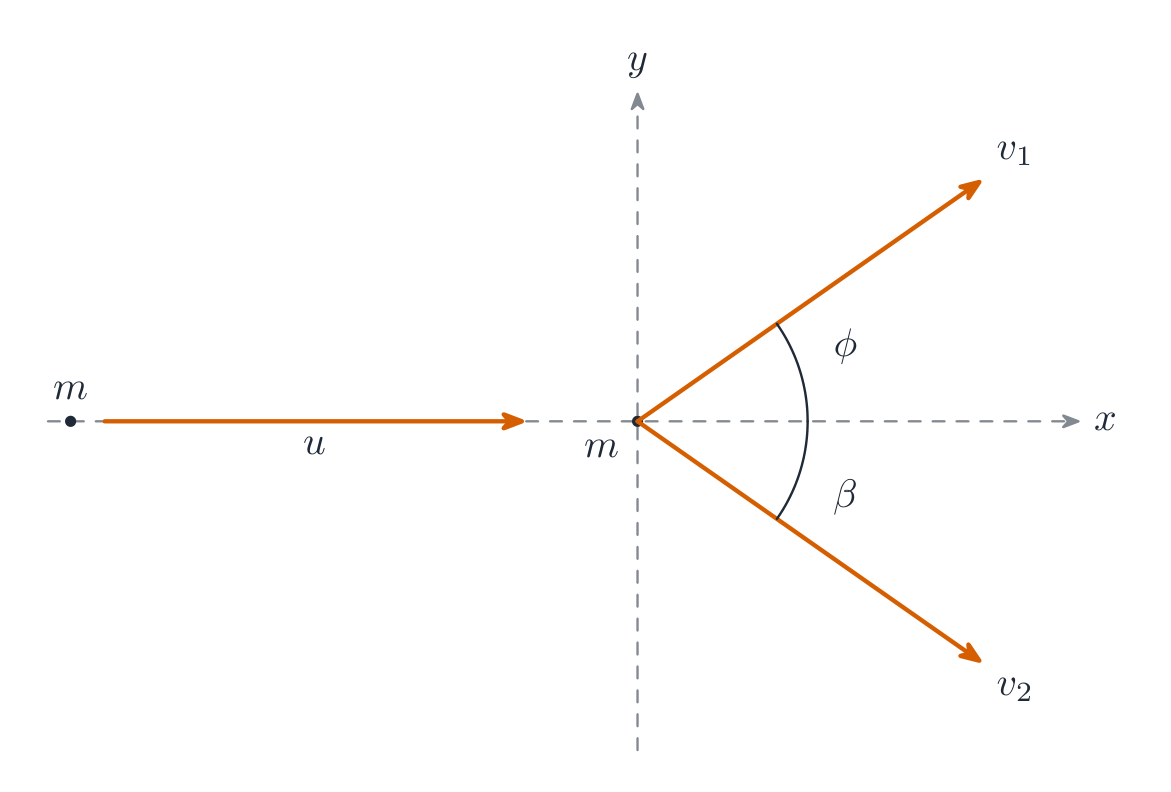
Exam skill. On FRQs, justify with the condition, not the slogan: "the net external force on the two-puck system is zero during the collision, so its total momentum is constant." If asked whether the collision is elastic, compute the kinetic energy before and after and compare – never assume.
Explore
Compare elastic and inelastic collisions
Momentum is always conserved, but kinetic energy is only conserved in an elastic collision. In an inelastic one the carts stick and some energy becomes heat.
Vocabulary
Train
| English |
|---|
| kinetic energy/kɪˈnetɪk ˈenədʒi/ |
| elastic collision/ɪˈlæstɪk kəˈlɪʒn/ |
| inelastic collision/ɪnɪˈlæstɪk kəˈlɪʒn/ |
| deformation/ˌdiːfɔːˈmeɪʃn/ |
| perfectly inelastic collision/ˈpɜːfektlɪ ɪnɪˈlæstɪk kəˈlɪʒn/ |
| center-of-mass frame |
4.4
Exam tips
- Impulse equals the momentum change: $\vec J=\int \vec F\,dt=\Delta\vec p$, and it is the area under a force–time graph.
- Momentum is conserved whenever the net external force is zero — always the go-to for collisions.
- Distinguish elastic (kinetic energy conserved) from inelastic (kinetic energy decreases) collisions; in a perfectly inelastic collision the objects stick and move with one velocity.
- Apply conservation to each component 分量 (x and y) separately in 2-D.
- Connect to center of mass: total momentum $=M\vec v_{cm}$.
Common mistakes
- Conserving momentum while an external impulse is large, for example during a long push from the ground. Conservation needs a negligible net external impulse over the interval.
- Calling a collision elastic because momentum is conserved. Check kinetic energy too.
- Reading impulse as the peak force times the time. Impulse is the area under the $F$–$t$ graph.
- Adding momenta in two dimensions as magnitudes. Conserve the $x$ and $y$ components separately.
- Forgetting that internal forces cannot move the centre of mass: an explosion leaves $\vec v_{cm}$ unchanged.
- Using energy conservation across a perfectly inelastic collision (as in a ballistic pendulum). Use momentum for the collision, then energy for the swing.
Vocabulary
Train
| English |
|---|
| component/kəmˈpəʊnənt/ |
Interactive lessons on this topic
Work through it step by step, with instant-check exercises.