Potential Energy
Introduced| English | Meaning |
|---|---|
| potential energy/pəˈtenʃl ˈenədʒi/ | Energy stored because of position or configuration. |
| gravitational potential energy/ˌɡrævɪˈteɪʃənl pəˈtenʃl ˈenədʒi/ | Energy stored because of an object’s position in a gravitational field. |
| elastic potential energy/ɪˈlæstɪk pəˈtenʃl ˈenədʒi/ | Energy stored when an elastic object is stretched or compressed. |
| conservative force/kənˈsɜːvətɪv fɔːs/ | conservative force |
| stable equilibrium/ˈsteɪbl ˌiːkwɪˈlɪbrɪəm/ | A position where a small displacement produces a restoring effect. |
| unstable equilibrium/ʌnˈsteɪbl ˌiːkwɪˈlɪbrɪəm/ | A position where a small displacement produces a separating effect. |
Energy waiting to happen
- Lift a book onto a shelf and it just sits there — but it now holds hidden energy.
- Nudge it off and that stored energy becomes motion as it falls.
- Energy tied up in position is called potential energy.
- It is nature's rechargeable battery.
Potential energy
- Potential energy 势能 is energy stored in the arrangement of a system, not its motion.
- It depends only on where things are.
- Two common kinds power most of mechanics.
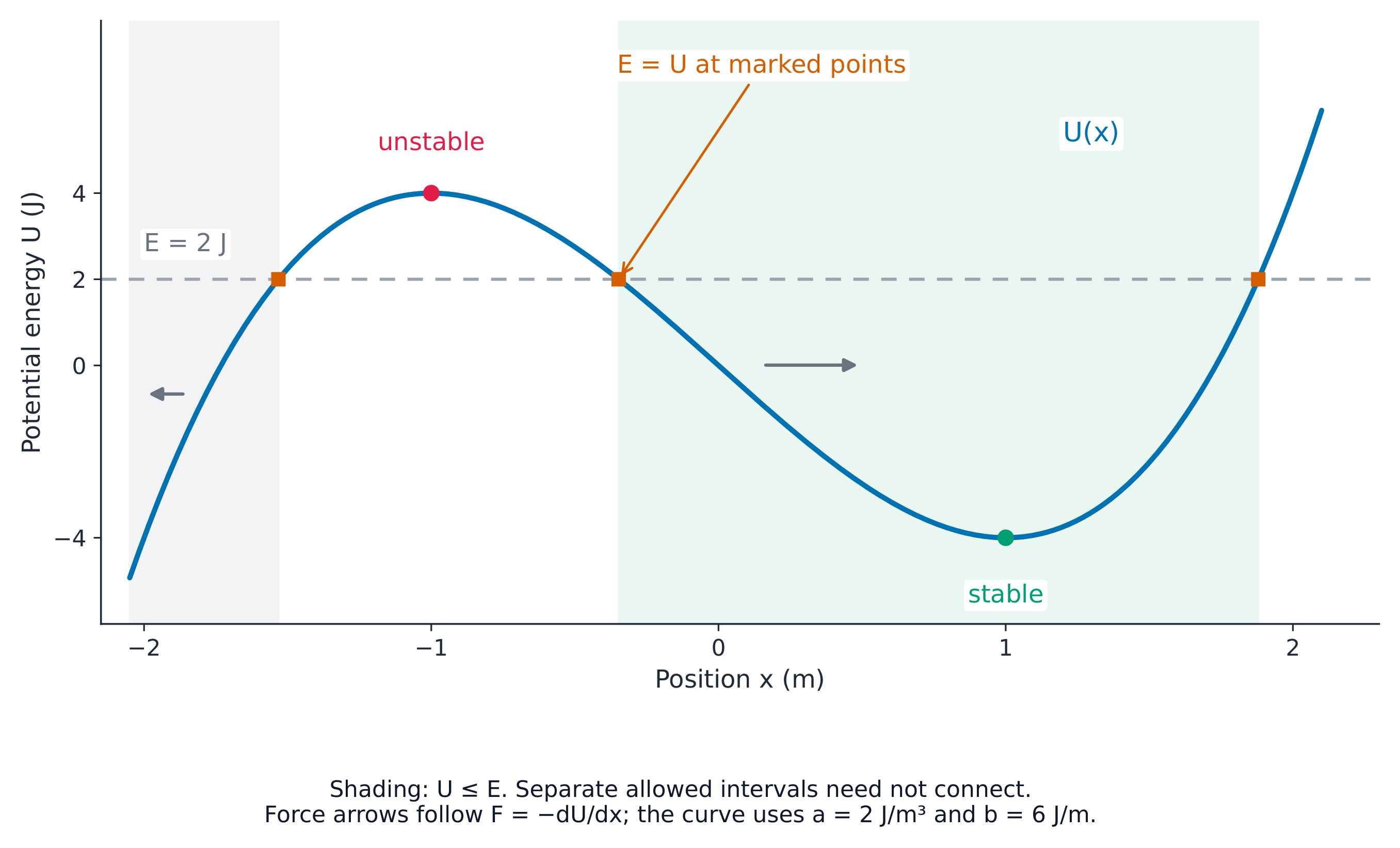
Cubic potential with units: slope determines force and fixed energy gives disconnected allowed intervals
Gravitational and elastic
- Gravitational potential energy 引力势能 near the ground: $U_g = mgy$ — lift higher, store more.
- Elastic potential energy 弹性势能 in a spring: $U_s = \tfrac{1}{2}kx^2$ — stretch more, store more.
- Release either and it converts into kinetic energy.
Lift a $2\ \text{kg}$ book $1.5\ \text{m}$ ($g = 9.8$). How much gravitational potential energy is stored (in J)?
Difficulty 2/5 · 140 coins + a small bonus on first completion today
$U_g = mgy = 2 \times 9.8 \times 1.5 = 29.4\ \text{J}$.
A spring ($k = 200\ \tfrac{\text{N}}{\text{m}}$) is compressed $0.10\ \text{m}$. Elastic potential energy stored (in J)?
Difficulty 2/5 · 140 coins + a small bonus on first completion today
$U_s = \tfrac{1}{2}kx^2 = \tfrac{1}{2}(200)(0.10)^2 = 1\ \text{J}$.
Select all forms of potential energy covered here.
Difficulty 2/5 · 140 coins + a small bonus on first completion today
Gravitational and elastic are conservative-force energies. There is no frictional potential energy.
Force is the slope of energy
- A conservative force 保守力 (gravity, springs) is the negative slope of its potential energy:
- Steep energy hill → strong force. Flat → no force.
- This turns an energy graph into a force map.
Gravitational potential energy
Near the surface, gravitational potential energy is proportional to height.
Friction has an associated potential energy, just like gravity.
Difficulty 1/5 · 100 coins + a small bonus on first completion today
Only conservative forces have potential energy. Friction dissipates energy as heat -- it cannot be stored.
A conservative force equals the ____ slope of its potential energy, $F_x = -dU/dx$.
Difficulty 1/5 · 100 coins + a small bonus on first completion today
$F_x = -dU/dx$ -- the force points "downhill" on the energy graph.
Reading a potential-energy graph
- On a $U$-versus-position graph, valleys are points of stable equilibrium 稳定平衡 (a nudge brings it back).
- Hilltops are unstable equilibrium 不稳定平衡 (a nudge sends it away).
- An object speeds up rolling downhill on the graph and slows going up.
On a potential-energy graph, a valley (local minimum) is a point of...
Difficulty 1/5 · 100 coins + a small bonus on first completion today
At a valley a small nudge brings the object back -- stable equilibrium. A hilltop is unstable.
For a spring, $U_s = \tfrac{1}{2}kx^2$.
- The force is $F_x = -\dfrac{dU}{dx} = -kx$ — Hooke's law falls right out of the derivative.
- The graph of $U_s$ is a parabola with its minimum at $x = 0$ — a stable equilibrium.
Only conservative forces have a potential energy. Friction does not — the energy it removes turns to heat and cannot be "stored" or recovered. So there is no "friction potential energy."
Potential energy is stored by position: gravitational $U_g = mgy$ and elastic $U_s = \tfrac{1}{2}kx^2$. A conservative force is the negative slope of its energy, $F_x = -dU/dx$. On a $U$-graph, valleys are stable equilibrium, hilltops unstable.
Write from a gravitational energy of 60 J
- A 2 kg book is 3 m above the chosen zero. Use g = 10.
- Find the gravitational potential energy.
A 2 kg book is 3 m above the height chosen as zero. Use g = 10 N/kg. What is its gravitational potential energy?
2 times 10 times 3 is 60.
What is the gravitational potential energy?
Difficulty 1/5 · 100 coins + a small bonus on first completion today
2 kilograms times 10 times 3 metres is 60 J.