Conservation of Energy
Introduced| English | Meaning |
|---|---|
| mechanical energy/mɪˈkænɪkl ˈenədʒi/ | mechanical energy |
| nonconservative forces/ˌnɒŋkənˈsɜːvətɪv ˈfɔːsɪz/ | Forces whose work is not described by a position-only potential energy; they can add or remove mechanical energy, with sliding friction usually dissipating it. |
| thermal energy/ˈθɜːml ˈenədʒi/ | Energy associated with the random motion and interactions of particles in a substance. |
A pendulum trades height for speed
- A swinging pendulum is fastest at the bottom and momentarily stops at the top of each swing.
- It is constantly trading height for speed and back again.
- Add up its motion energy and its height energy, and the total never changes.
- That unshakable total is one of physics' great bookkeeping laws.
Conservation of mechanical energy
- With only conservative forces, mechanical energy 机械能 (kinetic + potential) is conserved:
- Energy shifts between kinetic and potential, but the sum stays fixed.
- Solve motion problems without ever finding the force.
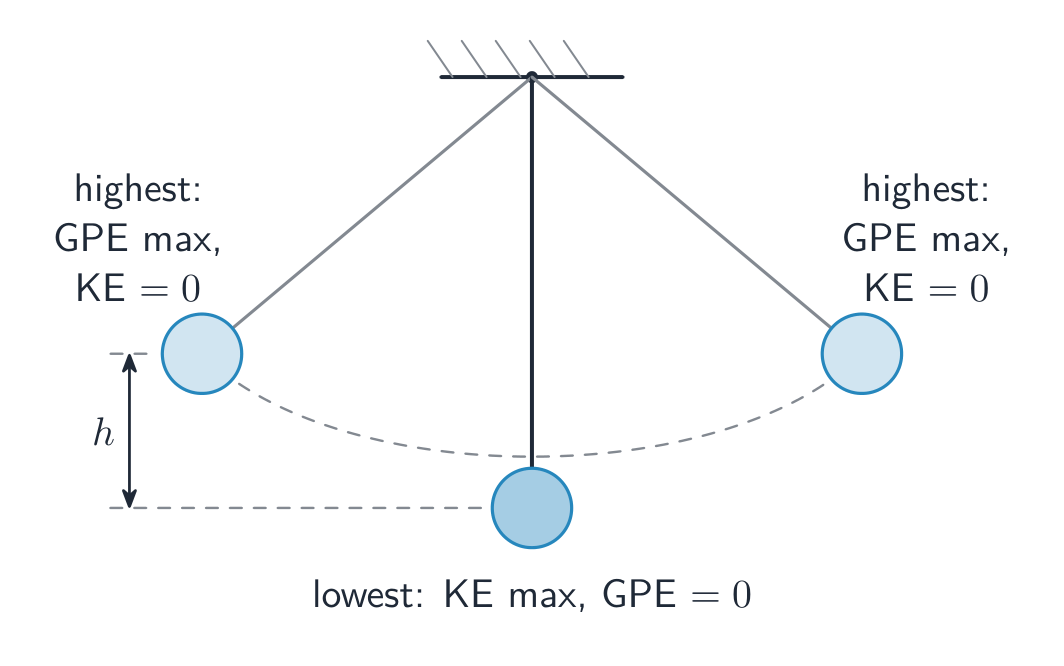
Ideal pendulum released from rest: extreme positions have zero speed
A ball is dropped from $2\ \text{m}$ (no air resistance, $g = 10$). Its speed at the bottom (in m/s)?
Difficulty 2/5 · 140 coins + a small bonus on first completion today
$mgh = \tfrac{1}{2}mv^2$, so $v = \sqrt{2gh} = \sqrt{2 \times 10 \times 2} = \sqrt{40} \approx 6.32\ \tfrac{\text{m}}{\text{s}}$.
With only conservative forces, the sum of kinetic and potential energy (the ____ energy) is conserved.
Difficulty 1/5 · 100 coins + a small bonus on first completion today
$K + U$ is the mechanical energy, conserved when no friction or drag acts.
A frictionless pendulum is at its lowest point. There, its energy is...
Difficulty 1/5 · 100 coins + a small bonus on first completion today
At the bottom, height (and $U$) is lowest and speed is highest -- the energy is all kinetic.
Conservative versus not
- Conservative forces (gravity, springs) conserve mechanical energy.
- Nonconservative forces 非保守力 (friction, drag) drain it away.
- The difference decides whether $K + U$ stays constant.
When friction acts, the mechanical energy $K + U$ stays constant.
Difficulty 1/5 · 100 coins + a small bonus on first completion today
Friction is nonconservative -- it drains mechanical energy into heat, so $K + U$ decreases.
Select all forces that conserve mechanical energy.
Difficulty 2/5 · 140 coins + a small bonus on first completion today
Gravity and springs are conservative. Kinetic friction is nonconservative -- it dissipates energy.
Where the energy goes
- Friction converts mechanical energy into thermal energy 热能 (heat).
- Energy is still conserved overall — it just leaves the mechanical account.
- The work done by friction equals the mechanical energy lost.
Conservation of energy
As an object rises and falls, energy shifts between kinetic and potential while the total stays constant.
A block slides to a stop on a rough floor. Where did its kinetic energy go?
Difficulty 1/5 · 100 coins + a small bonus on first completion today
Friction converted the kinetic energy to heat. Total energy is still conserved; it just left the mechanical account.
Energy accounting
- Track energy with bar charts or the equation $K_i + U_i = K_f + U_f\ (+\ \text{heat})$.
- List every form before and after; they must balance.
- This makes even messy multi-step motions solvable.
A $1\ \text{kg}$ ball is dropped from $5\ \text{m}$ (no air resistance).
- All its $U_g = mgh = 1 \times 9.8 \times 5 = 49\ \text{J}$ becomes kinetic energy at the bottom.
- So $\tfrac{1}{2}mv^2 = 49\ \text{J}$ gives $v = \sqrt{98} \approx 9.9\ \tfrac{\text{m}}{\text{s}}$.
"Energy is conserved" always holds — but mechanical energy is conserved only without friction or drag. When friction acts, do not set $K_i + U_i = K_f + U_f$; you must add the heat term, or you will over-count the final speed.
With only conservative forces, mechanical energy is conserved: $K_i + U_i = K_f + U_f$. Nonconservative forces like friction convert it to thermal energy — total energy is still conserved, but you must track the heat. Energy bookkeeping solves motion without forces.
Write from a landing speed of 10 m/s
- A stone is dropped from rest through 5 m. Use g = 10 and ignore air resistance.
- Find the speed at the bottom.
A stone drops from rest through 5 m. Use g = 10 m/s squared and ignore air resistance. What is its speed at the bottom?
2 times 10 times 5 is 100, and the square root of 100 is 10.
What is the speed at the bottom?
Difficulty 1/5 · 100 coins + a small bonus on first completion today
The speed squared is 100, so the speed is 10 m/s.