| Learning Objective | Essential Knowledge |
|---|---|
5.1.A |
Boundary statement: AP Physics C: Mechanics expects students to be able to mathematically manipulate the magnitudes of angular displacement, angular velocity, and angular acceleration using vector conventions. However, the directions of said vectors will not be assessed on the exam. Descriptions of the directions of rotational kinematics quantities for a point or rigid body are limited to clockwise and counterclockwise with respect to a given axis of rotation. |
Torque and Rotational Dynamics
AP Physics C: Mechanics · Topic 5
 7:22
Torque and Rotational Dynamics
Push a door at the handle and it swings open easily. Now push just as hard, right next to the hinge. Almost nothing happens. The force was the same both times.…
English narration · English + 中文 subtitles burned in
5.1
Rotational Kinematics
Syllabus
Source: College Board AP Course and Exam Description
Why is a door handle on the side far from the hinges? Why does a tightrope walker carry a long pole? Why does a tall chimney often break in the middle as it falls? All three answers come from this unit: where a force acts matters as much as how big it is, and where the mass sits matters as much as how much there is.
A fan can keep turning while it slows down. Its velocity and acceleration then have opposite signs. Choose one fixed axis and a positive sense, such as counterclockwise. A rigid body 刚体 holds its shape; its points share the same angular motion about that axis.
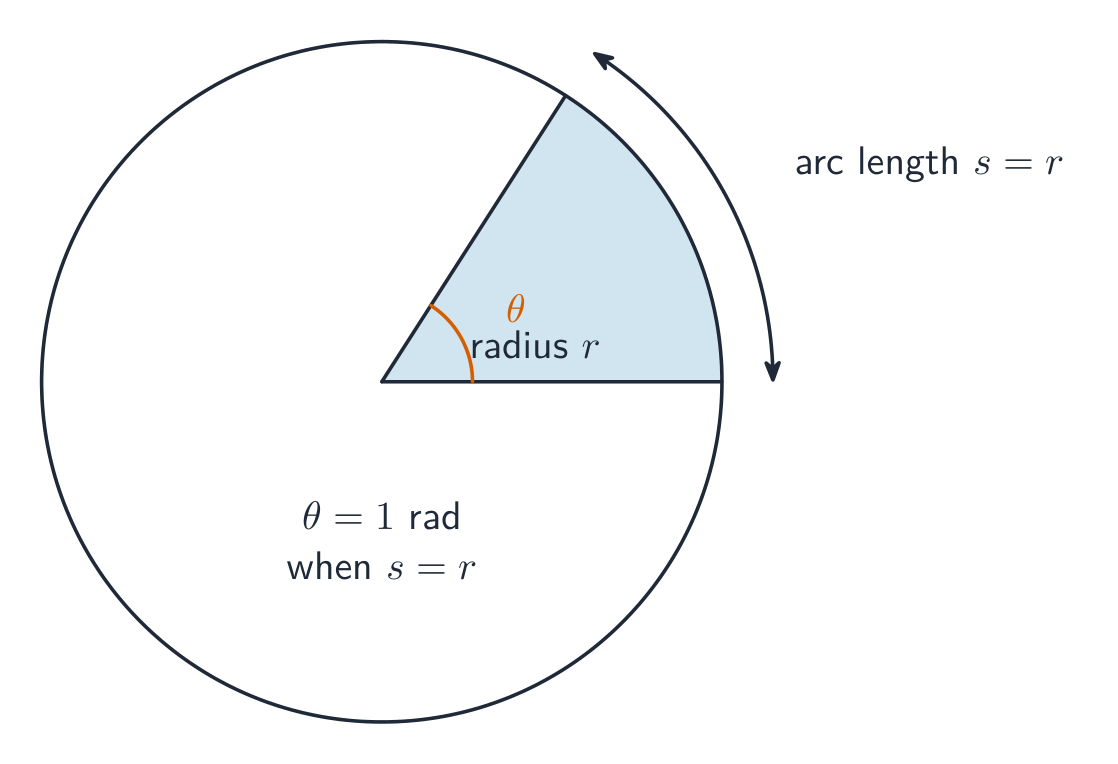
Angular displacement 角位移 is $\Delta\theta=\theta-\theta_0$, measured in radians 弧度. One revolution is $2\pi$ radians. Angular velocity 角速度 and angular acceleration 角加速度 are rates:
$$\omega=\frac{d\theta}{dt},\qquad\alpha=\frac{d\omega}{dt}.$$
The AP rotational-kinematics descriptions use clockwise/counterclockwise signs; three-dimensional directions of these kinematic vectors are outside this unit's assessment boundary. Torque directions are considered separately below.
For constant $\alpha$ only,
$$\omega=\omega_0+\alpha t,\qquad\Delta\theta=\omega_0t+\frac12\alpha t^2,\qquad\omega^2=\omega_0^2+2\alpha\Delta\theta.$$
For varying acceleration, retain the initial conditions:
$$\omega(t)=\omega_0+\int_0^t\alpha(t')\,dt',\qquad\theta(t)=\theta_0+\int_0^t\omega(t')\,dt'.$$
Slope of a $\theta$–$t$ graph gives $\omega$; slope of an $\omega$–$t$ graph gives $\alpha$. Signed area under $\omega(t)$ gives angular displacement; it need not equal total angle travelled after reversal.
Original constant-acceleration task. A fan slows from $30$ rad/s to rest at constant $\alpha=-6.0$ rad/s². From $\omega=\omega_0+\alpha t$, $t=(0-30)/(-6.0)=5.0$ s. Then $\Delta\theta=\omega_0t+\frac12\alpha t^2=75$ rad, or $75/(2\pi)\approx12$ revolutions. Stop the model at rest unless the driving torque is specified to continue.
Original variable-acceleration task. Let $\alpha=ct$, with $c=4.0$ rad/s³, $\omega_0=3.0$ rad/s and $\theta_0=1.0$ rad. Integration gives $\omega=\omega_0+\frac12ct^2$ and $\theta=\theta_0+\omega_0t+ct^3/6$. At $t=2.0$ s, these are $11$ rad/s and $12.3$ rad. Omitting the integration constants changes the physical initial state.
Explore
Rotational analogs
Each linear quantity has a rotational partner. Sort each description.
Vocabulary
Train
| English |
|---|
| rigid body/ˈrɪdʒɪd ˈbɒdi/ |
| angular displacement/ˈæŋɡjʊlə dɪˈspleɪsmənt/ |
| radians/ˈreɪdɪənz/ |
| angular velocity/ˈæŋɡjʊlə vəˈlɒsɪti/ |
| angular acceleration/ˈæŋɡjʊlə əkˌseləˈreɪʃn/ |
5.2
Connecting Linear and Rotational Motion
Syllabus
| Learning Objective | Essential Knowledge |
|---|---|
5.2.A |
Boundary statement: AP Physics C: Mechanics expects students to be able to mathematically manipulate the magnitudes of angular displacement, angular velocity, and angular acceleration using vector conventions. However, the directions of the vectors will not be assessed on the exam. Descriptions of the directions of rotational kinematics quantities for a point or rigid body are limited to clockwise and counterclockwise with respect to a given axis of rotation. |
Source: College Board AP Course and Exam Description
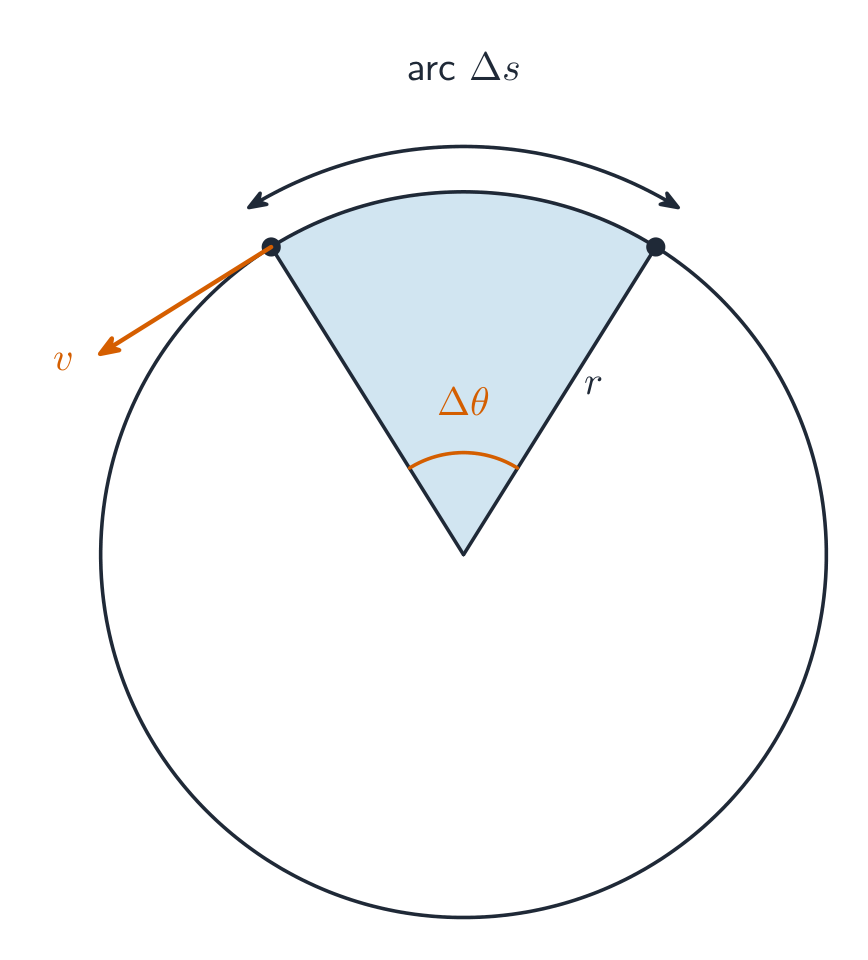
For a point at perpendicular distance $r$ from a fixed axis,
$$\Delta s=r\Delta\theta,\qquad v=r|\omega|,\qquad a_t=r\alpha,\qquad a_c=r\omega^2.$$
Here $v$ is speed; $a_t$ is signed relative to the chosen tangential direction. The tangential acceleration 切向加速度 changes speed and may oppose motion. The centripetal acceleration 向心加速度 points toward the axis and changes direction. Their perpendicular magnitudes give $a=\sqrt{a_t^2+a_c^2}$. Constant nonzero angular speed still gives centripetal acceleration.
Original wheel task. At one instant $\omega=4.0$ rad/s and $\alpha=-2.0$ rad/s². At $r=0.50$ m, $v=r|\omega|=2.0$ m/s, $a_t=r\alpha=-1.0$ m/s² and $a_c=r\omega^2=8.0$ m/s². Thus $a=\sqrt{(-1.0)^2+8.0^2}=8.1$ m/s². At twice the radius all three component magnitudes double, although $\omega$ and $\alpha$ are unchanged.
Explore
Linear from rotational
A point on a spinning body moves faster the farther it is from the axis: v = r times omega.
Vocabulary
Train
| English |
|---|
| tangential acceleration/tænˈdʒenʃl əkˌseləˈreɪʃn/ |
| centripetal acceleration/senˈtrɪpɪtl əkˌseləˈreɪʃn/ |
5.3
Torque
Syllabus
| Learning Objective | Essential Knowledge |
|---|---|
5.3.A |
|
5.3.B |
|
Source: College Board AP Course and Exam Description
Torque 力矩 describes a force's turning effect about a chosen axis. It is a vector product 矢量积:
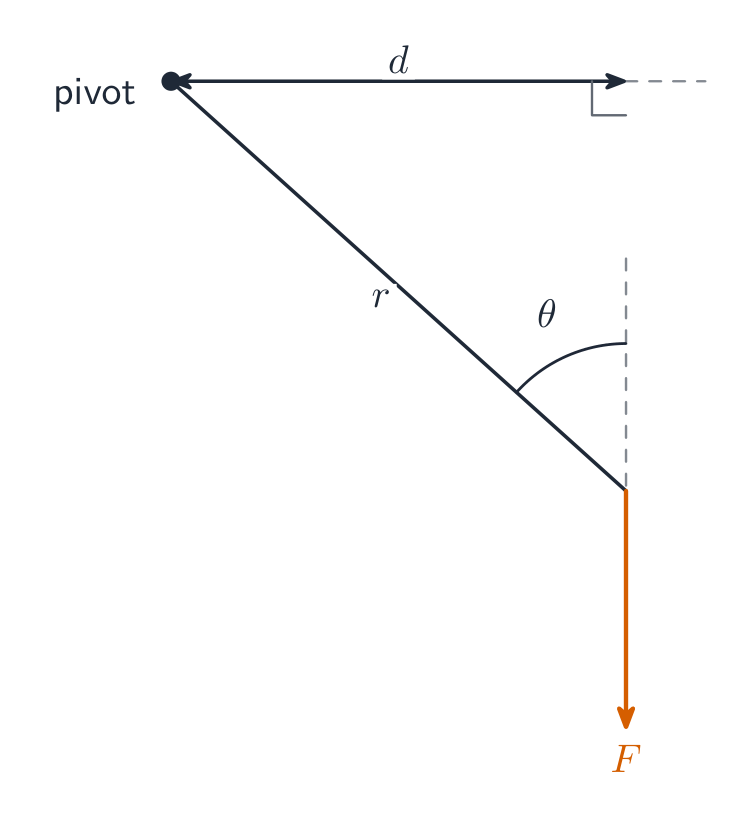
$$\vec\tau=\vec r\times\vec F,\qquad |\tau|=rF\sin\phi=F r_\perp.$$
The moment arm 力臂 $r_\perp$ is the perpendicular distance from the axis to the force's line of action, not necessarily the distance to its application point. A force whose line of action passes through the axis has zero torque about that axis; it can still exert a force and cause translation.
The right-hand rule 右手定则 gives the torque direction perpendicular to the plane of $\vec r$ and $\vec F$: curl from $\vec r$ toward $\vec F$. Counterclockwise torque is out of the page; clockwise is into it. For planar calculations choose signs consistently. Torque has unit N m, but it is not the scalar work measured in joules.
Original lever task. A $20$ N force acts at $r=0.30$ m and angle $30^\circ$ to the radius, tending counterclockwise. Its torque is $\tau=rF\sin\phi=(0.30)(20)\sin30^\circ=+3.0$ N m. Equivalently, $r_\perp=r\sin\phi=0.15$ m. A perpendicular $10$ N force at the same radius gives the same torque. More force alone does not determine more torque.
Worked example (the door handle). A stiff door needs a torque of 2.0 N m about its hinges to start opening. Pushing at right angles at the handle, 0.80 m from the hinge line, needs $F=\tau/r_\perp=2.0/0.80=2.5$ N. Pushing at 0.10 m from the hinges needs $2.0/0.10=20$ N, eight times as much. Pushing straight toward the hinges, along the door, gives $r_\perp=0$ and no torque at all, however hard you push.
Explore
Balance torques on a beam
Torque is force times perpendicular distance, $\tau=Fd$. The beam is in rotational equilibrium when the torques on each side are equal.
Vocabulary
Train
| English |
|---|
| Torque/tɔːk/ |
| vector product/ˈvektə ˈprɒdʌkt/ |
| moment arm/ˈməʊmənt ɑːm/ |
| right-hand rule/raɪt hænd ruːl/ |
5.4
Rotational Inertia
Syllabus
| Learning Objective | Essential Knowledge |
|---|---|
5.4.A |
|
5.4.B |
Boundary statement: AP Physics C: Mechanics only expects students to use calculus in the derivations of the rotational inertia of thin rods of uniform or nonuniform density about an arbitrary axis perpendicular to the rod, as well as derivations of the rotational inertia of a thin cylindrical shell, disk, or rigid bodies that can be considered to be made up of coaxial rings or shells about an axis that passes through their centers (e.g., annular rings). Students should have a qualitative understanding of the factors that affect rotational inertia; for example, how rotational inertia is greater when mass is farther from the axis of rotation, which is why a hoop has more rotational inertia than a solid puck of the same mass and radius. |
Source: College Board AP Course and Exam Description
Rotational inertia 转动惯量 depends on the mass distribution relative to a specified axis:
$$I=\sum_i m_i r_i^2,\qquad I=\int r^2\,dm.$$
Use perpendicular distance from each mass element to that axis. The unit is kg m². For a point-mass model, moving the same mass from $r$ to $2r$ multiplies its contribution by four. This is the tightrope walker's trick: a long pole puts mass far from the walker's axis, so a small sideways torque gives only a small $\alpha$, and the walker has time to correct a wobble. Inertias add only when defined about the same axis.
Uniform rod about its centre. For mass $M$, length $L$ and linear density 线密度 $\lambda=M/L$, take $x=0$ at the centre. Then $dm=(M/L)dx$ and
$$I_{\rm cm}=\int_{-L/2}^{L/2}x^2\frac{M}{L}\,dx=\frac{ML^2}{12}.$$
Nonuniform rod about its light end. If $\lambda(x)=cx$ on $0\le x\le L$, $c$ has unit kg/m². First normalise the density:
$$M=\int_0^L cx\,dx=\frac12cL^2,\qquad c=\frac{2M}{L^2}.$$
Then $I=\int_0^L x^2(cx)dx=cL^4/4=ML^2/2$. This is not the uniform-rod result; the mass is concentrated farther from the axis.
Disk from coaxial rings. For a uniform thin disk, surface density is $\sigma=M/(\pi R^2)$. A thin ring has $dm=\sigma 2\pi r\,dr$, so
$$I=\int_0^R r^2\sigma2\pi r\,dr=\frac12MR^2.$$
A thin hoop of the same mass and radius has $I=MR^2$. For a uniform annular disk with inner radius $a$ and outer radius $b$, use $\sigma=M/[\pi(b^2-a^2)]$ and limits $a$ to $b$: $I=M(a^2+b^2)/2$. AP's calculus scope includes rods and bodies built from coaxial rings/shells; arbitrary three-dimensional shapes are not required here.
The parallel-axis theorem 平行轴定理 relates an axis through the centre of mass to a parallel axis a distance $d$ away:
$$I'=I_{\rm cm}+Md^2.$$
For the uniform rod about one end, $I=ML^2/12+M(L/2)^2=ML^2/3$. The starting axis must pass through the centre of mass. For $M=3.0$ kg and $L=2.0$ m, $I_{\rm cm}=1.0$ kg m² and $I_{\rm end}=4.0$ kg m².
Verified exam connection — 2023 Set 1 Q2(a). The question gives $T=2\pi\sqrt{I/\kappa}$ for a torsional pendulum and $I_{\rm disk}=MR^2/2$. For $N$ identical coaxial disks moving together, $I_{\rm total}=NMR^2/2$, so $T=2\pi\sqrt{NMR^2/(2\kappa)}$. Four times as many disks doubles the period, not quadruples it. The official scheme checks the summed inertia and consistent substitution. The period relation is supplied here; its oscillation derivation belongs to the oscillations unit.
Explore
More or less rotational inertia?
Rotational inertia depends on how far the mass sits from the axis. Sort each case.
Vocabulary
Train
| English |
|---|
| Rotational inertia/rəʊˈteɪʃənl ɪˈnɜːʃə/ |
| linear density/ˈlɪnɪə ˈdensɪti/ |
| parallel-axis theorem/ˈpærəlel ˈæksɪs ˈθɪərəm/ |
5.5
Rotational Equilibrium
Syllabus
| Learning Objective | Essential Knowledge |
|---|---|
5.5.A |
Boundary statement: AP Physics C: Mechanics does not expect students to simultaneously analyze rotation in multiple planes. |
Source: College Board AP Course and Exam Description
For a rigid system with constant inertia about a fixed axis, zero net torque 净力矩 gives $\alpha=0$, so angular velocity is constant. This is rotational equilibrium 转动平衡, which can include steady rotation. It does not by itself establish zero net force or rest. Full static equilibrium 静平衡 also requires rest and
$$\sum\vec F=0,\qquad\sum\tau=0.$$
Draw forces at their actual application points. In a static beam problem, choosing the axis through an unknown support removes that force's torque, but its force remains in the force-balance equation. Equilibrium torque balance can be taken about any axis.
Original beam task. A horizontal uniform $20$ kg beam of length $4.0$ m is pivoted at its left end and held by a vertical rope at its right end. A $40$ kg child sits $1.0$ m from the pivot. With $g=9.8$ m/s², counterclockwise positive, torque balance gives
$$0=TL-Mg(L/2)-mgx,\qquad T=\frac{Mg(L/2)+mgx}{L}.$$
Thus $T=[(20)(9.8)(2.0)+(40)(9.8)(1.0)]/4.0=196$ N. Vertical force balance gives $F_p+T-(M+m)g=0$, so $F_p=(M+m)g-T=392$ N upward. Without the child, the tension would be $98$ N; these are different physical problems.
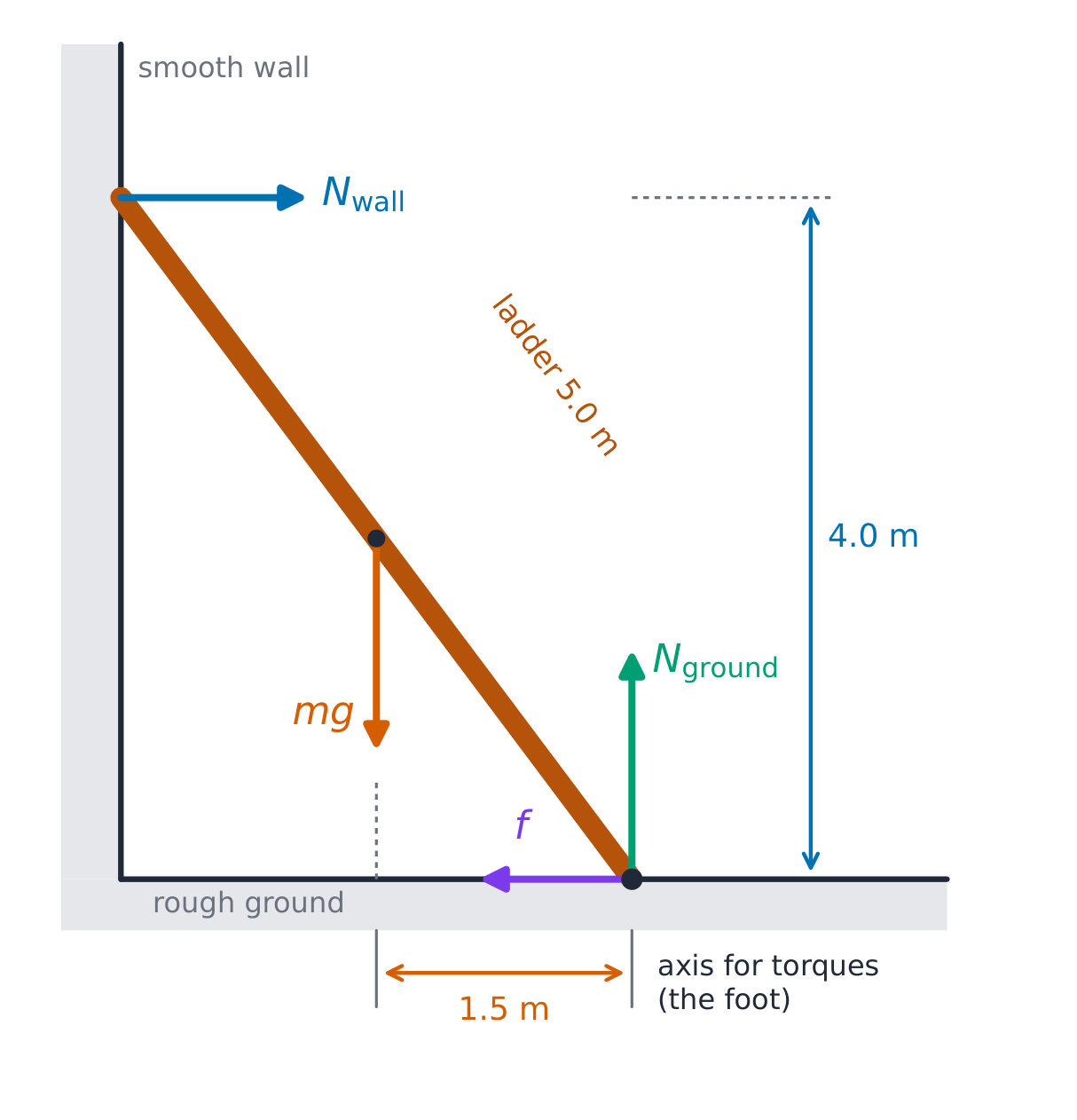
Worked example (the ladder). A uniform 5.0 m ladder of mass 20 kg leans against a smooth (frictionless) wall. Its top is 4.0 m up the wall and its foot is 3.0 m out. What friction must the ground supply? The wall can only push horizontally, so the foot needs friction toward the wall. Take torques about the foot, where two unknowns act:
$$N_{\rm wall}(4.0\text{ m})-mg(1.5\text{ m})=0,\qquad N_{\rm wall}=\frac{(196\text{ N})(1.5\text{ m})}{4.0\text{ m}}=73.5\text{ N}.$$
Horizontal force balance gives $f=N_{\rm wall}=73.5$ N. Vertical balance gives $N_{\rm ground}=mg=196$ N. The ladder stays put only if $\mu_s\ge f/N_{\rm ground}=0.375$. A person climbing higher adds torque with a longer lever arm, so the friction needed grows as they climb. That is why ladders slip with someone near the top.
Explore
Find the balance point
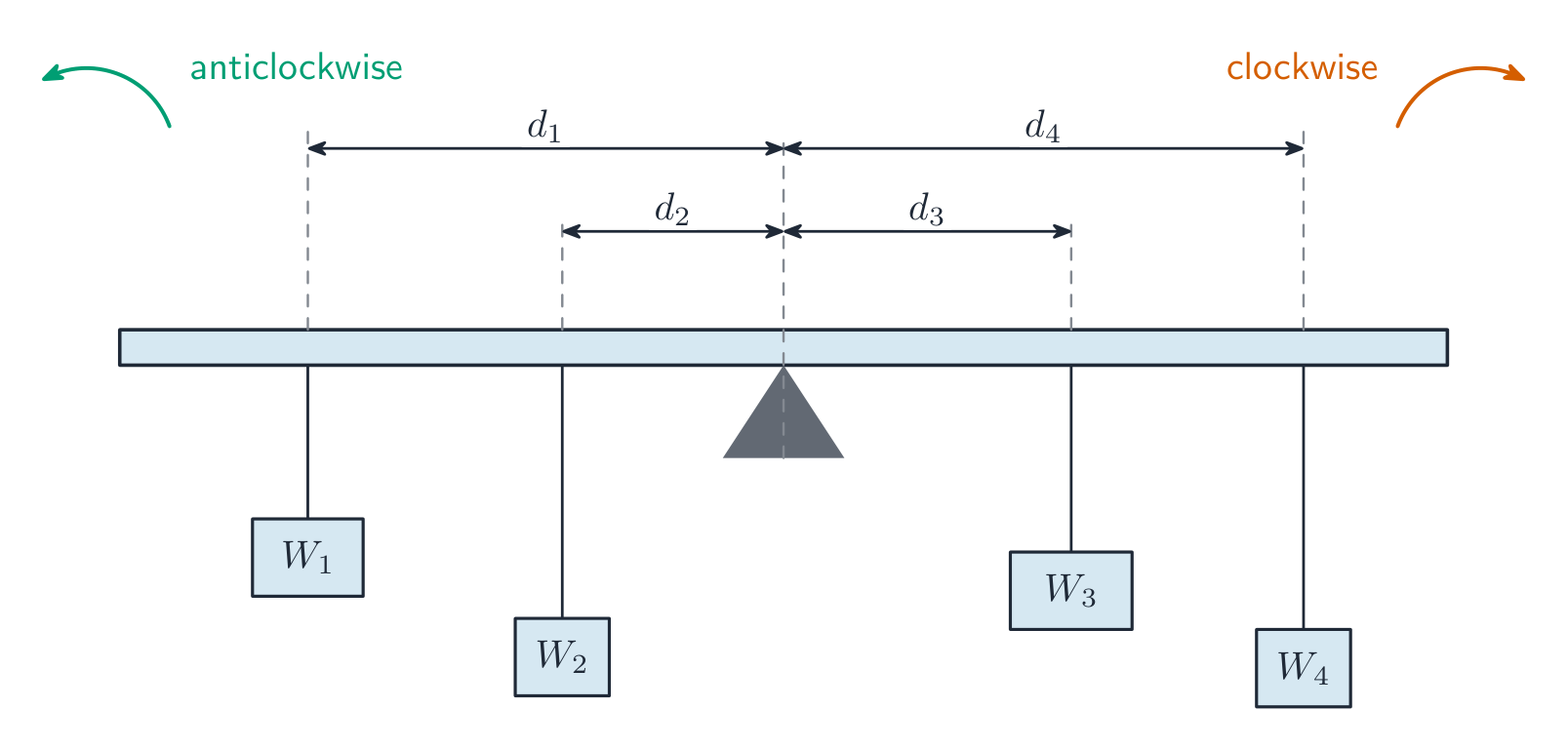
For rotational equilibrium the total clockwise torque equals the total anticlockwise torque. Move the forces and distances until the beam balances.
Vocabulary
Train
| English |
|---|
| net torque/net tɔːk/ |
| rotational equilibrium/rəʊˈteɪʃənl ˌiːkwɪˈlɪbrɪəm/ |
| static equilibrium/ˈstætɪk ˌiːkwɪˈlɪbrɪəm/ |
5.6
Newton's Second Law in Rotational Form
Syllabus
| Learning Objective | Essential Knowledge |
|---|---|
5.6.A |
|
Source: College Board AP Course and Exam Description
For a rigid body with constant $I$ about a fixed axis, the component along that axis obeys
$$\sum\tau=I\alpha.$$
The torque changes angular velocity, not necessarily in the direction of existing rotation. At fixed net torque, doubling $I$ halves $\alpha$. For $\sum\tau=6.0$ N m and $I=2.0$ kg m², $\alpha=3.0$ rad/s². If $I$ changes, the simple constant-$I$ model is insufficient; angular-momentum accounting is developed in Unit 6.
Worked example (a falling rod). A uniform rod of mass $M$ and length $L$ is pivoted at one end and released from rest while horizontal. Gravity acts at the centre, $L/2$ from the pivot, and $I=ML^2/3$ about the end. So
$$\alpha=\frac{\tau}{I}=\frac{Mg(L/2)}{ML^2/3}=\frac{3g}{2L}.$$
The free end has $a_t=L\alpha=\tfrac32g\approx14.7$ m/s², more than free fall. A coin resting on that end is left behind as the rod drops away from it. Points closer than $2L/3$ from the pivot accelerate at less than $g$. This is also part of why a falling chimney cracks: its top would need to fall faster than free fall, so the bricks there must be pulled down by the rest of the chimney.
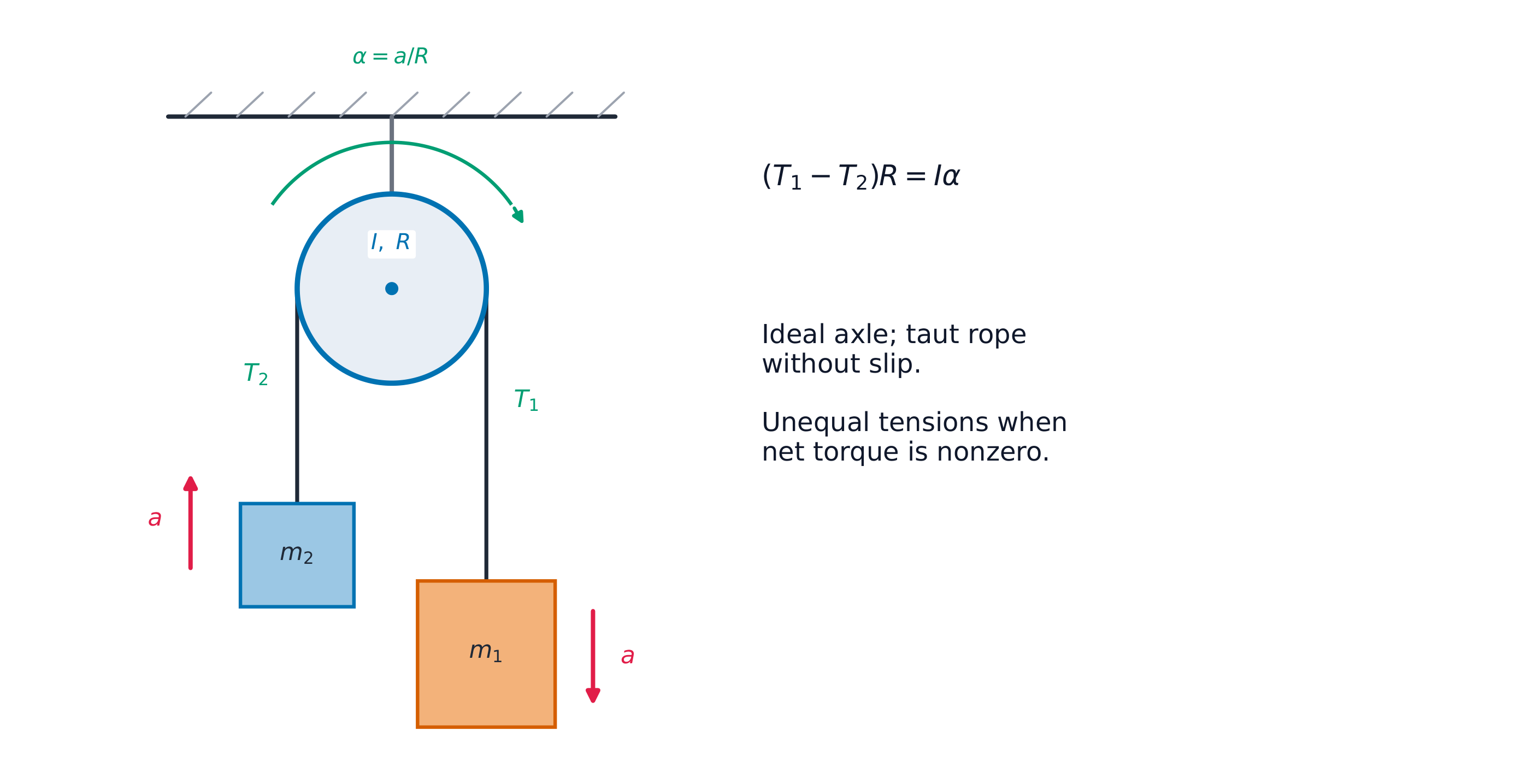
Original massive-pulley task. Masses $m_1=4.0$ kg and $m_2=2.0$ kg hang from a light inextensible rope over a pulley 滑轮 with $I=0.50$ kg m² and $R=0.20$ m. The axle has negligible friction, the rope remains taut and does not slip, and $m_1$ accelerates downward. Use down positive for $m_1$, up positive for $m_2$ and clockwise positive for the pulley. Draw each body's forces separately. The pulley has downward rope forces at opposite rims, its weight at the centre and an axle reaction; the last two give zero torque about its centre.
$$m_1g-T_1=m_1a,\qquad T_2-m_2g=m_2a.$$
$$\sum\tau=(T_1-T_2)R=I\alpha,\qquad a=R\alpha.$$
$$a=\frac{(m_1-m_2)g}{m_1+m_2+I/R^2}.$$
Here $I/R^2=12.5$ kg, so $a=19.6/18.5=1.059\ldots$ m/s², $T_1=m_1(g-a)=34.96\ldots$ N and $T_2=m_2(g+a)=21.72\ldots$ N. Keep unrounded $a$ until the tensions are found. The acceleration is less than the ideal massless-pulley value $3.27$ m/s². For this model, $T_1-T_2=Ia/R^2>0$. A massive pulley at zero angular acceleration can have equal tensions; finite inertia alone does not prove unequal tension. Axle friction would add a torque term.
Worked example (just after release). A uniform rod of mass $M$ and length $L$ is pivoted at one end and held horizontal, then released. Find its angular acceleration immediately after release.
- Torque from gravity acts at the centre of mass: $\tau=Mg\dfrac{L}{2}$.
- Rotational inertia about the end: $I=\tfrac13ML^2$.
- $\alpha=\dfrac{\tau}{I}=\dfrac{MgL/2}{ML^2/3}=\dfrac{3g}{2L}$.
The free end then has linear acceleration $a=\alpha L=\tfrac32g$, more than $g$. As the rod swings down, the lever arm of gravity shrinks, so $\alpha$ falls to zero when the rod is vertical. "Immediately after" means the speed is still zero, so only the torque matters.
Measuring rotational inertia. A string is wrapped round a spindle of radius $r$ on a platform and passes over a pulley to a hanging mass $m$. The mass falls from rest with measured acceleration $a$.
- For the mass: $mg-T=ma$, so $T=m(g-a)$.
- For the platform: $Tr=I\alpha=I\dfrac{a}{r}$.
- So $I=\dfrac{Tr^2}{a}=mr^2\left(\dfrac{g}{a}-1\right)$.
To find the inertia of an object added to the platform, measure $I$ with and without it and subtract. The acceleration $a$ comes from timing the fall through a known height: $a=\dfrac{2h}{t^2}$.
Explore
Newton's second law for rotation
Torque produces angular acceleration in proportion to the rotational inertia: torque = I times alpha.
Vocabulary
Train
| English |
|---|
| pulley/ˈpʊli/ |
5.6
Exam tips
Choose the axis, object/system and signs before writing equations. Use initial conditions with integrals, and constant-acceleration formulas only when justified. For inertia, state $dm$, the perpendicular distance and integration limits; use the centre-of-mass axis correctly in the parallel-axis theorem. For combined translation and rotation, write separate laws and the no-slip constraint before eliminating unknowns. Read the actual exam demand; a universal free-body-diagram or full-mark checklist is not a substitute for its prompt.
Common mistakes
- Using the full lever arm when the force is at an angle. $\tau = rF\sin\phi$, or $F$ times the perpendicular distance $r_\perp$.
- Using $I = \tfrac1{12}ML^2$ for a rod pivoted at its end. Rotational inertia depends on the axis: about the end it is $\tfrac13ML^2$ (parallel-axis theorem: $I = I_{cm} + Md^2$).
- Writing equal tensions on both sides of a pulley with mass. A net torque needs $T_1 \ne T_2$ when $\alpha \ne 0$.
- Using $a = \alpha R$ when the rope slips or the wheel skids. The link needs rolling or rope motion without slipping.
- Mixing degrees and radians. $\omega$ and $\alpha$ must be in rad/s and rad/s² before $v = \omega r$ or $a_t = \alpha r$.
Interactive lessons on this topic
Work through it step by step, with instant-check exercises.