Skip to content · ⁨ข้ามไปยังเนื้อหา⁩

Fluids · ⁨ของไหล⁩

AP Physics 1 · Topic 8 · ⁨หัวข้อ 8⁩

Video lesson for this topic · ⁨บทเรียนวิดีโอสำหรับหัวข้อนี้⁩ Open the video page · ⁨เปิดหน้าวิดีโอ⁩
8:06

ของไหล

ตะปูเหล็กที่-drop ลงในน้ำจะจมลงสู่ก้นโดยตรง ตอนนี้ดูเรือลำนี้ มันสร้างจากเหล็กชนิดเดียวกันนับหมื่นตัน และมัน…

English narration · English + 中文 subtitles burned in · ⁨การบรรยายภาษาอังกฤษ · คำบรรยายภาษาอังกฤษ + 中文 ลอยตัวบนภาพ⁩

8.1

Internal Structure and Density · ⁨โครงสร้างภายในและความหนาแน่น⁩

Syllabus · ⁨หลักสูตร⁩
English

Learning Objective 8.1.A: Describe the properties of a fluid.

  • 8.1.A.1 Distinguishing properties of solids, liquids, and gases stem from the varying interactions between atoms and molecules.
  • 8.1.A.2 A fluid is a substance that has no fixed shape.
  • 8.1.A.3 Fluids can be characterized by their density. Density is defined as a ratio of mass to volume.
    • Equation: $\rho = \dfrac{m}{V}$
  • 8.1.A.4 An ideal fluid is incompressible and has no viscosity.
ไทย

จุดประสงค์การเรียนรู้ 8.1.A: อธิบายคุณสมบัติของของไหล

  • 8.1.A.1 คุณสมบัติที่แตกต่างของของแข็ง ของเหลว และแก๊สเกิดจากการมีปฏิสัมพันธ์ระหว่างอะตอมและโมเลกุลที่แตกต่างกัน
  • 8.1.A.2 ของไหลคือสารที่ไม่มีรูปร่างตายตัว
  • 8.1.A.3 ของไหลสามารถจำแนกตามความหนาแน่นได้ ความหนาแน่นนิยามว่าเป็นอัตราส่วนระหว่างมวลต่อปริมาตร
    • สมการ: $\rho = \dfrac{m}{V}$
  • 8.1.A.4 ของไหลในอุดมคติเป็นของที่ไม่สามารถบีบอัดได้และไม่มีความหนืด

Source: College Board AP Course and Exam Description · ⁨แหล่งที่มา: คำอธิบายหลักสูตรและข้อสอบ College Board AP⁩

English

The differences between solids, liquids, and gases come from how strongly their particles interact. A fluid 流体 (liquid or gas) has no fixed shape – it flows because its particles move past one another. Density 密度 is mass per unit volume:

$$\rho=\frac{m}{V}.$$
It depends on the substance and its state. An object sinks or floats depending on how its density compares with the surrounding fluid's – less dense floats, more dense sinks. An ideal fluid 理想流体 is incompressible 不可压缩 (constant density, whatever the pressure) and has no viscosity 黏度 (internal friction) – the model AP uses throughout.

ไทย

ความแตกต่างระหว่างของแข็ง ของเหลว และ ก๊าซ มาจากการที่อนุภาคมีปฏิสัมพันธ์กันอย่างไร ของไหล (ของเหลวหรือก๊าซ) ไม่มีรูปร่างตายตัว – ไหลได้เพราะอนุภาคเคลื่อนที่ผ่านกัน ความหนาแน่น คือมวลต่อหน่วยปริมาตร:

$$\rho=\frac{m}{V}.$$
ขึ้นอยู่กับสารและสถานะ物体 sinking or floating取决于其密度与周围流体的比较 – ความหนาแน่นน้อยกว่าลอย, ความหนาแน่นมากกว่าจม. ของไหลในอุดมคติ เป็น ของอัดไม่ได้ (ความหนาแน่นคงที่ ไม่ว่าแรงดันจะเป็นอย่างไร) และไม่มี ความหนืด (แรงเสียดทานภายใน) – โมเดลที่ AP ใช้ตลอดทั้งบท

Explore · ⁨สำรวจ⁩

Float or sink by density · ⁨ลอยหรือจมตามความหนาแน่น⁩

An object floats if it is less dense than the fluid. Change the density and watch it ride higher or sink, displacing its own weight of fluid. · ⁨วัตถุจะลอยหากมีความ หนาแน่นน้อยกว่า ของเหลว เปลี่ยนความหนาแน่นเพื่อดูว่ามันลอยสูงขึ้นหรือจมลง โดยFeatureน้ำหนักของของเหลวเท่ากัน⁩

8.2

Pressure · ⁨ความดัน⁩

Syllabus · ⁨หลักสูตร⁩
English

Learning Objective 8.2.A: Describe the pressure exerted on a surface by a given force.

  • 8.2.A.1 Pressure is defined as the magnitude of the perpendicular force component exerted per unit area over a given surface area, as described by the equation
    • Equation: $P = \dfrac{F_\perp}{A}$
  • 8.2.A.2 Pressure is a scalar quantity.
  • 8.2.A.3 The volume and density of a given amount of an incompressible fluid is constant regardless of the pressure exerted on that fluid.

Learning Objective 8.2.B: Describe the pressure exerted by a fluid.

  • 8.2.B.1 The pressure exerted by a fluid is the result of the entirety of the interactions between the fluid's constituent particles and the surface with which those particles interact.
  • 8.2.B.2 The absolute pressure of a fluid at a given point is equal to the sum of a reference pressure $P_0$, such as the atmospheric pressure $P_{\text{atm}}$, and the gauge pressure $P_{\text{gauge}}$.
    • Equation: $P = P_0 + \rho g h$
  • 8.2.B.3 The gauge pressure of a vertical column of fluid is described by the equation
    • Equation: $P_{\text{gauge}} = \rho g h$
ไทย

จุดประสงค์การเรียนรู้ 8.2.A: อธิบายความดันที่กระทำต่อพื้นผิวโดยแรงที่กำหนดให้

  • 8.2.A.1 ความดันนิยามMagnitudeขององค์ประกอบแรงที่ตั้งฉากต่อหน่วยพื้นที่บนพื้นผิวที่กำหนด ตามสมการที่อธิบายไว้
    • สมการ: $P = \dfrac{F_\perp}{A}$
  • 8.2.A.2 ความดันเป็นปริมาณสเกลาร์
  • 8.2.A.3 ปริมาตรและความหนาแน่นของปริมาณของไหลที่ไม่สามารถบีบอัดได้หนึ่งๆจะมีค่าคงที่ไม่ว่าจะมีแรงกดทับลงบนของไหลนั้นก็ตาม

จุดประสงค์การเรียนรู้ 8.2.B: อธิบายความดันที่ของไหลกระทำ

  • 8.2.B.1 ความดันที่ของไหลกระทำเป็นผลจากปฏิสัมพันธ์ทั้งหมดระหว่างอนุภาคส่วนประกอบของของไหลกับพื้นผิวที่อนุภาคเหล่านั้นมีปฏิสัมพันธ์ด้วย
  • 8.2.B.2 ความดันสัมบูรณ์ของของไหลที่จุดใดจุดหนึ่งเท่ากับผลรวมของความดันอ้างอิง $P_0$ เช่น ความดันบรรยากาศ $P_{\text{atm}}$ และความดันเกจ $P_{\text{gauge}}$
    • สมการ: $P = P_0 + \rho g h$
  • 8.2.B.3 ความดันเกจของแนวตั้งของของไหลหนึ่งๆอธิบายได้ด้วยสมการ
    • สมการ: $P_{\text{gauge}} = \rho g h$

Source: College Board AP Course and Exam Description · ⁨แหล่งที่มา: คำอธิบายหลักสูตรและข้อสอบ College Board AP⁩

English

Pressure 压强 is the perpendicular force per unit area, a scalar 标量 measured in pascals (Pa):

$$P=\frac{F_\perp}{A}.$$
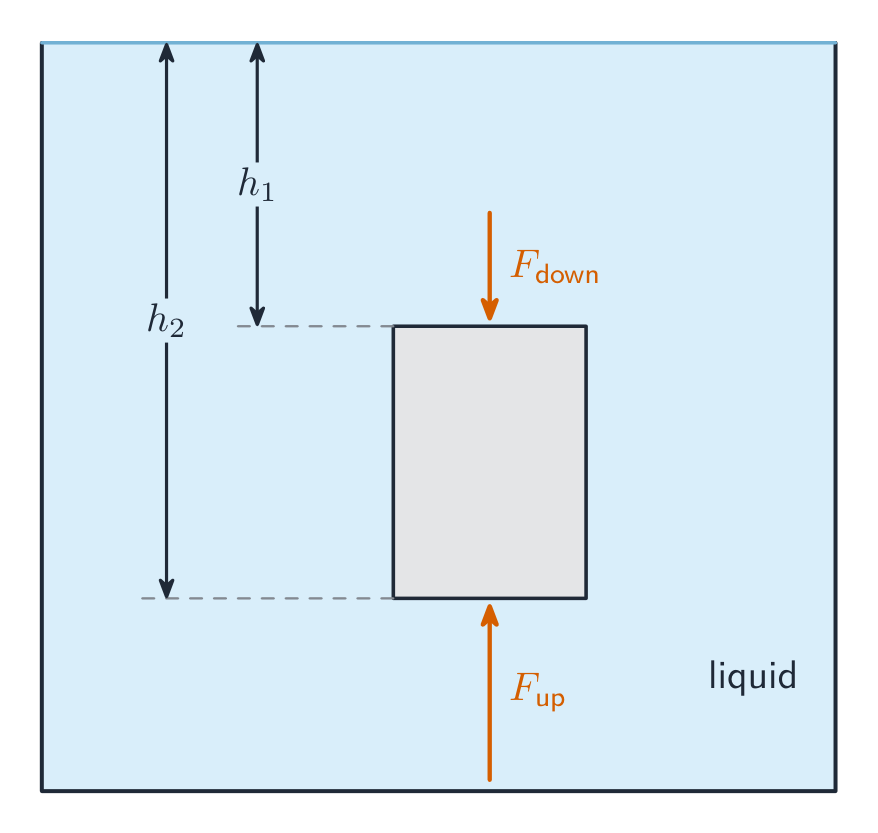
In a fluid at rest, pressure increases with depth 深度 because of the weight of fluid above:
$$P=P_0+\rho g h,$$
where $P_0$ is the pressure at the surface and $h$ is the depth. Pressure acts equally in all directions at a point and pushes perpendicular to any surface.

Distinguish the two pressures AP asks about: the gauge pressure 表压 is the extra pressure the fluid column adds, $P_{\text{gauge}}=\rho g h$, while the absolute pressure 绝对压强 is the total, $P=P_0+P_{\text{gauge}}$ (with $P_0$ usually atmospheric). A tyre gauge reading "$200\ \text{kPa}$" is gauge pressure; the air inside is really at about $300\ \text{kPa}$ absolute.

Worked example. Find the total pressure on a diver $10\ \text{m}$ below the surface of water ($\rho=1000\ \text{kg/m}^3$, surface pressure $P_0=1.0\times10^{5}\ \text{Pa}$):

$$P=P_0+\rho g h=1.0\times10^{5}+1000\times9.8\times10=1.98\times10^{5}\ \text{Pa}.$$
Every $10\ \text{m}$ of water adds roughly one extra atmosphere of pressure. Notice the pressure does not depend on the shape or width of the container, only on the depth.

ไทย

ความดัน คือแรงตั้งฉากต่อหน่วยพื้นที่, สเกลาร์ วัดเป็นปาสคาล (Pa):

$$P=\frac{F_\perp}{A}.$$
ในของไหลที่หยุดนิ่ง ความดันเพิ่มขึ้นตาม ความลึก เนื่องจากน้ำหนักของของไหลด้านบน:
$$P=P_0+\rho g h,$$
โดยที่ $P_0$ คือความดันที่พื้นผิว และ $h$ คือความลึก. ความดันกระทำ เท่ากันในทุกทิศทาง ที่จุดใดจุดหนึ่ง และดัน ตั้งฉาก กับพื้นผิวใดๆ

 JACK HYDRAULIC สองตัวยืนคู่กัน แต่ละตัวมีคันโยกปั๊มแคบและลูกสูบยกกว้าง
JACK HYDRAULIC: ความดันที่ applied กับลูกสูบเล็กจะถูกส่งต่อไปโดยไม่ลดทอน ผ่านของไหลไปยังลูกสูบใหญ่ ดังนั้นแรงเล็กสามารถยกรถได้

แยกแยะความดันสองประเภทที่ AP ถามถึง: ความดันเกจ คือความดันเพิ่มเติมที่ column ของไหลเพิ่มเข้าไป, $P_{\text{gauge}}=\rho g h$, ใน حالیที่ ความดันสัมบูรณ์ คือค่ารวม, $P=P_0+P_{\text{gauge}}$ (โดยที่ $P_0$ มักจะเป็นความดันบรรยากาศ).读数 "$200\ \text{kPa}$" บนเกจยางลมคือความดันเกจ; อากาศภายในอยู่ที่ประมาณ $300\ \text{kPa}$ จริงๆ เป็นความดันสัมบูรณ์.

น้ำหนักของ column ของเหลวกำหนดความดันเพิ่มเติมที่ความลึก

ตัวอย่างที่คำนวณแล้ว. หาความดันรวม作用于潜水员 $10\ \text{m}$ ใต้ผิวน้ำ ($\rho=1000\ \text{kg/m}^3$, ความดันผิว $P_0=1.0\times10^{5}\ \text{Pa}$):

$$P=P_0+\rho g h=1.0\times10^{5}+1000\times9.8\times10=1.98\times10^{5}\ \text{Pa}.$$
ทุก $10\ \text{m}$ ของน้ำจะเพิ่มแรงดันประมาณหนึ่ง atmosfer เดิม การสังเกตว่าความดันนี้ไม่ขึ้นอยู่กับรูปร่างหรือความกว้างของภาชนะ แต่ขึ้นอยู่กับความลึกเท่านั้น

Barometer แบบ aneroid ที่มีหน้าปัดวงกลม
Barometer แบบ aneroid วัดความดันอากาศด้วยกล่องโลหะปิดผนึกที่ยืดหยุ่นได้เมื่อความดันภายนอกเปลี่ยนแปลง
Vocabulary · ⁨คำศัพท์⁩ Train · ⁨ฝึกฝน⁩
English ไทย
Pressure/ˈpreʃə/ ความดัน
scalar/ˈskeɪlə/ สเกลาร์
depth/depθ/ มิติลึก
gauge pressure/ɡeɪdʒ ˈpreʃə/ แรงดันIndices gauge pressure
absolute pressure/ˈæbsəluːt ˈpreʃə/ แรงดันสัมบูรณ์
buoyant force/ˈbɔɪənt fɔːs/ แรงลอยตัว
Archimedes' principle/ˌɑːkɪˈmiːdiːz ˈprɪnsɪpl/ หลักของอาร์คิมิดีส
Continuity/kɒntɪˈnjuːɪti/ ความต่อเนื่อง
Bernoulli's equation/ˈbɜːnaʊliz ɪˈkweɪʒn/ สมการ伯努利 Bernoulli's equation
8.3

Fluids and Newton's Laws · ⁨ไหล่และกฎของนิวตัน⁩

Syllabus · ⁨หลักสูตร⁩
English

Learning Objective 8.3.A: Describe the conditions under which a fluid's velocity changes.

  • 8.3.A.1 Newton's laws can be used to describe the motion of particles within a fluid.
  • 8.3.A.2 The macroscopic behavior of a fluid is a result of the internal interactions between the fluid's constituent particles and external forces exerted on the fluid.

Learning Objective 8.3.B: Describe the buoyant force exerted on an object interacting with a fluid.

  • 8.3.B.1 The buoyant force is a net upward force exerted on an object by a fluid.
  • 8.3.B.2 The buoyant force exerted on an object by a fluid is a result of the collective forces exerted on the object by the particles making up the fluid.
  • 8.3.B.3 The magnitude of the buoyant force exerted on an object by a fluid is equivalent to the weight of the fluid displaced by the object.
    • Equation: $F_b = \rho V g$
ไทย

จุดประสงค์การเรียนรู้ 8.3.A: อธิบายเงื่อนไขที่ความเร็วของของไหลเปลี่ยนแปลง

  • 8.3.A.1 กฎของนิวตันสามารถใช้เพื่ออธิบายการเคลื่อนที่ของอนุภาคภายในของไหล
  • 8.3.A.2 พฤติกรรมระดับมหภาคของของไหลเป็นผลจากปฏิสัมพันธ์ภายในระหว่างอนุภาคส่วนประกอบของของไหลและแรงภายนอกที่กระทำต่อของไหล

จุดประสงค์การเรียนรู้ 8.3.B: อธิบายแรงลอยตัวที่กระทำต่อวัตถุที่มีปฏิสัมพันธ์กับของไหล

  • 8.3.B.1 แรงลอยตัวคือแรงสุทธิในแนวตั้งขึ้นที่ของไหลกระทำต่อวัตถุ
  • 8.3.B.2 แรงลอยตัวที่ของไหลกระทำต่อวัตถุเป็นผลจากแรงรวมที่อนุภาคส่วนประกอบของของไหลกระทำต่อวัตถุนั้น
  • 8.3.B.3 ขนาดของแรงลอยตัวที่ของไหลกระทำต่อวัตถุมีค่าเท่ากับน้ำหนักของของไหลที่ถูกวัตถุแทนที่
    • สมการ: $F_b = \rho V g$

Source: College Board AP Course and Exam Description · ⁨แหล่งที่มา: คำอธิบายหลักสูตรและข้อสอบ College Board AP⁩

English
Buoyancy: float or sink

An object in a fluid feels an upward buoyant force 浮力 equal to the weight of the fluid it displaces – Archimedes' principle 阿基米德原理:

$$F_b=\rho_{\text{fluid}}\,g\,V_{\text{displaced}}.$$
Combine this with Newton's laws: the object floats when buoyancy balances weight, sinks when weight wins, and rises when buoyancy wins. A floating object displaces exactly its own weight of fluid.

Worked example. A block of density $600\ \text{kg/m}^3$ floats in water ($1000\ \text{kg/m}^3$). What fraction is under the surface? For floating, the buoyant force equals the weight, so $\rho_{\text{fluid}}\,g\,V_{\text{sub}}=\rho_{\text{object}}\,g\,V$:

$$\frac{V_{\text{sub}}}{V}=\frac{\rho_{\text{object}}}{\rho_{\text{fluid}}}=\frac{600}{1000}=0.60.$$
So $60\%$ sits below the water – the same reason most of an iceberg (density $\approx 900$) hides underwater.

ไทย
แรงลอยตัว: ลอยหรือจม

วัตถุใน流体 จะรู้สึกถึง แรงลอยตัว ขึ้นไปเท่ากับความหนักของ流体 ที่วัตถุแทนที่ – กฎของอาร์คิมิดีส:

$$F_b=\rho_{\text{fluid}}\,g\,V_{\text{displaced}}.$$
รวมกับกฎของนิวตัน: วัตถุลอยเมื่อแรงลอยตัวสมดุลกับความหนัก จมเมื่อความหนักชนะ และลอยตัวขึ้นเมื่อแรงลอยตัวชนะ วัตถุลอยจะแทนที่流体的Exactly equal to its own weight of fluid.

ตัวอย่างที่คำนวณแล้ว. บล็อกที่มีความหนาแน่น $600\ \text{kg/m}^3$ ลอยอยู่ในน้ำ ($1000\ \text{kg/m}^3$). ส่วนใดอยู่ใต้ผิวน้ำ? สำหรับการลอย, แรงลอยตัวเท่ากับน้ำหนัก, ดังนั้น $\rho_{\text{fluid}}\,g\,V_{\text{sub}}=\rho_{\text{object}}\,g\,V$:

$$\frac{V_{\text{sub}}}{V}=\frac{\rho_{\text{object}}}{\rho_{\text{fluid}}}=\frac{600}{1000}=0.60.$$
ดังนั้น $60\%$ อยู่ใต้ผิวน้ำ – เหตุผลเดียวกันที่ทำให้ iceberg ส่วนใหญ่ (ความหนาแน่น $\approx 900$) ซ่อนอยู่ใต้น้ำ

Vocabulary · ⁨คำศัพท์⁩ Train · ⁨ฝึกฝน⁩
English ไทย
fluid/ˈfluːɪd/ ของไหล
Density/ˈdensɪti/ ความหนาแน่น
ideal fluid/aɪˈdɪəl ˈfluːɪd/ ของไหลในอุดมคติ
incompressible/ˌɪnkəmˈpresəbl/ อัดตัวไม่ได้
viscosity/vɪˈskɒsɪti/ ความหนืด
8.4

Fluids and Conservation Laws · ⁨ของเหลวและกฎการอนุรักษ์⁩

Syllabus · ⁨หลักสูตร⁩
English

Learning Objective 8.4.A: Describe the flow of an incompressible fluid through a cross-sectional area by using mass conservation.

  • 8.4.A.1 A difference in pressure between two locations causes a fluid to flow.
    • 8.4.A.1.i The rate at which matter enters a fluid-filled tube open at both ends must equal the rate at which matter exits the tube.
    • 8.4.A.1.ii The rate at which matter flows into a location is proportional to the cross-sectional area of the flow and the speed at which the fluid flows.
      • Derived equation: $\dfrac{V}{t} = A v$
  • 8.4.A.2 The continuity equation for fluid flow describes conservation of mass flow rate in incompressible fluids.
    • Equation: $A_1 v_1 = A_2 v_2$
ไทย

จุดประสงค์การเรียนรู้ 8.4.A: อธิบายการไหลของของไหลที่ไม่สามารถบีบอัดได้ผ่านพื้นที่หน้าตัดโดยใช้กฎการอนุรักษ์มวล

  • 8.4.A.1 ความแตกต่างของความดันระหว่างสองตำแหน่งทำให้ของไหลไหลได้
    • 8.4.A.1.i อัตราที่สสารเข้าสู่ท่อที่บรรจุของไหลและเปิดทั้งสองปลายต้องเท่ากับอัตราที่สสารออกจากท่อนั้น
    • 8.4.A.1.ii อัตราที่สสารไหลเข้าหาตำแหน่งหนึ่งแปรผันตรงกับพื้นที่หน้าตัดของการไหลและความเร็วที่ของไหลไหล
      • สมการที่ได้จาก: $\dfrac{V}{t} = A v$
  • 8.4.A.2 สมการความต่อเนื่องสำหรับการไหลของของไหลอธิบายถึงการอนุรักษ์อัตราการไหลของมวลในของไหลที่ไม่สามารถบีบอัดได้
    • สมการ: $A_1 v_1 = A_2 v_2$

Source: College Board AP Course and Exam Description · ⁨แหล่งที่มา: คำอธิบายหลักสูตรและข้อสอบ College Board AP⁩

English

For an ideal fluid flowing steadily, two conservation ideas apply:

  • Continuity 连续性 (conservation of mass): the volume flow rate is constant, so $A_1 v_1 = A_2 v_2$. A narrower pipe forces faster flow.
  • Bernoulli's equation 伯努利方程 (conservation of energy per volume): along a streamline,
    $$P+\tfrac{1}{2}\rho v^2+\rho g y = \text{constant}.$$

Together they explain why fluid speeds up and its pressure drops where a pipe narrows or where flow is fastest.

Worked example. Water flows at $2.0\ \text{m/s}$ through a pipe of cross-section $0.010\ \text{m}^2$, then enters a narrower section of $0.0040\ \text{m}^2$. By continuity the speed there is

$$v_2=\frac{A_1 v_1}{A_2}=\frac{0.010\times2.0}{0.0040}=5.0\ \text{m/s}.$$
By Bernoulli's equation this faster stream is at lower pressure – the effect that lifts an aeroplane wing and pulls two passing ships together.

Exam skill. Choose the right law by what changes. If the pipe changes width, start with continuity ($A_1v_1=A_2v_2$) to get the speeds; if you then need a pressure, feed those speeds into Bernoulli. Watch the height term $\rho g y$ only when the pipe also changes level.

ไทย

สำหรับ流体อุดมคติที่ไหลอย่างสม่ำเสมอ มีหลักการอนุรักษ์สองประการที่ใช้ได้:

แรงยกเกิดขึ้นเพราะความดันที่ด้านล่างของวัตถุมากกว่าด้านบน
  • ความต่อเนื่อง (การอนุรักษ์มวล): อัตราการไหลของปริมาตรคงที่, ดังนั้น $A_1 v_1 = A_2 v_2$. ท่อแคบกว่าบังคับให้ เร็วขึ้น การไหล
  • สมการ伯努利 (การอนุรักษ์พลังงานต่อหน่วยปริมาตร): ตามเส้นกระแส,
    $$P+\tfrac{1}{2}\rho v^2+\rho g y = \text{constant}.$$

ทั้งสองอธิบายร่วมกันว่าทำไม流体จึงเร็วขึ้นและความดันลดลงเมื่อท่อแคบลงหรือเมื่อการไหลเร็วที่สุด

เมื่อท่อแคบลง流体จะเร็วขึ้น (ความต่อเนื่อง) และความดันลดลง (伯努利)

ตัวอย่างที่คำนวณแล้ว. น้ำไหลด้วยความเร็ว $2.0\ \text{m/s}$ ผ่านท่อที่มีพื้นที่หน้าตัด $0.010\ \text{m}^2$, จากนั้นเข้าสู่ส่วนที่แคบกว่า $0.0040\ \text{m}^2$. จากความต่อเนื่องความเร็วที่นั่นคือ

$$v_2=\frac{A_1 v_1}{A_2}=\frac{0.010\times2.0}{0.0040}=5.0\ \text{m/s}.$$
จากสมการ伯努利 กระแสที่เร็วนี้จะมีความดัน ต่ำกว่า – ผลลัพธ์ที่ยกปีกเครื่องบินและดึงเรือสองลำที่ผ่านกันเข้าหากัน

ทักษะการสอบ. เลือกกฎที่เหมาะสมตามสิ่งที่เปลี่ยน หากท่อเปลี่ยน ความกว้าง ให้เริ่มจากความต่อเนื่อง ($A_1v_1=A_2v_2$) เพื่อหาความเร็ว; หากคุณต้องการ ความดัน ในขั้นตอนถัดไป ให้ใส่ความเร็วเหล่านั้นลงใน伯努利. ระวังพจน์ความสูง $\rho g y$ เฉพาะเมื่อท่อก็เปลี่ยนระดับด้วย

8.4

Exam tips · ⁨ข้อแนะนำสำหรับการสอบ⁩

English
  • Pressure with depth is $P=P_0+\rho g h$ — it depends on depth only, not the container's shape or width.
  • Buoyant force = weight of fluid displaced ($\rho_{\text{fluid}}\,gV_{\text{disp}}$); a floating object displaces its own weight, so the fraction submerged is $\rho_{\text{object}}/\rho_{\text{fluid}}$.
  • Compare densities to predict floating vs sinking; a floating object is in equilibrium (buoyancy = weight), not weightless.
  • Use continuity $A_1v_1=A_2v_2$: a narrower pipe means faster flow.
  • Bernoulli: where a fluid flows faster its pressure is lower (wing lift, spray).
ไทย
  • ความดันกับความลึกเป็น $P=P_0+\rho g h$ — มันขึ้นอยู่กับ ความลึกเท่านั้น ไม่ใช่รูปร่างหรือความกว้างของภาชนะ
  • แรงลอยตัว = น้ำหนักของ流体ที่ถูกแทนที่ ($\rho_{\text{fluid}}\,gV_{\text{disp}}$); วัตถุลอยจะแทนที่น้ำหนักของตัวเอง, ดังนั้นเศษส่วนที่จมน้ำคือ $\rho_{\text{object}}/\rho_{\text{fluid}}$
  • เปรียบเทียบความหนาแน่นเพื่อทำนายการลอยหรือจม; วัตถุลอยอยู่ในสภาวะสมดุล (แรงลอยตัว = น้ำหนัก), ไม่ใช่มวลศูนย์
  • ใช้ ความต่อเนื่อง $A_1v_1=A_2v_2$: ท่อแคบกว่าหมายถึงการไหลที่เร็วขึ้น
  • 伯努利: เมื่อ流体ไหลเร็วขึ้นความดันจะ ниже (ยกปีก, สเปรย์)

Interactive lessons on this topic · ⁨บทเรียนเชิงโต้ตอบสำหรับหัวข้อนี้⁩

Work through it step by step, with instant-check exercises. · ⁨ทำทีละขั้นตอน พร้อมแบบฝึกหัดตรวจสอบผลทันที⁩

Past Papers · ⁨ข้อสอบย้อนหลัง⁩

More topics in AP Physics 1 · ⁨หัวข้อเพิ่มเติมใน AP Physics 1⁩

Log in or create account · ⁨เข้าสู่ระบบหรือสร้างบัญชี⁩

IGCSE, A-Level & AP