| Learning Objective | Essential Knowledge |
|---|---|
5.1.A |
Boundary statement: Descriptions of the directions of rotation for a point or object are limited to clockwise and counterclockwise with respect to a given axis of rotation. |
Torque and Rotational Dynamics
AP Physics 1 · Topic 5
 7:41
Torque and Rotational Dynamics
Push a heavy door right next to its hinge, as hard as you can. It barely moves. Now push with the same force, out at the handle — and it swings wide open. Same…
English narration · English + 中文 subtitles burned in
5.1
Rotational Kinematics
Syllabus
Source: College Board AP Course and Exam Description
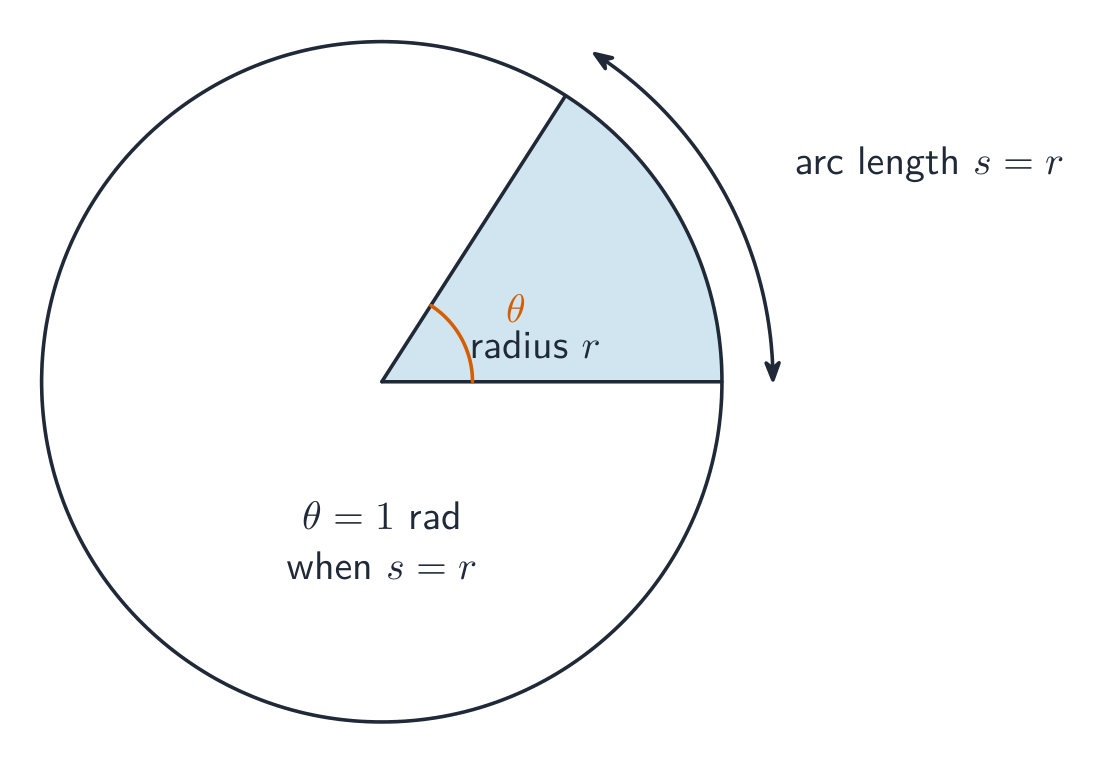
Why is a door handle on the side away from the hinges, and why does a tightrope walker carry a long pole? Both are about turning: how hard a force turns something, and how hard that something resists being turned. This unit gives each idea a number.
Until now we treated each object as a single point. A spinning wheel cannot be treated that way: its top moves forward while its bottom moves backward. We call it a rigid system 刚体系统, an object that keeps its shape while different points on it move in different directions. If the turning does not matter to the question (the Earth's daily spin when you study its orbit), you may still treat the system as a single object.
Rotation is described by angular quantities that mirror the linear ones:
- angular displacement 角位移 $\theta$ (in radians 弧度),
- angular velocity 角速度 $\omega=\dfrac{\Delta\theta}{\Delta t}$,
- angular acceleration 角加速度 $\alpha=\dfrac{\Delta\omega}{\Delta t}$.
For constant $\alpha$, the rotational kinematic equations 转动运动学方程 have the same form as the linear ones, with $\theta,\omega,\alpha$ replacing $x,v,a$: $\omega=\omega_0+\alpha t$, $\theta=\omega_0 t+\tfrac12\alpha t^2$, and $\omega^2=\omega_0^2+2\alpha\theta$.
Worked example. A wheel starts from rest and speeds up uniformly to $30\ \text{rad/s}$ in $6.0\ \text{s}$. Find its angular acceleration and the total angle turned:
$$\alpha=\frac{\Delta\omega}{\Delta t}=\frac{30}{6.0}=5.0\ \text{rad/s}^2,\qquad \theta=\tfrac12\alpha t^2=\tfrac12\times5.0\times6.0^2=90\ \text{rad}.$$
Signs. Choose one turning direction as positive, usually counterclockwise, and the other is negative. When $\omega$ and $\alpha$ have the same sign the rotation speeds up; when they have opposite signs it slows down.
Angular graphs work like linear ones. On a graph of $\omega$ against $t$, the slope is $\alpha$ and the area under the line is the angular displacement $\Delta\theta$. On a graph of $\theta$ against $t$, the slope is $\omega$.

Worked example (a disk slowed by friction). A disk spins at $\omega_0$ on an axle. Friction at the axle exerts a constant torque $\tau_0$ that stops it at time $t_1$.
- The torque is constant, so $\alpha$ is constant and negative: the $\omega$–$t$ graph is a straight line down to zero, and the $\alpha$–$t$ graph is a flat line below the axis.
- $\tau_0=I|\alpha|=I\dfrac{\omega_0}{t_1}$, so $I=\dfrac{\tau_0t_1}{\omega_0}$.
- If oil reaches the axle from $\tfrac12t_1$ on, and keeps reducing the friction, $|\alpha|$ falls toward zero. The $\omega$ line becomes flatter, and the disk is still turning at $t_1$.
A model for the oiled torque must decrease with time. $\tau=\dfrac{C_2}{t+\frac12t_1}$ does; $\tau=C_1\left(t-\tfrac12t_1\right)$ grows with time, so it cannot describe friction that is getting weaker.
Explore
Sweep an angle in radians
Change the angle and radius to feel how radians measure the turn and the arc length.
Vocabulary
Train
| English |
|---|
| rigid system |
| angular displacement/ˈæŋɡjʊlə dɪˈspleɪsmənt/ |
| radians/ˈreɪdɪənz/ |
| angular velocity/ˈæŋɡjʊlə vəˈlɒsɪti/ |
| angular acceleration/ˈæŋɡjʊlə əkˌseləˈreɪʃn/ |
| rotational kinematic equations |
5.2
Connecting Linear and Rotational Motion

Syllabus
| Learning Objective | Essential Knowledge |
|---|---|
5.2.A |
Boundary statement: Descriptions of the directions of rotation for a point or object are limited to clockwise and counterclockwise with respect to a given axis of rotation. |
Source: College Board AP Course and Exam Description
A point at radius $r$ from the axis of rotation 转轴 has linear quantities tied to the angular ones:
$$s=r\theta,\qquad v=r\omega,\qquad a_t=r\alpha.$$
Points farther from the axis move faster. This link lets you switch between "how fast the wheel spins" and "how fast a point on its rim moves."
Worked example. A bicycle wheel of radius $0.35\ \text{m}$ spins at $12\ \text{rad/s}$. A point on the rim (and so the bike) moves at $v=r\omega=0.35\times12=4.2\ \text{m/s}$. A point halfway to the axis moves at half that speed.
Every point on a rigid system turns through the same angle in the same time, so all points share the same $\omega$ and $\alpha$. Only the linear quantities $v$ and $a_t$ depend on $r$.
Explore
Radius sets the speed
Change the radius and see how the arc length (and so the linear speed) scales with r.
Vocabulary
Train
| English |
|---|
| axis of rotation |
5.3
Torque

Syllabus
| Learning Objective | Essential Knowledge |
|---|---|
5.3.A |
|
5.3.B |
Boundary statement: While AP Physics 1 expects students to mathematically manipulate the magnitude of torque using vector conventions, the direction of torque is beyond the scope of the course. |
Source: College Board AP Course and Exam Description
Torque 力矩 is the rotational effect of a force – how effectively it turns an object about an axis:
$$\tau=r F\sin\theta = F\cdot r_\perp,$$
where $r_\perp$ is the moment arm 力臂 (the perpendicular distance from the axis to the force's line of action 作用线). A force applied farther out, or more perpendicular, produces more torque. Torque has a sign (clockwise 顺时针 vs counterclockwise 逆时针).
Worked example. You push with $20\ \text{N}$ at the end of a $0.30\ \text{m}$ wrench. Perpendicular to the wrench the torque is $\tau=rF=0.30\times20=6.0\ \text{N m}$. If you push at $60^{\circ}$ to the wrench instead, only the perpendicular part counts: $\tau=rF\sin 60^{\circ}=0.30\times20\times0.87=5.2\ \text{N m}$ – which is why you push at a right angle for the most turning effect.
Lever arm, drawn. The lever arm (moment arm) $r_\perp$ is the perpendicular distance from the axis to the line drawn through the force. A force whose line passes through the axis has zero lever arm and no torque, however large it is. This is why, for a wheel rolling down a ramp, only static friction 静摩擦 changes its spin about its center: gravity acts at the center, and the normal force points straight at it, so neither has a torque about the center.
Explore
Balance torques on a beam
Torque is force times perpendicular distance, $\tau=Fd$. The beam is in rotational equilibrium when the torques on each side are equal.
Vocabulary
Train
| English |
|---|
| Torque/tɔːk/ |
| moment arm/ˈməʊmənt ɑːm/ |
| line of action/laɪn ɒv ˈækʃn/ |
| clockwise/ˈklɒkwaɪz/ |
| counterclockwise |
| static friction/ˈstætɪk ˈfrɪkʃn/ |
5.4
Rotational Inertia
Syllabus
| Learning Objective | Essential Knowledge |
|---|---|
5.4.A |
|
5.4.B |
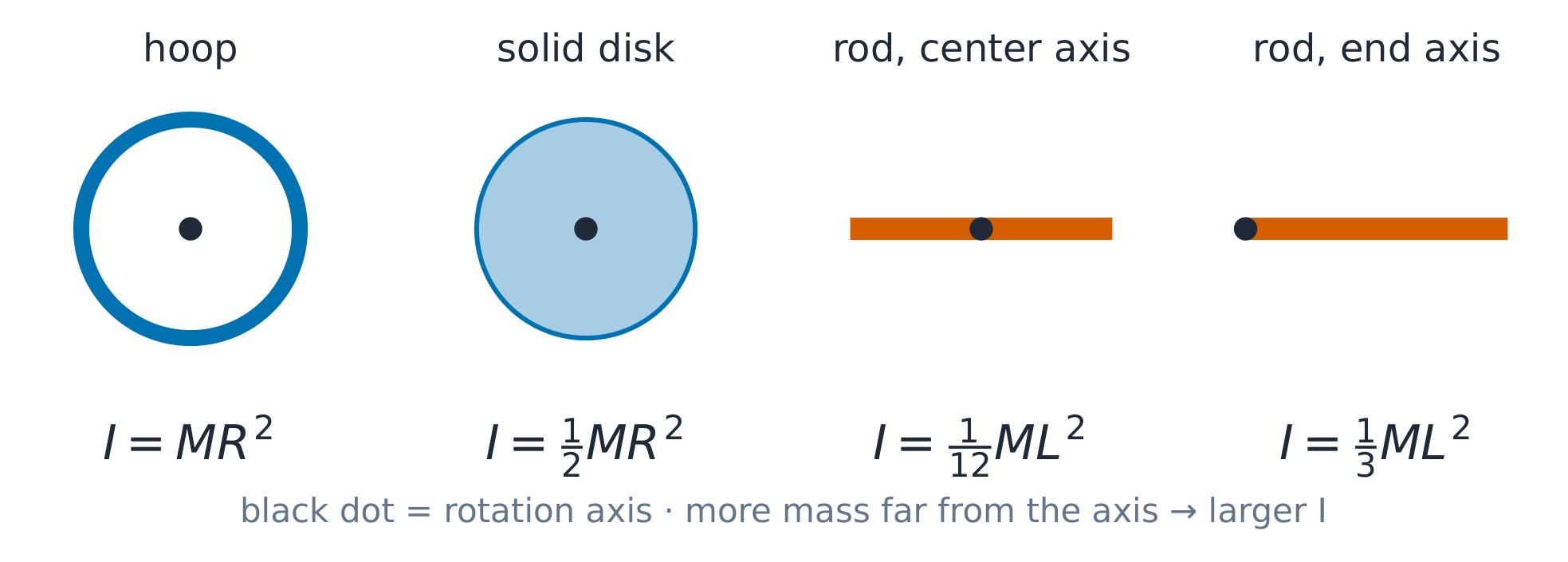
Boundary statement: AP Physics 1 only expects students to calculate the rotational inertia for systems of five or fewer objects arranged in a two-dimensional configuration. Boundary statement: Students do not need to know the rotational inertia of extended rigid systems, as these will be provided within the exam. Students should have a qualitative understanding of the factors that affect rotational inertia; for example, how rotational inertia is greater when mass is farther from the axis of rotation, which is why a hoop has more rotational inertia than a solid disk of the same mass and radius. |
Source: College Board AP Course and Exam Description
Rotational inertia 转动惯量 (moment of inertia 惯性矩) $I$ measures how hard it is to change an object's rotation – the rotational version of mass. It depends on both the mass and how far that mass sits from the axis: mass spread farther out gives a larger $I$. For a point mass 质点 $I=mr^2$; for extended bodies, standard formulas are provided (a hoop is $mR^2$, a solid disk $\tfrac12 mR^2$). This is why a figure skater spins faster when she pulls her arms in – she reduces $I$.
Equal masses, different distributions: the further the mass sits from the axis, the larger I
Worked example (hoop or disk?). A hoop 圆环 and a solid disk 实心圆盘 each have mass $2.0\ \text{kg}$ and radius $0.50\ \text{m}$. The same net torque of $1.0\ \text{N m}$ acts on each. The hoop has $I=MR^2=0.50\ \text{kg m}^2$, so $\alpha=1.0/0.50=2.0\ \text{rad/s}^2$. The disk has $I=\tfrac12MR^2=0.25\ \text{kg m}^2$, so $\alpha=4.0\ \text{rad/s}^2$. Same mass and same size, but the disk speeds up twice as fast, because its mass sits closer to the axis.
Adding up rotational inertia. For a collection of objects about the same axis, the rotational inertias simply add: $I_{\text{total}}=\sum m_ir_i^2$. Two $0.20\ \text{kg}$ balls on a light rod, each $0.30\ \text{m}$ from the axis, give $I=2(0.20)(0.30)^2=0.036\ \text{kg m}^2$. Slide them to $0.15\ \text{m}$ and $I$ falls to a quarter, because $r$ is squared.
The parallel-axis theorem. For a given object, $I$ is smallest about an axis through the center of mass. About any parallel axis a distance $d$ away,
$$I=I_{\text{cm}}+Md^2.$$
Check it on a rod of length $L$: about its center $I_{\text{cm}}=\tfrac1{12}ML^2$, and the end is $d=\tfrac12L$ away, so $I_{\text{end}}=\tfrac1{12}ML^2+\tfrac14ML^2=\tfrac13ML^2$, the value in the figure above.
Explore
More or less rotational inertia?
Rotational inertia depends on how far the mass sits from the axis. Sort each case.
Vocabulary
Train
| English |
|---|
| Rotational inertia/rəʊˈteɪʃənl ɪˈnɜːʃə/ |
| moment of inertia/ˈməʊmənt ɒv ɪˈnɜːʃə/ |
| point mass/pɔɪnt mæs/ |
| hoop/huːp/ |
| solid disk |
5.5
Rotational Equilibrium

Syllabus
| Learning Objective | Essential Knowledge |
|---|---|
5.5.A |
Boundary statement: AP Physics 1 does not expect students to simultaneously analyze rotation in multiple planes. |
Source: College Board AP Course and Exam Description
An object is in rotational equilibrium 转动平衡 when the net torque 合力矩 is zero, so its angular velocity stays constant. For a balanced (static) object, both the net force and the net torque are zero. Choosing the axis at an unknown force's location removes it from the torque equation – a useful trick for beam and ladder problems.
Worked example. A $30\ \text{kg}$ child sits $2.0\ \text{m}$ from the pivot 支点 of a seesaw. Where must a $40\ \text{kg}$ child sit on the other side to balance it? Set the clockwise torque equal to the anticlockwise torque (the $g$'s cancel):
$$30\times2.0=40\times d\;\Rightarrow\;d=\frac{60}{40}=1.5\ \text{m}.$$
The heavier child sits closer to the pivot – less distance, same torque.
Rotational and translational equilibrium are separate conditions. A wheel spinning at a steady rate on a fixed axle is in rotational equilibrium but not at rest. A box sliding at constant velocity while two equal forces push on opposite corners is in translational equilibrium, but it starts to spin. To describe a rotating object fully, you may need both analyses, done independently.
Worked example (a beam held by a string). A uniform beam of mass $M$ and length $L$ is hinged to a wall at its left end and held horizontal by a string from its right end to the wall above, at angle $\theta$ to the beam. Take torques about the hinge, so the unknown hinge force drops out:
$$F_T\sin\theta\,L=Mg\,\frac{L}{2}\;\Rightarrow\;F_T=\frac{Mg}{2\sin\theta}.$$
If the string is fixed lower on the wall, $\theta$ is smaller and the tension is larger. In words: a flatter string pulls mostly sideways, so it must pull harder to give the same upward torque. When the string is cut, gravity's torque about the hinge is largest at first and shrinks as the beam swings down (the lever arm shrinks), so the beam's angular speed rises with a slope that gets flatter. For the same reason, a rod falling from the top is speeding up fastest (largest $\alpha$) when it passes horizontal.
Explore
Find the balance point
For rotational equilibrium the total clockwise torque equals the total anticlockwise torque. Move the forces and distances until the beam balances.
Vocabulary
Train
| English |
|---|
| rotational equilibrium/rəʊˈteɪʃənl ˌiːkwɪˈlɪbrɪəm/ |
| net torque/net tɔːk/ |
| pivot/ˈpɪvət/ |
5.6
Newton's Second Law in Rotational Form
Syllabus
| Learning Objective | Essential Knowledge |
|---|---|
5.6.A |
|
Source: College Board AP Course and Exam Description
Net torque produces angular acceleration, in direct analogy with $F=ma$:
$$\sum\tau = I\alpha.$$
So a larger net torque, or a smaller rotational inertia, gives a larger angular acceleration. Solve rotation problems just like translation 平动 problems, with $\tau\leftrightarrow F$, $I\leftrightarrow m$, and $\alpha\leftrightarrow a$.
Worked example. A net torque of $12\ \text{N m}$ acts on a wheel with rotational inertia $I=3.0\ \text{kg m}^2$. Its angular acceleration is $\alpha=\tau/I=12/3.0=4.0\ \text{rad/s}^2$ – the exact rotational twin of $a=F/m$.
If the net torque is not zero, the angular velocity must change. The rotational form of Newton's first law says the reverse: $\omega$ is constant only when the net torque is zero.
Explore
Newton's second law for rotation
A torque produces angular acceleration in proportion to rotational inertia: torque = I times alpha.
Vocabulary
Train
| English |
|---|
| translation/trænˈsleɪʃn/ |
5.6
Rotation and translation together
Many AP problems join a falling object to a turning one. Write Newton's second law for each object, then link them with $a=r\alpha$.
Worked example (a block on a pulley). A $2.0\ \text{kg}$ block hangs from a light string wrapped around a pulley, a uniform disk of mass $4.0\ \text{kg}$ and radius $0.10\ \text{m}$. The block is released from rest. Find its acceleration and the tension 张力 in the string.
- Pulley: $I=\tfrac12(4.0)(0.10)^2=0.020\ \text{kg m}^2$.
- Block (down positive): $mg-T=ma$.
- Pulley: $TR=I\alpha=I\dfrac{a}{R}$, so $T=\dfrac{I}{R^2}a=\dfrac{0.020}{0.010}a=2.0a$.
- Add the two equations: $mg=(m+2.0)a$, so $19.6=4.0a$ and $a=4.9\ \text{m/s}^2$. Then $T=2.0(4.9)=9.8\ \text{N}$.
The block falls at half of $g$. The tension is less than the block's weight ($19.6\ \text{N}$), as it must be for the block to accelerate down. A heavier pulley would mean a slower fall.
Compare the tensions. A block on a frictionless table is pulled by a string over a pulley to a hanging block. With a massless pulley, the tension is $T_1$. Replace it with a massive one: the system now accelerates more slowly, and for the hanging block $T=m_B(g-a)$. A smaller $a$ means a larger tension in the vertical string, $T_2>T_1$. The horizontal string carries less tension than the vertical one, because their difference is what turns the pulley.
Worked example (two pulleys on one axle). A pulley of radius $2r_0$ and a pulley of radius $r_0$ are fixed together on a frictionless axle. Object 1 ($m_0$) hangs from the large one on one side; object 2 ($1.5m_0$) hangs from the small one on the other side. Released from rest, which way does it turn?
- Torque from object 1's side: $m_0g(2r_0)=2m_0gr_0$. From object 2's side: $1.5m_0g(r_0)=1.5m_0gr_0$.
- Net torque on the objects–pulleys system: $0.5m_0gr_0$, in the direction that lowers object 1. Object 1 goes down even though it is lighter: its lever arm is twice as long.
- If object 1's string is cut while it is moving, only object 2's torque is left, and it acts against the rotation. Now $\omega$ and $\alpha$ point in opposite directions: on an $\omega$–$t$ graph, the line that was rising turns to fall in a straight line, passes through zero, and the pulleys then turn the other way.
Vocabulary
Train
| English |
|---|
| tension/ˈtenʃn/ |
5.6
A beam on two supports
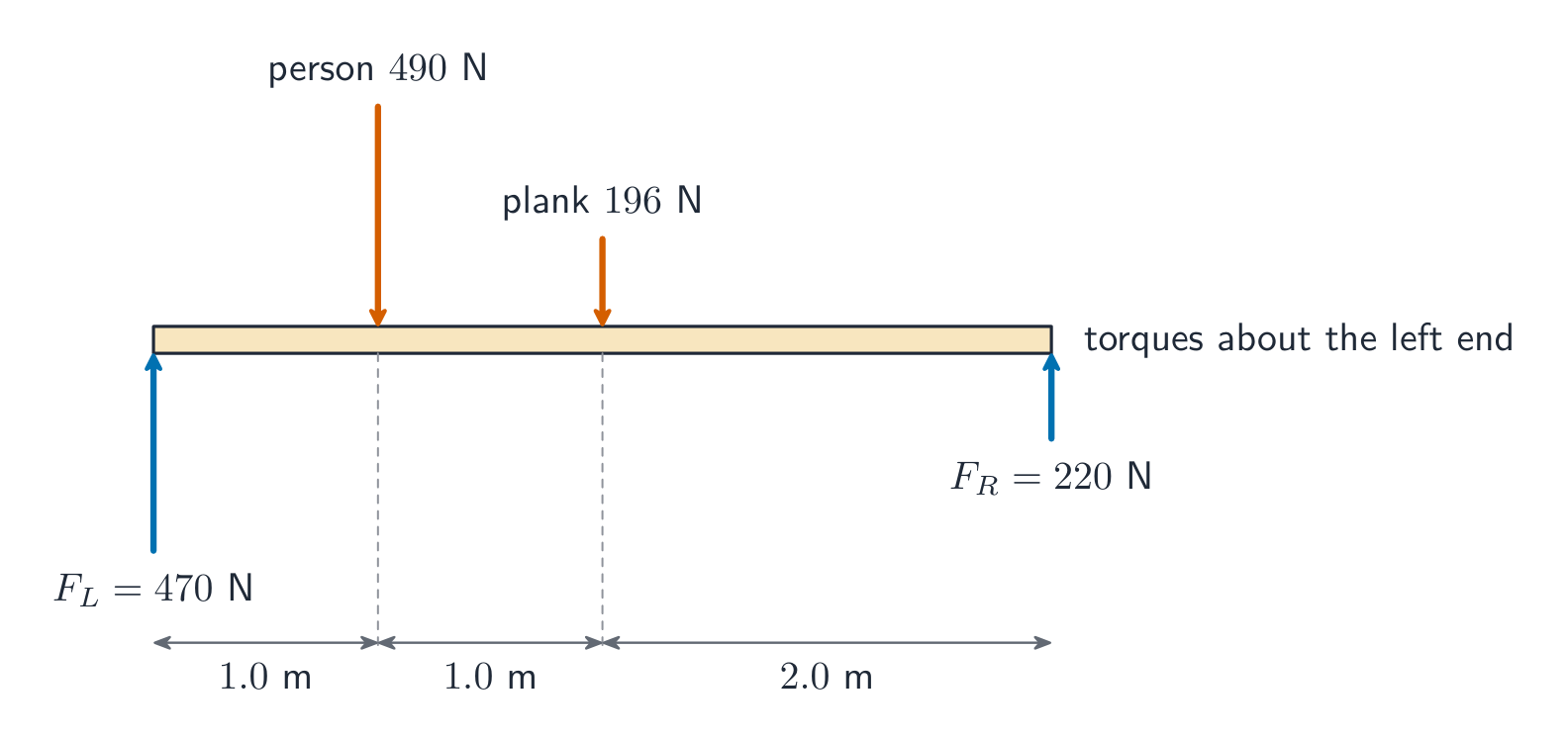
Static problems need both conditions: zero net force and zero net torque. Take torques about one support to remove its unknown force.
Worked example. A uniform 均匀的 plank $4.0\ \text{m}$ long with mass $20\ \text{kg}$ rests on supports at its two ends. A $50\ \text{kg}$ person stands $1.0\ \text{m}$ from the left end. Find the force from each support.
- Torques about the left support: $F_R(4.0)=(20)(9.8)(2.0)+(50)(9.8)(1.0)=392+490=882$, so $F_R=220\ \text{N}$.
- Forces: $F_L+F_R=(70)(9.8)=686\ \text{N}$, so $F_L=470\ \text{N}$.
The person stands nearer the left support, so that support carries more. The plank's weight acts at its center, $2.0\ \text{m}$ from either end.
Start such a problem with a force diagram 力图. It is like a free-body diagram, but each force is drawn at the point where it acts on the rigid object, and the arrow lengths show the relative sizes. Every lever arm can then be read straight off the drawing.
Is the equation plausible? Exam questions sometimes give an equation and ask whether it can be right, without deriving it. Check two things.
- Units. Both sides must have the same units.
- Behaviour. Ask what should happen when one quantity grows, or goes to zero. A student writes, for a rod of rotational inertia $I$ hit by a sliding disk, $\omega=\dfrac{Ixv_0}{m_{\text{disk}}d^4}$. Its units work out (both sides are $\text{s}^{-1}$), but it says a rod with more rotational inertia spins faster after the same hit. A heavier rod is harder to turn, so $I$ should be on the bottom. The equation is not plausible.
Measuring a mass from a linear graph (a lab). A metre stick of mass $M$ is hinged to a wall at one end and held horizontal by a spring scale fixed $0.60\ \text{m}$ from the hinge, pulling at angle $\theta$ to the stick. Torques about the hinge:
$$F_T\sin\theta\,(0.60)=Mg(0.50)\;\Rightarrow\;F_T=\frac{5Mg}{6}\cdot\frac{1}{\sin\theta}.$$
Plot $F_T$ on the vertical axis against $\dfrac1{\sin\theta}$: a straight line through the origin with slope $\dfrac{5Mg}6$. If the best-fit slope is $4.1\ \text{N}$, then $M=\dfrac{6(4.1)}{5(9.8)}=0.50\ \text{kg}$. Take several angles over a wide range, and repeat each reading to reduce uncertainty.
Vocabulary
Train
| English |
|---|
| uniform/ˈjuːnɪfɔːm/ |
| force diagram |
5.6
Practice
Answer each before reading the answers below. Take $g=9.8\ \text{m/s}^2$.
- A wheel speeds up uniformly from rest to $20\ \text{rad/s}$ in $4.0\ \text{s}$. Find its angular acceleration and how many revolutions 转数 it makes.
- A $15\ \text{N}$ force pushes a door $0.40\ \text{m}$ from the hinge. Find the torque when the force is perpendicular to the door, and when it is at $30°$ to the door.
- A $25\ \text{kg}$ child sits $1.6\ \text{m}$ from a seesaw pivot. Where must a $40\ \text{kg}$ child sit to balance?
- A disk with $I=0.50\ \text{kg m}^2$ starts from rest. A net torque of $2.0\ \text{N m}$ acts for $3.0\ \text{s}$. Find its final angular velocity.
- A student says: "Two wheels with the same mass and radius will speed up equally under the same torque." Correct the student.
Vocabulary
Train
| English |
|---|
| revolutions |
5.6
Answers
- $\alpha=20/4.0=5.0\ \text{rad/s}^2$. $\theta=\tfrac12(5.0)(4.0)^2=40\ \text{rad}=40/2\pi=6.4$ revolutions.
- Perpendicular: $(0.40)(15)=6.0\ \text{N m}$. At $30°$: $(0.40)(15)\sin30°=3.0\ \text{N m}$.
- $(25)(1.6)=(40)d$, so $d=1.0\ \text{m}$.
- $\alpha=2.0/0.50=4.0\ \text{rad/s}^2$, so $\omega=(4.0)(3.0)=12\ \text{rad/s}$.
- Rotational inertia depends on where the mass is, not only how much. A hoop has twice the $I$ of a solid disk with the same mass and radius, so under the same torque it speeds up only half as fast.
5.6
Exam tips
- Torque $\tau=Fr_\perp$ uses the perpendicular distance from the pivot; a force through the pivot gives zero torque.
- For balance, set clockwise torque = anticlockwise torque; choosing the pivot at an unknown force removes it from the equation.
- Use the rotational analogues 类比量: $\tau\leftrightarrow F$, $I\leftrightarrow m$, $\alpha\leftrightarrow a$, so $\sum\tau=I\alpha$ mirrors $\sum F=ma$.
- Rotational inertia depends on how far the mass sits from the axis, not just its amount — a hoop resists spinning more than a disc of equal mass.
- Convert angles to radians and link linear to angular with $v=r\omega$, $a_t=r\alpha$.
Common mistakes
- Using the distance along the force's line of action, or the length of the rod, when the force is at an angle. Torque uses the perpendicular distance $r_\perp$ (or $rF\sin\theta$).
- Leaving angles in degrees or revolutions in $v = r\omega$ and the rotational kinematic equations. Use radians; one revolution is $2\pi\ \text{rad}$.
- Setting the string tension equal to the hanging weight when a massive pulley turns. The block accelerates, so $T < mg$, and the tension on the two sides of a massive pulley can differ.
- Forgetting the weight of a uniform beam. It acts at the beam's center and must appear in the torque equation.
- Checking only $\sum\tau = 0$ for a static object. A static object also needs $\sum F = 0$; use it to find the second support force.
- Thinking a larger mass always means a larger rotational inertia. The distribution matters: $I$ grows with $r^2$.
- Saying gravity changes a rolling wheel's spin about its center. Gravity acts at the center, so it has no torque about it; static friction provides the torque.
- Thinking the tension is the same with a massive pulley. The vertical string's tension rises (the system accelerates less), and the two sides of the pulley carry different tensions.
- Assuming a heavier hanging object always wins on a stepped pulley. Compare torques, $mgr$, not weights.
- Using $I=\tfrac1{12}ML^2$ for a rod turning about its end. Use the parallel-axis theorem: $I=\tfrac13ML^2$.
Vocabulary
Train
| English |
|---|
| analogues |
Interactive lessons on this topic
Work through it step by step, with instant-check exercises.