| Learning Objective | Essential Knowledge |
|---|---|
4.1.A |
Boundary statement: Unless otherwise stated, the general term "momentum" will refer specifically to linear momentum. |
Linear Momentum
AP Physics 1 · Topic 4
 7:49
Linear Momentum
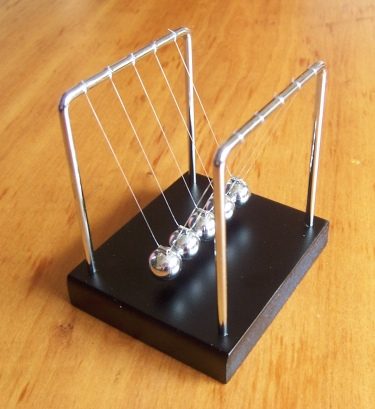
Five steel balls hang in a row, just touching. Lift one, let it go, and one ball flies off the far end. Only one. Lift two, and exactly two fly off. Something…
English narration · English + 中文 subtitles burned in
4.1
Linear Momentum
Syllabus
Source: College Board AP Course and Exam Description
Catch a raw egg with stiff hands and it breaks; draw your hands back as it lands and it survives. The egg stops either way, so its change in momentum is the same. What changes is how long the stopping takes. This unit is about that trade, and about the one quantity a collision can never create or destroy.
Linear momentum 动量 is mass times velocity – a vector pointing the same way as the velocity:
$$\vec{p}=m\vec{v}.$$
It measures "how hard it is to stop" a moving object. A heavy slow truck and a light fast ball can have the same momentum. Its unit is $\text{kg m/s}$, the same as $\text{N s}$.
Two models: collisions and explosions. A collision is a model for a short interaction in which the forces between the objects are much larger than any outside force during it. Because we look only at the moment just before and just after, each object can be treated as a single point (the object model), whatever its shape. An explosion is the reverse: forces inside the system push its parts apart, as when a spring between two carts is released or a firework bursts.
Explore
Compare two momenta
Change each mass and speed and read off the momentum p = mv of each object.
Vocabulary
Train
| English |
|---|
| Linear momentum/ˈlɪnɪə məʊˈmentəm/ |
4.2
Change in Momentum and Impulse

Syllabus
| Learning Objective | Essential Knowledge |
|---|---|
4.2.A |
|
4.2.B |
Boundary statement: AP Physics 1 does not require students to quantitatively analyze systems in which the mass of the system changes with respect to time. |
Source: College Board AP Course and Exam Description
A net force acting over time changes momentum. Using a constant force, or its average over the interval, the impulse 冲量 delivered is
$$\vec{J}=\vec{F}\,\Delta t=\Delta\vec{p}.$$
This is the impulse–momentum theorem 冲量–动量定理: impulse equals the change in momentum. On a force–time graph 力–时间图, impulse is the area 面积 under the curve. It explains why airbags 安全气囊 and follow-through help – spreading the same momentum change over a longer time reduces the force.
Worked example. A $0.15\ \text{kg}$ ball hits a wall at $20\ \text{m/s}$ and bounces straight back at $15\ \text{m/s}$. The contact lasts $0.020\ \text{s}$. Find the average force on the ball. Take the rebound direction as positive, so $u=-20\ \text{m/s}$ and $v=+15\ \text{m/s}$:
$$\Delta p=m(v-u)=0.15\big(15-(-20)\big)=5.25\ \text{kg m/s},\qquad F=\frac{\Delta p}{\Delta t}=\frac{5.25}{0.020}=260\ \text{N}.$$
The sign work matters: forgetting that the velocity reverses is the most common mistake here.
Worked example (reading a force–time graph). A $0.050\ \text{kg}$ golf ball at rest is struck by a club. The force rises steadily from zero to $400\ \text{N}$ and falls back to zero, a triangle lasting $0.010\ \text{s}$. The impulse is the triangle's area:
$$J=\tfrac12(400)(0.010)=2.0\ \text{N s},\qquad v=\frac{J}{m}=\frac{2.0}{0.050}=40\ \text{m/s}.$$
The average force 平均力 is $J/\Delta t=200\ \text{N}$, half the peak 峰值, as it must be for a triangle.
Force is the slope of a momentum–time graph. Rearranged, the impulse–momentum theorem says
$$\vec{F}_{\text{net}}=\frac{\Delta\vec{p}}{\Delta t}.$$
So on a graph of momentum against time, the slope is the net force: a straight line means a constant force, and a flat line means zero net force. For an object whose mass does not change, $\Delta\vec{p}=m\Delta\vec{v}$, and this becomes $\vec{F}_{\text{net}}=m\Delta\vec{v}/\Delta t=m\vec{a}$: Newton's second law is a special case of the impulse–momentum theorem.
Checking one graph against another (a lab). A cart of mass $0.50\ \text{kg}$ is pushed by a force sensor. The force–time graph is a rectangle of $2.0\ \text{N}$ lasting from $t=0.5\ \text{s}$ to $t=2.5\ \text{s}$, so the area gives $\Delta p\approx(2.0)(2.0)=4.0\ \text{kg m/s}$. The cart's velocity–time graph should then show a change of $\Delta v=\Delta p/m=8.0\ \text{m/s}$ over the same interval. If the measured $\Delta v$ is smaller, some other force (often friction) must also be acting, since the sensor reads only the push.
Explore
Impulse and momentum change
Impulse is force times time and equals the change in momentum. Sort each case.
Vocabulary
Train
| English |
|---|
| impulse/ˈɪmpʌls/ |
| impulse–momentum theorem/ˈɪmpʌls məʊˈmentəm ˈθɪərəm/ |
| force–time graph |
| area/ˈeərɪə/ |
| airbags |
| average force |
| peak/piːk/ |
4.3
Conservation of Linear Momentum
Syllabus
| Learning Objective | Essential Knowledge |
|---|---|
4.3.A |
Boundary statement: AP Physics 1 includes a quantitative and qualitative treatment of conservation of momentum in one dimension and a semiquantitative treatment of conservation of momentum in two dimensions. Exam questions involving solution of simultaneous equations are not included in AP Physics 1, but the AP Physics 1 Exam may include questions that assess whether students can set up the equations properly and reason about how changing a given mass, speed, or angle would affect other quantities. AP Physics 2 includes a full treatment of conservation of momentum in two dimensions for problems that include one unknown final velocity. |
4.3.B |
|
Source: College Board AP Course and Exam Description
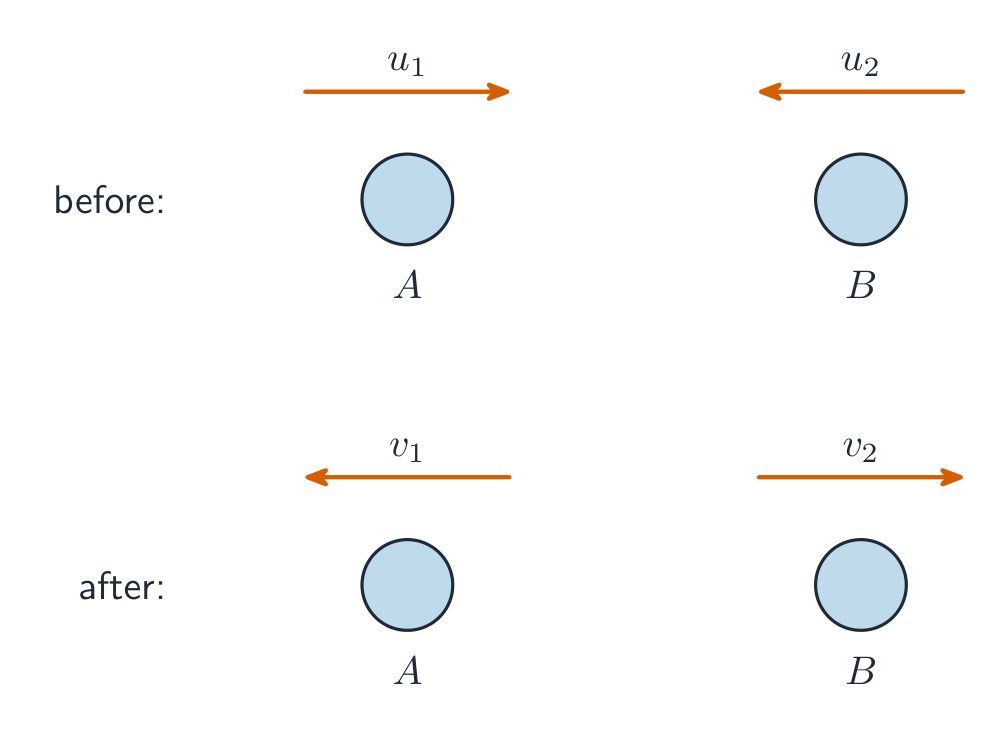
If the net external force 合外力 on a system is zero, its total momentum is conserved 守恒:
$$\sum \vec{p}_{\text{before}}=\sum \vec{p}_{\text{after}}.$$
Internal forces (like the push between two colliding carts) come in third-law pairs 第三定律力对 and cancel, so they cannot change the total momentum. This is the key tool for collisions 碰撞 and explosions 爆炸 – apply it separately in the $x$ and $y$ directions.
Worked example (recoil 反冲). A $60\ \text{kg}$ skater, initially at rest on frictionless ice, throws a $2.0\ \text{kg}$ ball at $8.0\ \text{m/s}$. Find her recoil speed. The total momentum starts at zero and stays zero:
$$0=(60)v+(2.0)(8.0)\;\Rightarrow\;v=-\frac{16}{60}=-0.27\ \text{m/s},$$
so she moves at $0.27\ \text{m/s}$ in the opposite direction to the ball – the principle behind rockets 火箭 and guns.
Equal and opposite impulses. During any interaction, the force of A on B and the force of B on A are a third-law pair: equal in size, opposite in direction, and acting for the same time. So the impulses are equal and opposite, and
$$|\Delta\vec{p}_A|=|\Delta\vec{p}_B|.$$
This holds even when the masses are very different: a truck and a fly gain momentum changes of the same size in a collision. Their velocity changes differ, because the fly's mass is so much smaller.
Worked example (push-off, in symbols). A student of mass $M_S$ on frictionless ice pushes a disk of mass $M_D$ with a constant force $F_H$ for a time $t_f$. Both start at rest.
- The disk: $F_Ht_f=M_Dv_D$, so $v_D=\dfrac{F_Ht_f}{M_D}$.
- The student gets an equal and opposite impulse: $M_Sv_S=M_Dv_D$, so $\dfrac{v_D}{v_S}=\dfrac{M_S}{M_D}$.
The lighter object moves faster. On a speed–time graph, both speeds rise in straight lines until $t_f$ (constant force), the disk's more steeply, and then both stay constant.
A whole collection of objects can be described by a single center-of-mass velocity 质心速度:
$$\vec{v}_{\text{cm}}=\frac{\sum m_i\vec{v}_i}{\sum m_i}=\frac{\vec{p}_{\text{total}}}{M_{\text{total}}}.$$
Since total momentum is conserved when no net external force acts, $\vec{v}_{\text{cm}}$ then stays constant – a $v_{\text{cm}}$-versus-time graph is flat unless an outside force acts. An internal collision or explosion never changes it, however violently the parts fly apart.

Reading the graph. The center-of-mass velocity is $v_{\text{cm}}=\dfrac{(6)(2)+(2)(0)}{8}=1.5\ \text{m/s}$, before and after: one straight line with no bend at $t=1.0\ \text{s}$. If the blocks had stuck together instead, both would follow that same dashed line after the collision. The center-of-mass line only bends when an external force acts: a plunger pushing the first block, or a rough patch of floor slowing it down.
Limiting cases. A disk of speed $v_1$ hits a block at rest and they stick: $v_{\text{cm}}=\dfrac{M_Dv_1}{M_D+M_B}$. If $M_D\gg M_B$, the block barely matters and $v_{\text{cm}}\to v_1$. If $M_D\ll M_B$, the disk barely moves the block and $v_{\text{cm}}\to0$. Checking that your formula gives these limits is a quick way to test it, and exams ask for it.
Explore
Collide two carts and conserve momentum
In any collision the total momentum $\sum mv$ before equals the total after. Set the masses and speeds and check the momentum bookkeeping.
Vocabulary
Train
| English |
|---|
| net external force/net ekˈstɜːnl fɔːs/ |
| conserved/kənˈsɜːvd/ |
| third-law pairs |
| collisions/kəˈlɪʒnz/ |
| explosions/ekˈspləʊʒnz/ |
| rockets |
| center-of-mass velocity/ˈsentə ɒv mæs vəˈlɒsɪti/ |
| recoil/rɪˈkɔɪl/ |
4.4
Elastic and Inelastic Collisions
Syllabus
| Learning Objective | Essential Knowledge |
|---|---|
4.4.A |
|
Source: College Board AP Course and Exam Description
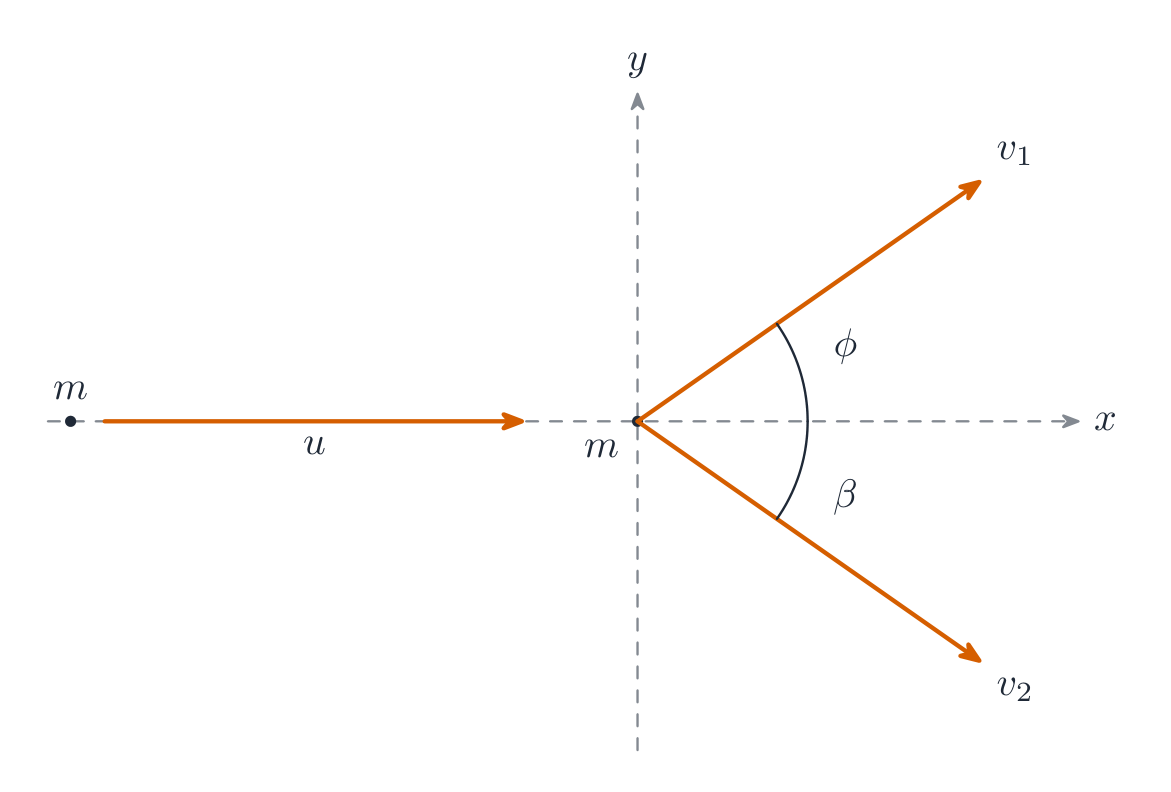
Momentum is conserved in every collision (with no external force). Kinetic energy 动能 is not:
- In an elastic collision 弹性碰撞, kinetic energy is also conserved (objects bounce apart cleanly).
- In an inelastic collision 非弹性碰撞, some kinetic energy becomes heat or deformation 形变. In a perfectly inelastic 完全非弹性 collision the objects stick together 粘在一起 and move with one common velocity afterward.
Strategy: always write momentum conservation; add energy conservation only if the collision is stated to be elastic. One elastic fact worth memorising: in a 1D elastic collision between equal masses, the two objects simply swap velocities (a moving ball striking an identical stationary 静止的 one stops dead, and the target flies off at the incoming speed).
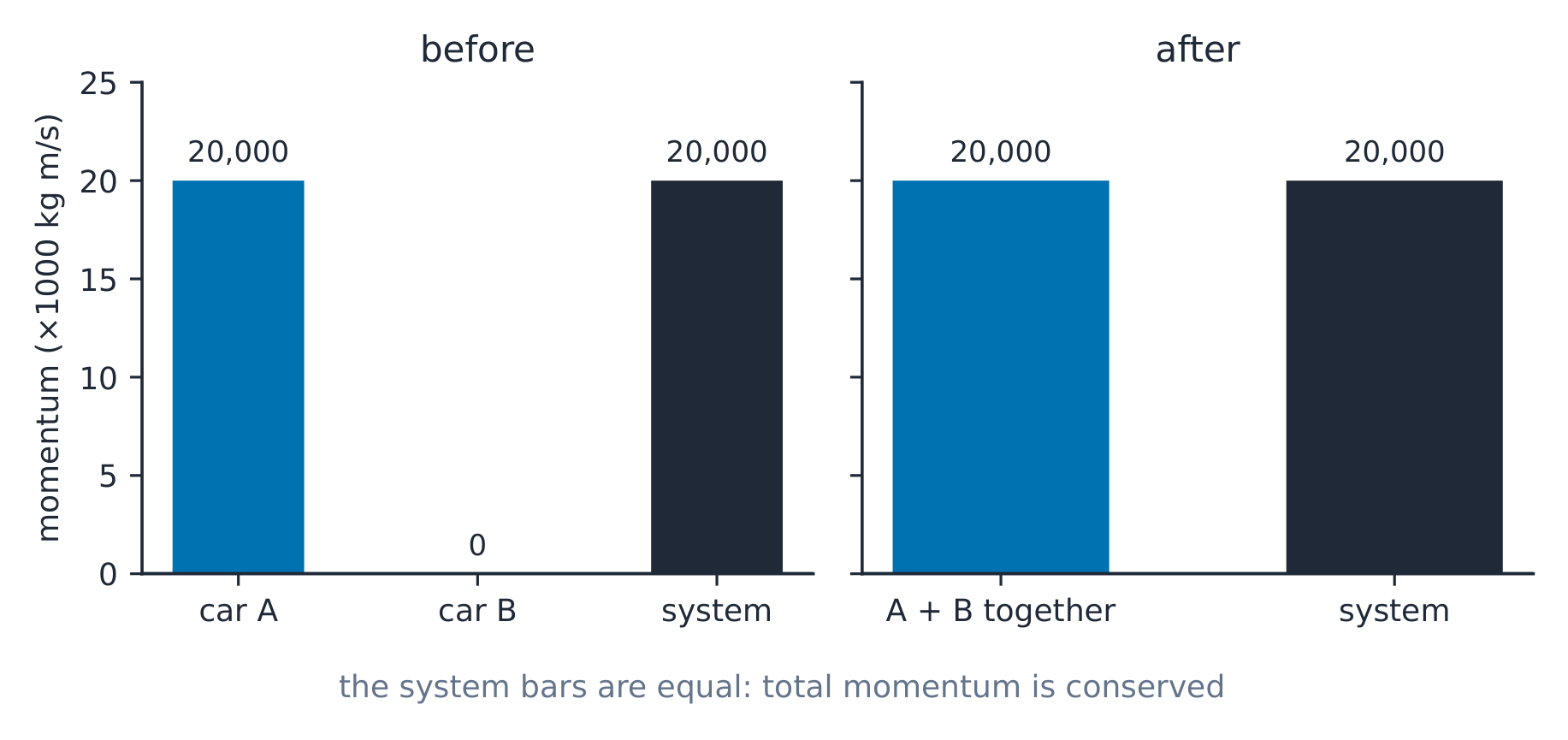
Worked example. A $1000\ \text{kg}$ car moving at $20\ \text{m/s}$ runs into a stationary $1500\ \text{kg}$ car and they lock together. Find their common speed, and the kinetic energy lost. Momentum conservation gives
$$1000\times20=(1000+1500)\,v\;\Rightarrow\;v=\frac{20000}{2500}=8.0\ \text{m/s}.$$
Kinetic energy before is $\tfrac12(1000)(20^2)=2.0\times10^{5}\ \text{J}$; after is $\tfrac12(2500)(8.0^2)=8.0\times10^{4}\ \text{J}$. So $1.2\times10^{5}\ \text{J}$ (about $60\%$) is lost to crumpling and heat – momentum is still conserved, but kinetic energy is not.
Worked example (is it elastic?). A $0.50\ \text{kg}$ cart at $2.0\ \text{m/s}$ hits a $1.5\ \text{kg}$ cart at rest. Afterward the first cart moves back at $1.0\ \text{m/s}$ and the second moves forward at $1.0\ \text{m/s}$. Momentum: $0.50(2.0)=1.0$ before and $0.50(-1.0)+1.5(1.0)=1.0\ \text{kg m/s}$ after. Kinetic energy: $\tfrac12(0.50)(2.0^2)=1.0\ \text{J}$ before and $\tfrac12(0.50)(1.0^2)+\tfrac12(1.5)(1.0^2)=0.25+0.75=1.0\ \text{J}$ after. Both are conserved, so this collision is elastic. Test kinetic energy only after momentum checks out.
Notice that in an elastic collision the system's kinetic energy is unchanged, but each object's kinetic energy can change a lot: here the first cart lost $0.75\ \text{J}$ and the second gained exactly that.
Worked example (momentum arrows). Disk R ($m_0$) moves at $v_0$ toward disk S ($3m_0$) at rest. After the collision R moves back at $\tfrac12v_0$. Find S's velocity and kinetic energy.
$$m_0v_0=m_0\left(-\tfrac12v_0\right)+3m_0v_S\;\Rightarrow\;v_S=\tfrac12v_0,\qquad K_S=\tfrac12(3m_0)\left(\tfrac12v_0\right)^2=\tfrac38m_0v_0^2.$$
On a momentum-vector diagram, if R's arrow before has length 2 units, then after R's arrow points backward with length 1 unit, and S's points forward with length 3 units. The arrows after must add to the arrow before: $-1+3=2$. The two changes in momentum have the same size, $3$ units each, as the third law requires. Total kinetic energy after is $\tfrac18m_0v_0^2+\tfrac38m_0v_0^2=\tfrac12m_0v_0^2$, so this collision happens to be elastic.
Bouncing gives a bigger impulse than sticking. Throw a ball of clay and a rubber ball of the same mass and speed at identical blocks. The clay stops; the rubber ball bounces back. The rubber ball's change in momentum is larger (it goes from $+mv$ to a negative value), so by the third law it gives the block a larger impulse. The block hit by the rubber ball moves faster, and if both blocks then slide off a table, it lands farther away. The sphere–block system has the same total momentum in both cases, because the external impulse is zero: the extra forward momentum of the block is balanced by the sphere's backward momentum.
Explore
Compare elastic and inelastic collisions
Momentum is always conserved, but kinetic energy is only conserved in an elastic collision. In an inelastic one the carts stick and some energy becomes heat.
Vocabulary
Train
| English |
|---|
| kinetic energy/kɪˈnetɪk ˈenədʒi/ |
| elastic collision/ɪˈlæstɪk kəˈlɪʒn/ |
| inelastic collision/ɪnɪˈlæstɪk kəˈlɪʒn/ |
| deformation/ˌdiːfɔːˈmeɪʃn/ |
| perfectly inelastic/ˈpɜːfektlɪ ɪnɪˈlæstɪk/ |
| stick together |
| stationary/ˈsteɪʃənəri/ |
4.4
Choosing the system
Every momentum answer starts with one decision: which objects are in the system 系统. Momentum is conserved only for a system on which the net external impulse 外部冲量 is zero, or small enough to ignore.
- Internal forces 内力 act between objects inside the system. They come in Newton's-third-law pairs, give equal and opposite impulses, and cannot change the total.
- External forces 外力 come from outside it. A ball falling alone is not a conserved system, because gravity is external. Ball and Earth together is: the Earth gains exactly the momentum the ball does, in the opposite direction.
- A short collision usually lets you ignore friction 摩擦力 and gravity 重力. The collision forces are huge, but they act for so little time that the outside forces add almost no impulse. So "conserved during the collision" is safe; "conserved for the whole trip" usually is not.
Momentum bar charts: the system total is the same before and after the collision
Momentum bar charts 动量柱状图 are the AP way to show this: one bar per object before and after, plus the system total. The figure shows the car collision above. The system bars match, so the claim "momentum is conserved" is visible, not just asserted.
Worked example (two stages, two laws). A $0.010\ \text{kg}$ bullet at $300\ \text{m/s}$ embeds in a $2.0\ \text{kg}$ block hanging on a string, a ballistic pendulum 冲击摆. How high does the block swing?
- Stage 1, the collision. It is over in a fraction of a second, so the string and gravity add negligible 可忽略的 impulse: momentum is conserved. $0.010(300)=(2.010)\,v$, so $v=1.49\ \text{m/s}$. Kinetic energy is not conserved here: it falls from $450\ \text{J}$ to about $2.2\ \text{J}$.
- Stage 2, the swing. Now gravity acts for a long time, so momentum is no longer conserved, but no energy is lost: $\tfrac12v^2=gh$, so $h=\dfrac{1.49^2}{2(9.8)}=0.11\ \text{m}$.
Using energy in stage 1, or momentum in stage 2, gives a wrong answer. Name the stage before you choose the law.
Worked example (dropping a block onto a moving cart). A cart of mass $m_c$ rolls at $v_c$ on a frictionless track. A block of mass $\tfrac15m_c$ is dropped from rest onto it and sticks. Choose the cart and block as the system.
- Horizontal momentum is conserved: there is no horizontal external force, and the falling block had no horizontal momentum. So a graph of $p_x$ against time is a flat line, even during the collision.
- $m_cv_c=\tfrac65m_cv_f$, so $v_f=\tfrac56v_c$.
- $\Delta K=\tfrac12\left(\tfrac65m_c\right)\left(\tfrac56v_c\right)^2-\tfrac12m_cv_c^2=-\tfrac1{12}m_cv_c^2$: kinetic energy is lost, as in any sticking collision.
Vertical momentum is not conserved: the track pushes up on the cart to stop the block's fall. If the block slides on the cart for a while before moving with it, the friction between them is internal, so $p_x$ of the system still stays constant.
Vocabulary
Train
| English |
|---|
| system/ˈsɪstəm/ |
| net external impulse |
| internal force/ɪnˈtɜːnl fɔːs/ |
| external force/ekˈstɜːnl fɔːs/ |
| friction/ˈfrɪkʃn/ |
| gravity/ˈɡrævɪti/ |
| momentum bar chart |
| ballistic pendulum |
| negligible/ˈneɡlɪdʒəbl/ |
4.4
A collision in two dimensions
Momentum is a vector 矢量, so it is conserved separately along each axis 轴.
Worked example. A $2.0\ \text{kg}$ puck moving east at $4.0\ \text{m/s}$ strikes a $3.0\ \text{kg}$ puck at rest. Afterward the $2.0\ \text{kg}$ puck moves at $1.5\ \text{m/s}$ at $60°$ north of east. Find the velocity of the $3.0\ \text{kg}$ puck.
- $x$ (east): $2.0(4.0)=2.0(1.5\cos60°)+3.0\,v_x$, so $8.0=1.5+3.0\,v_x$ and $v_x=2.17\ \text{m/s}$.
- $y$ (north): $0=2.0(1.5\sin60°)+3.0\,v_y$, so $v_y=-0.87\ \text{m/s}$, south.
- Speed $\sqrt{2.17^2+0.87^2}=2.33\ \text{m/s}$, at $\tan^{-1}(0.87/2.17)=22°$ south of east.
Check the energy: $16\ \text{J}$ before and $2.25+8.2=10.4\ \text{J}$ after. Kinetic energy fell, as it must in a real collision. If it had risen, an arithmetic slip would be the first suspect.
On the AP Physics 1 exam you will not have to solve two-dimensional simultaneous equations. You may be asked to set up the $x$ and $y$ equations correctly, or to reason about what happens if a mass, speed or angle changes. For example, if the first puck had bounced off at a larger angle with the same speed, its $x$ momentum after would be smaller, so the second puck must carry more $x$ momentum.
Vocabulary
Train
| English |
|---|
| vector/ˈvektə/ |
| axis/ˈæksɪs/ |
4.4
Justify it in words
Free-response questions often ask you to justify 论证 a conservation claim without numbers. A full-credit answer names the system, the forces and the law. For two carts 小车 colliding on a level, low-friction track 轨道:
Yes, the total momentum of the two-cart system is conserved. During the collision, the only horizontal forces on each cart are the forces the carts exert on each other. These are internal to the system and, by Newton's third law, equal and opposite, so their impulses cancel. Friction from the track is negligible, so the net external impulse on the system is zero.
"Momentum is always conserved" earns nothing: it is false for the wrong system, and it names no reason.
Designing a test of "perfectly elastic". A toy ball is said to bounce perfectly elastically. To test this at different speeds:
- Drop the ball from a measured height $h_1$ onto a hard floor and measure the height $h_2$ it bounces back to, filming against a metre rule. Repeat for a range of $h_1$, several trials each.
- The speed just before impact is $\sqrt{2gh_1}$. For a perfectly elastic bounce, kinetic energy is unchanged, so $h_2=h_1$.
- Plot $h_2$ against $h_1$ and add the line $h_2=h_1$. Points on the line are elastic; points falling further below it at large $h_1$ support the claim that higher-speed collisions lose more energy.
- A point above the line would mean the ball left the floor with more kinetic energy than it arrived with, which breaks energy conservation for a simple ball. It shows a measurement error, such as a ball that was thrown rather than dropped.
Vocabulary
Train
| English |
|---|
| justify |
| carts |
| track |
4.4
Practice
Answer each before reading the answers below. Take $g=9.8\ \text{m/s}^2$.
- A $0.40\ \text{kg}$ ball moving at $5.0\ \text{m/s}$ is caught and stopped in $0.10\ \text{s}$. Find the average force on it.
- The same ball is stopped in $0.020\ \text{s}$ instead. Find the force, and explain why a padded glove is used.
- A $3.0\ \text{kg}$ cart at $4.0\ \text{m/s}$ hits a $1.0\ \text{kg}$ cart at rest and they stick. Find their common speed and the kinetic energy lost.
- A $50\ \text{kg}$ astronaut floating at rest pushes off a $150\ \text{kg}$ satellite, also at rest, and moves away at $0.60\ \text{m/s}$. Find the satellite's velocity. What happens to the center of mass of the pair?
- A student says: "In question 3 kinetic energy was lost, so some momentum must have been lost too." Correct the student.
4.4
Answers
- $\Delta p=0.40(5.0)=2.0\ \text{kg m/s}$, so $F=2.0/0.10=20\ \text{N}$.
- $F=2.0/0.020=100\ \text{N}$. The momentum change is fixed; padding makes the stopping last longer, which lowers the force on the hand.
- $3.0(4.0)=(4.0)v$, so $v=3.0\ \text{m/s}$. Kinetic energy falls from $\tfrac12(3.0)(4.0^2)=24\ \text{J}$ to $\tfrac12(4.0)(3.0^2)=18\ \text{J}$: $6.0\ \text{J}$ is lost.
- $0=50(0.60)+150\,v$, so $v=-0.20\ \text{m/s}$: $0.20\ \text{m/s}$ in the opposite direction. The total momentum stays zero, so the center of mass stays at rest.
- Momentum and kinetic energy obey separate laws. With no net external impulse, momentum is conserved in every collision. Kinetic energy can turn into internal energy (heat, sound, deformation), so it may fall while momentum stays exactly the same.
4.4
Exam tips
- Momentum is a vector — assign $+$/$-$ signs before adding; a ball that rebounds reverses its velocity, giving a large $\Delta p$.
- Momentum is conserved in every collision (no external force); kinetic energy is conserved only if the collision is stated to be elastic.
- In a perfectly inelastic collision the objects stick and move with one common velocity.
- Impulse $=F\,\Delta t=\Delta p$ = the area under a force–time graph; spreading a collision over a longer time reduces the force (airbags, bending knees).
- For recoil/explosions, set the total momentum equal before and after (often zero before).
Common mistakes
- Subtracting speeds for a rebound. A ball that hits a wall at $20\ \text{m/s}$ and returns at $15\ \text{m/s}$ changes velocity by $35\ \text{m/s}$, not $5\ \text{m/s}$.
- Claiming momentum is conserved for a single object acted on by gravity or friction. Conservation needs a system with zero net external impulse.
- Using kinetic energy conservation for a collision that is not stated (or shown) to be elastic. Write momentum first; test kinetic energy only if the question asks.
- Saying a larger force means a larger impulse. Impulse is force times time: a soft catch has a smaller force but the same impulse.
- Adding the magnitudes of momenta in a 2D collision. Conserve the $x$ and $y$ components separately, then combine.
- Using momentum conservation for the swing of a ballistic pendulum, or energy conservation for the impact. Each stage has its own law.
- Saying the heavier object gets the larger change in momentum in a collision. The impulses are equal and opposite, so $|\Delta p|$ is the same for both; only the velocity changes differ.
- Drawing a bend in the center-of-mass line at a collision. Internal forces never change $v_{\text{cm}}$; only external forces do.
- Thinking a ball that sticks gives a target a bigger push than one that bounces. A bounce reverses the ball's momentum, so it delivers the larger impulse.
- Conserving vertical momentum when a block is dropped onto a cart. The track gives an upward impulse; only the horizontal momentum is conserved.
Interactive lessons on this topic
Work through it step by step, with instant-check exercises.