| Learning Objective | Essential Knowledge |
|---|---|
2.1.A |
|
2.1.B |
Boundary statement: AP Physics 1 only expects students to calculate the center of mass for systems of five or fewer particles arranged in a two-dimensional configuration or for systems that are highly symmetrical. |
Force and Translational Dynamics
AP Physics 1 · Topic 2
 10:50
Force & Translational Dynamics
Three skydivers, far above the ground. Gravity is pulling every one of them down, hard. Yet they hang there, steady, side by side. So why has that pull stopped…
English narration · English + 中文 subtitles burned in
2.1
Systems and Center of Mass
Syllabus
Source: College Board AP Course and Exam Description
A lift accelerating upward makes you feel heavier; a car rounding a bend pushes you against the door; astronauts float although Earth's gravity on them is still about 90% of its value at the surface. Newton's laws explain all three, as long as you choose the right system and draw the right forces.
A system 系统 is the object or group of objects you choose to analyze. A system can be treated as a single point at its center of mass 质心 – the average position of its mass. External forces change the motion of the center of mass; internal forces (between parts of the system) do not.
This is why a wrench spinning across a table still has its center of mass move in a straight line: the spinning is internal, and only the (near-zero) external force matters for the center of mass. For two masses $m_1,m_2$ on a line at positions $x_1,x_2$, the center of mass sits at $x_{\text{cm}}=\dfrac{m_1x_1+m_2x_2}{m_1+m_2}$ – always closer to the heavier mass.
Worked example (center of mass). Three small masses lie on a line: $2.0$ kg at $x=0$, $1.0$ kg at $x=3.0$ m and $3.0$ kg at $x=4.0$ m.
$$x_{\text{cm}}=\frac{2.0(0)+1.0(3.0)+3.0(4.0)}{2.0+1.0+3.0}=\frac{15}{6.0}=2.5\ \text{m}.$$
The center of mass is nearer the heavy end, and it need not be where any mass is. For a symmetric object, such as a uniform rod or ball, it lies on the lines of symmetry: at the middle. In two dimensions, use the same formula separately for $x$ and for $y$.
One system or several objects? A system's center of mass moves as if all the external forces acted on one point there. Its parts can still move differently: when a firework bursts, the pieces fly apart, but their center of mass carries on along the same parabola, because the explosion forces are internal.
Explore
Find the balance point
Change the two masses and their distances, and see where the system balances — the centre of mass.
Vocabulary
Train
| English |
|---|
| system/ˈsɪstəm/ |
| center of mass/ˈsentə ɒv mæs/ |
2.2
Forces and Free-Body Diagrams

Syllabus
| Learning Objective | Essential Knowledge |
|---|---|
2.2.A |
|
2.2.B |
Boundary statement: AP Physics 1 only expects students to depict the forces exerted on objects, not the force components on free-body diagrams. On the AP Physics exams, individual forces represented on a free-body diagram must be drawn as individual straight arrows, originating on the dot and pointing in the direction of the force. Individual forces that are in the same direction must be drawn side by side, not overlapping. |
Source: College Board AP Course and Exam Description

A force 力 is a push or pull – a vector, measured in newtons (N). A free-body diagram 受力图 shows one object as a dot with arrows for every force acting on it (weight 重力, normal, tension 张力, friction, applied), each labelled and pointing the right way. Draw it before any dynamics problem; it is where most marks are won or lost.
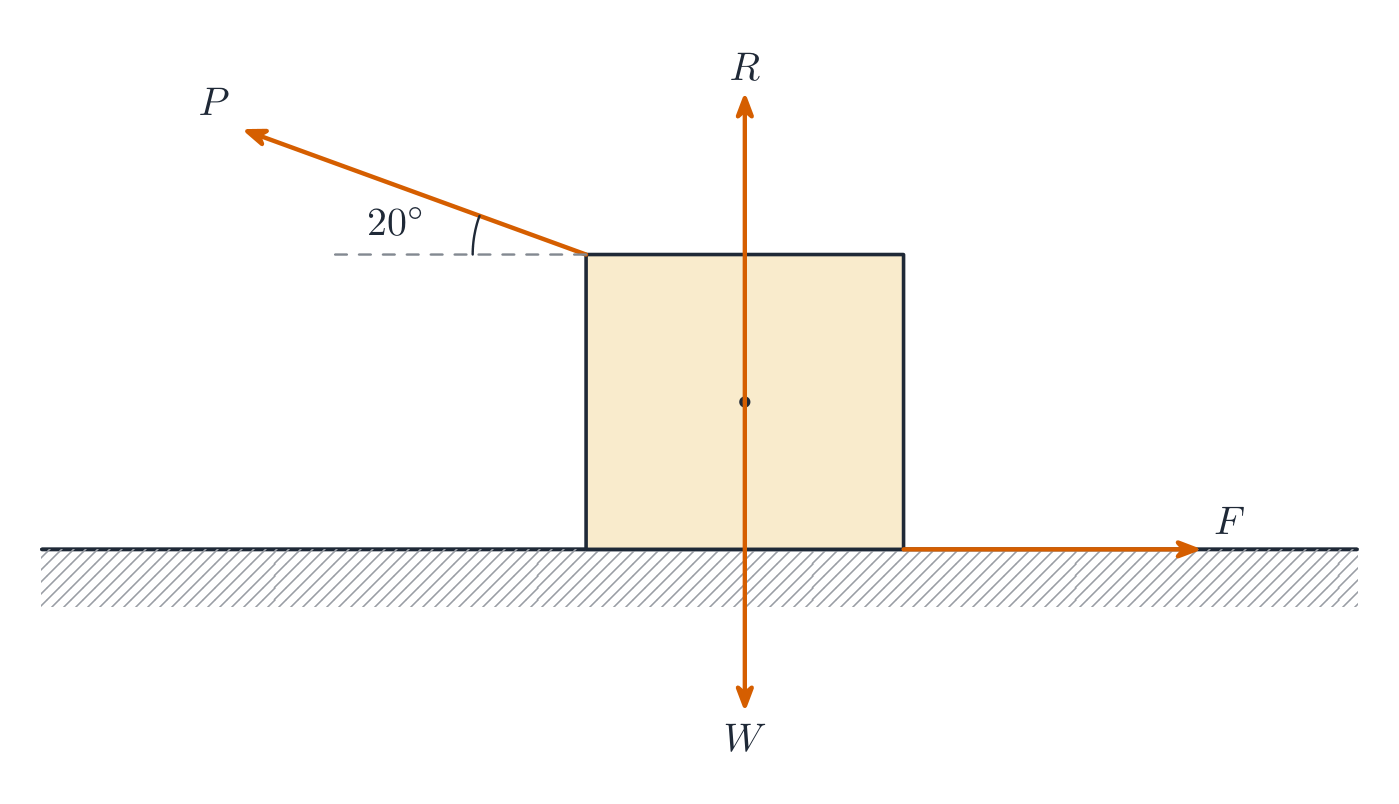
Two rules keep free-body diagrams honest: draw only forces acting on the chosen object (not forces it exerts on other things), and draw only real, physical forces (a rope, a surface, gravity, a hand) – never an "$ma$" arrow, which is the result of the forces, not a force itself.
Every force comes from an interaction with another object: no object can push itself forward. Contact forces (normal, friction, tension) are the large-scale effect of electric forces between the atoms of the two surfaces. On an AP free-body diagram, draw each force as one arrow from the dot, not as components; arrows drawn to scale should have lengths in proportion to the forces. To solve, choose one axis along the acceleration (for example, along a ramp), then split forces into components in your equations.
Explore
Balance the forces on a free-body diagram
A free-body diagram shows every force on one object as an arrow. The object accelerates only if the forces don't cancel — the net force sets $a=F/m$.
Vocabulary
Train
| English |
|---|
| force/fɔːs/ |
| free-body diagram/friː ˈbɒdi ˈdaɪəɡræm/ |
| weight/weɪt/ |
| tension/ˈtenʃn/ |
2.3
Newton's Third Law
Syllabus
| Learning Objective | Essential Knowledge |
|---|---|
2.3.A |
Boundary statement: AP Physics 1 only expects students to describe tension qualitatively in a string, cable, chain, or similar system with mass. For example, students might note that the tension in a hanging chain is greater toward the top of the chain. Boundary statement: The interaction between objects or systems at a distance is limited to gravitational forces in AP Physics 1. In AP Physics 2, gravitational, electric, and magnetic forces may be considered. |
Source: College Board AP Course and Exam Description
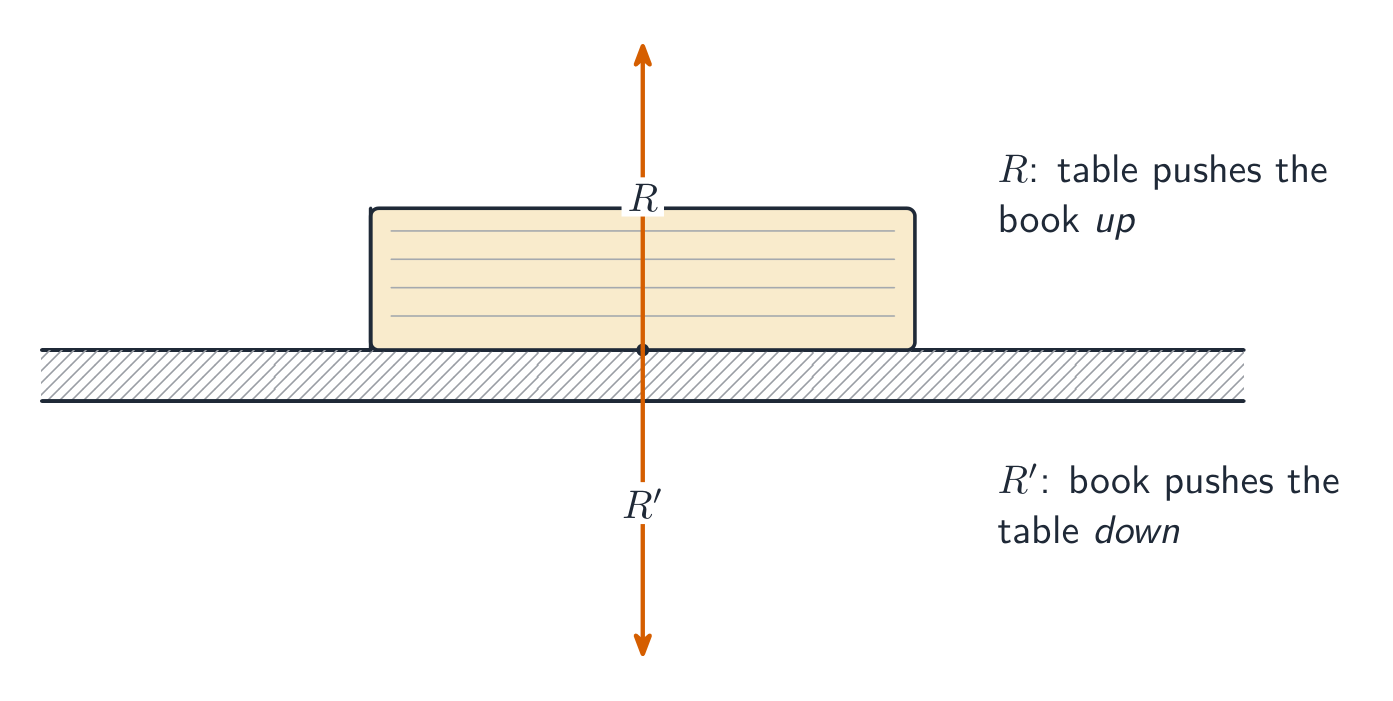
Newton's third law 牛顿第三定律: if object A pushes on object B, then B pushes back on A with a force equal in size and opposite in direction. These two forces act on different objects, so they do not cancel in one object's free-body diagram. If both objects belong to the chosen system, the pair cancels when summing its internal forces. Identify third-law pairs by the "A on B / B on A" wording.
A classic trap: the weight of a book and the normal force from the table are not a third-law pair – they act on the same object (the book). The partner of the book's weight is the pull the book exerts on the Earth; the partner of the table's push is the push the book makes on the table.
Strings and pulleys. Tension is the pull that the parts of a string exert on each other. An ideal string has negligible mass and does not stretch, so the tension is the same all along it, and both ends move with the same speed. An ideal pulley has negligible mass and no friction, so it only changes the direction of the tension. A heavy rope is different: its tension is largest at the top, where it must also hold up the rope below.
Worked example (checking with limiting cases). Two blocks, $m_A$ and $m_B$, hang on either side of an ideal pulley ($m_A>m_B$). Treating them as one system, the net force is $(m_A-m_B)g$ and the mass moved is $m_A+m_B$:
$$a=\frac{(m_A-m_B)g}{m_A+m_B}.$$
Test it at the extremes. If $m_A\gg m_B$, then $a\to g$: block A falls almost freely. If $m_A=m_B$, then $a=0$: the blocks balance. An expression that gives sensible answers in the limits is probably right, and FRQs often ask "does your equation agree with your reasoning?": this is how you check.
Explore
Third-law pairs
Newton's third-law forces are equal, opposite, and act on different objects. Sort each statement.
Vocabulary
Train
| English |
|---|
| Newton's third law/ˈnjuːtnz θɜːd lɔː/ |
2.4
Newton's First Law
Syllabus
| Learning Objective | Essential Knowledge |
|---|---|
2.4.A |
|
Source: College Board AP Course and Exam Description
Newton's first law 牛顿第一定律 (the law of inertia 惯性): an object's velocity stays constant unless a net force 合力 acts on it. So zero net force means constant velocity (including rest) – the object is in translational equilibrium 平衡. Inertia is the tendency to resist changes in motion, measured by mass.
Worked example. A $1200\ \text{kg}$ car cruises at a steady $25\ \text{m/s}$ on a level road. What is the net force on it? Because the velocity is constant, the acceleration is zero, so by the first law the net force is zero – the forward drive force exactly balances drag and friction. "Steady speed" always means balanced forces.
Forces can be balanced along one axis and not along another. A puck sliding across ice has its weight balanced by the normal force, so it does not speed up vertically; with no horizontal force, it keeps a constant horizontal velocity too. A projectile has balanced (zero) horizontal force but unbalanced vertical force, so only its vertical velocity changes.
Explore
Balance the forces
Reduce the applied force and friction to zero and see the net force vanish — constant velocity.
Vocabulary
Train
| English |
|---|
| Newton's first law/ˈnjuːtnz fɜːst lɔː/ |
| inertia/ɪˈnɜːʃə/ |
| net force/net fɔːs/ |
| translational equilibrium/trænˈsleɪʃənl ˌiːkwɪˈlɪbrɪəm/ |
2.5
Newton's Second Law
Syllabus
| Learning Objective | Essential Knowledge |
|---|---|
2.5.A |
|
Source: College Board AP Course and Exam Description
Newton's second law 牛顿第二定律 relates net force to acceleration:
$$\vec{a}=\frac{\sum \vec{F}}{m},\qquad\text{i.e.}\qquad \sum\vec{F}=m\vec{a}.$$
Apply it one axis at a time: add the force components along each axis and set the sum equal to $ma$ for that axis. Acceleration points the same way as the net force.
Worked example. A $4.0\ \text{kg}$ box is pulled along the floor by a horizontal force of $18\ \text{N}$. Friction on the box is $6.0\ \text{N}$. Find its acceleration. Along the direction of motion the net force is $18-6.0=12\ \text{N}$, so
$$a=\frac{\sum F}{m}=\frac{12}{4.0}=3.0\ \text{m/s}^2.$$
Worked example (incline 斜面). A block of mass $m$ slides down a frictionless ramp tilted at angle $\theta$. Find its acceleration. Resolve gravity into components along and perpendicular to the ramp; only the along-ramp part, $mg\sin\theta$, drives the motion, so
$$a=\frac{mg\sin\theta}{m}=g\sin\theta.$$
The steeper the ramp, the larger $\sin\theta$ and the faster it accelerates; at $\theta=90^{\circ}$ it is free fall.
Explore
Net force sets the acceleration
Raise the applied force or the mass and watch how the net force and the acceleration change.
Vocabulary
Train
| English |
|---|
| Newton's second law/ˈnjuːtnz ˈsekənd lɔː/ |
| incline/ɪnˈklaɪn/ |
2.6
Gravitational Force
Syllabus
| Learning Objective | Essential Knowledge |
|---|---|
2.6.A |
|
2.6.B |
|
2.6.C |
|
2.6.D |
|
Source: College Board AP Course and Exam Description
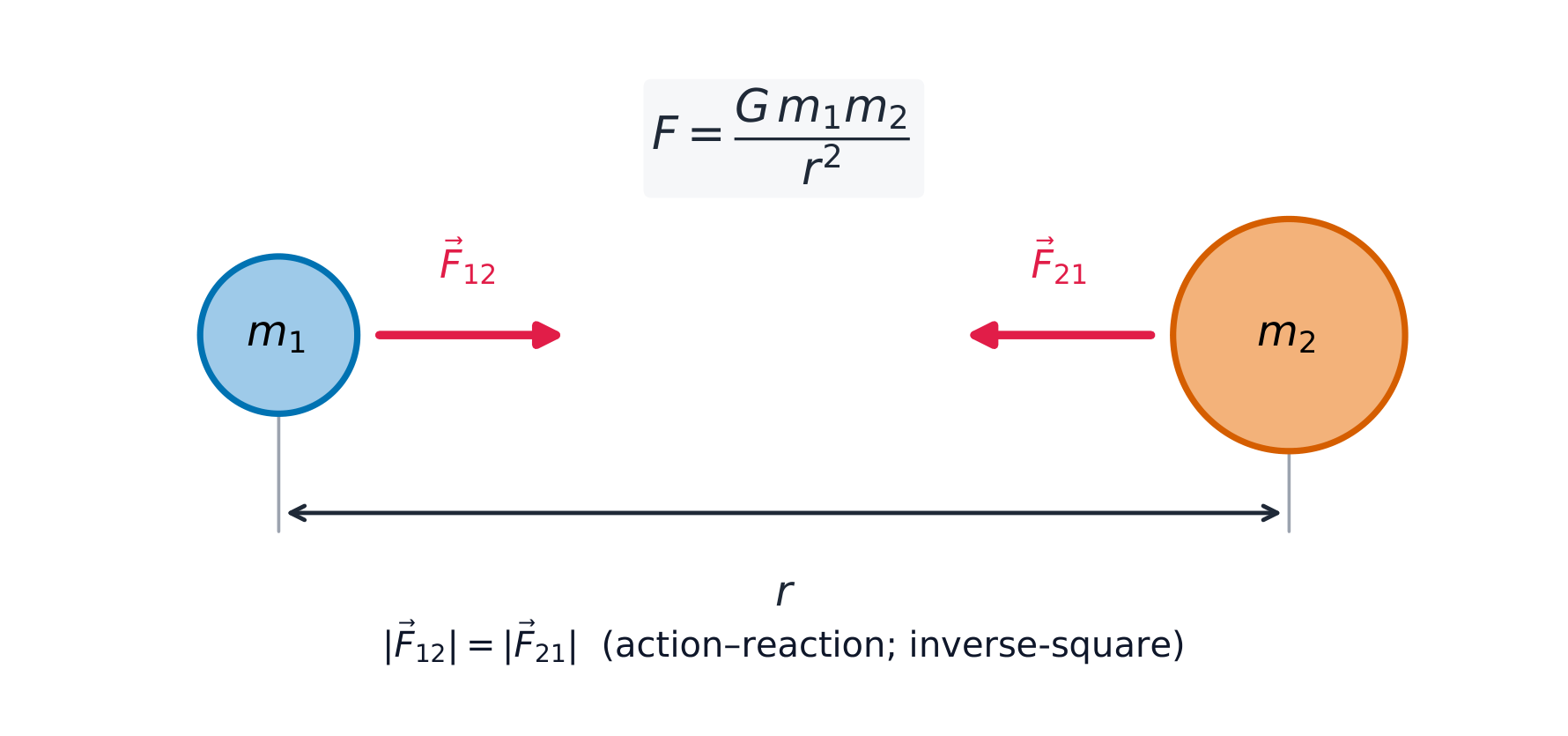
Near a planet's surface, the gravitational force (weight) is $F_g=mg$, directed down, where $g$ is the gravitational field strength 重力场强度. More generally, Newton's law of gravitation 万有引力定律 gives the attraction between point masses, or non-overlapping spherically symmetric masses:
$$F_g=\frac{G m_1 m_2}{r^2},$$
directed along the line joining them, weaker as the distance $r$ grows (an inverse-square law). Doubling the separation quarters the force.
Worked example. A $2.0\ \text{kg}$ object weighs $19.6\ \text{N}$ on Earth ($g=9.8\ \text{m/s}^2$). On the Moon $g_{\text{Moon}}=1.6\ \text{m/s}^2$. Its mass is unchanged ($2.0\ \text{kg}$), but its weight becomes $F_g=mg=2.0\times1.6=3.2\ \text{N}$. Mass measures inertia; weight is a force that depends on where you are.
Gravitational field. A mass creates a gravitational field 引力场 around it. The field strength at a point is the force per unit mass on a small test mass placed there: $g=\dfrac{F_g}{m}=\dfrac{GM}{r^2}$, measured in N/kg. Near Earth's surface $g\approx10$ N/kg, and if gravity is the only force, the acceleration in m/s² equals the field strength in N/kg.
Apparent weight. A scale reads the normal force on you, your apparent weight 视重, not the gravitational force. In a lift accelerating upward at $a$, $N-mg=ma$, so $N=m(g+a)$: you feel heavier. Accelerating downward, $N=m(g-a)$: you feel lighter. In free fall, $a=g$ and $N=0$: you feel weightless. Astronauts in orbit are weightless for this reason. They are not out of gravity's reach; they and their spacecraft are all falling around Earth together. An observer in a closed lift cannot tell whether the push of the floor comes from gravity or from the lift accelerating: this is the equivalence principle.
Mass actually plays two distinct roles. Inertial mass 惯性质量 sets how strongly an object resists acceleration ($F=ma$); gravitational mass 引力质量 sets how strongly it attracts other masses ($F=Gm_1m_2/r^2$). Experiments confirm the two are equal – which is exactly why every object, heavy or light, falls with the same $g$.
Explore
Gravity on different worlds
Switch the planet and watch how a weaker or stronger g bends the same launch differently.
Vocabulary
Train
| English |
|---|
| gravitational field strength/ˌɡrævɪˈteɪʃənl fiːld streŋθ/ |
| Newton's law of gravitation/ˈnjuːtnz lɔː ɒv ˌɡrævɪˈteɪʃn/ |
| gravitational field/ˌɡrævɪˈteɪʃənl fiːld/ |
| apparent weight |
| inertial mass/ɪˈnɜːʃl mæs/ |
| gravitational mass/ˌɡrævɪˈteɪʃənl mæs/ |
2.7
Kinetic and Static Friction
Syllabus
| Learning Objective | Essential Knowledge |
|---|---|
2.7.A |
|
2.7.B |
|
Source: College Board AP Course and Exam Description
Friction 摩擦力 acts along a surface, opposing relative sliding (or the tendency to slide):
- Kinetic friction 动摩擦 (while sliding): $f_k=\mu_k N$.
- Static friction 静摩擦 (while not yet sliding): $f_s\le \mu_s N$ – it adjusts up to a maximum to prevent motion.
Here $N$ is the normal force 法向力 (surface push, perpendicular to the surface) and $\mu$ is the coefficient of friction 摩擦系数.
Three facts are tested often. Friction does not depend on the area in contact: a brick slides the same on its side as on its end. The coefficient depends only on the two materials. And $\mu_s$ is usually larger than $\mu_k$, so it takes more force to start an object sliding than to keep it sliding.
Worked example. A $5.0\ \text{kg}$ crate sits on a level floor with $\mu_s=0.40$. Will a horizontal push of $15\ \text{N}$ move it? On a level floor $N=mg=5.0\times9.8=49\ \text{N}$, so the largest static friction is $f_{s,\max}=\mu_s N=0.40\times49=19.6\ \text{N}$. The $15\ \text{N}$ push is smaller than $19.6\ \text{N}$, so friction rises to match it and the crate stays still.
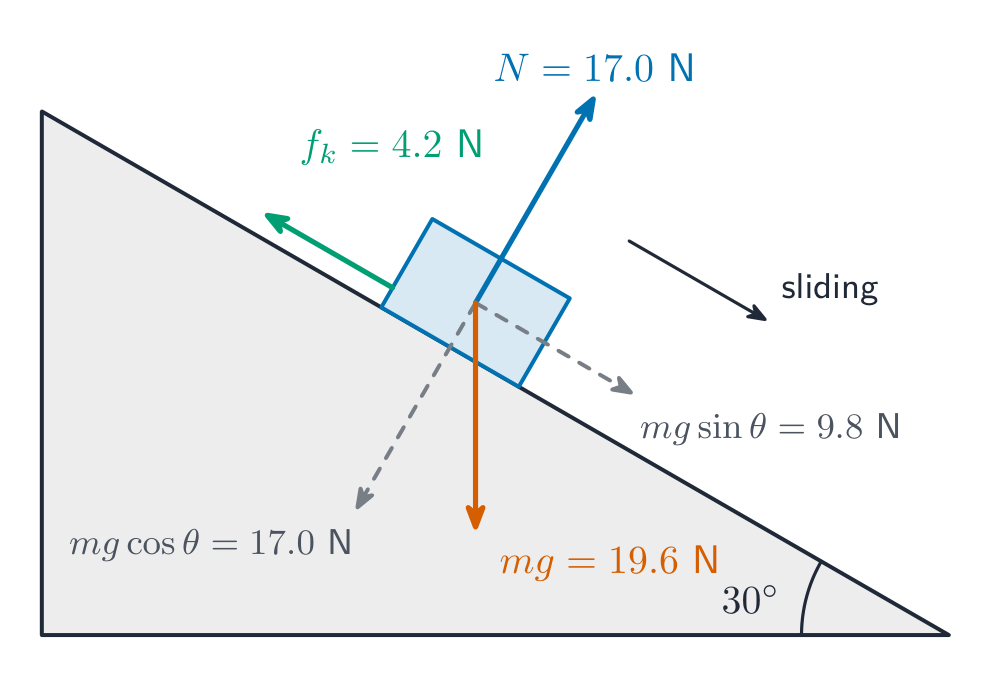
Worked example (incline with friction). A $2.0\ \text{kg}$ block slides down a ramp tilted at $30^{\circ}$, with $\mu_k = 0.25$. Find its acceleration.
- Perpendicular to the ramp the block does not accelerate, so $N = mg\cos\theta = 2.0 \times 9.8 \times \cos 30^{\circ} = 17.0\ \text{N}$ (not $mg = 19.6\ \text{N}$).
- Kinetic friction opposes the sliding, so it points up the ramp: $f_k = \mu_k N = 0.25 \times 17.0 = 4.2\ \text{N}$.
- Along the ramp (down the ramp positive): $\sum F = mg\sin\theta - f_k = 9.8 - 4.2 = 5.6\ \text{N}$.
$$a = \frac{\sum F}{m} = \frac{5.6}{2.0} = 2.8\ \text{m/s}^2 \qquad\text{or, in symbols,}\qquad a = g(\sin\theta - \mu_k\cos\theta)$$
Check the limits: with $\mu_k = 0$ this gives $g\sin\theta = 4.9\ \text{m/s}^2$, the frictionless result; friction can only make the block slower.
Worked example (pulling at an angle). A $10\ \text{kg}$ sled is pulled along level snow by a rope at $30^{\circ}$ above the horizontal with a tension of $50\ \text{N}$; $\mu_k = 0.20$. Find the acceleration.
Vertical: the rope's upward component helps hold the sled up, so $N + 50\sin 30^{\circ} = mg$, giving $N = 98 - 25 = 73\ \text{N}$. Friction: $f_k = 0.20 \times 73 = 14.6\ \text{N}$. Horizontal:
$$a = \frac{50\cos 30^{\circ} - 14.6}{10} = \frac{43.3 - 14.6}{10} = 2.9\ \text{m/s}^2$$
Using $N = mg$ here would give friction $19.6\ \text{N}$ and $a = 2.4\ \text{m/s}^2$: wrong, because the normal force is whatever the perpendicular equation says it is.
Worked example (connected objects). A $3.0\ \text{kg}$ cart on a frictionless table is tied by a light string over a light, frictionless pulley to a hanging $1.0\ \text{kg}$ mass. Find the acceleration and the tension.
Treat the cart and the hanging mass as one system moving along the string. The only external force along the string direction is the hanging mass's weight, $1.0 \times 9.8 = 9.8\ \text{N}$ (the tension is internal):
$$a = \frac{9.8}{3.0 + 1.0} = 2.45\ \text{m/s}^2 \approx 2.5\ \text{m/s}^2$$
Now take the cart alone: the only horizontal force on it is the tension, so $T = 3.0 \times 2.45 = 7.4\ \text{N}$. Check with the hanging mass alone: $mg - T = ma$ gives $9.8 - 7.4 = 2.4 \approx 1.0 \times 2.45$. The tension is less than the hanging weight; if it were equal, the hanging mass could not accelerate downward.
Measuring $\mu_s$ by tilting. Place a block on a board and slowly raise one end until the block just starts to slide, at angle $\theta_c$. At that moment static friction is at its maximum and balances the weight component down the slope: $\mu_s mg\cos\theta_c=mg\sin\theta_c$, so
$$\mu_s=\tan\theta_c.$$
The mass cancels. To reduce uncertainty, raise the board slowly, repeat several times and average $\theta_c$.
Measuring $\mu_k$ with a straight-line graph. Pull a block at constant velocity with a force sensor, so the pull equals kinetic friction. Repeat with extra masses on the block. Plot friction force $f_k$ (vertical) against normal force $N=mg$ (horizontal): the slope is $\mu_k$. Doubling the mass of the block doubles both $N$ and $f_k$, so $\mu_k$ itself does not change.
Explore
Slide a block down a slope with friction
Friction opposes motion up to a maximum $\mu N$. Tilt the slope until gravity's pull along it beats static friction and the block starts to slide.
Vocabulary
Train
| English |
|---|
| Friction/ˈfrɪkʃn/ |
| Kinetic friction/kɪˈnetɪk ˈfrɪkʃn/ |
| Static friction/ˈstætɪk ˈfrɪkʃn/ |
| normal force/ˈnɔːml fɔːs/ |
| coefficient of friction/ˌkəʊɪˈfɪʃənt ɒv ˈfrɪkʃn/ |
2.8
Spring Forces
Syllabus
| Learning Objective | Essential Knowledge |
|---|---|
2.8.A |
|
Source: College Board AP Course and Exam Description
An ideal spring exerts a restoring force 回复力 proportional to its stretch or compression – Hooke's law 胡克定律:
$$F_s=-kx,$$
where $k$ is the spring constant 弹簧常数 (stiffness) and $x$ is the displacement from the spring's natural length. The minus sign means the force points back toward equilibrium.
Worked example. A spring with $k=200\ \text{N/m}$ hangs vertically and a $0.50\ \text{kg}$ mass is hung on it. How far does it stretch at rest? At rest the spring force balances the weight, $kx=mg$, so
$$x=\frac{mg}{k}=\frac{0.50\times9.8}{200}=0.025\ \text{m}=2.5\ \text{cm}.$$
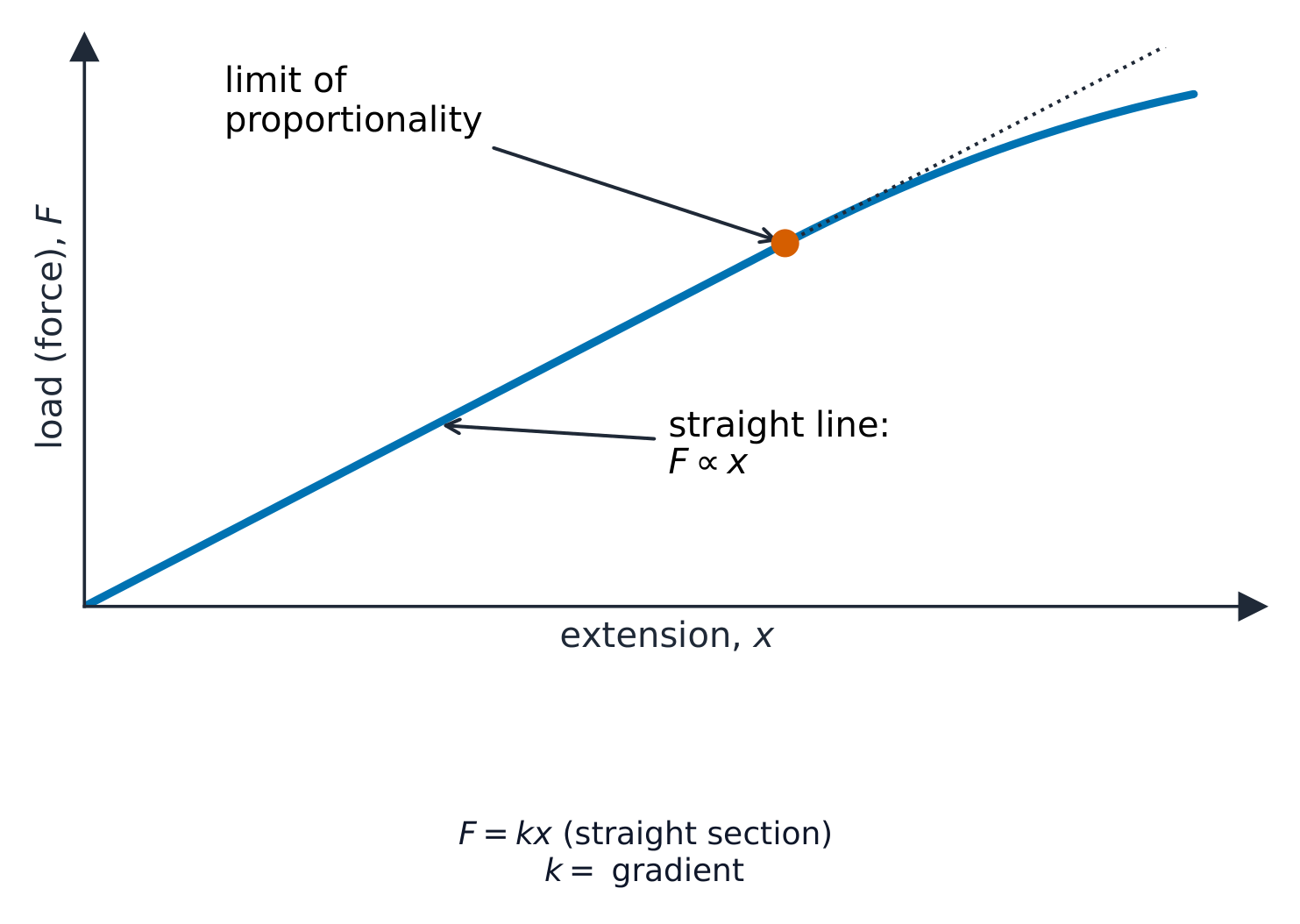
Finding $k$ in the lab. Hang different masses on the spring and measure each stretch $x$ from the spring's relaxed length. Plot the spring force $F=mg$ (vertical) against $x$ (horizontal). If the spring obeys Hooke's law, the points lie on a straight line through the origin, and the slope is $k$. A line that curves at large stretches shows the spring has gone past its limit of proportionality.
Explore
Stretch a spring (Hooke's law)
A spring's force is proportional to its extension, $F=kx$ (Hooke's law). Pull harder and the extension grows in step — until the spring's limit.
Vocabulary
Train
| English |
|---|
| restoring force/rɪˈstɔːrɪŋ fɔːs/ |
| Hooke's law/hʊks lɔː/ |
| spring constant/sprɪŋ ˈkɒnstənt/ |
2.9
Circular Motion
Syllabus
| Learning Objective | Essential Knowledge |
|---|---|
2.9.A |
|
2.9.B |
Boundary statement: AP Physics 1 only expects students to quantitatively analyze banked curves in which no friction is required to maintain uniform circular motion. Analysis of situations in which friction is required on a banked curve is limited to qualitative descriptions. Boundary statement: AP Physics 1 does not expect students to know Kepler's first or second laws of planetary motion. |
Source: College Board AP Course and Exam Description
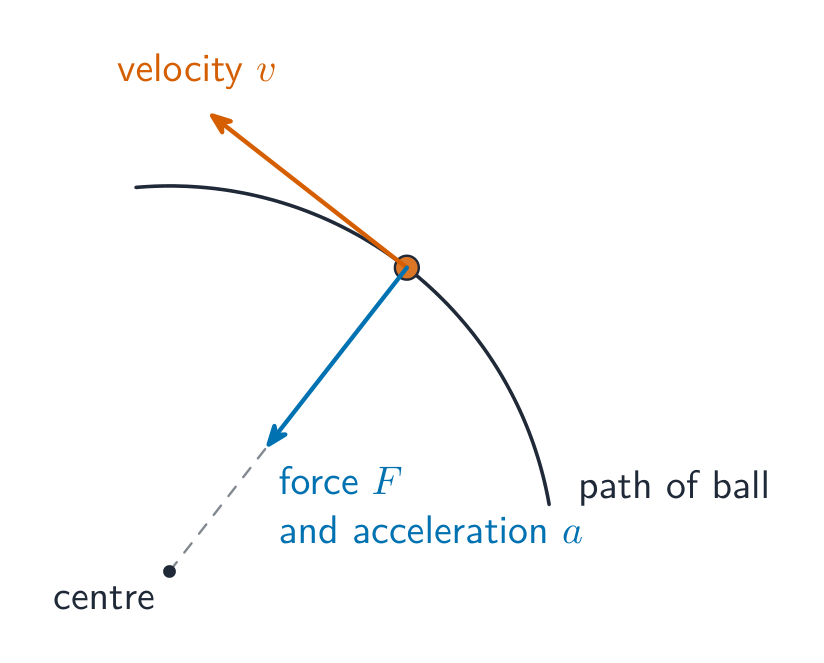
An object moving in a circle at constant speed still accelerates, because its velocity direction keeps changing. This centripetal acceleration 向心加速度 points toward the center:
$$a_c=\frac{v^2}{r}.$$
It is produced by a net inward (centripetal) force 向心力 $F_c=\dfrac{mv^2}{r}$ – supplied by whatever real force points inward (tension, gravity, friction, normal). The time for one full revolution is the period 周期 $T$, and the number of revolutions per second is the frequency 频率 $f$; they are reciprocals, $f = 1/T$, and the same definitions describe any rotation or oscillation.There is no separate outward force; "centrifugal" is only an apparent effect.
Worked example. A $0.30\ \text{kg}$ ball on a string is whirled in a horizontal circle of radius $0.80\ \text{m}$ at $4.0\ \text{m/s}$. Find the tension in the string. The tension supplies the whole centripetal force:
$$T=\frac{mv^2}{r}=\frac{0.30\times4.0^2}{0.80}=6.0\ \text{N}.$$
If the string can take at most $6.0\ \text{N}$, this is the fastest the ball can go at that radius – spin any faster and the string breaks.
Worked example (top of a vertical loop). A roller-coaster car goes over the inside top of a loop of radius $8.0\ \text{m}$. What is the slowest speed at which it stays on the track? At the top, both the weight and the normal force from the track point down, toward the center: $mg + N = \dfrac{mv^2}{r}$. The car is just about to lose contact when $N = 0$, so $mg = \dfrac{mv^2}{r}$:
$$v_{\min} = \sqrt{gr} = \sqrt{9.8 \times 8.0} = 8.9\ \text{m/s}$$
The mass cancels. Faster than this, the track must push down as well ($N > 0$); slower, gravity alone is more than enough inward force and the car falls away from the track.
Speeding up on a circle. If an object's speed along the circle changes, it also has a tangential acceleration 切向加速度, along the direction of motion. Its total acceleration is the vector sum of the centripetal part (towards the center, $v^2/r$) and the tangential part. A car speeding up as it rounds a bend has an acceleration that points forward and inward.
When a tilted force does the job. The centripetal force is often a component of a force:
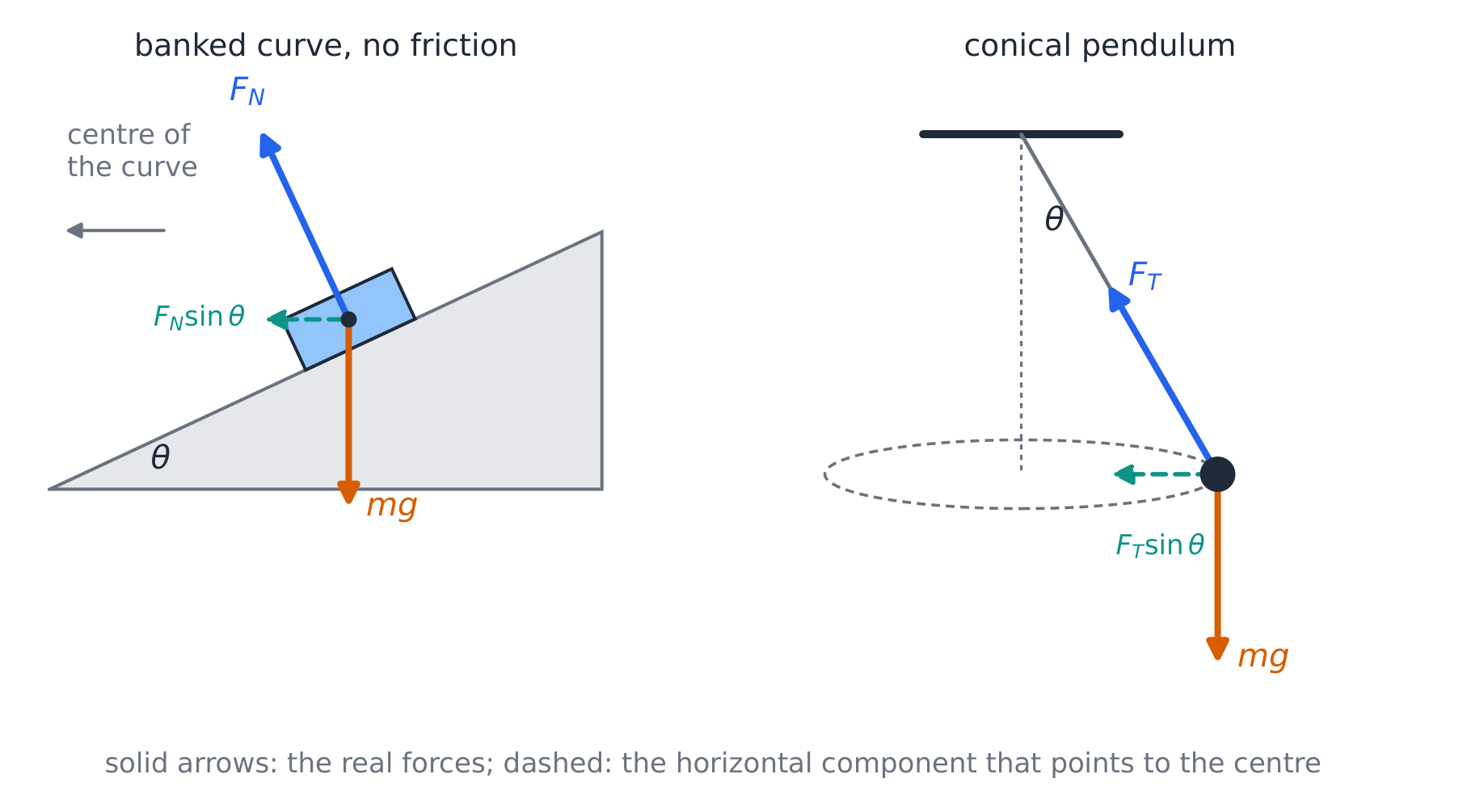
- Banked curve with no friction. Vertically, $F_N\cos\theta=mg$. Horizontally, $F_N\sin\theta=\dfrac{mv^2}{r}$. Dividing: $\tan\theta=\dfrac{v^2}{rg}$. A curve of radius 100 m banked at $\theta$ with $\tan\theta=0.25$ is safe at $v=\sqrt{0.25\times100\times10}\approx16$ m/s, even on ice.
- Conical pendulum. Vertically, $F_T\cos\theta=mg$. Horizontally, $F_T\sin\theta=\dfrac{mv^2}{r}$. So again $\tan\theta=\dfrac{v^2}{rg}$: the faster it swings, the larger the angle.
Orbits. For a satellite in a circular orbit, gravity alone supplies the centripetal force:
$$\frac{GMm}{r^2}=\frac{mv^2}{r}\ \Rightarrow\ v=\sqrt{\frac{GM}{r}}.$$
With $v=\dfrac{2\pi r}{T}$, the period is $T=2\pi\sqrt{\dfrac{r^3}{GM}}$. The satellite's own mass $m$ cancels, so a spacecraft of mass $2m$ in the same orbit has the same period. A larger orbit is slower and takes longer. The period $T$ and frequency $f=\dfrac1T$ also describe any uniform circular motion: $v=\dfrac{2\pi r}{T}$.
Explore
Around the circle
Sweep the angle and change the radius to see how position and direction change around a circle.
Vocabulary
Train
| English |
|---|
| centripetal acceleration/senˈtrɪpɪtl əkˌseləˈreɪʃn/ |
| net inward (centripetal) force/net ˈɪnwəd fɔːs/ |
| period/ˈpɪərɪəd/ |
| frequency/ˈfriːkwənsi/ |
| tangential acceleration/tænˈdʒenʃl əkˌseləˈreɪʃn/ |
2.9
Practice
Answer each before reading the answers below. Take $g=9.8\ \text{m/s}^2$.
- A $5.0\ \text{kg}$ box is pulled along a floor by a $30\ \text{N}$ horizontal force against $10\ \text{N}$ of friction. Find its acceleration.
- A $60\ \text{kg}$ person stands on a scale in an elevator accelerating upward at $2.0\ \text{m/s}^2$. What does the scale read?
- A block slides down a frictionless ramp inclined at $30°$. Find its acceleration.
- Blocks of $2.0\ \text{kg}$ and $3.0\ \text{kg}$ sit side by side on a frictionless floor. A $20\ \text{N}$ push acts on the $2.0\ \text{kg}$ block. Find the acceleration and the force between the blocks.
- A student says: "Newton's third-law forces are equal and opposite, so they cancel and nothing can ever accelerate." Correct the student.
2.9
Answers
- $a=\dfrac{30-10}{5.0}=4.0\ \text{m/s}^2$.
- $N-mg=ma$, so $N=60(9.8+2.0)=708\ \text{N}$. The scale reads more than the weight of $588\ \text{N}$.
- $a=g\sin30°=4.9\ \text{m/s}^2$.
- $a=\dfrac{20}{5.0}=4.0\ \text{m/s}^2$. The $3.0\ \text{kg}$ block is pushed only by the other block: $F=3.0(4.0)=12\ \text{N}$.
- A third-law pair acts on two different objects, so the two forces never appear in the same free-body diagram and cannot cancel. To decide whether one object accelerates, add only the forces acting on it.
2.9
Exam tips
- Always draw a free-body diagram first: only real forces on the chosen object (weight, normal, tension, friction, applied) — never an "$ma$" arrow.
- Apply $\sum F = ma$ one axis at a time; on an incline resolve gravity into $mg\sin\theta$ (along) and $mg\cos\theta$ (perpendicular).
- A Newton's third-law pair acts on two different objects — a book's weight and the table's normal force are not a pair (both act on the book).
- Static friction adjusts up to $\mu_s N$ (use it to test whether motion starts); once sliding, use kinetic friction $f_k=\mu_k N$.
- Circular motion needs a net inward (centripetal) force $mv^2/r$ supplied by a real force — there is no outward "centrifugal" force.
Common mistakes
- Writing $N = mg$ on a ramp, or when a force pulls up at an angle. Find $N$ from the perpendicular force equation each time.
- Pointing friction against the applied force instead of against the (tendency of) sliding. On a ramp it points up the slope for a block sliding down.
- Using $\mu_s N$ as the static friction force. $\mu_s N$ is only the maximum; below it, static friction equals whatever is needed to prevent sliding.
- Drawing a "centripetal force" arrow as an extra force on a free-body diagram. The centripetal force is the net inward part of the real forces (tension, gravity, normal, friction).
- Setting the tension equal to the hanging weight in a connected system that is accelerating. Tension equals the hanging weight only when the acceleration is zero.
- Thinking an astronaut in orbit is weightless because there is no gravity there. Gravity there is almost as strong as on the ground; the astronaut is in free fall.
- Thinking a heavier satellite needs a faster speed for the same orbit. The mass cancels.
- Saying a larger contact area gives more friction. Friction depends on the normal force and the materials, not on the area.
- Adding a third-law partner to the same free-body diagram. The partner force acts on the other object.
Interactive lessons on this topic
Work through it step by step, with instant-check exercises.