| Learning Objective | Essential Knowledge |
|---|---|
7.1.A |
|
Oscillations
AP Physics 1 · Topic 7
 7:48
Oscillations
Two identical springs, two identical masses. Pull one of them far down. Pull the other only a little. Let go of both at the same moment. Which one gets back…
English narration · English + 中文 subtitles burned in
7.1
Defining Simple Harmonic Motion
Syllabus
Source: College Board AP Course and Exam Description
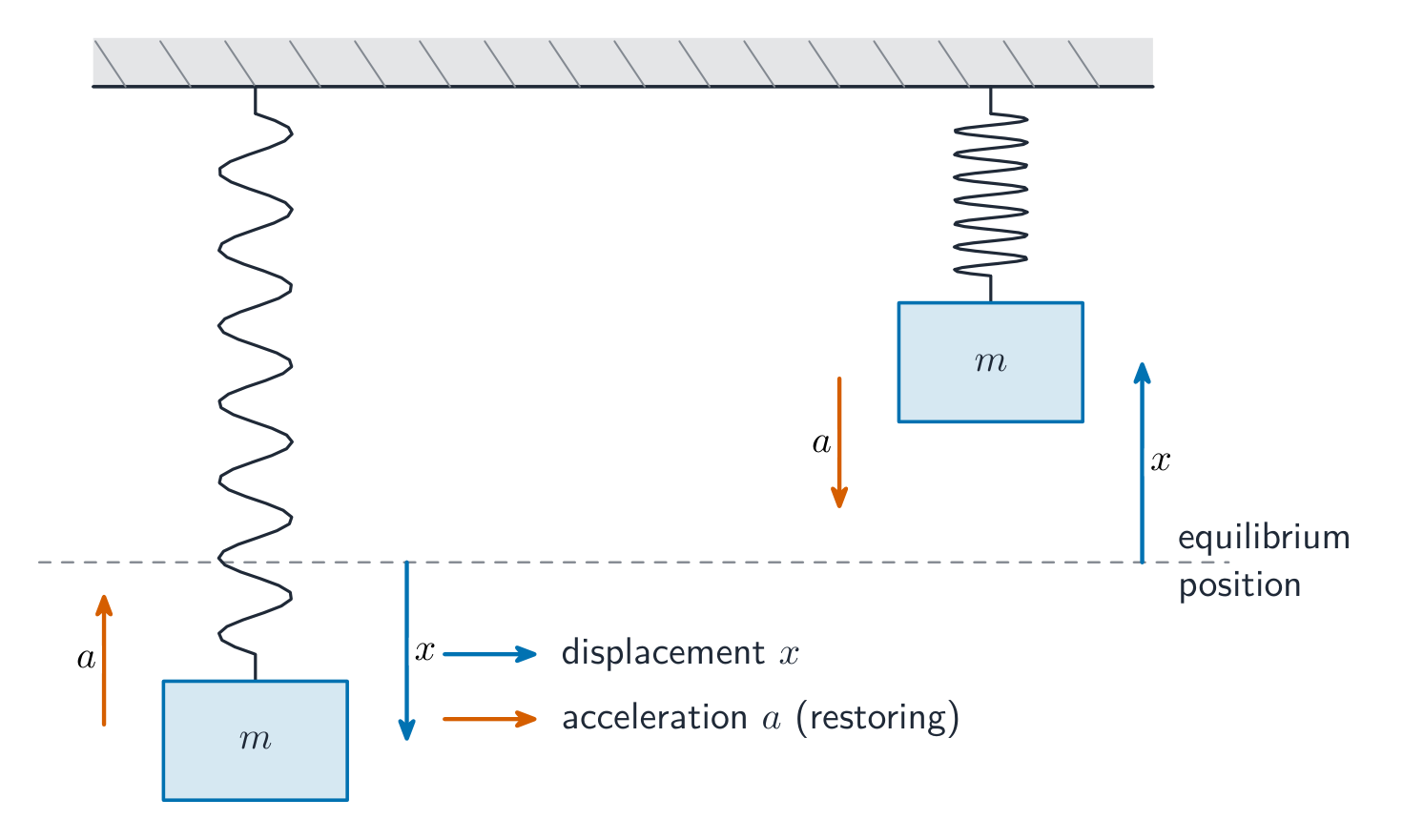
Simple harmonic motion 简谐运动 (SHM) is a back-and-forth oscillation 振动 caused by a restoring force 回复力 that is proportional 成正比 to the displacement 位移 from equilibrium and always points back toward it: $F=-kx$. A mass on a spring and (for small angles) a pendulum 单摆 are the standard examples. Because the force grows with displacement, the motion is smooth and repeating, tracing a sine curve in time.
SHM is a special case of periodic motion 周期性运动, any motion that repeats itself. A bouncing ball repeats, but it is not SHM: the force on it (gravity) does not grow with the distance from the middle. Two words matter here. The equilibrium position is where the net force is zero. A restoring force is one that always points back toward it, opposite to the displacement.
Here is the surprising part this unit explains. Push a child on a swing a little or a lot: the swing takes the same time to come back. A bigger swing travels further, but it also travels faster, and the two effects cancel exactly.
The test for SHM is exactly this: acceleration proportional to displacement and opposite in direction, $a=-\dfrac{k}{m}x$. A pendulum only obeys it for small swings, where $\sin\theta\approx\theta$; large swings are not quite SHM.
For a pendulum, think in terms of torque. About the pivot, gravity's restoring torque is $\tau=-mgL\sin\theta$. For small angles $\sin\theta\approx\theta$ (in radians), so the restoring torque is proportional to the angular displacement, $\tau\approx-mgL\,\theta$: that is the rotational version of $F=-kx$.
Explore
Restoring force grows with displacement
Stretch the spring and see the restoring force grow in proportion — the heart of SHM.
Vocabulary
Train
| English |
|---|
| Simple harmonic motion/ˈsɪmpl hɑːˈmɒnɪk ˈməʊʃn/ |
| oscillation/ˌɒsɪˈleɪʃn/ |
| restoring force/rɪˈstɔːrɪŋ fɔːs/ |
| proportional/prəˈpɔːʃənl/ |
| displacement/dɪˈspleɪsmənt/ |
| pendulum/ˈpendjʊləm/ |
| periodic motion/ˌpɪərɪˈɒdɪk ˈməʊʃn/ |
7.2
Frequency and Period of SHM
Syllabus
| Learning Objective | Essential Knowledge |
|---|---|
7.2.A |
|
Source: College Board AP Course and Exam Description
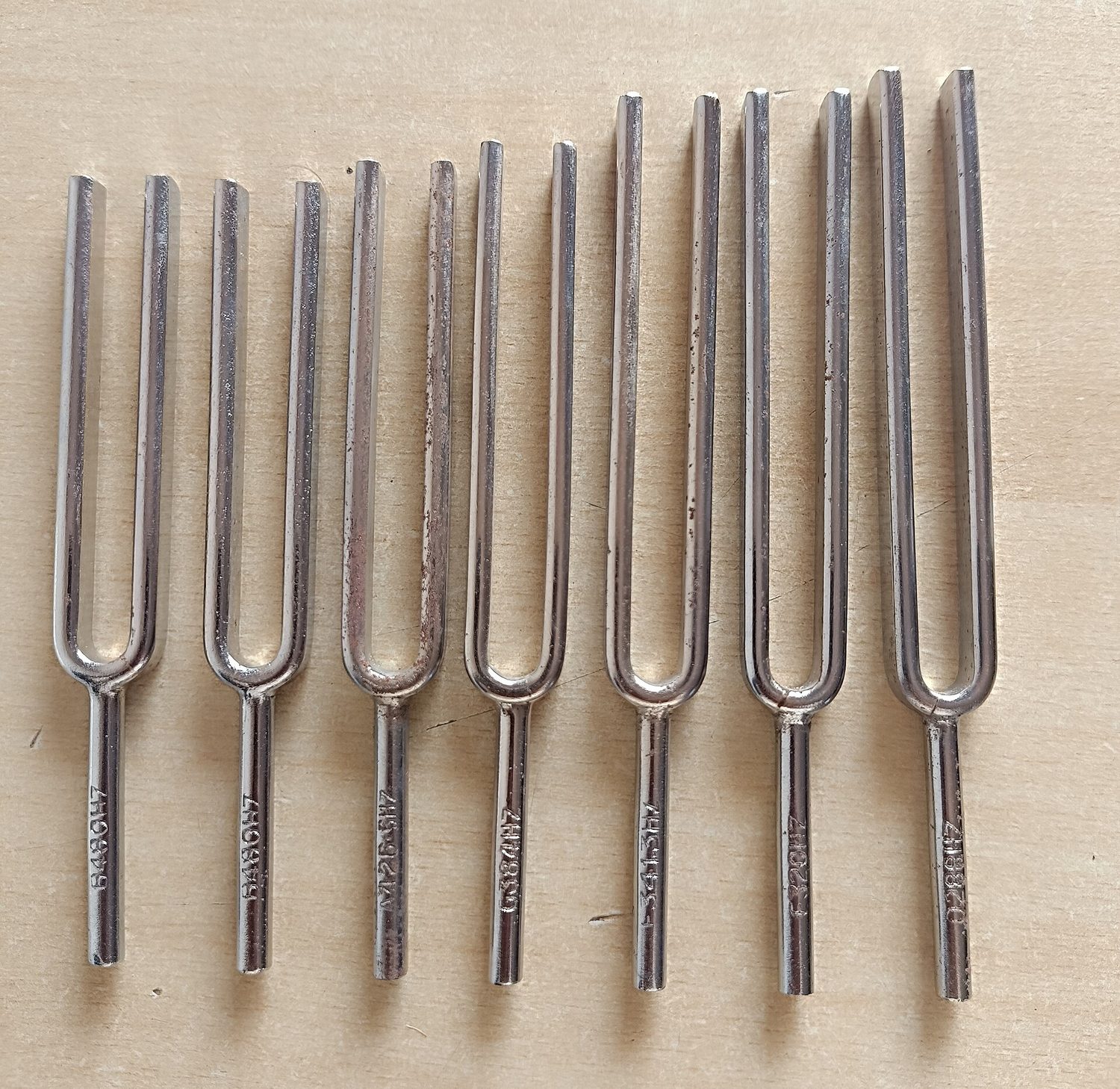
- The period 周期 $T$ is the time for one full cycle 循环.
- The frequency 频率 $f=\dfrac{1}{T}$ is cycles per second (hertz 赫兹).
For SHM these depend only on the system, not on the amplitude:
$$T_{\text{spring}}=2\pi\sqrt{\frac{m}{k}},\qquad T_{\text{pendulum}}=2\pi\sqrt{\frac{L}{g}}.$$
So a stiffer spring or smaller mass oscillates faster; a longer pendulum swings slower.
Worked example. A $0.25\ \text{kg}$ mass hangs on a spring of stiffness 劲度 $k=100\ \text{N/m}$. Its period is
$$T=2\pi\sqrt{\frac{m}{k}}=2\pi\sqrt{\frac{0.25}{100}}=0.31\ \text{s},\qquad f=\frac{1}{T}=3.2\ \text{Hz}.$$
Worked example. A pendulum clock ticks with a period of exactly $2.0\ \text{s}$. How long is it? Rearranging $T=2\pi\sqrt{L/g}$,
$$L=g\left(\frac{T}{2\pi}\right)^2=9.8\times\left(\frac{2.0}{2\pi}\right)^2=0.99\ \text{m}.$$
Notice the amplitude never entered – a wide or narrow swing keeps the same time, which is what makes pendulums good clocks.
Worked example (a stretchy pendulum on another planet). A pendulum hangs from a slightly elastic string. It is taken to Planet Y, which has the same radius as Earth but more mass, so $g$ is larger there. Can its period be longer and can it be shorter than on Earth?
- A larger $g$ on its own makes the period shorter, because $T\propto1/\sqrt g$.
- But the bob now pulls harder on the string. The elastic string stretches, so $L$ grows, and a longer pendulum has a longer period, because $T\propto\sqrt L$.
- Which effect wins depends on how much the string stretches. A stiff string barely stretches, so $T_Y<T_E$. A very stretchy one can lengthen enough that $T_Y>T_E$.
On a planet with the same mass but a larger radius, $g$ is smaller, so gravity does less work on the bob as it swings down from the same angle: $W=mgL(1-\cos\theta)$.
Explore
Time a pendulum's swing
A pendulum's period depends on its length and gravity, not its mass or (small) amplitude: $T=2\pi\sqrt{L/g}$. Lengthen it and each swing takes longer.
Vocabulary
Train
| English |
|---|
| period/ˈpɪərɪəd/ |
| cycle/ˈsaɪkl/ |
| frequency/ˈfriːkwənsi/ |
| hertz/hɜːts/ |
| stiffness/ˈstɪfnəs/ |
7.3
Representing and Analyzing SHM
Syllabus
| Learning Objective | Essential Knowledge |
|---|---|
7.3.A |
|
Source: College Board AP Course and Exam Description
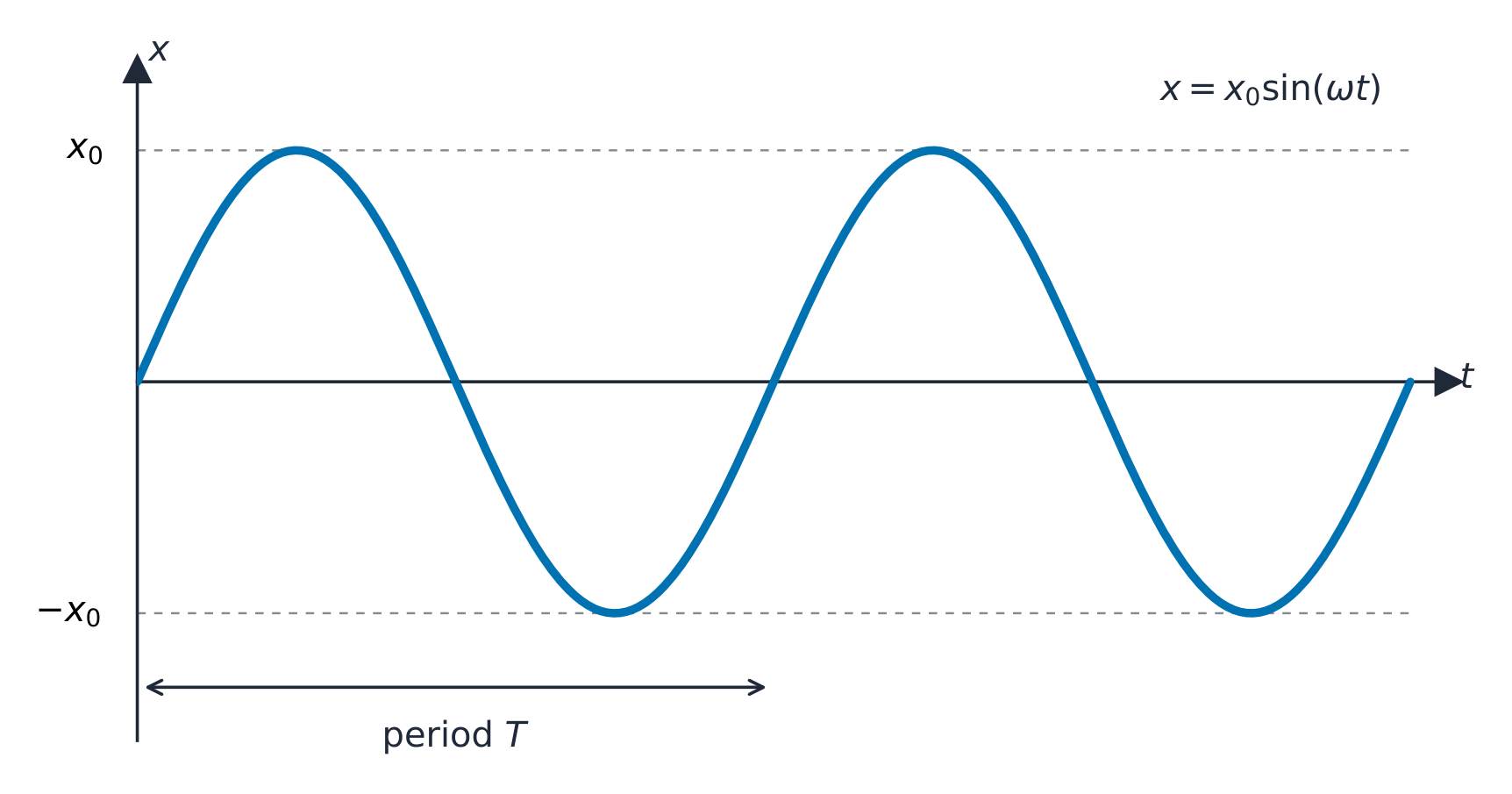
The displacement varies sinusoidally 按正弦规律: $x(t)=A\cos(\omega t)$ (or sine), where $A$ is the amplitude 振幅 (maximum displacement) and $\omega=2\pi f$ is the angular frequency 角频率. Reading the motion:
- At the extremes ($x=\pm A$): displacement and restoring force are maximum, so acceleration is maximum, but velocity is zero.
- At equilibrium 平衡 ($x=0$): force and acceleration are zero, but speed is maximum.
Velocity and acceleration are also sinusoidal, shifted in phase 相位 from the displacement – velocity leads displacement by a quarter cycle, and acceleration is exactly opposite to displacement.
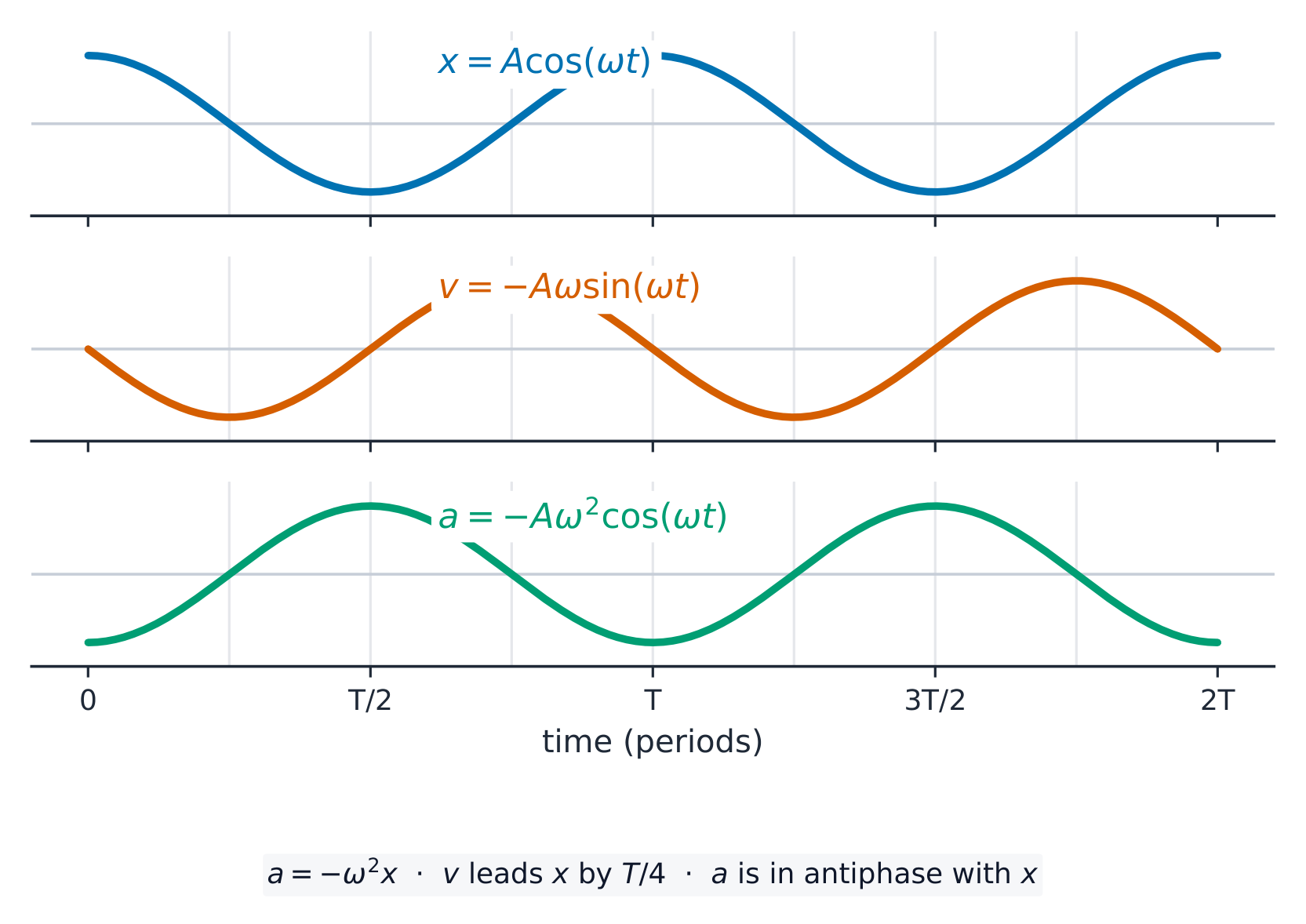
Read the figure as a story: where $x$ is largest (the turning point), $v$ has just fallen to zero and $a$ is at its most negative, hauling the mass back; a quarter-cycle later the mass races through the middle at top speed with zero acceleration.
Worked example (reading an $x$–$t$ graph). The graph shows a $0.50\ \text{kg}$ cart oscillating on a horizontal spring.

- Read the graph. Crest to crest takes $T = 0.40\ \text{s}$, so $f = 1/T = 2.5\ \text{Hz}$. The axis-to-crest height is $A = 0.10\ \text{m}$ (not the crest-to-trough height of $0.20\ \text{m}$).
- Spring constant. From $T = 2\pi\sqrt{m/k}$: $k = \dfrac{4\pi^2 m}{T^2} = \dfrac{4\pi^2(0.50)}{0.40^2} = 1.2\times10^2\ \text{N/m}$.
- Maximum speed. $v_{\max} = \omega A = \dfrac{2\pi A}{T} = \dfrac{2\pi(0.10)}{0.40} = 1.6\ \text{m/s}$, at Q, where the graph is steepest. Energy agrees: $\tfrac12 kA^2 = \tfrac12(123)(0.10)^2 = 0.62\ \text{J} = \tfrac12(0.50)v_{\max}^2$.
- At P ($x = -A$) the slope is zero, so $v = 0$; the spring pulls the cart back toward equilibrium, so the acceleration is positive and largest, $a = \dfrac{kA}{m} = 25\ \text{m/s}^2$.
- At Q the slope is positive, so the cart moves in the $+x$ direction at top speed with $a = 0$.
Reading a motion-detector graph. A $0.50\ \text{kg}$ object hangs from a vertical spring above a motion detector, is pulled down and released. The detector records its height against time, a sine curve about the equilibrium height.
- The spring constant. If the graph shows crests $0.75\ \text{s}$ apart, then $T=0.75\ \text{s}$ and $k=\dfrac{4\pi^2m}{T^2}=\dfrac{4\pi^2(0.50)}{0.75^2}=35\ \text{N/m}$.
- Same kinetic energy at two times. Where the curve has the same steepness (same size of slope), the object has the same speed, and so the same kinetic energy.
- Same potential energy at those times. If the object is at the same height at both times, the spring has the same stretch and the object the same height, so both the elastic and the gravitational potential energy are the same.
- A spring four times stiffer. The period halves, $T\propto1/\sqrt k$. The new equilibrium stretch $mg/k$ is a quarter as large, so the object hangs higher. Pulled down the same distance $d_0$, it has the same amplitude about this higher center line.
Explore
Position around a cycle
Step through the phase of the oscillation and see how position and energy vary across a cycle.
Vocabulary
Train
| English |
|---|
| sinusoidally |
| amplitude/ˈæmplɪtjuːd/ |
| angular frequency/ˈæŋɡjʊlə ˈfriːkwənsi/ |
| equilibrium/ˌiːkwɪˈlɪbrɪəm/ |
| phase/feɪz/ |
7.4
Energy of Simple Harmonic Oscillators
Syllabus
| Learning Objective | Essential Knowledge |
|---|---|
7.4.A |
|
Source: College Board AP Course and Exam Description
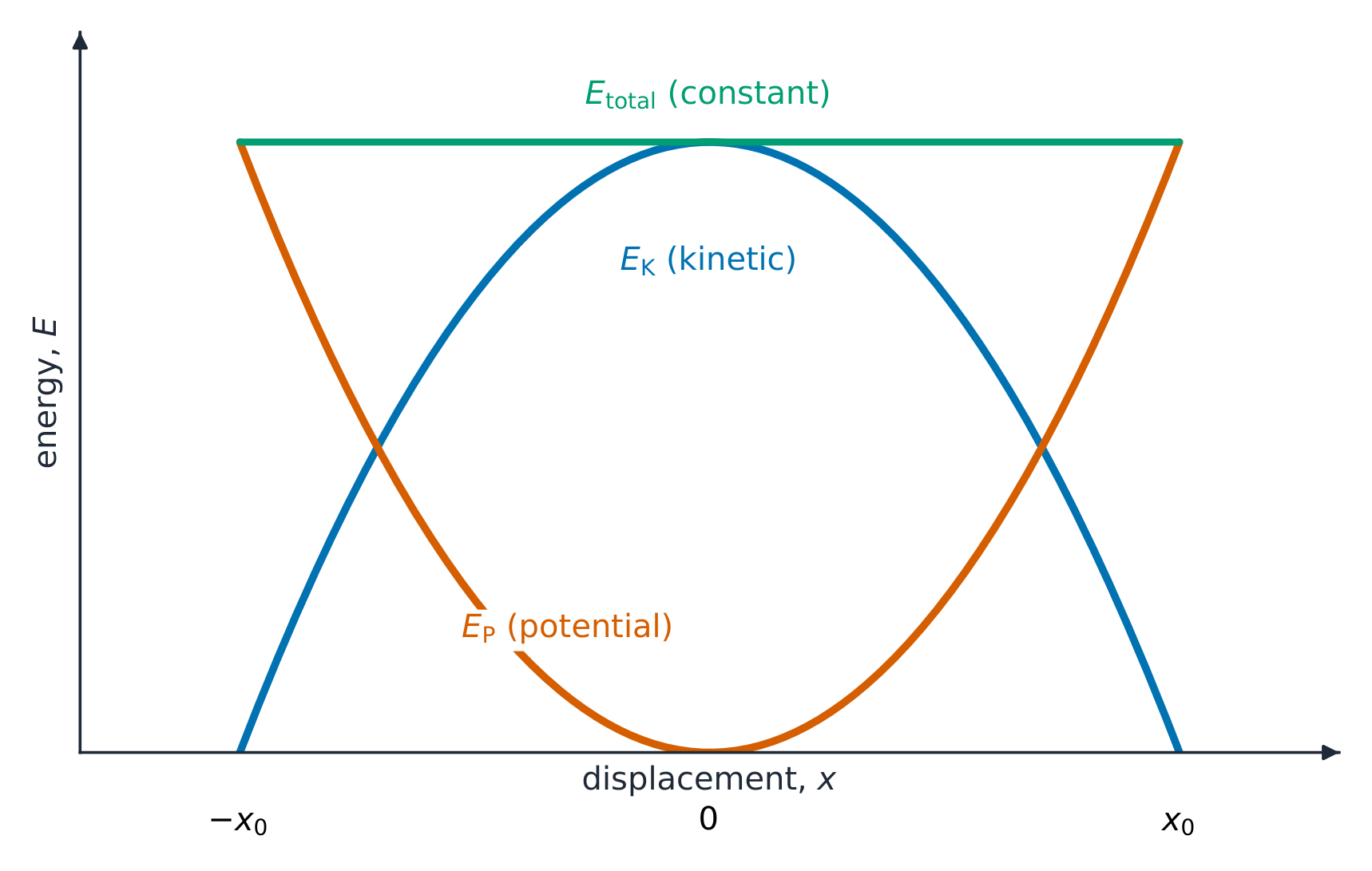
Energy sloshes between kinetic energy 动能 and potential energy 势能 while the total stays constant (no friction):
$$E=\tfrac{1}{2}kA^2 = \tfrac{1}{2}kx^2+\tfrac{1}{2}mv^2.$$
At the extremes it is all potential; at equilibrium it is all kinetic (maximum speed). Because $E\propto A^2$, doubling the amplitude quadruples the energy.
Worked example. A $0.50\ \text{kg}$ mass on a spring of stiffness $k=200\ \text{N/m}$ oscillates with amplitude $A=0.10\ \text{m}$. Find its maximum speed. All the energy is kinetic at the equilibrium point, so $\tfrac12 kA^2=\tfrac12 mv_{\max}^2$:
$$v_{\max}=A\sqrt{\frac{k}{m}}=0.10\times\sqrt{\frac{200}{0.50}}=0.10\times20=2.0\ \text{m/s}.$$
The energy method is faster than tracking the sine functions when you only need the greatest speed.
Worked example (speed at any position). For the same oscillator, find the speed at $x=0.050\ \text{m}$, half the amplitude. Energy is shared between the spring and the mass:
$$\tfrac12 kA^2=\tfrac12 kx^2+\tfrac12 mv^2\;\Rightarrow\;v=\sqrt{\frac{k}{m}\left(A^2-x^2\right)}=20\sqrt{0.0100-0.0025}=1.7\ \text{m/s}.$$
At half the amplitude the speed is already $87\%$ of the maximum: the mass slows down sharply only near the turning points 折返点.
Notice what the amplitude does and does not change. A larger amplitude means more energy, $E=\tfrac12kA^2$, and a larger maximum speed, but the same period. The kinetic energy always falls to zero at the turning points, whatever the amplitude.
Energy against energy. A graph of $K$ against $U$ for an oscillator is a straight line of slope $-1$: $K=E-U$ at every point. It crosses both axes at $E$, because when $U=0$ all the energy is kinetic, and when $K=0$ all of it is potential.
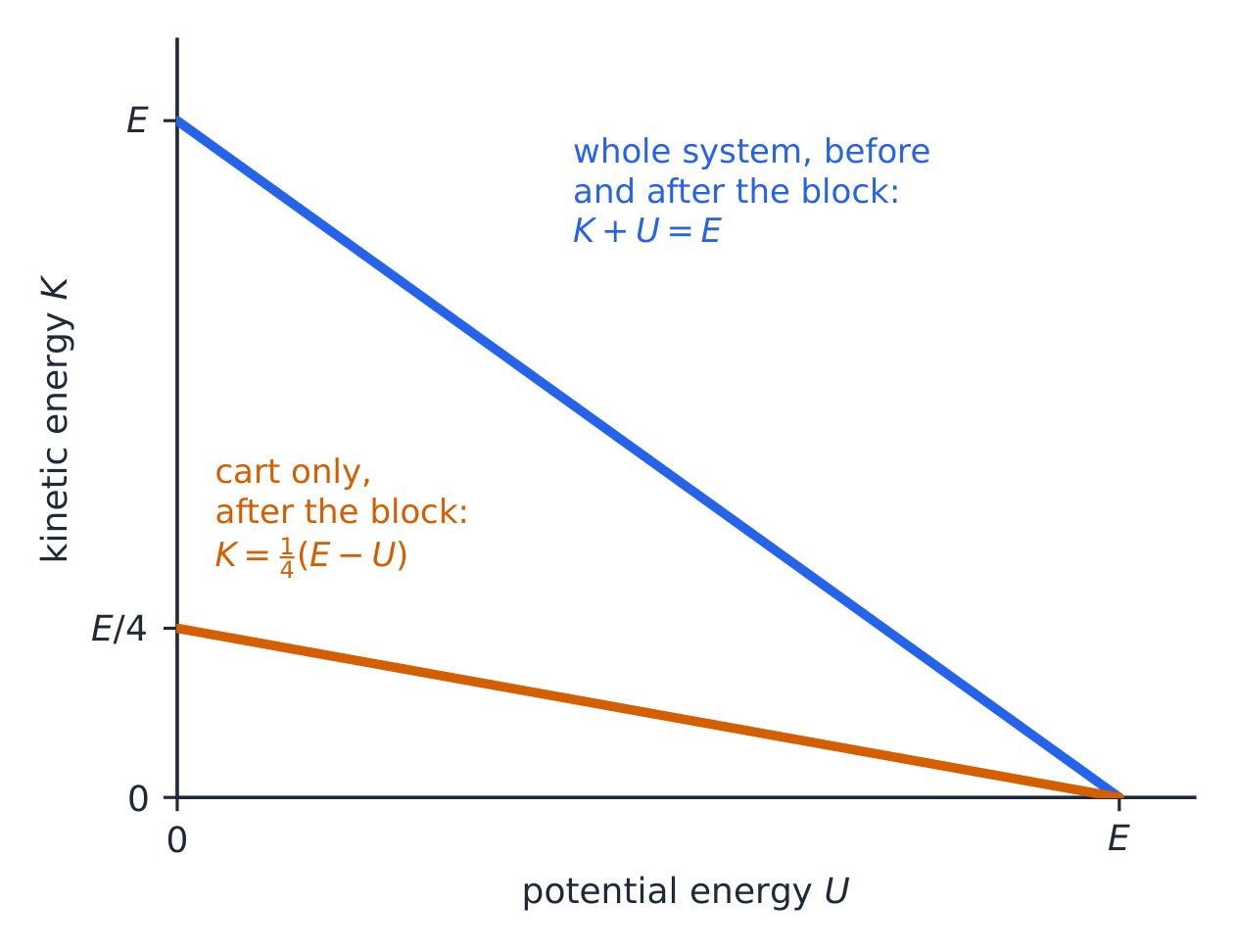
Worked example (a block dropped onto a cart: at the end, or in the middle?). A cart of mass $m_0$ oscillates on a spring between $x=+L$ and $x=-L$.
- Block of mass $3m_0$ dropped on at $x=+L$, where the cart is momentarily at rest. Nothing is moving, so no kinetic energy is lost when the block sticks. The amplitude stays $L$, the energy $E=\tfrac12kL^2$ is the same, and the system's $K$–$U$ line does not change. The mass is four times larger, so $\dfrac{f_2}{f_1}=\sqrt{\dfrac{m_0}{4m_0}}=\tfrac12$. The cart carries only a quarter of the moving mass, so its own kinetic energy is $\tfrac14$ of the total at every point: the lower line in the figure.
- Block of mass $2m_0$ dropped on at $x=0$, where the cart moves fastest. This is a sticking collision. Horizontal momentum is conserved: $m_0v=3m_0v'$, so $v'=\tfrac13v$. The kinetic energy becomes $\tfrac12(3m_0)\left(\tfrac13v\right)^2=\tfrac13\left(\tfrac12m_0v^2\right)$: two thirds of the energy is lost. Since $E=\tfrac12kA^2$, the new amplitude is $A/\sqrt3$, smaller than before. The period grows by $\sqrt3$.
Explore
Trade kinetic and potential energy in SHM
In simple harmonic motion, energy sloshes between kinetic (fastest at the centre) and potential (greatest at the extremes) while the total stays constant.
Vocabulary
Train
| English |
|---|
| kinetic energy/kɪˈnetɪk ˈenədʒi/ |
| potential energy/pəˈtenʃl ˈenədʒi/ |
| turning points/ˈtɜːnɪŋ pɔɪnts/ |
7.4
Vertical springs
Hang a $0.50\ \text{kg}$ mass on a spring with $k=200\ \text{N/m}$. It stretches until the spring force balances the weight: $k\,\Delta y=mg$, so $\Delta y=\dfrac{(0.50)(9.8)}{200}=0.025\ \text{m}$. Pull it down and let go, and it oscillates about this new equilibrium position.
- Gravity only moves the center of the oscillation. It does not change the period: $T=2\pi\sqrt{m/k}=0.31\ \text{s}$, exactly as on a horizontal track.
- Measure $x$ from the new equilibrium, not from the spring's unstretched length 原长, and every formula in this unit still works.
Vocabulary
Train
| English |
|---|
| unstretched length |
7.4
Finding k from an experiment

A laboratory question rarely hands you $k$. Instead you time oscillations for several hanging masses. Squaring the period formula gives
$$T^2=\frac{4\pi^2}{k}\,m,$$
so a graph of $T^2$ against $m$ should be a straight line through the origin 原点 with gradient 斜率 $4\pi^2/k$.
A straight line through the origin confirms T² ∝ m; the gradient gives the spring constant
Read the gradient from the best-fit line 最佳拟合线, not from one data point: $0.199\ \text{s}^2/\text{kg}$, so $k=\dfrac{4\pi^2}{0.199}=198\ \text{N/m}$. Time 10 oscillations and divide by 10: your reaction time 反应时间 is then spread across ten periods instead of one.
Vocabulary
Train
| English |
|---|
| origin/ˈɒrɪdʒɪn/ |
| gradient/ˈɡreɪdɪənt/ |
| best-fit line/best fɪt laɪn/ |
| reaction time/rɪˈækʃn taɪm/ |
7.4
Proportional reasoning
Many multiple-choice items change one quantity and ask what happens to the period. Read the power in the formula.
| Change | Formula | Effect on $T$ |
|---|---|---|
| mass on a spring ×4 | $T\propto\sqrt{m}$ | ×2 |
| spring constant ×4 | $T\propto1/\sqrt{k}$ | ×½ |
| pendulum length ×4 | $T\propto\sqrt{L}$ | ×2 |
| pendulum on the Moon ($g$ ÷ 6) | $T\propto1/\sqrt{g}$ | ×$\sqrt6\approx2.4$ |
| mass of a pendulum bob 摆锤 ×4 | $m$ is not in the formula | no change |
| amplitude ×2 | $A$ is not in the formula | no change |
Vocabulary
Train
| English |
|---|
| bob |
7.4
Practice
Answer each before reading the answers below. Take $g=9.8\ \text{m/s}^2$.
- A $0.20\ \text{kg}$ mass oscillates on a spring with $k=80\ \text{N/m}$. Find the period.
- The mass in question 1 is replaced by a $0.80\ \text{kg}$ mass. Find the new period without recalculating from the start.
- A pendulum has a period of $1.5\ \text{s}$ on Earth. Find its period on the Moon, where $g=1.6\ \text{m/s}^2$.
- A $0.50\ \text{kg}$ mass on a spring with $k=50\ \text{N/m}$ oscillates with amplitude $0.20\ \text{m}$. Find its maximum speed and its speed at $x=0.10\ \text{m}$.
- A student says: "If I double the amplitude, the mass travels twice as far, so the period doubles." Correct the student.
7.4
Answers
- $T=2\pi\sqrt{0.20/80}=2\pi(0.050)=0.31\ \text{s}$.
- The mass is 4 times larger and $T\propto\sqrt{m}$, so the period doubles: $0.63\ \text{s}$.
- $T\propto1/\sqrt{g}$, so $T=1.5\sqrt{9.8/1.6}=1.5(2.47)=3.7\ \text{s}$.
- $v_{\max}=A\sqrt{k/m}=0.20\sqrt{100}=2.0\ \text{m/s}$. At $x=0.10\ \text{m}$: $v=\sqrt{100\,(0.040-0.010)}=\sqrt{3.0}=1.7\ \text{m/s}$.
- The distance doubles, but so does the speed at every point, because $v_{\max}=A\sqrt{k/m}$. The two effects cancel, so the period, $2\pi\sqrt{m/k}$, does not change. Amplitude is not in the formula.
7.4
Exam tips
- Test for SHM: the acceleration must be proportional to the displacement and directed back toward the middle ($a=-\tfrac{k}{m}x$).
- The period does not depend on amplitude — use $T=2\pi\sqrt{m/k}$ (spring) or $T=2\pi\sqrt{L/g}$ (pendulum, small angles).
- Speed is maximum at the middle (all kinetic) and zero at the extremes (all potential); acceleration is largest at the extremes.
- Use energy ($\tfrac12 kA^2 = \tfrac12 kx^2 + \tfrac12 mv^2$) to find the maximum speed quickly: $v_{\max}=A\sqrt{k/m}$.
- Total energy $\propto A^2$, so doubling the amplitude quadruples the energy.
Common mistakes
- Saying the acceleration is zero at the turning points because the velocity is zero there. At $x = \pm A$ the restoring force, and so the acceleration, is largest.
- Making the period depend on amplitude, or on the mass of a pendulum bob. Neither appears in $T = 2\pi\sqrt{m/k}$ or $T = 2\pi\sqrt{L/g}$.
- Using the pendulum formula for a mass on a spring, or the reverse. A spring's period depends on $m$ and $k$; a pendulum's on $L$ and $g$.
- Measuring a vertical spring's displacement from its unstretched length. Measure from the new equilibrium position, where the spring force balances the weight.
- Calling one swing from one side to the other a full period. A period is a complete cycle: there and back.
- Reading $k$ from one data point instead of the gradient of a $T^2$–$m$ best-fit line.
- Assuming the amplitude stays the same whenever a block is added to an oscillating cart. Added at a turning point, it does; added at equilibrium, it is a sticking collision that loses energy, so the amplitude falls.
- Calling a bouncing ball SHM. It repeats, but its restoring force is not proportional to displacement.
- Saying a pendulum's period on a heavier planet must be shorter. That is true only if $L$ stays fixed; a stretchy string can lengthen enough to make it longer.
Interactive lessons on this topic
Work through it step by step, with instant-check exercises.