| Learning Objective | Essential Knowledge |
|---|---|
6.1.A |
|
Energy and Momentum of Rotating Systems
AP Physics 1 · Topic 6
 7:54
Energy and Momentum of Rotating Systems
Watch a skater spinning with her arms stretched out. She pulls them in — and suddenly she spins much faster. Nobody pushed her. No motor started. So where did…
English narration · English + 中文 subtitles burned in
6.1
Rotational Kinetic Energy
Syllabus
Source: College Board AP Course and Exam Description
Roll a full can of soup and an empty can down the same slope, side by side. One reaches the bottom clearly first. Which one, and why, is the kind of question this unit answers with energy and angular momentum, not with forces.
A spinning object has rotational kinetic energy 转动动能, the rotational twin of $\tfrac12 mv^2$:
$$K_{\text{rot}}=\tfrac{1}{2}I\omega^2.$$
An object that both moves and spins (like a rolling ball) has both translational kinetic energy 平动动能 and rotational kinetic energy, and its total is $K=\tfrac12 mv^2+\tfrac12 I\omega^2$, with $v$ the centre-of-mass 质心 speed and $I$ measured about the centre of mass.
Three facts follow from this formula.
- A spinning object can have kinetic energy while its center is at rest. A flywheel on a fixed axle does not go anywhere, but every point on it moves, so it stores energy.
- $\tfrac12I\omega^2$ is not a new kind of energy. Add up $\tfrac12mv^2$ for every small piece of the object, with $v=r\omega$, and you get $\tfrac12\left(\sum mr^2\right)\omega^2=\tfrac12I\omega^2$.
- Like all energy, rotational kinetic energy is a scalar: it has no direction.
Worked example (a rod swinging down). A rod with a sphere on its end has mass $M$ and length $L$, and its center of mass is $\tfrac34L$ from the axle. It is balanced pointing straight up, tapped, and swings down to point straight down. The center of mass falls from $\tfrac34L$ above the axle to $\tfrac34L$ below it, a drop of $\tfrac32L$, so the rod–sphere–Earth system gains
$$\Delta K=Mg\left(\tfrac32L\right)=\tfrac32MgL.$$
The rotational kinetic energy is greatest at the bottom, where the center of mass is lowest. If the Earth is not in the system, the answer is the same, but the reason changes: gravity is then an outside force that does positive work on the rod as its center of mass moves down.
Explore
Spin stores energy
Change how fast the angle sweeps to feel how spin rate feeds the rotational kinetic energy.
Vocabulary
Train
| English |
|---|
| rotational kinetic energy/rəʊˈteɪʃənl kɪˈnetɪk ˈenədʒi/ |
| translational kinetic energy/trænˈsleɪʃənl kɪˈnetɪk ˈenədʒi/ |
| centre-of-mass |
6.2
Torque and Work
Syllabus
| Learning Objective | Essential Knowledge |
|---|---|
6.2.A |
|
Source: College Board AP Course and Exam Description
A torque acting through an angular displacement does work 功, changing rotational kinetic energy:
$$W=\tau\,\Delta\theta,\qquad P=\tau\omega.$$
This is the rotational form of $W=Fd$ and $P=Fv$, and it extends the work–energy theorem 动能定理 to rotation.
Worked example. A motor applies a steady torque of $8.0\ \text{N m}$ to a flywheel 飞轮 while it turns through $10\ \text{rad}$. The work done is $W=\tau\,\Delta\theta=8.0\times10=80\ \text{J}$, and if the flywheel started from rest this all becomes rotational kinetic energy.
If the torque changes as the object turns, the work is the area under a graph of torque against angular position, just as linear work is the area under a force–position graph.
Worked example (pulling a string off a toy). A string of length $\ell_0$ is wrapped round the axle of a toy with rotational inertia $I_X$. A constant force $F_0$ pulls the string until it comes off. The force acts through a distance $\ell_0$, so it does work $F_0\ell_0$, and all of it becomes rotational kinetic energy:
$$F_0\ell_0=\tfrac12I_X\omega_X^2\;\Rightarrow\;\omega_X=\sqrt{\frac{2F_0\ell_0}{I_X}}.$$
A second toy with half the rotational inertia receives the same work, so it gets the same kinetic energy. With a smaller $I$, it needs a larger $\omega$ to hold that energy: $\omega_Y=\sqrt2\,\omega_X$.
Explore
Balance torques on a seesaw
Torque is force times perpendicular distance, $\tau = Fd$. The beam balances when the torques on each side are equal — move the forces and distances to find the balance point.
Vocabulary
Train
| English |
|---|
| work/wɜːk/ |
| work–energy theorem/wɜːk ˈenədʒi ˈθɪərəm/ |
| flywheel |
6.3
Angular Momentum and Angular Impulse
Syllabus
| Learning Objective | Essential Knowledge |
|---|---|
6.3.A |
|
6.3.B |
|
6.3.C |
Boundary statement: While AP Physics 1 expects that students can mathematically manipulate the magnitude of angular momentum using one-dimensional vector conventions, the direction of angular momentum and angular impulse is beyond the scope of the course. |
Source: College Board AP Course and Exam Description
Angular momentum 角动量 describes rotational motion. For a rigid body 刚体 rotating about a fixed principal axis, its component along that axis is:
$$L=I\omega.$$
A net torque acting over time delivers an angular impulse 角冲量 that changes it: $\tau_{\text{avg}}\,\Delta t=\Delta L$ – the rotational impulse–momentum theorem 冲量–动量定理.
Worked example (angular impulse). A motor applies a torque of $0.50\ \text{N m}$ for $4.0\ \text{s}$ to a wheel with $I=0.20\ \text{kg m}^2$, starting from rest. The angular impulse is $\tau\,\Delta t=2.0\ \text{kg m}^2/\text{s}$, so $\omega=\Delta L/I=2.0/0.20=10\ \text{rad/s}$.
The graph rules match the linear ones from the momentum unit. The angular impulse is the area under a graph of torque against time, and the net torque is the slope of a graph of angular momentum against time. For a fixed $I$, $\tau_{\text{net}}=\dfrac{\Delta L}{\Delta t}=I\dfrac{\Delta\omega}{\Delta t}=I\alpha$: the rotational form of Newton's second law.
Same angular momentum, different energy. A solid disk and a hoop of the same mass $M$ and radius $R$ are each turned by a string pulled with the same force $F_A$ for the same time $\Delta t$. Each receives the same angular impulse $F_AR\,\Delta t$, so each gains the same angular momentum $L$. But $K=\dfrac{L^2}{2I}$, and the disk has the smaller rotational inertia, so it gains more kinetic energy. In terms of work: the disk spins up faster, so its string is pulled through a longer distance in the same time, and the same force does more work on it.
A single small object moving in a straight line also has angular momentum about a chosen point: $L=mvr_\perp$, where $r_\perp$ is the perpendicular distance from the point to its line of motion. This is what lets a moving object set something spinning.
More generally, $L=rmv\sin\theta$, where $\theta$ is the angle between $\vec r$ (from the point to the object) and $\vec v$. The value depends on which point you choose. An object moving in a straight line at constant speed has constant angular momentum about any fixed point, because $r\sin\theta=r_\perp$ stays the same as it passes.
Explore
Spin carries angular momentum
Change the spin to feel how angular momentum L = Iω builds with faster rotation.
Vocabulary
Train
| English |
|---|
| Angular momentum/ˈæŋɡjʊlə məʊˈmentəm/ |
| rigid body/ˈrɪdʒɪd ˈbɒdi/ |
| angular impulse/ˈæŋɡjʊlə ˈɪmpʌls/ |
| impulse–momentum theorem/ˈɪmpʌls məʊˈmentəm ˈθɪərəm/ |
6.4
Conservation of Angular Momentum

Syllabus
| Learning Objective | Essential Knowledge |
|---|---|
6.4.A |
|
6.4.B |
|
Source: College Board AP Course and Exam Description
If the net external torque 合外力矩 on a system is zero, its total angular momentum is conserved 守恒:
$$I_1\omega_1=I_2\omega_2.$$
So if $I$ decreases, $\omega$ increases to keep $L$ constant – this is why a spinning skater speeds up when pulling their arms in. It applies to collisions 碰撞 and explosions 爆炸 of rotating systems too.
Worked example. A skater spins at $2.0\ \text{rev/s}$ with rotational inertia $I_1=4.0\ \text{kg m}^2$. She pulls her arms in, dropping her rotational inertia to $I_2=1.6\ \text{kg m}^2$. With no external torque, angular momentum is conserved:
$$\omega_2=\frac{I_1}{I_2}\,\omega_1=\frac{4.0}{1.6}\times2.0=5.0\ \text{rev/s}.$$
Her kinetic energy actually rises – the extra energy comes from the work her muscles do pulling her arms in against the outward pull.
The skater is a nonrigid system: she changes shape. Her angular speed changes although her angular momentum does not, because she moves mass closer to the axis. Only an outside torque can change the angular momentum of a system. Inside it, the angular impulses are equal and opposite (Newton's third law), so they cancel.
Check it with numbers. Writing $K=\dfrac{L^2}{2I}$, kinetic energy is inversely proportional 成反比 to $I$ when $L$ is fixed. Before: $\tfrac12(4.0)(4.0\pi)^2=316\ \text{J}$. After: $\tfrac12(1.6)(10\pi)^2=790\ \text{J}$, which is $2.5$ times as much, the same factor by which $I$ fell.
Worked example (a collision that starts a spin). A uniform rod of mass $1.2\ \text{kg}$ and length $0.80\ \text{m}$ hangs from a pivot at its top end, at rest. A $0.10\ \text{kg}$ lump of clay moving horizontally at $5.0\ \text{m/s}$ hits the bottom end and sticks. Find the angular velocity just after.
- About the pivot, gravity and the pivot force exert no torque during the brief collision, so angular momentum is conserved.
- Before: only the clay, $L=mvr=(0.10)(5.0)(0.80)=0.40\ \text{kg m}^2/\text{s}$.
- After: $I=\tfrac13(1.2)(0.80)^2+(0.10)(0.80)^2=0.256+0.064=0.320\ \text{kg m}^2$.
- $\omega=L/I=0.40/0.320=1.25\ \text{rad/s}$.
Linear momentum is not conserved here: the pivot pushes on the rod during the collision. Angular momentum about the pivot is, because that push passes through the pivot and has no torque.
Where should it hit, and does bouncing help? A disk of mass $m$ slides at $v_0$ and sticks to a rod pivoted at one end, a distance $x$ from the pivot. Its angular momentum about the pivot is $mv_0x$, so hitting farther from the pivot gives the rod more angular momentum, and more spin. Conservation gives
$$mv_0x=\left(I+mx^2\right)\omega\;\Rightarrow\;\omega=\frac{mv_0x}{I+mx^2}.$$
If the disk bounces back instead of sticking, its angular momentum changes from $+mv_0x$ to a negative value. That is a larger change, so by the third law the rod receives a larger angular impulse and spins faster than when the disk sticks.
Vocabulary
Train
| English |
|---|
| net external torque |
| conserved/kənˈsɜːvd/ |
| collisions/kəˈlɪʒnz/ |
| explosions/ekˈspləʊʒnz/ |
| inversely proportional/ɪnˈvɜːsli prəˈpɔːʃənl/ |
6.5
Rolling

Syllabus
| Learning Objective | Essential Knowledge |
|---|---|
6.5.A |
|
6.5.B |
|
6.5.C |
Boundary statement: Rolling friction is beyond the scope of AP Physics 1. Boundary statement: The precise mathematical relationships between linear and angular quantities while a rigid body is rolling while slipping are beyond the scope of AP Physics 1 and 2, and students will not be expected to model those relationships quantitatively. However, students are expected to qualitatively explain the changes to linear and angular quantities while a rigid body is rolling while slipping. |
Source: College Board AP Course and Exam Description
Rolling without slipping 纯滚动 links the translational and rotational motions: the contact point 接触点 is momentarily at rest, so
$$v=r\omega \qquad\text{and}\qquad a=r\alpha.$$
A rolling object's energy splits between translation and rotation, so on an incline 斜面 it accelerates more slowly than a frictionless sliding object – some energy goes into spin.
Worked example. For a solid disk ($I=\tfrac12 mR^2$) that rolls without slipping, what fraction of its kinetic energy is rotational? Using $v=R\omega$, the rotational part is $\tfrac12 I\omega^2=\tfrac12(\tfrac12 mR^2)\omega^2=\tfrac14 mv^2$, while the translational part is $\tfrac12 mv^2$. So the total is $\tfrac34 mv^2$ and the rotational share is $\tfrac{1/4}{3/4}=\tfrac13$. A hoop, with its mass farther out, stores half its energy in spin and rolls down a ramp even more slowly.
Friction in rolling. When an object rolls without slipping, the contact point is at rest for an instant, so static friction acts at a point that does not move: ideally it does no work and takes no energy from the system. Its job is to provide the torque that makes the object spin. When an object slips (skids), $v\ne r\omega$, the contact point slides over the surface, and kinetic friction turns some kinetic energy into thermal energy.
Worked example (a sphere pushed through its center). A plunger pushes a sphere with a force aimed at its center, from A to B, on a frictionless floor. The sphere then crosses a frictionless stretch B to C, a rough patch C to D, and a frictionless stretch D to E. Where does its angular velocity change?
- A to B: the push passes through the center, so it has no torque. The sphere slides without spinning.
- B to C: no horizontal force at all, so nothing changes.
- C to D: kinetic friction at the bottom acts backward, and it has a torque about the center. The sphere slows down and starts to spin. This is the only place $\omega$ changes.
- D to E: no friction again, so $v$ and $\omega$ both stay constant.
Wheel against block on a ramp. A wheel rolls down a ramp, with static friction equal to $40\%$ of the gravity component along the slope. Newton's second law along the slope gives $Ma=Mg\sin\theta-0.4\,Mg\sin\theta$, so $a=0.6\,g\sin\theta$. A block sliding down a frictionless ramp of the same angle reaches the bottom faster. In terms of forces: the net force down the slope is larger on the block. In terms of energy: the wheel's $Mgh$ is shared between translation and rotation, while all of the block's goes into translation.
A rolling cylinder and a block on a rough ramp can reach the bottom with the same speed. The cylinder puts part of its energy into spinning; the block loses part of its energy as thermal energy through kinetic friction. If those two parts are equal, the translational kinetic energy at the bottom is the same.
Energy graphs for a block turning a wheel. A block hangs from a string wound round a wheel on a fixed axle. As the block falls a distance $d$, the system loses $mgd$ of gravitational potential energy. The block gets part of it as translational kinetic energy; the rest is the wheel's rotational kinetic energy, the gap between the two lines below.
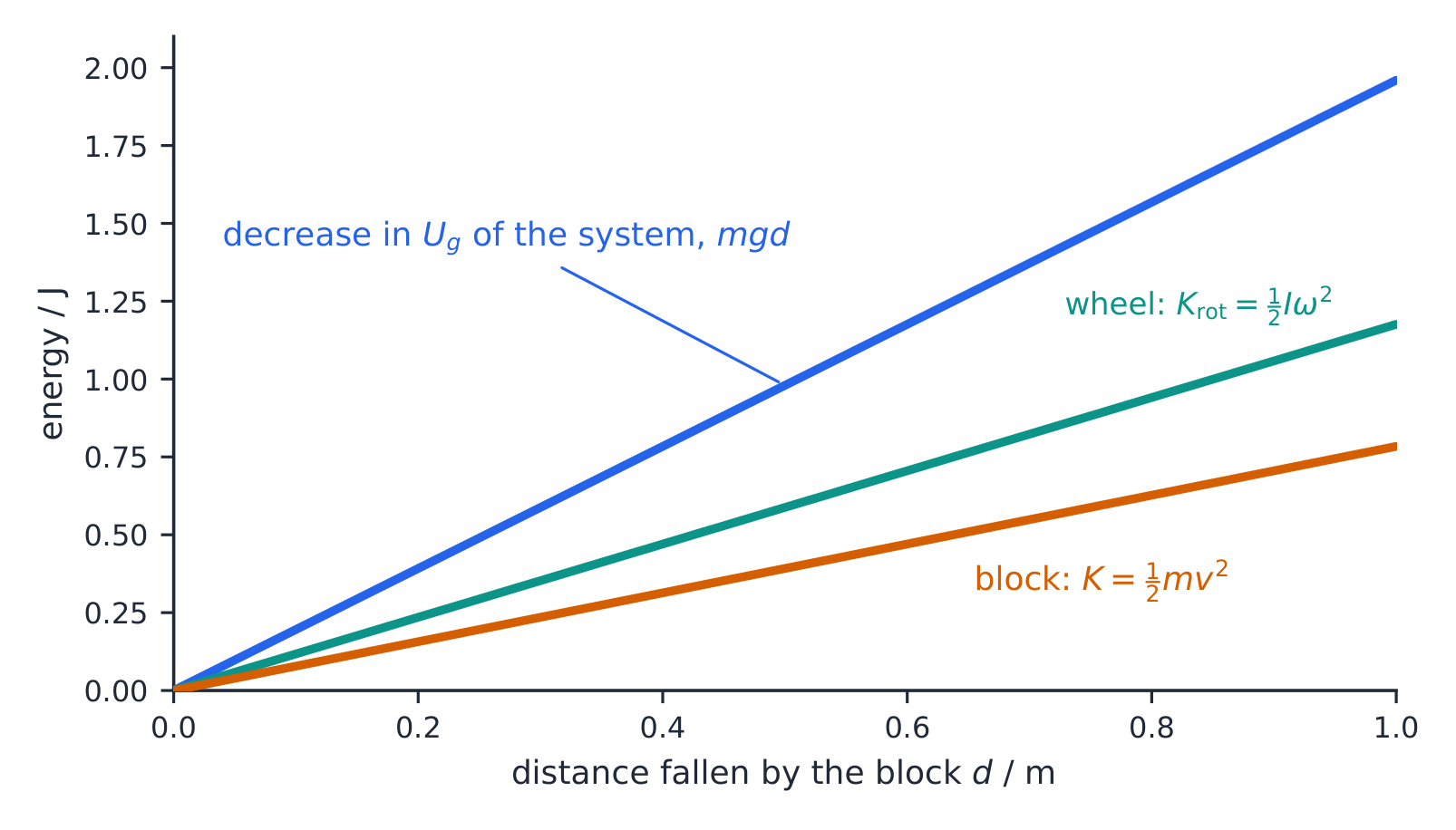
To measure the wheel's rotational inertia, record $\omega$ and $K_{\text{rot}}$ at several points and plot $K_{\text{rot}}$ against $\omega^2$. The points lie on a straight line through the origin with slope $\tfrac12I$, so $I=2\times\text{slope}$. A slope of $0.015\ \text{J s}^2$ gives $I=0.030\ \text{kg m}^2$.
Similarly, for a cylinder rolling down a ramp and then along a level floor, the total kinetic energy grows in a straight line with the distance travelled down the ramp ($K=mg\,s\sin\theta$), then stays constant along the floor.
Explore
Rolling without slipping
For a wheel that rolls without slipping, v = r omega. Sort each case.
Vocabulary
Train
| English |
|---|
| Rolling without slipping/ˈrəʊlɪŋ wɪˈðaʊt ˈslɪpɪŋ/ |
| contact point |
| incline/ɪnˈklaɪn/ |
6.5
The rolling race
Release several round objects from rest at the top of the same ramp, height $h$. Energy conservation with $v=R\omega$ gives
$$mgh=\tfrac12mv^2+\tfrac12I\omega^2=\tfrac12mv^2\left(1+\frac{I}{mR^2}\right)\;\Rightarrow\;v=\sqrt{\frac{2gh}{1+I/(mR^2)}}.$$
Neither mass nor radius appears on its own: only the shape factor 形状因子 $I/(mR^2)$ matters. For $h=1.2\ \text{m}$:
| Object | $I/(mR^2)$ | Speed at the bottom |
|---|---|---|
| block sliding without friction | 0 | $4.9\ \text{m/s}$ |
| solid sphere | 2/5 | $4.1\ \text{m/s}$ |
| solid disk (full can) | 1/2 | $4.0\ \text{m/s}$ |
| hoop (empty can, roughly) | 1 | $3.4\ \text{m/s}$ |
The full can wins against the empty one: less of its energy goes into spinning, so more goes into speed.
Vocabulary
Train
| English |
|---|
| shape factor |
6.6
Motion of Orbiting Satellites
Syllabus
| Learning Objective | Essential Knowledge |
|---|---|
6.6.A |
|
Source: College Board AP Course and Exam Description
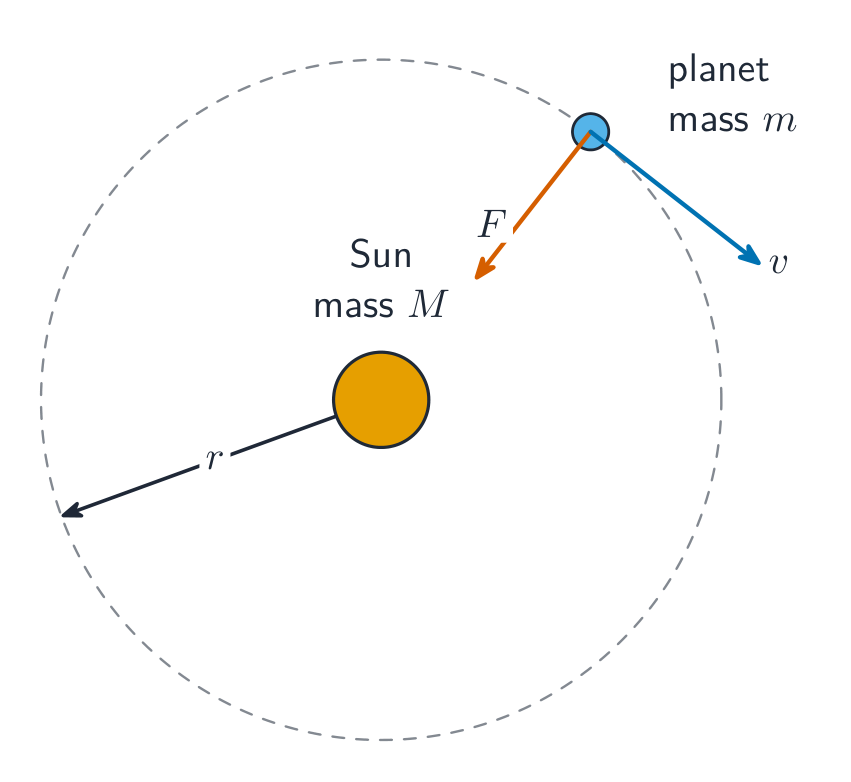
A satellite 卫星 in orbit 轨道 is in free fall 自由落体: gravity curves its path. For a circular orbit, gravity provides the centripetal force 向心力, so
$$\frac{GMm}{r^2}=\frac{mv^2}{r}\ \Rightarrow\ v=\sqrt{\frac{GM}{r}}.$$
So a larger orbit means a slower speed. For a circular orbit, angular momentum and mechanical energy 机械能 are both constant; for an elliptical 椭圆的 orbit, angular momentum is conserved (no torque about the planet) while speed varies – fastest when closest.
Worked example. Find the speed of a satellite in a low orbit just above the Earth, radius $r=6.4\times10^{6}\ \text{m}$, with $GM=4.0\times10^{14}\ \text{m}^3/\text{s}^2$:
$$v=\sqrt{\frac{GM}{r}}=\sqrt{\frac{4.0\times10^{14}}{6.4\times10^{6}}}=\sqrt{6.25\times10^{7}}\approx 7.9\times10^{3}\ \text{m/s},$$
about $7.9\ \text{km/s}$ – and notice that the satellite's mass cancels, so all low orbits share this speed.
Escape velocity 逃逸速度 is the launch speed that just lets an object leave for good: its total mechanical energy is exactly zero, so it slows to zero speed only at infinite distance. Setting $\tfrac12 mv^2 - \dfrac{GMm}{r}=0$ (using the general gravitational PE $U_g=-GMm/r$) and solving for $v$,
$$v_{\text{esc}}=\sqrt{\frac{2GM}{r}}.$$
It is $\sqrt2$ times the circular-orbit speed at the same radius, and (like orbital speed) does not depend on the escaping object's mass.
What stays constant in an orbit. When a satellite's mass is tiny compared with the planet's, the planet's own motion can be ignored. Gravitational potential energy is defined to be zero when the two are infinitely far apart, so for any orbit it is negative.
| Circular orbit | Elliptical orbit | |
|---|---|---|
| total mechanical energy of the system | constant | constant |
| satellite's angular momentum | constant | constant |
| gravitational potential energy | constant | changes |
| satellite's kinetic energy | constant | changes |
In an ellipse, as the satellite moves closer, $U_g$ becomes more negative and $K$ grows by the same amount. Angular momentum $L=mvr_\perp$ explains the same thing: a smaller $r_\perp$ needs a larger $v$.
Explore
Compare orbits at different radii
A satellite is in free fall, its gravity supplying the centripetal force. A larger orbit means a slower speed and a longer period — Kepler's third law.
Vocabulary
Train
| English |
|---|
| satellite/ˈsætəlaɪt/ |
| orbit/ˈɔːbɪt/ |
| free fall/friː fɔːl/ |
| centripetal force/senˈtrɪpɪtl fɔːs/ |
| mechanical energy/mɪˈkænɪkl ˈenədʒi/ |
| elliptical |
| Escape velocity/eˈskeɪp vəˈlɒsɪti/ |
6.6
Practice
Answer each before reading the answers below. Take $g=9.8\ \text{m/s}^2$.
- A flywheel with $I=2.0\ \text{kg m}^2$ spins at $30\ \text{rad/s}$. Find its rotational kinetic energy.
- A hoop and a solid disk of equal mass and radius roll from rest down the same ramp. Which reaches the bottom first? Explain without calculating.
- A skater spinning at $1.5\ \text{rev/s}$ reduces her rotational inertia from $3.0$ to $1.2\ \text{kg m}^2$. Find her new rate of spin.
- One satellite orbits at four times the radius of another. Compare their orbital speeds.
- A student says: "Angular momentum is conserved when the skater pulls her arms in, so her kinetic energy is conserved too." Correct the student.
6.6
Answers
- $K=\tfrac12(2.0)(30)^2=900\ \text{J}$.
- The disk. A hoop has all its mass at the rim, so a larger share of its energy goes into rotation and less into speed. The disk's shape factor is $\tfrac12$, the hoop's is 1.
- $\omega_2=\dfrac{3.0}{1.2}(1.5)=3.75\ \text{rev/s}$.
- $v\propto1/\sqrt{r}$, so the outer satellite moves at half the speed.
- With $L$ fixed, $K=L^2/2I$ rises as $I$ falls. Her muscles do work pulling her arms inward, and that work becomes the extra kinetic energy. Angular momentum is conserved; kinetic energy is not.
6.6
Exam tips
- Conserve angular momentum $L=I\omega$ when no external torque acts: a smaller $I$ (arms pulled in) gives a larger $\omega$.
- A rolling object splits its energy between $\tfrac12 mv^2$ and $\tfrac12 I\omega^2$, linked by $v=r\omega$ — so it accelerates down a ramp more slowly than a sliding one.
- For a circular orbit set gravity equal to the centripetal requirement: $v=\sqrt{GM/r}$, so a larger orbit is slower and the satellite's mass cancels.
- Pulling in raises the spin and the kinetic energy — the extra energy comes from the work done pulling inward; $L$ is unchanged.
- Watch which rotational quantity is conserved: $L$ (no torque) versus energy (no friction) are different conditions.
Common mistakes
- Leaving out rotational kinetic energy for a rolling object. Its total kinetic energy is $\tfrac12 mv^2 + \tfrac12 I\omega^2$, so it reaches the bottom of a ramp slower than a sliding block.
- Using $\omega$ in rev/s inside $\tfrac12 I\omega^2$. Change to rad/s first ($\times 2\pi$); in $I_1\omega_1 = I_2\omega_2$ any unit works, because it cancels.
- Saying a skater's kinetic energy stays the same when she pulls her arms in. Angular momentum stays the same; kinetic energy rises, supplied by the work her muscles do.
- Conserving linear momentum when an object hits a pivoted rod. The pivot exerts an external force; conserve angular momentum about the pivot instead.
- Thinking a heavier ball rolls down faster. For rolling from rest, only the shape factor $I/(mR^2)$ decides the speed.
- Writing that "there is no gravity" on an orbiting satellite. Gravity is the centripetal force; the satellite is in free fall.
- Saying static friction takes energy from a rolling object. Without slipping, the contact point does not move, so static friction does no work.
- Thinking that the same angular impulse gives the same kinetic energy. It gives the same angular momentum; the object with the smaller $I$ gets more energy.
- Saying a disk that sticks to a rod gives it more spin than one that bounces. Bouncing reverses the disk's angular momentum, so it gives the larger angular impulse.
- Saying the potential energy of a satellite in an elliptical orbit stays constant. Only the total energy and the angular momentum are constant.
Interactive lessons on this topic
Work through it step by step, with instant-check exercises.