| Learning Objective | Essential Knowledge |
|---|---|
3.1.A |
|
Work, Energy, and Power
AP Physics 1 · Topic 3
 8:07
Work, Energy, and Power
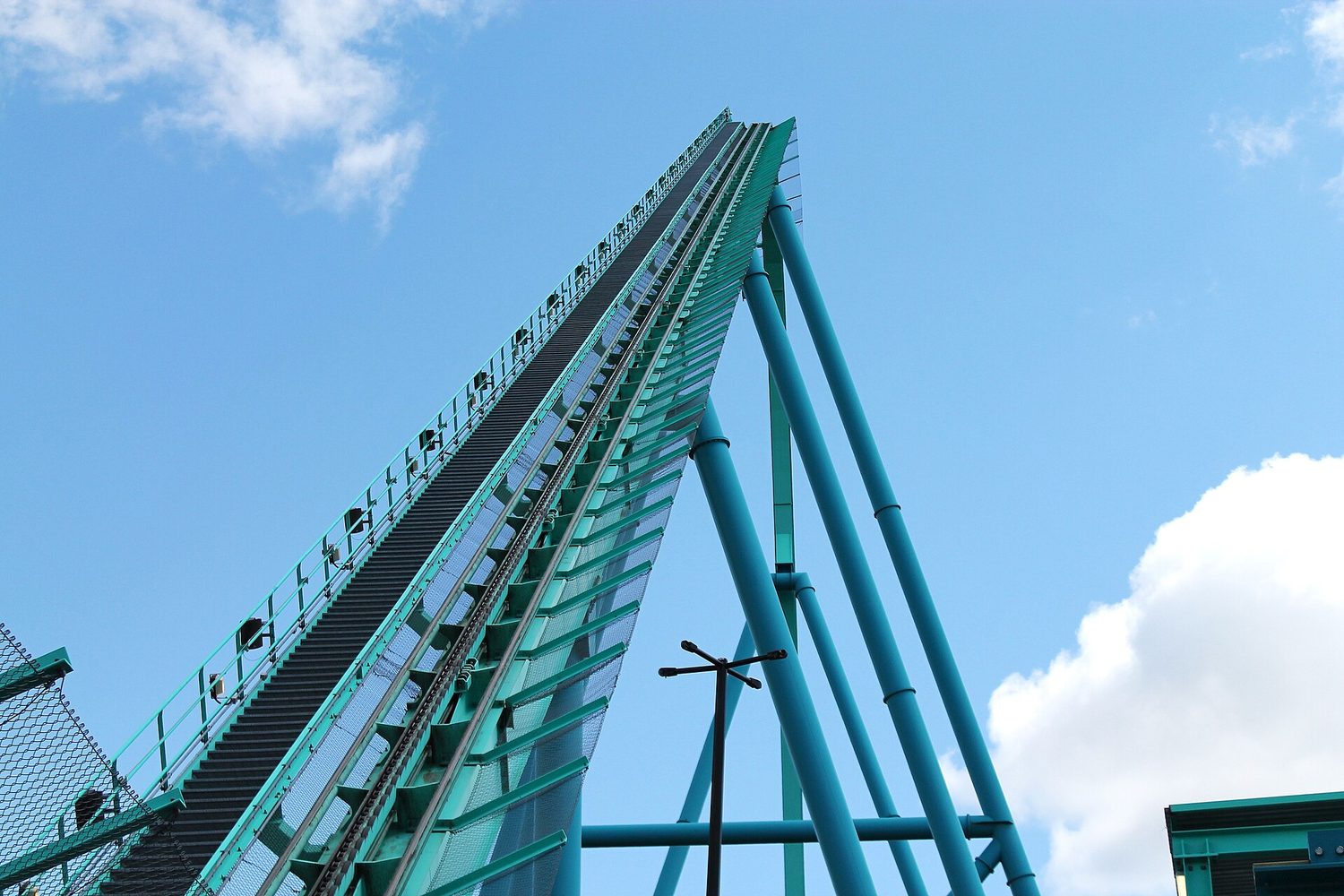
Look up at the first hill of a roller coaster. A chain drags the train to the top, then lets go. There is no engine on the train — nothing pushes it again for…
English narration · English + 中文 subtitles burned in
3.1
Translational Kinetic Energy
Syllabus
Source: College Board AP Course and Exam Description
A pole vaulter sprints, plants the pole, and rises over a bar five metres up. No engine lifts her. The speed she brought to the pole becomes bend in the pole, then height. This unit tracks energy as it moves between stores like these, and shows how to account for every joule.
Energy 能量 is the capacity to do work, measured in joules 焦耳 (J). A moving object has kinetic energy 动能:
$$K=\tfrac{1}{2}mv^2.$$
It depends on the square of the speed, so doubling the speed quadruples the kinetic energy. Kinetic energy is a scalar 标量 and is never negative.
Worked example. A $1500\ \text{kg}$ car travels at $20\ \text{m/s}$. Its kinetic energy is $K=\tfrac12\times1500\times20^2=3.0\times10^{5}\ \text{J}=300\ \text{kJ}$. If it speeds up to $40\ \text{m/s}$ (double), the kinetic energy becomes $4\times$ larger, $1200\ \text{kJ}$ – which is why stopping distance 制动距离 grows so fast with speed.
Kinetic energy depends on the frame. Speed is measured relative to an observer, so kinetic energy is too. A $70\ \text{kg}$ passenger sitting on a train moving at $30\ \text{m/s}$ has $K=0$ for someone on the train, but $K=\tfrac12(70)(30)^2=31.5\ \text{kJ}$ for someone on the platform. Both are correct; just use one frame for the whole problem.
A one-object system has only kinetic energy. Potential energy belongs to the interaction 相互作用 between two or more objects (a ball and the Earth, a block and a spring). If the system is a single object, it can store no potential energy, and the only way its energy changes is by outside forces doing work on it.
Explore
Energy grows as v squared
E_k = a·v² (here a = ½m)
Trace the quadratic curve of kinetic energy against speed and see how fast it climbs.
Vocabulary
Train
| English |
|---|
| Energy/ˈenədʒi/ |
| joules/dʒuːlz/ |
| kinetic energy/kɪˈnetɪk ˈenədʒi/ |
| scalar/ˈskeɪlə/ |
| stopping distance |
| interaction/ˌɪntəˈrækʃn/ |
3.2
Work
Syllabus
| Learning Objective | Essential Knowledge |
|---|---|
3.2.A |
Boundary statement: AP Physics 1 only expects students to analyze the transfer of mechanical energy (as defined in Unit 3, Topic 4: Conservation of Energy), although students should be aware that mechanical energy may be dissipated in the form of thermal energy or sound. In AP Physics 2, students will also study how thermal energy can be transferred between systems through heating or cooling. |
Source: College Board AP Course and Exam Description
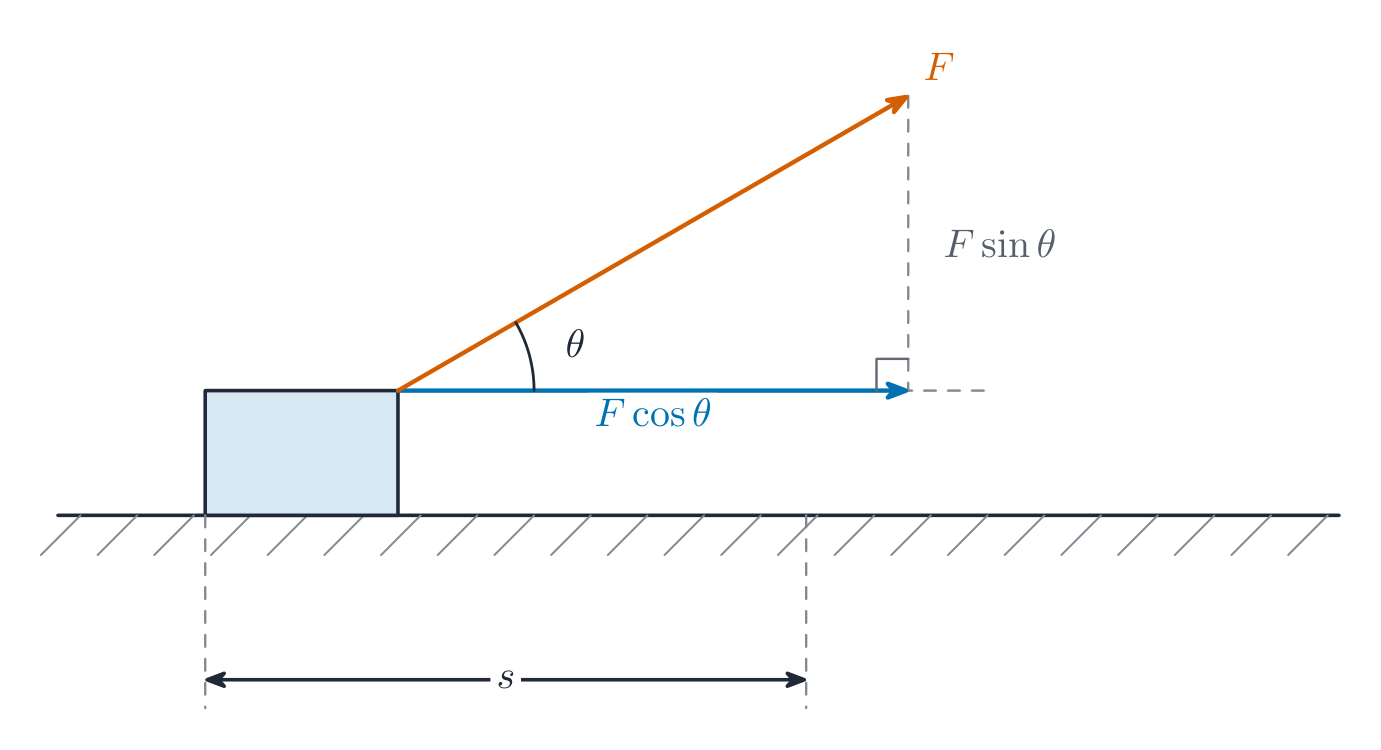
Work 功 is energy transferred by a force acting over a displacement 位移. For a constant force:
$$W=F\,d\cos\theta,$$
where $\theta$ is the angle between the force and the displacement. Work is positive when the force has a component along the motion (adds energy), negative when it opposes the motion (removes energy), and zero when the force is perpendicular 垂直. On a force–position graph, work is the area under the curve. The work–energy theorem 动能定理 states that the net work equals the change in kinetic energy: $W_{\text{net}}=\Delta K$.
Worked example. A $2.0\ \text{kg}$ block moving at $3.0\ \text{m/s}$ on a frictionless 无摩擦的 floor is pushed by a $5.0\ \text{N}$ force over $4.0\ \text{m}$ in the direction of motion. Find its final speed. The net work is $W=Fd=5.0\times4.0=20\ \text{J}$, and by the work–energy theorem $W=\tfrac12 m(v^2-v_0^2)$:
$$20=\tfrac12\times2.0\times(v^2-3.0^2)\;\Rightarrow\;v^2=29\;\Rightarrow\;v=5.4\ \text{m/s}.$$
A perpendicular force changes direction, not speed. If a force is always perpendicular to the velocity, it does no work, so $\Delta K=0$ and the speed stays constant. It can still change the direction of motion: this is exactly what the tension does on a ball whirled in a circle.
Worked example (twice the compression, how far does it slide?). A spring launches a block onto a rough floor, where the block slides a distance $d$ before stopping. The spring is now compressed twice as much. How far does the block slide?
- Energy stored: $U_s=\tfrac12kx^2$, so doubling $x$ gives $4\times$ the energy.
- On the rough floor, friction takes it all: $\tfrac12kx^2=\mu_k mg\,d$, so $d\propto x^2$.
- The block slides $4d$, not $2d$.
Exam questions often ask you to justify this kind of answer: say which quantity is squared, and write the equation that links it to the distance.
Explore
Work on a slope
Change the slope and mass to see how much work must be done to move the block along it.
Vocabulary
Train
| English |
|---|
| Work/wɜːk/ |
| displacement/dɪˈspleɪsmənt/ |
| perpendicular/ˌpɜːpənˈdɪkjʊlə/ |
| work–energy theorem/wɜːk ˈenədʒi ˈθɪərəm/ |
| frictionless/ˈfrɪkʃənləs/ |
3.3
Potential Energy
Syllabus
| Learning Objective | Essential Knowledge |
|---|---|
3.3.A |
|
Source: College Board AP Course and Exam Description
Potential energy 势能 is stored energy that depends on position or configuration:
- Gravitational potential energy 重力势能 near the surface: $U_g=mgh$ (height $h$ above a reference level 参考面).
- Elastic potential energy 弹性势能 in a spring: $U_s=\tfrac{1}{2}kx^2$.
Potential energy is defined only for conservative forces 保守力 (gravity, springs), for which the stored energy depends on position, not path. Only changes in potential energy matter, so you may put the zero level wherever is convenient.
Conservative forces and path. The work done by a conservative force between two points is the same for every path. Lift a book $1\ \text{m}$ straight up, or carry it round the room first: gravity does the same $-mg(1\ \text{m})$ of work. Around a closed path 闭合路径 (back to the start) a conservative force does zero total work. Friction is different: it does negative work on every part of the path, so a longer path loses more energy.
Total potential energy is a sum over pairs. Each pair of interacting objects has its own potential energy. For a block hanging on a spring near the Earth, the system's potential energy is $U=U_g+U_s$: one term for the block–Earth pair and one for the block–spring pair.
The $U_g=mgh$ form only holds near a surface where $g$ is roughly constant. The general form, for two spherical masses a distance $r$ apart, is
$$U_g=-\frac{G m_1 m_2}{r}.$$
It is negative and defined to be zero at infinite separation, so gravitational PE rises toward zero as the masses move apart. $mgh$ is simply its near-surface approximation. (This is the form you need for satellites 卫星 and escape speed 逃逸速度.)
Explore
Store elastic potential energy in a spring
Stretching a spring stores elastic potential energy $\tfrac12 kx^2$ — the area under the force-extension line. Release it and that energy becomes kinetic.
Vocabulary
Train
| English |
|---|
| Potential energy/pəˈtenʃl ˈenədʒi/ |
| Gravitational potential energy/ˌɡrævɪˈteɪʃənl pəˈtenʃl ˈenədʒi/ |
| reference level |
| Elastic potential energy/ɪˈlæstɪk pəˈtenʃl ˈenədʒi/ |
| conservative forces/kənˈsɜːvətɪv ˈfɔːsɪz/ |
| closed path |
| satellite/ˈsætəlaɪt/ |
| escape speed |
3.4
Conservation of Energy
Syllabus
| Learning Objective | Essential Knowledge |
|---|---|
3.4.A |
|
3.4.B |
|
3.4.C |
Boundary statement: AP Physics 1 expects students to know that mechanical energy can be dissipated as thermal energy or sound by nonconservative forces. |
Source: College Board AP Course and Exam Description
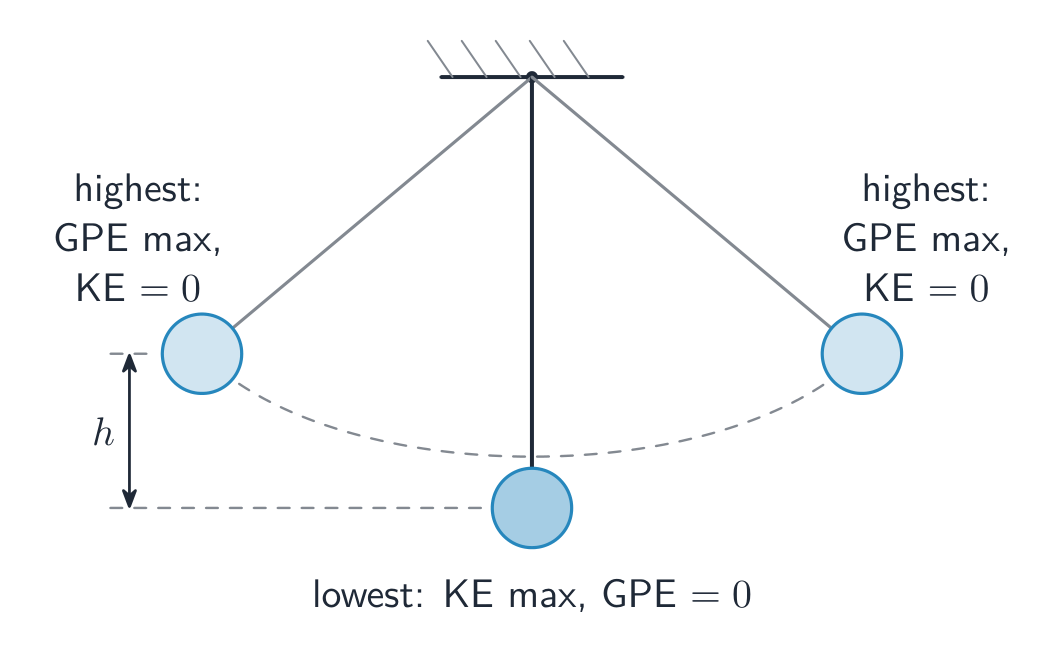
The total mechanical energy 机械能 is $E=K+U$. When only conservative forces do work, mechanical energy is conserved 守恒:
$$K_1+U_1=K_2+U_2.$$
Friction 摩擦力 can transfer mechanical energy to thermal energy 热能. Other non-conservative forces 非保守力 can add mechanical energy as well. Total energy is conserved when all stores and transfers across the chosen system boundary are included. Energy bar charts are a good way to track where the energy goes.
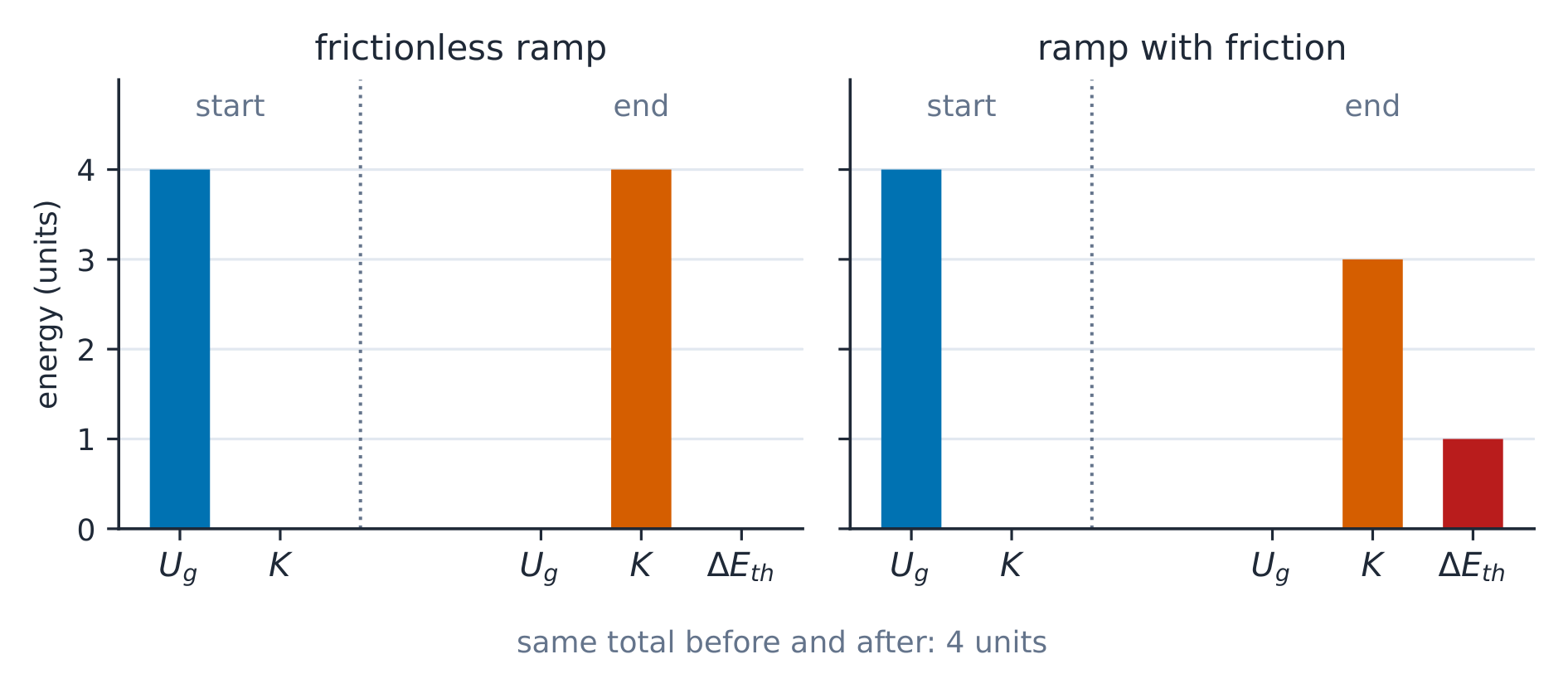
Energy bar charts: friction moves one unit into thermal energy, but the total stays four
An energy bar chart 能量柱状图 shows each store at the start and the end. The bars must add to the same total, unless work, heat or another energy transfer crosses the system boundary. Draw the chart before writing an equation: the equation is then just the chart in symbols, $U_{g1}=K_2+\Delta E_{th}$.
Energy against position. Free-response questions often ask you to sketch each energy store against position. Take a $0.50\ \text{kg}$ block hung on an unstretched spring ($k=50\ \text{N/m}$) and released from rest. Choose the system block + spring + Earth and the start as zero for both potential energies. As the block falls a distance $d$:
- $U_g=-mgd$ is a straight line going down;
- $U_s=\tfrac12kd^2$ is a parabola going up;
- $K$ is whatever is left, because the total stays $0$.
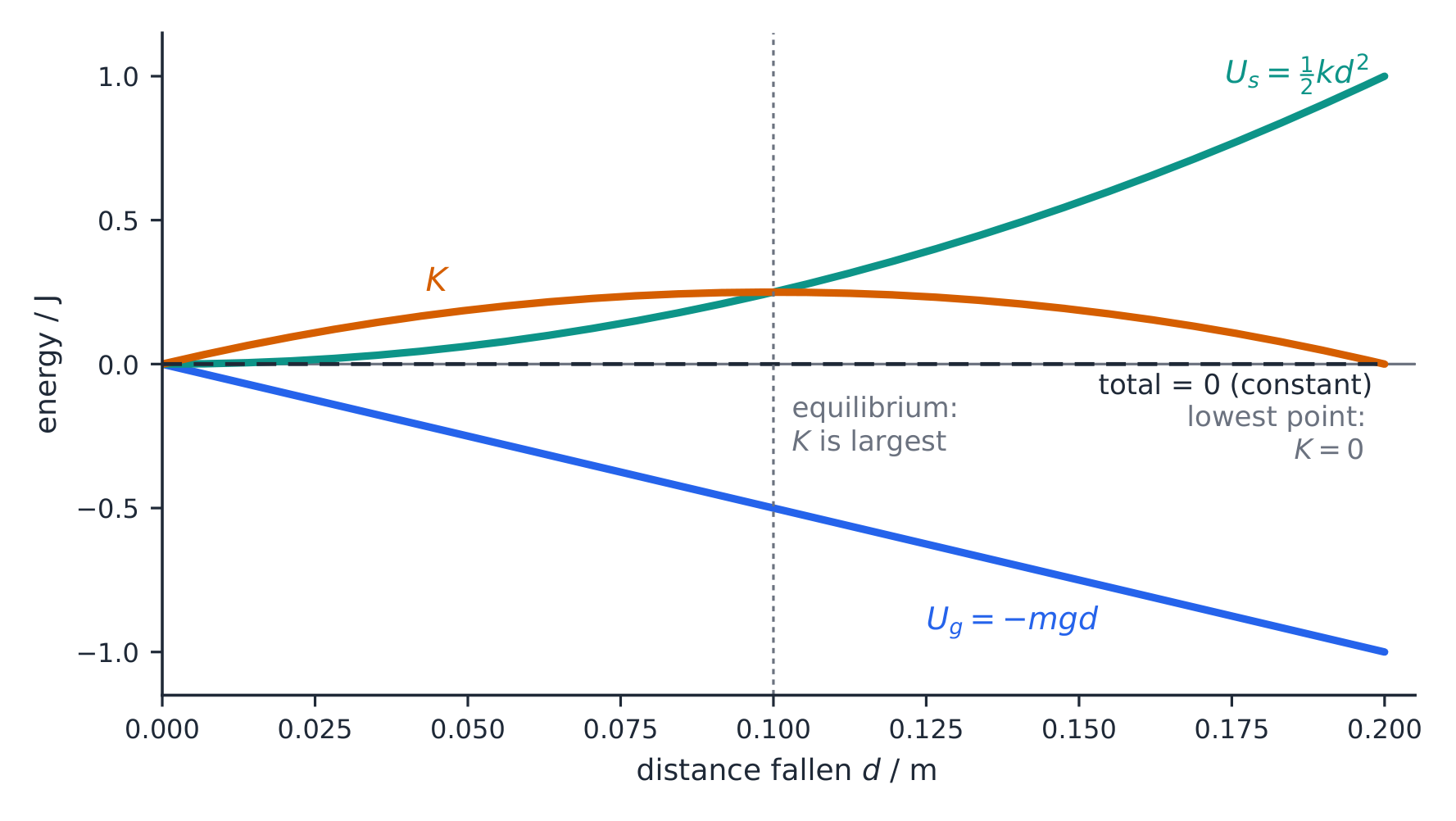
Kinetic energy is largest where the forces balance ($mg=kd$, at $d=0.10\ \text{m}$), and the block stops at $d=0.20\ \text{m}$, twice that distance. On a graph of $K$ against $U$ for a system with constant total energy $E$, the line is $K=E-U$: a straight line of slope $-1$.
Worked example. A ball is released from rest at the top of a frictionless ramp $5.0\ \text{m}$ high. Find its speed at the bottom. All the gravitational potential energy becomes kinetic energy:
$$mgh=\tfrac12 mv^2\;\Rightarrow\;v=\sqrt{2gh}=\sqrt{2\times9.8\times5.0}=9.9\ \text{m/s}.$$
The mass cancels, so every object reaches the same speed – exactly the free-fall result, now got from energy. If instead $30\ \text{J}$ were lost to friction, you would subtract it: $mgh-30=\tfrac12 mv^2$.
Explore
Watch energy convert as an object falls
With no friction, mechanical energy is conserved: as an object falls, gravitational potential energy turns into kinetic energy while the total stays fixed.
Vocabulary
Train
| English |
|---|
| total mechanical energy/ˈtəʊtl mɪˈkænɪkl ˈenədʒi/ |
| conserved/kənˈsɜːvd/ |
| friction/ˈfrɪkʃn/ |
| thermal energy/ˈθɜːml ˈenədʒi/ |
| non-conservative force |
| energy bar chart |
3.4
Choosing the system for energy
The most common error in this unit is counting gravity twice. Decide first whether the Earth is inside the system 系统.
- Earth inside the system: gravity is an internal force 内力, so you use gravitational potential energy $U_g=mgh$. Gravity does no "outside" work.
- Earth outside the system: there is no $U_g$; instead gravity does work on the object, $W_g=-mg\,\Delta h$.
Both give the same answer. Using $U_g$ and $W_g$ together counts the same energy twice. For a $10\ \text{kg}$ box lifted $5.0\ \text{m}$ at constant speed, the person does $490\ \text{J}$ of work, not $980\ \text{J}$.
Choose the system to make energy constant. If every force that does work is internal (gravity with the Earth inside, a spring with the spring inside) and there is no friction, the system's total energy is constant. When a question says "use conservation of energy", pick that system and write $E_{\text{start}}=E_{\text{end}}$. When an outside force does work, the change in the system's energy equals that work: $\Delta E=W_{\text{ext}}$.
Vocabulary
Train
| English |
|---|
| system/ˈsɪstəm/ |
| internal force/ɪnˈtɜːnl fɔːs/ |
3.4
Work from a force–displacement graph
When the force changes, $W=Fd$ no longer works directly. Instead, work is the area under a force–displacement graph. A spring's force grows steadily, $F=kx$, so the graph is a triangle with area $\tfrac12(kx)(x)=\tfrac12kx^2$. That is where the elastic potential energy formula comes from.
Worked example (spring launcher). A spring with $k=200\ \text{N/m}$ is compressed by $0.10\ \text{m}$ and launches a $0.050\ \text{kg}$ ball straight up. Ignore friction and the small height change while the spring extends.
- Energy stored: $U_s=\tfrac12(200)(0.10)^2=1.0\ \text{J}$.
- Launch speed: $\tfrac12(0.050)v^2=1.0$, so $v=\sqrt{40}=6.3\ \text{m/s}$.
- Highest point: $(0.050)(9.8)h=1.0$, so $h=2.0\ \text{m}$.
Measuring a spring constant from launch height (a lab). A student compresses a spring launcher by different amounts $x$, fires a ball of mass $m$ straight up, and measures the height $h$ it reaches. Energy gives $\tfrac12kx^2=mgh$, so
$$h=\frac{k}{2mg}\,x^2.$$
Plot $h$ against $x^2$: the points should lie on a straight line through the origin, with slope $\dfrac{k}{2mg}$. Then $k=2mg\times\text{slope}$. For $m=0.050\ \text{kg}$ and a slope of $200\ \text{m}^{-1}$, $k=2(0.050)(9.8)(200)=196\ \text{N/m}$. Plotting $h$ against $x$ would give a curve, from which the slope tells you nothing directly.
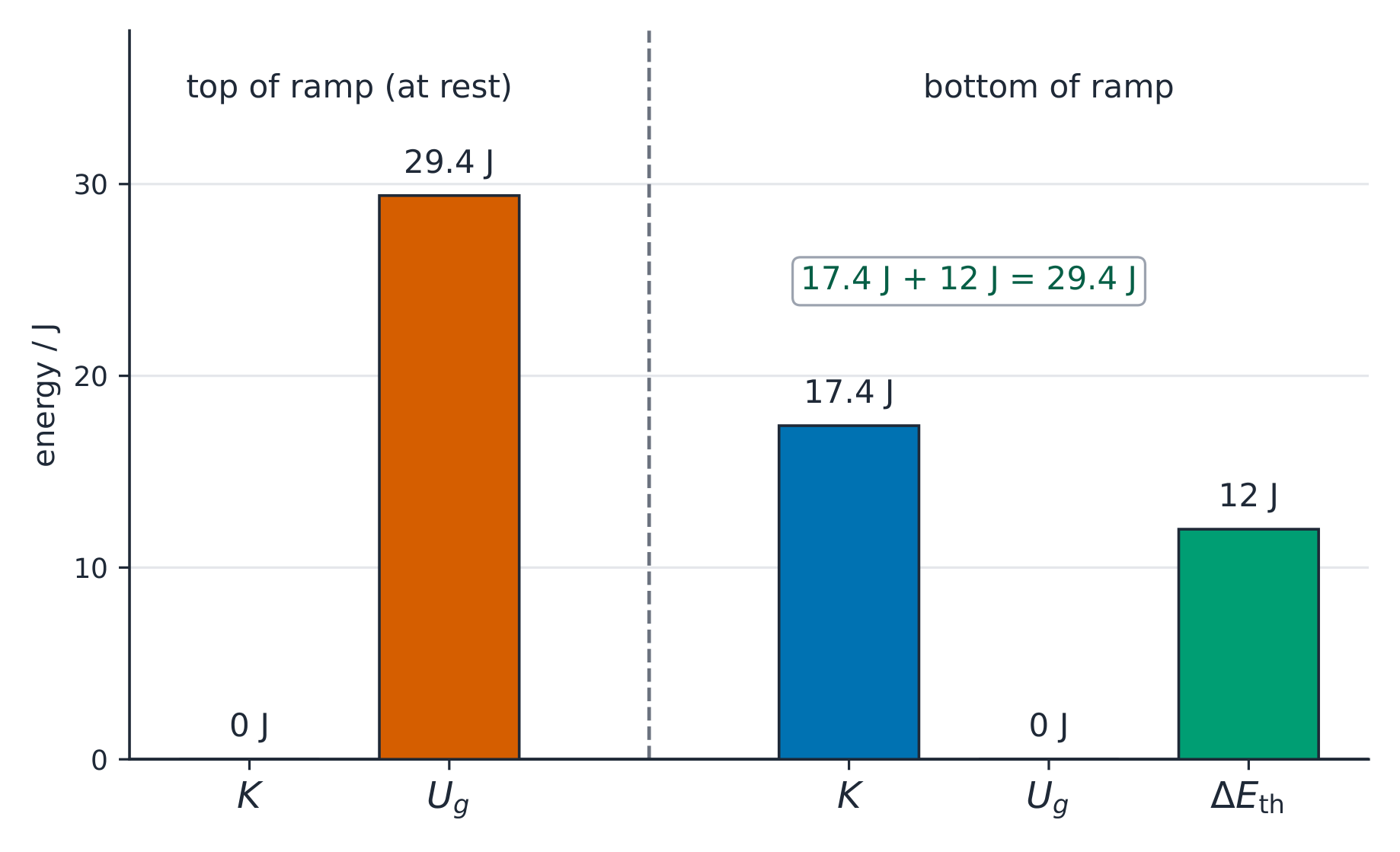
Worked example (friction on an incline). A $2.0\ \text{kg}$ block starts from rest at the top of a ramp $3.0\ \text{m}$ long and $1.5\ \text{m}$ high. A friction force of $4.0\ \text{N}$ acts along the ramp. Find its speed at the bottom.
$$mgh=\tfrac12mv^2+f\,d:\qquad (2.0)(9.8)(1.5)=\tfrac12(2.0)v^2+(4.0)(3.0)$$
$$29.4=v^2+12\;\Rightarrow\;v=\sqrt{17.4}=4.2\ \text{m/s}.$$
Friction turned $12\ \text{J}$ into thermal energy. Without it the block would reach $\sqrt{29.4}=5.4\ \text{m/s}$.
Drawing it as an energy bar chart. Free-response questions often ask for this as bars. Choose the system first: here the block, the Earth and the ramp, so friction's work stays inside as thermal energy $\Delta E_{\text{th}}$. Draw one bar for each energy store at the start and at the end. The totals must match, because no outside force does work on this system.
If the system were the block alone, there would be no $U_g$ bar: gravity would be an outside force doing $+29.4\ \text{J}$ of work, and friction an outside force doing $-12\ \text{J}$. Either choice gives the same speed; what changes is which bars you draw.
Worked example (energy and forces together: a loop). A small cart starts from rest at height $h$ on a frictionless track and goes round a vertical loop of radius $R = 0.40\ \text{m}$. What is the smallest $h$ for which it stays on the track at the top of the loop?
- Forces at the top (from the circular-motion unit): the cart just keeps contact when the normal force 法向力 is zero, so $mg = \dfrac{mv^2}{R}$, giving $v_{\text{top}}^2 = gR$.
- Energy from the start to the top (height $2R$): $mgh = mg(2R) + \tfrac12 m v_{\text{top}}^2 = 2mgR + \tfrac12 mgR$.
$$h = 2.5R = 2.5 \times 0.40 = 1.0\ \text{m}$$
Neither idea alone is enough: energy gives the speed at the top, and Newton's second law says how fast it must be. Starting at only $h = 2R$ fails, because the cart would need zero speed at the top, and then it falls off before it gets there.
Vocabulary
Train
| English |
|---|
| normal force/ˈnɔːml fɔːs/ |
3.5
Power
Syllabus
| Learning Objective | Essential Knowledge |
|---|---|
3.5.A |
|
Source: College Board AP Course and Exam Description
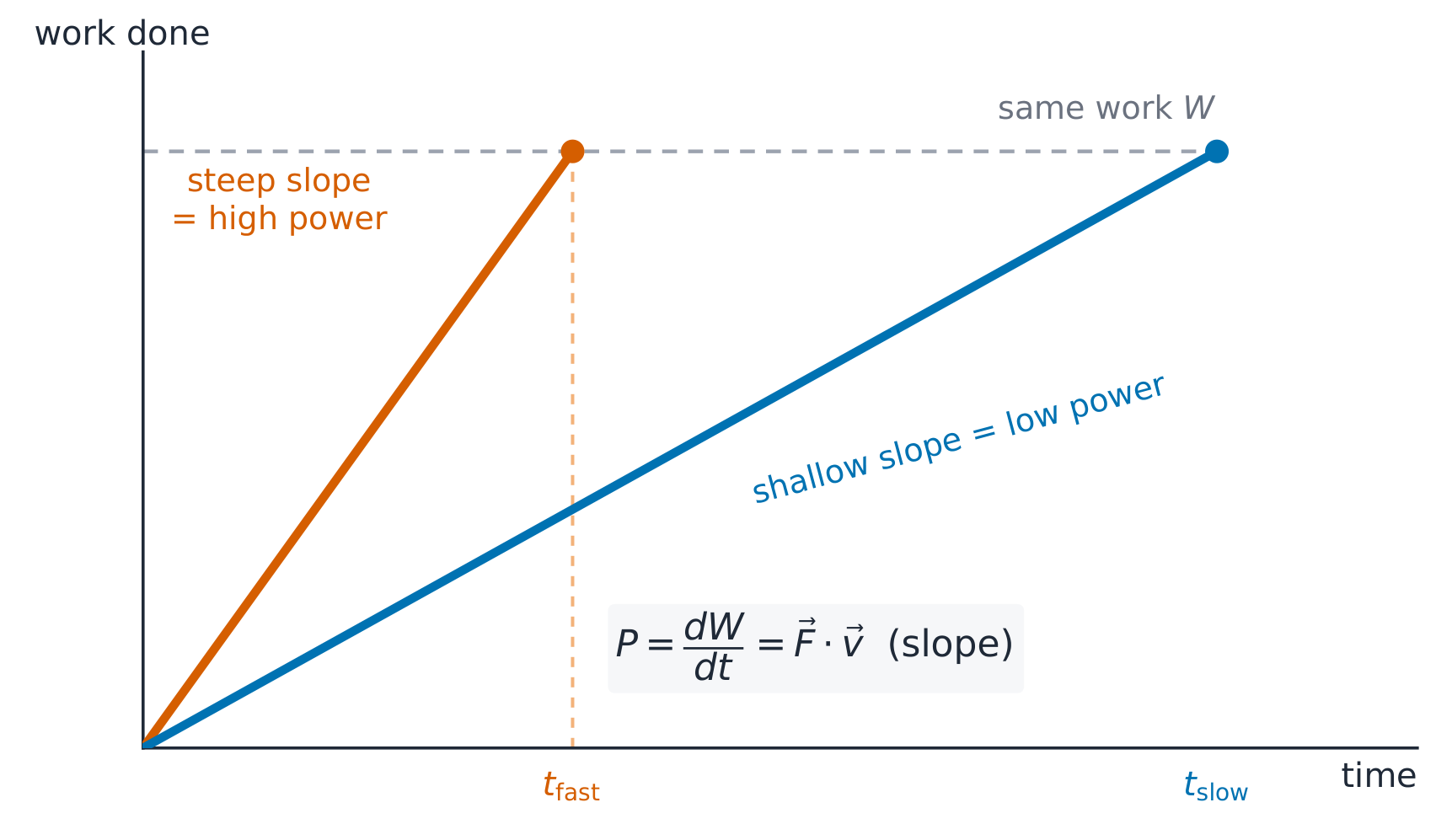
Power 功率 is the rate of doing work or transferring energy, measured in watts 瓦特 (W):
$$P=\frac{W}{\Delta t}=\frac{\Delta E}{\Delta t},\qquad\text{and instantaneously}\qquad P=\vec{F}\cdot\vec{v}.$$
So the same job done faster requires more power. On an energy–time graph, power is the slope 斜率.
Worked example. A motor lifts a $50\ \text{kg}$ load at a steady $2.0\ \text{m/s}$. Because it moves at constant speed, the lifting force equals the weight, so
$$P=Fv=mgv=50\times9.8\times2.0=980\ \text{W}.$$
Writing power in symbols. Many questions give only letters. A crane lifts a load of mass $M$ through a height $H$ at constant speed in a time $\Delta t$. The energy transferred is the gain in gravitational potential energy, $MgH$, so the average power is
$$P=\frac{MgH}{\Delta t}.$$
Check that it makes sense: a heavier load, a greater height or a shorter time each need more power.
Real machines waste some energy, so we quote efficiency 效率 – useful output power divided by total input power. If this motor draws $1400\ \text{W}$ of electrical power to deliver $980\ \text{W}$ of useful lifting, its efficiency is $980/1400=0.70$, or $70\%$; the other $30\%$ becomes heat and sound.
Explore
Faster work, more power
Relate how quickly motion builds up to the rate at which energy is delivered.
Vocabulary
Train
| English |
|---|
| Power/ˈpaʊə/ |
| watts/wɒts/ |
| slope/sləʊp/ |
| efficiency/ɪˈfɪʃənsi/ |
3.5
Practice
Answer each before reading the answers below. Take $g=9.8\ \text{m/s}^2$.
- A $0.20\ \text{kg}$ ball is thrown straight up at $12\ \text{m/s}$. Ignoring air resistance 空气阻力, how high does it rise?
- A spring with $k=400\ \text{N/m}$ is compressed $0.050\ \text{m}$ and launches a $0.10\ \text{kg}$ block along a frictionless floor. Find the block's speed.
- A $10\ \text{kg}$ box is pushed $5.0\ \text{m}$ across a floor at constant speed against a $30\ \text{N}$ friction force. Find the work done by the person, the net work, and the thermal energy produced.
- A $60\ \text{kg}$ student climbs stairs $4.0\ \text{m}$ high in $8.0\ \text{s}$. Find the student's average power output for the lifting.
- A student says: "Lifting the box $5.0\ \text{m}$ needs $980\ \text{J}$: gravity does $-490\ \text{J}$ of work, and the potential energy also rises by $490\ \text{J}$." Correct the student.
Vocabulary
Train
| English |
|---|
| air resistance/eə rɪˈzɪstəns/ |
3.5
Answers
- $\tfrac12mv^2=mgh$, so $h=\dfrac{v^2}{2g}=\dfrac{144}{19.6}=7.3\ \text{m}$. The mass cancels.
- $\tfrac12kx^2=\tfrac12mv^2$, so $v=x\sqrt{k/m}=0.050\sqrt{4000}=3.2\ \text{m/s}$.
- Person: $(30)(5.0)=150\ \text{J}$. Net work is zero, because the speed is constant. Thermal energy produced: $150\ \text{J}$.
- $P=\dfrac{mgh}{t}=\dfrac{(60)(9.8)(4.0)}{8.0}=290\ \text{W}$.
- The student has counted gravity twice. With the Earth in the system, use only $\Delta U_g=490\ \text{J}$. With the Earth outside, use only gravity's work, $-490\ \text{J}$. Either way the person must supply $490\ \text{J}$.
3.5
Exam tips
- Use $W=Fd\cos\theta$: work is zero when the force is perpendicular to the motion, and negative when it opposes it.
- Reach for the work–energy theorem ($W_{\text{net}}=\Delta K$) or energy conservation ($K_1+U_1=K_2+U_2$) instead of forces whenever the path is complicated.
- When friction acts, mechanical energy is not conserved — subtract the energy lost to heat.
- Remember $K\propto v^2$: doubling the speed quadruples the kinetic energy (and, for a constant braking force, the stopping distance).
- Use $P=Fv$ for power at a steady speed; at constant velocity the net force is zero but the power is not.
Common mistakes
- Counting gravity twice: using $U_g$ and the work done by gravity in the same equation. Choose one, depending on whether the Earth is in the system.
- Using $W = Fd$ when the force is at an angle to the motion. Only the component along the displacement does work: $W = Fd\cos\theta$.
- Saying the normal force or a centripetal force 向心力 does work on an object moving in a circle. A force perpendicular to the velocity does no work.
- Writing $\tfrac12 kx$ or $kx^2$ for spring energy. The stored energy is $\tfrac12 kx^2$ (the triangle under $F = kx$).
- Treating energy as a vector. Kinetic and potential energy have no direction, so a ball's speed at a given height is the same whether it moves up or down (no friction).
- Leaving out thermal energy when friction acts. The lost mechanical energy equals $f\,d$ and appears as thermal energy; it does not disappear.
- Saying that doubling the spring compression doubles the sliding distance. The energy is $\tfrac12kx^2$, so it quadruples, and so does the distance.
- Giving a single object potential energy. Potential energy belongs to a pair of interacting objects, so a one-object system has only kinetic energy.
- Plotting $h$ against $x$ for a spring launcher and calling the curve "the slope". Plot $h$ against $x^2$ to get a straight line.
- Thinking a longer path changes the work done by gravity. Only the start and end heights matter for a conservative force.
Vocabulary
Train
| English |
|---|
| centripetal force/senˈtrɪpɪtl fɔːs/ |
Interactive lessons on this topic
Work through it step by step, with instant-check exercises.