| Learning Objective | Essential Knowledge |
|---|---|
12.1.A |
|
12.1.B |
|
12.1.C |
|
Magnetism and Electromagnetism · Магнетизм и электромагнетизм
AP Physics 2 · AP Физика 2 · Topic 12 · Тема 12
 9:21
9:21
Магнетизм и электромагнетизм
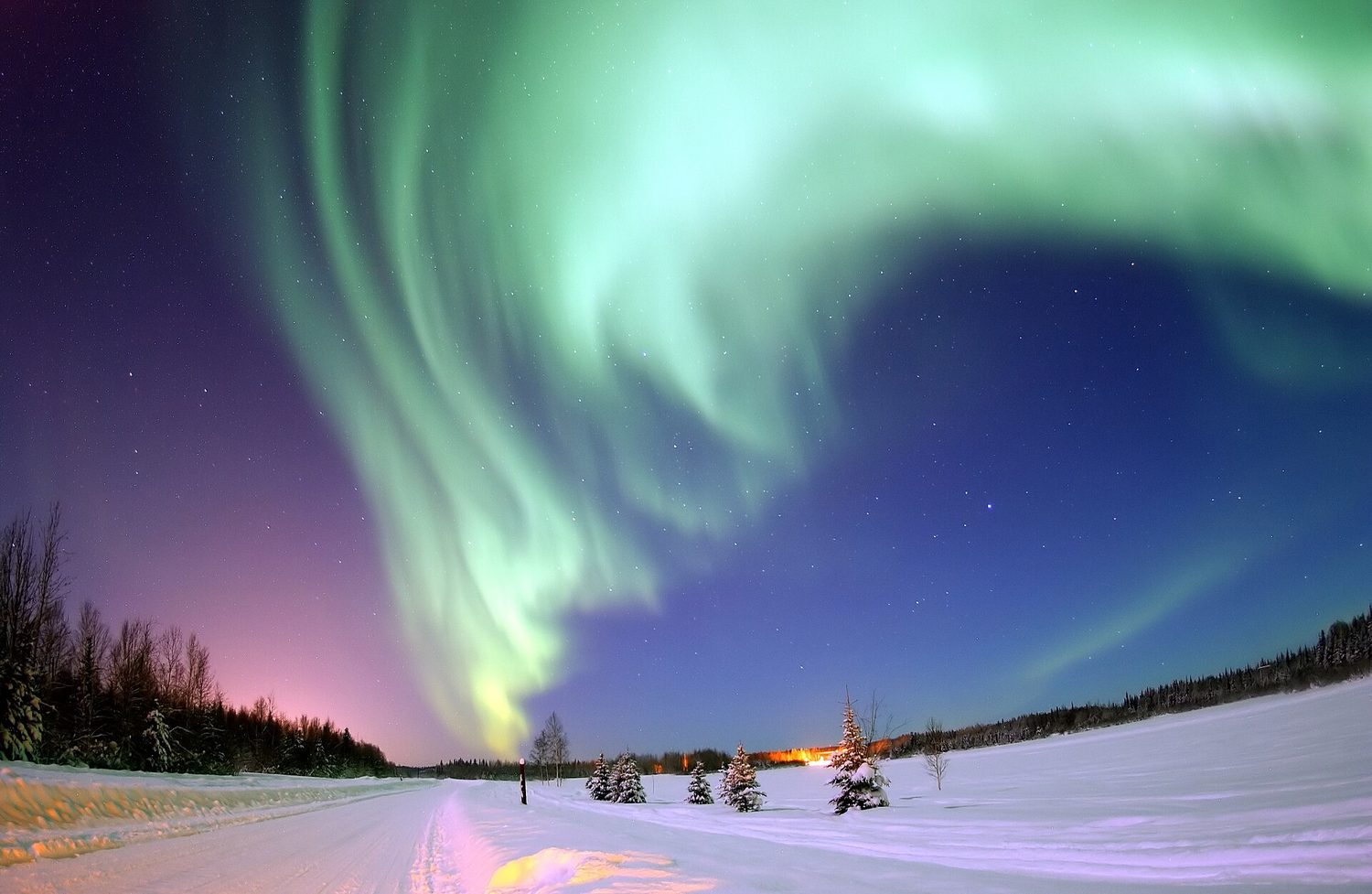
Высоко над Арктикой ночное небо светится зеленым. Эти занавесы света — не огонь. Это заряженные частицы от Солнца, прибывающие со скоростью миллиона…
English narration · English + 中文 subtitles burned in · Английское озвучивание · Английский + китайские субтитры (встроенные)
12.1
Magnetic Fields · Магнитные поля
Syllabus · Программа
Source: College Board AP Course and Exam Description · Источник: Описание курса и экзамена College Board AP
English
Different materials respond very differently to a magnetic field, and the course names three. Ferromagnetic 铁磁性 materials (iron, nickel, cobalt) have dipoles that align strongly and stay aligned, so they can be permanent magnets. Paramagnetic 顺磁性 materials (aluminium, titanium) align only weakly and do not stay aligned. Diamagnetic 抗磁性 materials - in fact all materials have some diamagnetism - align weakly opposite the field. This behaviour comes from a material property, the permeability 磁导率: free space has a fixed permeability of free space $\mu_0$, while the permeability of matter differs from it and is not even constant for a given material.
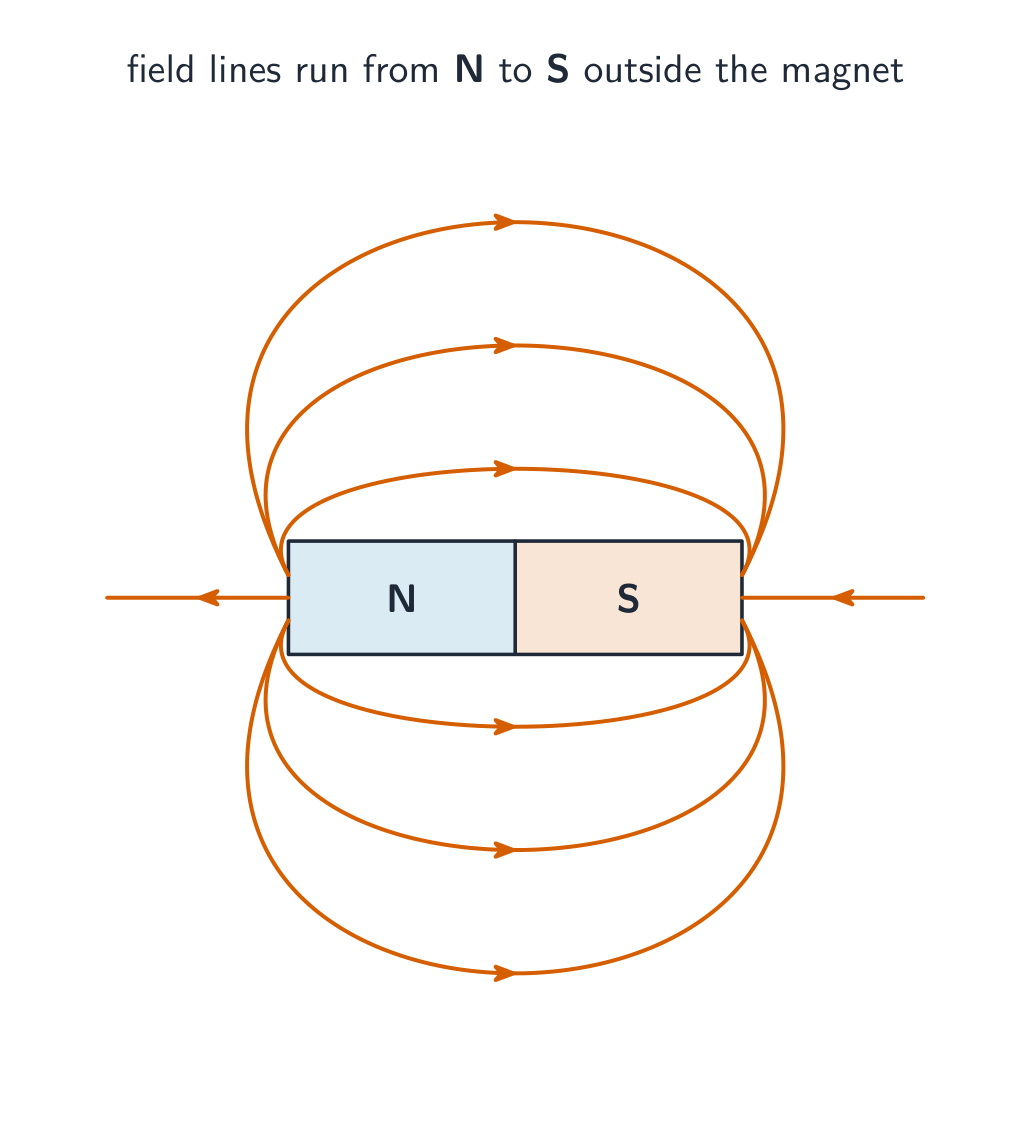
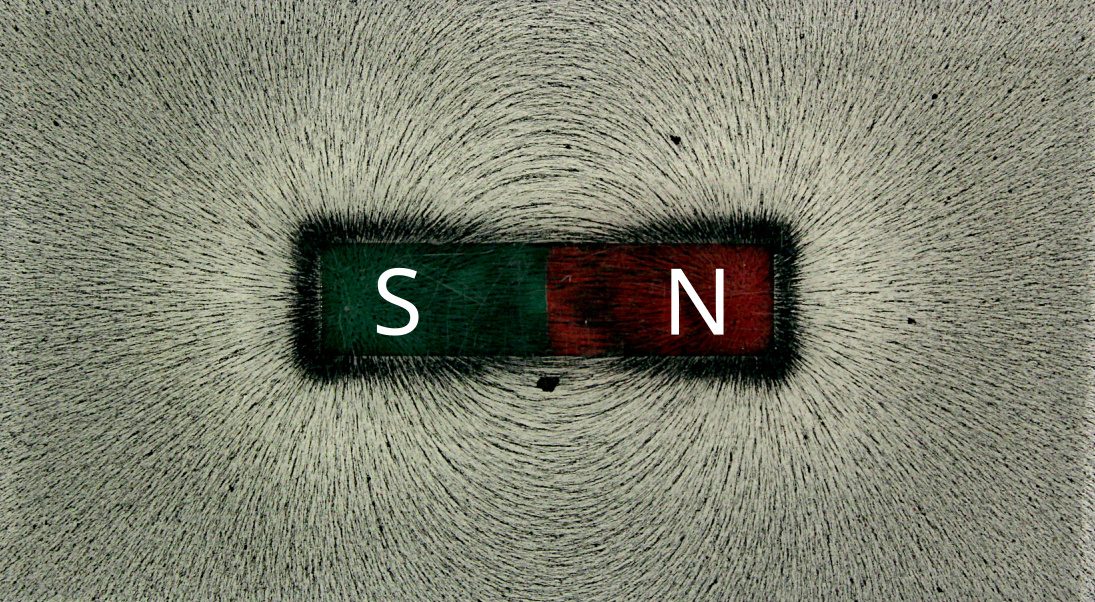
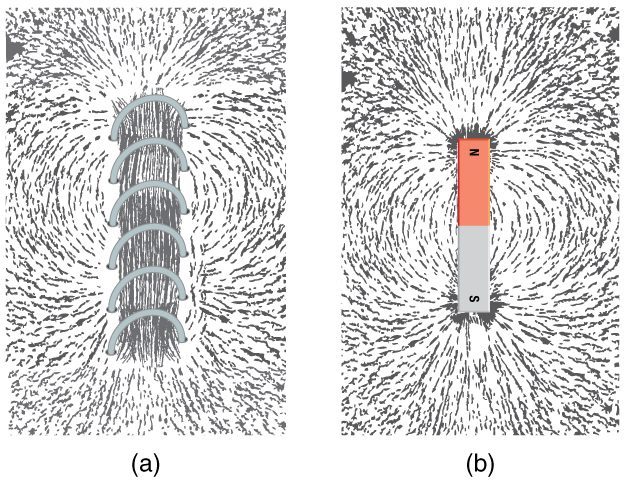
A magnetic field 磁场 $\vec{B}$ surrounds magnets and moving charges. Field lines run from a magnet's north pole to its south pole outside the magnet, and denser lines mean a stronger field. Magnetic poles always come in pairs – cutting a magnet in half makes two smaller magnets, never an isolated pole.
Русский
Различные материалы по-разному реагируют на магнитное поле, и курс рассматривает три типа. Ферромагнитные материалы (железо, никель, кобальт) имеют диполи, которые сильно выравниваются и сохраняют эту ориентацию, поэтому могут быть постоянными магнитами. Парамагнитные материалы (алюминий, титан) выравниваются лишь слабо и не сохраняют ориентацию. Диамагнитные материалы — фактически все вещества обладают диамагнетизмом — выравниваются слабой полярностью против направления поля. Такое поведение определяется свойством материала — магнитной проницаемостью: вакуум имеет фиксированную магнитную проницаемость $\mu_0$, тогда как магнитная проницаемость вещества отличается от неё и даже не является постоянной величиной для данного материала.
Магнитное поле $\vec{B}$ окружает магниты и движущиеся заряды. Линии поля идут от северного полюса магнита к южному вне его, а более плотные линии указывают на более сильное поле. Магнитные полюса всегда существуют парами — разрезав магнит пополам, вы получите два маленьких магнита, но никогда не изолированный полюс.
Explore · Исследовать
See a magnet's field lines · Увидьте линии магнитного поля
Magnetic field lines run from the north pole to the south pole outside the magnet. Where the lines crowd together the field is strongest. · Магнитные силовые линии идут от северного полюса к южному снаружи магнита. Там, где линии расположены гуще, поле сильнее.
Vocabulary · Словарь
Train · Тренировать
| English | Русский |
|---|---|
| Ferromagnetic/ˌferəməɡˈnetɪk/ | ферромагнитный |
| Paramagnetic/ˌpærəməɡˈnetɪk/ | парамагнитный |
| Diamagnetic/ˌdaɪəməɡˈnetɪk/ | диамагнитный |
| permeability/ˌpɜːməˈbɪlɪti/ | магнитная проницаемость |
| magnetic field/mæɡˈnetɪk fiːld/ | магнитным полем |
12.2
Magnetism and Moving Charges · Магнетизм и движущиеся заряды
Syllabus · Программа
English
Learning Objective 12.2.A: Describe the magnetic field produced by moving charged objects.
- 12.2.A.1 A single moving charged object produces a magnetic field.
- 12.2.A.1.i The magnetic field at a particular point produced by a moving charged object depends on the object's velocity and the distance between the point and the object.
- 12.2.A.1.ii At a point in space, the direction of the magnetic field produced by a moving charged object is perpendicular to both the velocity of the object and the position vector from the object to that point in space and can be determined using the right-hand rule.
- 12.2.A.1.iii The magnitude of the magnetic field is a maximum when the velocity vector and the position vector from the object to that point in space are perpendicular.
Learning Objective 12.2.B: Describe the force exerted on moving charged objects by a magnetic field.
- 12.2.B.1 Magnetic forces describe interactions between moving charged objects.
- 12.2.B.2 A magnetic field may exert a force on a charged object moving in that field.
- 12.2.B.2.i The magnitude of the force exerted by a magnetic field on a moving charged object is proportional to the magnitude of the charge, the magnitude of the charged object's velocity, and the magnitude of the magnetic field and also depends on the angle between the velocity and magnetic field vectors.
- Equation: $F_B = qvB\sin\theta$
- 12.2.B.2.ii The direction of the force exerted by a magnetic field on a moving charged object is perpendicular to both the direction of the magnetic field and the velocity of the charge, as defined by the right-hand rule.
- 12.2.B.2.i The magnitude of the force exerted by a magnetic field on a moving charged object is proportional to the magnitude of the charge, the magnitude of the charged object's velocity, and the magnitude of the magnetic field and also depends on the angle between the velocity and magnetic field vectors.
- 12.2.B.3 In a region containing both a magnetic field and an electric field, a moving charged object will experience independent forces from each field.
- 12.2.B.4 The Hall effect describes the potential difference created in a conductor by an external magnetic field that has a component perpendicular to the direction of charges moving in the conductor.
Boundary statement: Quantitative treatment of the magnitude of the magnetic force exerted by a magnetic field on a moving charge is limited to angles of 0, 90, and 180 degrees between the velocity and the magnetic field. Qualitative analysis of other angles is permitted.
Русский
Цель обучения 12.2.A: Описать магнитное поле, создаваемое движущимися заряженными объектами.
- 12.2.A.1 Один движущийся заряженный объект создает магнитное поле.
- 12.2.A.1.i Магнитное поле в конкретной точке, создаваемое движущимся заряженным объектом, зависит от скорости этого объекта и расстояния между точкой и объектом.
- 12.2.A.1.ii В данной точке пространства направление магнитного поля, создаваемого движущимся заряженным объектом, перпендикулярно как вектору скорости объекта, так и радиус-вектору, проведенному от объекта к этой точке в пространстве; это направление определяется с помощью правила правой руки.
- 12.2.A.1.iii Величина магнитного поля максимальна, когда вектор скорости и радиус-вектор, проведенный от объекта к данной точке в пространстве, перпендикулярны друг другу.
Цель обучения 12.2.B: Описать силу, действующую на движущиеся заряженные объекты со стороны магнитного поля.
- 12.2.B.1 Магнитные силы описывают взаимодействия между движущимися заряженными объектами.
- 12.2.B.2 Магнитное поле может оказывать силу на заряженный объект, движущийся в этом поле.
- 12.2.B.2.i Величина силы, действующей со стороны магнитного поля на движущийся заряженный объект, пропорциональна величине заряда, величине скорости заряженного объекта и величине магнитного поля, а также зависит от угла между векторами скорости и магнитного поля.
- Уравнение: $F_B = qvB\sin\theta$
- 12.2.B.2.ii Направление силы, действующей со стороны магнитного поля на движущийся заряженный объект, перпендикулярно как направлению магнитного поля, так и скорости заряда, что определяется правилом правой руки.
- 12.2.B.2.i Величина силы, действующей со стороны магнитного поля на движущийся заряженный объект, пропорциональна величине заряда, величине скорости заряженного объекта и величине магнитного поля, а также зависит от угла между векторами скорости и магнитного поля.
- 12.2.B.3 В области, содержащей как магнитное, так и электрическое поля, движущийся заряженный объект испытывает независимые силы от каждого из полей.
- 12.2.B.4 Эффект Холла описывает разность потенциалов, возникающую в проводнике под действием внешнего магнитного поля, имеющего компоненту, перпендикулярную направлению движения зарядов в проводнике.
Граничное условие: Количественное описание величины магнитной силы, действующей на движущийся заряд со стороны магнитного поля, ограничивается углами 0, 90 и 180 градусов между вектором скорости и магнитным полем. Количественный анализ других углов не требуется, допускается качественный анализ.
Source: College Board AP Course and Exam Description · Источник: Описание курса и экзамена College Board AP
English
A charge moving through a magnetic field feels a magnetic force 磁力:
$$F=qvB\sin\theta,$$
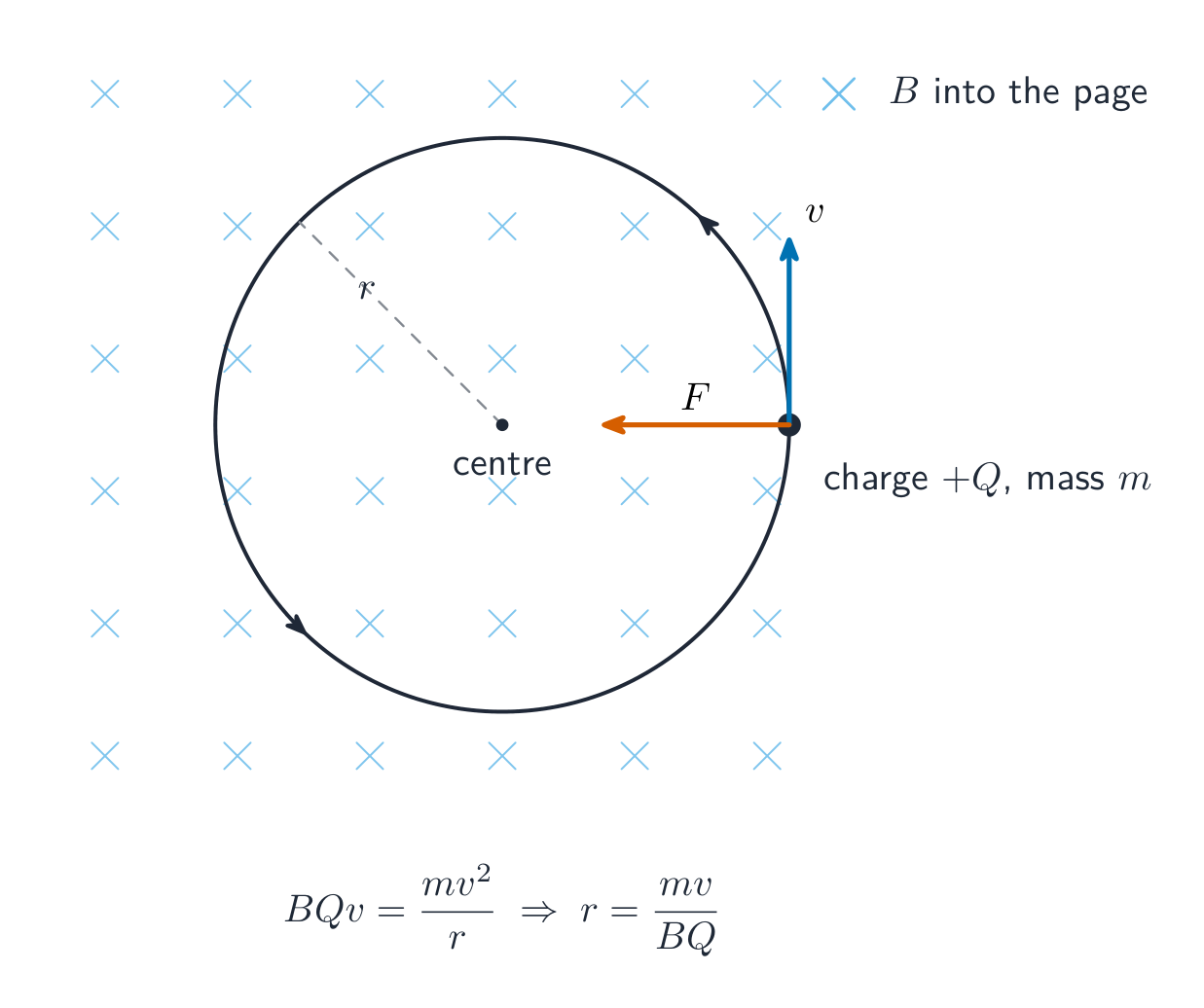
where $\theta$ is the angle between the velocity and the field. The force is perpendicular to both $\vec{v}$ and $\vec{B}$ (use the right-hand rule), so it changes direction but not speed – a charge moving perpendicular to a uniform field travels in a circle. A stationary charge, or one moving parallel to the field, feels no magnetic force.
Worked example. A proton ($q=1.6\times10^{-19}\ \text{C}$, $m=1.67\times10^{-27}\ \text{kg}$) enters a $0.50\ \text{T}$ field at $2.0\times10^{5}\ \text{m/s}$, at right angles to the field. The magnetic force is
$$F=qvB=1.6\times10^{-19}\times2.0\times10^{5}\times0.50=1.6\times10^{-14}\ \text{N}.$$
This force is the centripetal force, so it bends the proton into a circle of radius
$$r=\frac{mv}{qB}=\frac{1.67\times10^{-27}\times2.0\times10^{5}}{1.6\times10^{-19}\times0.50}=4.2\times10^{-3}\ \text{m}.$$
Setting $qvB=\dfrac{mv^2}{r}$ and cancelling gives that neat $r=mv/(qB)$ – the principle behind mass spectrometers.
Русский
Заряд, движущийся в магнитном поле, испытывает магнитную силу:
$$F=qvB\sin\theta,$$
где $\theta$ — угол между вектором скорости и полем. Сила перпендикулярна как $\vec{v}$, так и $\vec{B}$ (правило правой руки), поэтому она меняет направление, но не скорость — заряд, движущийся перпендикулярно однородному полю, движется по окружности. Покойный заряд или заряд, движущийся параллельно полю, не испытывает магнитной силы.
Разобранная задача. Протон ($q=1.6\times10^{-19}\ \text{C}$, $m=1.67\times10^{-27}\ \text{kg}$) входит в $0.50\ \text{T}$-поле под углом $2.0\times10^{5}\ \text{m/s}$, перпендикулярно линиям поля. Магнитная сила равна
$$F=qvB=1.6\times10^{-19}\times2.0\times10^{5}\times0.50=1.6\times10^{-14}\ \text{N}.$$
Эта сила является центростремительной, поэтому она отклоняет протон по окружности радиусом
$$r=\frac{mv}{qB}=\frac{1.67\times10^{-27}\times2.0\times10^{5}}{1.6\times10^{-19}\times0.50}=4.2\times10^{-3}\ \text{m}.$$
Приравнивая $qvB=\dfrac{mv^2}{r}$ и сокращая, получаем аккуратную формулу для $r=mv/(qB)$ — принцип работы масс-спектрометров.
Vocabulary · Словарь
Train · Тренировать
| English | Русский |
|---|---|
| magnetic force/mæɡˈnetɪk fɔːs/ | магнитная сила |
12.3
Magnetism and Current-Carrying Wires · Магнетизм и проводники с током
Syllabus · Программа
English
Learning Objective 12.3.A: Describe the magnetic field produced by a current-carrying wire.
- 12.3.A.1 A current-carrying wire produces a magnetic field.
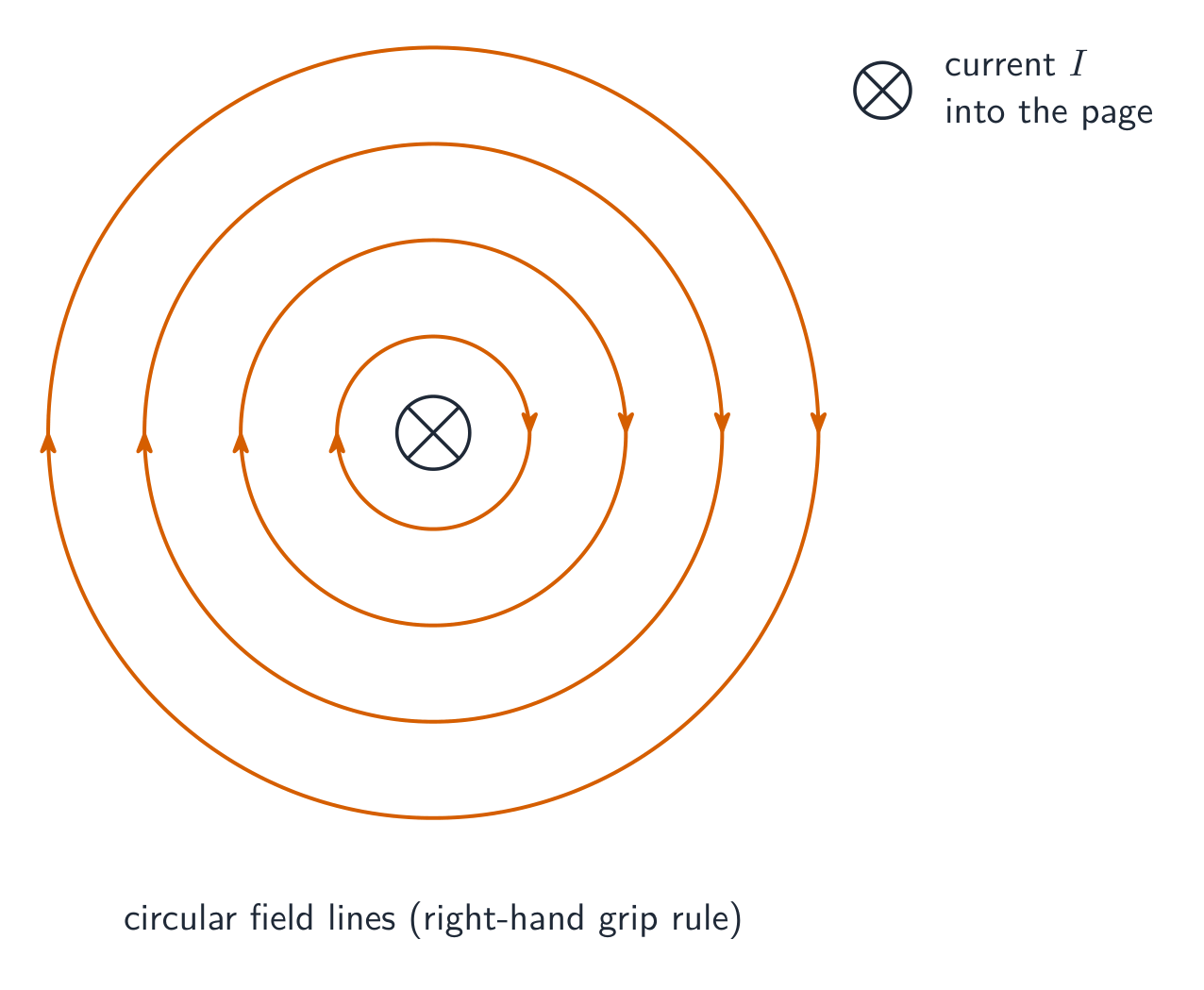
- 12.3.A.1.i The magnetic field vectors around a long, straight, current-carrying wire are tangent to concentric circles centered on that wire. The field has no component toward, away from, or parallel to the long, straight, current-carrying wire.
- 12.3.A.1.ii At a point in space, the magnitude of the magnetic field due to a long, straight, current-carrying wire is proportional to the magnitude of the current in the wire and inversely proportional to the perpendicular distance from the central axis of the wire to the point.
- Equation: $B = \dfrac{\mu_0}{2\pi}\dfrac{I}{r}$
- 12.3.A.1.iii The direction of the magnetic field created by a current-carrying wire is determined with the right-hand rule.
- 12.3.A.1.iv The direction of the magnetic field at the center of a current-carrying loop is directed along the axis of the loop and can be found using the right-hand rule.
- 12.3.A.1.v The magnetic field at a location near two or more current-carrying wires can be determined using vector addition principles.
Learning Objective 12.3.B: Describe the force exerted on a current-carrying wire by a magnetic field.
- 12.3.B.1 A magnetic field may exert a force on a current-carrying wire.
- 12.3.B.1.i The magnitude of the force exerted by a magnetic field on a current-carrying wire is proportional to the current, the length of the portion of the wire within the magnetic field, and the magnitude of the magnetic field, and also depends on the angle between the direction of the current in the wire and the direction of the magnetic field.
- Equation: $F_B = I\ell B\sin\theta$
- 12.3.B.1.ii The direction of the force exerted by the magnetic field on a current-carrying wire is determined by the right-hand rule.
- 12.3.B.1.i The magnitude of the force exerted by a magnetic field on a current-carrying wire is proportional to the current, the length of the portion of the wire within the magnetic field, and the magnitude of the magnetic field, and also depends on the angle between the direction of the current in the wire and the direction of the magnetic field.
Русский
Цель обучения 12.3.A: Описать магнитное поле, создаваемое проводником с током.
- 12.3.A.1 Проводник с током создает магнитное поле.
- 12.3.A.1.i Векторы магнитного поля вокруг длинного прямого проводника с током касаются концентрических окружностей, центр которых находится на этом проводнике. Поле не имеет компоненты, направленной к проводнику, от него или параллельно ему.
- 12.3.A.1.ii В данной точке пространства величина магнитного поля, создаваемого длинным прямым проводником с током, пропорциональна величине тока в проводнике и обратно пропорциональна перпендикулярному расстоянию от центральной оси проводника до данной точки.
- Уравнение: $B = \dfrac{\mu_0}{2\pi}\dfrac{I}{r}$
- 12.3.A.1.iii Направление магнитного поля, создаваемого проводником с током, определяется с помощью правила правой руки.
- 12.3.A.1.iv Направление магнитного поля в центре контура с током направлено вдоль оси контура и может быть определено с помощью правила правой руки.
- 12.3.A.1.v Магнитное поле в точке рядом с двумя или более проводниками с током можно определить, используя принципы векторного сложения.
Цель обучения 12.3.B: Описать силу, действующую на проводник с током со стороны магнитного поля.
- 12.3.B.1 Магнитное поле может оказывать силу на проводник с током.
- 12.3.B.1.i Величина силы, действующей со стороны магнитного поля на проводник с током, пропорциональна силе тока, длине участка проводника, находящегося в магнитном поле, и величине магнитного поля, а также зависит от угла между направлением тока в проводнике и направлением магнитного поля.
- Уравнение: $F_B = I\ell B\sin\theta$
- 12.3.B.1.ii Направление силы, действующей со стороны магнитного поля на проводник с током, определяется с помощью правила правой руки.
- 12.3.B.1.i Величина силы, действующей со стороны магнитного поля на проводник с током, пропорциональна силе тока, длине участка проводника, находящегося в магнитном поле, и величине магнитного поля, а также зависит от угла между направлением тока в проводнике и направлением магнитного поля.
Source: College Board AP Course and Exam Description · Источник: Описание курса и экзамена College Board AP
English
Because a current is moving charge, a magnetic field pushes on a current-carrying wire:
$$F=BIL\sin\theta.$$
A current also creates its own magnetic field: circular field lines wrap around a straight wire (right-hand rule), and a coil (solenoid) makes a field like a bar magnet. This is how electromagnets and motors work.
Worked example. A $0.30\ \text{m}$ length of wire carries $4.0\ \text{A}$ at right angles to a $0.20\ \text{T}$ field. The force on it is $F=BIL=0.20\times4.0\times0.30=0.24\ \text{N}$ – the push that turns a motor's coil.
Русский
Поскольку ток — это движущиеся заряды, магнитное поле действует на проводник с током:
$$F=BIL\sin\theta.$$
Ток также создает собственное магнитное поле: кольцевые линии поля охватывают прямой проводник (правило правой руки), а катушка (соленоид) создает поле, аналогичное полю постоянного магнита. Так работают электромагниты и двигатели.
Разобранная задача. Кусок провода длиной $0.30\ \text{m}$ несет ток $4.0\ \text{A}$ под прямым углом к $0.20\ \text{T}$-полю. Сила, действующая на него, равна $F=BIL=0.20\times4.0\times0.30=0.24\ \text{N}$ — толчок, который вращает катушку двигателя.
Explore · Исследовать
Find the force on a current in a field · Найдите силу, действующую на проводник с током в поле
A current in a magnetic field feels a force $F = BIL$, at right angles to both. Use the left-hand rule; reverse the current or field and the force flips. · Ток в магнитном поле испытывает силу $F = BIL$, направленную перпендикулярно как самому току, так и полю. Используйте правило левой руки; измените направление тока или поля, и сила перевернется.
12.4
Electromagnetic Induction and Faraday's Law · Электромагнитная индукция и закон Фарадея
Syllabus · Программа
English
Learning Objective 12.4.A: Describe the induced electric potential difference resulting from a change in magnetic flux.
- 12.4.A.1 Magnetic flux is a description of the amount of the component of a magnetic field that is perpendicular to a cross-sectional area.
- 12.4.A.2 Magnetic flux through a surface is proportional to the magnitude of the component of the magnetic field perpendicular to the surface and to the cross-sectional area of the surface.
- Equation: $\Phi_B = BA\cos\theta$
- 12.4.A.2.i The area vector is defined to be perpendicular to the plane of the surface and directed outward from a closed surface.
- 12.4.A.2.ii The sign of the magnetic flux indicates whether the magnetic field is parallel to or antiparallel to the area vector.
- 12.4.A.3 Faraday’s law describes the relationship between changing magnetic flux and the resulting induced emf in a system.
- Equation: $|\mathcal{E}| = \left|\dfrac{\Delta\Phi_B}{\Delta t}\right|$
- 12.4.A.4 Lenz’s law is used to determine the direction of an induced emf resulting from a changing magnetic flux.
- Equation: $\mathcal{E} = -\dfrac{\Delta\Phi_B}{\Delta t} = -\dfrac{\Delta(BA\cos\theta)}{\Delta t}$
- 12.4.A.4.i An induced emf generates a current that creates a magnetic field that opposes the change in magnetic flux.
- 12.4.A.4.ii The right-hand rule is used to determine the relationships between current, emf, and magnetic flux.
- 12.4.A.5 A common example of electromagnetic induction is a conducting rod on conducting rails in a region with a uniform magnetic field.
- Derived equation: $\mathcal{E} = B\ell v$
Русский
Цель обучения 12.4.A: Описать вызванную ЭДС (электродвижущую силу), возникающую при изменении магнитного потока.
- 12.4.A.1 Магнитный поток — это мера количества компоненты магнитного поля, перпендикулярного поперечной площади.
- 12.4.A.2 Магнитный поток через поверхность пропорционален величине компоненты магнитного поля, перпендикулярной поверхности, и площади поперечного сечения поверхности.
- Уравнение: $\Phi_B = BA\cos\theta$
- 12.4.A.2.i Вектор площади определяется как перпендикулярный плоскости поверхности и направленный наружу от замкнутой поверхности.
- 12.4.A.2.ii Знак магнитного потока указывает, параллелен ли магнитный вектор вектору площади или антипараллелен ему.
- 12.4.A.3 Закон Фарадея описывает связь между изменением магнитного потока и возникающей в системе ЭДС.
- Уравнение: $|\mathcal{E}| = \left|\dfrac{\Delta\Phi_B}{\Delta t}\right|$
- 12.4.A.4 Закон Ленца используется для определения направления вызванной ЭДС, возникающей при изменении магнитного потока.
- Уравнение: $\mathcal{E} = -\dfrac{\Delta\Phi_B}{\Delta t} = -\dfrac{\Delta(BA\cos\theta)}{\Delta t}$
- 12.4.A.4.i Вызванная ЭДС порождает ток, который создает магнитное поле, противодействующее изменению магнитного потока.
- 12.4.A.4.ii Правило правой руки используется для определения соотношений между током, ЭДС и магнитным потоком.
- 12.4.A.5 Распространенным примером электромагнитной индукции является проводящий стержень на проводящих рельсах в области с однородным магнитным полем.
- Выведенное уравнение: $\mathcal{E} = B\ell v$
Source: College Board AP Course and Exam Description · Источник: Описание курса и экзамена College Board AP
English
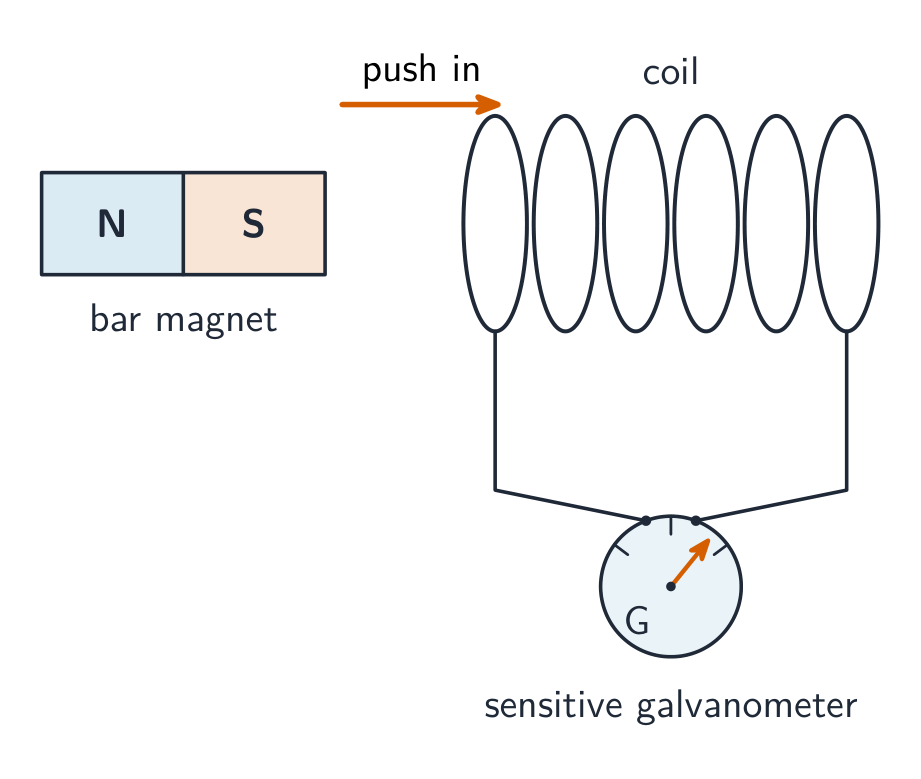
A changing magnetic field through a loop drives a current – electromagnetic induction 电磁感应. The magnetic flux 磁通量 $\Phi=BA\cos\theta$ measures how much field passes through the loop. Faraday's law 法拉第定律 gives the induced emf:
$$\varepsilon=-\frac{\Delta\Phi}{\Delta t}.$$
The flux changes if the field, the area, or the loop's orientation changes. Lenz's law 楞次定律 (the minus sign) says the induced current flows so as to oppose the change that caused it – the basis of generators.
Worked example. The magnetic flux through a single loop drops from $0.020\ \text{Wb}$ to $0.008\ \text{Wb}$ in $0.030\ \text{s}$. The average induced emf is
$$\varepsilon=\left|\frac{\Delta\Phi}{\Delta t}\right|=\frac{0.020-0.008}{0.030}=0.40\ \text{V}.$$
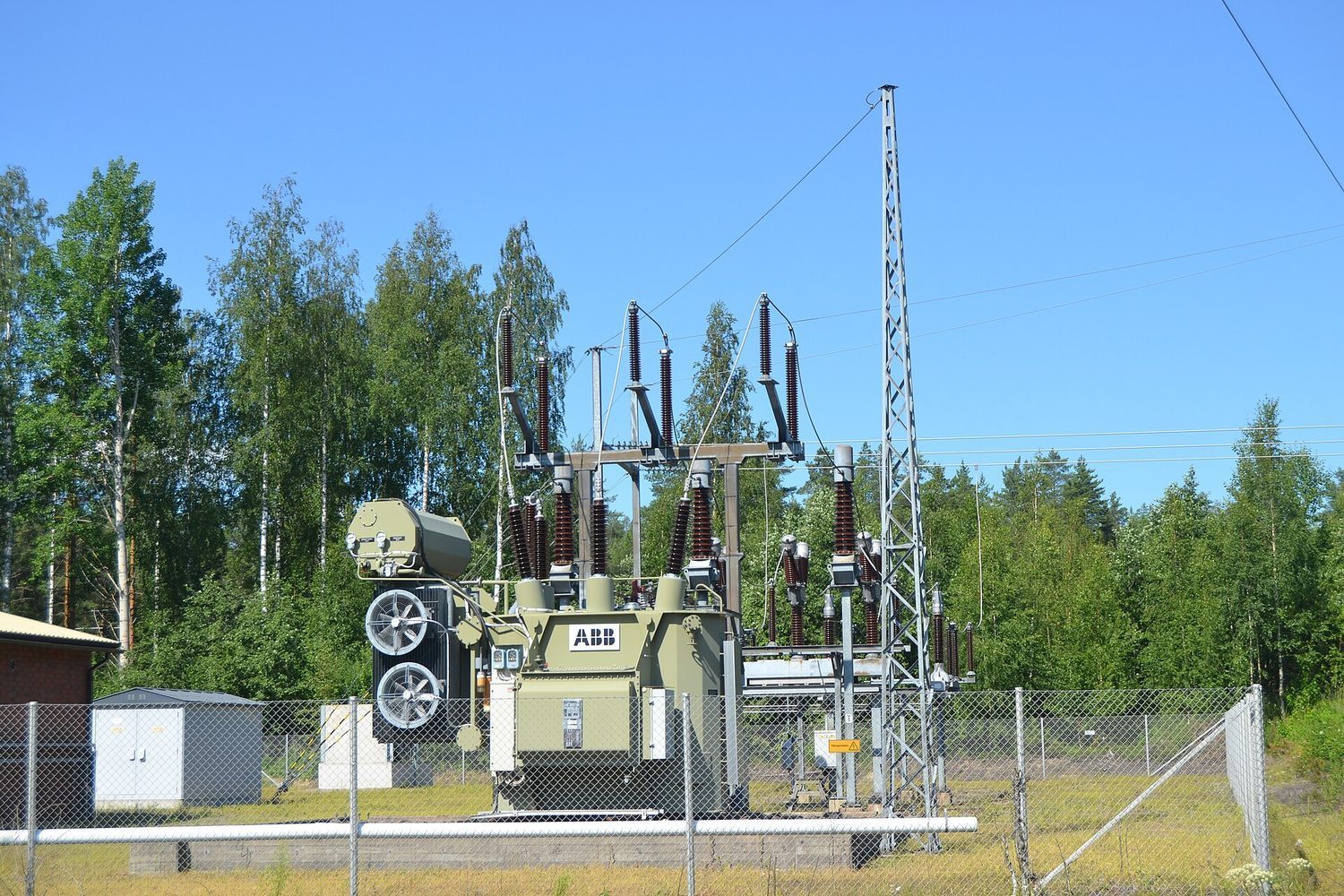
A coil of $N$ turns would give $N$ times this – which is why generators and transformers use many-turn coils.
Русский
Изменяющееся магнитное поле через контур вызывает ток — электромагнитная индукция. Магнитный поток $\Phi=BA\cos\theta$ измеряет, сколько линий поля проходит через контур. Закон Фарадея дает наведенную ЭДС:
$$\varepsilon=-\frac{\Delta\Phi}{\Delta t}.$$
Поток меняется, если изменяется поле, площадь или ориентация контура. Закон Ленца (минус в формуле) гласит, что наведенный ток течет так, чтобы противодействовать изменению, которое его вызвало — основа генераторов.
Разобранная задача. Магнитный поток через одиночный контур уменьшается от $0.020\ \text{Wb}$ до $0.008\ \text{Wb}$ за время $0.030\ \text{s}$. Средняя наведенная ЭДС равна
$$\varepsilon=\left|\frac{\Delta\Phi}{\Delta t}\right|=\frac{0.020-0.008}{0.030}=0.40\ \text{V}.$$
Катушка из $N$ витков дала бы в $N$ раз больше — именно поэтому генераторы и трансформаторы используют многовитковые катушки.
Explore · Исследовать
Induce a voltage by moving a magnet · Наведите ЭДС движением магнита
Faraday's law: a changing magnetic flux through a coil induces a voltage. Move the magnet faster and the induced EMF grows; Lenz's law sets its direction to oppose the change. · Закон Фарадея: изменяющийся магнитный поток через катушку наводит ЭДС. Двигайте магнит быстрее, и индуцированная ЭДС возрастет; закон Ленца определяет направление ЭДС, препятствующего изменению потока.
Vocabulary · Словарь
Train · Тренировать
| English | Русский |
|---|---|
| electromagnetic induction/ɪˌlektrəʊməɡˈnetɪk ɪnˈdʌkʃn/ | электромагнитная индукция |
| magnetic flux/mæɡˈnetɪk flʌks/ | магнитный поток |
| Faraday's law/ˈfærədeɪz lɔː/ | Законом Фарадея |
| Lenz's law/ˈlentsɪz lɔː/ | Правилом Ленца |
12.4
Exam tips · Советы для экзамена
English
- The magnetic force $F=qvB\sin\theta$ is perpendicular to the velocity, so it changes direction (a circle) but not speed; a stationary charge or one moving along the field feels no force.
- Use $F=BIL$ for the force on a current-carrying wire (the motor effect).
- A current creates a magnetic field (circles around a wire; a solenoid acts like a bar magnet).
- Induction needs a changing flux $\Phi=BA$ — a stationary magnet in a coil induces nothing.
- Faraday: $\varepsilon=\Delta\Phi/\Delta t$ (times $N$ turns); Lenz: the induced current opposes the change (energy conservation).
Русский
- Магнитная сила $F=qvB\sin\theta$ перпендикулярна скорости, поэтому меняет направление (круг), но не модуль скорости; покоящийся заряд или заряд, движущийся вдоль поля, не испытывает силы.
- Используйте $F=BIL$ для вычисления силы на проводник с током (эффект мотора).
- Ток создает магнитное поле (кольца вокруг провода; соленоид ведет себя как постоянный магнит).
- Индукция требует изменяющегося потока $\Phi=BA$ — неподвижный магнит в катушке ничего не наводит.
- Фарадей: $\varepsilon=\Delta\Phi/\Delta t$ (умножить на $N$ витков); Ленц: наведенный ток противодействует изменению (закон сохранения энергии).
Interactive lessons on this topic · Интерактивные уроки по этой теме
Work through it step by step, with instant-check exercises. · Пройдите его шаг за шагом с упражнениями мгновенной проверки.
Past Papers · Архив экзаменационных работ