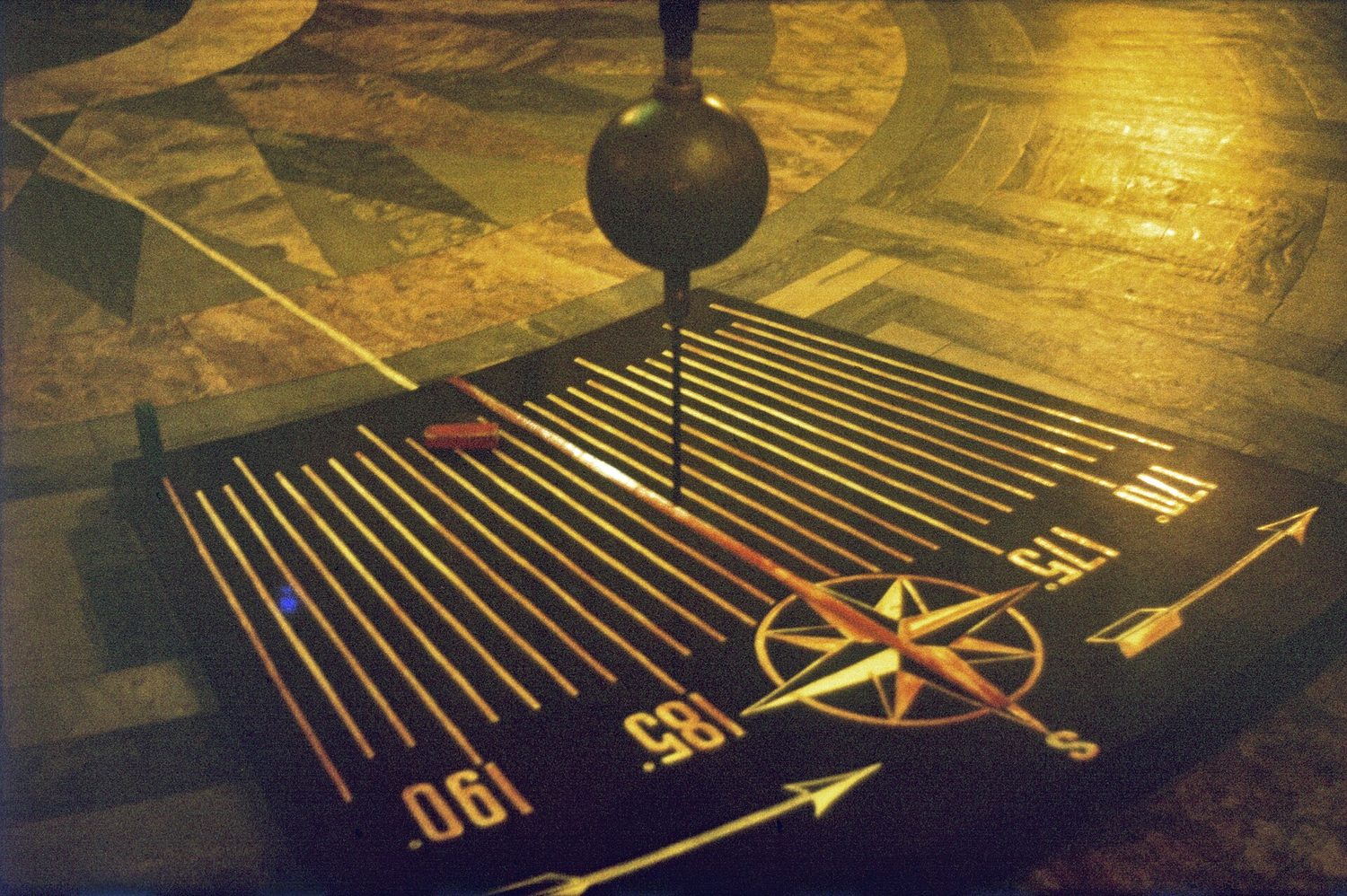
Num museu de ciências, uma bola de latão pendura-se de um fio muito longo. Ela balança o dia todo acima de um chão marcado, intocada. Cada balanço leva o mesmo tempo que o último.…
English narration · English + 中文 subtitles burned in · Narração em inglês · Legendas em inglês + 中文 gravadas
7.1
Defining Simple Harmonic Motion · Definindo Movimento Harmônico Simples
7.1.A.1 Simple harmonic motion is a special case of periodic motion.
7.1.A.2 SHM results when the magnitude of the restoring force exerted on an object is proportional to that object's displacement from its equilibrium position.
Derived equation:$ma_x = -k\Delta x$
7.1.A.2.i A restoring force is a force that is exerted in a direction opposite to the object's displacement from an equilibrium position.
7.1.A.2.ii An equilibrium position is a location at which the net force exerted on an object or system is zero.
Português
Objetivo de Aprendizagem 7.1.A: Descrever o movimento harmônico simples.
7.1.A.1 O movimento harmônico simples é um caso especial de movimento periódico.
7.1.A.2 O MHS resulta quando a magnitude da força restauradora exercida sobre um objeto é proporcional ao deslocamento desse objeto em relação à sua posição de equilíbrio.
Equação derivada:$ma_x = -k\Delta x$
7.1.A.2.i Uma força restauradora é uma força exercida em direção oposta ao deslocamento de um objeto em relação a uma posição de equilíbrio.
7.1.A.2.ii Uma posição de equilíbrio é um local no qual a força resultante exercida sobre um objeto ou sistema é zero.
Source: College Board AP Course and Exam Description · Fonte: College Board AP Course and Exam Description
English
Simple harmonic motion
Simple harmonic motion 简谐运动 (SHM) is a special case of periodic motion 周期运动. It appears whenever two things are true: there is an equilibrium 平衡位置 position where the net force is zero, and displacing the object produces a restoring force 回复力 – a force pointing back toward equilibrium – whose magnitude is proportional to the displacement:
$$F=-k\,\Delta x.$$
Newton's second law then gives the defining differential equation 微分方程:
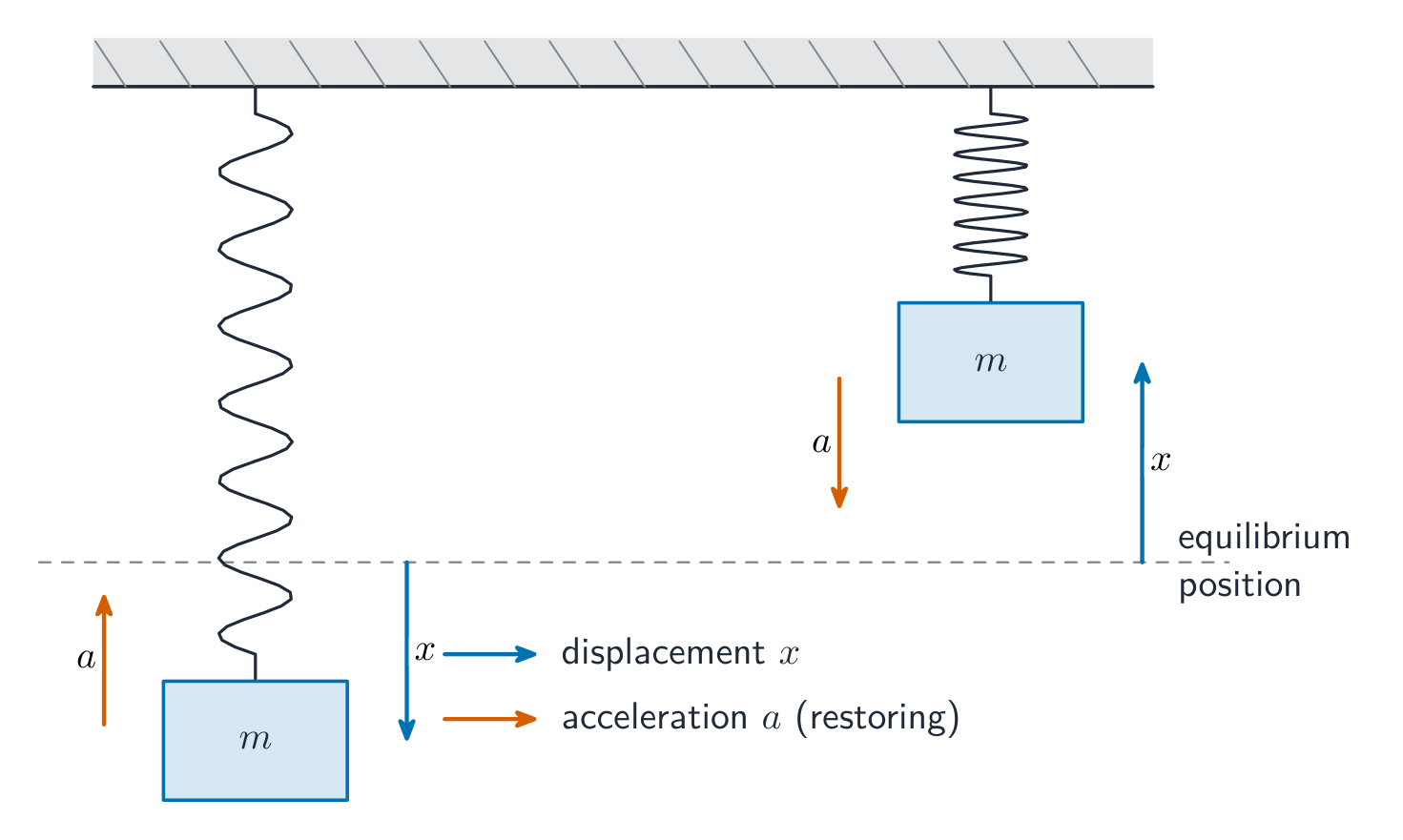
Its solution is sinusoidal, $x(t)=A\cos(\omega t+\phi)$. You do not need to prove this solution – you need to recognise the equation: any system whose motion obeys "$\ddot{x}=-\omega^2x$" is a simple harmonic oscillator, whatever it is made of. (A mass hanging on a vertical spring works the same way: gravity only shifts the equilibrium point; the oscillation about it is unchanged.)
Português
Movimento harmônico simples
Movimento harmônico simples 简谐运动 (SHM) é um caso especial de movimento periódico 周期运动. Aparece sempre que duas coisas são verdadeiras: existe uma posição de equilíbrio 平衡位置 onde a força líquida é zero, e deslocar o objeto produz uma força restauradora 回复力 – uma força apontando de volta para o equilíbrio – cuja magnitude é proporcional ao deslocamento:
$$F=-k\,\Delta x.$$
A segunda lei de Newton então fornece a equação diferencial 微分方程 definidora:
Sua solução é senoidal, $x(t)=A\cos(\omega t+\phi)$. Você não precisa provar essa solução – precisa reconhecer a equação: qualquer sistema cuja obedeça "$\ddot{x}=-\omega^2x$" é um oscilador harmônico simples, independentemente do que é feito. (Uma massa pendurada em uma mola vertical funciona da mesma forma: a gravidade apenas desloca o ponto de equilíbrio; a oscilação em torno dele permanece inalterada.)
No MHS a aceleração sempre aponta de volta para o equilíbrio, oposta ao deslocamento
7.2
Frequency and Period of SHM · Frequência e Período do MHS
Syllabus · Programa
English
Learning Objective 7.2.A: Describe the frequency and period of an object exhibiting SHM.
7.2.A.1 The period of SHM is related to the angular frequency, $\omega$, of the object's motion by the following equation:
Two classic conceptual traps: the period of SHM never depends on the amplitude 振幅, and each system ignores one obvious variable – the pendulum's period does not involve its mass, and the spring's period does not involve $g$ (a spring–block oscillator keeps perfect time in orbit; a pendulum clock does not).
Português
A frequência angular 角频率$\omega$ define o período 周期 e a frequência 频率:
Dois armadilhas conceituais clássicas: o período do SHM nunca depende da amplitude 振幅, e cada sistema ignora uma variável óbvia – o período do pêndulo não envolve sua massa, e o período da mola não envolve $g$ (um oscilador mola-bloco mantém tempo perfeito em órbita; um relógio de pêndulo não).
Explore · Explorar
Meça o período de oscilação de um pêndulo
O período de um pêndulo depende de seu comprimento e da gravidade, não de sua massa ou amplitude (pequena): $T=2\pi\sqrt{L/g}$. Alongue-o e cada oscilação levará mais tempo.
Representing and Analyzing SHM · Representando e Analisando MHS
Syllabus · Programa
English
Learning Objective 7.3.A: Describe the displacement, velocity, and acceleration of an object exhibiting SHM.
7.3.A.1 For an object exhibiting SHM, the displacement of that object measured from its equilibrium position can be represented by the equations $x = A\cos(2\pi ft)$ or $x = A\sin(2\pi ft)$.
7.3.A.1.i Minima, maxima, and zeros of displacement, velocity, and acceleration are features of harmonic motion.
7.3.A.1.ii Recognizing the positions or times at which the displacement, velocity, and acceleration for SHM have extrema or zeros can help in qualitatively describing the behavior of the motion.
7.3.A.2 The position as a function of time for an object exhibiting SHM is a solution of the second-order differential equation derived from the application of Newton's second law.
7.3.A.3 Characteristics of SHM, such as velocity and acceleration, can be determined by or derived from the equation $x = A\cos(\omega t + \phi).$
7.3.A.3.i The acceleration of an object exhibiting SHM is related to the object's angular frequency and position.
Derived equation:$a = -\omega^2 x$
7.3.A.3.ii It can be shown that the maximum velocity and acceleration of an object exhibiting SHM are related to the angular frequency of the object's motion.
Derived equations:$v_{\max} = A\omega$
$a_{\max} = A\omega^2$
7.3.A.4 In the presence of a sinusoidal external force, a system may exhibit resonance.
7.3.A.4.i Resonance occurs when an external force is exerted at the natural frequency of an oscillating system.
7.3.A.4.ii Resonance increases the amplitude of oscillating motion.
7.3.A.4.iii The natural frequency of a system is the frequency at which the system will oscillate when it is displaced from its equilibrium position.
7.3.A.5 Changing the amplitude of a system exhibiting SHM will not change its period.
7.3.A.6 Properties of SHM can be determined and analyzed using graphical representations.
Boundary statement: AP Physics C: Mechanics only expects students to know the solution to the second-order differential equation that describes SHM, as well as be able to identify SHM. AP Physics C: Mechanics does not expect students to mathematically prove that the solution is correct.
Português
Objetivo de Aprendizagem 7.3.A: Descrever o deslocamento, a velocidade e a aceleração de um objeto que exibe MHS.
7.3.A.1 Para um objeto que exibe MHS, o deslocamento desse objeto medido em relação à sua posição de equilíbrio pode ser representado pelas equações $x = A\cos(2\pi ft)$ ou $x = A\sin(2\pi ft)$.
7.3.A.1.i Mínimos, máximos e zeros de deslocamento, velocidade e aceleração são características do movimento harmônico.
7.3.A.1.ii Reconhecer as posições ou instantes nos quais o deslocamento, a velocidade e a aceleração para o MHS apresentam extremos ou zeros pode ajudar a descrever qualitativamente o comportamento do movimento.
7.3.A.2 A posição em função do tempo para um objeto apresentando MSO é uma solução da equação diferencial de segunda ordem derivada da aplicação da segunda lei de Newton.
7.3.A.3 Características do MSO, como velocidade e aceleração, podem ser determinadas ou derivadas da equação $x = A\cos(\omega t + \phi).$
7.3.A.3.i A aceleração de um objeto apresentando MSO está relacionada à sua frequência angular e posição.
Equação derivada:$a = -\omega^2 x$
7.3.A.3.ii Pode-se mostrar que a velocidade máxima e a aceleração de um objeto apresentando MSO estão relacionadas à frequência angular do movimento do objeto.
Equações derivadas:$v_{\max} = A\omega$
$a_{\max} = A\omega^2$
7.3.A.4 Na presença de uma força externa senoidal, um sistema pode exibir ressonância.
7.3.A.4.i A ressonância ocorre quando uma força externa é exercida na frequência natural de um sistema oscilatório.
7.3.A.4.ii A ressonância aumenta a amplitude do movimento oscilatório.
7.3.A.4.iii A frequência natural de um sistema é a frequência na qual o sistema oscilará quando deslocado de sua posição de equilíbrio.
7.3.A.5 Alterar a amplitude de um sistema apresentando MSO não alterará seu período.
7.3.A.6 As propriedades do MSO podem ser determinadas e analisadas usando representações gráficas.
Declaração de Escopo: AP Physics C: Mecânica apenas espera que os alunos conheçam a solução da equação diferencial de segunda ordem que descreve o MSO, bem como sejam capazes de identificar o MSO. AP Physics C: Mecânica não espera que os alunos provem matematicamente que a solução está correta.
Source: College Board AP Course and Exam Description · Fonte: College Board AP Course and Exam Description
So at the ends of the swing ($x=\pm A$) the speed is zero and the acceleration is largest; passing through equilibrium ($x=0$) the acceleration is zero and the speed is largest, $v_{\max}=A\omega$. The amplitude $A$ and the phase constant 相位常数$\phi$ come from the initial conditions: where the object starts and how fast it is moving. Eliminating $t$ (or using energy, below) gives speed as a function of position:
$$v=\pm\,\omega\sqrt{A^2-x^2}.$$
Worked example. A $0.50\ \text{kg}$ mass on a $k=200\ \text{N/m}$ spring: $\omega=\sqrt{k/m}=20\ \text{rad/s}$, $T=2\pi/\omega=0.31\ \text{s}$. With $A=0.10\ \text{m}$: $v_{\max}=A\omega=2.0\ \text{m/s}$ at equilibrium, and at $x=0.050\ \text{m}$ the speed is $v=\omega\sqrt{A^2-x^2}=20\sqrt{0.10^2-0.050^2}=1.7\ \text{m/s}$.
Português
Diferencie $x(t)=A\cos(\omega t+\phi)$ duas vezes:
Assim, nas extremidades do balanço ($x=\pm A$) a velocidade é zero e a aceleração é máxima; passando pelo equilíbrio ($x=0$) a aceleração é zero e a velocidade é máxima, $v_{\max}=A\omega$. A amplitude $A$ e a constante de fase 相位常数$\phi$ vêm das condições iniciais: onde o objeto começa e com que velocidade ele se move. Eliminando $t$ (ou usando energia, abaixo) dá a velocidade como função da posição:
$$v=\pm\,\omega\sqrt{A^2-x^2}.$$
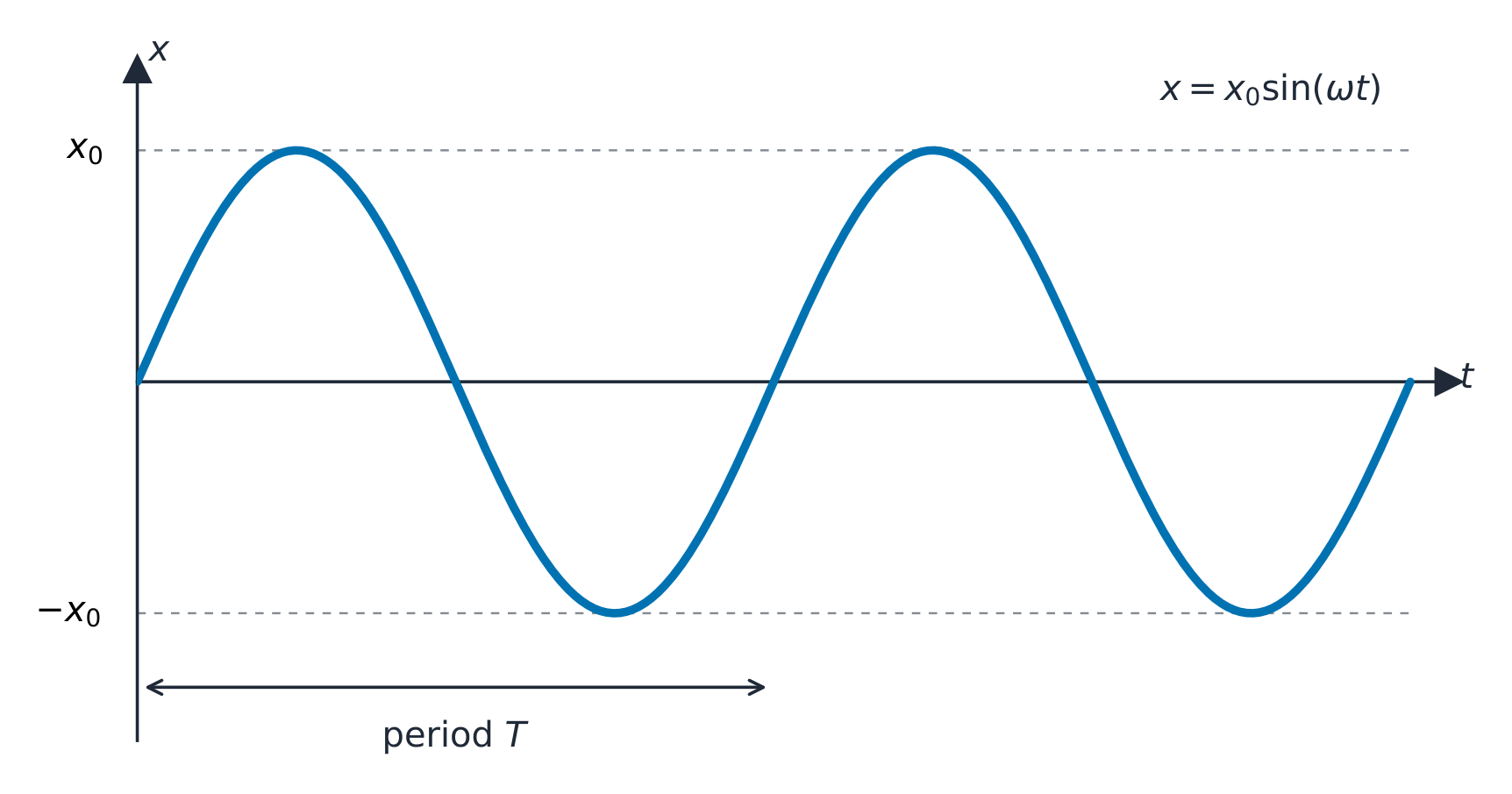
O deslocamento varia sinusoidalmente com o tempo no movimento harmônico simples
Exemplo resolvido. Uma massa $0.50\ \text{kg}$ em uma mola $k=200\ \text{N/m}$: $\omega=\sqrt{k/m}=20\ \text{rad/s}$, $T=2\pi/\omega=0.31\ \text{s}$. Com $A=0.10\ \text{m}$: $v_{\max}=A\omega=2.0\ \text{m/s}$ no equilíbrio, e em $x=0.050\ \text{m}$ a velocidade é $v=\omega\sqrt{A^2-x^2}=20\sqrt{0.10^2-0.050^2}=1.7\ \text{m/s}$.
7.4
Energy of Simple Harmonic Oscillators · Energia de Osciladores Harmônicos Simples
Syllabus · Programa
English
Learning Objective 7.4.A: Describe the mechanical energy of a system exhibiting SHM.
7.4.A.1 The total energy of a system exhibiting SHM is the sum of the system's kinetic and potential energies.
Relevant equation:$E_{\text{total}} = U + K$
7.4.A.2 Conservation of energy indicates that the total energy of a system exhibiting SHM is constant.
7.4.A.3 The kinetic energy of a system exhibiting SHM is at a maximum when the system's potential energy is at a minimum.
7.4.A.4 The potential energy of a system exhibiting SHM is at a maximum when the system's kinetic energy is at a minimum.
7.4.A.4.i The minimum kinetic energy of a system exhibiting SHM is zero.
7.4.A.4.ii Changing the amplitude of a system exhibiting SHM will change the maximum potential energy of the system and, therefore, the total energy of the system.
Relevant equation for a spring–object system:$E_{\text{total}} = \dfrac{1}{2}kA^2$
Português
Objetivo de Aprendizagem 7.4.A: Descrever a energia mecânica de um sistema que exibe MHS.
7.4.A.1 A energia total de um sistema que exibe MHS é a soma das energias cinética e potencial do sistema.
Equação relevante:$E_{\text{total}} = U + K$
7.4.A.2 A conservação de energia indica que a energia total de um sistema que exibe MHS é constante.
7.4.A.3 A energia cinética de um sistema que exibe MHS é máxima quando a energia potencial do sistema é mínima.
7.4.A.4 A energia potencial de um sistema que exibe MHS é máxima quando a energia cinética do sistema é mínima.
7.4.A.4.i A energia cinética mínima de um sistema que exibe MHS é zero.
7.4.A.4.ii Alterar a amplitude de um sistema que exibe MHS alterará a energia potencial máxima do sistema e, portanto, a energia total do sistema.
Equação relevante para um sistema objeto-mola:$E_{\text{total}} = \dfrac{1}{2}kA^2$
Source: College Board AP Course and Exam Description · Fonte: College Board AP Course and Exam Description
English
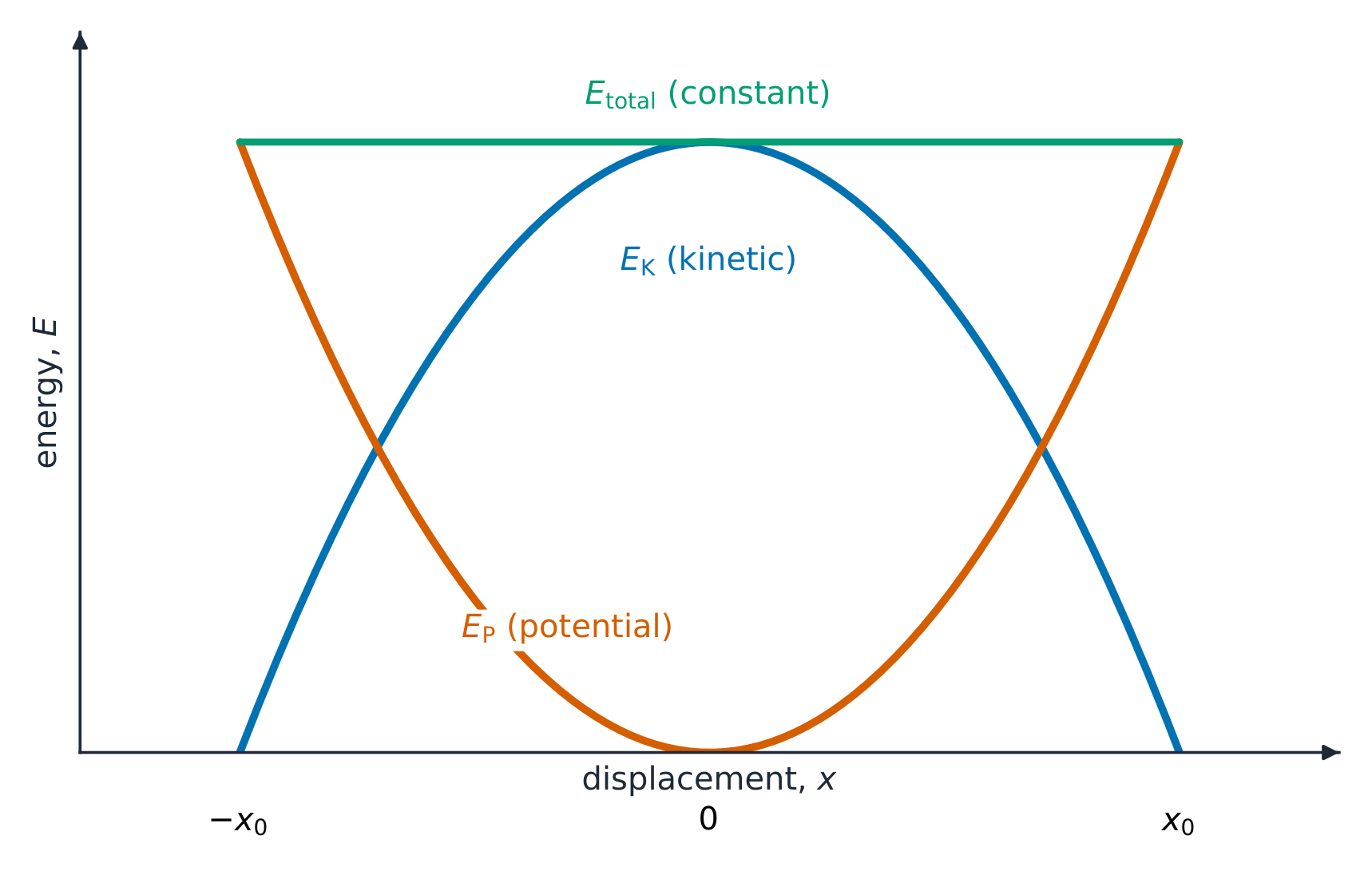
The total energy of the oscillator is the sum $E=U+K$, and with no friction it is constant – energy just trades back and forth between the spring's potential energy and the mass's kinetic energy:
$$E=\tfrac12kA^2=\tfrac12kx^2+\tfrac12mv^2.$$
All potential at the ends (where $K=0$), all kinetic at equilibrium (where $U$ is minimum). Because $E\propto A^2$, doubling the amplitude quadruples the energy.
Worked example. Where is the energy split evenly? Set $\tfrac12kx^2=\tfrac12E=\tfrac14kA^2$, so $x=A/\sqrt2\approx0.71A$ – much closer to the end than to the middle. For the system above ($A=0.10\ \text{m}$): $x=0.071\ \text{m}$.
Left alone, a system oscillates at its own natural frequency 固有频率 (set by $k$ and $m$: $f_0=\frac{1}{2\pi}\sqrt{k/m}$). Drive it with a periodic force at that same frequency and the amplitude grows dramatically – resonance 共振. Each well-timed push adds energy faster than damping removes it, so the driven amplitude peaks sharply when the driving frequency matches $f_0$ (a swing pumped in time, a bridge shaken by wind).
Português
A energia total do oscilador é a soma $E=U+K$, e sem atrito ela é constante – a energia apenas troca de volta e frente entre a energia potencial da mola e a energia cinética da massa:
$$E=\tfrac12kA^2=\tfrac12kx^2+\tfrac12mv^2.$$
Toda a energia potencial nas extremidades (onde $K=0$), toda cinética no equilíbrio (onde $U$ é mínimo). Como $E\propto A^2$, dobrar a amplitude quadruplica a energia.
Energia cinética e potencial trocam-se ao longo de um ciclo enquanto a energia total permanece constante
Exemplo resolvido. Onde a energia é dividida igualmente? Defina $\tfrac12kx^2=\tfrac12E=\tfrac14kA^2$, então $x=A/\sqrt2\approx0.71A$ – muito mais próximo da extremidade do que do meio. Para o sistema acima ($A=0.10\ \text{m}$): $x=0.071\ \text{m}$.
Deixado sozinho, um sistema oscila em sua frequência natural 固有频率 (definida por $k$ e $m$: $f_0=\frac{1}{2\pi}\sqrt{k/m}$). Impulsione-o com uma força periódica na mesma frequência e a amplitude cresce dramaticamente – ressonância 共振. Cada empurrão bem cronometrado adiciona energia mais rápido do que o amortecimento a remove, então a amplitude impulsionada atinge pico agudo quando a frequência de impulsos coincide com $f_0$ (um balanço impulsionado no ritmo certo, uma ponte sacudida pelo vento).
Explore · Explorar
Troque energia cinética e potencial no MHS
No movimento harmônico simples, a energia oscila entre cinética (máxima no centro) e potencial (máxima nas extremidades), enquanto o total permanece constante.
7.5
Simple and Physical Pendulums · Pêndulos Simples e Físicos
Syllabus · Programa
English
Learning Objective 7.5.A: Describe the properties of a physical pendulum.
7.5.A.1 A physical pendulum is a rigid body that undergoes oscillation about a fixed axis.
7.5.A.2 For small amplitudes of motion, the period of a physical pendulum is derived from the application of Newton's second law in rotational form.
7.5.A.3 A simple pendulum is a special case of physical pendulums in which the hanging object can be modeled as a point mass at a distance, $l$, from the pivot point.
7.5.A.4 A torsion pendulum is a case of SHM where the restoring torque is proportional to the angular displacement of a rotating system. For example, a horizontal disk that is suspended from a wire attached to its center of mass may undergo rotational oscillations about the wire in the horizontal plane.
Derived equation:$I\alpha = -k\Delta\theta$
Português
Objetivo de Aprendizagem 7.5.A: Descrever as propriedades de um pêndulo físico.
7.5.A.1 Um pêndulo físico é um corpo rígido que sofre oscilação em torno de um eixo fixo.
7.5.A.2 Para pequenas amplitudes de movimento, o período de um pêndulo físico é derivado da aplicação da segunda lei de Newton na forma rotacional.
7.5.A.2.i Ao ser deslocado do equilíbrio, a força gravitacional exercida no centro de massa de um pêndulo físico fornece um torque restaurador.
Equação derivada:$\tau = -mgd\sin\theta$
7.5.A.2.ii Para pequenas amplitudes de movimento, a aproximação de ângulos pequenos pode ser aplicada ao torque restaurador.
Equação derivada:$\sin\theta \approx \theta$
$\tau = -mgd\theta = I\alpha$
7.5.A.2.iii A aproximação de ângulos pequenos e a segunda lei de Newton na forma rotacional geram uma equação diferencial de segunda ordem que descreve o MSO:
7.5.A.3 Um pêndulo simples é um caso especial de pêndulos físicos no qual o objeto suspenso pode ser modelado como uma massa pontual a uma distância, $l$, do ponto de pivô.
7.5.A.4 Um pêndulo de torção é um caso de MSO no qual o torque restaurador é proporcional ao deslocamento angular de um sistema rotativo. Por exemplo, um disco horizontal suspenso por um fio preso ao seu centro de massa pode sofrer oscilações rotacionais em torno do fio no plano horizontal.
Equação derivada:$I\alpha = -k\Delta\theta$
Source: College Board AP Course and Exam Description · Fonte: College Board AP Course and Exam Description
English
Energy conservation: KE ⇄ PE
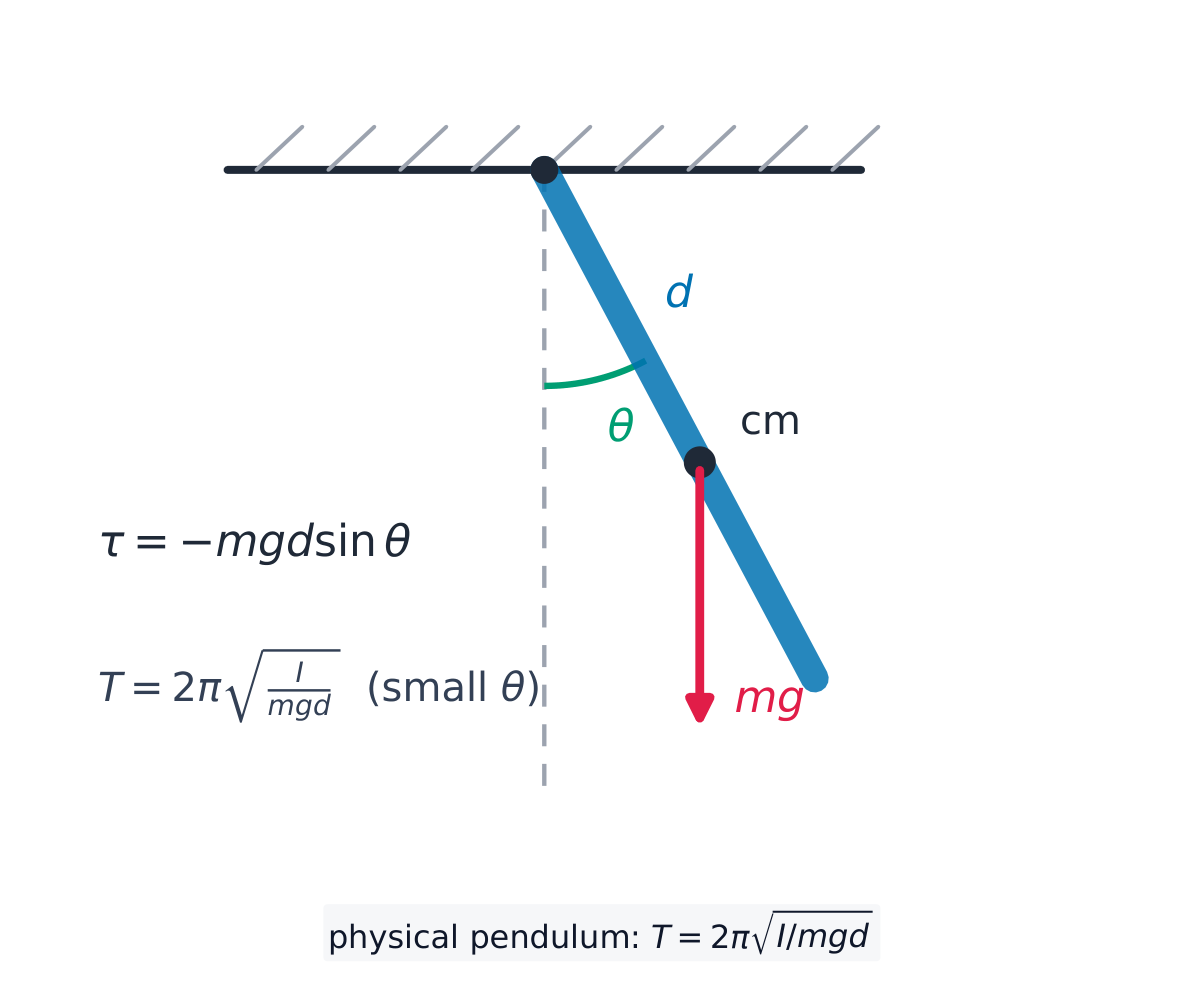
A physical pendulum 物理摆 is any rigid body swinging about a fixed pivot. Displace it by an angle $\theta$ and gravity, acting at the center of mass a distance $d$ from the pivot, supplies a restoring torque
$$\tau=-mgd\sin\theta.$$
For small angles, apply the small-angle approximation 小角度近似$\sin\theta\approx\theta$ and Newton's second law in rotational form ($\tau=I\alpha$):
This is the same "$\ddot\theta=-\omega^2\theta$" pattern as before – recognising it is the derivation. A simple pendulum 单摆 is the special case of a point mass on a light string: $I=m\ell^2$ and $d=\ell$ give $T=2\pi\sqrt{\ell/g}$.
Worked example. A uniform rod (mass $M$, length $L$) swings from one end: $I=\tfrac13ML^2$, $d=\tfrac{L}{2}$, so
– shorter than a simple pendulum of length $L$, because the rod's mass sits nearer the pivot.
A torsion pendulum 扭摆 – a disk hanging from a wire that twists – is SHM one more time: the wire's restoring torque is proportional to the twist angle, $I\alpha=-\kappa\,\Delta\theta$, giving $T=2\pi\sqrt{I/\kappa}$.
Exam skill. Every pendulum FRQ wants the same three steps: write the restoring torque about the pivot, apply the small-angle approximation, and match the result to $\ddot\theta=-\omega^2\theta$ to read off $\omega$. State the small-angle step explicitly – it is a scored point, and it is why large-amplitude swings are not simple harmonic.
Português
Conservação de energia: KE ⇄ PE
Um pêndulo físico 物理摆 é qualquer corpo rígido oscilando em torno de um pivô fixo. Desloque-o por um ângulo $\theta$ e a gravidade, atuando no centro de massa a uma distância $d$ do pivô, fornece um torque restaurador
$$\tau=-mgd\sin\theta.$$
Para pequenos ângulos, aplique a aproximação de pequenos ângulos 小角度近似$\sin\theta\approx\theta$ e a segunda lei de Newton na forma rotacional ($\tau=I\alpha$):
Este é o mesmo padrão "$\ddot\theta=-\omega^2\theta$" de antes – reconhecê-lo é a derivação. Um pêndulo simples 单摆 é o caso especial de uma massa pontual em uma corda leve: $I=m\ell^2$ e $d=\ell$ dão $T=2\pi\sqrt{\ell/g}$.
A gravidade atuando no centro de massa fornece o torque restaurador de um pêndulo físico
Exemplo resolvido. Uma haste uniforme (massa $M$, comprimento $L$) oscila de uma extremidade: $I=\tfrac13ML^2$, $d=\tfrac{L}{2}$, então
– mais curto que um pêndulo simples de comprimento $L$, porque a massa da haste fica mais próxima do pivô.
Um pêndulo de torção 扭摆 – um disco suspenso por um fio que torce – é mais uma vez SHM: o torque restaurador do fio é proporcional ao ângulo de torção, $I\alpha=-\kappa\,\Delta\theta$, dando $T=2\pi\sqrt{I/\kappa}$.
Habilidade de prova. Toda questão FRQ de pêndulo quer os mesmos três passos: escrever o torque restaurador em relação ao pivô, aplicar a aproximação de pequenos ângulos e ajustar o resultado a $\ddot\theta=-\omega^2\theta$ para ler $\omega$. Declare o passo de pequenos ângulos explicitamente – é um ponto avaliado, e é por isso que oscilações de grande amplitude não são harmônicas simples.
Um pêndulo de Foucault: um pêndulo longo e pesado cuja oscilação lenta revela a Terra girando sob ele
Pick one and the site follows you — notes, papers, videos and practice all open on it. · Escolha uma e o site te seguirá — notas, provas, vídeos e prática abrirão nela.
Type to search notes, lessons, code, vocabulary and past-paper questions across every subject. · Digite para pesquisar notas, aulas, código, vocabulário e questões de provas anteriores em todas as disciplinas.