Energy of Simple Harmonic Oscillators
Introduced| English | Meaning |
|---|---|
| potential energy/pəˈtenʃl ˈenədʒi/ | Energy stored because of position or configuration. |
| kinetic energy/kɪˈnetɪk ˈenədʒi/ | The energy an object has because of its motion. |
The endless trade
- A swing slows to a stop at the top, then rushes fastest through the bottom.
- Nothing is lost — the motion just keeps swapping form.
- Stretch is stored; speed is spent; back and forth forever.
- Two stores hand the same total to and fro.
Two stores in a spring
- The spring holds potential energy 势能 $U = \tfrac{1}{2}kx^2$.
- The mass carries kinetic energy 动能 $K = \tfrac{1}{2}mv^2$.
- As it oscillates, energy pours from one into the other.
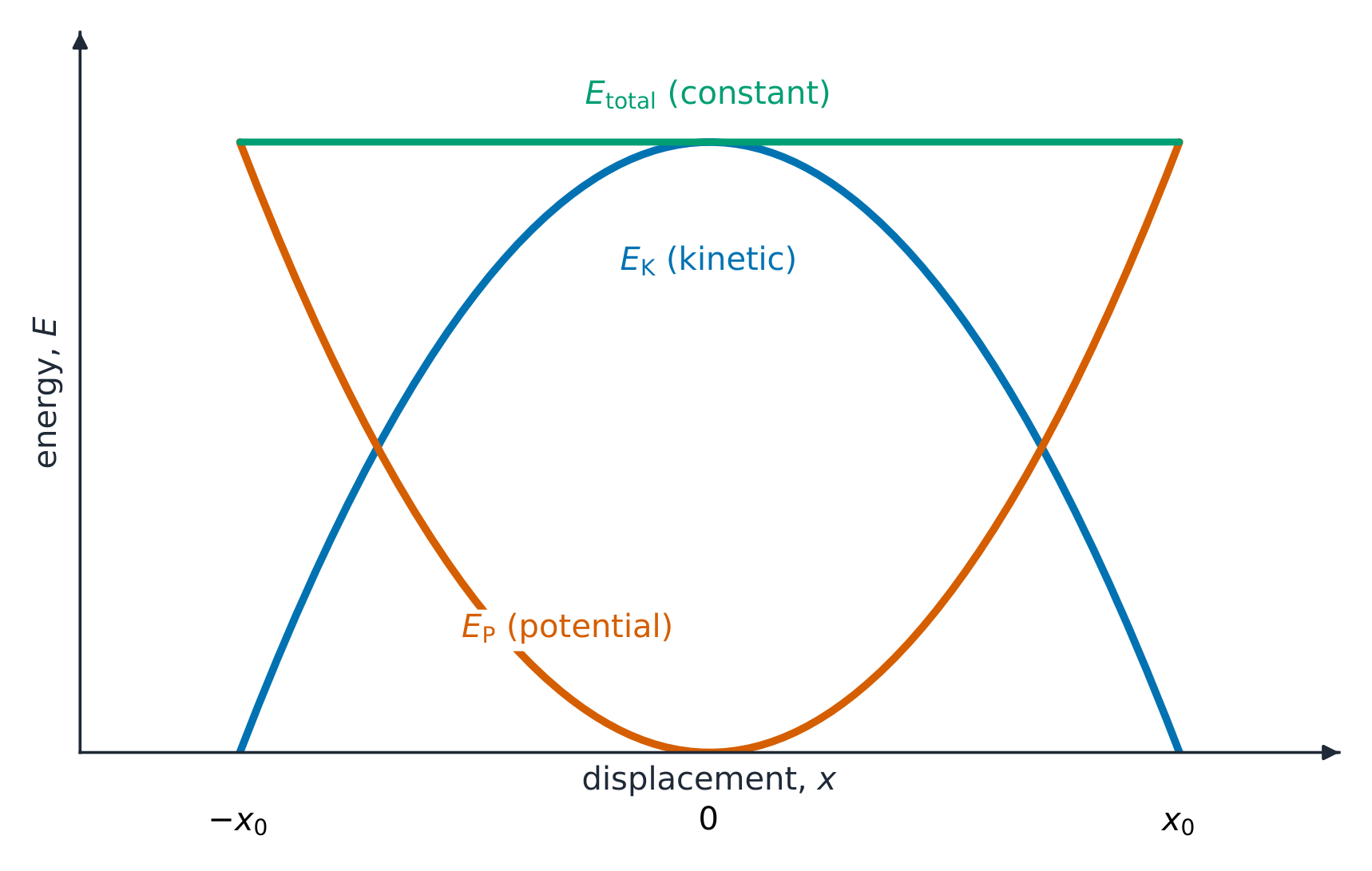
Kinetic and potential energy swap over a cycle while the total energy stays constant
A spring with $k = 100\ \text{N/m}$ is displaced $x = 0.1\ \text{m}$. Its stored potential energy (in J)?
Difficulty 2/5 · 140 coins + a small bonus on first completion today
$U = \tfrac{1}{2}kx^2 = \tfrac{1}{2}(100)(0.1)^2 = 0.5\ \text{J}$.
The total never changes
- Add them and the total stays fixed:
- At the ends it is all potential (speed zero); at the middle it is all kinetic.
- The amplitude alone sets the total.
A spring with $k = 100\ \text{N/m}$ oscillates with amplitude $A = 0.2\ \text{m}$. Its total energy (in J)?
Difficulty 2/5 · 140 coins + a small bonus on first completion today
$E = \tfrac{1}{2}kA^2 = \tfrac{1}{2}(100)(0.2)^2 = 2\ \text{J}$.
At which point is the oscillator's energy entirely kinetic?
Difficulty 1/5 · 100 coins + a small bonus on first completion today
At equilibrium $x = 0$ so $U = 0$ and all the energy is kinetic.
Cashing energy for speed
- At equilibrium every bit is kinetic, so:
- This recovers $v_{max} = A\omega$, since $\omega^2 = k/m$.
- Double the amplitude and you get four times the energy, twice the top speed.
Energy of an oscillator
Over a cycle, energy shifts between kinetic and potential while the total stays fixed.
A spring with $k = 200\ \text{N/m}$ oscillates with amplitude $A = 0.05\ \text{m}$.
- Total energy: $E = \tfrac{1}{2}kA^2 = \tfrac{1}{2}(200)(0.05)^2 = 0.25\ \text{J}$.
- It is all kinetic at the middle and all potential at the ends.
If you double the amplitude of an oscillator, its total energy...
Difficulty 1/5 · 100 coins + a small bonus on first completion today
$E = \tfrac{1}{2}kA^2 \propto A^2$, so $2^2 = 4$ times the energy.
Kinetic and potential energy can both reach their maximum at the same instant.
Difficulty 1/5 · 100 coins + a small bonus on first completion today
Each is largest where the other is zero -- they are never both maximal.
In a real oscillator with friction, over time the amplitude...
Difficulty 1/5 · 100 coins + a small bonus on first completion today
Friction drains energy, so the amplitude decays -- this is damping.
The energy goes as amplitude squared ($E = \tfrac{1}{2}kA^2$), so doubling $A$ quadruples the energy, not doubles it. Kinetic and potential energy are each largest where the other is zero, never both at once. And "the total stays constant" assumes no friction or drag — a real oscillator slowly loses energy and its amplitude decays (damping).
An oscillator's energy trades between potential energy $U = \tfrac{1}{2}kx^2$ and kinetic energy $K = \tfrac{1}{2}mv^2$, with a fixed total $E = \tfrac{1}{2}kA^2$. It is all potential at the extremes and all kinetic at equilibrium, giving $\tfrac{1}{2}mv_{max}^2 = \tfrac{1}{2}kA^2$. Because $E \propto A^2$, doubling the amplitude quadruples the energy.
Write from a total energy of 10 J
- A spring has k = 80 N/m and amplitude 0.50 m.
- Find the total energy of the oscillation.
A spring with k = 80 N/m oscillates with amplitude 0.50 m. What is the total energy?
One half of 80 is 40, and 40 times 0.25 is 10.
What is the total energy?
Difficulty 1/5 · 100 coins + a small bonus on first completion today
Half of 80 times 0.50 squared is 10 J.