Skip to content · ⁨Pular para o conteúdo⁩

Trabalho, Energia e Potência

Física C: Mecânica do AP · Topic 3 · ⁨Tópico 3⁩

Train · ⁨Treinar⁩
Video lesson for this topic · ⁨Videoaula para este tópico⁩ Open the video page · ⁨Abrir a página do vídeo⁩
7:46

Trabalho, Energia e Potência

Um bloco desliza contra uma mola e a esmaga até parar. How far does the spring compress? Try that with a kinematic equation. You cannot — the force grows…

English narration · English + 中文 subtitles burned in · ⁨Narração em inglês · Legendas em inglês + 中文 gravadas⁩

3.1

Translational Kinetic Energy · ⁨Energia Cinética Translacional⁩

Syllabus · ⁨Programa⁩
English

Learning Objective 3.1.A: Describe the translational kinetic energy of an object in terms of the object's mass and velocity.

  • 3.1.A.1 An object's translational kinetic energy is given by the equation
    • Equation: $K = \dfrac{1}{2}mv^2$
  • 3.1.A.2 Translational kinetic energy is a scalar quantity.
  • 3.1.A.3 Different observers may measure different values of the translational kinetic energy of an object, depending on the observer's frame of reference.
Português

Objetivo de Aprendizagem 3.1.A: Descrever a energia cinética translacional de um objeto em termos da massa e da velocidade do objeto.

  • 3.1.A.1 A energia cinética translacional de um objeto é dada pela equação
    • Equação: $K = \dfrac{1}{2}mv^2$
  • 3.1.A.2 Energia cinética translacional é uma grandeza escalar.
  • 3.1.A.3 Diferentes observadores podem medir diferentes valores da energia cinética translacional de um objeto, dependendo do referencial do observador.
Source: College Board AP Course and Exam Description · ⁨Fonte: College Board AP Course and Exam Description⁩

English

Kinetic energy 动能 is the energy of motion, a scalar 标量 measured in joules 焦耳 (J):

$$K=\tfrac{1}{2}mv^2.$$

It grows with the square of speed – doubling the speed quadruples $K$. One subtlety worth knowing: kinetic energy depends on the observer's reference frame 参考系. A passenger walking down a train has a small $K$ measured inside the train and a huge one measured from the ground – both observers are right, each in their own frame.

Português

Energia cinética 动能 é a energia do movimento, uma escalar 标量 medida em joules 焦耳 (J):

$$K=\tfrac{1}{2}mv^2.$$

Ela cresce com o quadrado da velocidade — dobrar a velocidade quadruplica $K$. Uma sutileza importante: a energia cinética depende do sistema de referência 参考系 do observador. Um passageiro caminhando em um trem tem uma pequena $K$ medida dentro do trem e uma enorme medida do solo — ambos os observadores estão certos, cada um em sua própria referência.

Vocabulary · ⁨Vocabulário⁩ Train · ⁨Treinar⁩
English · ⁨Inglês⁩ Chinese · ⁨Chinês⁩ Pinyin
Kinetic energy/kɪˈnetɪk ˈenədʒi/ 动能 dòng néng
scalar/ˈskeɪlə/ 标量 biāo liàng
joules/dʒuːlz/ 焦耳 jiāo ěr
reference frame/ˈrefrəns freɪm/ 参考系 cān kǎo xì
3.2

Work · ⁨Trabalho⁩

Syllabus · ⁨Programa⁩
English

Learning Objective 3.2.A: Describe the work done on an object or system by a given force or collection of forces.

  • 3.2.A.1 Work is the amount of energy transferred into or out of a system by a force exerted on that system over a distance.
    • 3.2.A.1.i The work done by a conservative force exerted on a system is path-independent and only depends on the initial and final configurations of that system.
    • 3.2.A.1.ii The work done by a conservative force on a system—or the change in the potential energy of the system—will be zero if the system returns to its initial configuration.
    • 3.2.A.1.iii Potential energies are associated only with conservative forces.
    • 3.2.A.1.iv The work done by a nonconservative force is path-dependent.
    • 3.2.A.1.v The most common nonconservative forces are friction and air resistance.
  • 3.2.A.2 Work is a scalar quantity that may be positive, negative, or zero.
  • 3.2.A.3 The work done on an object by a variable force is calculated using
    • Equation: $W = \displaystyle\int_a^b \vec{F}(r) \cdot d\vec{r}$, where the integral is taken over the path from point $a$ to point $b$.
    • 3.2.A.3.i The dot product between two vectors, $\vec{A}$ and $\vec{B}$, results in a scalar quantity of magnitude $\vec{A} \cdot \vec{B} = AB\cos\theta$.
    • 3.2.A.3.ii Only the component of the force exerted on a system that is parallel to the displacement of the point of application of the force will change the system's total energy.
    • 3.2.A.3.iii If the component of the force exerted on a system that is parallel to the displacement is constant, the work done on the system by the force is given by the derived equation $W = F_{\parallel}d = Fd\cos\theta$.
    • 3.2.A.3.iv The component of the force exerted on a system perpendicular to the direction of the displacement of the system's center of mass can change the direction of the system's motion without changing the system's kinetic energy.
  • 3.2.A.4 The work–energy theorem states that the change in an object's kinetic energy is equal to the sum of the work (net work) being done by all forces exerted on the object.
    • Equation: $\Delta K = \displaystyle\sum W_i = \sum F_{\parallel,i}\, d_i$
    • 3.2.A.4.i An external force may change the configuration of a system. The component of the external force parallel to the displacement times the displacement of the point of application of the force gives the change in kinetic energy of the system.
    • 3.2.A.4.ii If the system's center of mass and the point of application of the force move the same distance when a force is exerted on a system, then the system may be modeled as an object, and only the system's kinetic energy can change.
    • 3.2.A.4.iii The energy dissipated by friction is typically equated to the force of friction times the length of the path over which the force is exerted.
      • Equation: $\Delta E_{\text{mech}} = F_f d\cos\theta$
    • 3.2.A.5 Work is equal to the area under the curve of a graph of $F_{\parallel}$ as a function of displacement.

Boundary statement: AP Physics C: Mechanics only expects students to analyze the transfer of mechanical energy, although students should be aware that mechanical energy may be dissipated in the form of thermal energy or sound.

Português

Objetivo de Aprendizagem 3.2.A: Descrever o trabalho realizado sobre um objeto ou sistema por uma força dada ou conjunto de forças.

  • 3.2.A.1 Trabalho é a quantidade de energia transferida para dentro ou para fora de um sistema por uma força exercida sobre esse sistema ao longo de uma distância.
    • 3.2.A.1.i O trabalho realizado por uma força conservativa exercida sobre um sistema é independente do caminho e depende apenas das configurações inicial e final desse sistema.
    • 3.2.A.1.ii O trabalho realizado por uma força conservativa sobre um sistema — ou a variação da energia potencial do sistema — será zero se o sistema retornar à sua configuração inicial.
    • 3.2.A.1.iii As energias potenciais estão associadas apenas às forças conservativas.
    • 3.2.A.1.iv O trabalho realizado por uma força não conservativa depende do caminho.
    • 3.2.A.1.v As forças não conservativas mais comuns são o atrito e a resistência do ar.
  • 3.2.A.2 Trabalho é uma grandeza escalar que pode ser positiva, negativa ou nula.
  • 3.2.A.3 O trabalho realizado sobre um objeto por uma força variável é calculado usando
    • Equação: $W = \displaystyle\int_a^b \vec{F}(r) \cdot d\vec{r}$, onde a integral é tomada ao longo do caminho do ponto $a$ ao ponto $b$.
    • 3.2.A.3.i O produto escalar entre dois vetores, $\vec{A}$ e $\vec{B}$, resulta em uma quantidade escalar de magnitude $\vec{A} \cdot \vec{B} = AB\cos\theta$.
    • 3.2.A.3.ii Apenas o componente da força exercida sobre um sistema que é paralelo ao deslocamento do ponto de aplicação da força alterará a energia total do sistema.
    • 3.2.A.3.iii Se o componente da força exercida sobre um sistema que é paralelo ao deslocamento for constante, o trabalho realizado no sistema pela força é dado pela equação derivada $W = F_{\parallel}d = Fd\cos\theta$.
    • 3.2.A.3.iv O componente da força exercida sobre um sistema perpendicular à direção do deslocamento do centro de massa do sistema pode mudar a direção do movimento do sistema sem alterar a energia cinética do sistema.
  • 3.2.A.4 O teorema do trabalho-energia afirma que a variação da energia cinética de um objeto é igual à soma do trabalho (trabalho líquido) realizado por todas as forças exercidas sobre o objeto.
    • Equação: $\Delta K = \displaystyle\sum W_i = \sum F_{\parallel,i}\, d_i$
    • 3.2.A.4.i Uma força externa pode alterar a configuração de um sistema. O componente da força externa paralelo ao deslocamento multiplicado pelo deslocamento do ponto de aplicação da força dá a variação da energia cinética do sistema.
    • 3.2.A.4.ii Se o centro de massa do sistema e o ponto de aplicação da força se moverem a mesma distância quando uma força é exercida sobre um sistema, então o sistema pode ser modelado como um objeto, e apenas a energia cinética do sistema pode mudar.
    • 3.2.A.4.iii A energia dissipada pelo atrito é tipicamente igualada à força de atrito vezes o comprimento do caminho ao longo do qual a força é exercida.
      • Equação: $\Delta E_{\text{mech}} = F_f d\cos\theta$
    • 3.2.A.5 O trabalho é igual à área sob a curva de um gráfico de $F_{\parallel}$ em função do deslocamento.

Declaração de limite: AP Physics C: Mecânica apenas espera que os alunos analisem a transferência de energia mecânica, embora os alunos devem estar cientes de que a energia mecânica pode ser dissipada na forma de energia térmica ou som.

Source: College Board AP Course and Exam Description · ⁨Fonte: College Board AP Course and Exam Description⁩

English

Work 功 is energy transferred into or out of a system by a force acting over a distance. For a variable force it is an integral 积分 along the path:

$$W=\int_a^b \vec{F}\cdot d\vec{r}=\int F\cos\theta\,dr.$$

For a constant force this reduces to $W=Fd\cos\theta$; on a force–position graph, work is the area under the curve. Work is a scalar with a sign, and the sign is physics, not bookkeeping:

  • Positive – force has a component along the motion (it speeds the object up).
  • Negative – force opposes the motion (friction 摩擦力 and air drag do negative work).
  • Zero – force perpendicular to the motion (the normal force 法向力 on a sliding block, gravity on a horizontal move, tension in a circular swing).

The work–energy theorem 动能定理 collects every force's contribution: the net work equals the change in kinetic energy,

$$W_{\text{net}}=\sum W_i=\Delta K.$$

Worked example. A variable force $F(x)=3x^2\ \text{N}$ (along the motion) acts from $x=0$ to $x=2\ \text{m}$: $W=\displaystyle\int_0^2 3x^2\,dx=\big[x^3\big]_0^2=8\ \text{J}$. Acting alone on a body starting from rest, it would raise the kinetic energy to exactly $8\ \text{J}$.

Português

Trabalho 功 é energia transferida para ou de um sistema por uma força atuando sobre uma distância. Para uma força variável, é uma integral 积分 ao longo do caminho:

$$W=\int_a^b \vec{F}\cdot d\vec{r}=\int F\cos\theta\,dr.$$

Para uma força constante, isso se reduz a $W=Fd\cos\theta$; num gráfico de força-posição, o trabalho é a área sob a curva. Trabalho é uma escalar com sinal, e o sinal é física, não contabilidade:

  • Positivo — a força tem uma componente ao longo do movimento (ela acelera o objeto).
  • Negativo — a força se opõe ao movimento (atrito 摩擦力 e arrasto de ar fazem trabalho negativo).
  • Zero – força perpendicular ao movimento (a força normal 法向力 em um bloco deslizando, gravidade em movimento horizontal, tensão em oscilação circular).
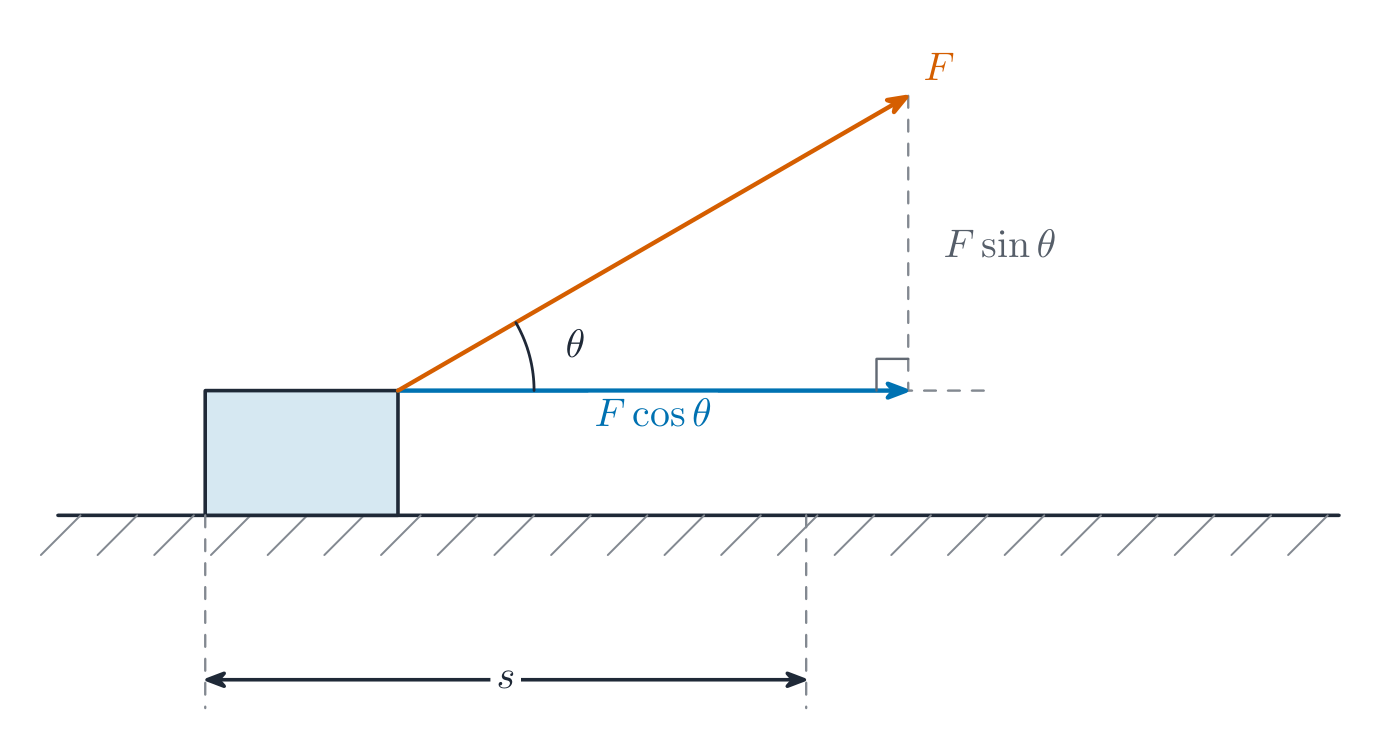
Apenas a componente da força ao longo do deslocamento realiza trabalho

O teorema do trabalho e da energia cinética 动能定理 soma a contribuição de todas as forças: o trabalho líquido é igual à variação da energia cinética,

$$W_{\text{net}}=\sum W_i=\Delta K.$$

Exemplo resolvido. Uma força variável $F(x)=3x^2\ \text{N}$ (ao longo do movimento) atua de $x=0$ até $x=2\ \text{m}$: $W=\displaystyle\int_0^2 3x^2\,dx=\big[x^3\big]_0^2=8\ \text{J}$. Atuando sozinha em um corpo partindo do repouso, ela elevaria a energia cinética exatamente para $8\ \text{J}$.

Vocabulary · ⁨Vocabulário⁩ Train · ⁨Treinar⁩
English · ⁨Inglês⁩ Chinese · ⁨Chinês⁩ Pinyin
Work/wɜːk/ 功 gōng
integral/ˈɪntɪɡrəl/ 积分 jī fēn
friction/ˈfrɪkʃn/ 摩擦力 mó cā lì
normal force/ˈnɔːml fɔːs/ 法向力 fǎ xiàng lì
work–energy theorem/wɜːk ˈenədʒi ˈθɪərəm/ 动能定理 dòng néng dìng lǐ
3.3

Potential Energy · ⁨Energia Potencial⁩

Syllabus · ⁨Programa⁩
English

Learning Objective 3.3.A: Describe the potential energy of a system.

  • 3.3.A.1 A system composed of two or more objects has potential energy if the objects within that system only interact with each other through conservative forces.
  • 3.3.A.2 Potential energy is a scalar quantity associated with the position of objects within a system.
  • 3.3.A.3 The definition of zero potential energy for a given system is a decision made by the observer considering the situation to simplify or otherwise assist in analysis.
  • 3.3.A.4 The relationship between conservative forces exerted on a system and the system's potential energy is
    • Equation: $\Delta U = -\displaystyle\int_a^b \vec{F}_{cf}(r) \cdot d\vec{r}$
  • 3.3.A.5 The conservative forces exerted on a system in a single dimension can be determined using the slope of the system's potential energy with respect to position in that dimension; these forces point in the direction of decreasing potential energy.
    • Equation: $F_x = -\dfrac{dU(x)}{dx}$
  • 3.3.A.6 Graphs of a system's potential energy as a function of its position can be useful in determining physical properties of that system.
    • 3.3.A.6.i Stable equilibrium is a location at which a small displacement in an object's position results in a force exerted on the object opposite to the direction of the small displacement, accelerating the object back toward the equilibrium position.
    • 3.3.A.6.ii Unstable equilibrium is a location at which a small displacement in an object's position results in a force exerted on the object in the same direction as the small displacement, accelerating the object away from the equilibrium position.
    • 3.3.A.6.iii In a given dimension, stable equilibrium positions exist at locations where the potential energy as a function of position in that dimension has a local minimum.
    • 3.3.A.6.iv In a given dimension, unstable equilibrium positions occur at locations where the potential energy as a function of position in that dimension has a local maximum.
  • 3.3.A.7 The potential energy of common physical systems can be described using the physical properties of that system.
    • 3.3.A.7.i The elastic potential energy of an ideal spring is given by the following equation, where $\Delta x$ is the distance the spring has been stretched or compressed from its equilibrium length.
      • Equation: $U_s = \dfrac{1}{2}k(\Delta x)^2$
    • 3.3.A.7.ii The general form for the gravitational potential energy of a system consisting of two approximately spherical distributions of mass (e.g., moons, planets, or stars) is given by the equation
      • Equation: $U_g = -G\dfrac{m_1 m_2}{r}$
    • 3.3.A.7.iii Because the gravitational field near the surface of a planet is nearly constant, the change in gravitational potential energy in a system consisting of an object with mass $m$ and a planet with gravitational field of magnitude $g$ when the object is near the surface of the planet may be approximated by the equation
      • Equation: $\Delta U_g = mg\Delta y$
  • 3.3.A.8 The total potential energy of a system containing more than two objects is the sum of the potential energy of each pair of objects within the system.
Português

Objetivo de Aprendizagem 3.3.A: Descrever a energia potencial de um sistema.

  • 3.3.A.1 Um sistema composto por dois ou mais objetos tem energia potencial se os objetos dentro desse sistema interagem uns com os outros apenas através de forças conservativas.
  • 3.3.A.2 Energia potencial é uma grandeza escalar associada à posição dos objetos dentro de um sistema.
  • 3.3.A.3 A definição de energia potencial zero para um dado sistema é uma decisão tomada pelo observador considerando a situação para simplificar ou de outra forma auxiliar na análise.
  • 3.3.A.4 A relação entre as forças conservativas exercidas sobre um sistema e a energia potencial do sistema é
    • Equação: $\Delta U = -\displaystyle\int_a^b \vec{F}_{cf}(r) \cdot d\vec{r}$
  • 3.3.A.5 As forças conservativas exercidas sobre um sistema em uma única dimensão podem ser determinadas usando a inclinação da energia potencial do sistema em relação à posição nessa dimensão; essas forças apontam na direção de diminuição da energia potencial.
    • Equação: $F_x = -\dfrac{dU(x)}{dx}$
  • 3.3.A.6 Gráficos da energia potencial de um sistema como função de sua posição podem ser úteis para determinar propriedades físicas desse sistema.
    • 3.3.A.6.i Equilíbrio estável é uma localização na qual um pequeno deslocamento na posição de um objeto resulta em uma força exercida sobre o objeto oposta à direção do pequeno deslocamento, acelerando o objeto de volta para a posição de equilíbrio.
    • 3.3.A.6.ii Equilíbrio instável é uma localização na qual um pequeno deslocamento na posição de um objeto resulta em uma força exercida sobre o objeto na mesma direção do pequeno deslocamento, acelerando o objeto para longe da posição de equilíbrio.
    • 3.3.A.6.iii Em uma dada dimensão, posições de equilíbrio estável existem em locais onde a energia potencial como função da posição nessa dimensão tem um mínimo local.
    • 3.3.A.6.iv Em uma dada dimensão, posições de equilíbrio instável ocorrem em locais onde a energia potencial como função da posição nessa dimensão tem um máximo local.
  • 3.3.A.7 A energia potencial de sistemas físicos comuns pode ser descrita usando as propriedades físicas desse sistema.
    • 3.3.A.7.i A energia potencial elástica de uma mola ideal é dada pela seguinte equação, onde $\Delta x$ é a distância que a mola foi esticada ou comprimida a partir de seu comprimento de equilíbrio.
      • Equação: $U_s = \dfrac{1}{2}k(\Delta x)^2$
    • 3.3.A.7.ii A forma geral para a energia potencial gravitacional de um sistema consistindo de duas distribuições de massa aproximadamente esféricas (por exemplo, luas, planetas ou estrelas) é dada pela equação
      • Equação: $U_g = -G\dfrac{m_1 m_2}{r}$
    • 3.3.A.7.iii Como o campo gravitacional próximo à superfície de um planeta é quase constante, a mudança na energia potencial gravitacional em um sistema consistindo de um objeto com massa $m$ e um planeta com campo gravitacional de magnitude $g$ quando o objeto está próximo à superfície do planeta pode ser aproximada pela equação
      • Equação: $\Delta U_g = mg\Delta y$
  • 3.3.A.8 A energia potencial total de um sistema contendo mais de dois objetos é a soma da energia potencial de cada par de objetos dentro do sistema.

Source: College Board AP Course and Exam Description · ⁨Fonte: College Board AP Course and Exam Description⁩

English

Potential energy 势能 is energy a system stores by the positions of its parts – it exists only for conservative forces 保守力, whose work is path independent. It is defined through work:

$$\Delta U=-\int_a^b\vec{F}\cdot d\vec{r},$$

and you are free to choose where $U=0$ – only changes in $U$ matter, so pick the zero that makes the problem simplest. The standard results:

  • Gravity near a surface: $\Delta U_g=mg\,\Delta y$.
  • Gravity in general: $U_g=-\dfrac{Gm_1m_2}{r}$ (zero at infinite separation).
  • Spring: $U_s=\tfrac12k(\Delta x)^2$, with $\Delta x$ measured from natural length.

For systems of several objects, add the potential energy of each pair. Turning the definition around, a conservative force is minus the derivative 导数 of its potential energy:

$$F_x=-\frac{dU}{dx}.$$

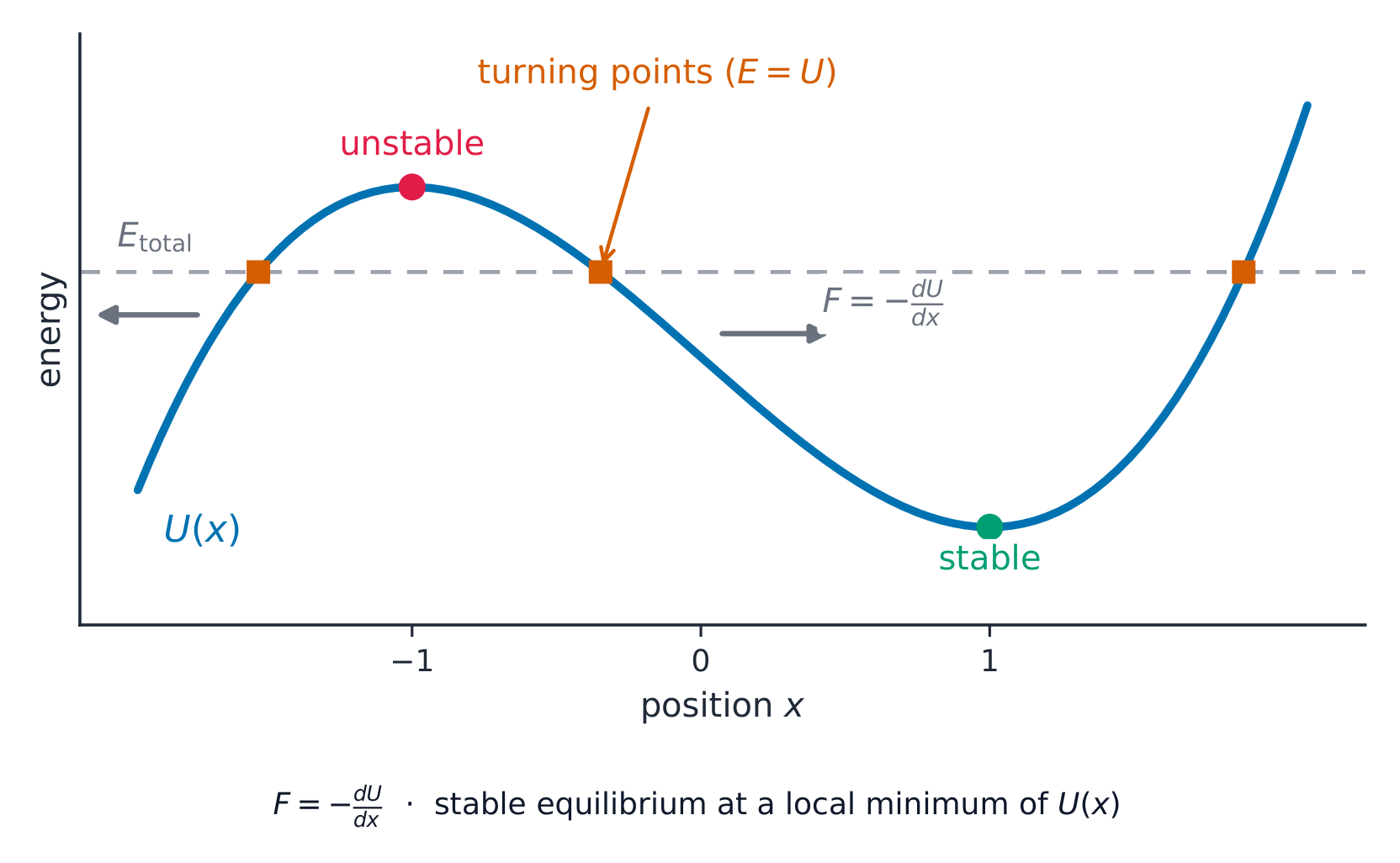
The force points "downhill" on the $U(x)$ curve. Equilibrium sits where the slope is zero: a minimum is a stable equilibrium 稳定平衡 (displaced, the force pushes back), a maximum is an unstable equilibrium 不稳定平衡 (displaced, the force pushes away).

Worked example. Given $U(x)=2x^3-6x$ (joules), the force is $F=-\dfrac{dU}{dx}=6-6x^2$. Equilibria sit at $F=0$: $x=\pm1$. Since $\dfrac{d^2U}{dx^2}=12x$ is positive at $x=+1$ (a minimum – stable) and negative at $x=-1$ (a maximum – unstable), the two points behave oppositely.

Português

Energia potencial 势能 é a energia que um sistema armazena devido às posições de suas partes – existe apenas para forças conservativas 保守力, cujo trabalho é independente do caminho. É definida através do trabalho:

$$\Delta U=-\int_a^b\vec{F}\cdot d\vec{r},$$

e você tem liberdade para escolher onde $U=0$ – apenas as variações em $U$ importam, então escolha o zero que simplifica o problema. Os resultados padrão:

  • Gravidade perto de uma superfície: $\Delta U_g=mg\,\Delta y$.
  • Gravidade em geral: $U_g=-\dfrac{Gm_1m_2}{r}$ (zero na separação infinita).
  • Mola: $U_s=\tfrac12k(\Delta x)^2$, com $\Delta x$ medido a partir do comprimento natural.

Para sistemas de vários objetos, some a energia potencial de cada par. Invertendo a definição, uma força conservativa é menos a derivada 导数 de sua energia potencial:

$$F_x=-\frac{dU}{dx}.$$

A força aponta "montanha abaixo" na curva de $U(x)$. O equilíbrio está onde a inclinação é zero: um mínimo é um equilíbrio estável 稳定平衡 (deslocado, a força empurra de volta), um máximo é um equilíbrio instável 不稳定平衡 (deslocado, a força afasta).

Numa curva de energia potencial a força aponta montanha abaixo e E = U marca os pontos de inversão

Exemplo resolvido. Dado $U(x)=2x^3-6x$ (joules), a força é $F=-\dfrac{dU}{dx}=6-6x^2$. Os equilíbrios estão em $F=0$: $x=\pm1$. Como $\dfrac{d^2U}{dx^2}=12x$ é positivo em $x=+1$ (um mínimo – estável) e negativo em $x=-1$ (um máximo – instável), os dois pontos se comportam opostamente.

Explore · ⁨Explorar⁩

Armazene energia potencial elástica em uma mola

Esticar uma mola armazena energia potencial elástica $\tfrac12 kx^2$ — a área sob a linha força-extensão. Solte-a e essa energia se converte em cinética.

Vocabulary · ⁨Vocabulário⁩ Train · ⁨Treinar⁩
English · ⁨Inglês⁩ Chinese · ⁨Chinês⁩ Pinyin
Potential energy/pəˈtenʃl ˈenədʒi/ 势能 shì néng
conservative forces/kənˈsɜːvətɪv ˈfɔːsɪz/ 保守力 bǎo shǒu lì
derivative/dɪˈrɪvətɪv/ 导数 dǎo shù
stable equilibrium/ˈsteɪbl ˌiːkwɪˈlɪbrɪəm/ 稳定平衡 wěn dìng píng héng
unstable equilibrium/ʌnˈsteɪbl ˌiːkwɪˈlɪbrɪəm/ 不稳定平衡 bù wěn dìng píng héng
Mechanical energy/mɪˈkænɪkl ˈenədʒi/ 机械能 jī xiè néng
nonconservative forces/ˌnɒŋkənˈsɜːvətɪv ˈfɔːsɪz/ 非保守力 fēi bǎo shǒu lì
thermal energy/ˈθɜːml ˈenədʒi/ 热能 rè néng
turning points/ˈtɜːnɪŋ pɔɪnts/ 转折点 zhuǎn zhé diǎn
3.4

Conservation of Energy · ⁨Conservação de Energia⁩

Syllabus · ⁨Programa⁩
English

Learning Objective 3.4.A: Describe the energies present in a system.

  • 3.4.A.1 A system composed of only a single object can only have kinetic energy.
  • 3.4.A.2 A system that contains objects that interact via conservative forces or that can change its shape reversibly may have both kinetic and potential energies.

Learning Objective 3.4.B: Describe the behavior of a system using conservation of mechanical energy principles.

  • 3.4.B.1 Mechanical energy is the sum of a system's kinetic and potential energies.
  • 3.4.B.2 Any change to a type of energy within a system must be balanced by an equivalent change of other types of energies within the system or by a transfer of energy between the system and its surroundings.
  • 3.4.B.3 A system may be selected so that the total energy of that system is constant.
  • 3.4.B.4 If the total energy of a system changes, that change will be equivalent to the energy transferred into or out of the system.

Learning Objective 3.4.C: Describe how the selection of a system determines whether the energy of that system changes.

  • 3.4.C.1 Energy is conserved in all interactions.
  • 3.4.C.2 If the work done on a selected system is zero and there are no nonconservative interactions within the system, the total mechanical energy of the system is constant.
  • 3.4.C.3 If the work done on a selected system is nonzero, energy is transferred between the system and the environment.

Boundary statement: AP Physics C: Mechanics expects students to know that mechanical energy can be dissipated as thermal energy or sound by nonconservative forces.

Português

Objetivo de Aprendizagem 3.4.A: Descrever as energias presentes em um sistema.

  • 3.4.A.1 Um sistema composto por apenas um único objeto só pode ter energia cinética.
  • 3.4.A.2 Um sistema que contém objetos que interagem via forças conservativas ou que pode mudar sua forma reversivelmente pode ter tanto energias cinéticas quanto potenciais.

Objetivo de Aprendizagem 3.4.B: Descrever o comportamento de um sistema usando princípios de conservação de energia mecânica.

  • 3.4.B.1 Energia mecânica é a soma das energias cinéticas e potenciais de um sistema.
  • 3.4.B.2 Qualquer mudança em um tipo de energia dentro de um sistema deve ser equilibrada por uma mudança equivalente de outros tipos de energias dentro do sistema ou por uma transferência de energia entre o sistema e suas vizinhanças.
  • 3.4.B.3 Um sistema pode ser selecionado de modo que a energia total desse sistema seja constante.
  • 3.4.B.4 Se a energia total de um sistema muda, essa mudança será equivalente à energia transferida para dentro ou para fora do sistema.

Objetivo de Aprendizagem 3.4.C: Descrever como a seleção de um sistema determina se a energia desse sistema muda.

  • 3.4.C.1 A energia é conservada em todas as interações.
  • 3.4.C.2 Se o trabalho realizado sobre um sistema selecionado é zero e não há interações não conservativas dentro do sistema, a energia mecânica total do sistema é constante.
  • 3.4.C.3 Se o trabalho realizado sobre um sistema selecionado é diferente de zero, energia é transferida entre o sistema e o ambiente.

Declaração de limite: AP Physics C: Mecânica espera que os alunos saibam que a energia mecânica pode ser dissipada como energia térmica ou som por forças não conservativas.

Source: College Board AP Course and Exam Description · ⁨Fonte: College Board AP Course and Exam Description⁩

English
Energy conservation: KE ⇄ PE

Energy is conserved in all interactions – the question is only where it goes. Mechanical energy 机械能 is the sum $E=K+U$. If the external work on a system is zero and nothing inside it acts through nonconservative forces 非保守力, then

$$K_1+U_1=K_2+U_2.$$

When friction or drag act, they convert mechanical energy into thermal energy 热能 ($\Delta E_{\text{mech}}=-F_fd$), and the balance must include that term. If external work is done, the system's total energy changes by exactly the energy transferred: $W_{\text{ext}}=\Delta E_{\text{sys}}$. Choosing the system is choosing the bookkeeping – a single object can only have kinetic energy; include the Earth or the spring and the system can store potential energy too.

A potential-energy graph is a complete motion map: the horizontal line at height $E$ is the total energy, the gap $E-U(x)$ is the kinetic energy at each $x$, and the crossings $E=U$ are the turning points 转折点 where the object momentarily stops and reverses.

Worked example. A $2.0\ \text{kg}$ block slides down a ramp from rest at height $1.5\ \text{m}$, arriving at the bottom at $4.0\ \text{m/s}$. Energy accounting: $mgh=29.4\ \text{J}$ available; $\tfrac12mv^2=16\ \text{J}$ arrives as kinetic energy; so friction converted $29.4-16=13\ \text{J}$ into thermal energy along the way.

Português
Conservação de energia: KE ⇄ PE

A energia é conservada em todas as interações – a questão é apenas para onde ela vai. Energia mecânica 机械能 é a soma $E=K+U$. Se o trabalho externo sobre um sistema é zero e nada dentro dele age por meio de forças não conservativas 非保守力, então

$$K_1+U_1=K_2+U_2.$$

Quando atrito ou arrasto atuam, eles convertem energia mecânica em energia térmica 热能 ($\Delta E_{\text{mech}}=-F_fd$), e o balanço deve incluir esse termo. Se trabalho externo é realizado, a energia total do sistema muda exatamente pela energia transferida: $W_{\text{ext}}=\Delta E_{\text{sys}}$. Escolher o sistema é escolher a contabilidade – um único objeto só pode ter energia cinética; inclua a Terra ou a mola e o sistema pode armazenar energia potencial também.

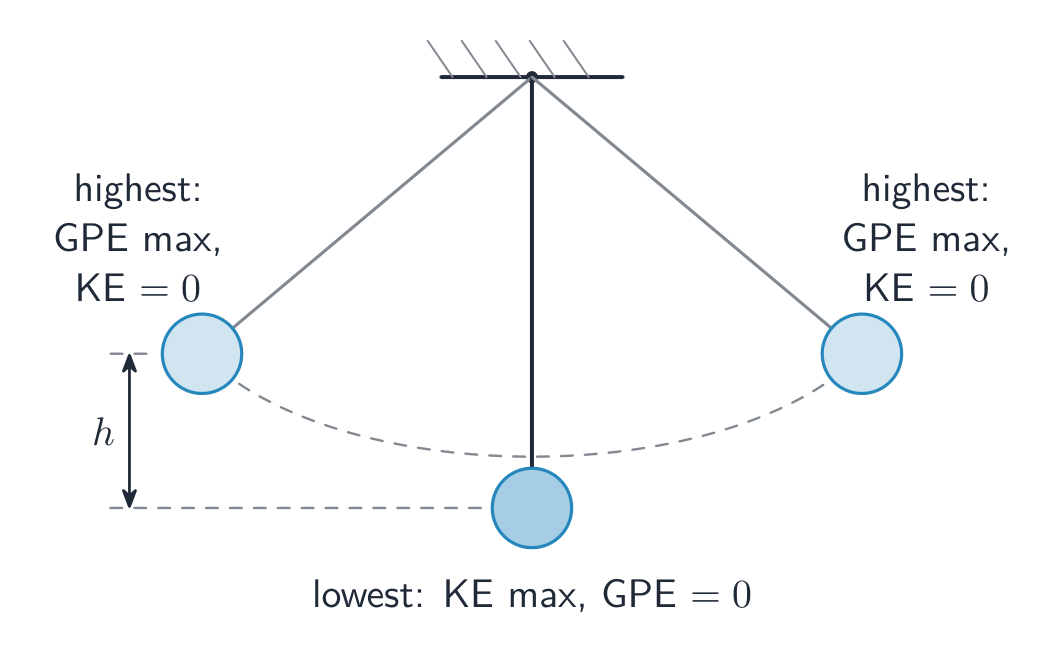
Um pêndulo troca energia potencial gravitacional por energia cinética e vice-versa

Um gráfico de energia potencial é um mapa completo do movimento: a linha horizontal na altura $E$ é a energia total, a diferença $E-U(x)$ é a energia cinética em cada $x$, e os cruzamentos $E=U$ são os pontos de inversão 转折点 onde o objeto para momentaneamente e inverte o sentido.

Exemplo resolvido. Um bloco de $2.0\ \text{kg}$ desliza por uma rampa partindo do repouso na altura $1.5\ \text{m}$, chegando ao fundo com velocidade $4.0\ \text{m/s}$. Contabilidade energética: $mgh=29.4\ \text{J}$ disponível; $\tfrac12mv^2=16\ \text{J}$ chega como energia cinética; logo, o atrito converteu $29.4-16=13\ \text{J}$ em energia térmica no trajeto.

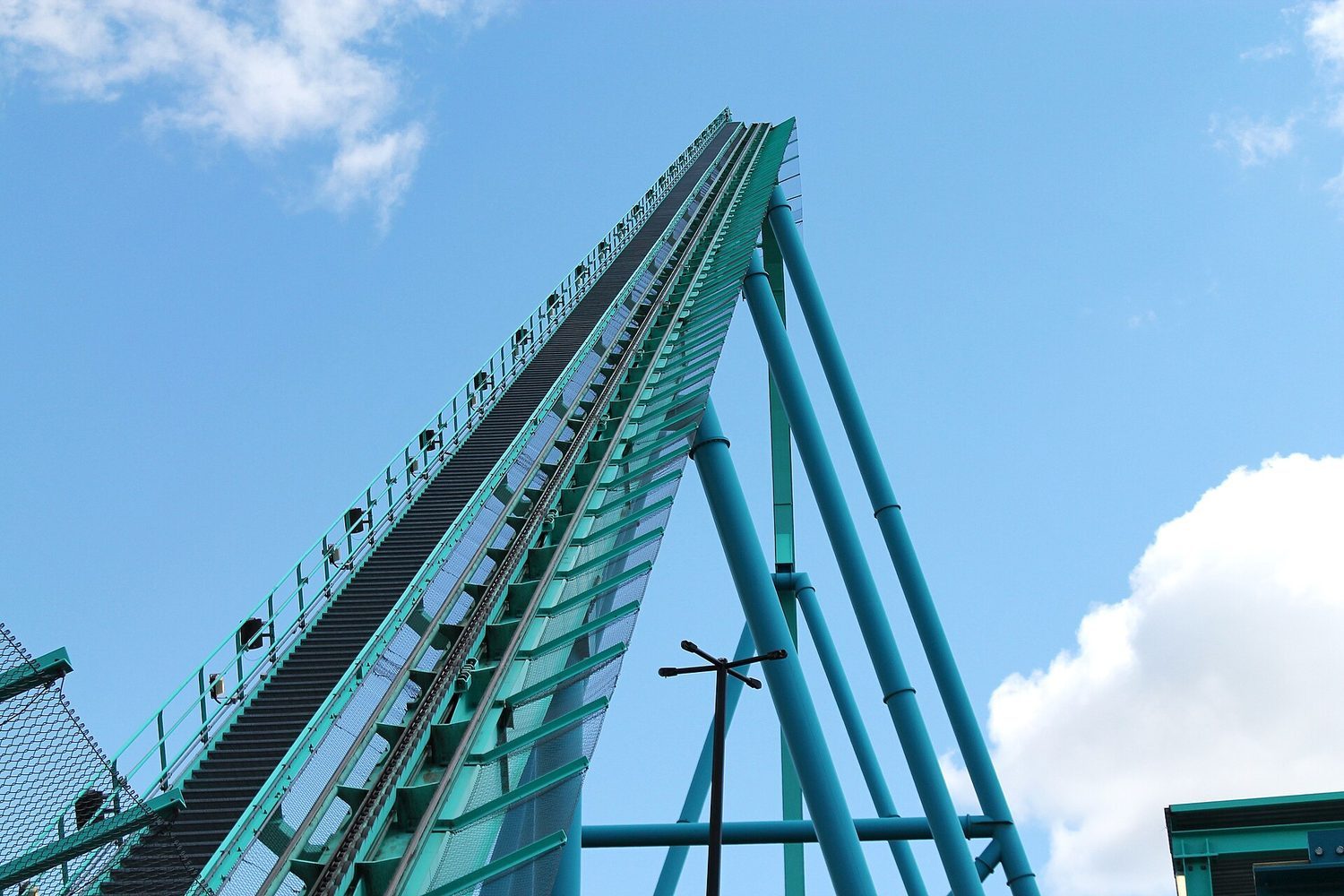
Um brinquedo de montanha-russa troca energia de volta e frente: mais alto (maior PE) no topo, mais rápido (maior KE) no fundo
Explore · ⁨Explorar⁩

Observe a conversão de energia durante a queda de um objeto

Sem atrito, a energia mecânica é conservada: enquanto um objeto cai, a energia potencial gravitacional se transforma em energia cinética, mantendo-se o total constante.

Watch lesson · ⁨Assistir aula⁩
3.5

Power · ⁨Potência⁩

Syllabus · ⁨Programa⁩
English

Learning Objective 3.5.A: Describe the transfer of energy into, out of, or within a system in terms of power.

  • 3.5.A.1 Power is the rate at which energy changes with respect to time, either by transfer into or out of a system or by conversion from one type to another within a system.
  • 3.5.A.2 Average power is the amount of energy being transferred or converted, divided by the time it took for that transfer or conversion to occur.
    • Equation: $P_{\text{avg}} = \dfrac{\Delta E}{\Delta t}$
  • 3.5.A.3 Because work is the change in energy of an object or system due to a force, average power is the total work done, divided by the time during which that work was done.
    • Equation: $P_{\text{avg}} = \dfrac{W}{\Delta t}$
  • 3.5.A.4 The instantaneous power delivered to an object by a force is given by the equation
    • Equation: $P_{\text{inst}} = \dfrac{dW}{dt}$
  • 3.5.A.5 The instantaneous power delivered to an object by the component of a constant force parallel to the object's velocity can be described with the derived equation
    • Equation: $P_{\text{inst}} = F_{\parallel}v = Fv\cos\theta$
Português

Objetivo de Aprendizagem 3.5.A: Descrever a transferência de energia para dentro, para fora ou dentro de um sistema em termos de potência.

  • 3.5.A.1 Potência é a taxa na qual a energia muda em relação ao tempo, seja por transferência para dentro ou para fora de um sistema ou por conversão de um tipo para outro dentro do sistema.
  • 3.5.A.2 Potência média é a quantidade de energia sendo transferida ou convertida, dividida pelo tempo que levou para que essa transferência ou conversão ocorra.
    • Equação: $P_{\text{avg}} = \dfrac{\Delta E}{\Delta t}$
  • 3.5.A.3 Como o trabalho é a mudança na energia de um objeto ou sistema devido a uma força, a potência média é o trabalho total realizado, dividido pelo tempo durante o qual esse trabalho foi realizado.
    • Equação: $P_{\text{avg}} = \dfrac{W}{\Delta t}$
  • 3.5.A.4 A potência instantânea fornecida a um objeto por uma força é dada pela equação
    • Equação: $P_{\text{inst}} = \dfrac{dW}{dt}$
  • 3.5.A.5 A potência instantânea fornecida a um objeto pela componente de uma força constante paralela à velocidade do objeto pode ser descrita com a equação derivada
    • Equação: $P_{\text{inst}} = F_{\parallel}v = Fv\cos\theta$

Source: College Board AP Course and Exam Description · ⁨Fonte: College Board AP Course and Exam Description⁩

English

Power 功率 is the rate of energy transfer, in watts 瓦特 (W):

$$P_{\text{avg}}=\frac{\Delta E}{\Delta t}=\frac{W}{\Delta t},\qquad P_{\text{inst}}=\frac{dW}{dt}=\vec{F}\cdot\vec{v}.$$

It measures how fast work is done, not how much. The dot product matters: only the force component along the velocity delivers power.

Worked example. A block released from rest at the top of a frictionless $3.0\ \text{m}$-high ramp reaches the bottom at $v=\sqrt{2gh}=7.7\ \text{m/s}$ (from $mgh=\tfrac12mv^2$). A motor that then drives it at a steady $7.7\ \text{m/s}$ against a $20\ \text{N}$ resistance delivers $P=Fv=20(7.7)\approx150\ \text{W}$.

Worked example. A $1200\ \text{kg}$ car climbs a hill that rises $1.0\ \text{m}$ for every $20\ \text{m}$ of road, at a steady $15\ \text{m/s}$. The engine must supply gravity's power drain: $P=mg\,v\sin\theta=1200(9.8)(15)\big(\tfrac{1}{20}\big)\approx8.8\ \text{kW}$ – before adding air resistance.

Exam skill. Energy FRQs reward the accounting sentence: name your system, state which forces do work on it, and write the balance ($W_{\text{ext}}=\Delta K+\Delta U+\Delta E_{\text{thermal}}$) before plugging in numbers. "Friction is present, so mechanical energy is not conserved" is a scored statement.

Português

Potência 功率 é a taxa de transferência de energia, em watts 瓦特 (W):

$$P_{\text{avg}}=\frac{\Delta E}{\Delta t}=\frac{W}{\Delta t},\qquad P_{\text{inst}}=\frac{dW}{dt}=\vec{F}\cdot\vec{v}.$$

Mede quão rápido o trabalho é feito, não quanto. O produto escalar importa: apenas a componente da força ao longo da velocidade entrega potência.

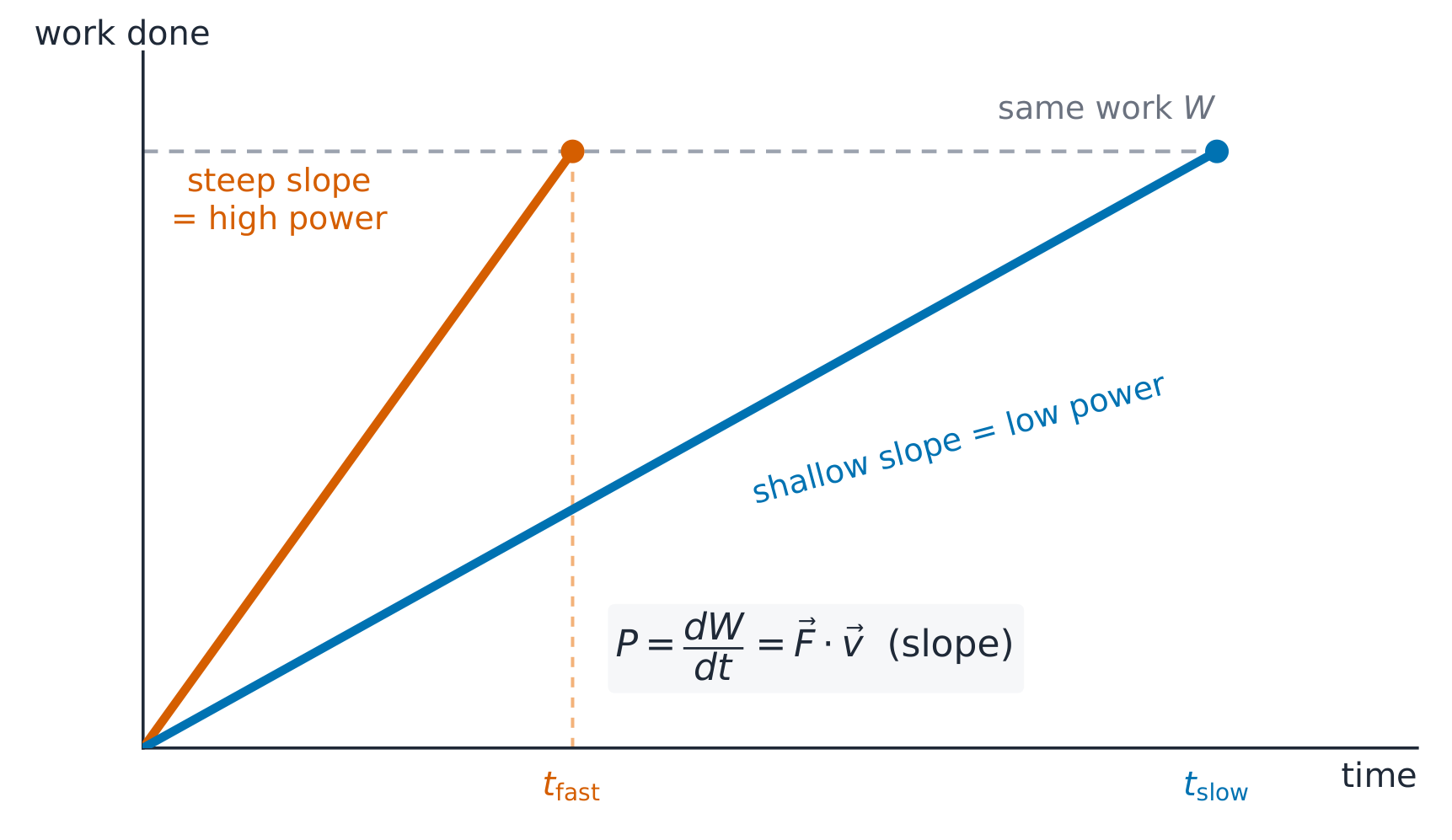
Potência é a inclinação do gráfico de trabalho-tempo: o mesmo trabalho em menos tempo significa mais potência

Exemplo resolvido. Um bloco solto do repouso no topo de uma rampa sem atrito de altura $3.0\ \text{m}$ atinge o fundo com velocidade $v=\sqrt{2gh}=7.7\ \text{m/s}$ (a partir de $mgh=\tfrac12mv^2$). Um motor que depois o move a uma velocidade constante $7.7\ \text{m/s}$ contra uma resistência $20\ \text{N}$ entrega $P=Fv=20(7.7)\approx150\ \text{W}$.

Exemplo resolvido. Um carro de $1200\ \text{kg}$ sobe uma colina que sobe $1.0\ \text{m}$ a cada $20\ \text{m}$ de estrada, a uma velocidade constante $15\ \text{m/s}$. O motor deve suprir a taxa de perda gravitacional: $P=mg\,v\sin\theta=1200(9.8)(15)\big(\tfrac{1}{20}\big)\approx8.8\ \text{kW}$ – antes de adicionar a resistência do ar.

Habilidade de prova. As questões de resposta discursiva de energia recompensam a frase de contabilidade: nomeie seu sistema, declare quais forças realizam trabalho sobre ele e escreva o balanço ($W_{\text{ext}}=\Delta K+\Delta U+\Delta E_{\text{thermal}}$) antes de inserir números. "O atrito está presente, portanto a energia mecânica não é conservada" é uma afirmação pontuada.

Vocabulary · ⁨Vocabulário⁩ Train · ⁨Treinar⁩
English · ⁨Inglês⁩ Chinese · ⁨Chinês⁩ Pinyin
Power/ˈpaʊə/ 功率 gōng lǜ
watts/wɒts/ 瓦特 wǎ tè
3.5

Exam tips · ⁨Dicas de prova⁩

English
  • Use the work–energy theorem $W_{net}=\Delta KE$ and compute work as $W=\int \vec F\cdot d\vec r$ for a variable force.
  • Read work off a force–position graph as the area under the curve.
  • Power is $P=\tfrac{dW}{dt}=\vec F\cdot\vec v$; watch instantaneous vs average.
  • Split forces into conservative (define a potential energy) and non-conservative (dissipate energy).
  • Choose energy methods over kinematics when the force varies or the path is complex.
Português
  • Use o teorema do trabalho e da energia cinética $W_{net}=\Delta KE$ e calcule o trabalho como $W=\int \vec F\cdot d\vec r$ para uma força variável.
  • Leia o trabalho num gráfico de força–posição como a área sob a curva.
  • Potência é $P=\tfrac{dW}{dt}=\vec F\cdot\vec v$; atenção entre instantânea e média.
  • Separe as forças em conservativas (defina uma energia potencial) e não-conservativas (dissipam energia).
  • Escolha métodos energéticos em vez de cinemática quando a força variar ou o caminho for complexo.

Interactive lessons on this topic · ⁨Aulas interativas sobre este tópico⁩

Work through it step by step, with instant-check exercises. · ⁨Passe por ele passo a passo, com exercícios de verificação instantânea.⁩

Past Papers · ⁨Provas Anteriores⁩

More topics in Física C: Mecânica do AP · ⁨Mais tópicos em Física C: Mecânica do AP⁩

Log in or create account · ⁨Entrar ou criar conta⁩

IGCSE, A-Level & AP