Simple and Physical Pendulums
Introduced| English | Meaning |
|---|---|
| simple pendulum/ˈsɪmpl ˈpendjʊləm/ | An ideal point mass on a light, inextensible string; for small oscillations in uniform gravity, its period is 2π√(l/g). |
| physical pendulum/ˈfɪzɪkl ˈpendjʊləm/ | A rigid body swinging under gravity about a fixed pivot; for small angles its period is 2π√(I/(mgd)), with I about the pivot and d the distance to its centre of mass. |
Every swing keeps time
- A grandfather clock's rod ticks out steady seconds.
- A child on a swing takes the same time whether pushed high or low.
- A swinging body — thin or bulky — has its own fixed beat.
- Two formulas time any small swing about a pivot.
The simple pendulum
- A simple pendulum 单摆 is a point mass on a light string of length $L$:
- Gravity provides a restoring torque that grows with the angle.
- For small angles the swing is SHM.
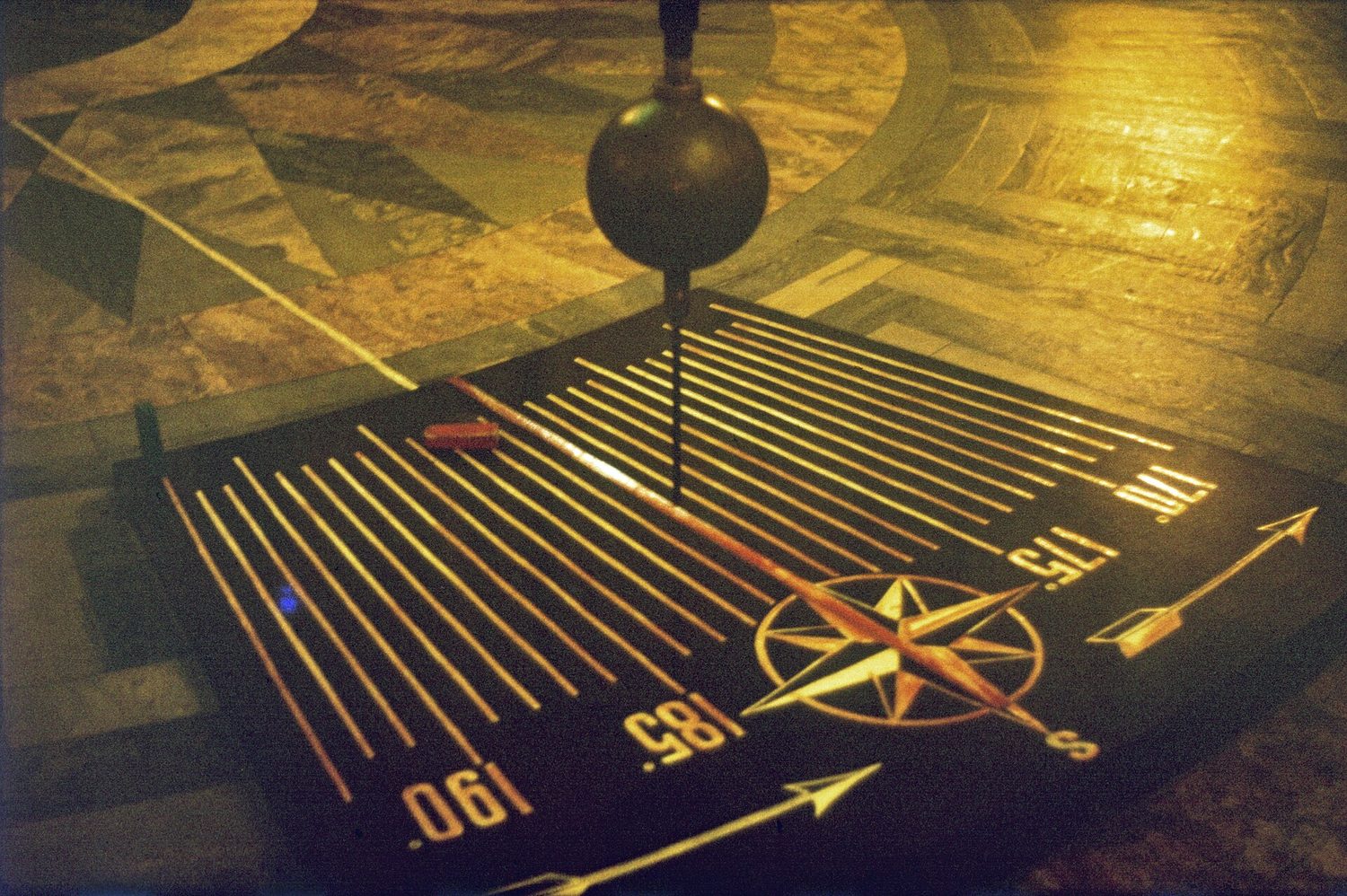
A Foucault pendulum: a long, heavy pendulum whose slow swing reveals the Earth turning beneath it
A simple pendulum has $L = 0.25\ \text{m}$ and $g = 9.8\ \text{m/s}^2$. Its period (in s, to 1 decimal)?
Difficulty 2/5 · 140 coins + a small bonus on first completion today
$T = 2\pi\sqrt{L/g} = 2\pi\sqrt{0.25/9.8} \approx 1.0\ \text{s}$.
Doubling the bob mass of a simple pendulum changes its period.
Difficulty 1/5 · 100 coins + a small bonus on first completion today
$T = 2\pi\sqrt{L/g}$ has no mass -- the bob's mass cancels.
The physical pendulum
- A physical pendulum 物理摆 is any rigid body swinging about a pivot:
- $I$ is the rotational inertia about the pivot, $d$ the pivot-to-centre distance.
- A ruler, a bat, a leg — each swings with this period.
In the physical pendulum period $T = 2\pi\sqrt{I/(mgd)}$, what is $d$?
Difficulty 1/5 · 100 coins + a small bonus on first completion today
$d$ is the pivot-to-centre-of-mass distance -- the lever arm of gravity.
One is a special case of the other
- For a point mass at distance $L$: $I = mL^2$ and $d = L$.
- Plug in: $T = 2\pi\sqrt{mL^2/(mgL)} = 2\pi\sqrt{L/g}$.
- So the simple pendulum is just the physical pendulum's simplest case.
Simple and physical pendulums
Change the length and gravity and see how the pendulum's period responds - amplitude barely matters.
The simple-pendulum formula is a special case of the physical-pendulum formula.
Difficulty 1/5 · 100 coins + a small bonus on first completion today
Put $I = mL^2$ and $d = L$ into $T = 2\pi\sqrt{I/(mgd)}$ and you recover $2\pi\sqrt{L/g}$.
A uniform rod of length $L$ pivoted at one end has $I = \tfrac{1}{3}mL^2$ and $d = L/2$.
- $T = 2\pi\sqrt{\dfrac{I}{mgd}} = 2\pi\sqrt{\dfrac{\tfrac{1}{3}mL^2}{mg\cdot L/2}} = 2\pi\sqrt{\dfrac{2L}{3g}}$.
- It swings a little faster than a simple pendulum of the same length.
For a physical pendulum, the rotational inertia $I$ must be measured about the...
Difficulty 1/5 · 100 coins + a small bonus on first completion today
The body rotates about the pivot, so $I$ is taken about that axis.
Both pendulum period formulas are valid only when the swing angle is...
Difficulty 1/5 · 100 coins + a small bonus on first completion today
Only small angles make the restoring torque proportional to displacement (SHM).
Both formulas assume small angles — beyond about $15^\circ$ the motion is no longer true SHM. For a physical pendulum, take $I$ about the pivot (use the parallel-axis theorem if you know $I$ about the centre), and let $d$ be the pivot-to-centre-of-mass distance, not the full length. The bob's mass cancels for a simple pendulum but need not for a physical one.
A simple pendulum (point mass on a string) swings with $T = 2\pi\sqrt{L/g}$; a physical pendulum (any rigid body on a pivot) swings with $T = 2\pi\sqrt{I/(mgd)}$, where $I$ is taken about the pivot and $d$ reaches the centre of mass. The simple case falls out of the physical one, and both are SHM only for small angles.
Write from a period of 2 pi seconds
- A simple pendulum has length 10 m. Use g = 10.
- Find the period for a small swing.
A simple pendulum is 10 m long. Use g = 10 m/s squared. What is its period for a small angle, and does doubling the bob mass change it?
Length over g is 1, and 2 pi times 1 is 2 pi.
What is the period?
Difficulty 1/5 · 100 coins + a small bonus on first completion today
The square root of 10 m over 10 is 1, so the period is 2 pi seconds.