English
Learning Objective 2.1.A: Explain the relationship between the type of bonding and the properties of the elements participating in the bond.
- 2.1.A.1 Electronegativity values for the representative elements increase going from left to right across a period and decrease going down a group. These trends can be understood qualitatively through the electronic structure of the atoms, the shell model, and Coulomb's law.
- 2.1.A.2 Valence electrons shared between atoms of similar electronegativity constitute a nonpolar covalent bond. For example, bonds between carbon and hydrogen are effectively nonpolar even though carbon is slightly more electronegative than hydrogen.
- 2.1.A.3 Valence electrons shared between atoms of unequal electronegativity constitute a polar covalent bond.
- i. The atom with a higher electronegativity will develop a partial negative charge relative to the other atom in the bond.
- ii. In single bonds, greater differences in electronegativity lead to greater bond dipoles.
- iii. All polar bonds have some ionic character, and the difference between ionic and covalent bonding is not distinct but rather a continuum.
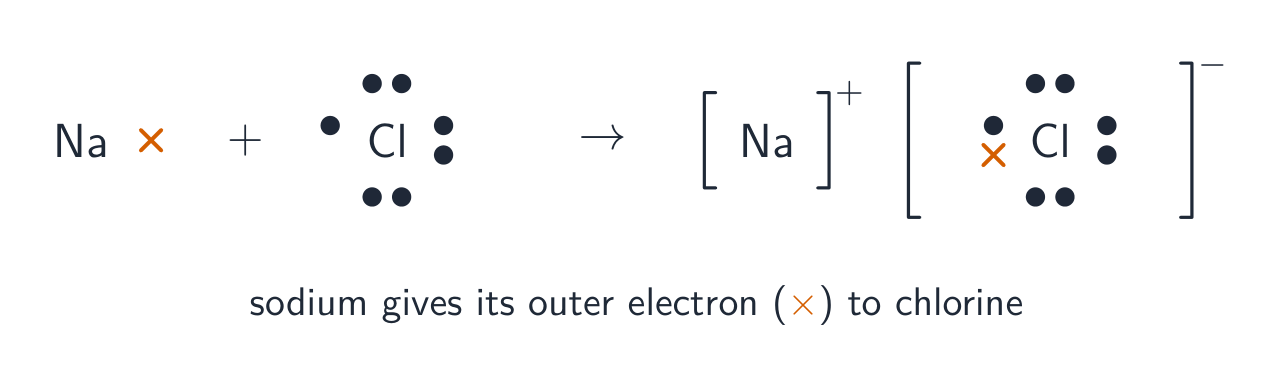
- 2.1.A.4 The difference in electronegativity is not the only factor in determining if a bond should be designated as ionic or covalent. Generally, bonds between a metal and nonmetal are ionic, and bonds between two nonmetals are covalent. Examination of the properties of a compound is the best way to characterize the type of bonding.
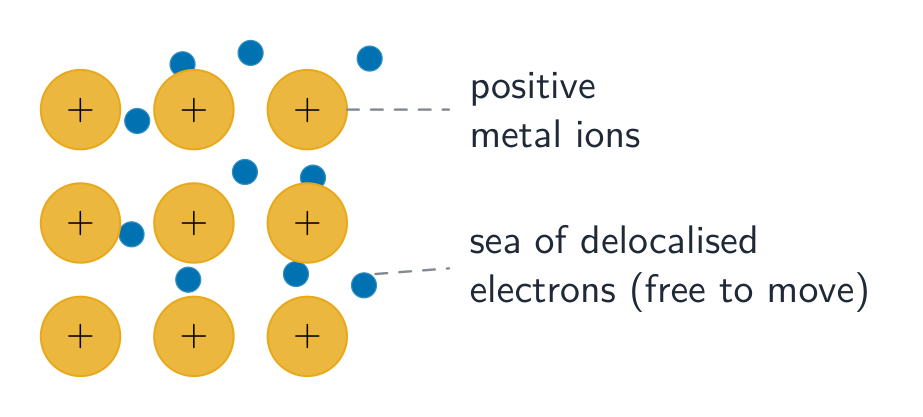
- 2.1.A.5 In a metallic solid, the valence electrons from the metal atoms are considered to be delocalized and not associated with any individual atom.
Português
Objetivo de Aprendizagem 2.1.A: Explicar a relação entre o tipo de ligação e as propriedades dos elementos participantes da ligação.
- 2.1.A.1 Os valores de eletronegatividade para os elementos representativos aumentam da esquerda para a direita ao longo de um período e diminuem ao descer um grupo. Essas tendências podem ser compreendidas qualitativamente através da estrutura eletrônica dos átomos, do modelo de camadas e da lei de Coulomb.
- 2.1.A.2 Elétrons de valência compartilhados entre átomos de eletronegatividade semelhante constituem uma ligação covalente apolar. Por exemplo, ligações entre carbono e hidrogênio são efetivamente apolares, embora o carbono seja ligeiramente mais eletronegativo que o hidrogênio.
- 2.1.A.3 Elétrons de valência compartilhados entre átomos de eletronegatividade desigual constituem uma ligação covalente polar.
- i. O átomo com maior eletronegatividade desenvolverá uma carga parcial negativa em relação ao outro átomo na ligação.
- ii. Em ligações simples, maiores diferenças de eletronegatividade levam a maiores momentos dipolares de ligação.
- iii. Todas as ligações polares possuem algum caráter iônico, e a diferença entre ligação iônica e covalente não é distinta, mas sim um continuum.
- 2.1.A.4 A diferença de eletronegatividade não é o único fator para determinar se uma ligação deve ser designada como iônica ou covalente. Geralmente, ligações entre um metal e um ametal são iônicas, e ligações entre dois ametais são covalentes. A examination das propriedades de um composto é a melhor maneira de caracterizar o tipo de ligação.
- 2.1.A.5 Em um sólido metálico, os elétrons de valência dos átomos metálicos são considerados deslocalizados e não associados a nenhum átomo individual.