Skip to content · ⁨Pular para o conteúdo⁩

Ácidos e Bases

Química do AP · Topic 8 · ⁨Tópico 8⁩

Train · ⁨Treinar⁩
Video lesson for this topic · ⁨Videoaula para este tópico⁩ Open the video page · ⁨Abrir a página do vídeo⁩
8:24

Ácidos e Bases

Duas tiras de papel — uma vermelha, uma azul. Mergulhe-as em um líquido e a cor muda, e essa cor diz se o líquido é um ácido ou uma base.…

English narration · English + 中文 subtitles burned in · ⁨Narração em inglês · Legendas em inglês + 中文 gravadas⁩

8.1

Introduction to Acids and Bases · ⁨Introdução a Ácidos e Bases⁩

Syllabus · ⁨Programa⁩
English

Learning Objective 8.1.A: Calculate the values of $\mathrm{pH}$ and $\mathrm{pOH}$, based on $K_w$ and the concentration of all species present in a neutral solution of water.

  • 8.1.A.1 The concentrations of hydronium ion and hydroxide ion are often reported as $\mathrm{pH}$ and $\mathrm{pOH}$, respectively.
    • Equation: $\mathrm{pH} = -\log[\mathrm{H_3O^+}]$
    • Equation: $\mathrm{pOH} = -\log[\mathrm{OH^-}]$
    • The terms "hydrogen ion" and "hydronium ion" and the symbols $\mathrm{H^+}(aq)$ and $\mathrm{H_3O^+}(aq)$ are often used interchangeably for the aqueous ion of hydrogen. Hydronium ion and $\mathrm{H_3O^+}(aq)$ are preferred, but $\mathrm{H^+}(aq)$ is also accepted on the AP Exam.
  • 8.1.A.2 Water autoionizes with an equilibrium constant $K_w$.
    • Equation: $K_w = [\mathrm{H_3O^+}][\mathrm{OH^-}] = 1.0 \times 10^{-14}$ at 25°C
  • 8.1.A.3 In pure water, $\mathrm{pH} = \mathrm{pOH}$ is called a neutral solution. At 25°C, $\mathrm{p}K_w = 14.0$ and thus $\mathrm{pH} = \mathrm{pOH} = 7.0$.
    • Equation: $\mathrm{p}K_w = 14 = \mathrm{pH} + \mathrm{pOH}$ at 25°C
  • 8.1.A.4 The value of $K_w$ is temperature dependent, so the pH of pure, neutral water will deviate from 7.0 at temperatures other than 25°C.
Português

Objetivo de Aprendizagem 8.1.A: Calcular os valores de $\mathrm{pH}$ e $\mathrm{pOH}$, com base em $K_w$ e na concentração de todas as espécies presentes em uma solução neutra de água.

  • 8.1.A.1 As concentrações dos íons hidrônio e hidroxila são frequentemente reportadas como $\mathrm{pH}$ e $\mathrm{pOH}$, respectivamente.
    • Equação: $\mathrm{pH} = -\log[\mathrm{H_3O^+}]$
    • Equação: $\mathrm{pOH} = -\log[\mathrm{OH^-}]$
    • Os termos "íon hidrogênio" e "ímion hidrônio" e os símbolos $\mathrm{H^+}(aq)$ e $\mathrm{H_3O^+}(aq)$ são frequentemente usados de forma intercambiável para se referir ao íon aquoso de hidrogênio. Ímion hidrônio e $\mathrm{H_3O^+}(aq)$ são preferidos, mas $\mathrm{H^+}(aq)$ também é aceito no AP Exam.
  • 8.1.A.2 A água autoioniza-se com uma constante de equilíbrio $K_w$.
    • Equação: $K_w = [\mathrm{H_3O^+}][\mathrm{OH^-}] = 1.0 \times 10^{-14}$ a 25°C
  • 8.1.A.3 Em água pura, $\mathrm{pH} = \mathrm{pOH}$ é chamada de solução neutra. A 25°C, $\mathrm{p}K_w = 14.0$ e, portanto, $\mathrm{pH} = \mathrm{pOH} = 7.0$.
    • Equação: $\mathrm{p}K_w = 14 = \mathrm{pH} + \mathrm{pOH}$ a 25°C
  • 8.1.A.4 O valor de $K_w$ depende da temperatura, portanto o pH da água pura e neutra desviará de 7.0 em temperaturas diferentes de 25°C.
Source: College Board AP Course and Exam Description · ⁨Fonte: College Board AP Course and Exam Description⁩

English

By the Brønsted–Lowry definition, an acid 酸 is a proton ($\text{H}^+$) donor and a base 碱 is a proton acceptor. When an acid donates a proton it becomes its conjugate base 共轭碱; a base gaining a proton becomes its conjugate acid 共轭酸. Water is amphoteric – it can act as either.

Português
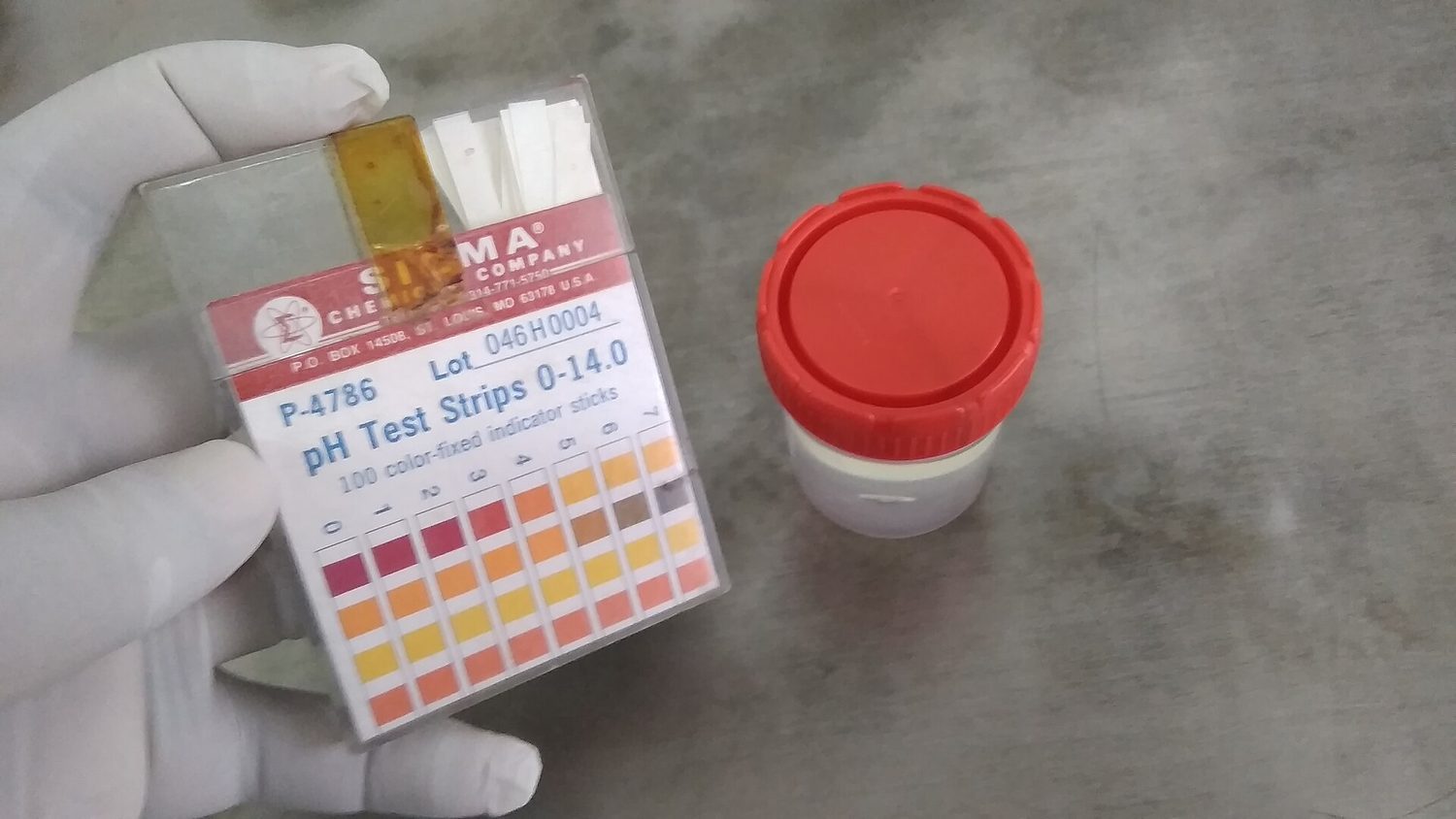
Papel tornassol: indicadores ácido-base mudam de cor com a concentração de H⁺ (pH)

Pela definição de Brønsted–Lowry, um ácido 酸 é um dador de prótons ($\text{H}^+$) e uma base 碱 é um receptor de prótons. Quando um ácido doa um próton, torna-se sua base conjugada 共轭碱; uma base que ganha um próton torna-se seu ácido conjugado 共轭酸. A água é anfiprótica – pode atuar como qualquer uma das duas.

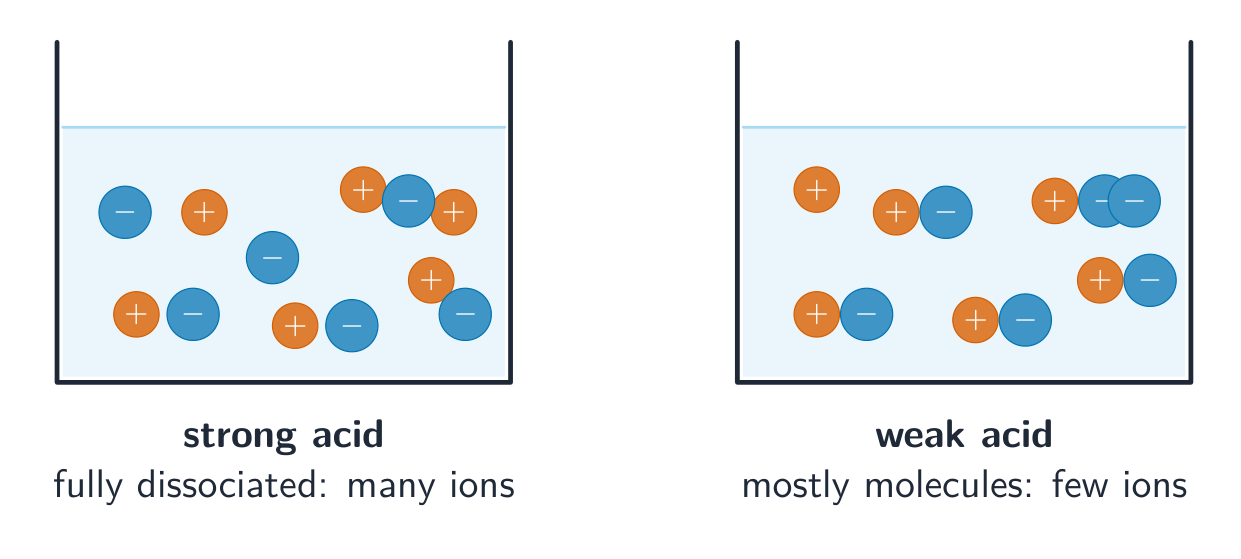
Um ácido forte está totalmente dissociado; um ácido fraco está apenas parcialmente dissociado
Tiras de pH: força e concentração do ácido-base determinam o pH medido
Vocabulary · ⁨Vocabulário⁩ Train · ⁨Treinar⁩
English · ⁨Inglês⁩ Chinese · ⁨Chinês⁩ Pinyin
acid/ˈæsɪd/ 酸 suān
base/beɪs/ 碱 jiǎn
conjugate base/ˈkɒndʒuːɡeɪt beɪs/ 共轭碱 gòng è jiǎn
conjugate acid/ˈkɒndʒuːɡeɪt ˈæsɪd/ 共轭酸 gòng è suān
autoionization/ˌɔːtəʊˌaɪənaɪˈzeɪʃn/ 自偶电离 zì ǒu diàn lí
hydronium ion/haɪˈdrəʊnɪəm ˈaɪɒn/ 水合氢离子 shuǐ hé qīng lí zi
ion-product constant of water/ˈaɪɒn ˈprɒdʌkt ˈkɒnstənt ɒv ˈwɔːtə/ 水的离子积 shuǐ de lí zi jī
weak acid/wiːk ˈæsɪd/ 弱酸 ruò suān
8.1

The Autoionization of Water · ⁨A Autoionização da Água⁩

Syllabus · ⁨Programa⁩
English

Learning Objective 8.1.A: Calculate the values of $\mathrm{pH}$ and $\mathrm{pOH}$, based on $K_w$ and the concentration of all species present in a neutral solution of water.

  • 8.1.A.1 The concentrations of hydronium ion and hydroxide ion are often reported as $\mathrm{pH}$ and $\mathrm{pOH}$, respectively.
    • Equation: $\mathrm{pH} = -\log[\mathrm{H_3O^+}]$
    • Equation: $\mathrm{pOH} = -\log[\mathrm{OH^-}]$
    • The terms "hydrogen ion" and "hydronium ion" and the symbols $\mathrm{H^+}(aq)$ and $\mathrm{H_3O^+}(aq)$ are often used interchangeably for the aqueous ion of hydrogen. Hydronium ion and $\mathrm{H_3O^+}(aq)$ are preferred, but $\mathrm{H^+}(aq)$ is also accepted on the AP Exam.
  • 8.1.A.2 Water autoionizes with an equilibrium constant $K_w$.
    • Equation: $K_w = [\mathrm{H_3O^+}][\mathrm{OH^-}] = 1.0 \times 10^{-14}$ at 25°C
  • 8.1.A.3 In pure water, $\mathrm{pH} = \mathrm{pOH}$ is called a neutral solution. At 25°C, $\mathrm{p}K_w = 14.0$ and thus $\mathrm{pH} = \mathrm{pOH} = 7.0$.
    • Equation: $\mathrm{p}K_w = 14 = \mathrm{pH} + \mathrm{pOH}$ at 25°C
  • 8.1.A.4 The value of $K_w$ is temperature dependent, so the pH of pure, neutral water will deviate from 7.0 at temperatures other than 25°C.
Português

Objetivo de Aprendizagem 8.1.A: Calcular os valores de $\mathrm{pH}$ e $\mathrm{pOH}$, com base em $K_w$ e na concentração de todas as espécies presentes em uma solução neutra de água.

  • 8.1.A.1 As concentrações dos íons hidrônio e hidroxila são frequentemente reportadas como $\mathrm{pH}$ e $\mathrm{pOH}$, respectivamente.
    • Equação: $\mathrm{pH} = -\log[\mathrm{H_3O^+}]$
    • Equação: $\mathrm{pOH} = -\log[\mathrm{OH^-}]$
    • Os termos "íon hidrogênio" e "ímion hidrônio" e os símbolos $\mathrm{H^+}(aq)$ e $\mathrm{H_3O^+}(aq)$ são frequentemente usados de forma intercambiável para se referir ao íon aquoso de hidrogênio. Ímion hidrônio e $\mathrm{H_3O^+}(aq)$ são preferidos, mas $\mathrm{H^+}(aq)$ também é aceito no AP Exam.
  • 8.1.A.2 A água autoioniza-se com uma constante de equilíbrio $K_w$.
    • Equação: $K_w = [\mathrm{H_3O^+}][\mathrm{OH^-}] = 1.0 \times 10^{-14}$ a 25°C
  • 8.1.A.3 Em água pura, $\mathrm{pH} = \mathrm{pOH}$ é chamada de solução neutra. A 25°C, $\mathrm{p}K_w = 14.0$ e, portanto, $\mathrm{pH} = \mathrm{pOH} = 7.0$.
    • Equação: $\mathrm{p}K_w = 14 = \mathrm{pH} + \mathrm{pOH}$ a 25°C
  • 8.1.A.4 O valor de $K_w$ depende da temperatura, portanto o pH da água pura e neutra desviará de 7.0 em temperaturas diferentes de 25°C.

Source: College Board AP Course and Exam Description · ⁨Fonte: College Board AP Course and Exam Description⁩

English

Even pure water conducts a tiny current, because water molecules react with each other in a reaction called autoionization 自偶电离:

$$2\text{H}_2\text{O} \rightleftharpoons \text{H}_3\text{O}^+ + \text{OH}^-.$$
One water molecule passes a proton to another, making a hydronium ion 水合氢离子 ($\text{H}_3\text{O}^+$, the ion we loosely write as $\text{H}^+$) and a hydroxide ion. This equilibrium has its own constant, the ion-product constant of water 水的离子积:
$$K_w = [\text{H}_3\text{O}^+][\text{OH}^-] = 1.0\times10^{-14}$$
at 25 °C. Defining $\text{pOH}=-\log[\text{OH}^-]$ and taking $-\log$ of the $K_w$ expression gives the rule the rest of this topic leans on:
$$\text{pH} + \text{pOH} = \text{p}K_w = 14.0$$
(again at 25 °C). Know one of pH or pOH and you get the other by subtracting from 14.

In pure water the two ions form in equal numbers, so $[\text{H}_3\text{O}^+]=[\text{OH}^-]$ and $\text{pH}=\text{pOH}=7.0$. This is what neutral 中性 means. Acidic means $[\text{H}_3\text{O}^+]>[\text{OH}^-]$ (pH below 7); basic is the reverse.

Worked example. A solution has $[\text{H}_3\text{O}^+]=2.0\times10^{-3}\ \text{M}$. Find $[\text{OH}^-]$. Because $K_w$ always holds in water,

$$[\text{OH}^-]=\frac{K_w}{[\text{H}_3\text{O}^+]}=\frac{1.0\times10^{-14}}{2.0\times10^{-3}}=5.0\times10^{-12}\ \text{M}.$$
The hydroxide concentration is far smaller than the hydronium, confirming the solution is acidic.

$K_w$ is temperature dependent: autoionization is endothermic, so heating water shifts it forward and raises $K_w$. At 50 °C, $K_w>1.0\times10^{-14}$, so neutral water has $\text{pH}=\text{pOH}<7.0$. It is still neutral, because the ion concentrations are still equal – neutral means equal ions, not a pH of exactly 7.

Português

Mesmo a água pura conduz uma corrente diminuta, porque as moléculas de água reagem entre si em uma reação chamada autoionização 自偶电离:

$$2\text{H}_2\text{O} \rightleftharpoons \text{H}_3\text{O}^+ + \text{OH}^-.$$
Uma molécula de água passa um próton para outra, formando um íon hidrônio 水合氢离子 ($\text{H}_3\text{O}^+$, o íon que escrevemos vagamente como $\text{H}^+$) e um íon hidróxido. Este equilíbrio possui sua própria constante, a constante do produto iônico da água 水的离子积:
$$K_w = [\text{H}_3\text{O}^+][\text{OH}^-] = 1.0\times10^{-14}$$
a 25 °C. Definindo $\text{pOH}=-\log[\text{OH}^-]$ e tomando $-\log$ da expressão $K_w$ obtemos a regra sobre a qual este tópico se baseia:
$$\text{pH} + \text{pOH} = \text{p}K_w = 14.0$$
(novamente a 25 °C). Conhecendo um de pH ou pOH, você obtém o outro subtraindo de 14.

Na água pura, os dois íons se formam em números iguais, logo $[\text{H}_3\text{O}^+]=[\text{OH}^-]$ e $\text{pH}=\text{pOH}=7.0$. Isso é o que significa neutro 中性. Ácido significa $[\text{H}_3\text{O}^+]>[\text{OH}^-]$ (pH abaixo de 7); básico é o inverso.

Exemplo resolvido. Uma solução tem $[\text{H}_3\text{O}^+]=2.0\times10^{-3}\ \text{M}$. Encontre $[\text{OH}^-]$. Como $K_w$ sempre vale na água,

$$[\text{OH}^-]=\frac{K_w}{[\text{H}_3\text{O}^+]}=\frac{1.0\times10^{-14}}{2.0\times10^{-3}}=5.0\times10^{-12}\ \text{M}.$$
A concentração de hidróxido é muito menor que a de hidrônio, confirmando que a solução é ácida.

$K_w$ depende da temperatura: a autoionização é endotérmica, logo aquecer a água desloca-a para frente e eleva $K_w$. A 50 °C, $K_w>1.0\times10^{-14}$, logo a água neutra tem $\text{pH}=\text{pOH}<7.0$. Ela ainda é neutra, porque as concentrações dos íons ainda são iguais – neutro significa íons iguais, não um pH exatamente igual a 7.

Tiras de pH: a água autoioniza-se, logo a água pura tem pH 7; ácidos e bases deslocam H+ e OH-
8.2

pH and pOH of Strong Acids and Bases · ⁨pH e pOH de Ácidos e Bases Fortes⁩

Syllabus · ⁨Programa⁩
English

Learning Objective 8.2.A: Calculate $\mathrm{pH}$ and $\mathrm{pOH}$ based on concentrations of all species in a solution of a strong acid or a strong base.

  • 8.2.A.1 Molecules of a strong acid (e.g., $\mathrm{HCl}$, $\mathrm{HBr}$, $\mathrm{HI}$, $\mathrm{HClO_4}$, $\mathrm{H_2SO_4}$, and $\mathrm{HNO_3}$) will completely ionize in aqueous solution to produce hydronium ions and the conjugate base of the acid. As such, the concentration of $\mathrm{H_3O^+}$ in a strong acid solution is equal to the initial concentration of the strong acid, and thus the $\mathrm{pH}$ of the strong acid solution is easily calculated.
  • 8.2.A.2 When dissolved in solution, strong bases (e.g., group I and II hydroxides) completely dissociate to produce hydroxide ions. As such, the concentration of $\mathrm{OH^-}$ in a strong base solution is equal to the initial concentration of a group I hydroxide and double the initial concentration of a group II hydroxide, and thus the $\mathrm{pOH}$ (and $\mathrm{pH}$) of the strong base solution is easily calculated.
Português

Objetivo de Aprendizagem 8.2.A: Calcular $\mathrm{pH}$ e $\mathrm{pOH}$ com base nas concentrações de todas as espécies em uma solução de um ácido forte ou uma base forte.

  • 8.2.A.1 Moléculas de um ácido forte (ex: $\mathrm{HCl}$, $\mathrm{HBr}$, $\mathrm{HI}$, $\mathrm{HClO_4}$, $\mathrm{H_2SO_4}$ e $\mathrm{HNO_3}$) ionizam completamente em solução aquosa para produzir íons hidrônio e a base conjugada do ácido. Assim, a concentração de $\mathrm{H_3O^+}$ em uma solução de ácido forte é igual à concentração inicial do ácido forte, e, portanto, o $\mathrm{pH}$ da solução de ácido forte é facilmente calculado.
  • 8.2.A.2 Ao serem dissolvidos em solução, bases fortes (ex: hidretos de grupo I e II) dissociam-se completamente para produzir íons hidróxido. Assim, a concentração de $\mathrm{OH^-}$ em uma solução de base forte é igual à concentração inicial de um hidreto de grupo I e ao dobro da concentração inicial de um hidreto de grupo II, e, portanto, o $\mathrm{pOH}$ (e $\mathrm{pH}$) da solução de base forte é facilmente calculado.

Source: College Board AP Course and Exam Description · ⁨Fonte: College Board AP Course and Exam Description⁩

English

The pH pH值 scale measures acidity: $\text{pH}=-\log[\text{H}^+]$, with $\text{pH}+\text{pOH}=14$ at 25 °C. A strong acid 强酸 or strong base 强碱 dissociates completely, so its ion concentration equals its concentration – read pH directly. Lower pH means more acidic.

Worked example. Find the pH of $0.010\ \text{M}$ HCl. Because HCl is a strong acid it is fully dissociated, so $[\text{H}^+]=0.010\ \text{M}$ and

$$\text{pH}=-\log(0.010)=2.0.$$
For a strong base like $0.010\ \text{M}$ NaOH, $\text{pOH}=2.0$, so $\text{pH}=14-2.0=12.0$.

Português

A escala de pH pH值 mede a acidez: $\text{pH}=-\log[\text{H}^+]$, com $\text{pH}+\text{pOH}=14$ a 25 °C. Um ácido forte 强酸 ou base forte 强碱 dissocia-se completamente, logo sua concentração de íons é igual à sua concentração – leia o pH diretamente. Menor pH significa mais ácido.

Escala de pH: pH é o logaritmo negativo da concentração do íon de hidrogênio

Exemplo resolvido. Encontre o pH de $0.010\ \text{M}$ HCl. Como HCl é um ácido forte, está totalmente dissociado, logo $[\text{H}^+]=0.010\ \text{M}$ e

$$\text{pH}=-\log(0.010)=2.0.$$
Para uma base forte como $0.010\ \text{M}$ NaOH, $\text{pOH}=2.0$, logo $\text{pH}=14-2.0=12.0$.

Explore · ⁨Explorar⁩

Mover-se ao longo da escala de pH

pH mede a concentração de íons hidrogênio em uma escala logarítmica: cada unidade é uma mudança dez vezes maior. Ácidos fortes ficam baixos, bases fortes altas, 7 é neutro.

Vocabulary · ⁨Vocabulário⁩ Train · ⁨Treinar⁩
English · ⁨Inglês⁩ Chinese · ⁨Chinês⁩ Pinyin
pH/piː eɪtʃ/ pH值 pH zhí
strong acid/strɒŋ ˈæsɪd/ 强酸 qiáng suān
strong base/strɒŋ beɪs/ 强碱 qiáng jiǎn
8.3

Weak Acid and Base Equilibria · ⁨Equilíbrios de Ácidos e Bases Fracos⁩

Syllabus · ⁨Programa⁩
English

Learning Objective 8.3.A: Explain the relationship among $\mathrm{pH}$, $\mathrm{pOH}$, and concentrations of all species in a solution of a monoprotic weak acid or weak base.

  • 8.3.A.1 Weak acids react with water to produce hydronium ions. However, only a small percentage of molecules of a weak acid will ionize in this way. Thus, the concentration of $\mathrm{H_3O^+}$ is much less than the initial concentration of the molecular acid, and the vast majority of the acid molecules remain un-ionized.
  • 8.3.A.2 A solution of a weak acid involves equilibrium between an un-ionized acid and its conjugate base. The equilibrium constant for this reaction is $K_a$, often reported as $\mathrm{p}K_a$. The pH of a weak acid solution can be determined from the initial acid concentration and the $\mathrm{p}K_a$.
    • Equation: $K_a = \dfrac{[\mathrm{H_3O^+}][\mathrm{A^-}]}{[\mathrm{HA}]}$
    • Equation: $\mathrm{p}K_a = -\log K_a$
  • 8.3.A.3 Weak bases react with water to produce hydroxide ions in solution. However, ordinarily just a small percentage of the molecules of a weak base in solution will ionize in this way. Thus, the concentration of $\mathrm{OH^-}$ in the solution does not equal the initial concentration of the base, and the vast majority of the base molecules remain un-ionized.
  • 8.3.A.4 A solution of a weak base involves equilibrium between an un-ionized base and its conjugate acid. The equilibrium constant for this reaction is $K_b$, often reported as $\mathrm{p}K_b$. The $\mathrm{pH}$ of a weak base solution can be determined from the initial base concentration and the $\mathrm{p}K_b$.
    • Equation: $K_b = \dfrac{[\mathrm{OH^-}][\mathrm{HB^+}]}{[\mathrm{B}]}$
    • Equation: $\mathrm{p}K_b = -\log K_b$
  • 8.3.A.5 The percent ionization of a weak acid (or base) can be calculated from its $\mathrm{p}K_a$ ($\mathrm{p}K_b$) and the initial concentration of the acid (base). The percent ionization can also be calculated from the initial concentration of the acid (base) and the equilibrium concentration of any of the species in the equilibrium expression.
  • 8.3.A.6 For any conjugate acid-base pair, the acid ionization constant and base ionization constant are related by $K_w$:
    • Equation: $K_w = K_a \times K_b$
    • Equation: $\mathrm{p}K_w = \mathrm{p}K_a + \mathrm{p}K_b$
Português

Objetivo de Aprendizagem 8.3.A: Explicar a relação entre $\mathrm{pH}$, $\mathrm{pOH}$ e as concentrações de todas as espécies em uma solução de um ácido fraco monoprotônico ou uma base fraca.

  • 8.3.A.1 Ácidos fracos reagem com a água para produzir íons hidrônio. No entanto, apenas uma pequena porcentagem de moléculas de um ácido fraco irá ionizar dessa maneira. Assim, a concentração de $\mathrm{H_3O^+}$ é muito menor que a concentração inicial do ácido molecular, e a vasta maioria das moléculas de ácido permanece não ionizada.
  • 8.3.A.2 Uma solução de ácido fraco envolve equilíbrio entre um ácido não ionizado e sua base conjugada. A constante de equilíbrio para essa reação é $K_a$, frequentemente reportada como $\mathrm{p}K_a$. O pH de uma solução de ácido fraco pode ser determinado pela concentração inicial do ácido e pelo $\mathrm{p}K_a$.
    • Equação: $K_a = \dfrac{[\mathrm{H_3O^+}][\mathrm{A^-}]}{[\mathrm{HA}]}$
    • Equação: $\mathrm{p}K_a = -\log K_a$
  • 8.3.A.3 Bases fracas reagem com a água para produzir íons hidróxido em solução. No entanto, normalmente apenas uma pequena porcentagem das moléculas de uma base fraca em solução irá ionizar dessa maneira. Assim, a concentração de $\mathrm{OH^-}$ na solução não é igual à concentração inicial da base, e a vasta maioria das moléculas de base permanece não ionizada.
  • 8.3.A.4 Uma solução de base fraca envolve equilíbrio entre uma base não ionizada e seu ácido conjugado. A constante de equilíbrio para essa reação é $K_b$, frequentemente reportada como $\mathrm{p}K_b$. O $\mathrm{pH}$ de uma solução de base fraca pode ser determinado pela concentração inicial da base e pelo $\mathrm{p}K_b$.
    • Equação: $K_b = \dfrac{[\mathrm{OH^-}][\mathrm{HB^+}]}{[\mathrm{B}]}$
    • Equação: $\mathrm{p}K_b = -\log K_b$
  • 8.3.A.5 A percentual de ionização de um ácido (ou base) fraco pode ser calculada a partir de sua $\mathrm{p}K_a$ ($\mathrm{p}K_b$) e da concentração inicial do ácido (base). A percentual de ionização também pode ser calculada a partir da concentração inicial do ácido (base) e da concentração de equilíbrio de qualquer uma das espécies na expressão de equilíbrio.
  • 8.3.A.6 Para qualquer par ácido-base conjugado, a constante de ionização ácida e a constante de ionização básica estão relacionadas por $K_w$:
    • Equação: $K_w = K_a \times K_b$
    • Equação: $\mathrm{p}K_w = \mathrm{p}K_a + \mathrm{p}K_b$

Source: College Board AP Course and Exam Description · ⁨Fonte: College Board AP Course and Exam Description⁩

English

A weak acid 弱酸 only partly dissociates, described by an equilibrium constant $K_a$ (larger $K_a$ = stronger weak acid); a weak base has $K_b$. For any conjugate acid–base pair the two are linked through water, $K_a\times K_b = K_w$, so $\text{p}K_a+\text{p}K_b=14$ – a stronger acid always has a weaker conjugate base. Because dissociation is small, find $[\text{H}^+]$ with an ICE table and the $K_a$ expression, often using the small-$x$ approximation.

Worked example. Find the pH of $0.10\ \text{M}$ acetic acid, $K_a=1.8\times10^{-5}$. Let $x=[\text{H}^+]$ at equilibrium; the ICE table gives $K_a=\dfrac{x^2}{0.10-x}\approx\dfrac{x^2}{0.10}$ (small-$x$ approximation), so

$$x=\sqrt{K_a\times0.10}=\sqrt{1.8\times10^{-6}}=1.3\times10^{-3}\ \text{M}\;\Rightarrow\;\text{pH}=-\log(1.3\times10^{-3})=2.9.$$
The weak acid is far less acidic than a strong acid of the same concentration (which would be pH $1.0$).

Português

Um ácido fraco 弱酸 só se dissocia parcialmente, descrito por uma constante de equilíbrio $K_a$ (maior $K_a$ = ácido fraco mais forte); uma base fraca tem $K_b$. Para qualquer par ácido-base conjugado os dois estão ligados através da água, $K_a\times K_b = K_w$, então $\text{p}K_a+\text{p}K_b=14$ – um ácido mais forte sempre tem uma base conjugada mais fraca. Como a dissociação é pequena, encontre $[\text{H}^+]$ com uma tabela ICE e a expressão $K_a$, muitas vezes usando a aproximação de pequeno-$x$.

Exemplo resolvido. Encontre o pH de $0.10\ \text{M}$ ácido acético, $K_a=1.8\times10^{-5}$. Seja $x=[\text{H}^+]$ no equilíbrio; a tabela ICE fornece $K_a=\dfrac{x^2}{0.10-x}\approx\dfrac{x^2}{0.10}$ (aproximação de pequeno-$x$), logo

$$x=\sqrt{K_a\times0.10}=\sqrt{1.8\times10^{-6}}=1.3\times10^{-3}\ \text{M}\;\Rightarrow\;\text{pH}=-\log(1.3\times10^{-3})=2.9.$$
O ácido fraco é muito menos ácido que um ácido forte de mesma concentração (que teria pH $1.0$).

8.4

Acid-Base Reactions and Buffers · ⁨Reações Ácido-Base e Tampões⁩

Syllabus · ⁨Programa⁩
English

Learning Objective 8.4.A: Explain the relationship among the concentrations of major species in a mixture of weak and strong acids and bases.

  • 8.4.A.1 When a strong acid and a strong base are mixed, they react quantitatively in a reaction represented by the equation: $\mathrm{H^+}(aq) + \mathrm{OH^-}(aq) \rightarrow \mathrm{H_2O}(l)$. The pH of the resulting solution may be determined from the concentration of excess reagent.
  • 8.4.A.2 When a weak acid and a strong base are mixed, they react quantitatively in a reaction represented by the equation: $\mathrm{HA}(aq) + \mathrm{OH^-}(aq) \rightleftarrows \mathrm{A^-}(aq)\ \mathrm{H_2O}(l)$. If the weak acid is in excess, then a buffer solution is formed, and the $\mathrm{pH}$ can be determined from the Henderson-Hasselbalch (H–H) equation (see 8.9.A.1). If the strong base is in excess, then the $\mathrm{pH}$ can be determined from the moles of excess hydroxide ion and the total volume of solution. If they are equimolar, then the (slightly basic) $\mathrm{pH}$ can be determined from the equilibrium represented by the equation: $\mathrm{A^-}(aq) + \mathrm{H_2O}(l) \rightleftarrows \mathrm{HA}(aq) + \mathrm{OH^-}(aq)$.
  • 8.4.A.3 When a weak base and a strong acid are mixed, they will react quantitatively in a reaction represented by the equation: $\mathrm{B}(aq) + \mathrm{H_3O^+}(aq) \rightleftarrows \mathrm{HB^+}(aq) + \mathrm{H_2O}(l)$. If the weak base is in excess, then a buffer solution is formed, and the $\mathrm{pH}$ can be determined from the H–H equation. If the strong acid is in excess, then the $\mathrm{pH}$ can be determined from the moles of excess hydronium ion and the total volume of solution. If they are equimolar, then the (slightly acidic) $\mathrm{pH}$ can be determined from the equilibrium represented by the equation: $\mathrm{HB^+}(aq) + \mathrm{H_2O}(l) \rightleftarrows \mathrm{B}(aq) + \mathrm{H_3O^+}(aq)$.
  • 8.4.A.4 When a weak acid and a weak base are mixed, they will react to an equilibrium state whose reaction may be represented by the equation: $\mathrm{HA}(aq) + \mathrm{B}(aq) \rightleftarrows \mathrm{A^-}(aq) + \mathrm{HB^+}(aq)$.
Português

Objetivo de Aprendizagem 8.4.A: Explicar a relação entre as concentrações de espécies principais em uma mistura de ácidos e bases fracas e fortes.

  • 8.4.A.1 Quando um ácido forte e uma base forte são misturados, eles reagem quantitativamente em uma reação representada pela equação: $\mathrm{H^+}(aq) + \mathrm{OH^-}(aq) \rightarrow \mathrm{H_2O}(l)$. O pH da solução resultante pode ser determinado pela concentração do reagente em excesso.
  • 8.4.A.2 Quando um ácido fraco e uma base forte são misturados, eles reagem quantitativamente em uma reação representada pela equação: $\mathrm{HA}(aq) + \mathrm{OH^-}(aq) \rightleftarrows \mathrm{A^-}(aq)\ \mathrm{H_2O}(l)$. Se o ácido fraco estiver em excesso, então uma solução tampão é formada, e o $\mathrm{pH}$ pode ser determinado pela equação Henderson-Hasselbalch (H–H) (veja 8.9.A.1). Se a base forte estiver em excesso, então o $\mathrm{pH}$ pode ser determinado pelos mols de íon hidróxido em excesso e pelo volume total da solução. Se forem equimolares, então o (levemente básico) $\mathrm{pH}$ pode ser determinado pelo equilíbrio representado pela equação: $\mathrm{A^-}(aq) + \mathrm{H_2O}(l) \rightleftarrows \mathrm{HA}(aq) + \mathrm{OH^-}(aq)$.
  • 8.4.A.3 Quando uma base fraca e um ácido forte são misturados, eles reagirão quantitativamente em uma reação representada pela equação: $\mathrm{B}(aq) + \mathrm{H_3O^+}(aq) \rightleftarrows \mathrm{HB^+}(aq) + \mathrm{H_2O}(l)$. Se a base fraca estiver em excesso, então uma solução tampão é formada, e o $\mathrm{pH}$ pode ser determinado pela equação H–H. Se o ácido forte estiver em excesso, então o $\mathrm{pH}$ pode ser determinado pelos mols de íon hidrônio em excesso e pelo volume total da solução. Se forem equimolares, então o (levemente ácido) $\mathrm{pH}$ pode ser determinado pelo equilíbrio representado pela equação: $\mathrm{HB^+}(aq) + \mathrm{H_2O}(l) \rightleftarrows \mathrm{B}(aq) + \mathrm{H_3O^+}(aq)$.
  • 8.4.A.4 Quando um ácido fraco e uma base fraca são misturados, eles reagirão até um estado de equilíbrio cuja reação pode ser representada pela equação: $\mathrm{HA}(aq) + \mathrm{B}(aq) \rightleftarrows \mathrm{A^-}(aq) + \mathrm{HB^+}(aq)$.

Source: College Board AP Course and Exam Description · ⁨Fonte: College Board AP Course and Exam Description⁩

English

A buffer 缓冲溶液 resists pH change. It contains a weak acid and its conjugate base (or a weak base and its conjugate acid) in comparable amounts. Added acid is neutralized by the conjugate base, and added base by the weak acid, so pH barely moves.

Português

Um tampão 缓冲溶液 resiste à mudança de pH. Contém um ácido fraco e sua base conjugada (ou uma base fraca e seu ácido conjugado) em quantidades comparáveis. O ácido adicionado é neutralizado pela base conjugada, e a base adicionada pelo ácido fraco, logo o pH mal se move.

Vocabulary · ⁨Vocabulário⁩ Train · ⁨Treinar⁩
English · ⁨Inglês⁩ Chinese · ⁨Chinês⁩ Pinyin
neutral/ˈnjuːtrəl/ 中性 zhōng xìng
8.5

Acid-Base Titrations · ⁨Titulações Ácido-Base⁩

Syllabus · ⁨Programa⁩
English

Learning Objective 8.5.A: Explain results from the titration of a mono- or polyprotic acid or base solution, in relation to the properties of the solution and its components.

  • 8.5.A.1 An acid-base reaction can be carried out under controlled conditions in a titration. A titration curve, plotting $\mathrm{pH}$ against the volume of titrant added, is useful for summarizing results from a titration.
  • 8.5.A.2 At the equivalence point for titrations of monoprotic acids or bases, the number of moles of titrant added is equal to the number of moles of analyte originally present. This relationship can be used to obtain the concentration of the analyte. This is the case for titrations of strong acids/bases and weak acids/bases.
  • 8.5.A.3 For titrations of weak acids/bases, it is useful to consider the point halfway to the equivalence point, that is, the half-equivalence point. At this point, there are equal concentrations of each species in the conjugate acid-base pair, for example, for a weak acid $[\mathrm{HA}] = [\mathrm{A^-}]$. Because $\mathrm{pH} = \mathrm{p}K_a$ when the conjugate acid and base have equal concentrations, the $\mathrm{p}K_a$ can be determined from the $\mathrm{pH}$ at the half-equivalence point in a titration.
  • 8.5.A.4 At the equivalence point, pH is determined by the major species in solution. Strong acid and strong base titrations result in neutral pH at the equivalence point. However, in titrations of weak acids (weak bases), the conjugate base of the weak acid (conjugate acid of the weak base) is present at the equivalence point and can undergo proton-transfer reactions with the surrounding water, producing basic (acidic) solutions.
  • 8.5.A.5 For polyprotic acids, titration curves can be used to determine the number of acidic protons. In doing so, the major species present at any point along the curve can be identified, along with the $\mathrm{p}K_a$ associated with each proton in a weak polyprotic acid.
    • Exclusion statement: Computation of the concentration of each species present in the titration curve for polyprotic acids will not be assessed on the AP Exam. Such computations for titration of monoprotic acids are within the scope of the course (see 8.4.A.2 and 8.4.A.3), as is qualitative reasoning regarding what species are present in large versus small concentrations at any point in a titration of a polyprotic acid.
Português

Objetivo de Aprendizagem 8.5.A: Explicar resultados da titulação de uma solução de ácido ou base mono ou poliprotônica, em relação às propriedades da solução e seus componentes.

  • 8.5.A.1 Uma reação ácido-base pode ser realizada sob condições controladas em uma titulação. Uma curva de titulação, plotando $\mathrm{pH}$ contra o volume de titulante adicionado, é útil para resumir resultados de uma titulação.
  • 8.5.A.2 No ponto de equivalência para titulações de ácidos ou bases monoprotônicos, o número de mols de titulante adicionado é igual ao número de mols de analito originalmente presente. Essa relação pode ser usada para obter a concentração do analito. Este é o caso para titulações de ácidos/bases fortes e ácidos/bases fracas.
  • 8.5.A.3 Para titulações de ácidos/bases fracas, é útil considerar o ponto intermediário ao ponto de equivalência, isto é, o ponto de semiequivalência. Neste ponto, há concentrações iguais de cada espécie no par ácido-base conjugado, por exemplo, para um ácido fraco $[\mathrm{HA}] = [\mathrm{A^-}]$. Como $\mathrm{pH} = \mathrm{p}K_a$ quando o ácido conjugado e a base têm concentrações iguais, o $\mathrm{p}K_a$ pode ser determinado a partir do $\mathrm{pH}$ no ponto de semiequivalência em uma titulação.
  • 8.5.A.4 No ponto de equivalência, o pH é determinado pelas espécies principais em solução. Titulações de ácido forte e base forte resultam em pH neutro no ponto de equivalência. No entanto, em titulações de ácidos fracos (bases fracas), a base conjugada do ácido fraco (ácido conjugado da base fraca) está presente no ponto de equivalência e pode sofrer reações de transferência de prótons com a água circundante, produzindo soluções básicas (ácidas).
  • 8.5.A.5 Para ácidos poliprotônicos, curvas de titulação podem ser usadas para determinar o número de prótons ácidos. Ao fazê-lo, as espécies principais presentes em qualquer ponto ao longo da curva podem ser identificadas, junto com a $\mathrm{p}K_a$ associada a cada próton em um ácido poliprotônico fraco.
    • Declaração de exclusão: O cálculo da concentração de cada espécie presente na curva de titulação para ácidos polipróticos não será avaliado no Exame AP. Tais cálculos para a titulação de ácidos monopróticos estão dentro do escopo do curso (ver 8.4.A.2 e 8.4.A.3), assim como o raciocínio qualitativo sobre quais espécies estão presentes em grandes versus pequenas concentrações em qualquer ponto de uma titulação de um ácido poliprótico.

Source: College Board AP Course and Exam Description · ⁨Fonte: College Board AP Course and Exam Description⁩

English
An acid–base titration curve

A titration curve 滴定曲线 plots pH as base (or acid) is added. Key points: the equivalence point 等当点 (moles of acid = moles of base – a steep jump), and the half-equivalence point, where $\text{pH}=\text{p}K_a$ (half the weak acid is converted, so a buffer is at its center).

An acid-base indicator 酸碱指示剂 is itself a weak acid whose protonated and deprotonated forms have different colours, so its colour responds to pH. You pick an indicator whose colour change happens near the titration's equivalence-point pH, so the colour flips just as the reaction completes.

Português
Curva de titulação ácido-base

Uma curva de titulação 滴定曲线 plota o pH à medida que uma base (ou ácido) é adicionada. Pontos-chave: o ponto de equivalência 等当点 (mols de ácido = mols de base – um salto íngreme), e o ponto de meia-equivalência, onde $\text{pH}=\text{p}K_a$ (metade do ácido fraco foi convertida, logo um tampão está em seu centro).

Um indicador ácido-base 酸碱指示剂 é em si um ácido fraco cujas formas protonada e desprotonada têm cores diferentes, logo sua cor responde ao pH. Você escolhe um indicador cuja mudança de cor ocorra próximo ao pH do ponto de equivalência da titração, para que a cor mude justamente quando a reação terminar.

Uma curva de titulação tem um salto íngreme próximo ao ponto de equivalência
Explore · ⁨Explorar⁩

Titular até o ponto de equivalência

Uma curva de titulação sobe suavemente, depois abruptamente no ponto de equivalência onde os mols de ácido e base correspondem. A subida ímpar aponta esse volume.

Vocabulary · ⁨Vocabulário⁩ Train · ⁨Treinar⁩
English · ⁨Inglês⁩ Chinese · ⁨Chinês⁩ Pinyin
titration curve/taɪˈtreɪʃn kɜːv/ 滴定曲线 dī dìng qū xiàn
equivalence point/ɪˈkwɪvələns pɔɪnt/ 等当点 děng dāng diǎn
acid-base indicator/ˈæsɪd beɪs ˈɪndɪkeɪtə/ 酸碱指示剂 suān jiǎn zhǐ shì jì
Buffer capacity/ˈbʌfə kəˈpæsɪti/ 缓冲容量 huǎn chōng róng liàng
8.6

Molecular Structure of Acids and Bases · ⁨Estrutura Molecular de Ácidos e Bases⁩

Syllabus · ⁨Programa⁩
English

Learning Objective 8.6.A: Explain the relationship between the strength of an acid or base and the structure of the molecule or ion.

  • 8.6.A.1 The protons on a molecule that will participate in acid-base reactions, and the relative strength of these protons, can be inferred from the molecular structure.
    • i. Strong acids (such as $\mathrm{HCl}$, $\mathrm{HBr}$, $\mathrm{HI}$, $\mathrm{HClO_4}$, $\mathrm{H_2SO_4}$, and $\mathrm{HNO_3}$) have very weak conjugate bases that are stabilized by electronegativity, inductive effects, resonance, or some combination thereof.
    • ii. Carboxylic acids are one common class of weak acid.
    • iii. Strong bases (such as group I and II hydroxides) have very weak conjugate acids.
    • iv. Common weak bases include nitrogenous bases such as ammonia as well as carboxylate ions.
    • v. Electronegative elements tend to stabilize the conjugate base relative to the conjugate acid, and so increase acid strength.
Português

Objetivo de Aprendizagem 8.6.A: Explicar a relação entre a força de um ácido ou base e a estrutura da molécula ou íon.

  • 8.6.A.1 Os prótons em uma molécula que participarão de reações ácido-base, e a força relativa desses prótons, podem ser inferidos a partir da estrutura molecular.
    • i. Ácidos fortes (como $\mathrm{HCl}$, $\mathrm{HBr}$, $\mathrm{HI}$, $\mathrm{HClO_4}$, $\mathrm{H_2SO_4}$ e $\mathrm{HNO_3}$) possuem bases conjugadas muito fracas que são estabilizadas por eletronegatividade, efeitos indutivos, ressonância ou alguma combinação desses fatores.
    • ii. Ácidos carboxílicos são uma classe comum de ácidos fracos.
    • iii. Bases fortes (como hidróxidos dos grupos I e II) possuem ácidos conjugados muito fracos.
    • iv. Bases fracas comuns incluem bases nitrogenadas como a amônia, bem como íons carboxilato.
    • v. Elementos eletronegativos tendem a estabilizar a base conjugada em relação ao ácido conjugado, aumentando assim a força do ácido.

Source: College Board AP Course and Exam Description · ⁨Fonte: College Board AP Course and Exam Description⁩

English

Strength has structural roots. An acid is stronger when its conjugate base is more stable – for example, more electronegative atoms or resonance spreading the negative charge stabilize it. For oxoacids, more oxygen atoms on the central atom means a stronger acid.

Português

A força tem raízes estruturais. Um ácido é mais forte quando sua base conjugada é mais estável – por exemplo, átomos mais eletronegativos ou ressonância espalhando a carga negativa estabilizam-na. Para oxiacidos, mais átomos de oxigênio no átomo central significam um ácido mais forte.

8.7

pH and pKa · ⁨pH e pKa⁩

Syllabus · ⁨Programa⁩
English

Learning Objective 8.7.A: Explain the relationship between the predominant form of a weak acid or base in solution at a given $\mathrm{pH}$ and the $\mathrm{p}K_a$ of the conjugate acid or the $\mathrm{p}K_b$ of the conjugate base.

  • 8.7.A.1 The protonation state of an acid or base (i.e., the relative concentrations of $\mathrm{HA}$ and $\mathrm{A^-}$) can be predicted by comparing the $\mathrm{pH}$ of a solution to the $\mathrm{p}K_a$ of the acid in that solution. When solution $\mathrm{pH} < \mathrm{acid}\ \mathrm{p}K_a$, the acid form has a higher concentration than the base form. When solution $\mathrm{pH} > \mathrm{acid}\ \mathrm{p}K_a$, the base form has a higher concentration than the acid form.
  • 8.7.A.2 Acid-base indicators are substances that exhibit different properties (such as color) in their protonated versus deprotonated state, making that property respond to the $\mathrm{pH}$ of a solution.
  • 8.7.A.3 To ensure accurate results in a titration experiment, acid-base indicators should be selected that have a $\mathrm{p}K_a$ close to the $\mathrm{pH}$ at the equivalence point.
Português

Objetivo de Aprendizagem 8.7.A: Explicar a relação entre a forma predominante de um ácido ou base fraco em solução em um dado $\mathrm{pH}$ e o $\mathrm{p}K_a$ do ácido conjugado ou o $\mathrm{p}K_b$ da base conjugada.

  • 8.7.A.1 O estado de protonação de um ácido ou base (ou seja, as concentrações relativas de $\mathrm{HA}$ e $\mathrm{A^-}$) pode ser previsto comparando-se o $\mathrm{pH}$ de uma solução com o $\mathrm{p}K_a$ do ácido nessa solução. Quando a solução tem $\mathrm{pH} < \mathrm{acid}\ \mathrm{p}K_a$, a forma ácida tem concentração maior que a forma básica. Quando a solução tem $\mathrm{pH} > \mathrm{acid}\ \mathrm{p}K_a$, a forma básica tem concentração maior que a forma ácida.
  • 8.7.A.2 Indicadores ácido-base são substâncias que exibem propriedades diferentes (como cor) em seu estado protonado versus deprotonado, fazendo com que essa propriedade responda ao $\mathrm{pH}$ de uma solução.
  • 8.7.A.3 Para garantir resultados precisos em um experimento de titulação, os indicadores ácido-base devem ser selecionados de modo que tenham um $\mathrm{p}K_a$ próximo ao $\mathrm{pH}$ no ponto de equivalência.

Source: College Board AP Course and Exam Description · ⁨Fonte: College Board AP Course and Exam Description⁩

English

$\text{p}K_a=-\log K_a$: a smaller $\text{p}K_a$ means a stronger acid. Comparing pH to $\text{p}K_a$ tells you the dominant form: below $\text{p}K_a$ the acid form dominates; above it, the conjugate base form dominates.

Português

$\text{p}K_a=-\log K_a$: um $\text{p}K_a$ menor significa um ácido mais forte. Comparando pH para $\text{p}K_a$ diz qual forma domina: abaixo de $\text{p}K_a$ a forma ácida domina; acima dela, a forma da base conjugada domina.

8.8

Properties of Buffers · ⁨Propriedades dos Tampons⁩

Syllabus · ⁨Programa⁩
English

Learning Objective 8.8.A: Explain the relationship between the ability of a buffer to stabilize $\mathrm{pH}$ and the reactions that occur when an acid or a base is added to a buffered solution.

  • 8.8.A.1 A buffer solution contains a large concentration of both members in a conjugate acid-base pair. The conjugate acid reacts with added base and the conjugate base reacts with added acid. These reactions are responsible for the ability of a buffer to stabilize $\mathrm{pH}$.
Português

Objetivo de Aprendizagem 8.8.A: Explicar a relação entre a capacidade de uma solução tampão em estabilizar $\mathrm{pH}$ e as reações que ocorrem quando um ácido ou uma base é adicionado a uma solução tamponada.

  • 8.8.A.1 Uma solução tampão contém uma grande concentração de ambos os membros de um par ácido-base conjugado. O ácido conjugado reage com a base adicionada e a base conjugada reage com o ácido adicionado. Essas reações são responsáveis pela capacidade de uma solução tampão em estabilizar $\mathrm{pH}$.

Source: College Board AP Course and Exam Description · ⁨Fonte: College Board AP Course and Exam Description⁩

English
How a buffer resists pH change

A buffer works best when the weak acid and conjugate base concentrations are similar (pH near $\text{p}K_a$). Choose a buffer whose $\text{p}K_a$ is close to the target pH. Diluting a buffer barely changes its pH, because the acid-to-base ratio stays the same.

Português
Como um tampão resiste à mudança de pH

Um buffer funciona melhor quando as concentrações de ácido fraco e base conjugada são similares (pH perto de $\text{p}K_a$). Escolha um buffer cujo $\text{p}K_a$ esteja próximo do pH alvo. Diluir um buffer quase não muda seu pH, porque a razão ácido-base permanece a mesma.

Um tampão resiste à mudança de pH absorvendo ácido ou base adicionado
Vocabulary · ⁨Vocabulário⁩ Train · ⁨Treinar⁩
English · ⁨Inglês⁩ Chinese · ⁨Chinês⁩ Pinyin
buffer/ˈbʌfə/ 缓冲溶液 huǎn chōng róng yè
8.9

The Henderson-Hasselbalch Equation · ⁨A Equação de Henderson-Hasselbalch⁩

Syllabus · ⁨Programa⁩
English

Learning Objective 8.9.A: Identify the $\mathrm{pH}$ of a buffer solution based on the identity and concentrations of the conjugate acid-base pair used to create the buffer.

  • 8.9.A.1 The $\mathrm{pH}$ of the buffer is related to the $\mathrm{p}K_a$ of the acid and the concentration ratio of the conjugate acid-base pair. This relation is a consequence of the equilibrium expression associated with the dissociation of a weak acid, and is described by the Henderson-Hasselbalch equation. Adding small amounts of acid or base to a buffered solution does not significantly change the ratio of $[\mathrm{A^-}]/[\mathrm{HA}]$ and thus does not significantly change the solution $\mathrm{pH}$. The change in $\mathrm{pH}$ on addition of acid or base to a buffered solution is therefore much less than it would have been in the absence of the buffer.
    • Equation: $\mathrm{pH} = \mathrm{p}K_a + \log\dfrac{[\mathrm{A^-}]}{[\mathrm{HA}]}$
    • Exclusion statement: Computation of the change in pH resulting from the addition of an acid or a base to a buffer will not be assessed on the AP Exam.
    • Exclusion statement: Derivation of the Henderson-Hasselbalch equation will not be assessed on the AP Exam.
Português

Objetivo de Aprendizagem 8.9.A: Identificar o $\mathrm{pH}$ de uma solução tampão com base na identidade e nas concentrações do par ácido-base conjugado usado para criar o tampão.

  • 8.9.A.1 O $\mathrm{pH}$ do tampão está relacionado ao $\mathrm{p}K_a$ do ácido e à razão de concentração do par ácido-base conjugado. Essa relação é consequência da expressão de equilíbrio associada à dissociação de um ácido fraco e é descrita pela equação de Henderson-Hasselbalch. A adição de pequenas quantidades de ácido ou base a uma solução tamponada não altera significativamente a razão de $[\mathrm{A^-}]/[\mathrm{HA}]$ e, portanto, não altera significativamente o $\mathrm{pH}$ da solução. A mudança no $\mathrm{pH}$ na adição de ácido ou base a uma solução tamponada é, portanto, muito menor do que seria na ausência do tampão.
    • Equação: $\mathrm{pH} = \mathrm{p}K_a + \log\dfrac{[\mathrm{A^-}]}{[\mathrm{HA}]}$
    • Declaração de exclusão: O cálculo da mudança no pH resultante da adição de um ácido ou uma base a um tampão não será avaliado no AP Exam.
    • Declaração de exclusão: A derivação da equação de Henderson-Hasselbalch não será avaliada no AP Exam.

Source: College Board AP Course and Exam Description · ⁨Fonte: College Board AP Course and Exam Description⁩

English

For a buffer, the pH follows from the acid-to-base ratio:

$$\text{pH}=\text{p}K_a+\log\frac{[\text{A}^-]}{[\text{HA}]}.$$
When the concentrations are equal, the log is zero and $\text{pH}=\text{p}K_a$. Use it to design a buffer or find its pH quickly.

Worked example. A buffer holds $0.20\ \text{M}$ acetic acid ($\text{p}K_a=4.74$) and $0.30\ \text{M}$ acetate. Its pH is

$$\text{pH}=4.74+\log\frac{0.30}{0.20}=4.74+\log(1.5)=4.74+0.18=4.92.$$
A little more conjugate base than acid pushes the pH just above $\text{p}K_a$, as the equation predicts.

Português

Para um tampão, o pH deriva da razão ácido-base:

$$\text{pH}=\text{p}K_a+\log\frac{[\text{A}^-]}{[\text{HA}]}.$$
Quando as concentrações são iguais, o logaritmo é zero e $\text{pH}=\text{p}K_a$. Use isso para projetar um tampão ou encontrar seu pH rapidamente.

Exemplo resolvido. Um tampão contém $0.20\ \text{M}$ ácido acético ($\text{p}K_a=4.74$) e $0.30\ \text{M}$ acetato. Seu pH é

$$\text{pH}=4.74+\log\frac{0.30}{0.20}=4.74+\log(1.5)=4.74+0.18=4.92.$$
Um pouco mais de base conjugada que ácido empurra o pH ligeiramente acima de $\text{p}K_a$, conforme previsto pela equação.

8.10

Buffer Capacity · ⁨Capacidade do Tampão⁩

Syllabus · ⁨Programa⁩
English

Learning Objective 8.10.A: Explain the relationship between the buffer capacity of a solution and the relative concentrations of the conjugate acid and conjugate base components of the solution.

  • 8.10.A.1 Increasing the concentration of the buffer components (while keeping the ratio of these concentrations constant) keeps the $\mathrm{pH}$ of the buffer the same but increases the capacity of the buffer to neutralize added acid or base.
  • 8.10.A.2 When a buffer has more conjugate acid than base, it has a greater buffer capacity for addition of added base than acid. When a buffer has more conjugate base than acid, it has a greater buffer capacity for addition of added acid than base.
Português

Objetivo de Aprendizagem 8.10.A: Explicar a relação entre a capacidade tamponante de uma solução e as concentrações relativas dos componentes ácido conjugado e base conjugada da solução.

  • 8.10.A.1 Aumentar a concentração dos componentes do tampão (mantendo a razão dessas concentrações constante) mantém o $\mathrm{pH}$ do tampão o mesmo, mas aumenta a capacidade do tampão de neutralizar ácido ou base adicionados.
  • 8.10.A.2 Quando um tampão tem mais ácido conjugado do que base, ele possui maior capacidade tamponante para a adição de base do que de ácido. Quando um tampão tem mais base conjugada do que ácido, ele possui maior capacidade tamponante para a adição de ácido do que de base.

Source: College Board AP Course and Exam Description · ⁨Fonte: College Board AP Course and Exam Description⁩

English

Buffer capacity 缓冲容量 is how much acid or base a buffer can absorb before its pH changes sharply. It is greatest when the components are concentrated and in roughly equal amounts. Once one component is used up, the buffer fails.

Português

Capacidade do tampão 缓冲容量 é quanto ácido ou base um tampão pode absorver antes que seu pH mude abruptamente. É máxima quando os componentes são concentrados e em quantidades aproximadamente iguais. Uma vez que um componente seja consumido, o tampão falha.

8.11

pH and Solubility · ⁨pH e Solubilidade⁩

Syllabus · ⁨Programa⁩
English

Learning Objective 8.11.A: Identify the qualitative effect of changes in pH on the solubility of a salt.

  • 8.11.A.1 The solubility of a salt is pH sensitive when one of the constituent ions is a weak acid, a weak base, or the hydroxide ion. These effects can be understood qualitatively using Le Châtelier's principle.
    • Exclusion statement: Computations of solubility as a function of pH will not be assessed on the AP Exam.
Português

Objetivo de Aprendizagem 8.11.A: Identificar o efeito qualitativo das mudanças de pH na solubilidade de um sal.

  • 8.11.A.1 A solubilidade de um sal é sensível ao pH quando um dos íons constituintes é um ácido fraco, uma base fraca ou o íon hidróxido. Esses efeitos podem ser compreendidos qualitativamente usando o princípio de Le Châtelier.
    • Declaração de exclusão: Cálculos de solubilidade em função do pH não serão avaliados no Exame AP.

Source: College Board AP Course and Exam Description · ⁨Fonte: College Board AP Course and Exam Description⁩

English

The solubility of a salt with a basic anion rises in acidic solution: the added $\text{H}^+$ reacts with the anion, removing it from the solubility equilibrium and pulling more solid to dissolve (Le Chatelier applied to $K_{sp}$). So pH can control whether an ionic solid dissolves.

Português

A solubilidade de um sal com um ânion básico aumenta em solução ácida: o $\text{H}^+$ adicionado reage com o ânion, removendo-o do equilíbrio de solubilidade e puxando mais sólido para dissolver (Le Chatelier aplicado a $K_{sp}$). Assim, o pH pode controlar se um sólido iônico dissolve.

8.11

Exam tips · ⁨Dicas de prova⁩

English
  • Neutral means equal ions, not pH 7. In pure water $[\text{H}_3\text{O}^+]=[\text{OH}^-]$; since $K_w$ rises with temperature, neutral pH drifts below 7 above 25 °C. Use $K_w=[\text{H}_3\text{O}^+][\text{OH}^-]=1.0\times10^{-14}$ (25 °C) to convert between $[\text{OH}^-]$ and $[\text{H}_3\text{O}^+]$.
  • $\text{pH}=-\log[\text{H}^+]$ is logarithmic — each unit is a ten-fold change in $[\text{H}^+]$.
  • A strong acid/base dissociates completely (so $[\text{H}^+]$ = concentration); a weak one only partly, needing $K_a$.
  • A buffer contains a weak acid and its conjugate base together; it resists pH change by mopping up added acid or base.
  • On a titration curve the equivalence point is the steep jump; the half-equivalence point has $\text{pH}=\text{p}K_a$.
  • A smaller $\text{p}K_a$ means a stronger acid.
Português
  • Neutro significa íons iguais, não pH 7. Na água pura $[\text{H}_3\text{O}^+]=[\text{OH}^-]$; como $K_w$ aumenta com a temperatura, o pH neutro desvia para abaixo de 7 acima de 25 °C. Use $K_w=[\text{H}_3\text{O}^+][\text{OH}^-]=1.0\times10^{-14}$ (25 °C) para converter entre $[\text{OH}^-]$ e $[\text{H}_3\text{O}^+]$.
  • $\text{pH}=-\log[\text{H}^+]$ é logarítmico – cada unidade é uma mudança de dez vezes em $[\text{H}^+]$.
  • Um ácido/base forte dissocia-se completamente (logo $[\text{H}^+]$ = concentração); um fraco apenas parcialmente, necessitando de $K_a$.
  • Um tampão contém um ácido fraco e sua base conjugada juntos; ele resiste à mudança de pH absorvendo ácido ou base adicionado.
  • Em uma curva de titulação, o ponto de equivalência é o salto íngreme; o ponto de meia-equivalência tem $\text{pH}=\text{p}K_a$.
  • Um $\text{p}K_a$ menor indica um ácido mais forte.

Interactive lessons on this topic · ⁨Aulas interativas sobre este tópico⁩

Work through it step by step, with instant-check exercises. · ⁨Passe por ele passo a passo, com exercícios de verificação instantânea.⁩

Past Papers · ⁨Provas Anteriores⁩

More topics in Química do AP · ⁨Mais tópicos em Química do AP⁩

Log in or create account · ⁨Entrar ou criar conta⁩

IGCSE, A-Level & AP