Ligue um interruptor, e a luz acende instantaneamente. Então os elétrons devem estar correndo pelo fio à velocidade da luz — certo? Errado. Dentro de um fio de cobre…
English narration · English + 中文 subtitles burned in · Narração em inglês · Legendas em inglês + 中文 gravadas
9.1
Electric current · Corrente elétrica
Syllabus · Programa
English
understand that an electric current is a flow of charge carriers
understand that the charge on charge carriers is quantised
recall and use $Q = It$
use, for a current-carrying conductor, the expression $I = Anvq$, where $n$ is the number density of charge carriers
Português
compreender que uma corrente elétrica é um fluxo de portadores de carga
compreender que a carga nos portadores de carga é quantizada
recordar e usar $Q = It$
utilizar, para um condutor percorrido por corrente, a expressão $I = Anvq$, onde $n$ é a densidade numérica de portadores de carga
Source: Cambridge International syllabus · Fonte: Programa Cambridge International
English
An electric current 电流 is a flow of charge carriers 载流子. In a metal the carriers are negative conduction electrons 电子; in an electrolyte 电解质 they are positive and negative ions 离子; in a semiconductor 半导体 they may be electrons or "holes" 空穴. The conventional current 常规电流 direction is the way positive charge would flow — opposite to the real flow of electrons in a wire.
Charge
Charge is quantised 量子化: the smallest free unit of charge is the elementary charge 基本电荷
$$e = 1.60 \times 10^{-19}\ \text{C}.$$
Every free charge in this syllabus is a whole-number multiple of $e$. The unit of charge is the coulomb 库仑, $\text{C}$.
So a particle can carry $4.8 \times 10^{-19}\ \text{C}$ (three electrons' worth) or $-2.4 \times 10^{-18}\ \text{C}$ (fifteen), but never $1.1 \times 10^{-19}\ \text{C}$ or $6.4 \times 10^{-20}\ \text{C}$; a set of measurements that gives a charge carrier $2.5 \times 10^{-19}\ \text{C}$ cannot be right, because that is not a multiple of $e$. For the one-mark definitions: an electric current is a flow of charge carriers; the coulomb is the charge that passes a point in one second when the current is one ampere (an ampere multiplied by a second); a charge carrier can be an electron, a proton, an ion or an $\alpha$-particle, but never a neutron.
Current as the rate of flow of charge
If charge $Q$ passes a point in time $t$, the current is
$$I = \frac{Q}{t}, \qquad Q = It.$$
Unit of current: ampere, $\text{A}$ ($= \text{C s}^{-1}$). For a changing current, the charge that has flowed in a time is the area under an $I$–$t$ graph.
Worked example. A current of $0.50\ \text{A}$ flows for $2.0$ minutes. Find the charge that passes, and how many electrons this represents. ($e = 1.60 \times 10^{-19}\ \text{C}$.)
The same two lines answer "how many electrons pass in $10$ hours at $4.0\ \text{mA}$" (convert the time to seconds: $N = It/e = 4.0 \times 10^{-3} \times 36\,000 / (1.60 \times 10^{-19}) = 9.0 \times 10^{20}$) and, the other way round, "the average current when $6.0 \times 10^{23}$ electrons pass in $24$ hours" ($I = Ne/t = 1.1\ \text{A}$). A beam of $\alpha$-particles carries a current too: each carries $2e$, so a beam current of $6.9 \times 10^{-9}\ \text{A}$ is $6.9 \times 10^{-9} / (2 \times 1.60 \times 10^{-19}) = 2.2 \times 10^{10}$ particles per second. A lightning strike that transfers $1 \times 10^{20}$ electrons in $30\ \mu\text{s}$ is a current of $Ne/t = 5.3 \times 10^{5}\ \text{A}$.
Drift velocity equation
For a uniform conductor of cross-section area $A$, with $n$ charge carriers per unit volume (the number density 数密度), each carrying charge $q$, moving with average drift velocity 漂移速度$v$:
$$I = A n v q.$$
Worked example. A copper wire of cross-sectional area $1.0 \times 10^{-6}\ \text{m}^{2}$ carries a current of $5.0\ \text{A}$. Copper has $n = 8.5 \times 10^{28}$ free electrons per $\text{m}^{3}$. Find the drift velocity. ($e = 1.60 \times 10^{-19}\ \text{C}$.)
The electrons drift very slowly — less than a millimetre per second.
Two "show that" steps that often precede this calculation. The number density of a metal with one free electron per atom is $n = \dfrac{\text{density} \times N_{\text{A}}}{\text{molar mass}}$: for copper, $8.9 \times 10^{3} \times 6.02 \times 10^{23} / 0.0635 = 8.5 \times 10^{28}\ \text{m}^{-3}$. And the time for an electron to drift the length of a wire is $t = L / v$: at $3.7 \times 10^{-4}\ \text{m s}^{-1}$ a $2.0\ \text{m}$ wire takes $5\,400\ \text{s}$, an hour and a half, even though the current is established almost instantly. Between them, the equation $I = Anvq$ is used as a ratio far more often than as a calculation:
two wires in series carry the same current; if wire Y has twice the diameter of X (four times the area) and the same metal, its electrons drift at a quarter of the speed. Two wires of the same length and diameter but different metals have drift speeds in the inverse ratio of their number densities.
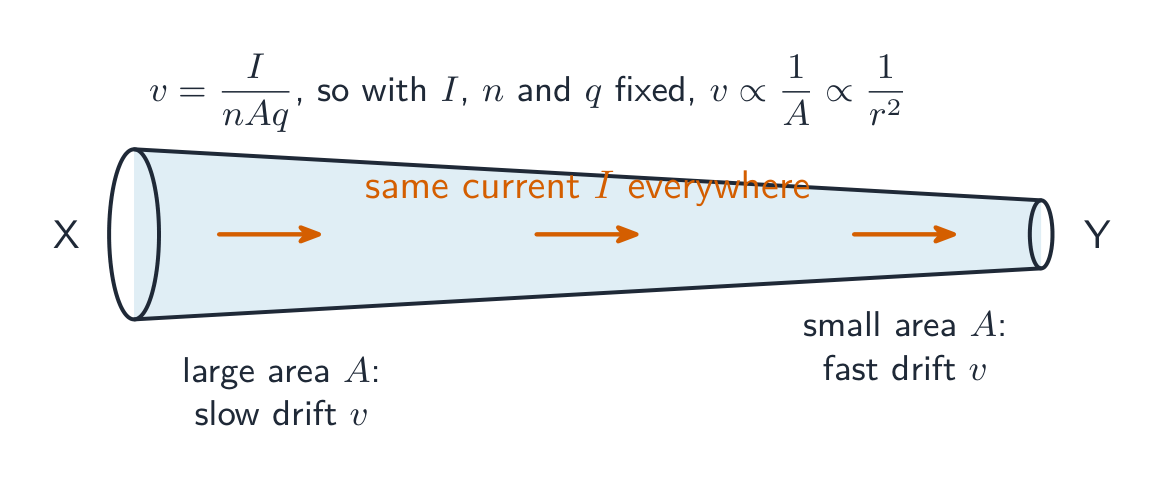
a wire that narrows (a wedge, a tapered rod, a cable of thick and thin strands) carries the same current at every cross-section, so the drift speed rises where the area falls: $v \propto 1/A \propto 1/r^{2}$. A sketch of $v$ against distance along a tapering wire is a curve that rises more and more steeply towards the narrow end, not a straight line.
the p.d. across a uniform wire is proportional to its length at fixed current, because $V = IR = I\rho L / A$ with $I$, $\rho$ and $A$ constant.
Use this to compare currents:
a thinner wire (smaller $A$) at the same $I$ needs a faster drift $v$.
a semiconductor has far fewer free carriers than a metal (smaller $n$), so for the same $I$ the drift velocity is much larger.
in series 串联 components, $I$ is the same everywhere, so if $A$ stays the same but the material changes, $nv$ changes the other way.
Português
Uma corrente elétrica 电流 é um fluxo de portadores de carga 载流子. Em um metal, os portadores são elétrons 电子 de condução negativos; em um eletrólito 电解质, são íons 离子 positivos e negativos; em um semicondutor 半导体, podem ser elétrons ou "buracos" 空穴. A direção da corrente convencional 常规电流 é a forma como a carga positiva fluiria — oposta ao fluxo real de elétrons em um fio.
Carga
A carga é quantizada 量子化: a menor unidade livre de carga é a carga elementar 基本电荷
$$e = 1.60 \times 10^{-19}\ \text{C}.$$
Toda carga livre neste programa é um múltiplo de número inteiro de $e$. A unidade de carga é o coulomb 库仑, $\text{C}$.
Assim, uma partícula pode carregar $4.8 \times 10^{-19}\ \text{C}$ (equivalente a três elétrons) ou $-2.4 \times 10^{-18}\ \text{C}$ (quinze), mas nunca $1.1 \times 10^{-19}\ \text{C}$ ou $6.4 \times 10^{-20}\ \text{C}$; um conjunto de medições que dê uma carga de portador $2.5 \times 10^{-19}\ \text{C}$ não pode estar certo, pois isso não é um múltiplo de $e$. Para as definições de uma marca: uma corrente elétrica é um fluxo de portadores de carga; o coulomb é a carga que passa por um ponto em um segundo quando a corrente é de um ampère (um ampère multiplicado por um segundo); um portador de carga pode ser um elétron, um próton, um íon ou uma partícula $\alpha$, mas nunca um nêutron.
Corrente como a taxa de fluxo de carga
Se a carga $Q$ passar por um ponto no tempo $t$, a corrente é
$$I = \frac{Q}{t}, \qquad Q = It.$$
Unidade de corrente: ampère, $\text{A}$ ($= \text{C s}^{-1}$). Para uma corrente variável, a carga que fluiu em um tempo é a área sob um gráfico de $I$–$t$.
Exemplo resolvido. Uma corrente de $0.50\ \text{A}$ flui por $2.0$ minutos. Encontre a carga que passa e quantos elétrons isso representa. ($e = 1.60 \times 10^{-19}\ \text{C}$.)
As mesmas duas linhas respondem a "quantos elétrons passam em $10$ horas a $4.0\ \text{mA}$" (converta o tempo para segundos: $N = It/e = 4.0 \times 10^{-3} \times 36\,000 / (1.60 \times 10^{-19}) = 9.0 \times 10^{20}$) e, ao contrário, "a corrente média quando $6.0 \times 10^{23}$ elétrons passam em $24$ horas" ($I = Ne/t = 1.1\ \text{A}$). Um feixe de partículas $\alpha$ também carrega corrente: cada uma carrega $2e$, então uma corrente de feixe de $6.9 \times 10^{-9}\ \text{A}$ é $6.9 \times 10^{-9} / (2 \times 1.60 \times 10^{-19}) = 2.2 \times 10^{10}$ partículas por segundo. Um raio que transfere $1 \times 10^{20}$ elétrons em $30\ \mu\text{s}$ é uma corrente de $Ne/t = 5.3 \times 10^{5}\ \text{A}$.
Equação da velocidade de deriva
Para um condutor uniforme de área transversal $A$, com $n$ portadores de carga por unidade de volume (a densidade numérica 数密度), cada um carregando carga $q$, movendo-se com velocidade de deriva 漂移速度 média $v$:
$$I = A n v q.$$
Portadores de carga derivando dentro de um condutor: portadores positivos derivam com $I$, elétrons contra ele
Exemplo resolvido. Um fio de cobre de área transversal $1.0 \times 10^{-6}\ \text{m}^{2}$ carrega uma corrente de $5.0\ \text{A}$. O cobre tem $n = 8.5 \times 10^{28}$ elétrons livres por $\text{m}^{3}$. Encontre a velocidade de deriva. ($e = 1.60 \times 10^{-19}\ \text{C}$.)
Os elétrons derivam muito lentamente — menos de um milímetro por segundo.
Dois passos "mostre que" que frequentemente antecedem este cálculo. A densidade numérica de um metal com um elétron livre por átomo é $n = \dfrac{\text{density} \times N_{\text{A}}}{\text{molar mass}}$: para o cobre, $8.9 \times 10^{3} \times 6.02 \times 10^{23} / 0.0635 = 8.5 \times 10^{28}\ \text{m}^{-3}$. E o tempo para um elétron derivar o comprimento de um fio é $t = L / v$: a $3.7 \times 10^{-4}\ \text{m s}^{-1}$ um $2.0\ \text{m}$ fio leva $5\,400\ \text{s}$, uma hora e meia, embora a corrente seja estabelecida quase instantaneamente. Entre eles, a equação $I = Anvq$ é usada como uma razão muito mais frequentemente do que como um cálculo:
dois fios em série carregam a mesma corrente; se o fio Y tem o dobro do diâmetro de X (quatro vezes a área) e o mesmo metal, seus elétrons derivam a um quarto da velocidade. Dois fios do mesmo comprimento e diâmetro, mas metais diferentes, têm velocidades de deriva na razão inversa de suas densidades numéricas.
um fio que afina (uma cunha, uma haste cônica, um cabo de mechas grossas e finas) carrega a mesma corrente em toda seção transversal, então a velocidade de deriva aumenta onde a área diminui: $v \propto 1/A \propto 1/r^{2}$. Um esboço de $v$ contra a distância ao longo de um fio cônico é uma curva que sobe cada vez mais acentuadamente em direção à extremidade estreita, não uma linha reta.
a d.d.p. através de um fio uniforme é proporcional ao seu comprimento a corrente fixa, porque $V = IR = I\rho L / A$ com $I$, $\rho$ e $A$ constantes.
A mesma corrente em todos os lugares, então os elétrons derivam mais rápido onde o fio é mais fino
Use isso para comparar correntes:
um fio mais fino (menor $A$) na mesma $I$ precisa de uma deriva mais rápida $v$.
um semicondutor tem muitos menos portadores livres do que um metal (menor $n$), então para a mesma $I$ a velocidade de deriva é muito maior.
em componentes em série 串联, $I$ é o mesmo em todos os lugares, então se $A$ permanece o mesmo, mas o material muda, $nv$ muda da outra forma.
Explore · Explorar
Corrente, tensão e resistência
Corrente é a taxa de fluxo de carga. Aumentar a tensão aumenta a corrente; aumentar a resistência a diminui — I = V / R.
define the potential difference across a component as the energy transferred per unit charge
recall and use $V = W/Q$
recall and use $P = VI$, $P = I^2R$ and $P = V^2/R$
Português
definir a diferença de potencial através de um componente como a energia transferida por unidade de carga
recordar e usar $V = W/Q$
recordar e utilizar $P = VI$, $P = I^2R$ e $P = V^2/R$
Source: Cambridge International syllabus · Fonte: Programa Cambridge International
English
The potential difference 电势差 (p.d.) across a component is the energy 能量 transferred per unit charge as that charge passes through it:
$$V = \frac{W}{Q}.$$
Unit: volt 伏特, $\text{V}$ ($= \text{J C}^{-1}$).
If $1\ \text{J}$ of electrical energy changes into other forms (thermal, light, kinetic, …) when $1\ \text{C}$ of charge passes through a component, the p.d. across it is $1\ \text{V}$.
The electromotive force 电动势 (e.m.f.) of a source is the energy given per unit charge by the source. The formula is the same as for p.d.; the difference is direction: e.m.f. is energy given to the charge by the change; p.d. is energy given up by the charge to the component.
The definitions the examiner accepts: the potential difference across a component is the energy transferred (from electrical to other forms) per unit charge passing through it; the e.m.f. of a source is the energy transferred from other forms (chemical, in a cell) to electrical energy per unit charge in driving the charge round a complete circuit; one volt is one joule per coulomb. A battery "marked $9.0\ \text{V}$" therefore gives each coulomb $9.0\ \text{J}$ of electrical energy for the whole circuit, and the product of charge and p.d. is the energy transferred.
Português
A diferença de potencial 电势差 (d.d.p.) através de um componente é a energia 能量 transferida por unidade de carga enquanto essa carga passa por ele:
$$V = \frac{W}{Q}.$$
Unidade: volt 伏特, $\text{V}$ ($= \text{J C}^{-1}$).
Se $1\ \text{J}$ de energia elétrica se transforma em outras formas (térmica, luz, cinética, …) quando $1\ \text{C}$ de carga passa por um componente, a d.d.p. através dele é $1\ \text{V}$.
A força eletromotriz 电动势 (f.e.m.) de uma fonte é a energia fornecida por unidade de carga pela fonte. A fórmula é a mesma que para a d.d.p.; a diferença é a direção: a f.e.m. é energia dada à carga pela mudança; a d.d.p. é energia dada para cima pela carga para o componente.
As definições aceitas pelo examinador: a diferença de potencial através de um componente é a energia transferida (de elétrica para outras formas) por unidade de carga passando por ele; a f.e.m. de uma fonte é a energia transferida de outras formas (química, em uma pilha) para energia elétrica por unidade de carga ao impulsionar a carga ao redor de um circuito completo; um volt é um joule por coulomb. Uma bateria "marcada $9.0\ \text{V}$" fornece, portanto, a cada coulomb $9.0\ \text{J}$ de energia elétrica para todo o circuito, e o produto de carga e d.d.p. é a energia transferida.
Pick the form with the quantities you know. Examples:
two heaters of equal resistance — the one with the larger current gives more power 功率 ($P = I^{2}R$).
two resistors in parallel 并联 across the same voltage 电压 — the one with smaller $R$ gives more power ($P = V^{2}/R$).
a kettle marked "$2.4\ \text{kW}, 240\ \text{V}$" draws $I = P/V = 10\ \text{A}$ and has resistance $R = V^{2}/P = 24\ \Omega$.
Energy transferred in time $t$ is $E = P t$.
Worked example. Two lamps, P rated $250\ \text{V}$, $50\ \text{W}$ and Q rated $250\ \text{V}$, $200\ \text{W}$, are connected in series to a $250\ \text{V}$ supply. Which is brighter?
Their resistances at the rated p.d. are $R = V^{2}/P$: $1250\ \Omega$ for P and $313\ \Omega$ for Q. In series they carry the same current, so $P = I^{2}R$ makes the larger resistance, lamp P, dissipate more power: the "weaker" lamp is the brighter one. In parallel the p.d. is the same across both and $P = V^{2}/R$ favours the smaller resistance: Q. "State and explain which resistor dissipates more power" is answered by naming the quantity the two share (current in series, p.d. in parallel) and the form of the power equation that uses it.
Worked example. A supply delivers $2.4\ \text{kW}$ at $240\ \text{V}$ to a kettle through two cables of resistance $0.10\ \Omega$ each. Find the power lost in the cables.
The current is $I = P/V = 10\ \text{A}$, so the cables dissipate $I^{2}R = 10^{2} \times 0.20 = 20\ \text{W}$, and the kettle receives $2380\ \text{W}$. The efficiency of a circuit that exists to power one component is that component's power divided by the total power from the supply: with $6.0\ \text{V}$ across a $0.86\ \Omega$ series resistor and $4.5\ \text{V}$ across the component at the same current, the efficiency is $4.5 / (6.0 + 4.5) = 43\%$. A thermistor across a fixed p.d. dissipates $P = V^{2}/R$, so as its temperature rises and $R$ falls, the power rises. A kettle draws about $10\ \text{A}$ from a $250\ \text{V}$ supply; a mobile phone charger a fraction of an ampere.
Português
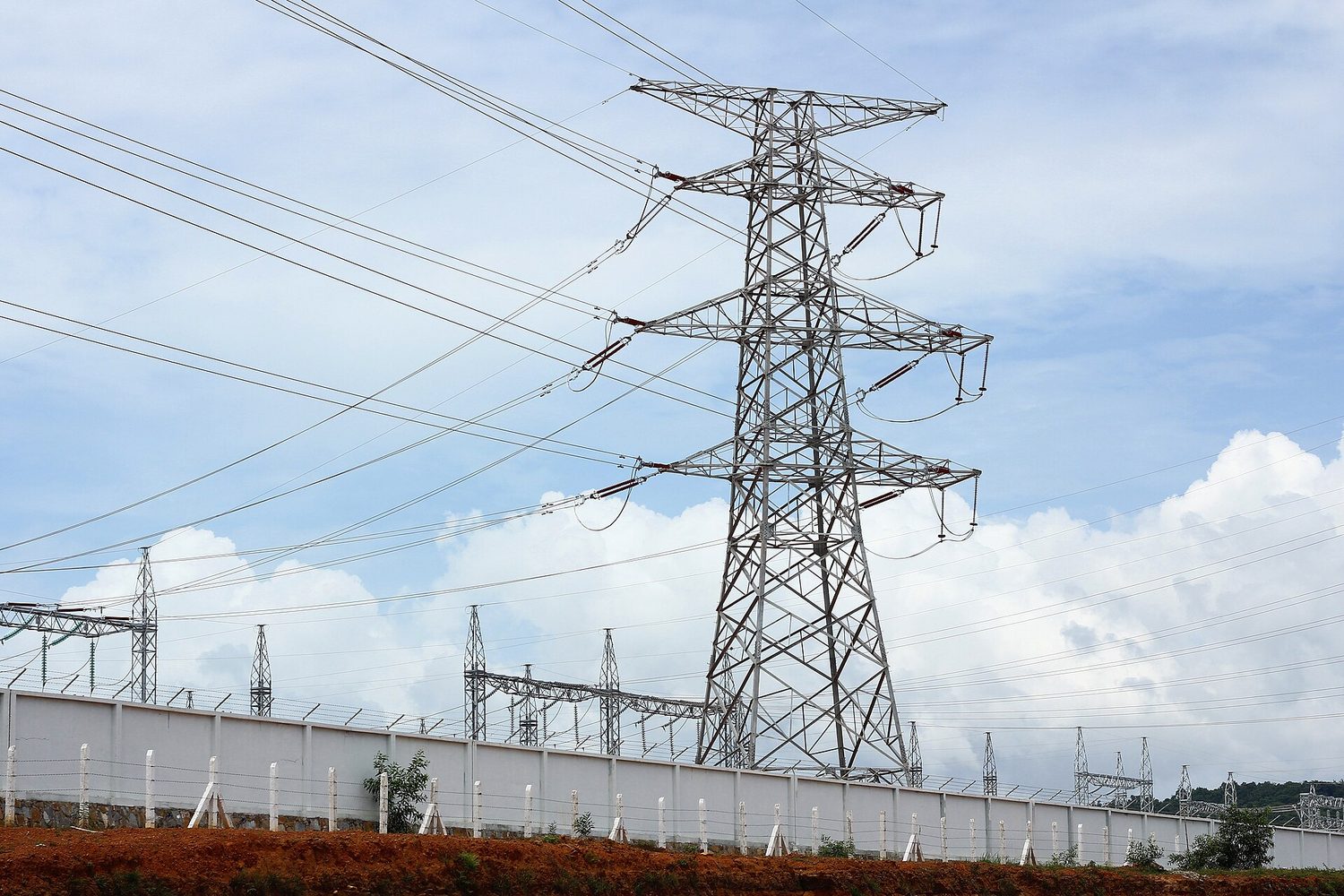
Linhas de transmissão de alta tensão transportam energia elétrica pelo país.
Combinando $V = W/Q$ e $I = Q/t$:
$$P = \frac{W}{t} = V I.$$
Usando a lei de Ohm $V = IR$:
$$P = V I = I^{2} R = \frac{V^{2}}{R}.$$
Escolha a forma com as quantidades que você conhece. Exemplos:
dois aquecedores de resistência igual — aquele com maior corrente fornece mais potência 功率 ($P = I^{2}R$).
dois resistores em paralelo 并联 sobre a mesma tensão 电压 — aquele com menor $R$ fornece mais potência ($P = V^{2}/R$).
uma chaleira marcada "$2.4\ \text{kW}, 240\ \text{V}$" consome $I = P/V = 10\ \text{A}$ e tem resistência $R = V^{2}/P = 24\ \Omega$.
Energia transferida no tempo $t$ é $E = P t$.
Exemplo resolvido. Duas lâmpadas, P classificada $250\ \text{V}$, $50\ \text{W}$ e Q classificada $250\ \text{V}$, $200\ \text{W}$, são conectadas em série a uma alimentação de $250\ \text{V}$. Qual é mais brilhante?
Suas resistências na d.d.p. nominal são $R = V^{2}/P$: $1250\ \Omega$ para P e $313\ \Omega$ para Q. Em série, elas carregam a mesma corrente, então $P = I^{2}R$ faz a resistência maior, a lâmpada P, dissipar mais potência: a lâmpada "mais fraca" é a mais brilhante. Em paralelo, a d.d.p. é a mesma em ambas e $P = V^{2}/R$ favorece a menor resistência: Q. "Affirme e explique qual resistor dissipa mais potência" é respondido nomeando a quantidade que as duas compartilham (corrente em série, d.d.p. em paralelo) e a forma da equação de potência que a usa.
Exemplo resolvido. Uma alimentação entrega $2.4\ \text{kW}$ a $240\ \text{V}$ para uma chaleira através de dois cabos de resistência $0.10\ \Omega$ cada. Encontre a potência perdida nos cabos.
A corrente é $I = P/V = 10\ \text{A}$, portanto os cabos dissipam $I^{2}R = 10^{2} \times 0.20 = 20\ \text{W}$, e a chaleira recebe $2380\ \text{W}$. A eficiência de um circuito projetado para alimentar um componente é a potência desse componente dividida pela potência total da fonte: com $6.0\ \text{V}$ através de um resistor em série de $0.86\ \Omega$ e $4.5\ \text{V}$ através do componente na mesma corrente, a eficiência é $4.5 / (6.0 + 4.5) = 43\%$. Um termistor conectado a uma d.d.p. fixa dissipa $P = V^{2}/R$, portanto à medida que sua temperatura sobe e $R$ cai, a potência aumenta. Uma chaleira consome cerca de $10\ \text{A}$ de uma rede de $250\ \text{V}$; um carregador de telefone celular, uma fração de ampere.
Explore · Explorar
Potência elétrica
P = VI
Com uma tensão fixa, a potência é proporcional à corrente que ela gera.
Resistance and Ohm's law · Resistência e Lei de Ohm
Syllabus · Programa
English
define resistance
recall and use $V = IR$
sketch the $I\text{--}V$ characteristics of a metallic conductor at constant temperature, a semiconductor diode and a filament lamp
explain that the resistance of a filament lamp increases as current increases because its temperature increases
state Ohm's law
recall and use $R = \rho L/A$
understand that the resistance of a light-dependent resistor (LDR) decreases as the light intensity increases
understand that the resistance of a thermistor decreases as the temperature increases (it will be assumed that thermistors have a negative temperature coefficient)
Português
definir resistência
recordar e usar $V = IR$
esboçar as características $I\text{--}V$ de um condutor metálico a temperatura constante, de um diodo semicondutor e de uma lâmpada incandescente
explicar que a resistência de uma lâmpada incandescente aumenta à medida que a corrente aumenta porque a sua temperatura aumenta
enunciar a Lei de Ohm
recordar e utilizar $R = \rho L/A$
compreender que a resistência de uma resistência dependente da luz (LDR) diminui à medida que a intensidade luminosa aumenta
compreender que a resistência de um termistor diminui à medida que a temperatura aumenta (presume-se que os termistores tenham um coeficiente de temperatura negativo)
Source: Cambridge International syllabus · Fonte: Programa Cambridge International
English
The resistance 电阻$R$ of a component is
$$R = \frac{V}{I}.$$
Unit: ohm 欧姆, $\Omega$ ($= \text{V A}^{-1}$). Resistance depends on the conditions (such as temperature) when it is measured.
Ohm's law
A conductor obeys Ohm's law 欧姆定律 when the current through it is proportional to the p.d. across it, as long as the conditions (especially temperature) stay constant. For such a conductor $R$ is constant and the $I$–$V$ graph is a straight line through the origin.
Ohm's law is an experimental result, not a definition. The definition $R = V/I$ works for any component; only ohmic ones have constant $R$.
For the marks: resistance is the ratio of the potential difference across a component to the current in it; the ohm is the resistance of a component in which a p.d. of one volt produces a current of one ampere (a volt per ampere); Ohm's law states that the current in a metallic conductor is directly proportional to the potential difference across it, provided that its temperature (and other physical conditions) remains constant. Of several $I$–$V$ graphs, only a straight line through the origin obeys Ohm's law; a straight line that misses the origin, or any curve, does not.
$I$–$V$ characteristics
You should be able to sketch these:
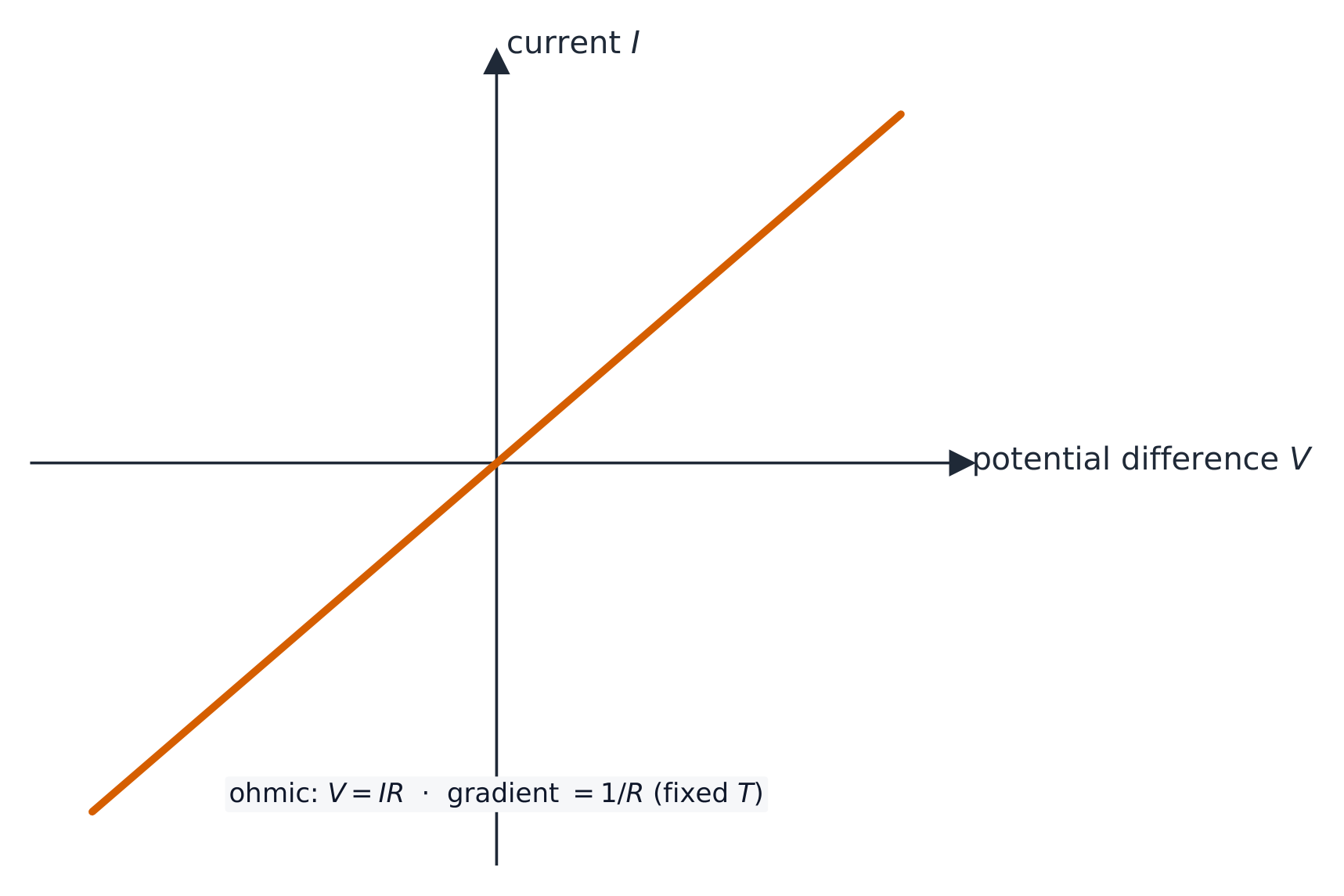
metal wire at constant temperature — a straight line through the origin (constant $R$). Reversing the p.d. drives the current the other way, giving a straight line in both directions.
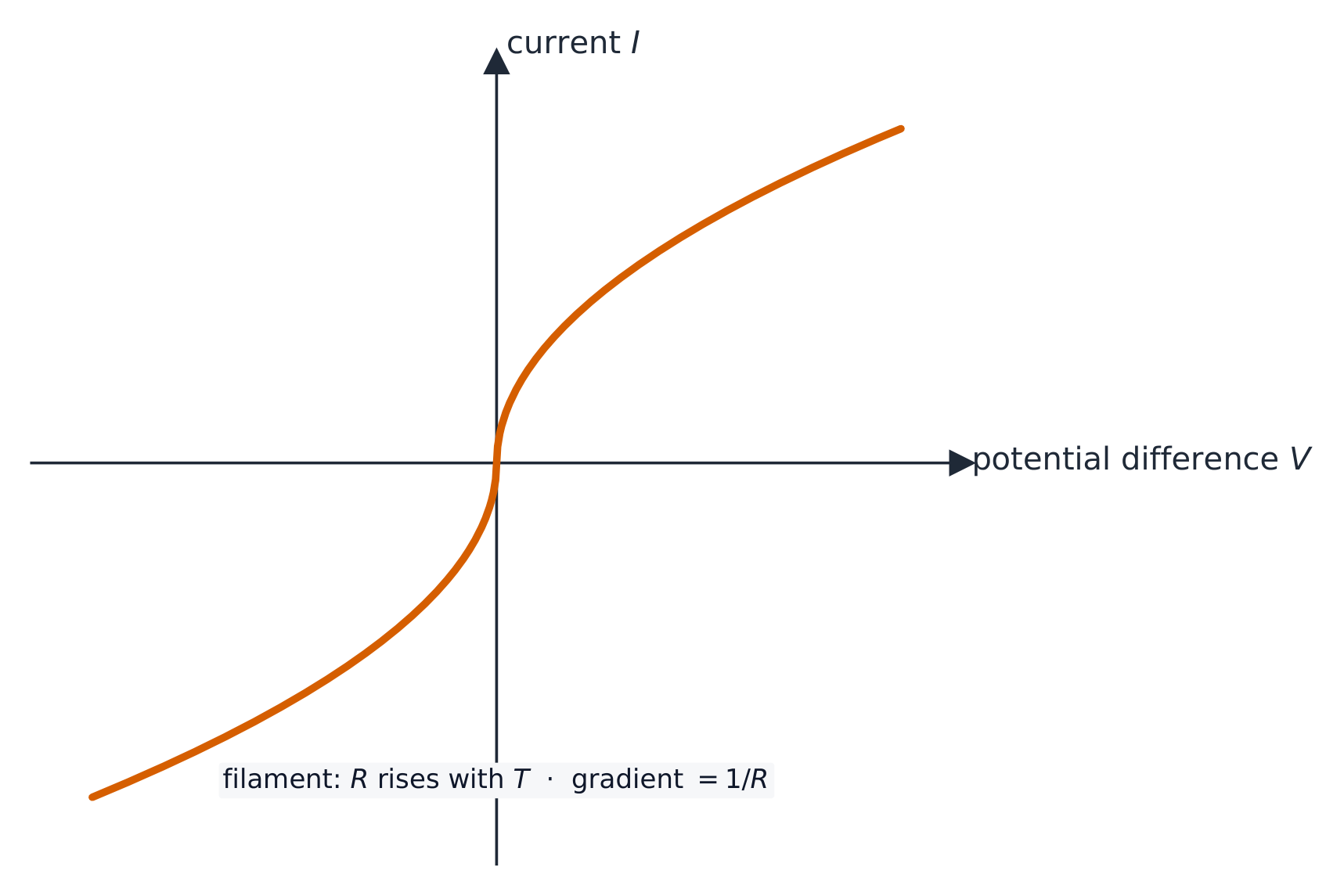
filament lamp 灯丝灯泡 — through the origin, steep at first, then flatter as $V$ (and $I$) grow. Reason: more current heats the filament, so its resistance rises and the gradient $1/R$ falls.
semiconductor diode 二极管 — almost no current for negative $V$ or small positive $V$. Above a "switch-on" voltage (about $0.7\ \text{V}$ for silicon), the current rises sharply.
Explain the shape of the filament lamp's line (three marks): as the current increases the filament's temperature rises; the lattice ions vibrate with larger amplitude, so the free electrons collide with them more often; each collision takes energy from the electrons, so the resistance increases; on the graph the ratio $V/I$ grows and the gradient falls. Run backwards for "the current decreases": the temperature falls, so the resistance falls. Two things to read off any characteristic. The resistance at a point is $V/I$ for that point, never the gradient of a curve, so a diode's resistance is very large (infinite, in practice) up to the switch-on p.d. and then falls steeply as $V$ rises further, and of four components at the same p.d. the one with the smallest current has the greatest resistance. And when a lamp (or a diode) is in series with a resistor, the two carry the same current and their p.d.s add: read the current from the component's curve at its own p.d., then use $V = IR$ for the resistor, and the supply p.d. is the sum.
Resistivity
For a uniform conductor of length $L$ and cross-section area $A$,
$$R = \frac{\rho L}{A}.$$
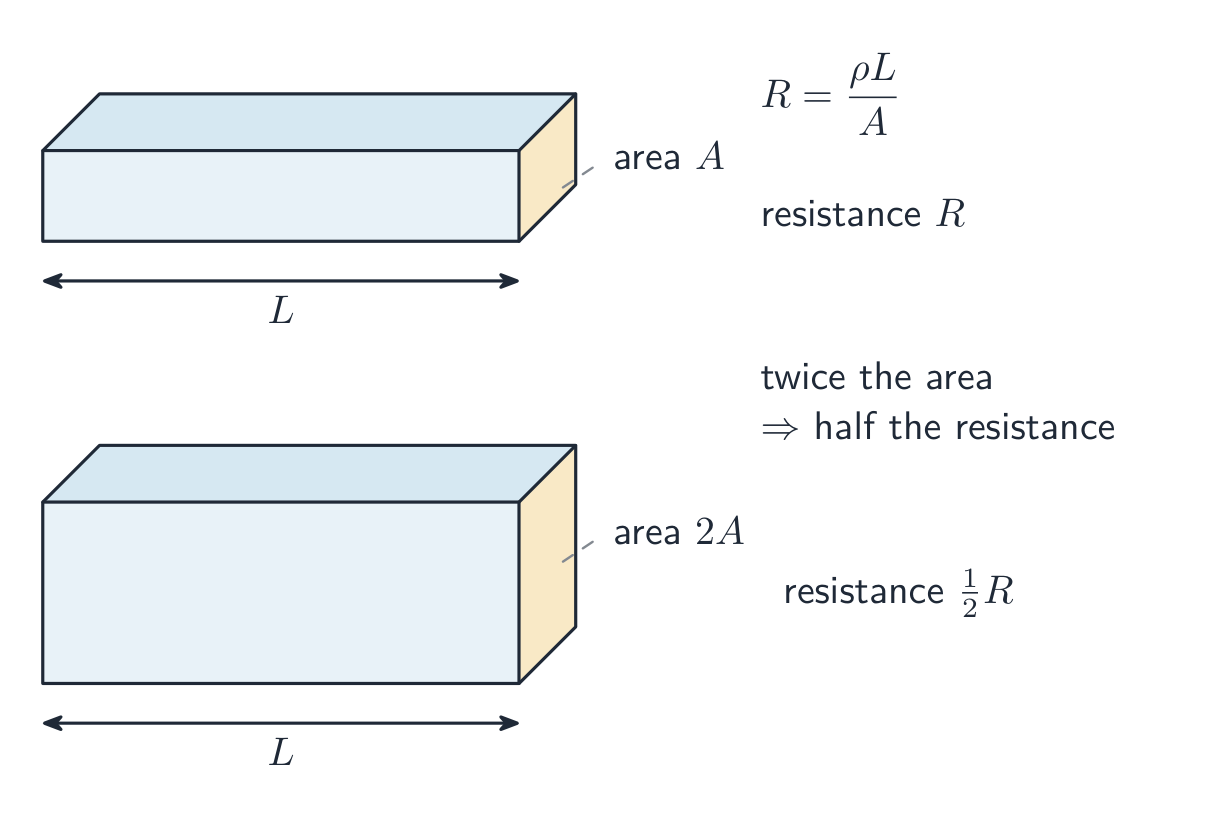
$\rho$ is the resistivity 电阻率, a property of the material, with unit $\Omega\ \text{m}$. Doubling the length doubles $R$; doubling the area halves it; halving the diameter quarters the area and so makes $R$ four times bigger.
Worked example. A copper wire of length $2.0\ \text{m}$ and cross-sectional area $1.7 \times 10^{-7}\ \text{m}^{2}$ has resistivity $1.7 \times 10^{-8}\ \Omega\ \text{m}$. Find its resistance.
Typical values: copper at room temperature $\rho \sim 1.7 \times 10^{-8}\ \Omega\ \text{m}$; an insulator 绝缘体$\rho \sim 10^{15}\ \Omega\ \text{m}$ or more.
The resistivity of a metal rises with temperature (more lattice vibration 晶格振动scatters 散射 the electrons), which is why the filament lamp's $I$–$V$ line curves.
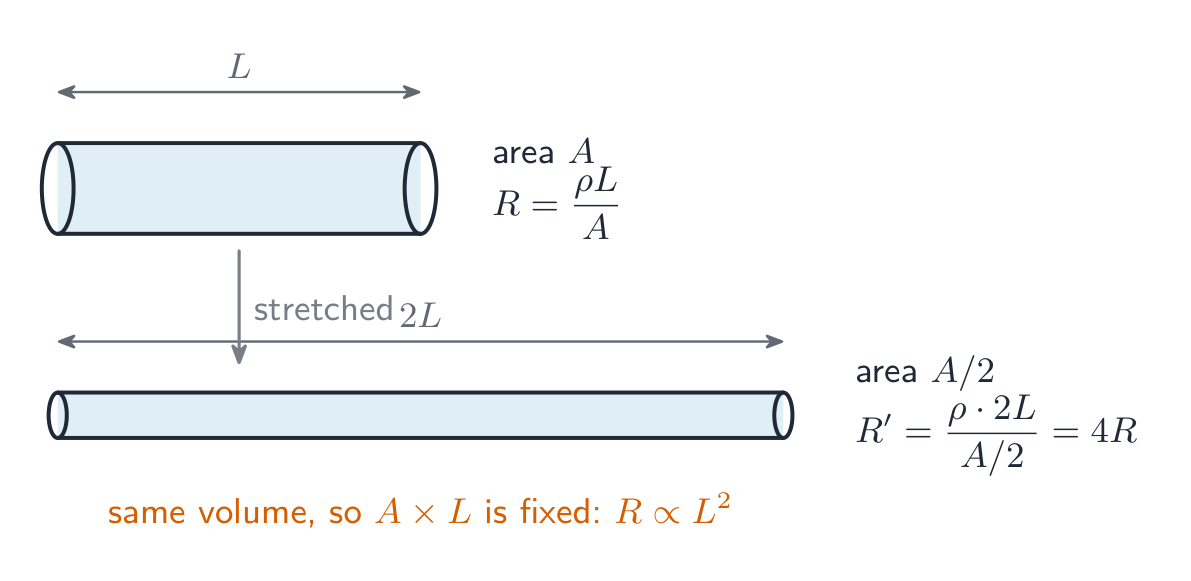
Most resistivity questions are ratios. Stretching a wire keeps its volume ($A \times L$) constant, so if the length becomes $k$ times longer the area becomes $k$ times smaller and $R = \rho L / A$ becomes $k^{2}$ times larger: a wire three times as long (same mass, same metal) has nine times the resistance, and a wire whose diameter falls to $0.940$ of its value has its area multiplied by $0.884$, its length divided by $0.884$, and its resistance multiplied by $1/0.884^{2} = 1.28$.
Worked example. A copper lightning rod of resistance $9.6\ \Omega$ and length $20\ \text{m}$ has resistivity $1.7 \times 10^{-8}\ \Omega\ \text{m}$. Find its radius.
$A = \rho L / R = 1.7 \times 10^{-8} \times 20 / 9.6 = 3.5 \times 10^{-8}\ \text{m}^{2}$, and $r = \sqrt{A / \pi} = 1.1 \times 10^{-4}\ \text{m}$. Doubling the radius (same length) quarters the resistance. The other standard ratios: strands in parallel — seven identical strands share the current, so the cable's resistance is one seventh of one strand's; two wires of the same resistance where one metal has twice the resistivity need the second wire to have twice the area (a diameter $\sqrt{2}$ times larger) for the same length; a wire's resistance per unit length, $0.92\ \Omega\ \text{m}^{-1}$, multiplied by its area, $5.3 \times 10^{-7}\ \text{m}^{2}$, is its resistivity, $4.9 \times 10^{-7}\ \Omega\ \text{m}$; and a cylinder of conducting putty $60\ \text{mm}$ long and $20\ \text{mm}$ across, or a cube of side $a$ ($R = \rho a / a^{2} = \rho / a$), uses the same $R = \rho L / A$ with the shape's own length and end area. When the wire is held under tension, $R_{0} = \rho L / A$ still gives its resistance, and a stretch that lengthens it and thins it raises $R$ for both reasons. Because $\rho = RA/L = R\pi d^{2}/(4L)$, the percentage uncertainty in a measured resistivity is the sum of the percentage uncertainties in $R$ and $L$ plus twice that in $d$.
Português
A resistência 电阻$R$ de um componente é
$$R = \frac{V}{I}.$$
Unidade: ohm 欧姆, $\Omega$ ($= \text{V A}^{-1}$). A resistência depende das condições (como temperatura) quando é medida.
Resistores fixos reais — as faixas coloridas codificam a resistência em ohms
Lei de Ohm
Um condutor obedece à Lei de Ohm 欧姆定律 quando a corrente através dele é proporcional à d.p. (diferença de potencial) entre seus terminais, desde que as condições (especialmente a temperatura) permaneçam constantes. Para tal condutor $R$ é constante e o gráfico $I$–$V$ é uma linha reta que passa pela origem.
A Lei de Ohm é um resultado experimental, não uma definição. A definição $R = V/I$ funciona para qualquer componente; apenas os componentes ôhmicos têm $R$ constante.
Para fins de avaliação: resistência é a razão entre a diferença de potencial entre um componente e a corrente que o atravessa; o ohm é a resistência de um componente no qual uma d.p. de um volt produz uma corrente de um ampere (um volt por ampere); a Lei de Ohm afirma que a corrente em um condutor metálico é diretamente proporcional à diferença de potencial entre seus terminais, desde que sua temperatura (e outras condições físicas) permaneça constante. De vários gráficos $I$–$V$, apenas uma linha reta que passa pela origem obedece à Lei de Ohm; uma linha reta que não passa pela origem ou qualquer curva não obedecem.
Características $I$–$V$
Você deve ser capaz de esboçar estas:
fio metálico a temperatura constante — uma linha reta que passa pela origem ($R$ constante). Inverter a d.p. inverte a direção da corrente, resultando em uma linha reta em ambas as direções.
lâmpada incandescente 灯丝灯泡 — passa pela origem, íngreme no início, depois mais plana à medida que $V$ (e $I$) crescem. Razão: mais corrente aquece o filamento, portanto sua resistência aumenta e o gradiente $1/R$ cai.
diodo semicondutor 二极管 — praticamente nenhuma corrente para $V$ negativos ou pequenos valores positivos de $V$. Acima de uma tensão de "condução" (cerca de $0.7\ \text{V}$ para silício), a corrente aumenta abruptamente.
Explique a forma da linha da lâmpada incandescente (três pontos): à medida que a corrente aumenta, a temperatura do filamento sobe; os íons da rede vibram com maior amplitude, então os elétrons livres colidem com eles com mais frequência; cada colisão retira energia dos elétrons, assim a resistência aumenta; no gráfico, a razão $V/I$ cresce e a inclinação cai. Faça o inverso para "a corrente diminui": a temperatura cai, logo a resistência cai. Duas coisas para extrair de qualquer característica. A resistência em um ponto é $V/I$ para aquele ponto, nunca a inclinação de uma curva, então a resistência de um diodo é muito grande (infinita, na prática) até a d.p. de ligar e depois cai abruptamente à medida que $V$ aumenta ainda mais, e de quatro componentes na mesma d.p., aquele com a menor corrente tem a maior resistência. E quando uma lâmpada (ou um diodo) está em série com um resistor, os dois percorrem a mesma corrente e suas d.p.s se somam: leia a corrente na curva do componente em sua própria d.p., depois use $V = IR$ para o resistor, e a d.p. da fonte é a soma.
Característica $I$–$V$ de um condutor ôhmico (fio metálico a temperatura constante)Característica $I$–$V$ de uma lâmpada incandescenteCaracterística $I$–$V$ de um diodo semicondutor
Resistividade
Para um condutor uniforme de comprimento $L$ e área da seção transversal $A$,
$$R = \frac{\rho L}{A}.$$
$\rho$ é a resistividade 电阻率, uma propriedade do material, com unidade $\Omega\ \text{m}$. Dobrar o comprimento dobra $R$; dobrar a área reduz pela metade; reduzir o diâmetro à metade reduz a área a um quarto e, portanto, torna $R$ quatro vezes maior.
Exemplo resolvido. Um fio de cobre de comprimento $2.0\ \text{m}$ e área da seção transversal $1.7 \times 10^{-7}\ \text{m}^{2}$ tem resistividade $1.7 \times 10^{-8}\ \Omega\ \text{m}$. Encontre sua resistência.
Valores típicos: cobre à temperatura ambiente $\rho \sim 1.7 \times 10^{-8}\ \Omega\ \text{m}$; um isolante 绝缘体$\rho \sim 10^{15}\ \Omega\ \text{m}$ ou mais.
Um condutor mais longo tem mais resistência — dobrar $L$ dobra $R$Um condutor mais largo tem menos resistência — dobrar $A$ reduz à metade $R$
A resistividade de um metal aumenta com a temperatura (mais vibração da rede 晶格振动dispersa 散射 os elétrons), é por isso que a linha $I$–$V$ da lâmpada incandescente se curva.
A maioria das questões de resistividade são razões. Esticando um fio mantém seu volume ($A \times L$) constante, então se o comprimento torna-se $k$ vezes mais longo, a área torna-se $k$ vezes menor e $R = \rho L / A$ torna-se $k^{2}$ vezes maior: um fio três vezes mais longo (mesma massa, mesmo metal) tem nove vezes a resistência, e um fio cujo diâmetro cai para $0.940$ de seu valor tem sua área multiplicada por $0.884$, seu comprimento dividido por $0.884$, e sua resistência multiplicada por $1/0.884^{2} = 1.28$.
Esticado a volume constante: duas vezes o comprimento, metade da área, quatro vezes a resistência
Exemplo resolvido. Um raio captador de cobre de resistência $9.6\ \Omega$ e comprimento $20\ \text{m}$ tem resistividade $1.7 \times 10^{-8}\ \Omega\ \text{m}$. Encontre seu raio.
$A = \rho L / R = 1.7 \times 10^{-8} \times 20 / 9.6 = 3.5 \times 10^{-8}\ \text{m}^{2}$, e $r = \sqrt{A / \pi} = 1.1 \times 10^{-4}\ \text{m}$. Dobrar o raio (mesmo comprimento) reduz a resistência a um quarto. As outras razões padrão: fios em paralelo — sete fios idênticos compartilham a corrente, então a resistência do cabo é um sétimo da resistência de um fio; dois fios da mesma resistência onde um metal tem o dobro da resistividade precisam que o segundo fio tenha o dobro da área (um diâmetro $\sqrt{2}$ vezes maior) para o mesmo comprimento; a resistência por unidade de comprimento de um fio, $0.92\ \Omega\ \text{m}^{-1}$, multiplicada por sua área, $5.3 \times 10^{-7}\ \text{m}^{2}$, é sua resistividade, $4.9 \times 10^{-7}\ \Omega\ \text{m}$; e um cilindro de massa condutora $60\ \text{mm}$ de comprimento e $20\ \text{mm}$ de diâmetro, ou um cubo de lado $a$ ($R = \rho a / a^{2} = \rho / a$), usa a mesma $R = \rho L / A$ com o próprio comprimento da forma e área final. Quando o fio é mantido sob tensão, $R_{0} = \rho L / A$ ainda dá sua resistência, e um estiramento que o alonga e afina eleva $R$ por ambos os motivos. Como $\rho = RA/L = R\pi d^{2}/(4L)$, a incerteza percentual na resistividade medida é a soma das incertezas percentuais em $R$ e $L$ mais duas vezes aquela em $d$.
Explore · Explorar
No que a resistência depende: R = ρL/A
Um fio mais longo tem mais resistência; um mais espesso (maior área) tem menos. Altere o comprimento, a área e o metal.
Explore · Explorar
Resistência (Lei de Ohm)
V = R·I
Lei de Ohm: a tensão é proporcional à corrente — a inclinação é a resistência R.
Explore · Explorar
Lei de Ohm: V = IR
V = aI
Arraste a resistência. Para um condutor ôhmico, a tensão é proporcional à corrente — uma linha reta cujo gradiente é a resistência.
Light-dependent resistor (LDR) · Resistor dependente de luz (LDR)
English
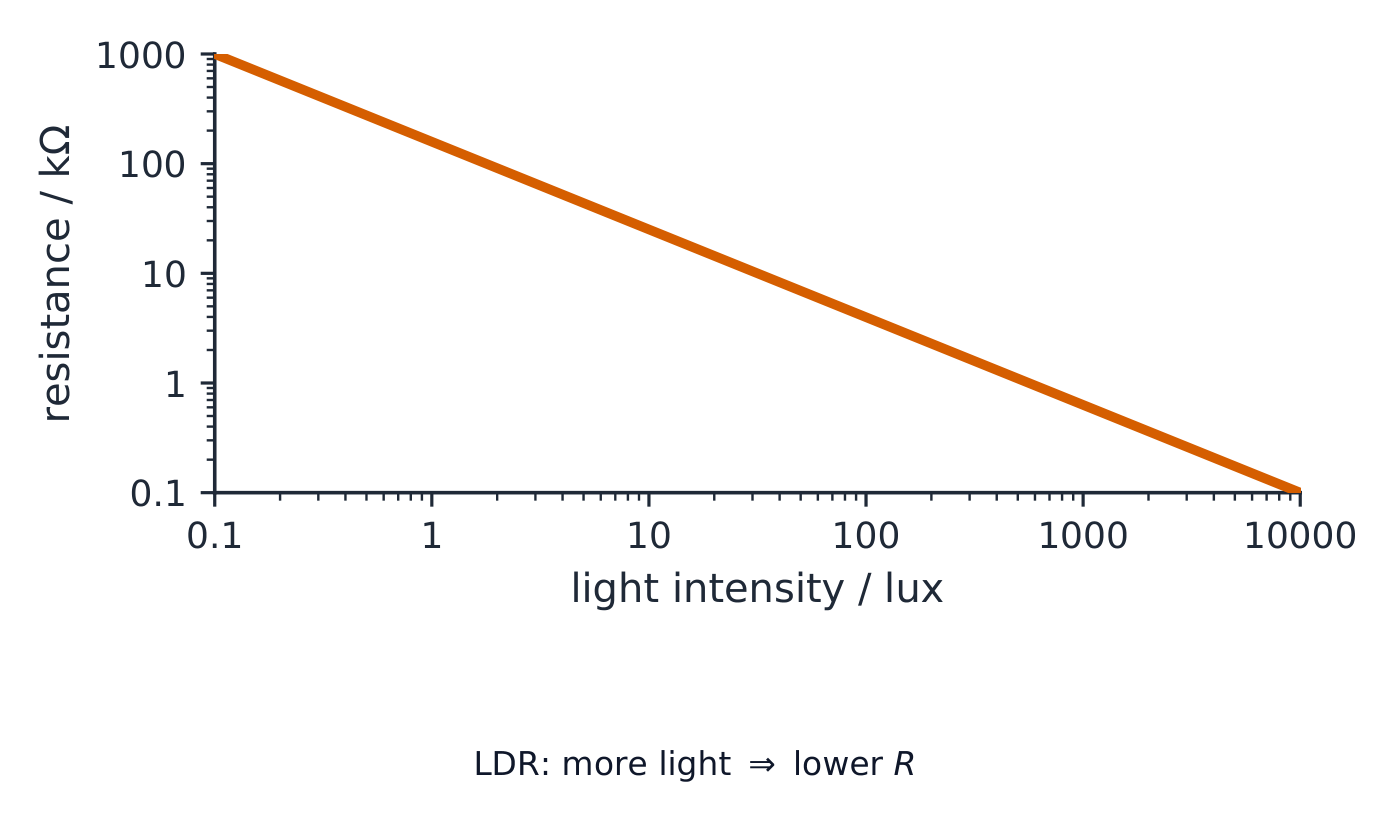
A light-dependent resistor 光敏电阻 (LDR) is a semiconductor whose resistance falls as the light intensity rises. In bright light $R$ may be a few hundred $\Omega$; in the dark it can be in the megaohms. LDRs are used in light-sensing circuits (street lamps, camera light meters). Here the light intensity 光强 controls the resistance.
Português
Um resistor dependente de luz 光敏电阻 (LDR) é um semicondutor cuja resistência diminui à medida que a intensidade da luz aumenta. Em luz brilhante $R$ pode ser algumas centenas de $\Omega$; na escuridão pode chegar a megaohms. LDRs são usados em circuitos de detecção de luz (postes de rua, medidores de luz de câmeras). Aqui a intensidade da luz 光强 controla a resistência.
A resistência de um LDR diminui à medida que a intensidade da luz aumenta
In this syllabus a thermistor 热敏电阻 has a negative temperature coefficient 负温度系数: its resistance falls as its temperature rises. This is useful for sensing temperature — put it in a potential divider 分压器 and the output voltage changes with temperature.
This is the opposite of a metal: in a semiconductor, more thermal energy frees more charge carriers, and this matters more than the extra scattering.
A sketch of a thermistor's resistance against temperature starts at $R_{0}$ at $0\ °\text{C}$ and falls along a curve that flattens: the fall is not linear, which is the disadvantage of a thermistor as a thermometer (its scale is not uniform, so it needs calibrating). When the light on an LDR is increased, or a thermistor is warmed, its resistance falls, the current in its circuit rises, and the p.d. across it (in series with a fixed resistor) falls while the p.d. across the resistor rises; a fixed resistor and a metal wire at constant temperature keep their resistance, and a filament lamp's rises with current.
Português
Neste programa curricular, um termistor 热敏电阻 tem um coeficiente de temperatura negativo 负温度系数: sua resistência diminui à medida que sua temperatura aumenta. Isso é útil para sensing de temperatura — coloque-o em um divisor de potencial 分压器 e a tensão de saída muda com a temperatura.
A resistência de um termistor diminui à medida que a temperatura aumenta
Isso é o oposto de um metal: em um semicondutor, mais energia térmica libera mais portadores de carga, e isso importa mais do que a dispersão adicional.
Um esboço da resistência de um termistor contra a temperatura começa em $R_{0}$ em $0\ °\text{C}$ e desce ao longo de uma curva que se aplaina: a queda não é linear, que é a desvantagem de um termistor como termômetro (sua escala não é uniforme, então precisa de calibração). Quando a luz em um LDR é aumentada, ou um termistor é aquecido, sua resistência diminui, a corrente em seu circuito aumenta, e a d.p. sobre ele (em série com um resistor fixo) diminui enquanto a d.p. sobre o resistor aumenta; um resistor fixo e um fio metálico a temperatura constante mantêm sua resistência, e a resistência de uma lâmpada incandescente aumenta com a corrente.
Definitions the examiner accepts · Definições aceitas pelo examinador
English
A definition question is marked against fixed wording. Learn these exactly, and give one answer only.
Term
Definition
electric current
a flow of charge carriers
coulomb
the charge passing a point in one second when the current is one ampere
potential difference
the energy transferred from electrical to other forms per unit charge passing through a component
electromotive force (e.m.f.)
the energy transferred from other forms to electrical energy per unit charge, by a source driving charge round a complete circuit
volt
one joule per coulomb
resistance
the ratio of the potential difference across a component to the current in it
ohm
the resistance of a component in which a potential difference of one volt produces a current of one ampere
Ohm's law
the current in a metallic conductor is directly proportional to the potential difference across it, provided its temperature remains constant
resistivity
the constant $\rho$ in $R = \rho L / A$, a property of the material with unit $\Omega\ \text{m}$
number density
the number of charge carriers per unit volume of the conductor
Português
Uma questão de definição é avaliada contra wording fixo. Aprenda estas exatamente, e dê apenas uma resposta.
Termo
Definição
corrente elétrica
fluxo de portadores de carga
coulomb
a carga que passa por um ponto em um segundo quando a corrente é um ampere
diferença de potencial
a energia transferida de elétrica para outras formas por unidade de carga passando por um componente
força eletromotriz (f.e.m.)
a energia transferida de outras formas para energia elétrica por unidade de carga, por uma fonte impulsionando cargas ao redor de um circuito completo
volt
um joule por coulomb
resistência
a razão entre a diferença de potencial entre um componente e a corrente que o atravessa
ohm
a resistência de um componente no qual uma diferença de potencial de um volt produz uma corrente de um ampere
Lei de Ohm
a corrente em um condutor metálico é diretamente proporcional à diferença de potencial entre seus terminais, desde que sua temperatura permaneça constante
resistividade
a constante $\rho$ em $R = \rho L / A$, uma propriedade do material com unidade $\Omega\ \text{m}$
densidade numérica
o número de portadores de carga por unidade de volume do condutor
9.3
Exam tips · Dicas de prova
English
Use $I = Q/t$, $V = W/Q$ (energy per unit charge) and $P = VI = I^2 R = V^2/R$.
Ohm's law ($V = IR$) applies only to an ohmic conductor at constant temperature — a filament lamp is non-ohmic.
Sketch and interpret the $I$-$V$ characteristics of a resistor, filament lamp and diode.
An LDR's resistance falls with light; a thermistor's falls as temperature rises.
Common mistakes
Taking the resistance from the gradient of a curved $I$–$V$ graph. Resistance is $V/I$ at the point; only for a straight line through the origin is it the reciprocal of the gradient.
Leaving a time in minutes or hours in $Q = It$. Convert to seconds first.
Saying the filament lamp's resistance rises "because of the voltage". The chain is current, temperature, ion vibration, more collisions, more resistance.
Forgetting that a stretched wire changes in two ways. At constant volume the area falls as the length rises, so $R \propto L^{2}$.
Using the diameter as the radius in $A = \pi r^{2}$, or leaving $\text{mm}^{2}$ unconverted.
Comparing powers with the wrong form. Series components share the current, so use $I^{2}R$; parallel components share the p.d., so use $V^{2}/R$.
Português
Use $I = Q/t$, $V = W/Q$ (energia por unidade de carga) e $P = VI = I^2 R = V^2/R$.
Lei de Ohm ($V = IR$) aplica-se apenas a um condutor ôhmico a temperatura constante — uma lâmpada incandescente é não-ôhmica.
Esboce e interprete as características $I$-$V$ de um resistor, lâmpada incandescente e diodo.
A resistência de um LDR diminui com a luz; a de um termistor diminui à medida que a temperatura aumenta.
Erros comuns
Tendo a resistência a partir do gradiente de um gráfico $I$–$V$ curvo. A resistência é $V/I$ no ponto; apenas para uma linha reta passando pela origem ela é o inverso do gradiente.
Deixando um tempo em minutos ou horas em $Q = It$. Converta para segundos primeiro.
Dizer que a resistência da lâmpada de filamento aumenta "devido à tensão". A cadeia é: corrente, temperatura, vibração dos íons, mais colisões, maior resistência.
Esquecer que um fio esticado muda de duas formas. Em volume constante, a área diminui conforme o comprimento aumenta, então $R \propto L^{2}$.
Usar o diâmetro como raio em $A = \pi r^{2}$, ou deixar $\text{mm}^{2}$ sem converter.
Comparar potências com a forma errada. Componentes em série compartilham a corrente, então use $I^{2}R$; componentes em paralelo compartilham a d.d.p., então use $V^{2}/R$.
Interactive lessons on this topic · Aulas interativas sobre este tópico
Work through it step by step, with instant-check exercises. · Passe por ele passo a passo, com exercícios de verificação instantânea.
Pick one and the site follows you — notes, papers, videos and practice all open on it. · Escolha uma e o site te seguirá — notas, provas, vídeos e prática abrirão nela.
Type to search notes, lessons, code, vocabulary and past-paper questions across every subject. · Digite para pesquisar notas, aulas, código, vocabulário e questões de provas anteriores em todas as disciplinas.