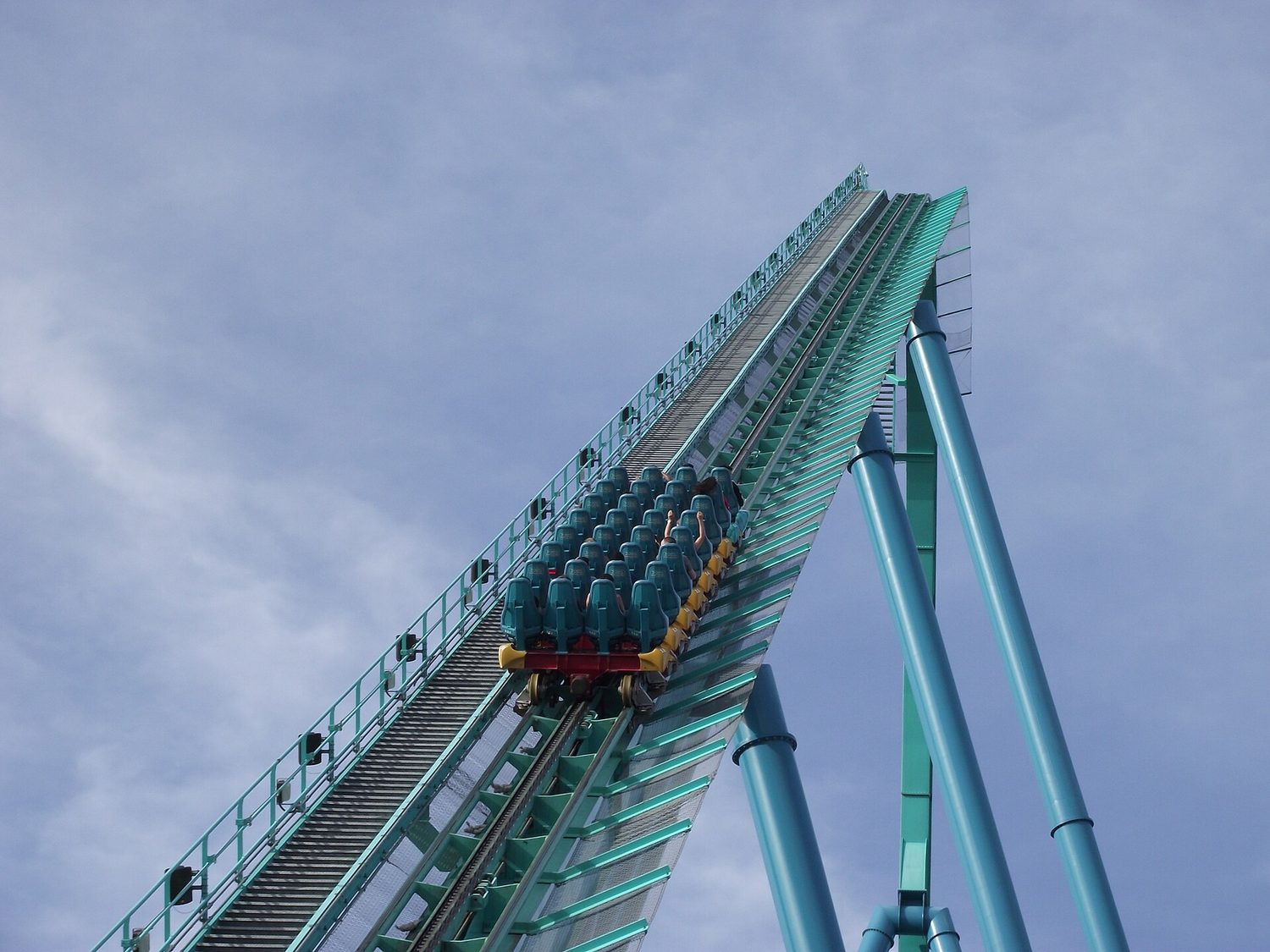
Uma montanha-russa não tem motor em seus trilhos. Uma corrente a puxa até o topo da primeira colina — e a partir daí, ela fica sozinha. Então como ela consegue correr por todas as voltas…
English narration · English + 中文 subtitles burned in · Narração em inglês · Legendas em inglês + 中文 gravadas
5.1
Work, energy and power · Trabalho, energia e potência
Syllabus · Programa
English
understand the concept of work, and recall and use $\text{work done} = \text{force} \times \text{displacement in the direction of the force}$
recall and apply the principle of conservation of energy
recall and understand that the efficiency of a system is the ratio of useful energy output from the system to the total energy input
use the concept of efficiency to solve problems
define power as work done per unit time
solve problems using $P = W/t$
derive $P = Fv$ and use it to solve problems
Português
compreender o conceito de trabalho, e recordar e usar $\text{work done} = \text{force} \times \text{displacement in the direction of the force}$
recordar e aplicar o princípio de conservação de energia
recordar e compreender que a eficiência de um sistema é a razão entre a energia útil de saída do sistema e a energia total de entrada
usar o conceito de eficiência para resolver problemas
definir potência como trabalho realizado por unidade de tempo
resolver problemas usando $P = W/t$
derivar $P = Fv$ e usá-la para resolver problemas
Source: Cambridge International syllabus · Fonte: Programa Cambridge International
English
Work done by a force
Work 功 is done when a force moves its point of contact along the line of the force. For the one-mark definition write: work done is the product of the force and the distance moved in the direction of the force. The work done by a constant force $F$ that causes a displacement 位移$s$ is
$$W = F \cdot s \cdot \cos\theta,$$
where $\theta$ is the angle between the force and the displacement. Only the component 分量 of the force along the displacement does work.
Worked example. A child pulls a sledge $5.0\ \text{m}$ across the snow with a rope, using a force of $20\ \text{N}$ at $60°$ to the ground. Find the work done by the rope.
Unit: $\text{J} = \text{N m}$. Work is a scalar 标量.
Special cases:
force in the same direction as the motion ($\theta = 0$): $W = Fs$, positive work, energy 能量 given to the object.
force at right angles to the motion ($\theta = 90°$): $W = 0$. The normal contact force 支持力 on a car on a flat road does no work.
force opposite to the motion ($\theta = 180°$): $W = -Fs$, negative work, energy taken from the object (for example friction 摩擦力).
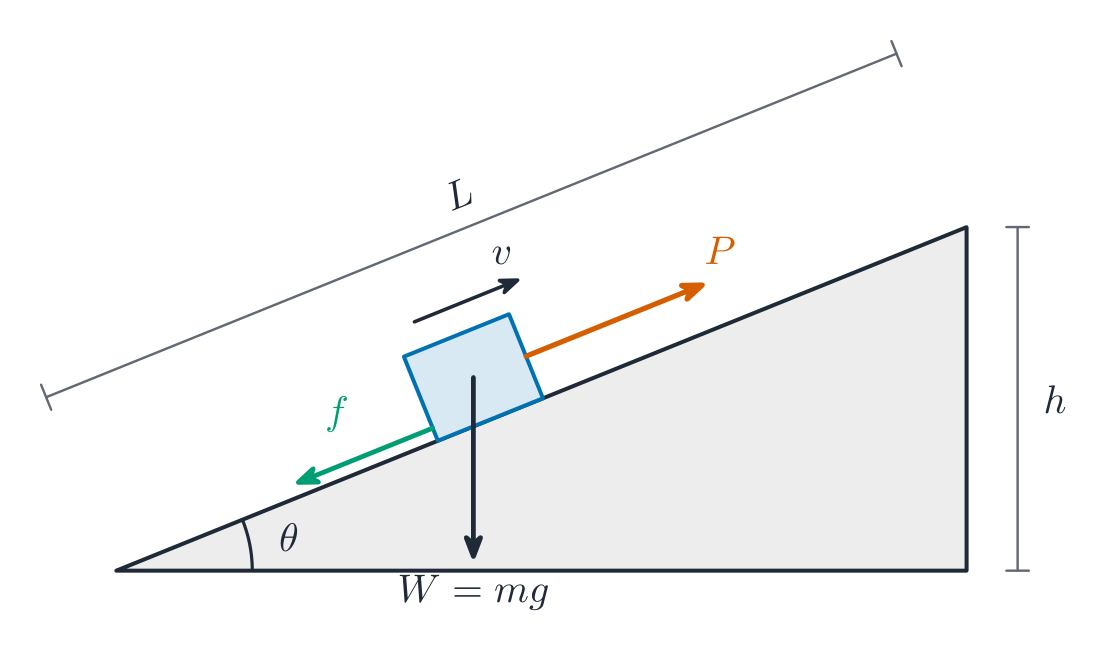
For an object moving up a slope at angle $\alpha$ to the horizontal 水平, the work done against gravity in rising a height $h$ is $mgh$, while the work done by a horizontal push over the slope length $L$ uses $\cos\alpha$.
Two multiple-choice tests of the definition: no work is done on an object that slides at constant velocity along a frictionless surface (no force along the motion), or on one that is simply held still (no distance moved); work is done when a force lifts it. And when a box is pushed at constant velocity across a rough floor, the work done by the push is $F \times d$ for the whole distance, however the path is split into stages.
Worked example. A block of mass $4.9\ \text{kg}$ is pushed at constant velocity up a rough slope of length $8.0\ \text{m}$ that rises $1.5\ \text{m}$, by a force of $12\ \text{N}$ acting along the slope. Find the work done against friction.
Constant velocity means no change in kinetic energy, so the work done by the push is shared between the gain in gravitational potential energy and the work done against friction. Work by the push: $12 \times 8.0 = 96\ \text{J}$. Gain in GPE, using the vertical rise: $4.9 \times 9.81 \times 1.5 = 72\ \text{J}$. So the work done against friction is $96 - 72 = 24\ \text{J}$, and the friction force is $24 / 8.0 = 3.0\ \text{N}$. Using the slope length in $mgh$ is the commonest error on this question.
Conservation of energy
Energy is never made or destroyed — it only changes from one form to another, or moves from one object to another. In a closed system 封闭系统, the total energy stays constant. This is conservation of energy 能量守恒, stated for the marks as: energy cannot be created or destroyed; it can only be transferred from one form to another (so the total energy of a closed system is constant).
When you write an energy equation, list every form the energy starts as and ends as. Common forms in this syllabus: kinetic, gravitational potential, elastic potential energy 弹性势能, electrical 电能, thermal, sound, chemical energy 化学能.
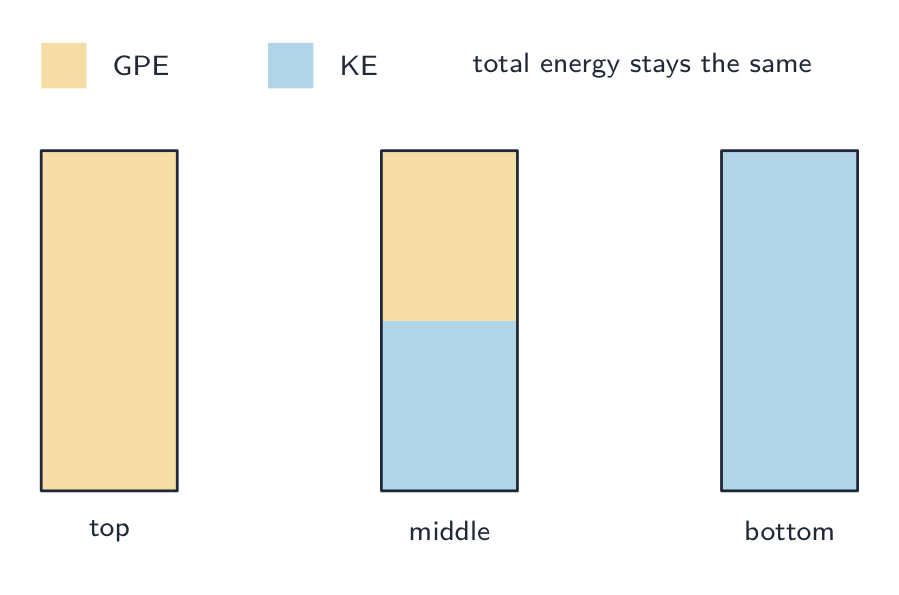
A ball rolling down a frictionless 无摩擦ramp 斜坡 turns gravitational potential energy 重力势能 into kinetic energy 动能: $mgh = \tfrac{1}{2} m v^{2}$, so $v = \sqrt{2gh}$. With friction, some of this energy becomes thermal energy 热能 of the ramp and the air.
Worked example. A ball is released from rest at the top of a smooth ramp $1.2\ \text{m}$ high. Find its speed at the bottom (take $g = 9.81\ \text{m s}^{-2}$).
All the gravitational potential energy becomes kinetic energy, so $v = \sqrt{2gh}$ (the mass cancels):
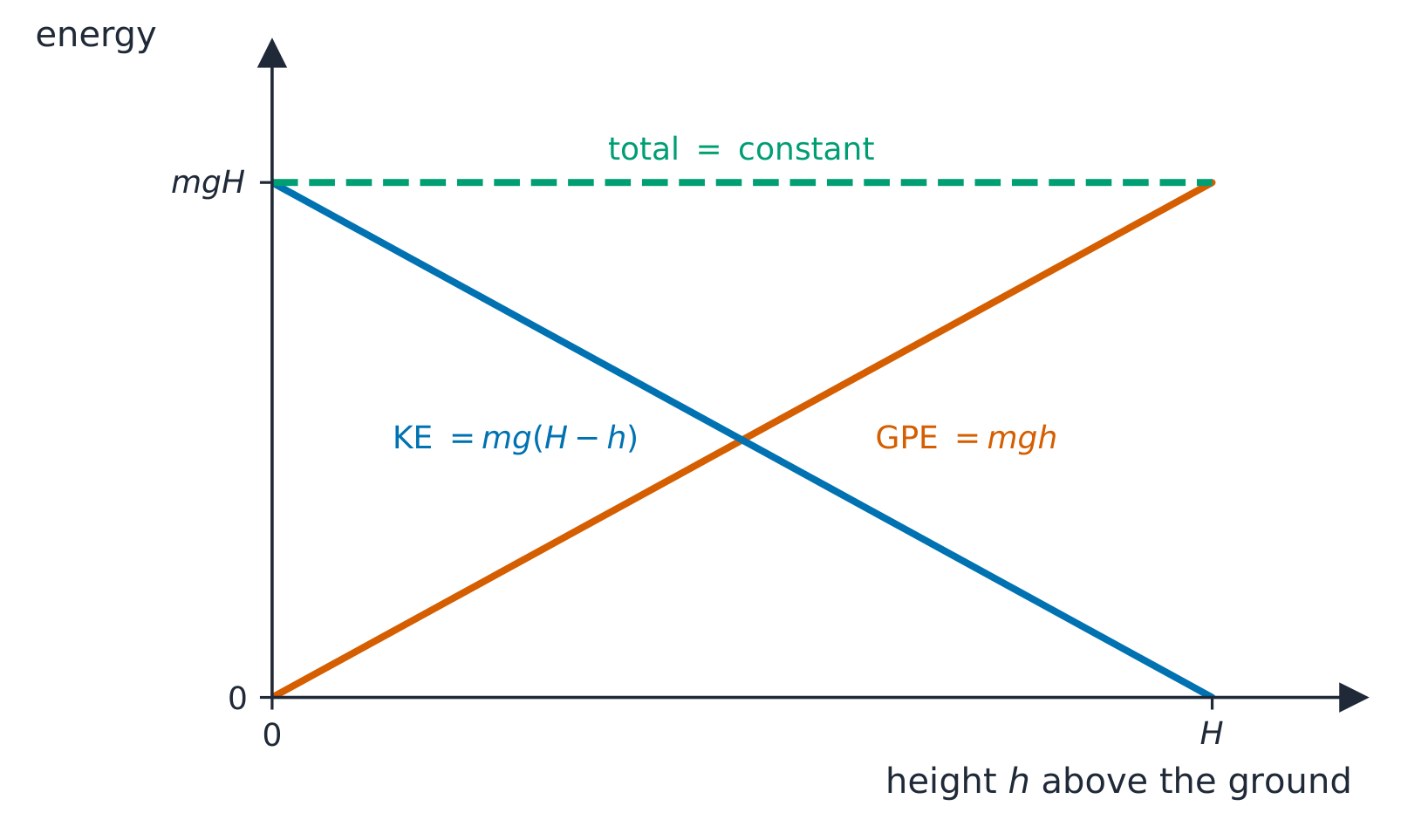
The same idea reads a graph. For a ball falling from height $H$ with air resistance negligible, the GPE falls in a straight line with height ($mgh$), the KE rises in a straight line ($mg(H - h)$), and the two add to the constant $mgH$ at every height.
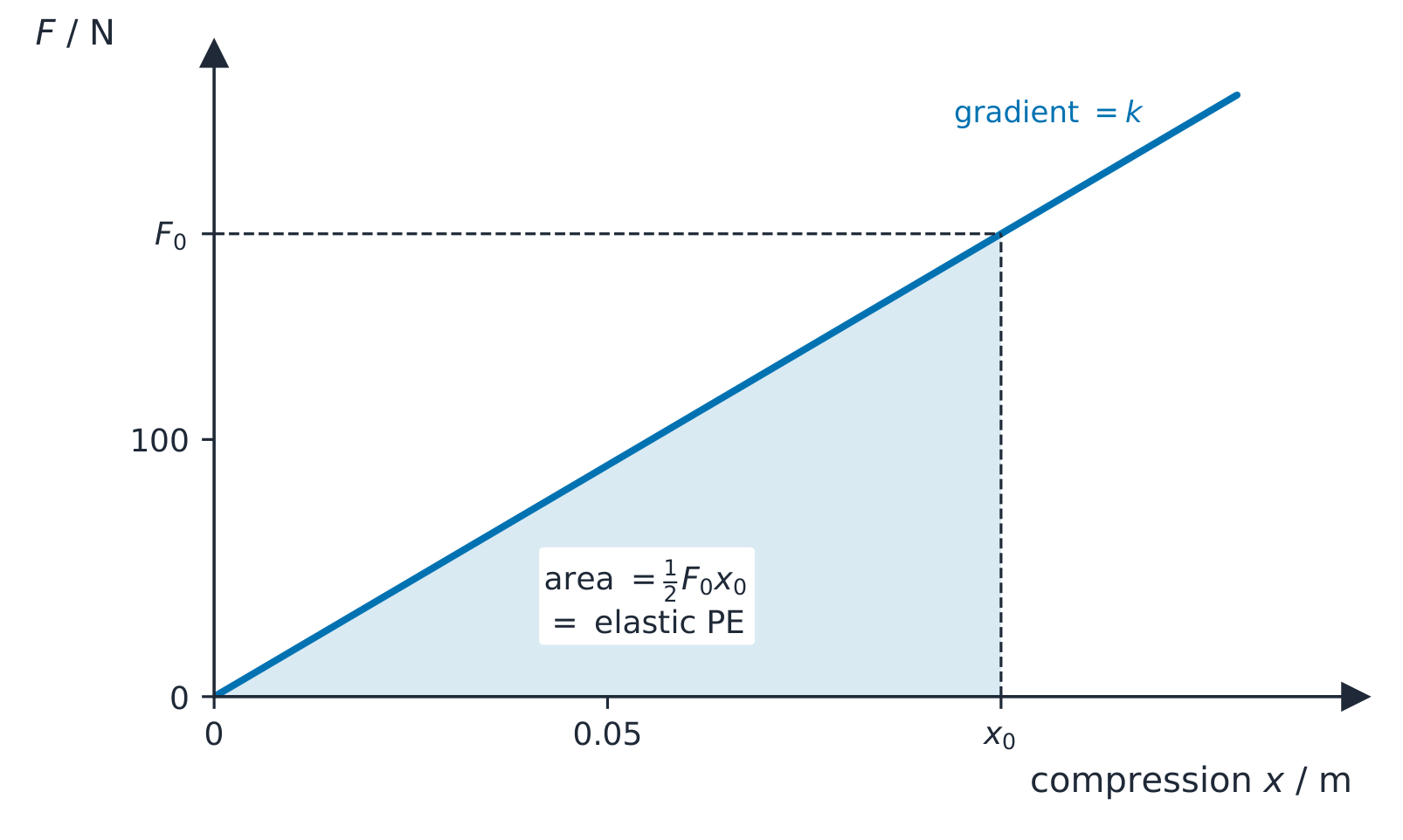
The energy chain can pass through a spring. A block that hits a spring with kinetic energy $110\ \text{J}$ while sliding a little downhill, so that its GPE falls by a further $20\ \text{J}$ before the spring stops it, stores $110 + 20 = 130\ \text{J}$ of elastic potential energy at the greatest compression, if nothing is lost to friction. The spring's force–compression graph then gives the compression: the energy stored is the area under the line, $\tfrac{1}{2} F_{0} x_{0}$ for a spring that obeys Hooke's law (topic 6), so a maximum force of $2600\ \text{N}$ means $x_{0} = 2 \times 130 / 2600 = 0.10\ \text{m}$. At that instant the resultant force on the block is the spring force minus the component of the weight down the slope, and its acceleration follows from $F = ma$ (topic 3).
Efficiency
The efficiency 效率 of a system is
$$\text{efficiency} = \frac{\text{useful energy output}}{\text{total energy input}} \times 100\%.$$
The same idea with power:
$$\text{efficiency} = \frac{\text{useful power output}}{\text{total power input}} \times 100\%.$$
Efficiency is always less than 100% in a real system, because some input energy becomes "useless" forms — usually thermal energy. If a total energy $E$ is supplied and an amount $Q$ is wasted, the useful output is $E - Q$ and the efficiency is $(E - Q) / E$; a motor rated at $1.7\ \text{kW}$ input with efficiency $53\%$ delivers $0.53 \times 1.7 = 0.90\ \text{kW}$ of useful output.
For an electric motor lifting a load with efficiency $\eta$ at voltage 电压$V$ and current 电流$I$, the useful output power is $\eta V I$. From this you can find a force, a lifting speed, or a tension 张力.
Worked example. An electric motor lifts a $50\ \text{kg}$ load at a steady $0.40\ \text{m s}^{-1}$ while drawing $250\ \text{W}$ of electrical power. Find its efficiency (take $g = 9.81\ \text{m s}^{-2}$).
The useful output power is $P = mgv = 50 \times 9.81 \times 0.40 = 196\ \text{W}$, so
Worked example. A motor raises a block with a force of $240\ \text{N}$ through a vertical distance of $12\ \text{m}$ in $60\ \text{s}$. The input power to the motor is $900\ \text{W}$. Find the useful output power and the efficiency.
Work done on the block: $W = Fd = 240 \times 12 = 2880\ \text{J}$. Useful output power: $P = W / t = 2880 / 60 = 48\ \text{W}$. Efficiency: $48 / 900 \times 100\% = 5.3\%$. Most of the input goes into thermal energy in the motor and its cable. Turned round, a lift motor of useful output $20\ \text{kW}$ raising $1500\ \text{kg}$ through $20\ \text{m}$ takes $t = mgh / P = 1500 \times 9.81 \times 20 / 20\,000 = 15\ \text{s}$.
Português
As turbinas eólicas transferem a energia cinética do vento para energia elétrica.
Trabalho realizado por uma força
Trabalho 功 é realizado quando uma força desloca seu ponto de aplicação ao longo da linha de ação da força. Para a definição de uma marca, escreva: trabalho realizado é o produto da força pela distância percorrida na direção da força. O trabalho realizado por uma força constante $F$ que causa um deslocamento 位移$s$ é
$$W = F \cdot s \cdot \cos\theta,$$
onde $\theta$ é o ângulo entre a força e o deslocamento. Apenas a componente 分量 da força ao longo do deslocamento realiza trabalho.
Apenas a componente da força ao longo do deslocamento ($F\cos\theta$) realiza trabalho
Exemplo resolvido. Uma criança puxa um trenó $5.0\ \text{m}$ sobre a neve com uma corda, usando uma força de $20\ \text{N}$ a $60°$ em relação ao chão. Encontre o trabalho realizado pela corda.
Unidade: $\text{J} = \text{N m}$. Trabalho é uma grandeza escalar 标量.
Casos especiais:
força na mesma direção do movimento ($\theta = 0$): $W = Fs$, trabalho positivo, energia 能量 fornecida ao objeto.
força em ângulo reto em relação ao movimento ($\theta = 90°$): $W = 0$. A força de contato normal 支持力 sobre um carro em uma estrada plana não realiza trabalho.
força oposta ao movimento ($\theta = 180°$): $W = -Fs$, trabalho negativo, energia removida do objeto (por exemplo atrito 摩擦力).
Trabalho positivo ($W = +Fs$): força ao longo do movimento (superior). Trabalho negativo ($W = -Fs$): força oposta ao movimento, ex.: atrito (inferior)
Para um objeto subindo uma rampa com ângulo $\alpha$ em relação à horizontal 水平, o trabalho realizado contra a gravidade ao subir uma altura $h$ é $mgh$, enquanto o trabalho realizado por um empurrão horizontal sobre o comprimento da rampa $L$ usa $\cos\alpha$.
Dois testes de múltipla escolha da definição: nenhum trabalho é realizado sobre um objeto que desliza com velocidade constante sobre uma superfície sem atrito (nenhuma força ao longo do movimento), ou sobre um que é simplesmente segurado parado (nenhuma distância percorrida); trabalho é realizado quando uma força o levanta. E quando uma caixa é empurrada com velocidade constante sobre um piso áspero, o trabalho realizado pelo empurrão é $F \times d$ para a distância total, independentemente de o trajeto ser dividido em etapas.
Exemplo resolvido. Um bloco de massa $4.9\ \text{kg}$ é empurrado com velocidade constante por uma rampa áspera de comprimento $8.0\ \text{m}$ que sobe $1.5\ \text{m}$, por uma força de $12\ \text{N}$ atuando ao longo da rampa. Encontre o trabalho realizado contra o atrito.
Uma caixa empurrada para cima numa rampa áspera com velocidade constante: o trabalho realizado pelo empurrão paga o ganho em EPGrav, que depende apenas da elevação vertical $h$, e para o trabalho contra o atrito ao longo de todo o comprimento $L$
Velocidade constante significa nenhuma mudança na energia cinética, então o trabalho realizado pelo empurrão é compartilhado entre o ganho em energia potencial gravitacional e o trabalho realizado contra o atrito. Trabalho pelo empurrão: $12 \times 8.0 = 96\ \text{J}$. Ganho em EPGrav, usando a elevação vertical: $4.9 \times 9.81 \times 1.5 = 72\ \text{J}$. Então o trabalho realizado contra o atrito é $96 - 72 = 24\ \text{J}$, e a força de atrito é $24 / 8.0 = 3.0\ \text{N}$. Usar o comprimento da rampa em $mgh$ é o erro mais comum nesta questão.
Conservação de energia
Energia nunca é criada nem destruída — ela apenas muda de uma forma para outra, ou se move de um objeto para outro. Em um sistema isolado 封闭系统, a energia total permanece constante. Isso é conservação de energia 能量守恒, formulado para as marcas como: a energia não pode ser criada nem destruída; ela só pode ser transferida de uma forma para outra (portanto a energia total de um sistema isolado é constante).
Ao escrever uma equação de energia, liste todas as formas nas quais a energia começa e termina. Formas comuns neste programa: cinética, potencial gravitacional, energia potencial elástica 弹性势能, elétrica 电能, térmica, sonora, energia química 化学能.
Uma bola rolando por uma ramp 斜坡sem atrito 无摩擦 transforma energia potencial gravitacional 重力势能 em energia cinética 动能: $mgh = \tfrac{1}{2} m v^{2}$, então $v = \sqrt{2gh}$. Com atrito, parte dessa energia se torna energia térmica 热能 da rampa e do ar.
Em uma rampa sem atrito, a EPGrav se transforma em EC enquanto a energia total permanece constante
Exemplo resolvido. Uma bola é solta do repouso no topo de uma rampa lisa $1.2\ \text{m}$ de altura. Encontre sua velocidade na base (considere $g = 9.81\ \text{m s}^{-2}$).
Toda a energia potencial gravitacional se torna energia cinética, então $v = \sqrt{2gh}$ (a massa se cancela):
A mesma ideia lê um gráfico. Para uma bola caindo de altura $H$ com resistência do ar desprezível, a EPGrav cai em linha reta com a altura ($mgh$), a EC sobe em linha reta ($mg(H - h)$), e as duas somam a constante $mgH$ em toda altura.
Uma bola caindo: EPGrav e EC ambas mudam em linha reta com a altura, e a soma é constante
A cadeia de energia pode passar por uma mola. Um bloco que atinge uma mola com energia cinética $110\ \text{J}$ enquanto desliza um pouco cuesta abaixo, de modo que sua EPGrav diminui adicionalmente em $20\ \text{J}$ antes que a mola o pare, armazena $110 + 20 = 130\ \text{J}$ de energia potencial elástica na maior compressão, se nada for perdido para o atrito. O gráfico de força versus compressão da mola então fornece a compressão: a energia armazenada é a área sob a linha, $\tfrac{1}{2} F_{0} x_{0}$ para uma mola que obedece à lei de Hooke (tópico 6), então uma força máxima de $2600\ \text{N}$ significa $x_{0} = 2 \times 130 / 2600 = 0.10\ \text{m}$. Naquele instante, a força resultante sobre o bloco é a força da mola menos a componente do peso para baixo da rampa, e sua aceleração segue de $F = ma$ (tópico 3).
A energia armazenada em uma mola é a área sob seu gráfico de força versus compressão: $\tfrac{1}{2} F_{0} x_{0}$, que é igual a $\tfrac{1}{2} k x_{0}^{2}$
Eficiência
A eficiência 效率 de um sistema é
$$\text{efficiency} = \frac{\text{useful energy output}}{\text{total energy input}} \times 100\%.$$
A mesma ideia com potência:
$$\text{efficiency} = \frac{\text{useful power output}}{\text{total power input}} \times 100\%.$$
Eficiência é sempre menor que 100% em um sistema real, porque alguma energia de entrada se torna formas "inúteis" — geralmente energia térmica. Se uma energia total $E$ é fornecida e uma quantidade $Q$ é desperdiçada, a saída útil é $E - Q$ e a eficiência é $(E - Q) / E$; um motor classificado com entrada de $1.7\ \text{kW}$ e eficiência $53\%$ entrega $0.53 \times 1.7 = 0.90\ \text{kW}$ de saída útil.
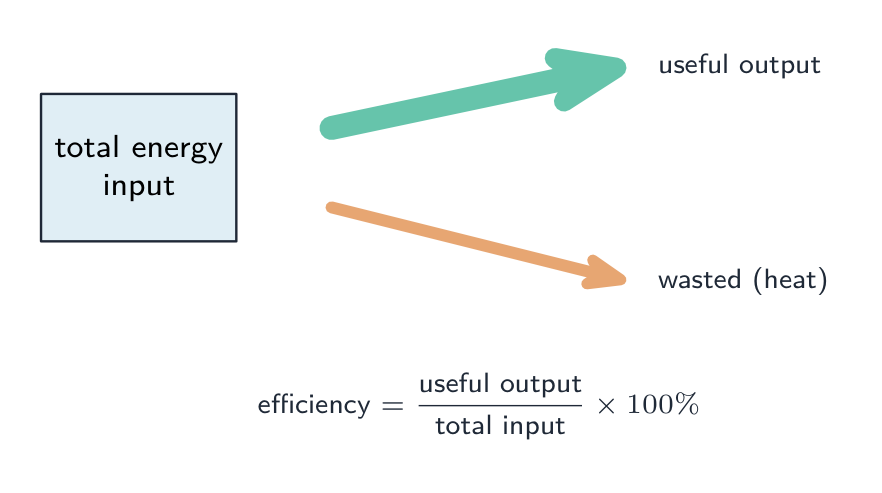
Eficiência: apenas parte da energia de entrada sai como saída útil; o resto é desperdiçado, geralmente como calor
Para um motor elétrico levantando uma carga com eficiência $\eta$ a tensão 电压$V$ e corrente 电流$I$, a potência de saída útil é $\eta V I$. A partir disso você pode encontrar uma força, uma velocidade de elevação ou uma tensão 张力.
Exemplo resolvido. Um motor elétrico levanta uma carga de $50\ \text{kg}$ a uma velocidade constante de $0.40\ \text{m s}^{-1}$ enquanto consome $250\ \text{W}$ de potência elétrica. Encontre sua eficiência (considere $g = 9.81\ \text{m s}^{-2}$).
A potência de saída útil é $P = mgv = 50 \times 9.81 \times 0.40 = 196\ \text{W}$, então
Exemplo resolvido. Um motor levanta um bloco com uma força de $240\ \text{N}$ por uma distância vertical de $12\ \text{m}$ em $60\ \text{s}$. A potência de entrada para o motor é $900\ \text{W}$. Encontre a potência de saída útil e a eficiência.
Trabalho realizado no bloco: $W = Fd = 240 \times 12 = 2880\ \text{J}$. Potência de saída útil: $P = W / t = 2880 / 60 = 48\ \text{W}$. Eficiência: $48 / 900 \times 100\% = 5.3\%$. A maior parte da entrada vai para energia térmica no motor e em seu cabo. Invertendo, um motor de elevador com saída útil de $20\ \text{kW}$ levantando $1500\ \text{kg}$ por $20\ \text{m}$ consome $t = mgh / P = 1500 \times 9.81 \times 20 / 20\,000 = 15\ \text{s}$.
Explore · Explorar
Fluxo de energia & eficiência
A energia de entrada divide-se em trabalho útil e energia dissipada; eficiência = útil ÷ entrada, e útil + dissipada sempre iguala a entrada.
Explore · Explorar
Trabalho, energia e potência
PE + CE = constante
Trabalho transfere energia; ao cair, PE torna-se KE com o total fixo.
Power 功率 is the rate of doing work, or the rate of transferring energy:
$$P = \frac{W}{t} = \frac{\Delta E}{\Delta t}.$$
Unit: $\text{W} = \text{J s}^{-1}$. Power is a scalar.
Power, force and velocity
For an object moving at velocity 速度$v$ with a force $F$ along the direction of motion, in a short time $\Delta t$ the displacement is $v\,\Delta t$ and the work done is $F v\,\Delta t$. Dividing by $\Delta t$:
$$P = F v.$$
This is one of the most useful results in mechanics. A "derive $P = Fv$" answer needs exactly those three lines: $P = W / t$, $W = Fs$ for a force along the motion, and $s / t = v$; then use it to solve problems in which a vehicle or a load moves at constant speed.
Worked example. A car travels at a steady $25\ \text{m s}^{-1}$ against a total resistive force of $600\ \text{N}$. Find the output power of its engine.
At constant speed the driving force equals the resistive force, so
For a car at constant velocity $v$ on a flat road, the engine power must balance the total resistive force: $P = F_{\text{resist}} \cdot v$. If the drag 阻力 grows with $v^{2}$, doubling the speed roughly quadruples the power needed.
For lifting a weight 重力$mg$ straight up at constant speed $v$, the useful output power is $P = mg \cdot v$.
For an aircraft hovering at a fixed height, the lift force equals the weight, and a large power is needed because air must be pushed downwards all the time.
A crane raising $600\ \text{kg}$ at a steady $12\ \text{m}$ per minute lifts at $v = 0.20\ \text{m s}^{-1}$, so its useful output power is $mgv = 600 \times 9.81 \times 0.20 = 1.2\ \text{kW}$. Convert the speed to $\text{m s}^{-1}$ first.
A sailboat pushed by a constant wind force at constant velocity must also feel an equal resistive force from the water: constant velocity means zero resultant force, so the wind's power $Fv$ is all going into work against the water.
Português
Potência 功率 é a taxa de realização de trabalho, ou a taxa de transferência de energia:
Mesmo trabalho realizado em menos tempo significa mais potência
$$P = \frac{W}{t} = \frac{\Delta E}{\Delta t}.$$
Unidade: $\text{W} = \text{J s}^{-1}$. Potência é uma grandeza escalar.
Potência, força e velocidade
Para um objeto movendo-se com velocidade 速度$v$ com uma força $F$ ao longo da direção do movimento, em um curto intervalo de tempo $\Delta t$ o deslocamento é $v\,\Delta t$ e o trabalho realizado é $F v\,\Delta t$. Dividindo por $\Delta t$:
$$P = F v.$$
Este é um dos resultados mais úteis da mecânica. Uma resposta de "dedução $P = Fv$" precisa exatamente dessas três linhas: $P = W / t$, $W = Fs$ para uma força ao longo do movimento, e $s / t = v$; então use-o para resolver problemas em que um veículo ou carga se move a velocidade constante.
Exemplo resolvido. Um carro viaja a uma velocidade constante de $25\ \text{m s}^{-1}$ contra uma força resistiva total de $600\ \text{N}$. Encontre a potência de saída do seu motor.
A velocidade constante a força motriz é igual à força resistiva, portanto
Para um carro com velocidade constante $v$ em uma estrada plana, a potência do motor deve equilibrar a força resistiva total: $P = F_{\text{resist}} \cdot v$. Se o arrasto 阻力 aumenta com $v^{2}$, dobrar a velocidade aproximadamente quadruplica a potência necessária.
Para levantar um peso 重力$mg$ verticalmente a velocidade constante $v$, a potência útil de saída é $P = mg \cdot v$.
Para uma aeronave pairando a altura fixa, a força de sustentação é igual ao peso, e uma grande potência é necessária porque o ar deve ser empurrado para baixo o tempo todo.
Uma guindaste elevando $600\ \text{kg}$ a uma velocidade constante de $12\ \text{m}$ por minuto levanta a $v = 0.20\ \text{m s}^{-1}$, então sua potência útil de saída é $mgv = 600 \times 9.81 \times 0.20 = 1.2\ \text{kW}$. Converta a velocidade para $\text{m s}^{-1}$ primeiro.
Um veleiro empurrado por uma força de vento constante a velocidade constante também deve sentir uma força resistiva igual da água: velocidade constante significa força resultante zero, então a potência do vento $Fv$ está toda sendo usada no trabalho contra a água.
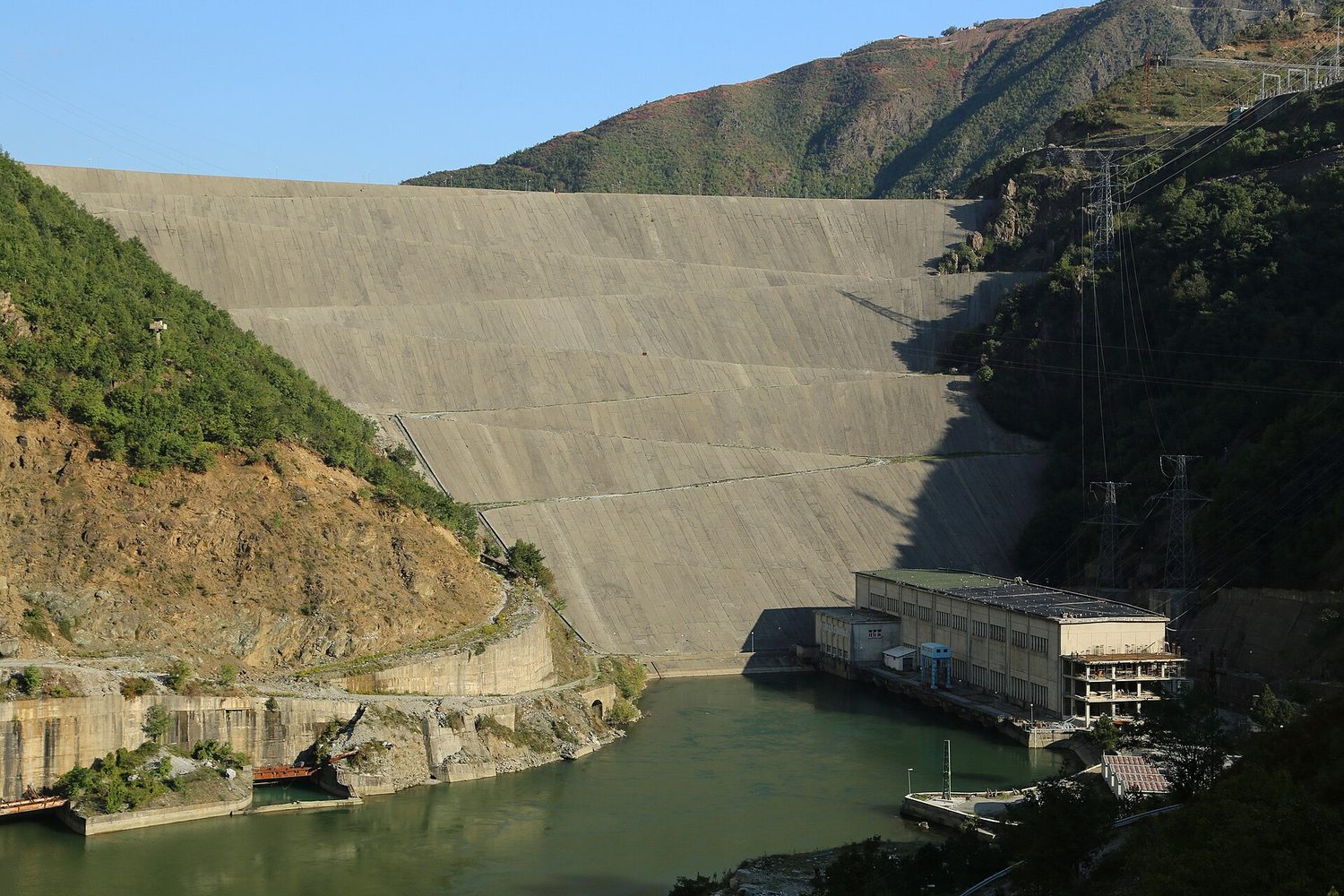
Uma estação hidrelétrica tem capacidade em megawatts: a energia da água armazenada, dividida pelo tempo necessário para liberá-la
5.2
Gravitational potential energy · Energia potencial gravitacional
Syllabus · Programa
English
derive, using $W = Fs$, the formula $\Delta E_{\text{P}} = mg\Delta h$ for gravitational potential energy changes in a uniform gravitational field
recall and use the formula $\Delta E_{\text{P}} = mg\Delta h$ for gravitational potential energy changes in a uniform gravitational field
derive, using the equations of motion, the formula for kinetic energy$E_{\text{K}} = \frac{1}{2}mv^2$
recall and use $E_{\text{K}} = \frac{1}{2}mv^2$
Português
derivar, usando $W = Fs$, a fórmula $\Delta E_{\text{P}} = mg\Delta h$ para mudanças na energia potencial gravitacional em um campo gravitacional uniforme
lembre-se e use a fórmula $\Delta E_{\text{P}} = mg\Delta h$ para mudanças de energia potencial gravitacional em um campo gravitacional uniforme
derive, usando as equations of motion, a fórmula para kinetic energy$E_{\text{K}} = \frac{1}{2}mv^2$
recordar e usar $E_{\text{K}} = \frac{1}{2}mv^2$
Source: Cambridge International syllabus · Fonte: Programa Cambridge International
English
Energy exchange in a pendulum
In a uniform gravitational field (close to a planet's surface), the change in gravitational potential energy of mass 质量$m$ rising or falling through a height $\Delta h$ is
$$\Delta E_{\text{P}} = m g \Delta h.$$
Where it comes from
The work done against gravity to raise a mass $m$ slowly (no change in kinetic energy) through height $\Delta h$ equals the gravitational potential energy gained:
the gravitational force on the mass is $mg$ downwards,
the force needed to lift it slowly is $mg$ upwards,
the work done by this force is $W = F \cdot s = mg \cdot \Delta h$,
this work becomes $\Delta E_{\text{P}}$.
So $\Delta E_{\text{P}} = mg \Delta h$. To use it you need $m$ and $\Delta h$ (and $g$). You do not need speed or time. The two-mark derivation wants the same four lines, with the condition stated: the block is raised at constant speed, so the lifting force equals the weight $mg$, and the work done by that force over the vertical distance $\Delta h$ is $mg\Delta h$, which is the gain in gravitational potential energy. A $100\ \text{g}$ object falling $10\ \text{m}$ loses $0.100 \times 9.81 \times 10 = 9.8\ \text{J}$, about $10\ \text{J}$; the mass must be in kilograms.
Português
Troca de energia em um pêndulo
Em um campo gravitacional uniforme (perto da superfície de um planeta), a variação na energia potencial gravitacional de massa 质量$m$ subindo ou descendo uma altura $\Delta h$ é
$$\Delta E_{\text{P}} = m g \Delta h.$$
De onde vem
O trabalho feito contra a gravidade para elevar uma massa $m$ lentamente (sem mudança na energia cinética) através de uma altura $\Delta h$ é igual à energia potencial gravitacional ganho:
a força gravitacional sobre a massa é $mg$ para baixo,
a força necessária para levantá-la lentamente é $mg$ para cima,
o trabalho feito por essa força é $W = F \cdot s = mg \cdot \Delta h$,
esse trabalho torna-se $\Delta E_{\text{P}}$.
Então $\Delta E_{\text{P}} = mg \Delta h$. Para usá-lo você precisa de $m$ e $\Delta h$ (e $g$). Você não precisa de velocidade ou tempo. A dedução de duas marcas quer as mesmas quatro linhas, com a condição declarada: o bloco é elevado a velocidade constante, então a força de levantamento é igual ao peso $mg$, e o trabalho feito por essa força sobre a distância vertical $\Delta h$ é $mg\Delta h$, que é o ganho na energia potencial gravitacional. Um objeto $100\ \text{g}$ caindo $10\ \text{m}$ perde $0.100 \times 9.81 \times 10 = 9.8\ \text{J}$, cerca de $10\ \text{J}$; a massa deve estar em quilogramas.
A energia potencial gravitacional depende apenas da altura subida, não do caminho percorridoUm trem de montanha-russa puxado para cima da colina: o trabalho feito contra a gravidade é armazenado como energia potencial gravitacional
The kinetic energy of an object of mass $m$ moving at speed $v$ is
$$E_{\text{K}} = \tfrac{1}{2} m v^{2}.$$
Where it comes from
Apply a resultant force $F$ to a mass $m$ that starts at rest. It speeds up evenly from $0$ to $v$ over a displacement $s$. From $v^{2} = u^{2} + 2as$ with $u = 0$,
$$s = \frac{v^{2}}{2a}.$$
The work done on the mass is
$$W = F \cdot s = m a \cdot \frac{v^{2}}{2a} = \tfrac{1}{2} m v^{2}.$$
All this work becomes kinetic energy, so $E_{\text{K}} = \tfrac{1}{2} m v^{2}$. In the exam, state the assumptions as you go: the object starts from rest, the force is constant, so the acceleration is uniform, and $F = ma$ is Newton's second law.
Because $E_{\text{K}} \propto v^{2}$, quadrupling the speed multiplies the kinetic energy by sixteen: an object with $1500\ \text{J}$ at $10\ \text{m s}^{-1}$ has $24\,000\ \text{J}$ at $40\ \text{m s}^{-1}$. The same square is why a stopping force is found from energy: a ball of mass $1.2\ \text{kg}$ moving at $3.0\ \text{m s}^{-1}$ that is stopped by a cushion over $0.020\ \text{m}$ loses $\tfrac{1}{2} \times 1.2 \times 3.0^{2} = 5.4\ \text{J}$, so the average force on it is $5.4 / 0.020 = 270\ \text{N}$: the work done by the cushion equals the kinetic energy lost.
Kinetic energy and momentum
Combining $p = mv$ and $E_{\text{K}} = \tfrac{1}{2} m v^{2}$:
$$E_{\text{K}} = \frac{p^{2}}{2m}.$$
This is handy when the momentum 动量 is given but not the velocity. For a momentum change from $p_{1}$ to $p_{2}$ at constant mass, the change in kinetic energy is $(p_{2}^{2} - p_{1}^{2}) / (2m)$.
Português
A energia cinética de um objeto de massa $m$ movendo-se a velocidade $v$ é
$$E_{\text{K}} = \tfrac{1}{2} m v^{2}.$$
De onde vem
Aplique uma força resultante $F$ a uma massa $m$ que começa em repouso. Ela acelera uniformemente de $0$ para $v$ ao longo de um deslocamento $s$. De $v^{2} = u^{2} + 2as$ com $u = 0$,
$$s = \frac{v^{2}}{2a}.$$
O trabalho feito na massa é
$$W = F \cdot s = m a \cdot \frac{v^{2}}{2a} = \tfrac{1}{2} m v^{2}.$$
Todo esse trabalho torna-se energia cinética, então $E_{\text{K}} = \tfrac{1}{2} m v^{2}$. No exame, declare as suposições conforme avança: o objeto parte do repouso, a força é constante, então a aceleração é uniforme, e $F = ma$ é a segunda lei de Newton.
Porque $E_{\text{K}} \propto v^{2}$, quadruplicar a velocidade multiplica a energia cinética por dezesseis: um objeto com $1500\ \text{J}$ a $10\ \text{m s}^{-1}$ tem $24\,000\ \text{J}$ a $40\ \text{m s}^{-1}$. O mesmo quadrado é por que uma força de parada é encontrada a partir da energia: uma bola de massa $1.2\ \text{kg}$ movendo-se a $3.0\ \text{m s}^{-1}$ que é parada por uma almofada sobre $0.020\ \text{m}$ perde $\tfrac{1}{2} \times 1.2 \times 3.0^{2} = 5.4\ \text{J}$, então a força média sobre ela é $5.4 / 0.020 = 270\ \text{N}$: o trabalho feito pela almofada é igual à energia cinética perdida.
Energia cinética e momento
Combinando $p = mv$ e $E_{\text{K}} = \tfrac{1}{2} m v^{2}$:
$$E_{\text{K}} = \frac{p^{2}}{2m}.$$
Isso é útil quando o momento 动量 é dado mas não a velocidade. Para uma mudança de momento de $p_{1}$ para $p_{2}$ a massa constante, a mudança na energia cinética é $(p_{2}^{2} - p_{1}^{2}) / (2m)$.
Um saltador com vara: a energia cinética da corrida é armazenada na vara curvada, depois devolvida como altura
Explore · Explorar
Energia cinética e potencial
PE + CE = constante
Potencial energia se transforma em cinética energia — o total nunca muda.
5.2
Using energy methods · Usando métodos de energia
English
A useful plan for problems that mix forces and energy:
Find the start and end states. Write the kinetic and potential energies in each.
List any work done by outside forces (friction, a push). Friction usually takes energy out; a push can add it.
Conservation of energy: $E_{\text{start}} + W_{\text{in}} = E_{\text{end}} + W_{\text{lost as heat etc.}}$.
Examples:
A box pushed at constant velocity up a ramp of length $L$ rising by $h$: $E_{\text{K}}$ does not change, so the work done by the push goes into $\Delta E_{\text{P}}$ plus the work done against friction.
A block sliding into a spring 弹簧 with kinetic energy $E_{\text{K}}$ on a frictionless surface: at greatest compression 压缩$x$, all the kinetic energy has become elastic potential energy $\tfrac{1}{2} k x^{2}$ (where $k$ is the spring constant 劲度系数).
A ball dropped from height $h_{1}$ that bounces to height $h_{2}$: the ratio $h_{2}/h_{1}$ is the fraction of mechanical energy kept, $h_{2}/h_{1} = (v_{\text{up}}/v_{\text{down}})^{2}$.
A projectile 抛体 thrown to the same height at different angles: the final speed is the same (only the height matters); use components to get its direction.
A bungee jumper 蹦极者: from the platform to the point where the cord goes taut, GPE becomes KE; from there the cord stretches and takes energy as elastic potential energy, so the KE reaches its maximum where the cord's pull first equals the weight, then falls to zero at the lowest point, where GPE lost $=$ elastic PE stored (plus any thermal energy).
Português
Um plano útil para problemas que misturam forças e energia:
Encontre os estados inicial e final. Escreva as energias cinéticas e potenciais em cada.
Liste qualquer trabalho feito por forças externas (atrito, empurrão). O atrito geralmente remove energia; um empurrão pode adicioná-la.
Conservação de energia: $E_{\text{start}} + W_{\text{in}} = E_{\text{end}} + W_{\text{lost as heat etc.}}$.
Exemplos:
Uma caixa empurrada a velocidade constante para cima de uma rampa de comprimento $L$ subindo por $h$: $E_{\text{K}}$ não muda, então o trabalho feito pelo empurrão vai para $\Delta E_{\text{P}}$ mais o trabalho feito contra o atrito.
Um bloco deslizando para dentro de uma mola 弹簧 com energia cinética $E_{\text{K}}$ em uma superfície sem atrito: na maior compressão 压缩$x$, toda a energia cinética tornou-se energia potencial elástica $\tfrac{1}{2} k x^{2}$ (onde $k$ é a constante da mola 劲度系数).
Uma bola solta de altura $h_{1}$ que quica até altura $h_{2}$: a razão $h_{2}/h_{1}$ é a fração de energia mecânica mantida, $h_{2}/h_{1} = (v_{\text{up}}/v_{\text{down}})^{2}$.
Um projétil 抛体 lançado até a mesma altura em diferentes ângulos: a velocidade final é a mesma (apenas a altura importa); use componentes para obter sua direção.
Um saltador de bungee 蹦极者: da plataforma até o ponto onde a corda fica esticada, EPG torna-se EC; daí a corda se estica e leva energia como energia potencial elástica, então a EC atinge seu máximo onde a tração da corda primeiramente iguala o peso, depois cai a zero no ponto mais baixo, onde EPG perdido $=$ EP elástica armazenada (mais qualquer energia térmica).
A energia cinética de um bloco torna-se energia potencial elástica enquanto comprime a mola
Explore · Explorar
Conservação de energia
Solte a massa e observe a EPE se transformar em EC. Sem atrito, a energia total permanece a mesma — esse é o método energético.
5.2
Definitions the examiner accepts · Definições aceitas pelo examinador
English
A definition question is marked against fixed wording. Learn these exactly, and give one answer only.
Term
Definition
work done by a force
the product of the force and the distance moved in the direction of the force
principle of conservation of energy
energy cannot be created or destroyed, only transferred from one form to another, so the total energy of a closed system is constant
efficiency
the ratio of useful energy (or power) output from a system to the total energy (or power) input, usually as a percentage
power
the work done per unit time, or the rate at which energy is transferred
gravitational potential energy
the energy an object has because of its position in a gravitational field
kinetic energy
the energy an object has because of its motion
elastic potential energy
the energy stored in an object that has been stretched or compressed
Português
Uma questão de definição é avaliada contra wording fixo. Aprenda estas exatamente, e dê apenas uma resposta.
Termo
Definição
trabalho feito por uma força
o produto da força e a distância percorrida na direção da força
princípio de conservação de energia
a energia não pode ser criada nem destruída, apenas transferida de uma forma para outra, então a energia total de um sistema fechado é constante
eficiência
a razão entre a energia útil (ou potência) de saída de um sistema para a energia total (ou potência) de entrada, geralmente como porcentagem
potência
o trabalho feito por unidade de tempo, ou a taxa na qual a energia é transferida
energia potencial gravitacional
a energia que um objeto possui devido à sua posição em um campo gravitacional
energia cinética
a energia que um objeto possui devido ao seu movimento
energia potencial elástica
a energia armazenada em um objeto que foi esticado ou comprimido
5.2
Exam tips · Dicas de prova
English
Work $=$ force $\times$ distance moved in the direction of the force — use $Fs\cos\theta$ when they are at an angle.
Use conservation of energy: loss in GPE $=$ gain in KE ($+$ work done against resistance).
Power $=$ work $/$ time $= Fv$; efficiency $=$ useful output $\div$ total input.
GPE uses the vertical height gained, not the distance along a slope.
Common mistakes
Giving the change in height as the answer to a change-in-energy question. Finish the calculation: $\Delta E_{\text{P}} = mg\Delta h$.
Using the distance along a slope as the height in $mg\Delta h$, or using mass where weight is needed. Use the vertical height gained, and check whether the quantity wanted is $m$ in kg or $W$ in N.
Putting the resistive force into $P = Fv$ for a car that is accelerating. $F$ is the driving force; only at constant speed does it equal the resistive force.
Efficiency above 100%, or efficiency as output divided by wasted. It is useful output divided by total input, and the total input is always the larger number.
Reading a force–extension graph's gradient when the question wants the energy. Energy stored is the area under the line, not its slope.
Português
Trabalho $=$ força $\times$ distância percorrida na direção da força — use $Fs\cos\theta$ quando estão em um ângulo.
Use conservação de energia: perda em EPG $=$ ganho em EC ($+$ trabalho feito contra resistência).
Potência $=$ trabalho $/$ tempo $= Fv$; eficiência $=$ saída útil $\div$ entrada total.
EPG usa a altura vertical ganha, não a distância ao longo de uma inclinação.
Erros comuns
Dar a mudança na altura como a resposta para uma pergunta de mudança de energia. Termine o cálculo: $\Delta E_{\text{P}} = mg\Delta h$.
Usar a distância ao longo de uma inclinação como a altura em $mg\Delta h$, ou usar massa onde peso é necessário. Use a altura vertical ganha, e verifique se a quantidade desejada é $m$ em kg ou $W$ em N.
Colocar a força resistiva em $P = Fv$ para um carro que está acelerando. $F$ é a força motriz; apenas a velocidade constante ela é igual à força resistiva.
Eficiência acima de 100%, ou eficiência como saída dividida pelo desperdício. É a saída útil dividida pela entrada total, e a entrada total é sempre o número maior.
Ler a inclinação de um gráfico de força-extensão quando a questão quer a energia. A energia armazenada é a área sob a linha, não sua inclinação.
Interactive lessons on this topic · Aulas interativas sobre este tópico
Work through it step by step, with instant-check exercises. · Passe por ele passo a passo, com exercícios de verificação instantânea.
Pick one and the site follows you — notes, papers, videos and practice all open on it. · Escolha uma e o site te seguirá — notas, provas, vídeos e prática abrirão nela.
Type to search notes, lessons, code, vocabulary and past-paper questions across every subject. · Digite para pesquisar notas, aulas, código, vocabulário e questões de provas anteriores em todas as disciplinas.