Um bungee jumper salta de uma ponte e cai — cada vez mais rápido, direto para o chão. Então, no último momento, uma corda elástica estala tensa e puxa…
English narration · English + 中文 subtitles burned in · Narração em inglês · Legendas em inglês + 中文 gravadas
6.1
Forces that cause deformation · Forças que causam deformação
Syllabus · Programa
English
understand that deformation is caused by tensile or compressive forces (forces and deformations will be assumed to be in one dimension only)
understand and use the terms load, extension, compression and limit of proportionality
recall and use Hooke's law
recall and use the formula for the spring constant$k = F/x$
define and use the terms stress, strain and the Young modulus
describe an experiment to determine the Young modulus of a metal in the form of a wire
Português
compreenda que deformation é causada por tensile ou compressive forces (forças e deformações serão assumidas como sendo apenas em uma dimensão)
compreenda e use os termos load, extension, compression e limit of proportionality
lembre-se e use Hooke's law
lembre-se e use a fórmula para a spring constant$k = F/x$
defina e use os termos stress, strain e o Young modulus
descreva um experimento para determinar o Young modulus de um metal na forma de um fio
Source: Cambridge International syllabus · Fonte: Programa Cambridge International
English
Hooke's law & the elastic limit
When a force acts on a solid along its length, the object changes shape (deformation 形变). Two cases (treated as one-dimensional here):
a tensile 拉伸 force stretches the object — it makes an extension 伸长量$x$,
a compressive force squeezes the object — it makes a compression 压缩, treated as a negative extension.
The applied force is the load 负载. The change from the natural length is the extension (or compression).
Both are measured from the natural, unstretched length, never from the loaded length: on a diagram of a spring under a box, the distance the spring has shortened is its compression. A spring's own mass is usually said to be negligible 可忽略的, so the only forces on it are the load and the tension it provides.
Português
Lei de Hooke & limite elástico
Quando uma força atua em um sólido ao longo de seu comprimento, o objeto muda de forma (deformação 形变). Dois casos (tratados aqui como unidimensionais):
uma força tracionante 拉伸 estica o objeto — faz uma extensão 伸长量$x$,
uma força compressiva aperta o objeto — faz uma compressão 压缩, tratada como uma extensão negativa.
A força aplicada é a carga 负载. A mudança do comprimento natural é a extensão (ou compressão).
Ambos são medidos a partir do comprimento natural, não esticado, nunca a partir do comprimento carregado: em um diagrama de uma mola sob uma caixa, a distância que a mola encurtou é sua compressão. A massa própria de uma mola geralmente é dita negligenciável 可忽略的, então as únicas forças sobre ela são a carga e a tensão que ela fornece.
Explore · Explorar
Mola da lei de Hooke
Pendure uma carga na mola real: até o limite elástico, a extensão é proporcional à força; além dele, a mola fica esticada permanentemente.
Hooke's law and the spring constant · Lei de Hooke e a constante da mola
English
For many materials at small extensions, the extension is proportional to the load — this is Hooke's law 胡克定律. The constant that links them is the spring constant 劲度系数$k$:
$$F = kx \qquad\Longleftrightarrow\qquad k = \frac{F}{x}.$$
Unit of $k$: $\text{N m}^{-1}$.
Worked example. A spring stretches by $4.0\ \text{cm}$ when a $2.0\ \text{N}$ load is hung from it. Find its spring constant.
Converting the extension to metres ($4.0\ \text{cm} = 0.040\ \text{m}$):
For the one-mark "state Hooke's law", write it in words: the extension is directly proportional to the applied force (load), provided the limit of proportionality is not exceeded. The spring constant is the force per unit extension; the multiple-choice distractors are "extension per unit force" (that is $1/k$) and $\tfrac{1}{2}Fx$ (the energy stored).
Reading a graph:
A force–extension ($F$ against $x$) graph has gradient $k$ in the Hooke's-law region.
An extension–force ($x$ against $F$) graph has gradient $1/k$ in the Hooke's-law region.
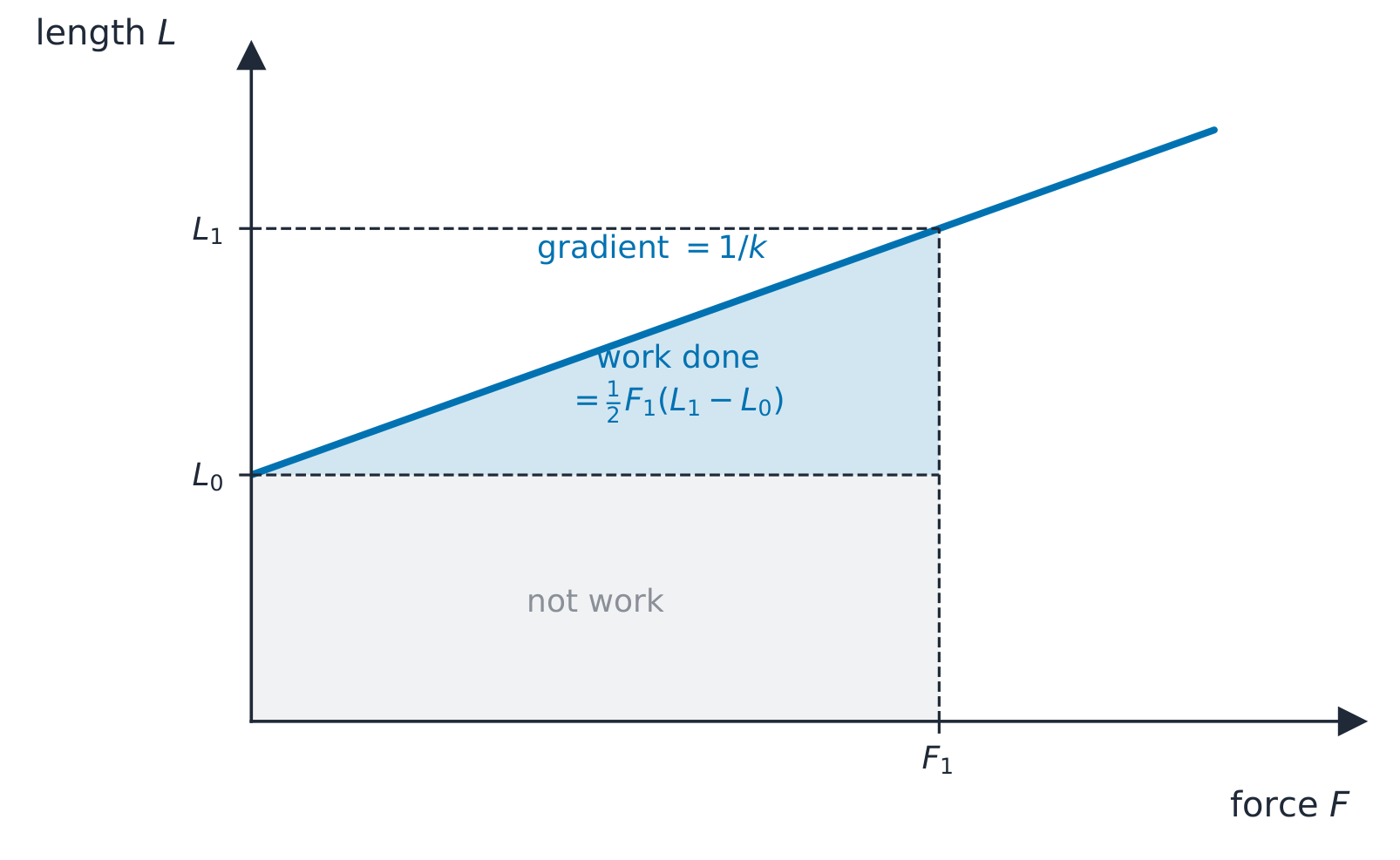
A common trap: if a graph plots length$L$ against force, you can still find the spring constant from the gradient (since $L = L_{0} + F/k$, the gradient is $1/k$ — read it off carefully).
Worked example. A spring has length $90\ \text{mm}$ under a force of $0.80\ \text{N}$ and $115\ \text{mm}$ under $1.30\ \text{N}$. Find the spring constant and the unstretched length.
The extra force $0.50\ \text{N}$ produces the extra extension $25\ \text{mm} = 0.025\ \text{m}$, so $k = 0.50 / 0.025 = 20\ \text{N m}^{-1}$. At $0.80\ \text{N}$ the extension is $x = F/k = 0.80 / 20 = 0.040\ \text{m}$, so the unstretched length is $90 - 40 = 50\ \text{mm}$. On a graph of length against force the intercept on the length axis is $L_{0}$, the gradient is $1/k$, and the work done in stretching the spring is the triangle between the line and the level $L = L_{0}$, not the whole area down to the force axis: the rectangle below $L_{0}$ is the unstretched length multiplied by the force, which means nothing.
Limit of proportionality
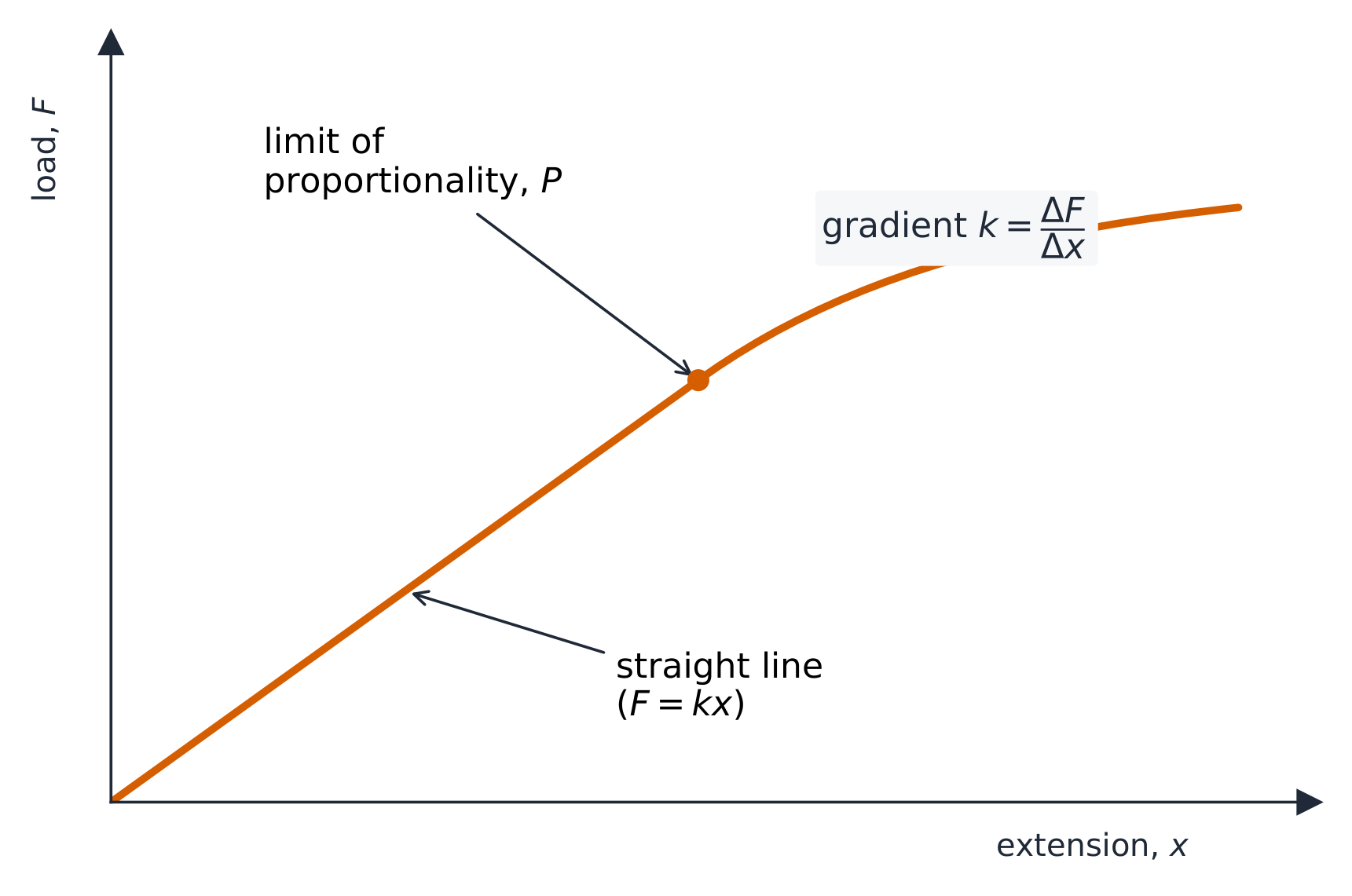
Hooke's law only holds up to the limit of proportionality 比例极限. Past this point the $F$ against $x$ line curves and is no longer straight. The material may still be elastic 弹性 (it returns to its first length when you remove the load) a little further, then it becomes plastic 塑性.
Springs in series and parallel
You may need to combine spring constants:
Series 串联 (one spring hangs from another): the same load passes through both, the total extension is the sum, so $\dfrac{1}{k_{\text{total}}} = \dfrac{1}{k_{1}} + \dfrac{1}{k_{2}}$.
Parallel 并联 (two springs side by side holding the same load): each takes half the load (if they are identical), the extensions are equal, so $k_{\text{total}} = k_{1} + k_{2}$.
Worked example. Springs of spring constant $6.0\ \text{N cm}^{-1}$ and $4.0\ \text{N cm}^{-1}$ are joined end to end and a load of $80\ \text{N}$ hangs from them. Find the total extension.
Each spring carries the full $80\ \text{N}$, so the extensions are $80/6.0 = 13.3\ \text{cm}$ and $80/4.0 = 20\ \text{cm}$: a total of $33\ \text{cm}$ (the same as $k = 2.4\ \text{N cm}^{-1}$ from $1/k = 1/6.0 + 1/4.0$). Three identical springs give the largest combined constant when all three are in parallel ($3k$) and the smallest when all are in series ($k/3$). When a load is shared by two identical springs in parallel, each carries half the force and so stores a quarter of the energy of one spring holding the whole load; the pair together stores half as much as the single spring did. A spring constant in $\text{N cm}^{-1}$ is $100$ times smaller than the same constant in $\text{N m}^{-1}$; give the unit the question asks for.
Português
Uma mola obedece à Lei de Hooke: a extensão é proporcional à força aplicada.
Para muitos materiais em pequenas extensões, a extensão é proporcional à carga — isso é a Lei de Hooke 胡克定律. A constante que os liga é a constante da mola 劲度系数$k$:
$$F = kx \qquad\Longleftrightarrow\qquad k = \frac{F}{x}.$$
Unidade de $k$: $\text{N m}^{-1}$.
Exemplo resolvido. Uma mola estica-se em $4.0\ \text{cm}$ quando uma carga de $2.0\ \text{N}$ é pendurada nela. Encontre sua constante da mola.
Convertendo a extensão para metros ($4.0\ \text{cm} = 0.040\ \text{m}$):
Para a questão de um ponto "enuncie a lei de Hooke", escreva-a em palavras: a extensão é diretamente proporcional à força aplicada (carga), desde que o limite de proporcionalidade não seja excedido. A constante da mola é a força por unidade de extensão; as alternativas incorretas de múltipla escolha são "extensão por unidade de força" (isto é $1/k$) e $\tfrac{1}{2}Fx$ (a energia armazenada).
Um gráfico de carga–extensão: reto até o limite de proporcionalidade $P$, depois curva
Lendo um gráfico:
Um gráfico de força–extensão ($F$ contra $x$) tem inclinação $k$ na região da lei de Hooke.
Um gráfico de extensão–força ($x$ contra $F$) tem inclinação $1/k$ na região da lei de Hooke.
Uma armadilha comum: se um gráfico plota comprimento$L$ contra força, você ainda pode encontrar a constante da mola a partir da inclinação (já que $L = L_{0} + F/k$, a inclinação é $1/k$ — leia com cuidado).
Exemplo resolvido. Uma mola tem comprimento $90\ \text{mm}$ sob uma força de $0.80\ \text{N}$ e $115\ \text{mm}$ sob $1.30\ \text{N}$. Encontre a constante da mola e o comprimento sem alongamento.
A força extra $0.50\ \text{N}$ produz a extensão extra $25\ \text{mm} = 0.025\ \text{m}$, então $k = 0.50 / 0.025 = 20\ \text{N m}^{-1}$. Em $0.80\ \text{N}$ a extensão é $x = F/k = 0.80 / 20 = 0.040\ \text{m}$, então o comprimento sem alongamento é $90 - 40 = 50\ \text{mm}$. Em um gráfico de comprimento contra força, o intercepto no eixo do comprimento é $L_{0}$, a inclinação é $1/k$, e o trabalho realizado ao esticar a mola é o triângulo entre a linha e o nível $L = L_{0}$, não toda a área até o eixo da força: o retângulo abaixo $L_{0}$ é o comprimento sem alongamento multiplicado pela força, o que não significa nada.
Comprimento contra força: o intercepto é $L_{0}$, a inclinação é $1/k$, e apenas o triângulo acima de $L_{0}$ é o trabalho realizado
Limite de proporcionalidade
A lei de Hooke só vale até o limite de proporcionalidade 比例极限. Após esse ponto, a linha de $F$ contra $x$ curva-se e deixa de ser reta. O material ainda pode ser elástico 弹性 (retorna ao seu primeiro comprimento quando você remove a carga) um pouco mais, depois torna-se plástico 塑性.
Molas em série e paralelo
Você pode precisar combinar constantes de mola:
Série 串联 (uma mola pendurada de outra): a mesma carga passa por ambas, a extensão total é a soma, então $\dfrac{1}{k_{\text{total}}} = \dfrac{1}{k_{1}} + \dfrac{1}{k_{2}}$.
Paralelo 并联 (duas molas lado a lado segurando a mesma carga): cada uma suporta metade da carga (se forem idênticas), as extensões são iguais, então $k_{\text{total}} = k_{1} + k_{2}$.
Combinando constantes de mola: série resulta em uma mola mais macia, paralelo em uma mais rígida
Exemplo resolvido. Molas de constante $6.0\ \text{N cm}^{-1}$ e $4.0\ \text{N cm}^{-1}$ são unidas ponta a ponta e uma carga de $80\ \text{N}$ pende delas. Encontre a extensão total.
Cada mola carrega a carga completa $80\ \text{N}$, então as extensões são $80/6.0 = 13.3\ \text{cm}$ e $80/4.0 = 20\ \text{cm}$: um total de $33\ \text{cm}$ (o mesmo que $k = 2.4\ \text{N cm}^{-1}$ de $1/k = 1/6.0 + 1/4.0$). Três molas idênticas dão a maior constante combinada quando todas estão em paralelo ($3k$) e a menor quando todas estão em série ($k/3$). Quando uma carga é dividida por duas molas idênticas em paralelo, cada uma carrega metade da força e, portanto, armazena um quarto da energia de uma mola segurando a carga inteira; o par juntos armazena metade da energia da única mola. Uma constante de mola em $\text{N cm}^{-1}$ é $100$ vezes menor do que a mesma constante em $\text{N m}^{-1}$; dê a unidade que a pergunta solicitar.
Explore · Explorar
Lei de Hooke
F = k·x
A força é proporcional à extensão — a inclinação é a constante da mola k.
Explore · Explorar
Lei de Hooke
F = kx
Até o limite, a extensão é proporcional à força — o gradiente é a constante da mola k.
Explore · Explorar
Lei de Hooke: F = kx
F = ax
Arraste a constante da mola. A força é proporcional à extensão — uma linha reta pela origem cujo gradiente é a constante da mola.
limit of proportionality/ˈlɪmɪt ɒv prəˌpɔːʃəˈnælɪti/
比例极限
bǐ lì jí xiàn
6.1
Stress, strain and the Young modulus · Tensão, deformação e módulo de Young
English
For a wire of uniform cross-section under a tensile load:
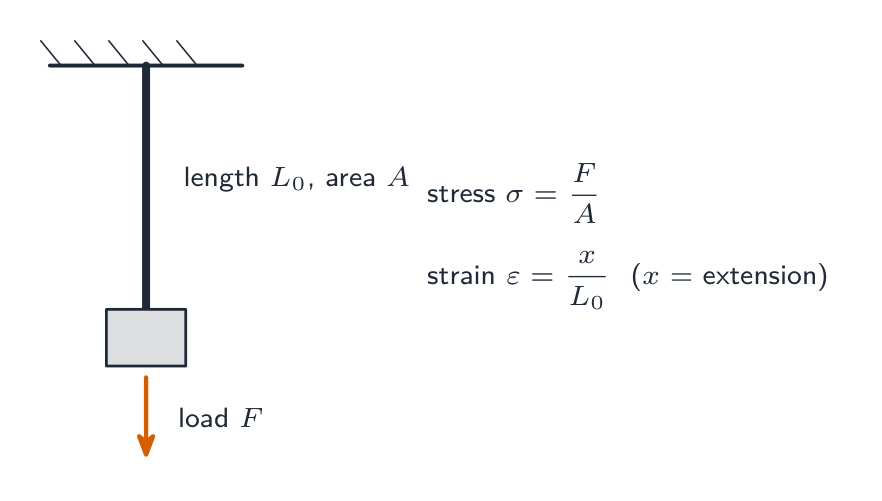
Stress 应力$\sigma = \dfrac{F}{A}$, where $F$ is the load and $A$ is the cross-sectional area 横截面积. Unit: $\text{Pa}$.
Strain 应变$\varepsilon = \dfrac{x}{L_{0}}$, where $x$ is the extension and $L_{0}$ is the original length. Strain has no unit (it is a ratio of lengths).
For the one-mark definitions: stress is the force per unit cross-sectional area (the force acting normally to the area); strain is the extension per unit original length. The unit of stress, $\text{Pa} = \text{N m}^{-2}$, is $\text{kg m}^{-1}\ \text{s}^{-2}$ in base units. The area of a round wire comes from its diameter $d$: $A = \pi d^{2}/4 = \pi r^{2}$, and using $d$ in place of $r$ makes the area four times too big. Convert $\text{mm}^{2}$ to $\text{m}^{2}$ with $10^{-6}$.
Worked example. A tensile force of $18\ \text{N}$ acts on a wire of cross-sectional area $3.2\ \text{mm}^{2}$. Find the stress.
$\sigma = F/A = 18 / (3.2 \times 10^{-6}) = 5.6 \times 10^{6}\ \text{Pa}$. The same force acts along the whole wire, so a bolt whose diameter is $2d$ at one end and $d$ at the other has four times the stress at the narrow end ($\sigma \propto 1/d^{2}$), and a wire of three times the radius carries one ninth of the stress.
The Young modulus 杨氏模量 is the ratio of stress to strain in the Hooke's-law region:
Unit: $\text{Pa}$ (about $10^{11}$ for metals; e.g. steel $\approx 2.0 \times 10^{11}$ Pa).
Worked example. A steel wire of length $2.0\ \text{m}$ and cross-sectional area $1.5 \times 10^{-7}\ \text{m}^{2}$ stretches by $1.0\ \text{mm}$ under a load of $15\ \text{N}$. Find the Young modulus.
The Young modulus is a property of the material — it does not depend on the wire's shape or size. The spring constant $k$ depends on both the material and the size: $k = EA/L_{0}$.
For the one-mark definition: the Young modulus is the ratio of stress to strain (for a material deformed within its limit of proportionality). Because it belongs to the material, a thicker wire of the same metal has the same Young modulus: it stretches less under the same load because its area is larger, not because the metal is stiffer. A "show that $k = EA/L_{0}$" question wants two lines: $k = F/x$ and $E = FL_{0}/(Ax)$, so $E = kL_{0}/A$. Two things follow: a wire's spring constant stays constant while Hooke's law holds, whatever the force, and a wire of the same metal with twice the diameter has four times the spring constant.
Worked example. A copper wire of length $1.7\ \text{m}$ and diameter $0.64\ \text{mm}$ has Young modulus $1.2 \times 10^{11}\ \text{Pa}$. Find its spring constant.
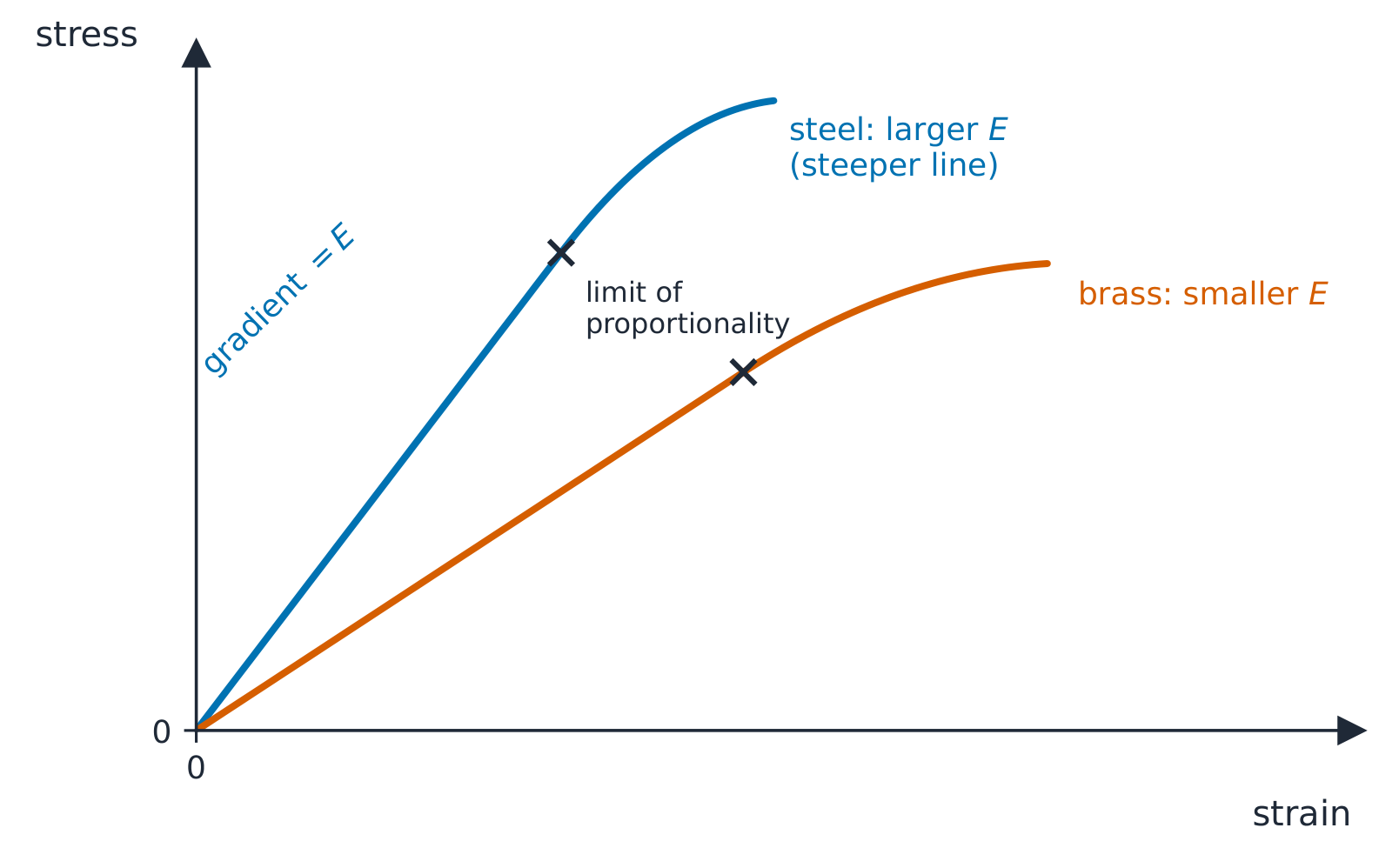
On a stress–strain graph the gradient of the straight part is $E$, so of two materials drawn on the same axes the steeper line is the stiffer material, and a wire with double the Young modulus is drawn as a line through the origin with twice the gradient. On a force–extension graph the gradient is $EA/L_{0}$ and the Young modulus is the gradient multiplied by $L_{0}/A$; only a stress–strain graph has a gradient equal to $E$ itself.
Experiment to find the Young modulus of a metal wire
A standard setup:
Clamp one end of a long, thin wire to a fixed support. Pass the wire over a pulley 滑轮 at the edge of the bench so it hangs straight down.
Measure the original length $L_{0}$ between the clamp and a marker near the pulley, using a metre rule.
Measure the diameter 直径$d$ of the wire at several places with a micrometer 螺旋测微器 and take the average. Work out $A = \pi d^{2}/4$.
Hang weights one at a time. Record the load $F$ and the extension $x$ (how far the marker moves against a fixed scale).
Plot $F$ against $x$. In the straight region the gradient is $EA/L_{0}$, so $E = \text{gradient} \times L_{0}/A$.
Why a long, thin wire? To make the extension big enough to measure well. Why repeat readings and measure $d$ at several places? To reduce random error 随机误差 and check the wire is uniform.
A "describe an experiment" answer earns its marks for the quantities measured and how ($L_{0}$ with a metre rule; $d$ with a micrometer at several points; the load from the masses or a newton meter; the extension from a marker read against a fixed scale, or a vernier scale), the graph ($F$ against $x$, gradient $EA/L_{0}$, or stress against strain, gradient $E$) and the precautions: safety goggles in case the wire snaps, a small load first to straighten kinks, and readings taken on unloading as well as loading to check the wire stayed elastic.
Português
Para um fio de seção transversal uniforme sob carga de tração:
Tensão 应力$\sigma = \dfrac{F}{A}$, onde $F$ é a carga e $A$ é a área da seção transversal 横截面积. Unidade: $\text{Pa}$.
Deformação 应变$\varepsilon = \dfrac{x}{L_{0}}$, onde $x$ é a extensão e $L_{0}$ é o comprimento original. Deformação não tem unidade (é uma razão de comprimentos).
Para as definições de um ponto: tensão é a força por unidade de área da seção transversal (a força atuando normalmente à área); deformação é a extensão por unidade de comprimento original. A unidade de tensão, $\text{Pa} = \text{N m}^{-2}$, é $\text{kg m}^{-1}\ \text{s}^{-2}$ em unidades base. A área de um fio redondo vem de seu diâmetro $d$: $A = \pi d^{2}/4 = \pi r^{2}$, e usar $d$ em vez de $r$ torna a área quatro vezes maior. Converta $\text{mm}^{2}$ para $\text{m}^{2}$ usando $10^{-6}$.
Exemplo resolvido. Uma força de tração de $18\ \text{N}$ age em um fio de área de seção transversal $3.2\ \text{mm}^{2}$. Encontre a tensão.
$\sigma = F/A = 18 / (3.2 \times 10^{-6}) = 5.6 \times 10^{6}\ \text{Pa}$. A mesma força age ao longo de todo o fio, então um parafuso cujo diâmetro é $2d$ em uma extremidade e $d$ na outra tem quatro vezes a tensão na extremidade mais estreita ($\sigma \propto 1/d^{2}$), e um fio de três vezes o raio carrega um nono da tensão.
Tensão é a carga por área de seção transversal; deformação é a extensão por comprimento original
O módulo de Young 杨氏模量 é a razão entre tensão e deformação na região da lei de Hooke:
Unidade: $\text{Pa}$ (cerca de $10^{11}$ para metais; ex.: aço $\approx 2.0 \times 10^{11}$ Pa).
Exemplo resolvido. Um fio de aço de comprimento $2.0\ \text{m}$ e área de seção transversal $1.5 \times 10^{-7}\ \text{m}^{2}$ estica-se em $1.0\ \text{mm}$ sob uma carga de $15\ \text{N}$. Encontre o módulo de Young.
Um gráfico de tensão–deformação, reto até o limite de proporcionalidade $P$
O módulo de Young é uma propriedade do material — não depende do formato ou tamanho do fio. A constante da mola $k$ depende tanto do material quanto do tamanho: $k = EA/L_{0}$.
Para a definição de um ponto: o módulo de Young é a razão entre tensão e deformação (para um material deformado dentro de seu limite de proporcionalidade). Como pertence ao material, um fio mais espesso do mesmo metal tem o mesmo módulo de Young: ele estica menos sob a mesma carga porque sua área é maior, não porque o metal é mais rígido. Uma questão "mostre que $k = EA/L_{0}$" pede duas linhas: $k = F/x$ e $E = FL_{0}/(Ax)$, logo $E = kL_{0}/A$. Duas coisas decorrem disso: a constante de mola de um fio permanece constante enquanto a lei de Hooke vale, independentemente da força, e um fio do mesmo metal com dois vezes o diâmetro tem quatro vezes a constante de mola.
Exemplo resolvido. Um fio de cobre de comprimento $1.7\ \text{m}$ e diâmetro $0.64\ \text{mm}$ tem módulo de Young $1.2 \times 10^{11}\ \text{Pa}$. Encontre sua constante de mola.
Em um gráfico de tensão–deformação, a inclinação da parte reta é $E$, então, de dois materiais desenhados nos mesmos eixos, a linha mais íngreme é do material mais rígido, e um fio com dobro do módulo de Young é desenhado como uma linha pela origem com o dobro da inclinação. Em um gráfico de força–extensão, a inclinação é $EA/L_{0}$ e o módulo de Young é a inclinação multiplicada por $L_{0}/A$; apenas um gráfico de tensão–deformação tem inclinação igual a $E$ propriamente dito.
Dois metais em um gráfico de tensão–deformação: a linha mais íngreme tem o maior módulo de Young
Experimento para encontrar o módulo de Young de um fio metálico
Um equipamento padrão:
Prenda uma extremidade de um fio longo e fino a um suporte fixo. Passe o fio por uma polia 滑轮 na borda da bancada para que ele pendure reto.
Meça o comprimento original $L_{0}$ entre o prendedor e um marcador próximo à polia, usando uma régua métrica.
Meça o diâmetro 直径$d$ do fio em vários lugares com um micrômetro 螺旋测微器 e tire a média. Calcule $A = \pi d^{2}/4$.
Pendure pesos um de cada vez. Registre a carga $F$ e a extensão $x$ (o quão longe o marcador se move contra uma escala fixa).
Plote $F$ contra $x$. Na região reta, a inclinação é $EA/L_{0}$, logo $E = \text{gradient} \times L_{0}/A$.
Por que um fio longo e fino? Para tornar a extensão grande o suficiente para medir bem. Por que repetir leituras e medir $d$ em vários lugares? Para reduzir erro aleatório 随机误差 e verificar se o fio é uniforme.
Uma resposta "descreva um experimento" ganha pontos pelas quantidades medidas e como ($L_{0}$ com uma régua métrica; $d$ com um micrômetro em vários pontos; a carga pelos massas ou um dinamômetro; a extensão por um marcador lido contra uma escala fixa, ou uma escala de vernier), o gráfico ($F$ contra $x$, inclinação $EA/L_{0}$, ou tensão contra deformação, inclinação $E$) e as precauções: óculos de proteção caso o fio arrebente, uma carga pequena primeiro para alinhar os nós, e leituras feitas durante a descarga além da carga para verificar se o fio permaneceu elástico.
Equipamento para medir o módulo de Young de um fio
Elastic and plastic behaviour · Comportamento elástico e plástico
Syllabus · Programa
English
understand and use the terms elastic deformation, plastic deformation and elastic limit
understand that the area under the force–extension graph represents the work done
determine the elastic potential energy of a material deformed within its limit of proportionality from the area under the force–extension graph
recall and use $E_p = \frac{1}{2}Fx = \frac{1}{2}kx^2$ for a material deformed within its limit of proportionality
Português
compreenda e use os termos elastic deformation, plastic deformation e elastic limit
compreenda que a área sob o force–extension graph representa o work done
determine a elastic potential energy de um material deformado dentro de seu limit of proportionality a partir da área sob o force–extension graph
lembre-se e use $E_p = \frac{1}{2}Fx = \frac{1}{2}kx^2$ para um material deformado dentro de seu limit of proportionality
Source: Cambridge International syllabus · Fonte: Programa Cambridge International
English
As the load grows:
Elastic and straight (Hooke obeyed) — up to the limit of proportionality. Removing the load returns the object to its first length.
Elastic but curved — between the limit of proportionality and the elastic limit 弹性极限. The extension is no longer straight in the load, but on unloading the object still returns to its first length.
Plastic — past the elastic limit. On unloading, the object does not return to its first length; a permanent extension stays.
Hooke's law only holds in the straight, elastic region.
In words: elastic deformation means the object returns to its original length (or shape) when the load is removed; plastic deformation means it does not, and a permanent extension remains; the elastic limit is the maximum load (or extension) for which the deformation is still elastic; the limit of proportionality is the point beyond which the extension is no longer proportional to the load. On a graph the limit of proportionality is where the line stops being straight. The elastic limit lies a little beyond it and cannot be read from a loading line alone. So in a "which statement must be correct" item, the end of the straight part is the limit of proportionality, but whether a later point is the elastic limit or the breaking point cannot be told from the shape of the loading line.
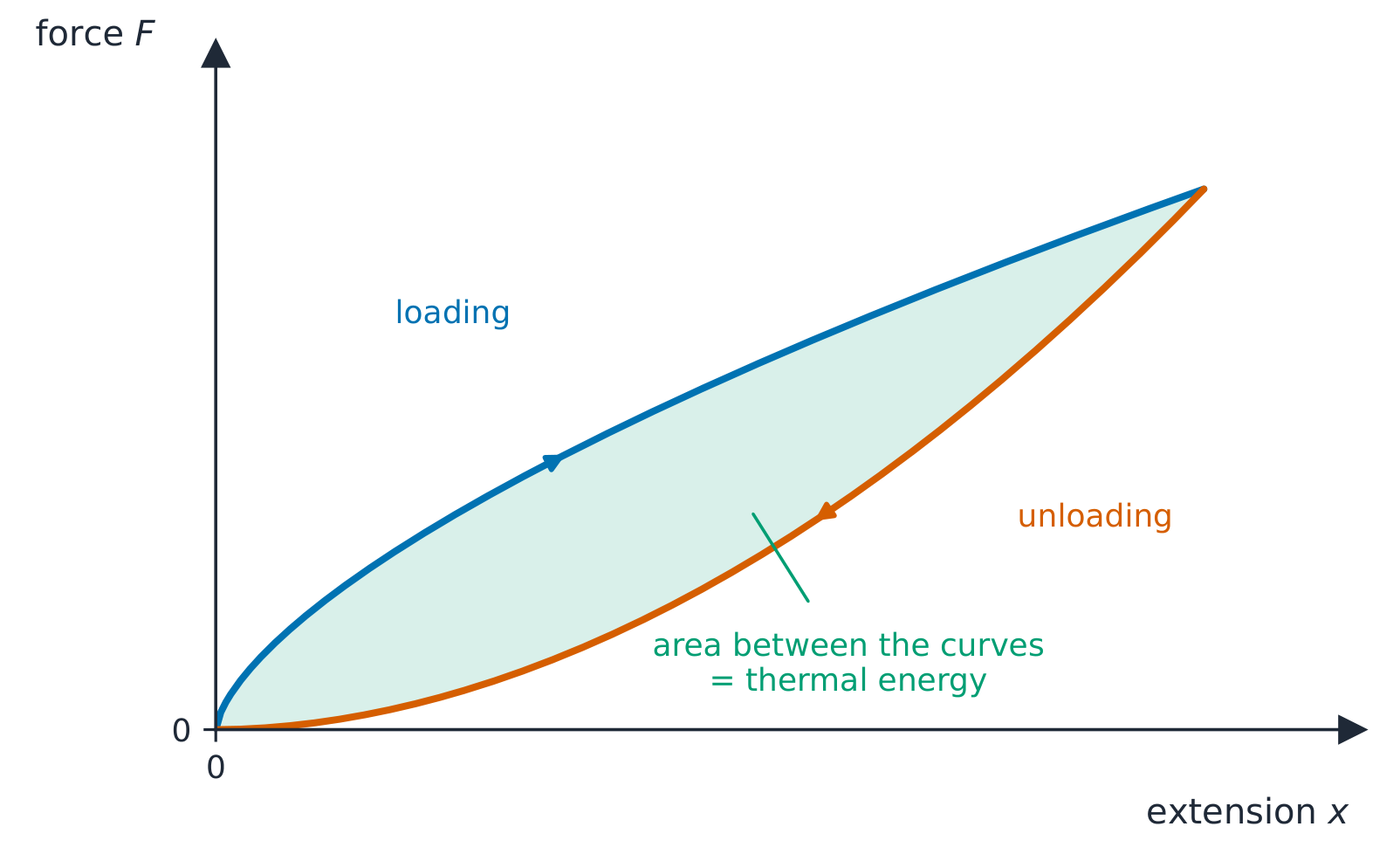
On a force–extension graph for a material taken into the plastic region and then unloaded, the loading line and the unloading line are different. The unloading line is parallel to the first Hooke line but shifted to the right (the permanent extension left when the load reaches zero). The area between the loading and unloading lines is the energy turned into thermal energy 热能 in the material.
A rubber band 橡皮筋 also has different loading and unloading curves, but it returns to its original length: its deformation is elastic. The area between the two curves is again energy dissipated as thermal energy (elastic hysteresis 弹性滞后), and the energy recovered on unloading is the area under the lower curve. The two-mark "explain why the work done in stretching the wire is not equal to the energy recovered when the force is removed" answer says that the wire was taken past its elastic limit, so part of the deformation is plastic and a permanent extension remains, and that part of the work done became thermal energy in the wire.
Português
À medida que a carga aumenta:
Elástico e reto (obedece a Hooke) — até o limite de proporcionalidade. Remover a carga retorna o objeto ao seu primeiro comprimento.
Elástico mas curvo — entre o limite de proporcionalidade e o limite elástico 弹性极限. A extensão já não é reta na carga, mas na descarga o objeto ainda retorna ao seu primeiro comprimento.
Plástico — além do limite elástico. Na descarga, o objeto não retorna ao seu primeiro comprimento; uma extensão permanente permanece.
A lei de Hooke só vale na região reta e elástica.
Em palavras: deformação elástica significa que o objeto retorna ao seu comprimento (ou forma) original quando a carga é removida; deformação plástica significa que ele não retorna, e permanece uma extensão permanente; o limite elástico é a carga máxima (ou extensão) para a qual a deformação ainda é elástica; o limite de proporcionalidade é o ponto além do qual a extensão deixa de ser proporcional à carga. Em um gráfico, o limite de proporcionalidade é onde a linha deixa de ser reta. O limite elástico fica um pouco além dele e não pode ser lido apenas pela linha de carregamento. Portanto, em uma questão "qual afirmação deve estar correta", o final da parte reta é o limite de proporcionalidade, mas se um ponto posterior é o limite elástico ou o ponto de ruptura não pode ser determinado apenas pela forma da linha de carregamento.
Força–extensão após o limite elástico: $P$ e $E$ marcados, com uma extensão permanente $B$ deixada após o descarregamentoUma máquina universal (de tração) moderna estica uma amostra e registra a força e a extensão
Em um gráfico de força–extensão para um material levado para a região plástica e depois descarregado, a linha de carregamento e a linha de descarregamento são diferentes. A linha de descarregamento é paralela à primeira linha de Hooke, mas deslocada para a direita (a extensão permanente deixada quando a carga atinge zero). A área entre as linhas de carregamento e descarregamento é a energia convertida em energia térmica 热能 no material.
Uma elástica 橡皮筋 também tem curvas de carregamento e descarregamento diferentes, mas retorna ao seu comprimento original: sua deformação é elástica. A área entre as duas curvas é novamente energia dissipada como energia térmica (histerese elástica 弹性滞后), e a energia recuperada no descarregamento é a área sob a curva inferior. A resposta de dois pontos "explique por que o trabalho realizado ao esticar o fio não é igual à energia recuperada quando a força é removida" diz que o fio foi levado além do seu limite elástico, portanto parte da deformação é plástica e uma extensão permanente permanece, e que parte do trabalho realizado tornou-se energia térmica no fio.
Uma elástica retorna ao seu comprimento original, mas a área entre carregamento e descarregamento é energia perdida como energia térmica
Energy stored in a stretched material · Energia armazenada em um material esticado
English
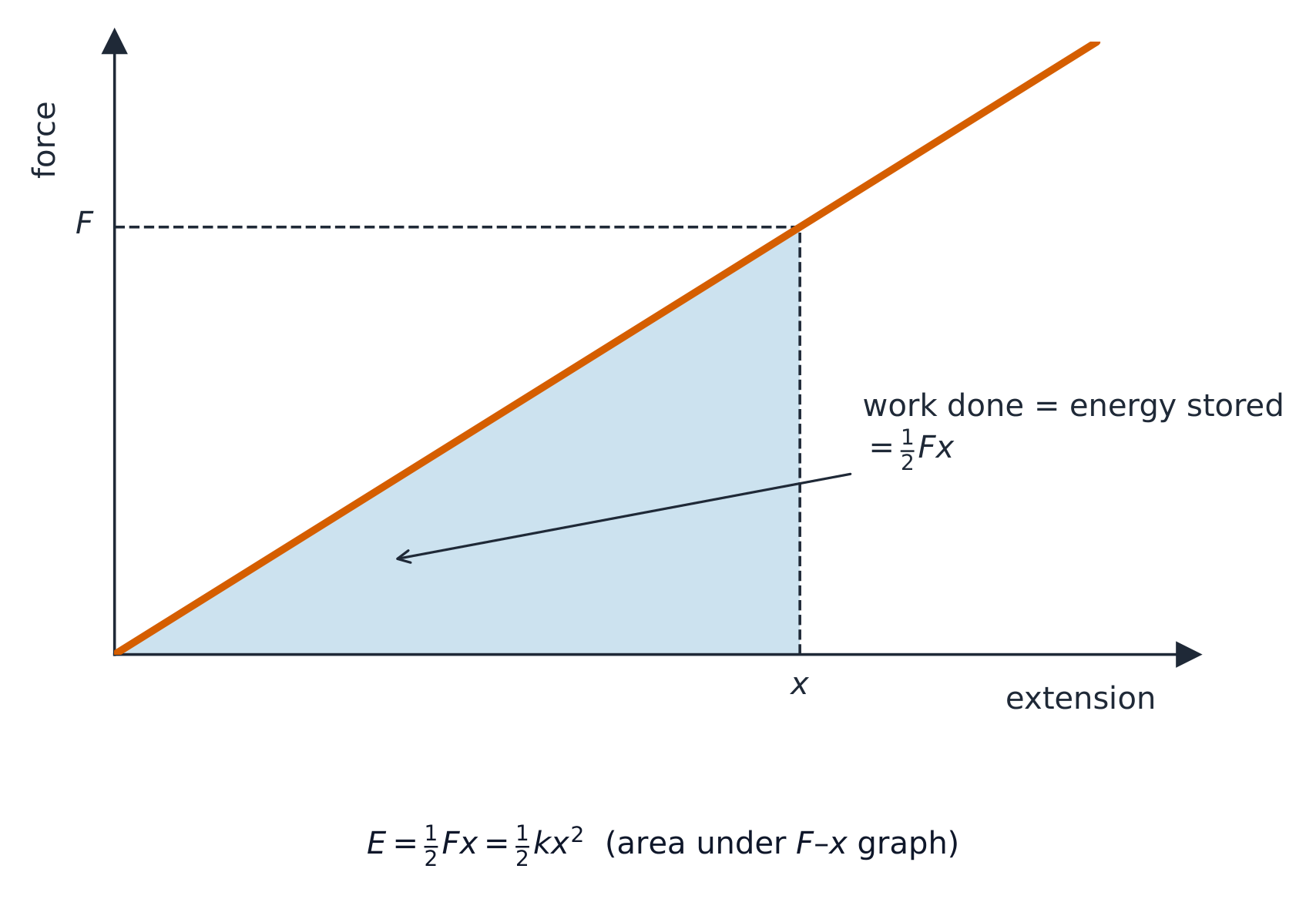
The work done in stretching a material from $0$ to extension $x$, as the load grows from $0$ to $F$, is the area under the force–extension graph.
Why the area: work done is force multiplied by the distance moved, but here the force grows as the material stretches, so the work is the sum of $F\,\Delta x$ over many small extensions, which is the area under the line. Within the limit of proportionality the force rises uniformly from $0$ to $F$, so the average force is $\tfrac{1}{2}F$ and the work is $\tfrac{1}{2}Fx$. On a force–extension graph the gradient is the spring constant.
Hooke's-law material
When Hooke's law holds, the $F$ against $x$ graph is a straight line through the origin. The area under it from $0$ to $x$ is a triangle:
$$E_{\text{P}} = \tfrac{1}{2} F x = \tfrac{1}{2} k x^{2}.$$
This is the elastic potential energy 弹性势能 stored in a spring or wire stretched within its limit of proportionality. An equal form:
$$E_{\text{P}} = \frac{F^{2}}{2k}.$$
Worked example. A spring of spring constant $50\ \text{N m}^{-1}$ is stretched by $0.20\ \text{m}$, within its limit of proportionality. Find the elastic potential energy stored.
Worked example. A wire of spring constant $2.0 \times 10^{4}\ \text{N m}^{-1}$ is already extended by $2.0\ \text{mm}$. Find the work done to increase its extension to $3.0\ \text{mm}$.
The stored energy rises from $\tfrac{1}{2} k x_{1}^{2}$ to $\tfrac{1}{2} k x_{2}^{2}$: $W = \tfrac{1}{2} \times 2.0 \times 10^{4} \times \left[(3.0 \times 10^{-3})^{2} - (2.0 \times 10^{-3})^{2}\right] = 0.050\ \text{J}$. This is the trapezium under the line between the two extensions, not $\tfrac{1}{2} k (x_{2} - x_{1})^{2}$. Because $E_{\text{P}} \propto x^{2}$ at fixed $k$, doubling the extension of a wire stores four times the energy ($0.65\ \text{J}$ becomes $2.6\ \text{J}$), and a stored energy gives the extension as $x = \sqrt{2E_{\text{P}}/k}$: a spring of $k = 400\ \text{N m}^{-1}$ storing $0.32\ \text{J}$ is compressed by $\sqrt{2 \times 0.32 / 400} = 0.040\ \text{m}$. For two wires joined end to end the tension is the same in both, so the total energy stored is $\tfrac{1}{2}F x_{1} + \tfrac{1}{2}F x_{2}$ with each wire's own extension.
Non-Hooke material
For a graph that is not a straight line (a stretched rubber band, or a spring past its limit of proportionality), find the area by counting grid squares or by using trapezia 梯形. The same idea holds: the area under the force–extension graph is the work done on the material. To estimate the work done up to the breaking point, count the squares under the whole curve (part squares as halves) and multiply by the energy one square represents, the force step multiplied by the extension step; saying that the area was found by counting squares is the "explain your reasoning" mark.
Comparing stored energy
A common multiple-choice case: two materials are stretched by the same force, or by the same extension. Using $E_{\text{P}} = \tfrac{1}{2} F x$:
same $F$, smaller $k$ (less stiff) → larger $x$ → more energy stored.
same $x$, larger $k$ (stiffer) → larger $F$ → more energy stored.
A sketch of $E_{\text{P}}$ against extension or compression is a curve through the origin that gets steeper ($E_{\text{P}} \propto x^{2}$), not a straight line. Of two wires of the same length and area under the same load, the one with the smaller Young modulus extends more and so stores more energy.
When a stretched spring is released onto a mass, the elastic potential energy becomes kinetic energy 动能 (and gravitational potential energy if the mass rises). Set $\tfrac{1}{2} k x^{2}$ equal to $\tfrac{1}{2} m v^{2}$ (plus any $mgh$) to find the speed or height.
Português
O trabalho realizado ao esticar um material de $0$ para extensão $x$, conforme a carga cresce de $0$ para $F$, é a área sob o gráfico de força–extensão.
O trabalho realizado ao esticar um material é a área sob o gráfico de força–extensão
Por que a área: o trabalho realizado é força multiplicada pela distância percorrida, mas aqui a força cresce à medida que o material estica, então o trabalho é a soma de $F\,\Delta x$ sobre muitas pequenas extensões, que é a área sob a linha. Dentro do limite de proporcionalidade, a força aumenta uniformemente de $0$ para $F$, então a força média é $\tfrac{1}{2}F$ e o trabalho é $\tfrac{1}{2}Fx$. Em um gráfico de força–extensão, a inclinação é a constante da mola.
Material de lei de Hooke
Quando a lei de Hooke se aplica, o gráfico de $F$ contra $x$ é uma linha reta que passa pela origem. A área sob ela de $0$ a $x$ é um triângulo:
$$E_{\text{P}} = \tfrac{1}{2} F x = \tfrac{1}{2} k x^{2}.$$
Esta é a energia potencial elástica 弹性势能 armazenada em uma mola ou fio esticado dentro do seu limite de proporcionalidade. Uma forma equivalente:
$$E_{\text{P}} = \frac{F^{2}}{2k}.$$
Exemplo resolvido. Uma mola de constante de mola $50\ \text{N m}^{-1}$ é esticada em $0.20\ \text{m}$, dentro do seu limite de proporcionalidade. Encontre a energia potencial elástica armazenada.
Exemplo resolvido. Um fio de constante de mola $2.0 \times 10^{4}\ \text{N m}^{-1}$ já está esticado em $2.0\ \text{mm}$. Encontre o trabalho realizado para aumentar sua extensão para $3.0\ \text{mm}$.
A energia armazenada sobe de $\tfrac{1}{2} k x_{1}^{2}$ para $\tfrac{1}{2} k x_{2}^{2}$: $W = \tfrac{1}{2} \times 2.0 \times 10^{4} \times \left[(3.0 \times 10^{-3})^{2} - (2.0 \times 10^{-3})^{2}\right] = 0.050\ \text{J}$. Esta é a trapézio sob a linha entre as duas extensões, não $\tfrac{1}{2} k (x_{2} - x_{1})^{2}$. Como $E_{\text{P}} \propto x^{2}$ em $k$ fixo, dobrar a extensão de um fio armazena quatro vezes a energia ($0.65\ \text{J}$ torna-se $2.6\ \text{J}$), e uma energia armazenada dá a extensão como $x = \sqrt{2E_{\text{P}}/k}$: uma mola de $k = 400\ \text{N m}^{-1}$ armazenando $0.32\ \text{J}$ é comprimida em $\sqrt{2 \times 0.32 / 400} = 0.040\ \text{m}$. Para dois fios ligados ponta a ponta, a tensão é a mesma em ambos, então a energia total armazenada é $\tfrac{1}{2}F x_{1} + \tfrac{1}{2}F x_{2}$ com a própria extensão de cada fio.
Material não-Hookeano
Para um gráfico que não é uma linha reta (uma elástica esticada, ou uma mola além do seu limite de proporcionalidade), encontre a área contando os quadrados da grade ou usando trapézios 梯形. A mesma ideia se aplica: a área sob o gráfico de força–extensão é o trabalho realizado sobre o material. Para estimar o trabalho realizado até o ponto de ruptura, conte os quadrados sob toda a curva (quadrados parciais como metades) e multiplique pela energia que um quadrado representa, o passo de força multiplicado pelo passo de extensão; dizer que a área foi encontrada contando quadrados é a marca "explique seu raciocínio".
Comparando energia armazenada
Um caso comum de múltipla escolha: dois materiais são esticados pela mesma força, ou pela mesma extensão. Usando $E_{\text{P}} = \tfrac{1}{2} F x$:
mesma $F$, menor $k$ (menos rígido) → maior $x$ → mais energia armazenada.
mesma $x$, maior $k$ (mais rígido) → maior $F$ → mais energia armazenada.
Um esboço de $E_{\text{P}}$ contra extensão ou compressão é uma curva que passa pela origem e fica mais íngreme ($E_{\text{P}} \propto x^{2}$), não uma linha reta. De dois fios do mesmo comprimento e área sob a mesma carga, aquele com o módulo de Young menor estica mais e, portanto, armazena mais energia.
Quando uma mola esticada é liberada sobre uma massa, a energia potencial elástica torna-se energia cinética 动能 (e energia potencial gravitacional se a massa subir). Iguale $\tfrac{1}{2} k x^{2}$ a $\tfrac{1}{2} m v^{2}$ (mais qualquer $mgh$) para encontrar a velocidade ou a altura.
6.2
Definitions the examiner accepts · Definições aceitas pelo examinador
English
A definition question is marked against fixed wording. Learn these exactly, and give one answer only.
Term
Definition
Hooke's law
the extension is directly proportional to the applied force, provided the limit of proportionality is not exceeded
spring constant
the force per unit extension
limit of proportionality
the point beyond which the extension is no longer proportional to the applied force
elastic limit
the maximum force (or extension) for which the material returns to its original length when the force is removed
elastic deformation
the material returns to its original length (shape) when the force is removed
plastic deformation
the material does not return to its original length when the force is removed; a permanent extension remains
stress
the force per unit cross-sectional area
strain
the extension per unit original length
Young modulus
the ratio of stress to strain (within the limit of proportionality)
elastic potential energy
the energy stored in an object because it has been stretched or compressed
Português
Uma questão de definição é avaliada contra wording fixo. Aprenda estas exatamente, e dê apenas uma resposta.
Termo
Definição
Lei de Hooke
a extensão é diretamente proporcional à força aplicada, desde que o limite de proporcionalidade não seja excedido
constante da mola
a força por unidade de extensão
limite de proporcionalidade
o ponto além do qual a extensão deixa de ser proporcional à força aplicada
limite elástico
a força máxima (ou extensão) para a qual o material retorna ao seu comprimento original quando a força é removida
deformação elástica
o material retorna ao seu comprimento (forma) original quando a força é removida
deformação plástica
o material não retorna ao seu comprimento original quando a força é removida; uma extensão permanente permanece
tensão
a força por unidade de área transversal
deformação
a extensão por unidade de comprimento original
módulo de Young
a razão entre tensão e deformação (dentro do limite de proporcionalidade)
energia potencial elástica
a energia armazenada em um objeto porque foi esticado ou comprimido
6.2
Exam tips · Dicas de prova
English
Hooke's law ($F = kx$) holds only up to the limit of proportionality.
Stress $= F/A$, strain $= x/L$, Young modulus $=$ stress$/$strain (gradient of the straight part of the stress-strain graph) — watch the units (Pa).
Energy stored $=$area under the force-extension graph$= \frac{1}{2}Fx$ in the elastic region.
Distinguish elastic (returns to shape) from plastic (permanent) deformation.
Common mistakes
Using the diameter as the radius in $A = \pi r^{2}$, or leaving an area in $\text{mm}^{2}$. Halve the diameter first; $1\ \text{mm}^{2} = 10^{-6}\ \text{m}^{2}$.
Reading the work done off a length–force graph as the whole area down to the axis. Only the triangle above $L_{0}$ is work.
Treating stored energy as proportional to extension. It goes as $x^{2}$: double the extension, four times the energy; and the work done between two extensions is the difference of two $\tfrac{1}{2}kx^{2}$ values.
Stating Hooke's law without its condition. "Provided the limit of proportionality is not exceeded" is part of the law.
Swapping the limit of proportionality (the end of the straight line) and the elastic limit (the end of elastic behaviour, a little beyond it).
Saying a thicker wire has a larger Young modulus. The modulus is the material's; the thicker wire has a larger spring constant.
Português
Lei de Hooke ($F = kx$) só se aplica até o limite de proporcionalidade.
Tensão $= F/A$, deformação $= x/L$, módulo de Young $=$ tensão$/$/deformação (inclinação da parte reta do gráfico de tensão-deformação) — atenção às unidades (Pa).
Energia armazenada $=$área sob o gráfico de força-extensão$= \frac{1}{2}Fx$ na região elástica.
Distinguir elástica (retorna à forma) de plástica (permanente) deformação.
Erros comuns
Usar o diâmetro como raio em $A = \pi r^{2}$, ou deixar uma área em $\text{mm}^{2}$. Divida o diâmetro primeiro; $1\ \text{mm}^{2} = 10^{-6}\ \text{m}^{2}$.
Lendo o trabalho realizado em um gráfico de comprimento-força como a área inteira até o eixo. Apenas o triângulo acima de $L_{0}$ é trabalho.
Tratar a energia armazenada como proporcional à extensão. Ela varia com $x^{2}$: dobre a extensão, quatro vezes a energia; e o trabalho realizado entre duas extensões é a diferença de dois valores de $\tfrac{1}{2}kx^{2}$.
Declarar a lei de Hooke sem sua condição. "Desde que o limite de proporcionalidade não seja excedido" faz parte da lei.
Inverter o limite de proporcionalidade (o final da linha reta) e o limite elástico (o final do comportamento elástico, um pouco além dele).
Dizer que um fio mais espesso tem um módulo de Young maior. O módulo é do material; o fio mais espesso tem uma constante de mola maior.
Interactive lessons on this topic · Aulas interativas sobre este tópico
Work through it step by step, with instant-check exercises. · Passe por ele passo a passo, com exercícios de verificação instantânea.
Pick one and the site follows you — notes, papers, videos and practice all open on it. · Escolha uma e o site te seguirá — notas, provas, vídeos e prática abrirão nela.
Type to search notes, lessons, code, vocabulary and past-paper questions across every subject. · Digite para pesquisar notas, aulas, código, vocabulário e questões de provas anteriores em todas as disciplinas.