Torque
Introduced| English | Meaning |
|---|---|
| torque/tɔːk/ | The turning effect of a force, given by the force multiplied by the perpendicular distance of its line of action from the pivot. |
| lever arm/ˈliːvə ɑːm/ | The perpendicular distance from a pivot or axis to a force's line of action. |
| vector product/ˈvektə ˈprɒdʌkt/ | The cross product a×b, with magnitude ab sin θ and direction by the right-hand rule. |
| net torque/net tɔːk/ | The combined turning effect of all forces acting on a body about a specified axis. |
Why a long wrench beats a short one
- A stuck bolt won't budge with a stubby spanner, but a long one cracks it loose easily.
- Same force from your hand — yet a completely different result.
- The difference is where and how you push relative to the pivot.
- That twisting effect has a name and a formula.
Torque is a twist
- Torque 力矩 measures how strongly a force turns something about an axis:
- $r$ is the distance from the axis, $\theta$ the angle between the force and that line.
- More distance, or a more perpendicular push, means more twist.
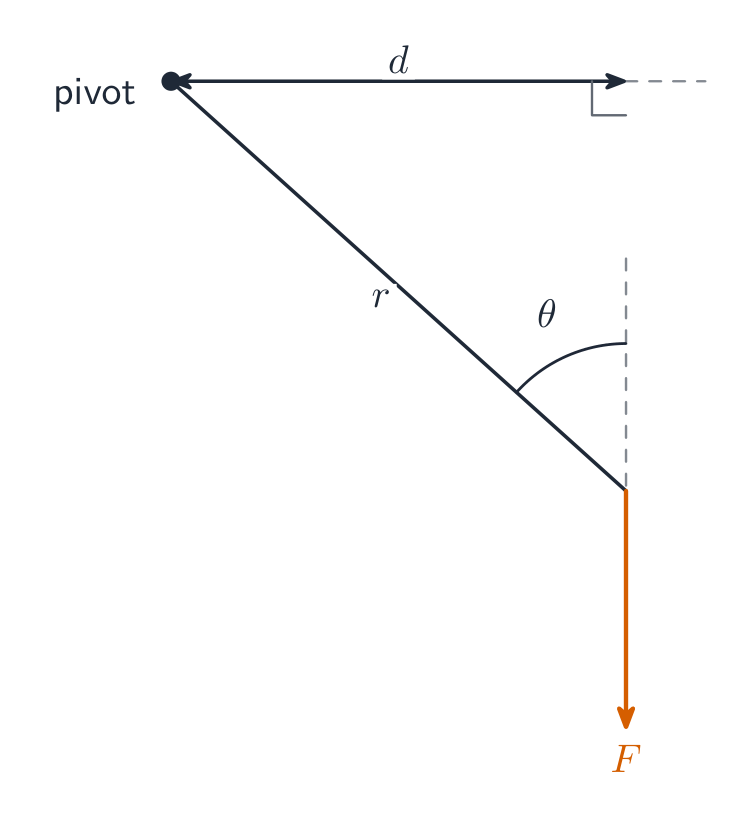
The torque of a force depends on the perpendicular distance from the axis
A $20\ \text{N}$ force pushes perpendicular to a wrench $0.25\ \text{m}$ from the bolt. What torque results (in N·m)?
Difficulty 2/5 · 140 coins + a small bonus on first completion today
$\tau = rF\sin 90^\circ = 0.25 \times 20 \times 1 = 5\ \text{N}\cdot\text{m}$.
The same $20\ \text{N}$ at $0.25\ \text{m}$ now acts at $30^\circ$ to the wrench. The torque (in N·m)?
Difficulty 2/5 · 140 coins + a small bonus on first completion today
$\tau = rF\sin 30^\circ = 0.25 \times 20 \times 0.5 = 2.5\ \text{N}\cdot\text{m}$ -- only the perpendicular part counts.
The lever arm
- The lever arm 力臂 is the perpendicular distance from the axis to the line of the force.
- Torque equals force times lever arm — a longer lever arm wins.
- That is exactly why the long wrench works and pushing near the hinge does not.
The perpendicular distance from the axis to the line of a force is called the lever ____.
Difficulty 1/5 · 100 coins + a small bonus on first completion today
Torque = force times lever arm; a longer lever arm gives more torque.
Torque as a vector
- More fully, torque is a vector product 矢量积 $\vec{\tau} = \vec{r}\times\vec{F}$.
- Its direction lies along the axis, found by the right-hand rule.
- The magnitude is still $rF\sin\theta$.
Torque and the principle of moments
Torque is force times distance from the pivot. Balance the turning effects on each side.
Select all true statements about torque.
Difficulty 2/5 · 140 coins + a small bonus on first completion today
The first two define torque. A force along the radius gives zero torque, not maximum.
Net torque
- The net torque 净力矩 about an axis is the sum of all the torques on the body.
- Counterclockwise and clockwise torques carry opposite signs.
- A push far from the axis and perpendicular to $r$ gives the most torque.
A force pushing straight toward the axis produces...
Difficulty 1/5 · 100 coins + a small bonus on first completion today
With $\theta = 0$, $\sin 0 = 0$, so the torque is zero -- pushing along the radius cannot spin it.
To get the most torque from a fixed force, apply it...
Difficulty 1/5 · 100 coins + a small bonus on first completion today
Torque $rF\sin\theta$ is largest for big $r$ and $\theta = 90^\circ$ -- far out and perpendicular.
You push a door with $10\ \text{N}$ at the handle, $0.8\ \text{m}$ from the hinge, perpendicular to the door.
- Torque: $\tau = rF\sin 90^\circ = 0.8 \times 10 \times 1 = 8\ \text{N}\cdot\text{m}$.
- Push at $30^\circ$ instead and it drops to $0.8 \times 10 \times 0.5 = 4\ \text{N}\cdot\text{m}$.
Only the perpendicular part of a force makes torque. A push straight toward the axis ($\theta = 0$) gives $\sin 0 = 0$ — zero torque, no matter how hard you shove. Pushing along the radius does nothing to spin it.
Torque $\tau = rF\sin\theta$ (or the vector product $\vec{r}\times\vec{F}$) measures a force's turning effect. It equals force times the lever arm (perpendicular distance to the axis). The net torque sums all torques — push far out and perpendicular for the most twist.
Write from a torque of 3
- A force of 12 N acts with a perpendicular lever arm of 0.25 m.
- Find the torque.
A force of 12 N has a perpendicular lever arm of 0.25 m. What is the torque, in N m?
12 times 0.25 is 3.
What is the torque?
Difficulty 1/5 · 100 coins + a small bonus on first completion today
Force times the perpendicular lever arm is 12 times 0.25. Other options — 5 N m (the lesson torque); 12 N m (the force used as a torque).