Newton's Second Law in Rotational Form
Introduced| English | Meaning |
|---|---|
| rotational inertia/rəʊˈteɪʃənl ɪˈnɜːʃə/ | A measure of resistance to changes in rotational motion, determined by mass and its distribution about an axis. |
| angular acceleration/ˈæŋɡjʊlə əkˌseləˈreɪʃn/ | The rate of change of angular velocity with time. |
| Newton's second law for rotation/ˈnjuːtnz ˈsekənd lɔː fɔː rəʊˈteɪʃn/ | Newton's second law for rotation |
The recipe for spinning something up
- A strong twist spins a wheel up quickly; a gentle one barely stirs it.
- A light wheel responds eagerly; a massive flywheel resists.
- This is exactly like $F = ma$ — but for turning.
- One equation ties torque, rotational inertia, and angular acceleration together.
Newton's second law for rotation
- Newton's second law for rotation 转动的牛顿第二定律 is:
- Net torque equals rotational inertia times angular acceleration 角加速度.
- Give it a torque, and it gains angular acceleration.
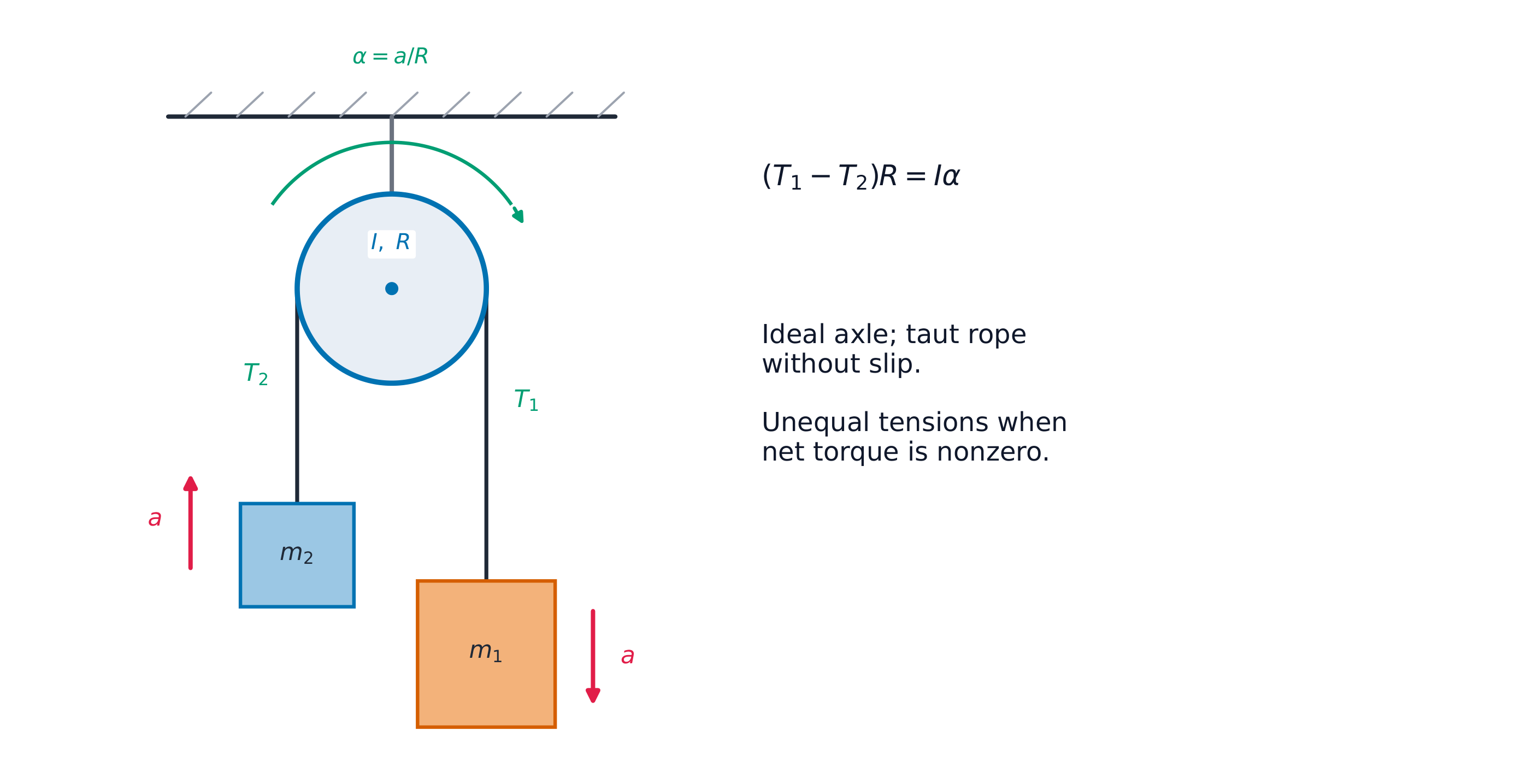
For nonzero angular acceleration and an ideal axle, a tension difference supplies net torque
A net torque of $8\ \text{N}\cdot\text{m}$ acts on a wheel with $I = 2\ \text{kg}\cdot\text{m}^2$. Its angular acceleration (in rad/s^2)?
Difficulty 2/5 · 140 coins + a small bonus on first completion today
$\alpha = \tau/I = 8/2 = 4\ \tfrac{\text{rad}}{\text{s}^2}$.
The rotational form of Newton's second law is tau = I times ____.
Difficulty 1/5 · 100 coins + a small bonus on first completion today
$\tau_{net} = I\alpha$ -- net torque equals rotational inertia times angular acceleration.
What net torque gives a $5\ \text{kg}\cdot\text{m}^2$ wheel an angular acceleration of $3\ \tfrac{\text{rad}}{\text{s}^2}$ (in N·m)?
Difficulty 2/5 · 140 coins + a small bonus on first completion today
$\tau = I\alpha = 5 \times 3 = 15\ \text{N}\cdot\text{m}$.
The perfect analogy
- Compare with $F = ma$: torque plays the role of force.
- Rotational inertia 转动惯量 $I$ plays the role of mass.
- Angular acceleration $\alpha$ plays the role of acceleration.
In $\tau = I\alpha$, rotational inertia $I$ plays the role of which quantity in $F = ma$?
Difficulty 1/5 · 100 coins + a small bonus on first completion today
Torque ~ force, $I$ ~ mass, $\alpha$ ~ acceleration. So $I$ is the rotational mass.
Select all correct analogies between $F = ma$ and $\tau = I\alpha$.
Difficulty 2/5 · 140 coins + a small bonus on first completion today
Force ~ torque and mass ~ $I$; acceleration maps to angular acceleration, not torque.
Bigger inertia, gentler response
- For a fixed torque, a larger $I$ gives a smaller $\alpha$.
- A massive, spread-out wheel is hard to spin up or slow down.
- That is why flywheels resist changes in their rotation.
Newton's second law for rotation
Torque produces angular acceleration in proportion to the rotational inertia: torque = I times alpha.
For the same net torque, a wheel with a larger rotational inertia gets a smaller angular acceleration.
Difficulty 1/5 · 100 coins + a small bonus on first completion today
$\alpha = \tau/I$, so a larger $I$ means a smaller $\alpha$ -- a gentler response.
Translation and rotation together
- A mass on a string over a pulley couples the two worlds.
- Write $F = ma$ for the hanging mass and $\tau = I\alpha$ for the pulley.
- Link them with the rope tension and $a = \alpha r$, then solve together.
A net torque of $12\ \text{N}\cdot\text{m}$ acts on a wheel with rotational inertia $I = 3\ \text{kg}\cdot\text{m}^2$.
- Angular acceleration: $\alpha = \dfrac{\tau}{I} = \dfrac{12}{3} = 4\ \tfrac{\text{rad}}{\text{s}^2}$.
- Double the rotational inertia and the same torque gives only $2\ \tfrac{\text{rad}}{\text{s}^2}$.
You cannot use $F = ma$ for the pulley itself. A pulley with mass has rotational inertia, so the rope tensions on its two sides are different — that difference provides the net torque $\tau = I\alpha$. Treating it as massless (equal tensions) is a common error.
Newton's second law for rotation is $\tau_{net} = I\alpha$ — the rotational twin of $F = ma$, with torque for force, rotational inertia for mass, and angular acceleration for acceleration. A bigger $I$ means a gentler response, and coupled mass-pulley systems solve $F = ma$ and $\tau = I\alpha$ together.
Write from an angular acceleration of 3
- A net torque of 9 N m acts on an object with rotational inertia 3.
- Find the angular acceleration.
A net torque of 9 N m acts on an object whose rotational inertia is 3 kg m squared. What is the angular acceleration, in rad/s squared?
9 divided by 3 is 3.
What is the angular acceleration?
Difficulty 1/5 · 100 coins + a small bonus on first completion today
Torque divided by rotational inertia is 9 divided by 3. Other options — 4 rad/s squared (the lesson value); 9 rad/s squared (the torque used as an acceleration).