Rotational Equilibrium
Introduced| English | Meaning |
|---|---|
| rotational equilibrium/rəʊˈteɪʃənl ˌiːkwɪˈlɪbrɪəm/ | A state in which the net torque on an object is zero and its angular momentum does not change. |
| net torque/net tɔːk/ | The combined turning effect of all forces acting on a body about a specified axis. |
| static equilibrium/ˈstætɪk ˌiːkwɪˈlɪbrɪəm/ | Rest in the chosen inertial frame, with both zero resultant force and zero resultant torque. |
| extended free-body diagram/ekˈstendɪd friː ˈbɒdi ˈdaɪəɡræm/ | extended free-body diagram |
How a seesaw finds its balance
- A small child far out can balance a big adult sitting close to the pivot.
- It is not about weight alone — it is about weight times distance.
- When the turning effects match, the seesaw holds steady.
- That balance of torques is the key to bridges, beams, and cranes.
Rotational equilibrium
- A body is in rotational equilibrium 转动平衡 when the net torque 净力矩 on it is zero.
- It does not start or stop spinning — its angular velocity stays constant.
- Clockwise torques exactly balance counterclockwise ones.
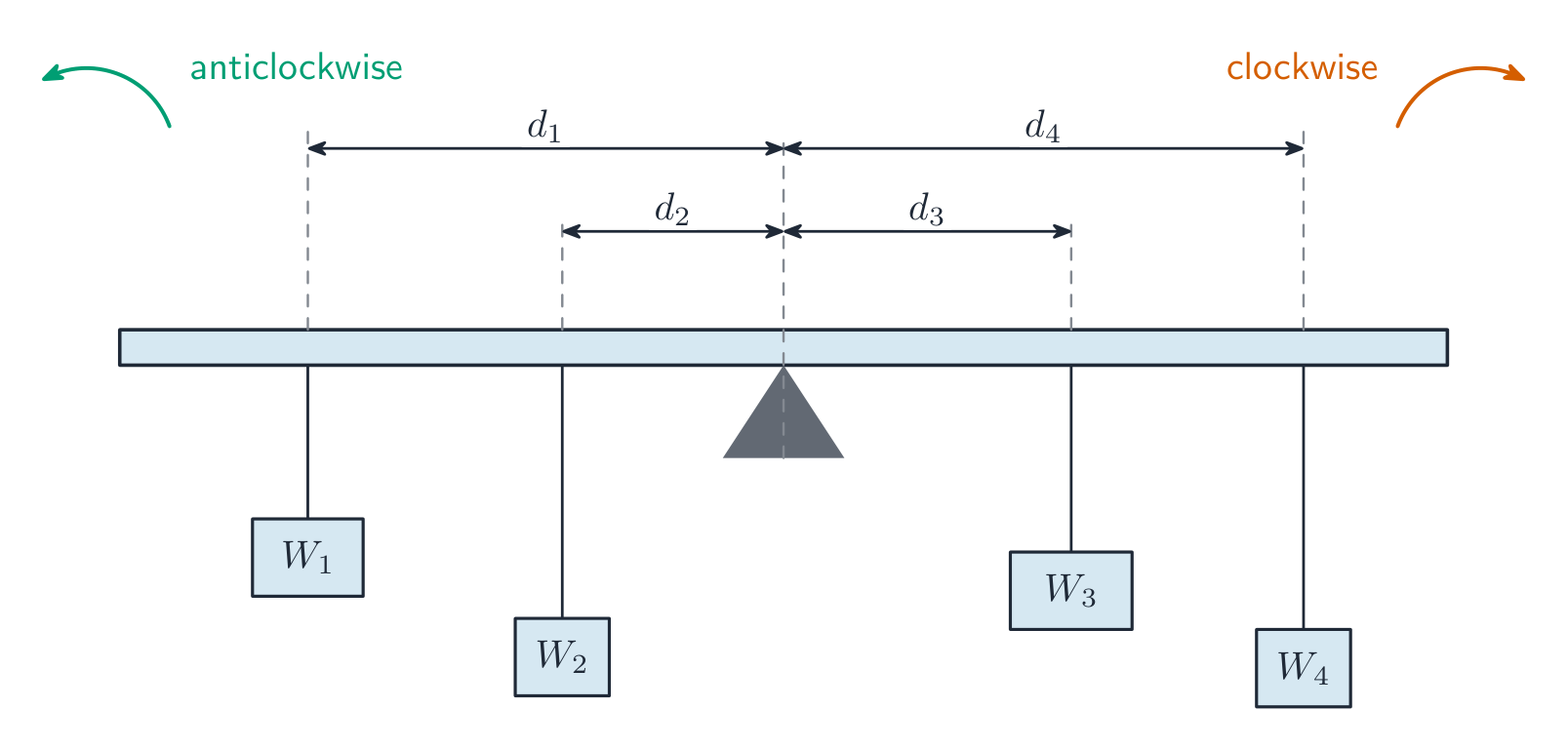
At balance the clockwise and anticlockwise torques about the axis are equal
Select all conditions true in rotational equilibrium.
Difficulty 2/5 · 140 coins + a small bonus on first completion today
Rotational equilibrium means zero net torque and constant angular velocity -- it could be spinning steadily, not necessarily still.
Full static equilibrium
- For static equilibrium 静平衡, both conditions must hold: zero net force and zero net torque.
- Zero net force keeps it from accelerating; zero net torque keeps it from spinning.
- Both together mean it stays completely at rest.
For an object to be in full static equilibrium, which must be true?
Difficulty 1/5 · 100 coins + a small bonus on first completion today
Static equilibrium requires zero net force and zero net torque.
An extended diagram
- Torque depends on where a force acts, so draw an extended free-body diagram 扩展受力图.
- Show each force at its actual point of application, not all at one dot.
- The weight of a uniform beam acts at its center.
In rotational equilibrium?
An object is in rotational equilibrium when the torques cancel. Sort each case.
If the net force on an object is zero, it cannot possibly be rotating faster and faster.
Difficulty 1/5 · 100 coins + a small bonus on first completion today
Two offset equal-opposite forces give zero net force but a net torque -- the object angularly accelerates.
On an extended free-body diagram of a uniform beam, its weight is drawn acting at...
Difficulty 1/5 · 100 coins + a small bonus on first completion today
A uniform beam's weight acts at its center of mass -- its geometric center.
The solving trick
- Choose your axis cleverly — put it at an unknown force so that force's torque becomes zero.
- Then $\sum \tau = 0$ has fewer unknowns and is easy to solve.
- Combine with $\sum F = 0$ to find every remaining force.
A $20\ \text{kg}$ child sits $3\ \text{m}$ left of a pivot. A $30\ \text{kg}$ child balances it on the right. How far from the pivot must they sit (in m)?
Difficulty 2/5 · 140 coins + a small bonus on first completion today
Balance torques, $20 \times 3 = 30 \times x$, so $x = 60/30 = 2\ \text{m}$.
A smart choice of ____ puts an unknown force's torque to zero, simplifying the equation.
Difficulty 1/5 · 100 coins + a small bonus on first completion today
Placing the axis at an unknown force makes its lever arm zero, so it drops out of $\sum\tau = 0$.
A seesaw balances with a $30\ \text{kg}$ child $2\ \text{m}$ left of the pivot and a $40\ \text{kg}$ child at $x$ right.
- Balance torques: $30 \times 2 = 40 \times x$, so $x = \dfrac{60}{40} = 1.5\ \text{m}$.
- The heavier child must sit closer to the pivot — less distance, same torque.
Zero net force alone is not enough for full equilibrium. A pair of equal, opposite forces offset from each other has zero net force but a nonzero net torque — it would spin. You must check both conditions.
Rotational equilibrium means the net torque is zero (no change in spin). Full static equilibrium needs zero net force and zero net torque. Draw an extended free-body diagram (forces at their real locations), and put your axis at an unknown force to simplify $\sum \tau = 0$.
Write from a seat 1 m from the pivot
- A 30 kg child sits 2 m from the pivot.
- A 60 kg adult balances the seesaw. Find the adult's distance.
A 30 kg child sits 2 m to the left of a seesaw pivot. Where must a 60 kg adult sit on the right to balance it?
60 divided by 60 is 1.
How far from the pivot does the adult sit?
Difficulty 1/5 · 100 coins + a small bonus on first completion today
The adult is twice as heavy, so the distance is half of 2 m.