DNA and RNA Structure
Introduced| English | Meaning |
|---|---|
| sugar-phosphate backbone/ˈʃʊɡə ˈfɒsfeɪt ˈbækbəʊn/ | sugar-phosphate backbone |
| nucleotide/ˈnjuːklɪɒtaɪd/ | A unit of a nucleic acid containing a nitrogenous base, a pentose sugar and a phosphate group. |
| base pair/beɪs peə/ | base pair |
A closer look at the code
- You have met DNA as the molecule of information.
- Now look closely at how it is built.
- Its structure is what lets it store a code and be copied exactly.
- The shape holds the secret of how genes work.
The sugar-phosphate backbone
- DNA is built from nucleotide 核苷酸 units, each a sugar, a phosphate, and a base.
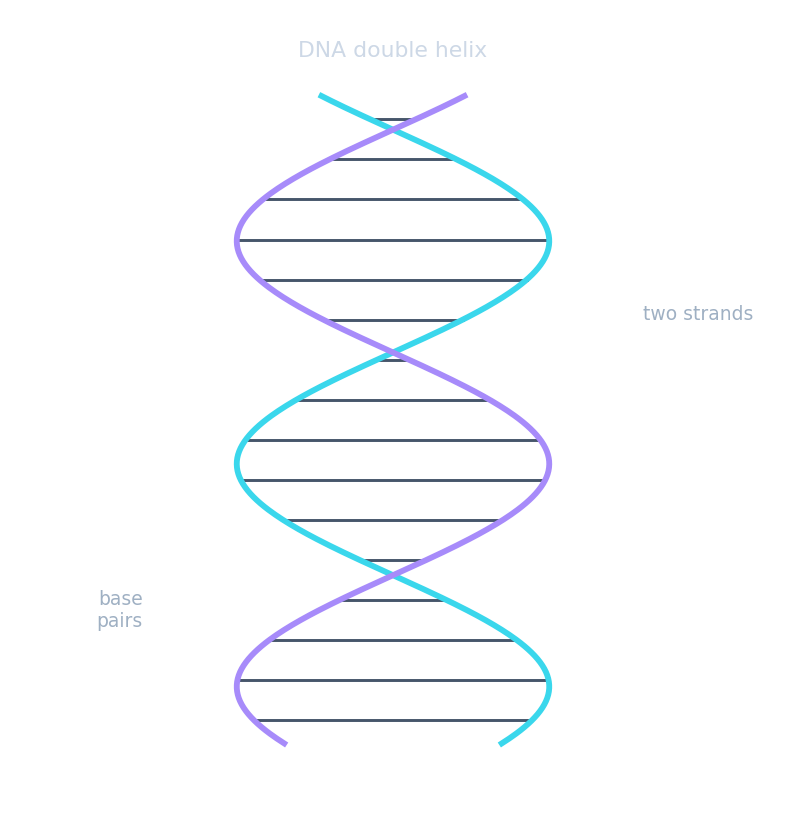
- The sugars and phosphates link into a sugar-phosphate backbone 糖磷酸骨架.
- Two backbones form the long sides of a twisted ladder.
- The bases point inward, forming the rungs.
The two long sides of the DNA ladder are made of a repeating…
Difficulty 1/5 · 100 coins + a small bonus on first completion today
Each strand's backbone is an alternating sugar-phosphate chain; the bases stick out from it.
The repeating unit of a nucleic acid — a sugar, phosphate, and base — is a ____.
Difficulty 1/5 · 100 coins + a small bonus on first completion today
Each nucleotide is one sugar + one phosphate + one base; many joined make a strand.
Base pairs make the rungs
- Each rung is a base pair 碱基对 joining the two strands.
- A always pairs with T, and G always pairs with C.
- So the two strands carry matching, complementary information.
- Read one strand and you know the other exactly.
In a DNA base pair, guanine (G) always pairs with…
Difficulty 1/5 · 100 coins + a small bonus on first completion today
G pairs with C, and A pairs with T — the rungs of the DNA ladder are these base pairs.
How RNA differs
- RNA is usually a single strand, not a double helix.
- Its sugar is ribose, not the deoxyribose of DNA.
- It uses the base uracil (U) where DNA uses thymine (T).
- These differences suit RNA to its job of carrying copies of the code.
A DNA or an RNA feature?
Sort each structural feature by whether it belongs to DNA or RNA.
RNA is usually single-stranded and uses uracil instead of thymine.
Difficulty 1/5 · 100 coins + a small bonus on first completion today
RNA differs from DNA: single strand, ribose sugar, and uracil in place of thymine.
Select all true statements about DNA and RNA structure.
Difficulty 2/5 · 140 coins + a small bonus on first completion today
Nucleic acids are made of nucleotides, not amino acids. The other three are correct.
The base pairing rules are fixed: A–T and G–C in DNA (A–U and G–C when RNA is involved). A never pairs with G, and C never pairs with T. These strict rules are what make copying and reading the code reliable.
Writing the partner strand:
- Suppose one DNA strand reads $\text{G–C–A–T}$.
- Its partner must read $\text{C–G–T–A}$ — each base matched to its pair.
- This exact matching is why a cell can copy DNA without errors.
DNA is a double helix of two sugar-phosphate backbones, with nucleotide bases forming base pairs (A–T, G–C) as the rungs. RNA differs: it is usually single-stranded, uses ribose sugar, and has uracil in place of thymine. The structure is what lets the code be stored and copied exactly.
Write from the complement TACG
- One DNA strand reads 5 prime ATGC 3 prime.
- The strands are antiparallel.
What is the complementary strand, written 3 prime to 5 prime?
Antiparallel base pairing gives TACG from 3 prime toward 5 prime.
What is the 3 prime to 5 prime complement of 5 prime ATGC 3 prime?
Difficulty 1/5 · 100 coins + a small bonus on first completion today
Each base is replaced by its partner without reversing the written order for that direction.