Skip to content · ⁨コンテンツへスキップ⁩

Magnetism and Electromagnetism

AP Physics 2 · ⁨AP物理学 2⁩ · Topic 12 · ⁨トピック 12⁩

View Slides · ⁨查看幻灯片⁩ Train · ⁨練習する⁩
Video lesson for this topic · ⁨このトピックのビデオレッスン⁩ Open the video page · ⁨動画ページを開く⁩
9:21

磁気学と電磁気学

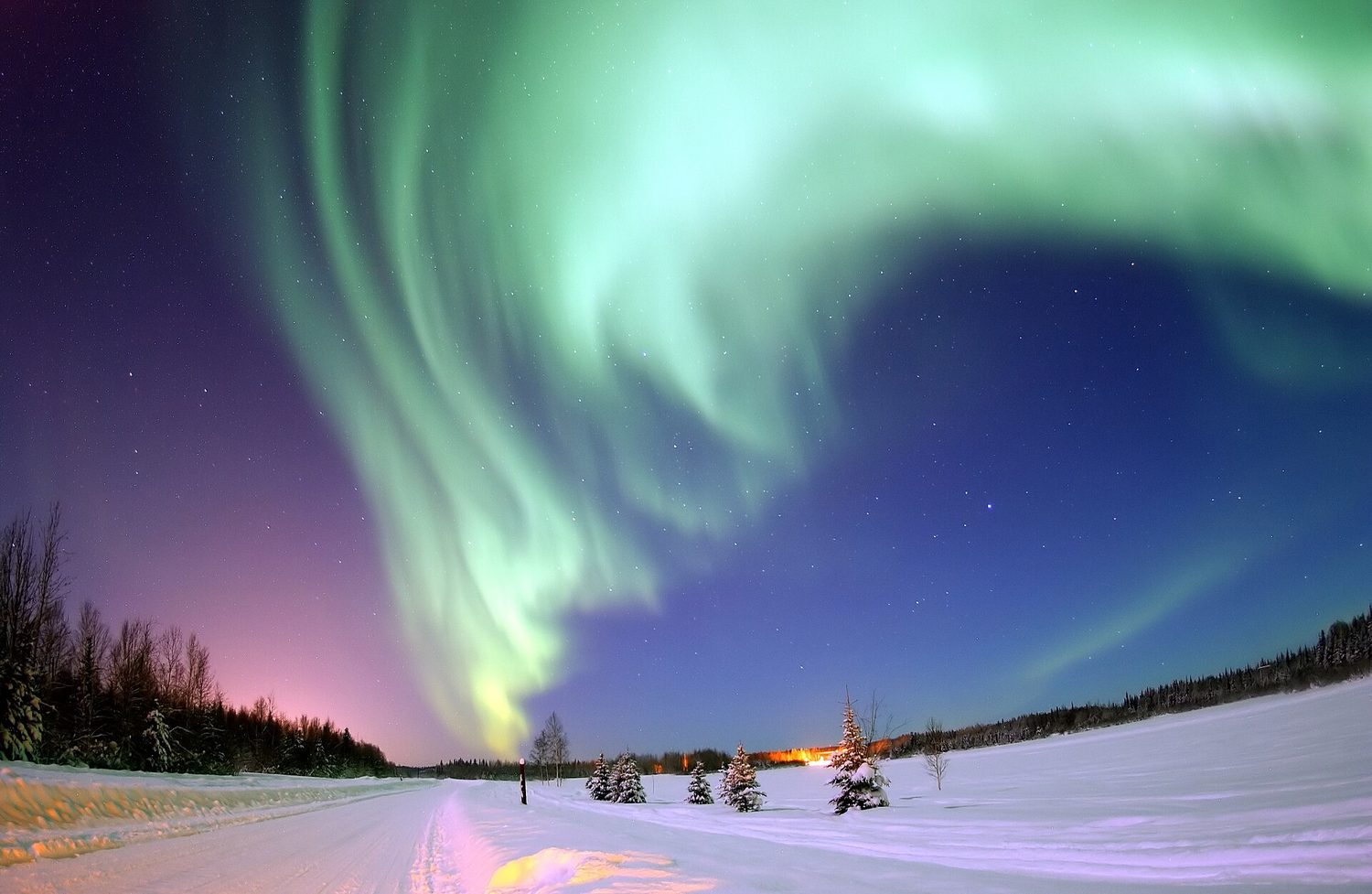
北極上空の高い所、夜空が緑色に輝いています。これらの光のカーテンは火ではありません。太陽からの带电粒子が、百万…

English narration · English + 中文 subtitles burned in · ⁨英語ナレーション・英語+中文字幕 burning-in⁩

12.1

Magnetic Fields · ⁨磁場⁩

Syllabus · ⁨シラバス⁩
English

Learning Objective 12.1.A: Describe the properties of a magnetic field.

  • 12.1.A.1 A magnetic field is a vector field that can be used to determine the magnetic force exerted on moving electric charges, electric currents, or magnetic materials.
    • 12.1.A.1.i Magnetic fields can be produced by magnetic dipoles or combinations of dipoles, but never by monopoles.
    • 12.1.A.1.ii Magnetic dipoles have north and south polarity.
  • 12.1.A.2 A magnetic field is a vector quantity and can be represented using vector field maps.
    • 12.1.A.2.i Magnetic field lines form closed loops.
    • 12.1.A.2.ii Magnetic fields in a bar magnet form closed loops, with the external magnetic field pointing away from one end (defined as the north pole) and returning to the other end (defined as the south pole).

Learning Objective 12.1.B: Describe the magnetic behavior of a material as a result of the configuration of magnetic dipoles in the material.

  • 12.1.B.1 Magnetic dipoles result from the circular or rotational motion of electric charges. In magnetic materials, this can be the motion of electrons.
    • 12.1.B.1.i Permanent magnetism and induced magnetism are system properties that both result from the alignment of magnetic dipoles within a system.
    • 12.1.B.1.ii No magnetic north pole is ever found in isolation from a south pole. For example, if a bar magnet is broken in half, both halves are magnetic dipoles.
    • 12.1.B.1.iii Magnetic poles of the same polarity will repel; magnetic poles of opposite polarity will attract.
    • 12.1.B.1.iv The magnitude of the magnetic field from a magnetic dipole decreases with increasing distance from the dipole.
  • 12.1.B.2 A magnetic dipole, such as a magnetic compass, placed in a magnetic field will tend to align with the magnetic field.
  • 12.1.B.3 A material's composition influences its magnetic behavior in the presence of an external magnetic field.
    • 12.1.B.3.i Ferromagnetic materials such as iron, nickel, and cobalt can be permanently magnetized by an external field that causes the alignment of magnetic domains or atomic magnetic dipoles.
    • 12.1.B.3.ii Paramagnetic materials such as aluminum, titanium, and magnesium interact weakly with an external magnetic field, in that the magnetic dipoles of the material do not remain aligned after the external field is removed.
    • 12.1.B.3.iii All materials have the property of diamagnetism, in that their electronic structure creates a usually weak alignment of the dipole moments of the material opposite the external magnetic field.
  • 12.1.B4 Earth's magnetic field may be approximated as a magnetic dipole.

Learning Objective 12.1.C: Describe the magnetic permeability of a material.

  • 12.1.C.1 Magnetic permeability is a measurement of the amount of magnetization in a material in response to an external magnetic field.
  • 12.1.C.2 Free space has a constant value of magnetic permeability, known as the vacuum permeability $\mu_0$, that appears in equations representing physical relationships.
  • 12.1.C.3 The permeability of matter has values different from that of free space and arises from the matter's composition and arrangement. It is not a constant for a material and varies based on many factors, including temperature, orientation, and strength of the external field.
日本語

学習目標 12.1.A: 磁場の性質を説明せよ。

  • 12.1.A.1 磁場は、運動する電気荷重、電流、あるいは磁性体にかかる磁力を決定するために用いられるベクトル場である。
    • 12.1.A.1.i 磁場は磁気双極子や双極子の組み合わせによって生じるが、単極子によって生じることはない。
    • 12.1.A.1.ii 磁気双極子には北極と南極の偏性がある。
  • 12.1.A.2 磁場はベクトル量であり、ベクトル線図を用いて表現できる。
    • 12.1.A.2.i 磁場線は閉じたループを形成する。
    • 12.1.A.2.ii 棒状磁石内の磁場は閉じたループを形成し、外部磁場は一方の端(北極と定義される)から外側へ向かい、もう一方の端(南極と定義される)に戻ってくる。

学習目標 12.1.B: 磁性体内部の磁気双極子の配置による磁性体の磁気的挙動を説明せよ。

  • 12.1.B.1 磁気双極子は、電気荷重の円運動または回転運動によって生じる。磁性体においては、これは電子の運動であることがある。
    • 12.1.B.1.i 永久磁気と誘起磁気は、どちらも系内の磁気双極子の配列によって生じる系の性質である。
    • 12.1.B.1.ii 南極から孤立して北極が存在することはない。例えば、棒状磁石を半分に切断した場合、両方の断片はそれぞれ磁気双極子となる。
    • 12.1.B.1.iii 同極性の磁極同士は反発し、異極性の磁極同士は吸引する。
    • 12.1.B.1.iv 磁気双極子からの磁場の大きさは、双極子からの距離が増加するにつれて減少する。
  • 12.1.B.2 磁気コンパスなどの磁気双極子を磁場内に置くと、その双極子は磁場方向に配列しようとする。
  • 12.1.B.3 物質の組成は、外部磁場中存在する際の磁性体の磁気的挙動に影響を与える。
    • 12.1.B.3.i 鉄、ニッケル、コバルトなどの強磁性体は、外部磁場によって磁気ドメインや原子レベルの磁気双極子が配列されることで、永久磁石として機能することがある。
    • 12.1.B.3.ii アルミウム、チタン、マグネシウムなどの常磁性体は、外部磁場との相互作用が弱く、外部磁場を取り除いた後も材料の磁気双極子の配列が維持されない。
    • 12.1.B.3.iii すべての物質は抗磁性という性質を持つ。すなわち、その電子構造により、通常は微弱な配列が生じ、その双極子モーメントの向きが外部磁場と逆向きになる。
  • 12.1.B4 地球の磁場は、磁気双極子として近似できる。

学習目標 12.1.C: 磁性体の透磁率を説明せよ。

  • 12.1.C.1 透磁率は、外部磁場に対して磁性体がどれだけ磁化されるかを示す指標である。
  • 12.1.C.2 真空は物理的関係を表す式に現れる一定値である透磁率(真空透磁率)$\mu_0$を持つ。
  • 12.1.C.3 物質の透磁率には真空中の値とは異なる値があり、これは物質の組成と配置に起因する。ある材料に対する一定値ではなく、温度、方向性、外部磁場の強さなどの多くの要因に基づいて変化する。
Source: College Board AP Course and Exam Description · ⁨出典: College Board AP コースおよび試験説明書⁩

English
The magnetic field around a current

Different materials respond very differently to a magnetic field, and the course names three. Ferromagnetic 铁磁性 materials (iron, nickel, cobalt) have dipoles that align strongly and stay aligned, so they can be permanent magnets. Paramagnetic 顺磁性 materials (aluminium, titanium) align only weakly and do not stay aligned. Diamagnetic 抗磁性 materials - in fact all materials have some diamagnetism - align weakly opposite the field. This behaviour comes from a material property, the permeability 磁导率: free space has a fixed permeability of free space $\mu_0$, while the permeability of matter differs from it and is not even constant for a given material.

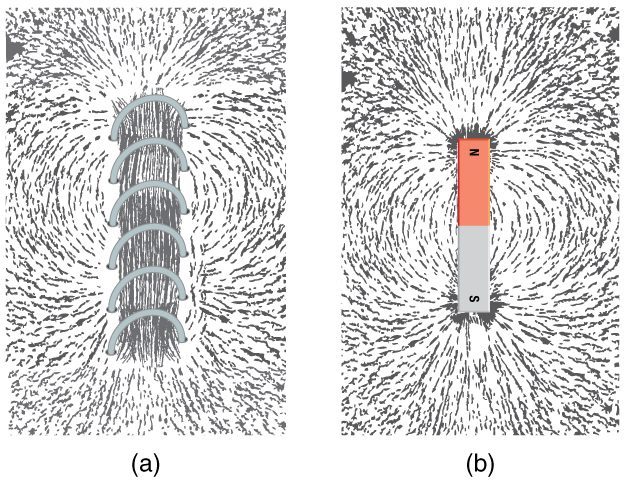
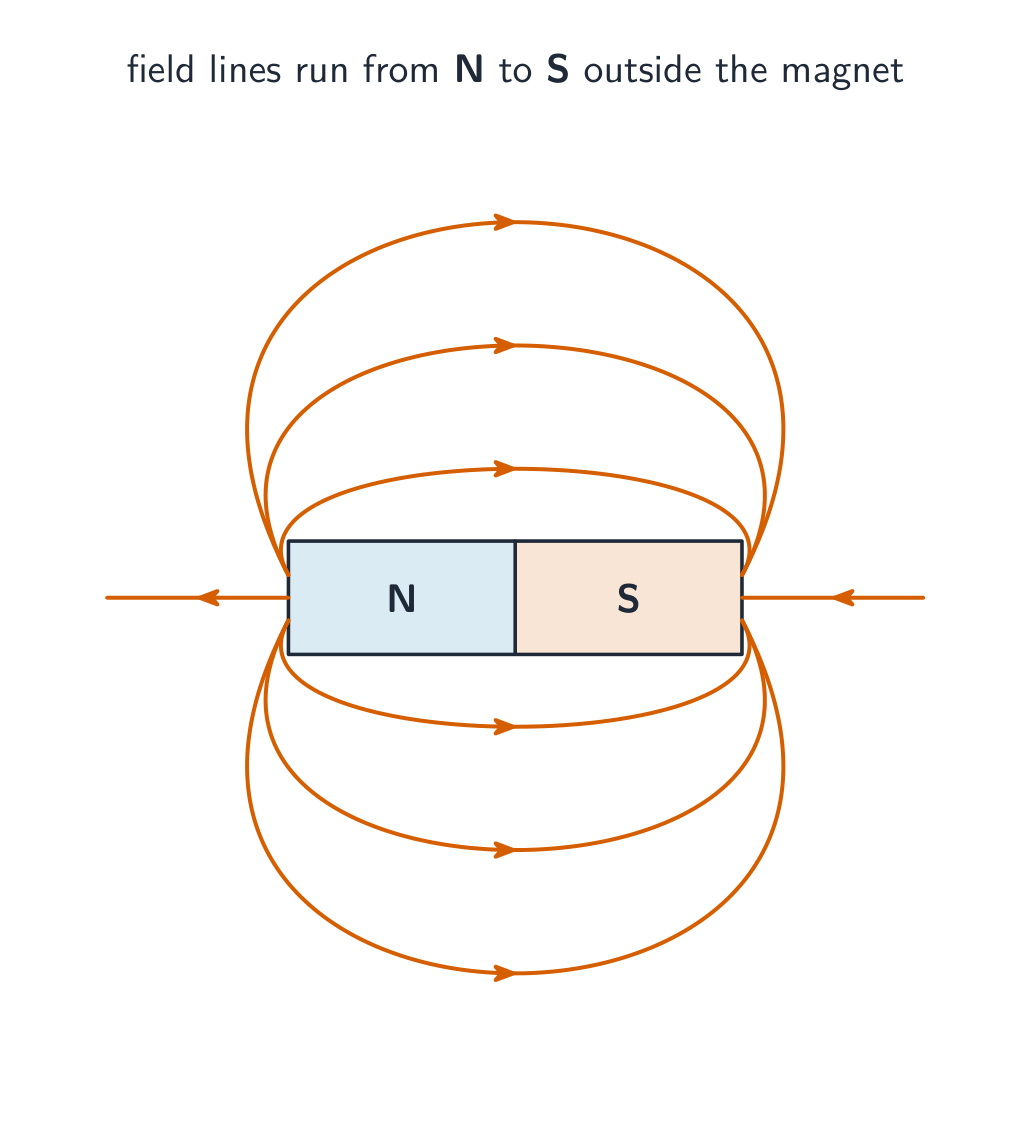
A magnetic field 磁场 $\vec{B}$ surrounds magnets and moving charges. Field lines run from a magnet's north pole to its south pole outside the magnet, and denser lines mean a stronger field. Magnetic poles always come in pairs – cutting a magnet in half makes two smaller magnets, never an isolated pole.

日本語
電流周囲の磁気場
雪景色の夜空に緑色の光のカーテンが輝いている
オーロラ:太陽からの帯電粒子は地球の磁気場によって極方向へ誘導され、大気に衝突して発光させる

異なる材料は磁気場に対して非常に異なった反応を示し、本コースでは3種類を名指している。強磁性体(鉄、ニッケル、コバルト)は双極子が強く整列し、その状態を維持するため、永久磁石となりうる。常磁性体(アルミ、チタン)は弱く整列するのみで、その状態を維持しない。反磁性体 – 実際にはあらゆる材料に何らかの反磁性がある – は磁場とは逆向きに弱く整列する。この挙動は材料固有の性質である透磁率に由来する:自由空間には固定された真空透磁率 $\mu_0$ があり、物質の透磁率はそれと異なり、ある材料であっても一定ではない場合もある。

磁気場 $\vec{B}$ は磁石や移動する電荷を取り囲んでいる。磁束線は磁石の外側で北極から南極へと走り、線が密集しているほど強い磁場を表す。磁気極は常に対で存在する – 磁石を半分に切っても、孤立した磁気極になることはなく、2つの小さな磁石ができるだけである。

棒状磁石の外側でNからSへ向かう磁束線、磁場が強い場所ほど密に描かれている
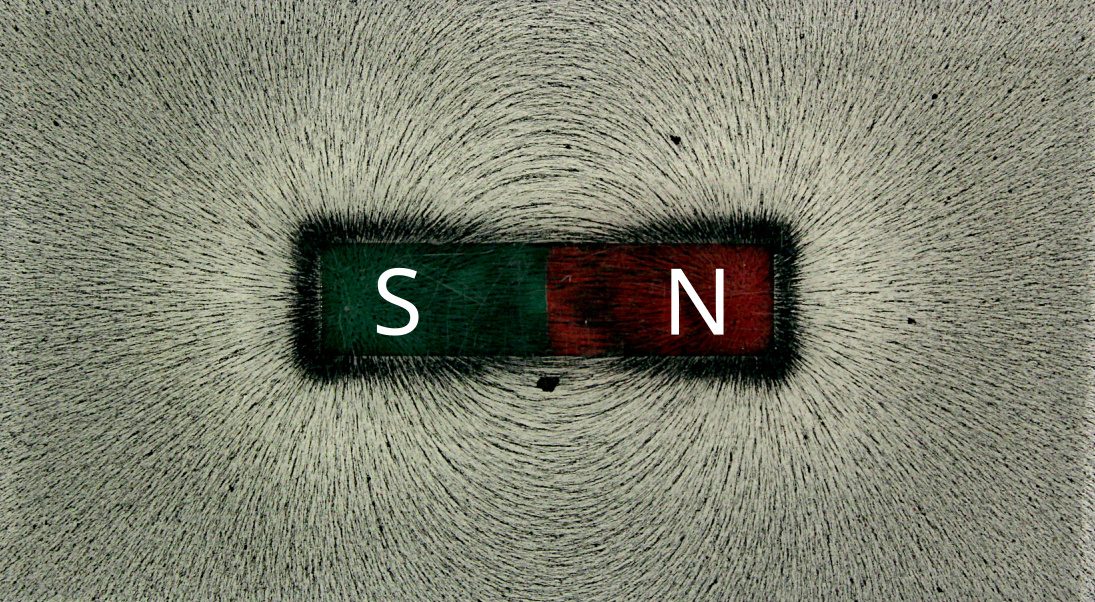
棒状磁石の周囲に湾曲した線を描く鉄粉
鉄粉が磁気場に沿って並び、棒状磁石の見えない磁束線を可視化する
Explore · ⁨探索⁩

See a magnet's field lines · ⁨磁石の磁力線を見る⁩

Magnetic field lines run from the north pole to the south pole outside the magnet. Where the lines crowd together the field is strongest. · ⁨磁界 の磁力線は磁石の外側で北極から南極へ向かう。線が密集している場所ほど磁界は強い。⁩

Vocabulary · ⁨語彙⁩ Train · ⁨練習する⁩
English 日本語
Ferromagnetic/ˌferəməɡˈnetɪk/ 強磁性体
Paramagnetic/ˌpærəməɡˈnetɪk/ 常磁性体
Diamagnetic/ˌdaɪəməɡˈnetɪk/ 反磁性体
permeability/ˌpɜːməˈbɪlɪti/ 透磁率
magnetic field/mæɡˈnetɪk fiːld/ 磁場
12.2

Magnetism and Moving Charges · ⁨磁気と移動する電荷⁩

Syllabus · ⁨シラバス⁩
English

Learning Objective 12.2.A: Describe the magnetic field produced by moving charged objects.

  • 12.2.A.1 A single moving charged object produces a magnetic field.
    • 12.2.A.1.i The magnetic field at a particular point produced by a moving charged object depends on the object's velocity and the distance between the point and the object.
    • 12.2.A.1.ii At a point in space, the direction of the magnetic field produced by a moving charged object is perpendicular to both the velocity of the object and the position vector from the object to that point in space and can be determined using the right-hand rule.
    • 12.2.A.1.iii The magnitude of the magnetic field is a maximum when the velocity vector and the position vector from the object to that point in space are perpendicular.

Learning Objective 12.2.B: Describe the force exerted on moving charged objects by a magnetic field.

  • 12.2.B.1 Magnetic forces describe interactions between moving charged objects.
  • 12.2.B.2 A magnetic field may exert a force on a charged object moving in that field.
    • 12.2.B.2.i The magnitude of the force exerted by a magnetic field on a moving charged object is proportional to the magnitude of the charge, the magnitude of the charged object's velocity, and the magnitude of the magnetic field and also depends on the angle between the velocity and magnetic field vectors.
      • Equation: $F_B = qvB\sin\theta$
    • 12.2.B.2.ii The direction of the force exerted by a magnetic field on a moving charged object is perpendicular to both the direction of the magnetic field and the velocity of the charge, as defined by the right-hand rule.
  • 12.2.B.3 In a region containing both a magnetic field and an electric field, a moving charged object will experience independent forces from each field.
  • 12.2.B.4 The Hall effect describes the potential difference created in a conductor by an external magnetic field that has a component perpendicular to the direction of charges moving in the conductor.

Boundary statement: Quantitative treatment of the magnitude of the magnetic force exerted by a magnetic field on a moving charge is limited to angles of 0, 90, and 180 degrees between the velocity and the magnetic field. Qualitative analysis of other angles is permitted.

日本語

学習目標 12.2.A: 運動する電荷物体によって生じる磁場を説明する。

  • 12.2.A.1 単一の運動する電荷物体は磁場を生ずる。
    • 12.2.A.1.i 特定の点における運動する電荷物体によって生じる磁場は、その物体の速度およびその点と物体との距離に依存する。
    • 12.2.A.1.ii 空間内の一点において、運動する電荷物体によって生じる磁場の方向は、物体の速度および物体からその空間の点への位置ベクトルの両方に対して垂直であり、右手則を用いて決定できる。
    • 12.2.A.1.iii 磁場の大きさ(絶対値)は、速度ベクトルと空間の点への位置ベクトルが垂直な場合に最大となる。

学習目標 12.2.B: 磁場によって運動する電荷物体に作用する力を説明する。

  • 12.2.B.1 磁力は運動する電荷物体間の相互作用を表す。
  • 12.2.B.2 磁場はその中を運動する電荷物体に力を及ぼすことがある。
    • 12.2.B.2.i 磁場が運動する電荷物体に及ぼす力の大きさは、電荷の大きさ、電荷物体の速度の大きさ、および磁場の大きさに比例し、さらに速度と磁場ベクトルのなす角度にも依存する。
      • 数式: $F_B = qvB\sin\theta$
    • 12.2.B.2.ii 磁場が運動する電荷物体に及ぼす力の方向は、磁場の方向および電荷の速度の方向の両方に対して垂直であり、右手則によって定義される。
  • 12.2.B.3 磁場と電場が共存する領域において、運動する電荷物体は各磁場から独立した力を受ける。
  • 12.2.B.4 ハール効果とは、導体中の電荷の移動方向に対して成分を持つ外部磁場によって導体内に生じる電位差を指す。

境界声明: 磁場が運動する電荷に及ぼす磁力の大きさの定量的な扱いは、速度と磁場とのなす角が0度、90度、180度のみに限定される。他の角度については定性的な分析が許可されている。

Source: College Board AP Course and Exam Description · ⁨出典: College Board AP コースおよび試験説明書⁩

English
A moving charge in a magnetic field

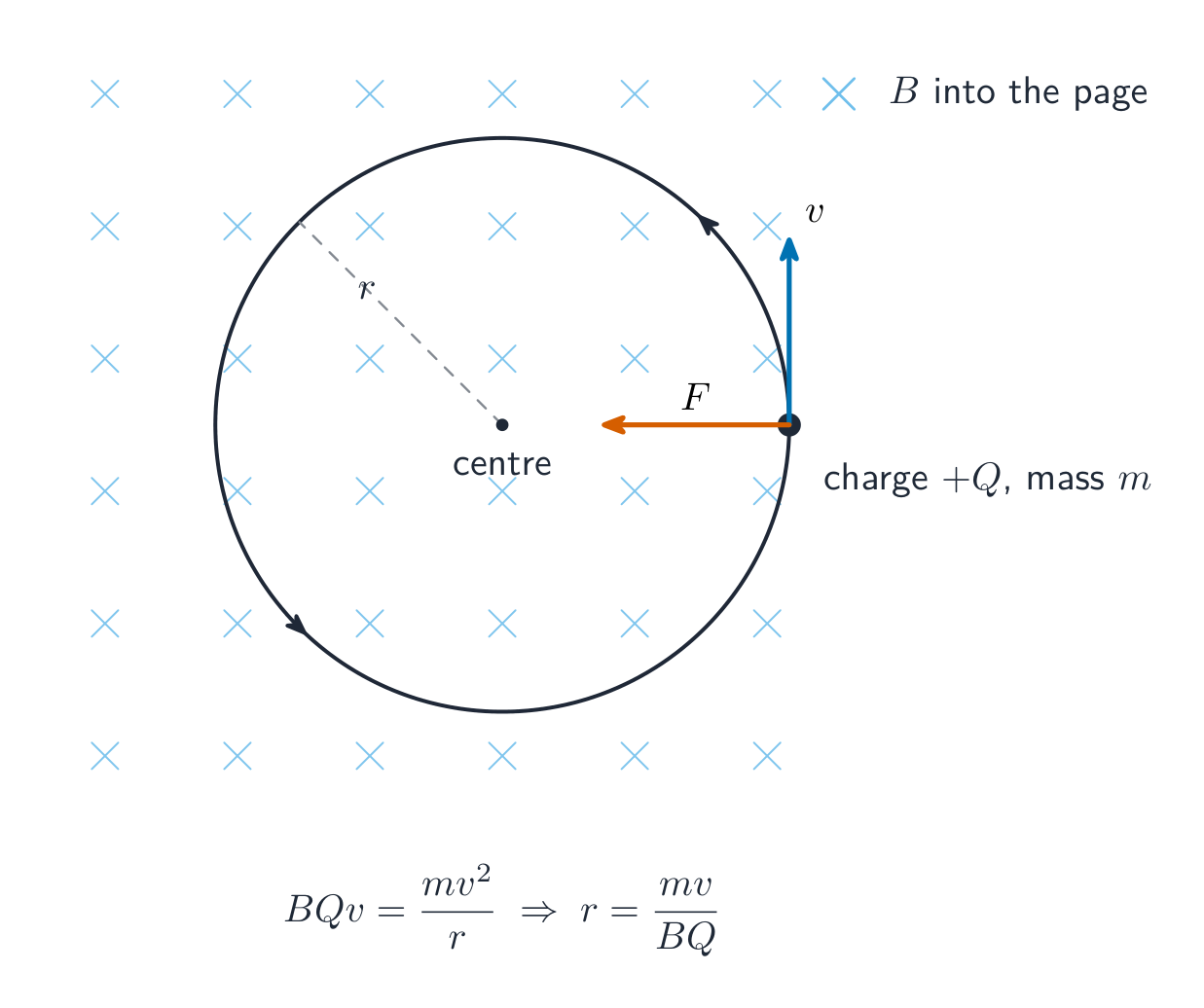
A charge moving through a magnetic field feels a magnetic force 磁力:

$$F=qvB\sin\theta,$$
where $\theta$ is the angle between the velocity and the field. The force is perpendicular to both $\vec{v}$ and $\vec{B}$ (use the right-hand rule), so it changes direction but not speed – a charge moving perpendicular to a uniform field travels in a circle. A stationary charge, or one moving parallel to the field, feels no magnetic force.

Worked example. A proton ($q=1.6\times10^{-19}\ \text{C}$, $m=1.67\times10^{-27}\ \text{kg}$) enters a $0.50\ \text{T}$ field at $2.0\times10^{5}\ \text{m/s}$, at right angles to the field. The magnetic force is

$$F=qvB=1.6\times10^{-19}\times2.0\times10^{5}\times0.50=1.6\times10^{-14}\ \text{N}.$$
This force is the centripetal force, so it bends the proton into a circle of radius
$$r=\frac{mv}{qB}=\frac{1.67\times10^{-27}\times2.0\times10^{5}}{1.6\times10^{-19}\times0.50}=4.2\times10^{-3}\ \text{m}.$$
Setting $qvB=\dfrac{mv^2}{r}$ and cancelling gives that neat $r=mv/(qB)$ – the principle behind mass spectrometers.

日本語
磁場内の動く電荷

磁場中を移動する電荷は磁力を受けます:

$$F=qvB\sin\theta,$$
ここで $\theta$ は速度と磁場のなす角です。力は $\vec{v}$ と $\vec{B}$ の両方に垂直です(右手の法則を使用)。したがって、方向は変わりますが速さは変わりません。均一な磁場に垂直に動く電荷は円を描いて進みます。静止した電荷や、磁場と平行に動く電荷には磁力は働きません。

帯電粒子が磁場中を横切ると円軌道を描く
帯電粒子が磁場中を横切ると円軌道を描く

** worked example.** ($q=1.6\times10^{-19}\ \text{C}$, $m=1.67\times10^{-27}\ \text{kg}$) を持つ陽子が $0.50\ \text{T}$ 磁場内に $2.0\times10^{5}\ \text{m/s}$ で入り、磁場に対して直角に入りました。磁力は

$$F=qvB=1.6\times10^{-19}\times2.0\times10^{5}\times0.50=1.6\times10^{-14}\ \text{N}.$$
この力は向心力なので、陽子を半径を持つ円に曲げます。
$$r=\frac{mv}{qB}=\frac{1.67\times10^{-27}\times2.0\times10^{5}}{1.6\times10^{-19}\times0.50}=4.2\times10^{-3}\ \text{m}.$$
$qvB=\dfrac{mv^2}{r}$ を設定して約分すると、綺麗な $r=mv/(qB)$ が得られます——質量分析計の原理です。

Vocabulary · ⁨語彙⁩ Train · ⁨練習する⁩
English 日本語
magnetic force/mæɡˈnetɪk fɔːs/ 磁気力
12.3

Magnetism and Current-Carrying Wires · ⁨磁性と電流を流す導線⁩

Syllabus · ⁨シラバス⁩
English

Learning Objective 12.3.A: Describe the magnetic field produced by a current-carrying wire.

  • 12.3.A.1 A current-carrying wire produces a magnetic field.
    • 12.3.A.1.i The magnetic field vectors around a long, straight, current-carrying wire are tangent to concentric circles centered on that wire. The field has no component toward, away from, or parallel to the long, straight, current-carrying wire.
    • 12.3.A.1.ii At a point in space, the magnitude of the magnetic field due to a long, straight, current-carrying wire is proportional to the magnitude of the current in the wire and inversely proportional to the perpendicular distance from the central axis of the wire to the point.
      • Equation: $B = \dfrac{\mu_0}{2\pi}\dfrac{I}{r}$
    • 12.3.A.1.iii The direction of the magnetic field created by a current-carrying wire is determined with the right-hand rule.
    • 12.3.A.1.iv The direction of the magnetic field at the center of a current-carrying loop is directed along the axis of the loop and can be found using the right-hand rule.
    • 12.3.A.1.v The magnetic field at a location near two or more current-carrying wires can be determined using vector addition principles.

Learning Objective 12.3.B: Describe the force exerted on a current-carrying wire by a magnetic field.

  • 12.3.B.1 A magnetic field may exert a force on a current-carrying wire.
    • 12.3.B.1.i The magnitude of the force exerted by a magnetic field on a current-carrying wire is proportional to the current, the length of the portion of the wire within the magnetic field, and the magnitude of the magnetic field, and also depends on the angle between the direction of the current in the wire and the direction of the magnetic field.
      • Equation: $F_B = I\ell B\sin\theta$
    • 12.3.B.1.ii The direction of the force exerted by the magnetic field on a current-carrying wire is determined by the right-hand rule.
日本語

学習目標 12.3.A: 電流を流す導線によって生じる磁場を説明する。

  • 12.3.A.1 電流を流す導線は磁場を生ずる。
    • 12.3.A.1.i 長い直線状の電流を流す導線の周囲の磁場ベクトルは、その導線を中心とする同心円に沿った接線方向である。磁場は、長い直線状の電流を流す導線 toward, away from, or parallel to の成分を持たない。
    • 12.3.A.1.ii 空間内の一点において、長い直線状の電流を流す導線による磁場の大きさは、導線内の電流の大きさに比例し、導線の中心軸からその点までの垂直距離に反比例する。
      • 数式: $B = \dfrac{\mu_0}{2\pi}\dfrac{I}{r}$
    • 12.3.A.1.iii 電流を流す導線によって生じる磁場の方向は、右手則で決定される。
    • 12.3.A.1.iv 電流を流すループの中心における磁場の方向はループの軸に沿って向いており、右手則を用いて見つけることができる。
    • 12.3.A.1.v 二つ以上の電流を流す導線の近くにある地点における磁場は、ベクトル加算の原理を用いて決定できる。

学習目標 12.3.B: 磁場によって電流を流す導線に作用する力を説明する。

  • 12.3.B.1 磁場は電流を流す導線に力を及ぼすことがある。
    • 12.3.B.1.i 磁場が電流を流す導線に及ぼす力の大きさは、電流、磁場内にある導線の部分の長さ、および磁場の大きさに比例し、さらに導線内の電流の方向と磁場の方向のなす角度にも依存する。
      • 数式: $F_B = I\ell B\sin\theta$
    • 12.3.B.1.ii 磁場が電流を流す導線に及ぼす力の方向は、右手則によって決定される。

Source: College Board AP Course and Exam Description · ⁨出典: College Board AP コースおよび試験説明書⁩

English

Because a current is moving charge, a magnetic field pushes on a current-carrying wire:

$$F=BIL\sin\theta.$$
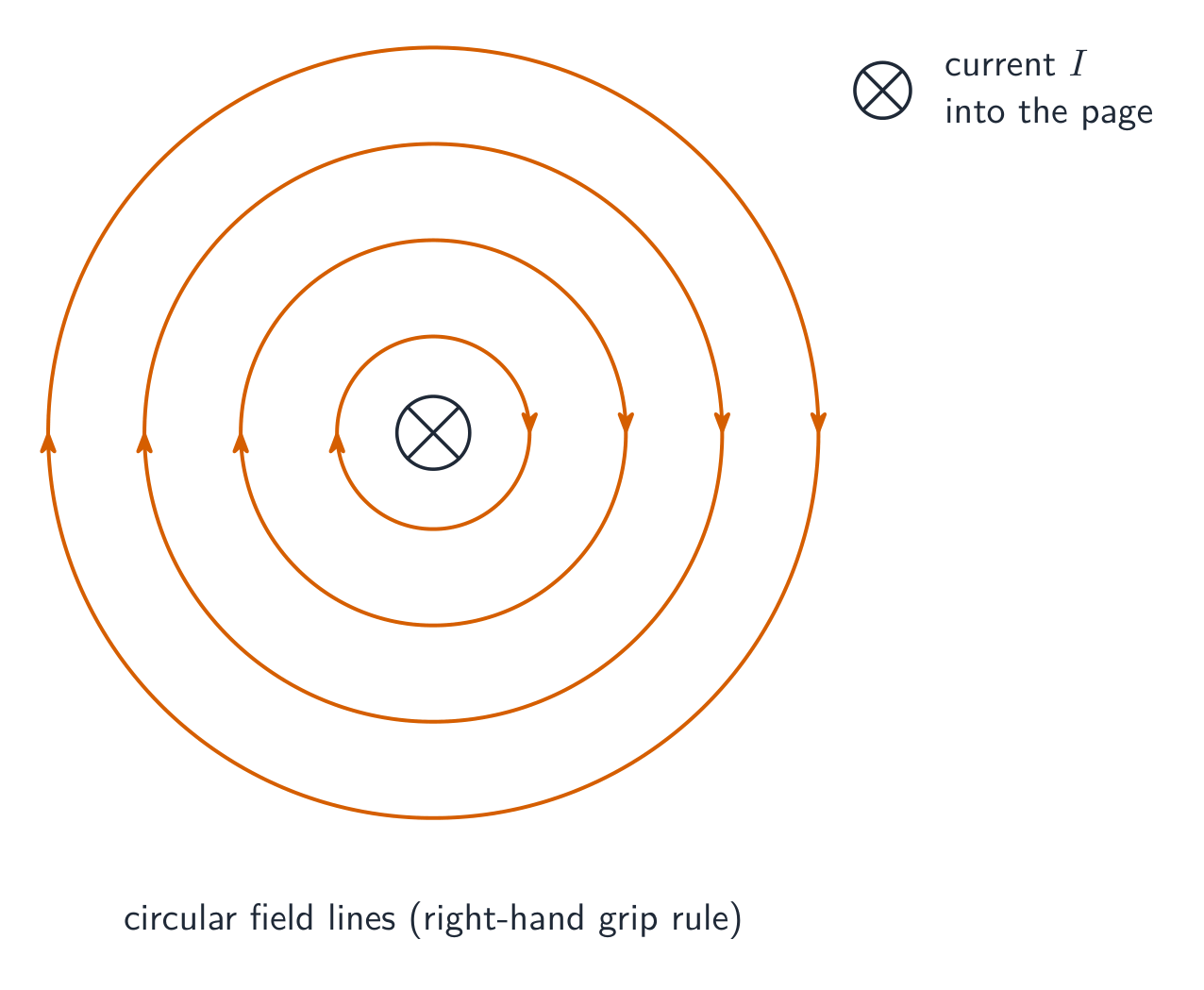
A current also creates its own magnetic field: circular field lines wrap around a straight wire (right-hand rule), and a coil (solenoid) makes a field like a bar magnet. This is how electromagnets and motors work.

Worked example. A $0.30\ \text{m}$ length of wire carries $4.0\ \text{A}$ at right angles to a $0.20\ \text{T}$ field. The force on it is $F=BIL=0.20\times4.0\times0.30=0.24\ \text{N}$ – the push that turns a motor's coil.

日本語

電流は移動する電荷であるため、磁場は電流を流す導線に力を与えます:

$$F=BIL\sin\theta.$$
また、電流は自身の磁場を生み出します。直線の導線を取り巻くように同心円状の磁束線が形成され(右手の法則)、コイル(ソレノイド)は棒磁石のような磁場を作ります。これが電磁石やモーターの動作原理です。

直線導体を取り巻く同心円状の磁場線
直線導体を取り巻く同心円状の磁場線

** worked example.** 長さ $0.30\ \text{m}$ の導線に $4.0\ \text{A}$ の電流が流れ、$0.20\ \text{T}$ 磁場に対して直角に入っています。これにかかる力は $F=BIL=0.20\times4.0\times0.30=0.24\ \text{N}$ —— モーターのコイルを回転させる力です。

電流が流れるコイル(ソレノイド)は棒磁石のような形状の磁場を生む
Explore · ⁨探索⁩

Find the force on a current in a field · ⁨磁場中の電流に働く力を見つける⁩

A current in a magnetic field feels a force $F = BIL$, at right angles to both. Use the left-hand rule; reverse the current or field and the force flips. · ⁨磁場中の電流は $F = BIL$ という力を受け、それは両方に直角である。左手の法則を用いる;電流または磁場を逆転させると力も逆転する。⁩

12.4

Electromagnetic Induction and Faraday's Law · ⁨電磁誘起とファラデーの法則⁩

Syllabus · ⁨シラバス⁩
English

Learning Objective 12.4.A: Describe the induced electric potential difference resulting from a change in magnetic flux.

  • 12.4.A.1 Magnetic flux is a description of the amount of the component of a magnetic field that is perpendicular to a cross-sectional area.
  • 12.4.A.2 Magnetic flux through a surface is proportional to the magnitude of the component of the magnetic field perpendicular to the surface and to the cross-sectional area of the surface.
    • Equation: $\Phi_B = BA\cos\theta$
    • 12.4.A.2.i The area vector is defined to be perpendicular to the plane of the surface and directed outward from a closed surface.
    • 12.4.A.2.ii The sign of the magnetic flux indicates whether the magnetic field is parallel to or antiparallel to the area vector.
  • 12.4.A.3 Faraday’s law describes the relationship between changing magnetic flux and the resulting induced emf in a system.
    • Equation: $|\mathcal{E}| = \left|\dfrac{\Delta\Phi_B}{\Delta t}\right|$
  • 12.4.A.4 Lenz’s law is used to determine the direction of an induced emf resulting from a changing magnetic flux.
    • Equation: $\mathcal{E} = -\dfrac{\Delta\Phi_B}{\Delta t} = -\dfrac{\Delta(BA\cos\theta)}{\Delta t}$
    • 12.4.A.4.i An induced emf generates a current that creates a magnetic field that opposes the change in magnetic flux.
    • 12.4.A.4.ii The right-hand rule is used to determine the relationships between current, emf, and magnetic flux.
  • 12.4.A.5 A common example of electromagnetic induction is a conducting rod on conducting rails in a region with a uniform magnetic field.
    • Derived equation: $\mathcal{E} = B\ell v$
日本語

学習目標 12.4.A: 磁束の変化に伴って生じる誘起電気電位差を説明する。

  • 12.4.A.1 磁束とは、磁場のうち断面積に対して垂直な成分の量を記述するものである。
  • 12.4.A.2 面を貫通する磁束は、磁場のうち面に対して垂直な成分の大きさに比例し、面の断面積にも比例する。
    • 式: $\Phi_B = BA\cos\theta$
    • 12.4.A.2.i 面積ベクトルは、面の平面に対して垂直に定義され、閉じた表面からは外向きに向かう。
    • 12.4.A.2.ii 磁束の符号は、磁場が面積ベクトルと平行か反平行かを示す。
  • 12.4.A.3 ファラデーの法則は、磁束の変化とそれに伴う系内の誘起起電力との関係性を記述する。
    • 式: $|\mathcal{E}| = \left|\dfrac{\Delta\Phi_B}{\Delta t}\right|$
  • 12.4.A.4 レンツの法則は、磁束の変化に伴って生じる誘起起電力の方向を決定するために用いられる。
    • 式: $\mathcal{E} = -\dfrac{\Delta\Phi_B}{\Delta t} = -\dfrac{\Delta(BA\cos\theta)}{\Delta t}$
    • 12.4.A.4.i 誘起起電力は電流を生じ、その電流が作る磁場は磁束の変化に反対する。
    • 12.4.A.4.ii 右手の法則は、電流、起電力(EMF)、磁束の間の関係性を決定するために用いられる。
  • 12.4.A.5 電磁誘起の一般的な例として、均一な磁場内にある導電レール上の導電棒がある。
    • 導出された式: $\mathcal{E} = B\ell v$

Source: College Board AP Course and Exam Description · ⁨出典: College Board AP コースおよび試験説明書⁩

English
Electromagnetic induction

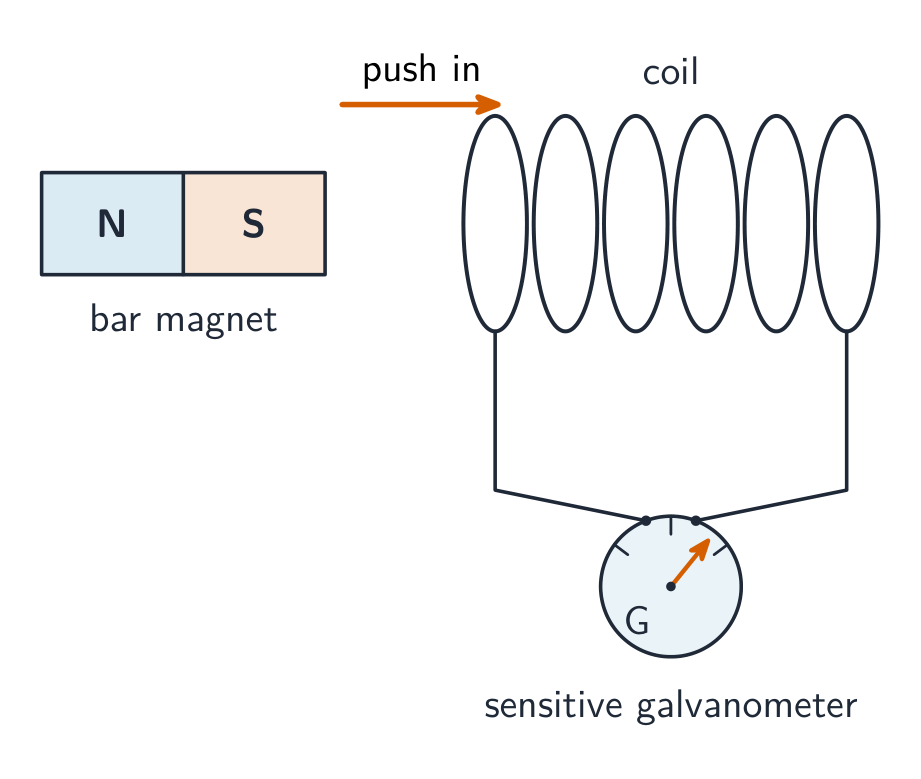
A changing magnetic field through a loop drives a current – electromagnetic induction 电磁感应. The magnetic flux 磁通量 $\Phi=BA\cos\theta$ measures how much field passes through the loop. Faraday's law 法拉第定律 gives the induced emf:

$$\varepsilon=-\frac{\Delta\Phi}{\Delta t}.$$
The flux changes if the field, the area, or the loop's orientation changes. Lenz's law 楞次定律 (the minus sign) says the induced current flows so as to oppose the change that caused it – the basis of generators.

Worked example. The magnetic flux through a single loop drops from $0.020\ \text{Wb}$ to $0.008\ \text{Wb}$ in $0.030\ \text{s}$. The average induced emf is

$$\varepsilon=\left|\frac{\Delta\Phi}{\Delta t}\right|=\frac{0.020-0.008}{0.030}=0.40\ \text{V}.$$
A coil of $N$ turns would give $N$ times this – which is why generators and transformers use many-turn coils.

日本語
電磁誘起

ループを通る変化する磁場は電流を駆動します——これが電磁誘起です。磁束 $\Phi=BA\cos\theta$ はループを通る磁場の量を表します。ファラデーの法則は誘起起電力を次のように与えます:

$$\varepsilon=-\frac{\Delta\Phi}{\Delta t}.$$
磁束は、磁場、面積、あるいはループの向きが変わることで変化します。レンツの法則(マイナス記号)は、誘起電流がその変化を妨げるように流れることを示しており、発電機の基礎となっています。

コイルに磁石を挿入すると起電力が生じ、電流を駆動させる

** worked example.** 単一ループを通る磁束が $0.020\ \text{Wb}$ から $0.008\ \text{Wb}$ に $0.030\ \text{s}$ で減少しました。平均誘起起電力は

$$\varepsilon=\left|\frac{\Delta\Phi}{\Delta t}\right|=\frac{0.020-0.008}{0.030}=0.40\ \text{V}.$$
$N$ 巻きのコイルであれば、この $N$ 倍の値になります——これが発電機やトランスが多巻きコイルを使用する理由です。

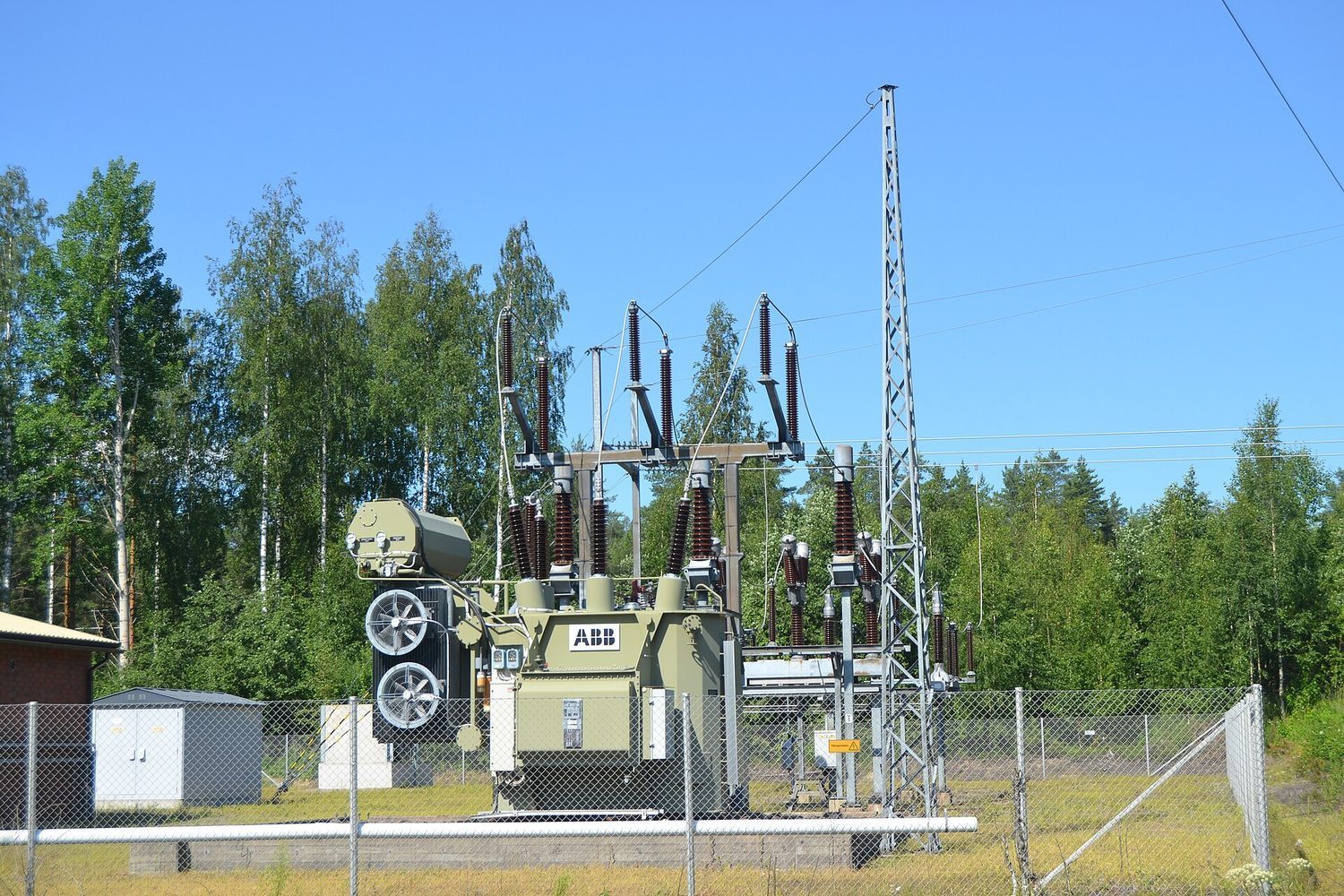
変電所の変圧器: コイル内の磁束変化が送電網を駆動する電圧を生み出す
Explore · ⁨探索⁩

Induce a voltage by moving a magnet · ⁨磁石を動かして電圧を誘起する⁩

Faraday's law: a changing magnetic flux through a coil induces a voltage. Move the magnet faster and the induced EMF grows; Lenz's law sets its direction to oppose the change. · ⁨ファラデーの法則 :コイルを貫く磁束の変化が電圧を誘起する。磁石を速く動かすと誘起 EMF は増大し、レンツの法則 がその方向を変化に反対するよう定める。⁩

Vocabulary · ⁨語彙⁩ Train · ⁨練習する⁩
English 日本語
electromagnetic induction/ɪˌlektrəʊməɡˈnetɪk ɪnˈdʌkʃn/ 電磁誘導
magnetic flux/mæɡˈnetɪk flʌks/ 磁気磁束
Faraday's law/ˈfærədeɪz lɔː/ ファラデーの法則
Lenz's law/ˈlentsɪz lɔː/ レンツの法則
12.4

Exam tips · ⁨試験対策⁩

English
  • The magnetic force $F=qvB\sin\theta$ is perpendicular to the velocity, so it changes direction (a circle) but not speed; a stationary charge or one moving along the field feels no force.
  • Use $F=BIL$ for the force on a current-carrying wire (the motor effect).
  • A current creates a magnetic field (circles around a wire; a solenoid acts like a bar magnet).
  • Induction needs a changing flux $\Phi=BA$ — a stationary magnet in a coil induces nothing.
  • Faraday: $\varepsilon=\Delta\Phi/\Delta t$ (times $N$ turns); Lenz: the induced current opposes the change (energy conservation).
日本語
  • 磁力 $F=qvB\sin\theta$ は速度に垂直なので、方向は変わる(円を描く)が速さは変わらず、静止している電荷や磁場と並行に動く電荷には力が働きません。
  • 電流を流す導線にかかる力には $F=BIL$ を用います(モーター効果)。
  • 電流は磁場を生み出す(導線の周りに円を描き、ソレノイドは棒磁石のように振る舞う)。
  • 誘起には変化する磁束 $\Phi=BA$ が必要です——コイル内の静止した磁石では何も誘起されません。
  • ファラデー: $\varepsilon=\Delta\Phi/\Delta t$ (× $N$ 巻き); レンツ: 誘起電流は変化を妨げる(エネルギー保存則)。

Interactive lessons on this topic · ⁨このトピックのインタラクティブ授業⁩

Work through it step by step, with instant-check exercises. · ⁨一歩ずつ進め、即時チェック付きの問題で学習します。⁩

Past Papers · ⁨過去問⁩

More topics in AP Physics 2 · ⁨AP物理学 2⁩ · ⁨AP Physics 2 · ⁨AP物理学 2⁩ の他のトピック⁩

Log in or create account · ⁨ログインまたはアカウント作成⁩

IGCSE, A-Level & AP