AP Biology is built on four big ideas: evolution, energetics, information storage and transmission, and systems interactions. Its content is huge, but the exam does not test recall of it. It tests whether you can use biology on an unfamiliar case — a species you have never met, an experiment you have never seen.
The science practices are the real syllabus: reading a graph, designing an experiment, identifying the control, and justifying a claim with evidence. These are exactly what the free-response section asks for.
Statistics is examinable.Chi-square, standard error and error bars appear regularly, and they carry marks that pure content revision never reaches.
Notes run through all eight units, with diagrams for the processes that are easier seen than read. The library holds released free-response questions; the biology rubric pays for linking structure to function and for handling data correctly, so the worked answers are built that way.
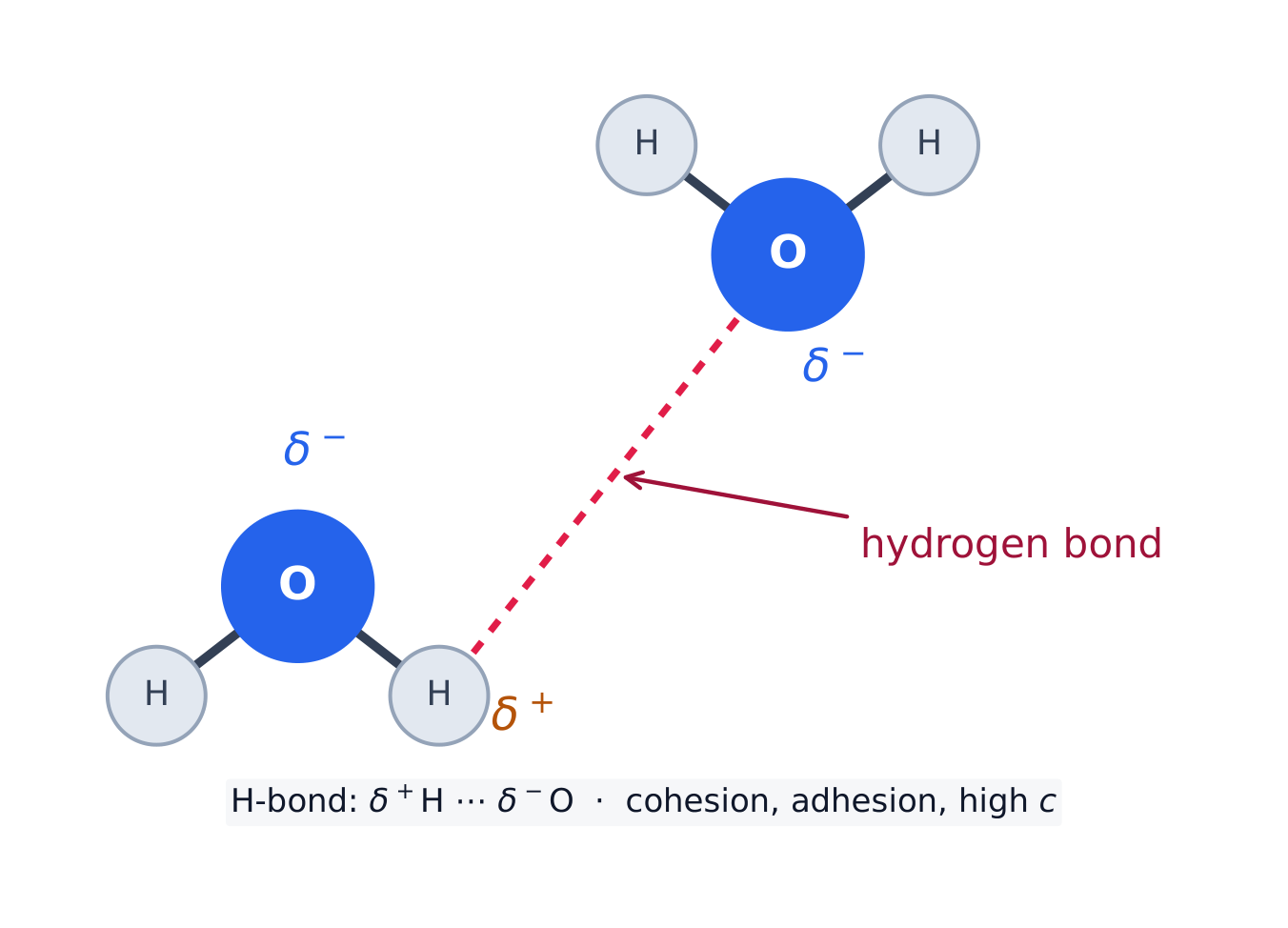
Ice floats on water because hydrogen bonding makes solid water less dense than liquid water
Water is polar 极性: its oxygen pulls electrons more strongly than its hydrogens, giving a slightly negative O and slightly positive H. This lets water molecules form hydrogen bonds 氢键 with each other, which explains water's life-supporting properties:
Cohesion 内聚力 and adhesion 附着力 (surface tension, capillary action, water rising in plants),
high specific heat 比热容 (resists temperature change, stabilizing organisms),
high heat of vaporization (evaporative cooling),
ice floating (less dense solid), and being a great solvent for polar and ionic substances.
Living matter is built mostly from a few elements – carbon, hydrogen, oxygen, nitrogen, phosphorus, and sulfur. Carbon 碳 is central because it forms four stable covalent bonds, building long chains, branches, and rings – the skeletons of all biological molecules.
Carbohydrates and fats contain carbon, hydrogen, and oxygen; proteins also contain nitrogen
Large biological molecules – macromolecules 大分子 – are polymers 聚合物 built from repeating monomers 单体. Cells join monomers by dehydration synthesis 脱水缩合 (removing water to form a bond) and break polymers by hydrolysis 水解 (adding water). Four classes: carbohydrates, lipids, nucleic acids, and proteins.
Dehydration synthesis builds polymers and releases water; hydrolysis reverses it
Carbohydrates 碳水化合物 are made of sugar monomers (monosaccharides 单糖 like glucose). They store energy (starch, glycogen) and provide structure (cellulose 纤维素 in plant walls). Their many hydroxyl groups make them polar and water-soluble.
The shapes of storage polysaccharides (starch, glycogen) and structural cellulose
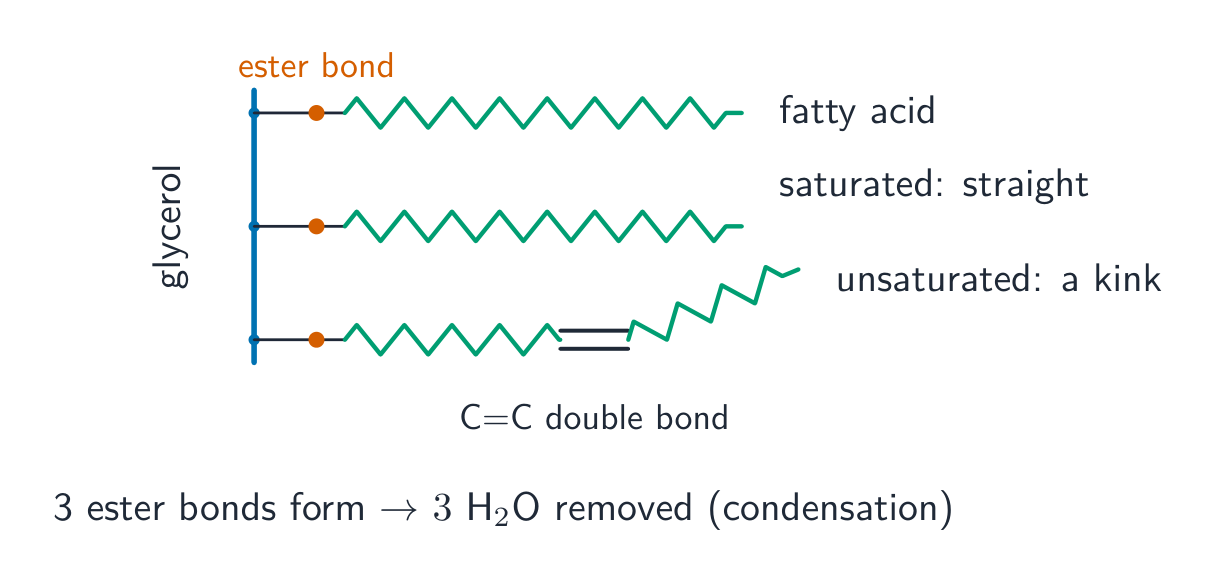
Lipids 脂质 are nonpolar and do not mix with water (hydrophobic 疏水). They include fats (long-term energy storage), phospholipids 磷脂 (which build membranes), and steroids. A phospholipid has a polar "head" and nonpolar "tails," the key to the cell membrane.
A phospholipid has a polar head and two nonpolar tails, so phospholipids form a bilayerA triglyceride: glycerol joined to three fatty acids
Space-filling model of the DNA double helix (NHGRI)
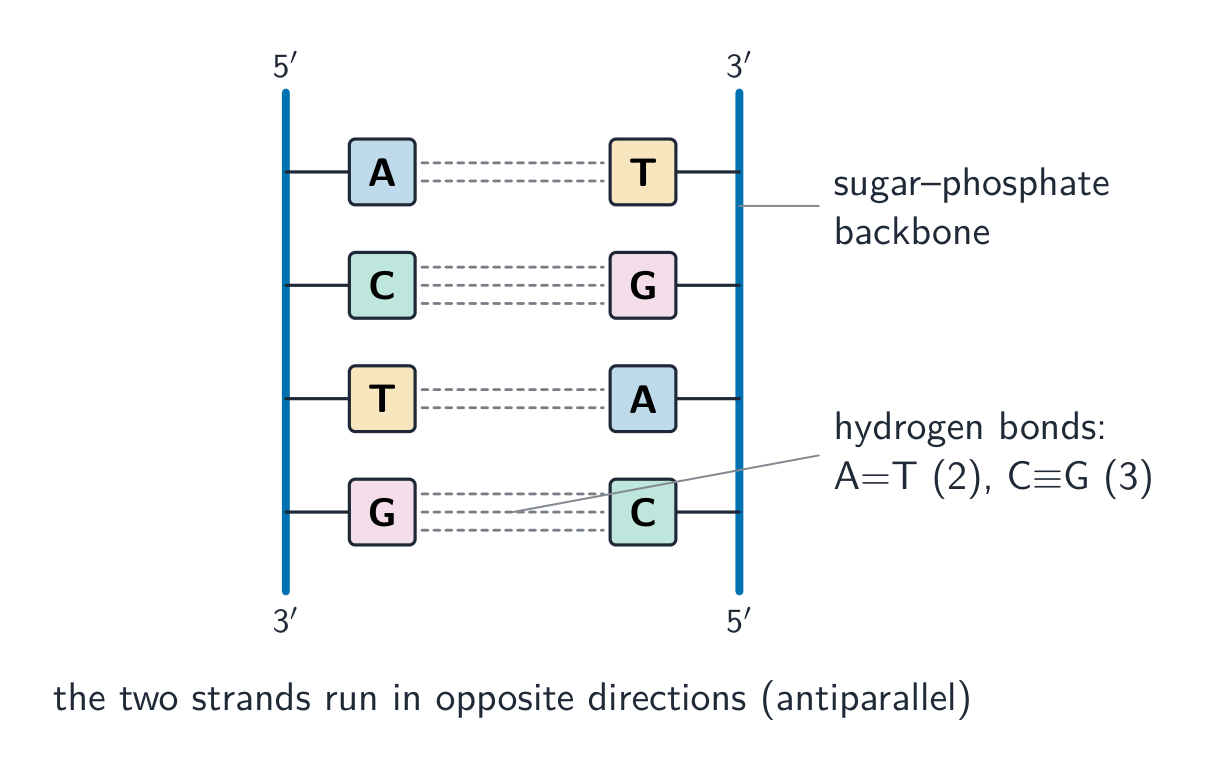
Nucleic acids 核酸 (DNA and RNA) store and carry genetic information. Their monomers are nucleotides 核苷酸, each a sugar, a phosphate, and a nitrogen base. The base sequence encodes instructions; DNA is double-stranded, RNA single-stranded.
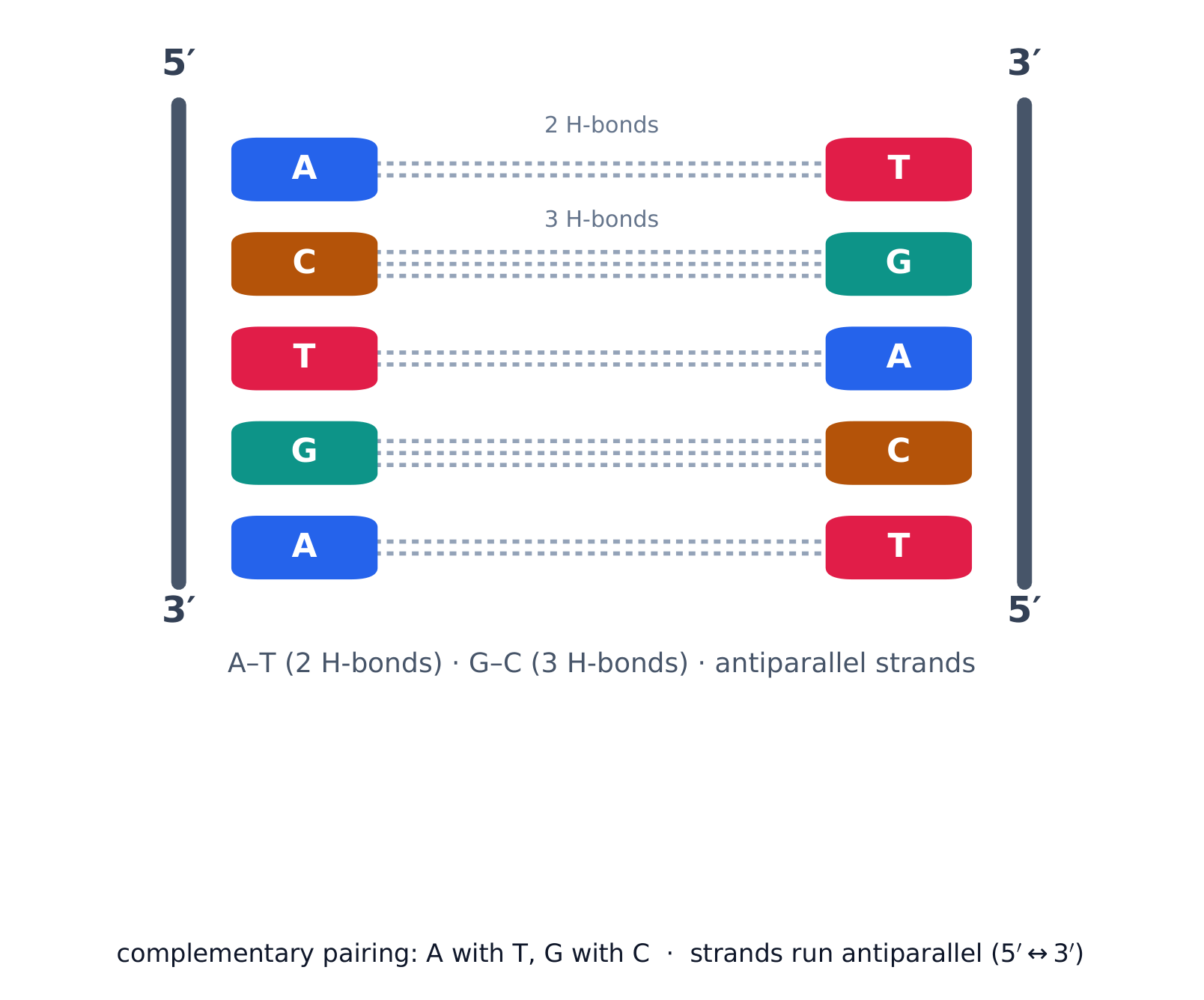
Complementary base pairing holds the two antiparallel strands of DNA together
Haemoglobin quaternary structure: four folded polypeptide chains, each holding a haem group
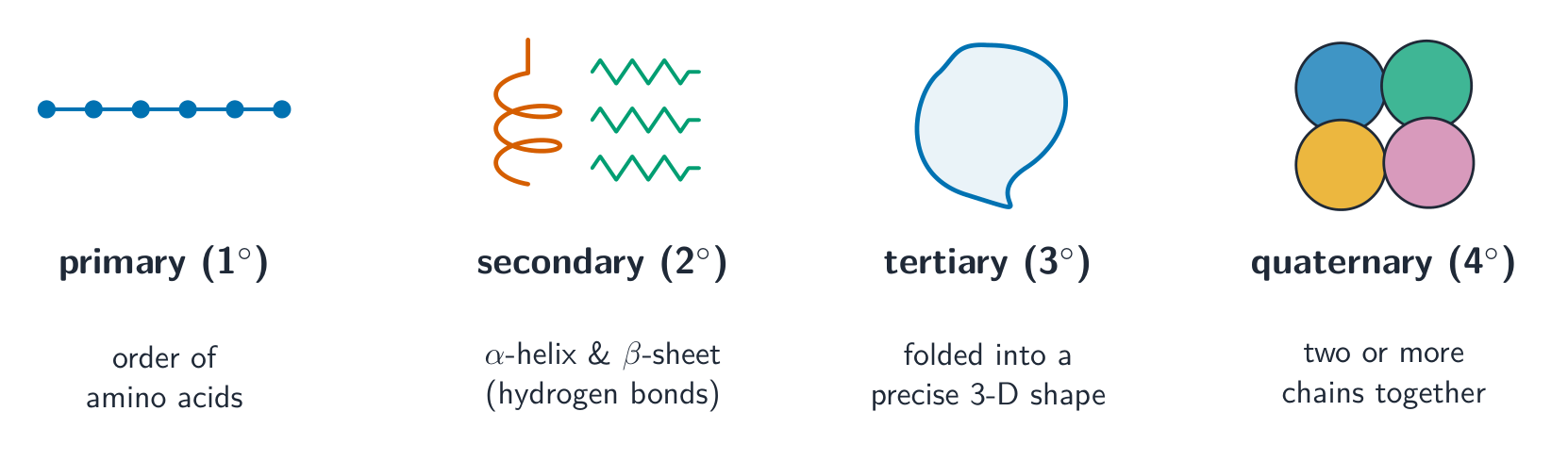
Proteins 蛋白质 are polymers of amino acids 氨基酸 joined by peptide bonds 肽键. Their sequence folds into a specific 3-D shape at four levels (primary, secondary, tertiary, quaternary), and shape determines function – as enzymes, transporters, receptors, and structural parts. Changing the environment (heat, pH) can denature 变性 a protein, unfolding it and stopping its function.
An amino acid, and the peptide bond formed by condensationThe four levels of protein structure
Worked example. Building a polymer from 10 monomers by dehydration synthesis forms 9 bonds and releases 9 water molecules — one per bond, so $N$ monomers release $N-1$ waters. Hydrolysis reverses this exactly: adding those 9 waters breaks the polymer back into 10 monomers. This is why biosynthesis (dehydration) and digestion (hydrolysis) are chemical opposites.
Cells coordinate by sending and receiving chemical signals 信号. A signaling cell releases a ligand 配体 that binds a receptor 受体 on a target cell. Signals travel over different ranges: direct contact (cell junctions), local signaling (nearby cells, like neurotransmitters), and long-distance signaling (hormones 激素 through the blood).
A signal molecule (ligand) binds a matching receptor on the target cell
i. リガンドが結合した後、受容体タンパク質の細胞内ドメインの形状が変化し、シグナルの伝達が開始される。
ii. 酵素および第二 metavar(cAMPなどの環状AMP)は、細胞内シグナルを伝達・増幅する。
iii. ホルモンは、血流中を長距離を移動できるシグナルメッセンジャーの一例である。
iv. リガンドの結合により、リガンド依存性チャネルが開くか閉じたりする。
出典: College Board AP コースおよび試験説明書
Signal transduction 信号转导 converts an outside signal into a cellular response in three stages: reception (ligand binds receptor), transduction (a relay of molecules inside the cell), and response (a change in the cell's activity, such as switching on a gene). Receptors are specific, so a cell only responds to signals it can receive.
A chemical synapse: signal transduction passes a message across a gap with a ligand and receptor
In the transduction stage, the signal passes through a pathway – often a cascade of proteins that activate one another, frequently amplifying the signal so a few ligands trigger a large response. Second messengers (like cyclic AMP or calcium ions) spread the signal quickly through the cell. A change in one step can alter the whole outcome.
A signalling cascade amplifies the message inside the cell
4.4
Feedback
シラバス
Big Idea 2 — エネルギー学: 生物系はエネルギーと分子の構成要素を用いて成長し、繁殖し、動的な恒常性を維持する。
ii. 有糸分裂は、前中期、中期、後期、末期という連続したステップで行われ、細胞周期内で間期と交互に現れる。
iii. 前中期:姉妹染色分体が凝縮し、有糸分裂紡錘体の形成が始まり、中心小体が細胞の反対極へ移動する。
iv. 中期:紡錘糸が赤道板上で染色体を配列させる。
v. 後期:姉妹染色分体のペアが分離し、紡錘糸が染色分体を極へ引っ張る。
vi. 末期:有糸分裂紡錘体が分解し、新しい核膜が形成され、その後胞質分裂が行われる。
vii. 胞質分裂:動物細胞では分裂溝が形成され、植物細胞では細胞板が形成され、2つの新たな娘細胞が生まれる。
出典: College Board AP コースおよび試験説明書
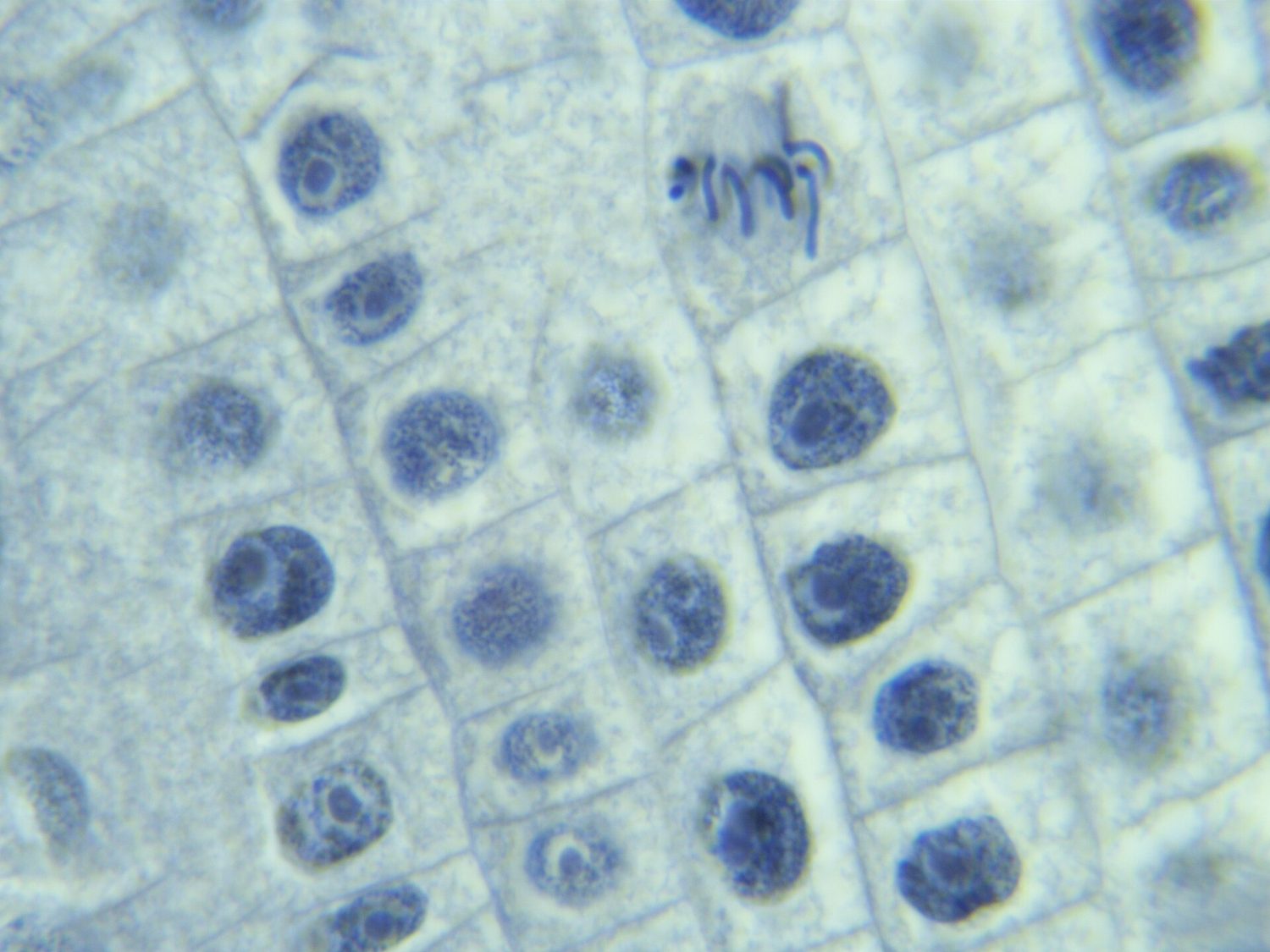
Onion root-tip cells at different stages of mitosis (light micrograph)
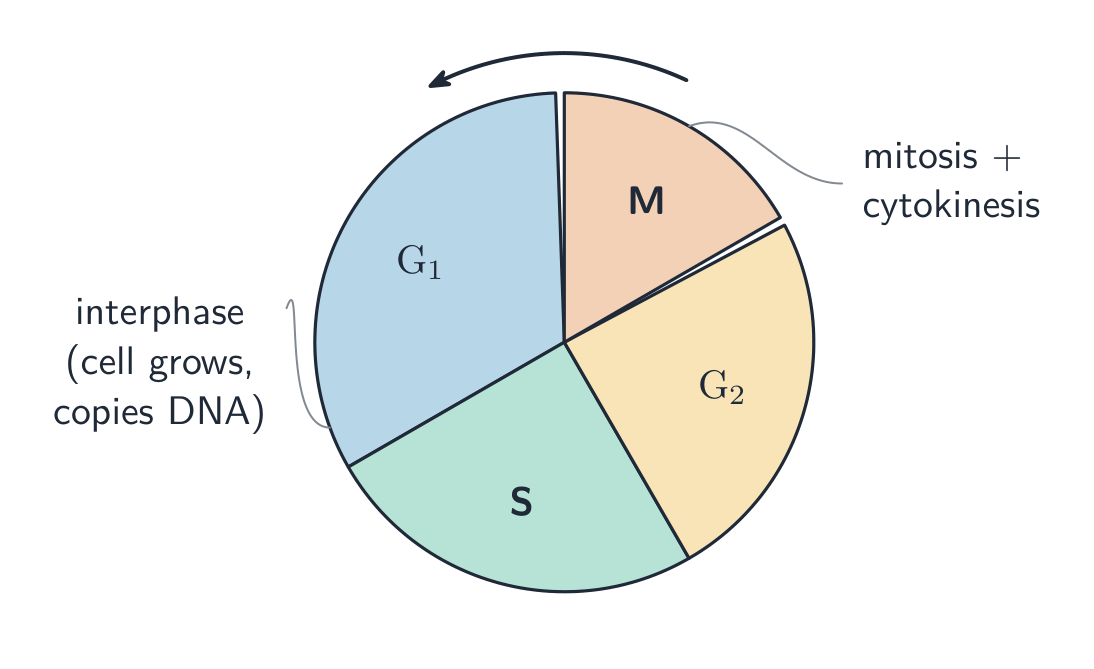
The cell cycle 细胞周期 is the life of a cell from one division to the next: interphase 间期 (G1 growth, S DNA replication, G2 preparation) followed by mitosis 有丝分裂 (M) and cytokinesis, which produce two identical daughter cells. Interphase takes most of the time; DNA is copied only in S phase.
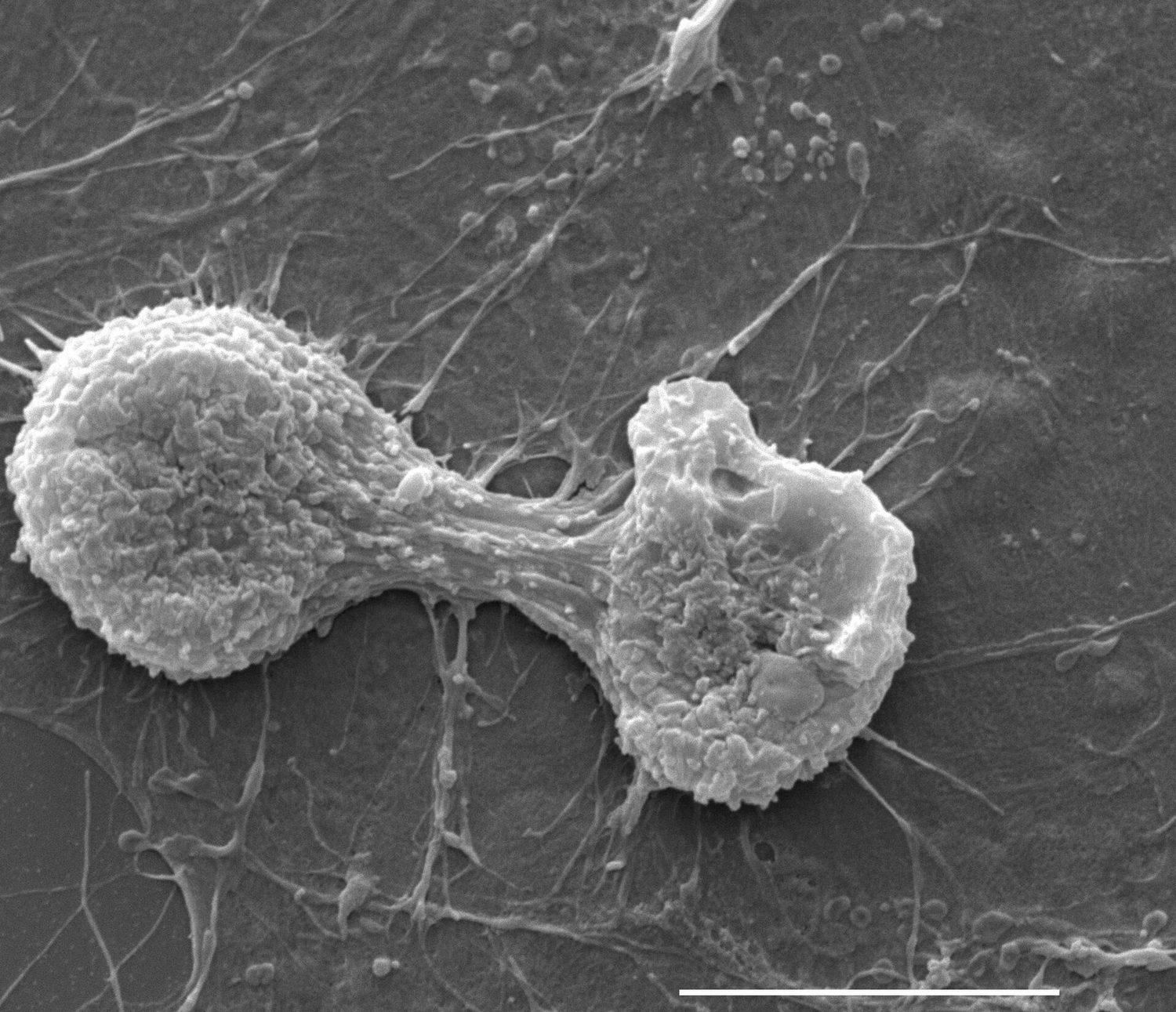
The cell cycle: interphase, then mitosis and cytokinesisA fibroblast dividing: cytokinesis splits one cell into two after mitosis finishesOnion root tip at metaphase: chromosomes line up before sister chromatids separate
The cycle is controlled at checkpoints 检查点 that verify conditions before proceeding (Is the DNA intact? Are chromosomes attached?). Internal signals (cyclins and their kinases) and external signals drive the cycle forward. When this control fails – for example, a mutation that ignores a checkpoint – cells divide uncontrollably, which underlies cancer 癌症.
Uncontrolled division from failed checkpoints forms a tumour
Worked example. Signal amplification in a cascade: one hormone activates one receptor, which switches on about 100 relay proteins, and each of those makes about 1,000 second-messenger molecules — so a single signal produces roughly $100 \times 1000 = 10^{5}$ product molecules. This is why a hormone concentration as low as $10^{-9}\,\text{M}$ can trigger a large cellular response.
In signal transduction name the three stages: reception → transduction → response.
Negative feedback reverses a change to keep conditions steady (homeostasis); positive feedback amplifies a change to completion (childbirth, clotting).
Order the cell cycle: interphase (grow, copy DNA in S phase) then mitosis → two identical daughter cells.
The DNA is copied once, in S phase, so each daughter gets a full copy.
A human karyotype: 22 pairs of autosomes plus the sex chromosomes
Meiosis 减数分裂 makes gametes 配子 (eggs and sperm) with half the chromosome number, so fertilization restores the full set. One diploid cell divides twice to give four haploid cells. Meiosis I separates homologous chromosomes 同源染色体 (reducing the number); meiosis II separates sister chromatids (like mitosis).
Meiosis halves the chromosome number in two divisions
iii. 生物型の遺伝子型とは、ある個体において1つ以上の遺伝子について受け継いだ対立遺伝子のセットのことである。生物型の遺伝子型は、各遺伝子についてホモ接合体またはヘテロ接合体可以是也可以是。
iv. 生物型の表現型とは、受け継いだ形質の観察可能な発現のことである。
v. 継承のパターン(常染色体、遺伝子連鎖、性染色体連関)や対立遺伝子が優性か劣性かは、系図表を含むデータからしばしば予測可能である。ポンネット四角表を用いて、親および子の遺伝子型や表現型を予測することができる。
式(確率の法則):$A$ と $B$ が互いに排他的である場合、以下の式が成り立つ: $P(A \text{ or } B) = P(A) + P(B)$
数式(確率の法則):$A$ と $B$ が独立である場合、次式が成り立つ: $P(A \text{ and } B) = P(A) \times P(B)$
出典: College Board AP コースおよび試験説明書
Natural variation in snail shell banding — heritable differences selection can act on
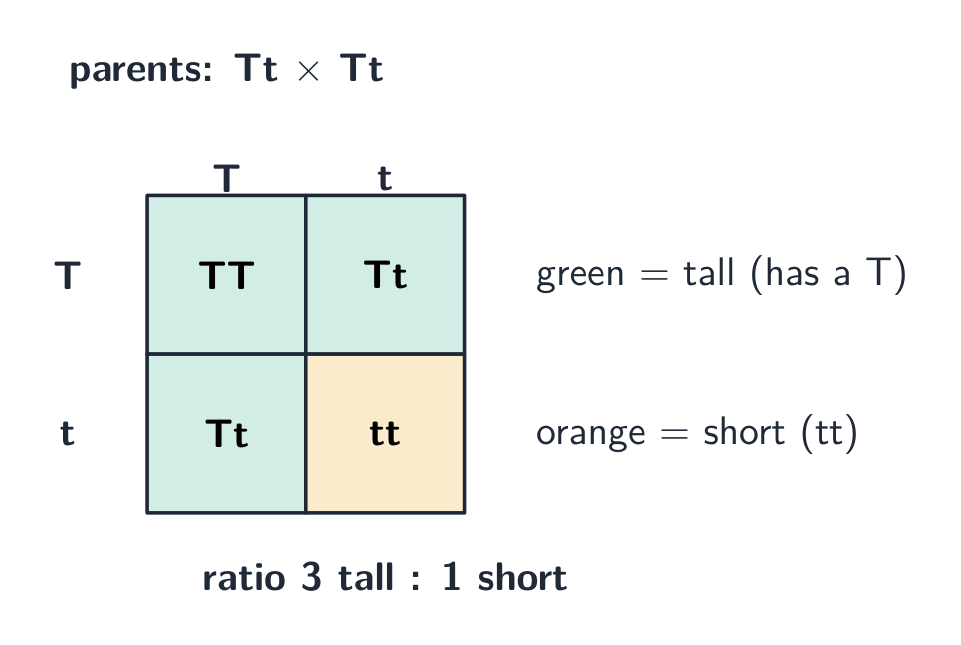
A gene's alternative versions are alleles 等位基因. An organism's genotype 基因型 (its alleles) produces its phenotype 表型 (its traits). Mendel's rules: a dominant 显性 allele masks a recessive 隐性 one; the two alleles segregate into different gametes (law of segregation); genes for different traits assort independently. A Punnett square 庞纳特方格 predicts offspring ratios (a heterozygous cross gives 3:1). Homozygous 纯合 means two identical alleles; heterozygous 杂合 means two different.
A monohybrid Punnett square giving a 3:1 ratio
Worked example. For a dihybrid cross of two independent genes, $AaBb\times AaBb$, use the multiplication rule instead of a $16$-box square. Each gene alone gives $\tfrac34$ dominant, so the chance an offspring shows both dominant traits is $\tfrac34\times\tfrac34=\tfrac{9}{16}$, and the chance of the fully recessive $aabb$ is $\tfrac14\times\tfrac14=\tfrac{1}{16}$. Multiplying two independent $3{:}1$ ratios is what produces the classic $9{:}3{:}3{:}1$ pattern.
i. クロロプラストとミトコンドリアは生殖細胞および娘細胞にランダムに分配されるため、クロロプラストDNAおよびミトコンドリアDNAによって決定される形質は単純なメンデル的法則に従わない。
ii. 動物では、ミトコンドリアは通常卵によって遺伝され、精子ではなく遺伝されるため、ミトコンドリアDNAによって決定される形質は一般的に母性遺伝を示す。
iii. 植物では、ミトコンドリアと葉緑体は花粉ではなく胚珠によって遺伝されるため、ミトコンドリアや葉緑体によって決定される形質は一般的に母性遺伝を示す。
出典: College Board AP コースおよび試験説明書
Many traits do not follow simple dominance:
Sex linkage gives different results for sons and daughters
Incomplete dominance 不完全显性: heterozygotes are a blend (red × white → pink).
Codominance 共显性: both alleles show fully (AB blood type).
Multiple alleles, polygenic 多基因 traits (many genes, like height), pleiotropy (one gene, many effects), and sex-linked 伴性 genes (on the X chromosome) all give more complex ratios.
Worked example (chi-square test). To check whether real data fit a predicted ratio, use $\chi^2=\sum\dfrac{(o-e)^2}{e}$. A monohybrid cross predicts $3{:}1$, so of $80$ offspring you expect $60$ dominant and $20$ recessive, but you observe $55$ and $25$. Then $\chi^2=\dfrac{(55-60)^2}{60}+\dfrac{(25-20)^2}{20}=\dfrac{25}{60}+\dfrac{25}{20}=0.42+1.25=1.67$. With $1$ degree of freedom the critical value at $p=0.05$ is $3.84$; since $1.67<3.84$, we fail to reject the null hypothesis – the deviation is within chance.
Phenotype is not set by genes alone – the environment also matters. Temperature, nutrition, and other factors can change how genes are expressed (a Himalayan rabbit's dark fur where it is cold, a plant's height with more sunlight). So identical genotypes can give different phenotypes in different conditions.
5.5
Exam tips
Contrast mitosis (2 identical, full chromosome number) with meiosis (4 non-identical gametes, half the number).
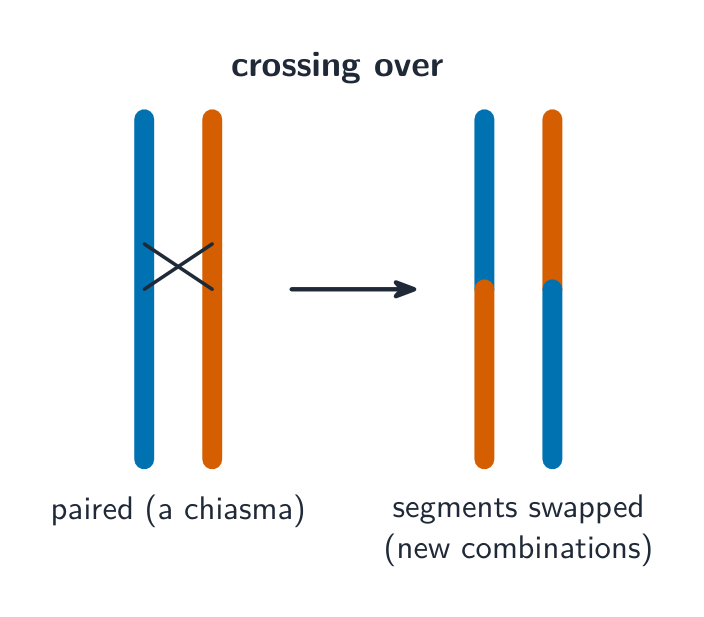
Explain variation from crossing over, independent assortment, and random fertilisation.
Use the multiplication rule for dihybrid crosses (each gene's $3{:}1$ multiplied), and a chi-square test ($\chi^2=\sum\frac{(o-e)^2}{e}$) to judge observed vs expected ratios.
Keep genotype (the alleles) separate from phenotype (what you see) — $AA$ and $Aa$ can look the same.
Recognise non-Mendelian patterns: incomplete dominance, codominance, and sex linkage.
DNA は二本鎖の二重らせんとして遺伝情報を持ちます。ヌクレオチドは特定のルールでペアリングし、AはTと、GはCと対応します(相補的塩基対合)。これにより一本の鎖がもう一本の鎖を決定します。両方の鎖は反平行に走ります。RNA は一本鎖であり、チミンの代わりにウラシル(U)を使用し、リボース糖を含みます。
Big Idea 3 — Information Storage and Transmission
Living systems store, retrieve, transmit, and respond to information essential to life processes.
6.3.A
Describe the mechanisms by which genetic information flows from DNA to RNA to protein.
6.3.A.1 The sequence of the RNA bases, together with the structure of the RNA molecule, determines RNA function.
6.3.A.1.i Messenger RNA (mRNA) molecules carry information from DNA in the nucleus to the ribosome in the cytoplasm.
6.3.A.1.ii Distinct transfer RNA (tRNA) molecules bind specific amino acids and have anticodon sequences that base pair with the codons of mRNA. tRNA is recruited to the ribosome during translation to generate the primary peptide sequence based on the mRNA sequence.
6.3.A.1.iii Ribosomal RNA (rRNA) molecules are functional building blocks of ribosomes.
6.3.A.2 RNA polymerases use a single template strand of DNA to direct the inclusion of bases in the newly formed RNA molecule. This process is known as transcription.
6.3.A.3 The enzyme RNA polymerase synthesizes mRNA molecules in the 5' to 3' direction by reading the template DNA strand in the 3' to 5' direction.
6.3.A.4 In eukaryotic cells the mRNA transcript undergoes a series of enzyme-mediated modifications.
6.3.A.4.i The addition of a poly-A tail makes mRNA more stable.
6.3.A.4.ii The addition of a GTP cap helps with ribosomal recognition.
6.3.A.4.iii The excision of introns, along with the splicing and retention of exons, generates different versions of the resulting mature mRNA molecule. This process is known as alternative splicing.
i. 生物は、他の生物の行動に変化をもたらす多様な信号行動を持っており、結果として繁殖成功率の差を生むことがある。
ii. 動物は、優位性の表示、餌の探索、領土の確立、そして繁殖成功率の確保のために信号を使用する。
除外事項: 特定のコミュニケーションメカニズムに関する知識はAP試験の範囲外である。
8.1.B.1の例示:
哺乳類の領土標示
開花植物および動物の体色
鳥のささり声
動物の群れ行動
捕食者への警告
8.1.B.2 情報への反応や情報の伝達は、自然選択と進化にとって不可欠である。
i. 適応度は、生存と繁殖の成功を高める先天的および学習された行動を好む。
ii. 協力的な行動は、個体の適応度と集団の生存率を高める傾向がある。
除外事項: 多様なコミュニケーションやコミュニティ行動システムの詳細は、AP試験の範囲外である。
8.1.B.2.iに関する例示:
親と子孫の相互作用
求愛と交尾の行動
ミツバチや他の動物による採食
8.1.B.2.iiに関する例示:
動物の群れ行動
動物の群集、群飛、魚群行動
捕食者からの警告
昆虫のコロニー形成や群れ行動
血縁選択
出典: College Board AP コースおよび試験説明書
Organisms sense and respond to their surroundings in ways that aid survival and reproduction. Behaviors may be innate (inherited, like reflexes and instincts) or learned. Responses such as migration, hibernation, and phototropism, and signals between organisms, are shaped by natural selection because they improve fitness.
Sunflowers face the light: organisms detect and respond to environmental stimuli
The behaviours the CED lists by name
These are the illustrative behaviours an exam question builds its scenario from, so learn what each one is and what it buys the organism:
Behaviour
What it is
Why it aids fitness
taxis 趋性
movement directed towards or away from a stimulus
reaches food, light or moisture, or escapes a hazard
kinesis 动性
a change in the rate of random movement, with no direction
keeps the animal in favourable conditions by moving less there and more elsewhere
nocturnal and diurnal activity 夜行性与昼行性
being active at night, or by day
avoids predators or heat, and matches activity to when food is available
territorial marking 领域标记
scent, sound or visual marks that claim an area
secures food, nesting sites and mates without repeated fighting
coloration 体色
pigmentation in animals and flowering plants
warning, camouflage, mate attraction — and in flowers, attracting pollinators
foraging 觅食 by bees and others
searching for and collecting food
efficient foraging returns more energy than it costs, which is what selection acts on
⚠️ Taxis and kinesis are the pair most often confused. Taxis has a direction: the woodlouse walks towards the damp. Kinesis has only a rate: the woodlouse moves quickly and turns often in dry air and slows down in damp air, so it ends up in the damp without ever steering there.
Life-history strategy 生活史策略 is the pattern of when an organism grows, reproduces and dies, and it too is shaped by selection: a biennial plant stores resources in its first year and flowers in its second; reproductive diapause pauses development until conditions improve, so offspring arrive when they can survive. Both trade the timing of reproduction against the chance that it succeeds.
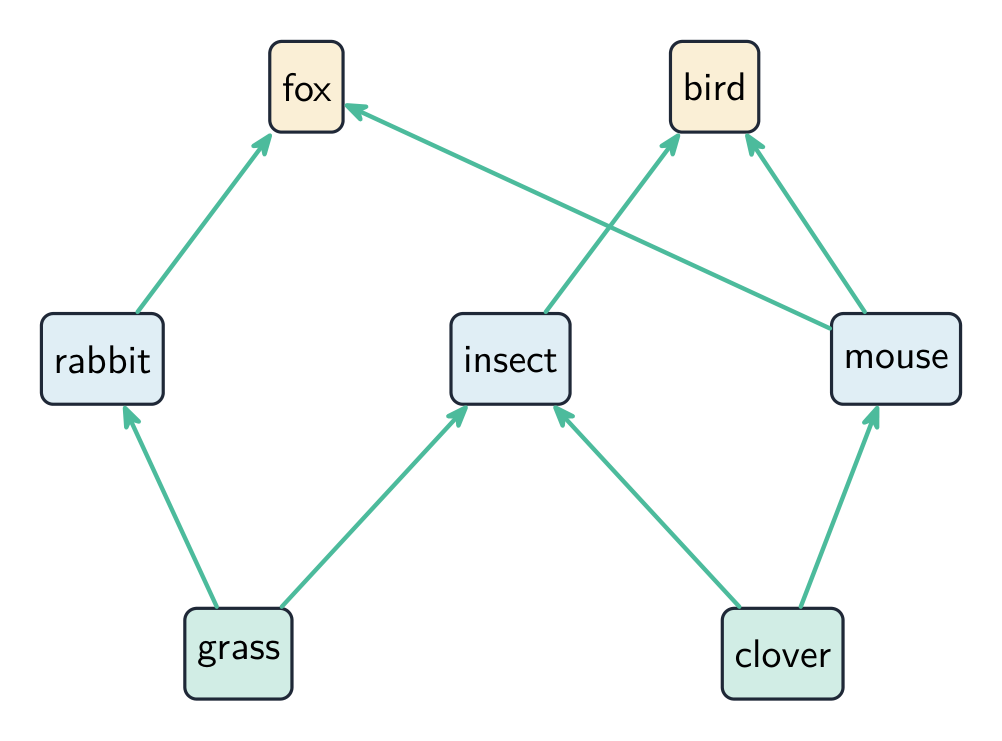
Energy enters most ecosystems 生态系统 as sunlight, is captured by producers 生产者 (photosynthesizers), and passes to consumers 消费者 along a food chain 食物链. Each level is a trophic level 营养级. Only about 10% of energy transfers up each level (the rest is lost as heat), so food chains are short and producers are the most abundant. Energy flows through and is lost, while matter (carbon, nitrogen) cycles.
Only about 10% of the energy passes to the next trophic level
Worked example. Suppose producers capture $10{,}000\ \text{kcal}$. Applying the $10\%$ rule, primary consumers receive about $1{,}000\ \text{kcal}$, secondary consumers $100\ \text{kcal}$, and tertiary consumers only $10\ \text{kcal}$. Losing $90\%$ as heat at every step is exactly why food chains rarely exceed four or five levels – there is too little energy left to support another.
A population 种群 is the individuals of one species in an area. Its growth depends on birth, death, immigration, and emigration. Exponential growth 指数增长 ($J$-shaped) happens with unlimited resources; logistic growth 逻辑斯蒂增长 ($S$-shaped) levels off at the carrying capacity 环境容纳量 $K$ – the maximum the environment can sustain – following $\dfrac{dN}{dt}=r_{\max}N\dfrac{K-N}{K}$.
Population growth: lag, exponential, then levelling off at the carrying capacity
Worked example. A population has $r_{\max}=0.5\ \text{yr}^{-1}$, carrying capacity $K=1000$, and current size $N=400$. Then $\dfrac{dN}{dt}=0.5\times400\times\dfrac{1000-400}{1000}=0.5\times400\times0.6=120$ individuals per year. The $\frac{K-N}{K}$ term is why growth is fastest near $N=K/2$ and slows toward zero as $N$ approaches $K$.
Clownfish among sea-anemone tentacles — a textbook mutualism
A community 群落 is all the interacting populations in an area. Key interactions: competition 竞争 (for shared resources), predation 捕食, symbiosis 共生 – mutualism (both benefit), commensalism (one benefits, other unaffected), and parasitism (one benefits, other harmed). These relationships shape which species coexist.
Coral reef outcrop: high biodiversity in a productive marine ecosystem
Biodiversity 生物多样性 is the variety of life – genes, species, and ecosystems. Higher diversity generally makes a community more resilient 有韧性, better able to withstand and recover from disturbance. A keystone species 关键种 has an outsized effect, so losing it can collapse the community.
Biodiversity at three levels: genetic, species, and habitat
Deforested landscape — habitat loss is a major disruption to ecosystems
Ecosystems change from natural and human causes – climate shifts, invasive species, habitat loss, and pollution. A disturbance can trigger ecological succession 生态演替 (the community rebuilds over time). Because species are interconnected, a change to one – especially a keystone or a trophic level – can ripple through the whole ecosystem.
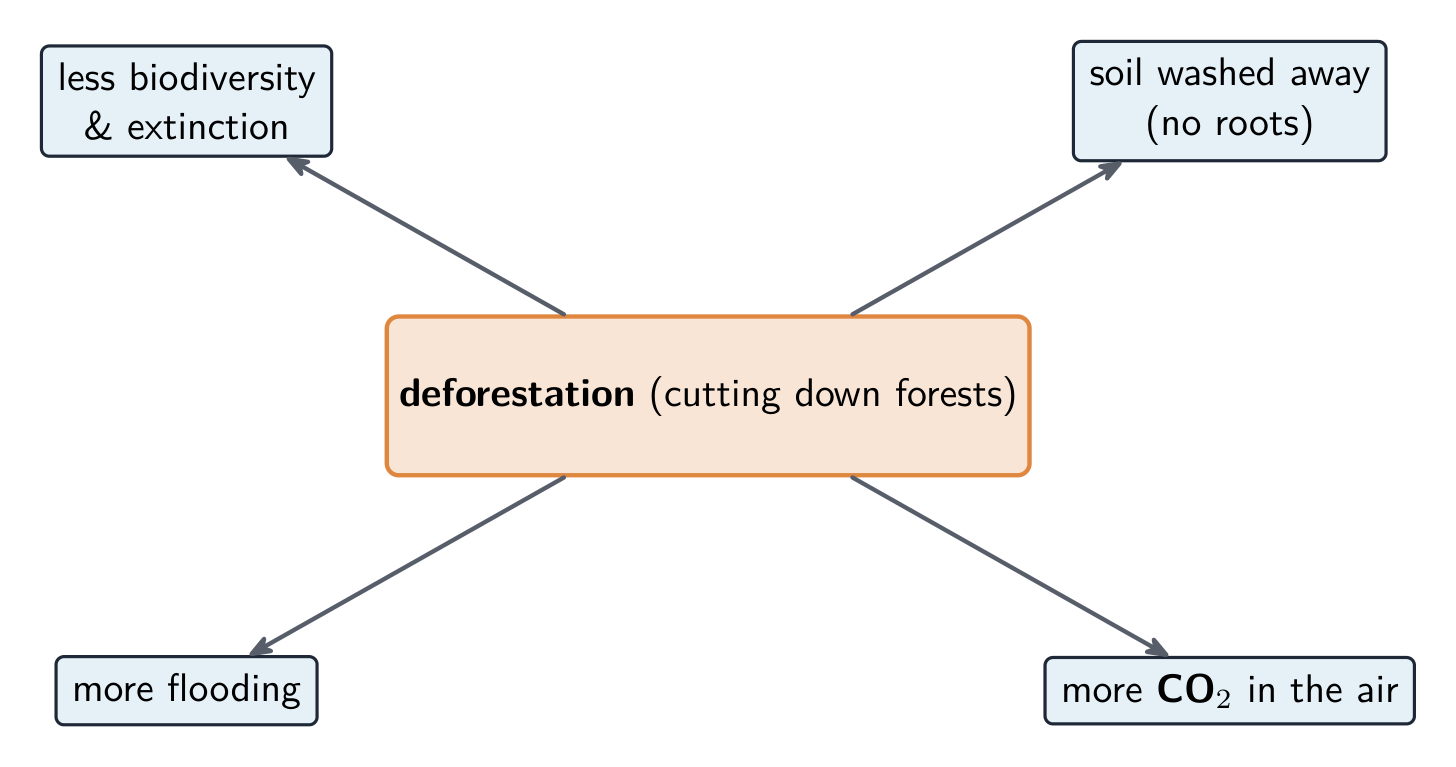
Deforestation lowers biodiversity and causes erosion, flooding, and higher CO2