English
Learning Objective 12.1.A: Describe the properties of a magnetic field.
- 12.1.A.1 A magnetic field is a vector field that can be used to determine the magnetic force exerted on moving electric charges, electric currents, or magnetic materials.
- 12.1.A.1.i Magnetic fields can be produced by magnetic dipoles or combinations of dipoles, but never by monopoles.
- 12.1.A.1.ii Magnetic dipoles have north and south polarity.
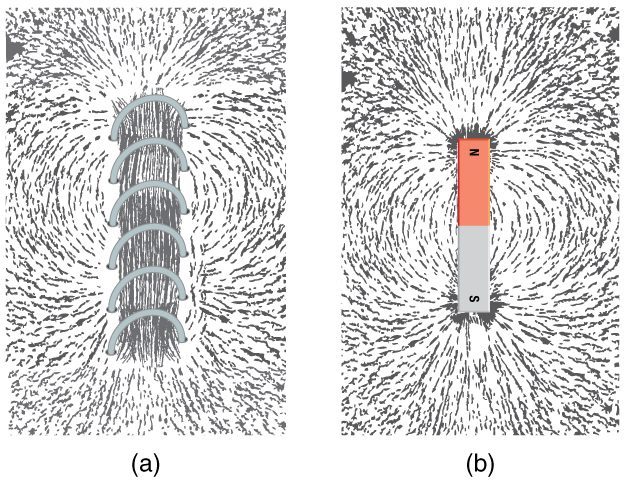
- 12.1.A.2 A magnetic field is a vector quantity and can be represented using vector field maps.
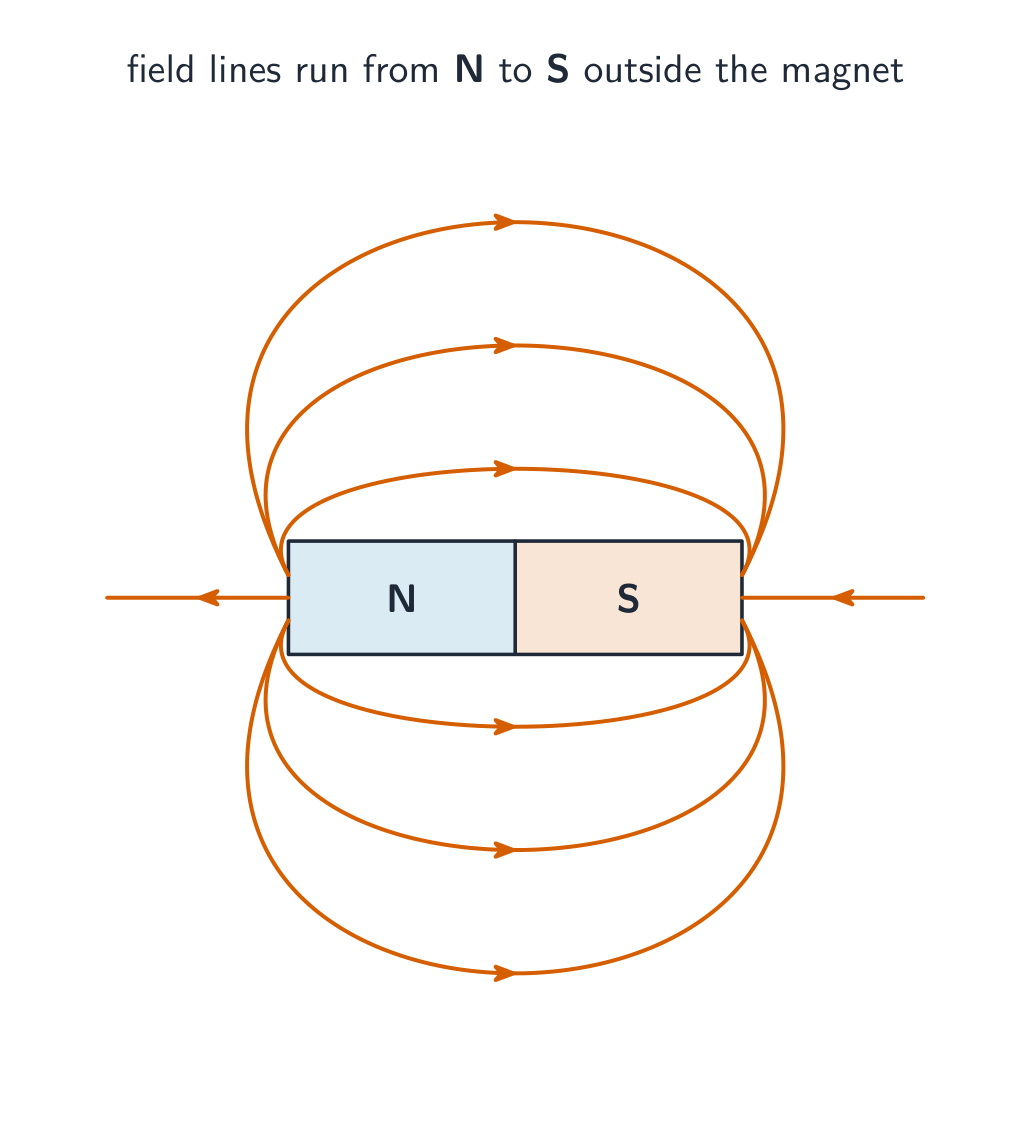
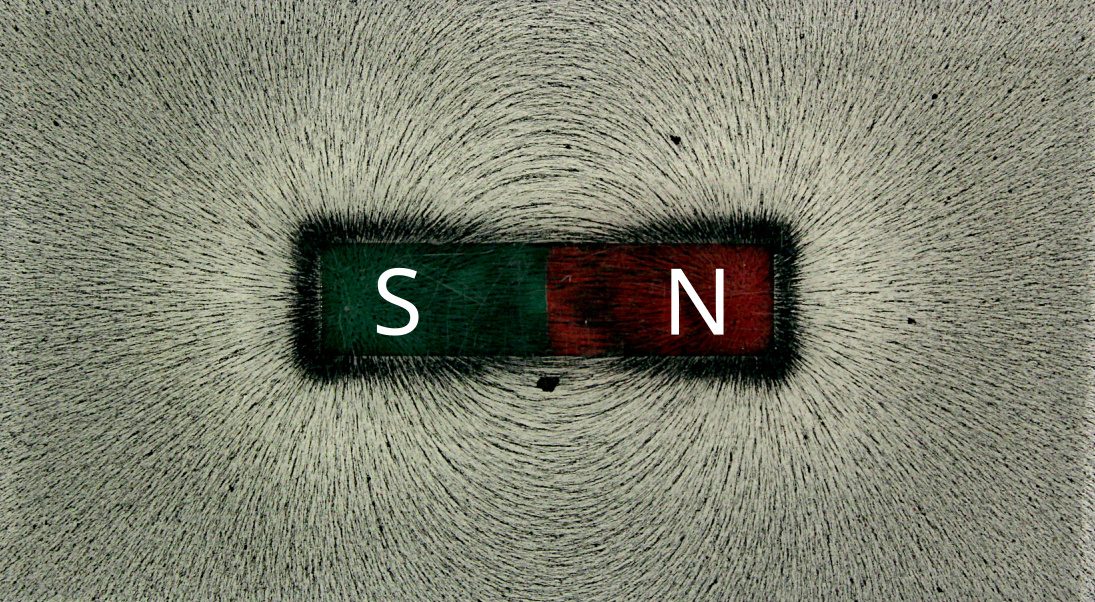
- 12.1.A.2.i Magnetic field lines form closed loops.
- 12.1.A.2.ii Magnetic fields in a bar magnet form closed loops, with the external magnetic field pointing away from one end (defined as the north pole) and returning to the other end (defined as the south pole).
Learning Objective 12.1.B: Describe the magnetic behavior of a material as a result of the configuration of magnetic dipoles in the material.
- 12.1.B.1 Magnetic dipoles result from the circular or rotational motion of electric charges. In magnetic materials, this can be the motion of electrons.
- 12.1.B.1.i Permanent magnetism and induced magnetism are system properties that both result from the alignment of magnetic dipoles within a system.
- 12.1.B.1.ii No magnetic north pole is ever found in isolation from a south pole. For example, if a bar magnet is broken in half, both halves are magnetic dipoles.
- 12.1.B.1.iii Magnetic poles of the same polarity will repel; magnetic poles of opposite polarity will attract.
- 12.1.B.1.iv The magnitude of the magnetic field from a magnetic dipole decreases with increasing distance from the dipole.
- 12.1.B.2 A magnetic dipole, such as a magnetic compass, placed in a magnetic field will tend to align with the magnetic field.
- 12.1.B.3 A material's composition influences its magnetic behavior in the presence of an external magnetic field.
- 12.1.B.3.i Ferromagnetic materials such as iron, nickel, and cobalt can be permanently magnetized by an external field that causes the alignment of magnetic domains or atomic magnetic dipoles.
- 12.1.B.3.ii Paramagnetic materials such as aluminum, titanium, and magnesium interact weakly with an external magnetic field, in that the magnetic dipoles of the material do not remain aligned after the external field is removed.
- 12.1.B.3.iii All materials have the property of diamagnetism, in that their electronic structure creates a usually weak alignment of the dipole moments of the material opposite the external magnetic field.
- 12.1.B4 Earth's magnetic field may be approximated as a magnetic dipole.
Learning Objective 12.1.C: Describe the magnetic permeability of a material.
- 12.1.C.1 Magnetic permeability is a measurement of the amount of magnetization in a material in response to an external magnetic field.
- 12.1.C.2 Free space has a constant value of magnetic permeability, known as the vacuum permeability $\mu_0$, that appears in equations representing physical relationships.
- 12.1.C.3 The permeability of matter has values different from that of free space and arises from the matter's composition and arrangement. It is not a constant for a material and varies based on many factors, including temperature, orientation, and strength of the external field.
Bahasa Indonesia
Tujuan Pembelajaran 12.1.A: Jelaskan sifat-sifat medan magnet.
- 12.1.A.1 Medan magnet adalah medan vektor yang dapat digunakan untuk menentukan gaya magnet yang bekerja pada muatan listrik bergerak, arus listrik, atau material magnet.
- 12.1.A.1.i Medan magnet dapat dihasilkan oleh dipol magnet atau kombinasi dipol, tetapi tidak pernah oleh monopole.
- 12.1.A.1.ii Dipol magnet memiliki kutub utara dan selatan.
- 12.1.A.2 Medan magnet adalah besaran vektor dan dapat direpresentasikan menggunakan peta medan vektor.
- 12.1.A.2.i Garis-garis medan magnet membentuk lintasan tertutup.
- 12.1.A.2.ii Medan magnet pada magnet batang membentuk lintasan tertutup, dengan medan magnet eksternal menunjuk menjauhi salah satu ujung (didefinisikan sebagai kutub utara) dan kembali ke ujung lainnya (didefinisikan sebagai kutub selatan).
Tujuan Pembelajaran 12.1.B: Jelaskan perilaku magnetik suatu material akibat konfigurasi dipol magnet di dalamnya.
- 12.1.B.1 Dipol magnet berasal dari gerakan melingkar atau rotasi muatan listrik. Dalam material magnetik, hal ini dapat berupa gerakan elektron.
- 12.1.B.1.i Kemagnetan permanen dan kemagnetan induksi adalah sifat sistem yang keduanya berasal dari penyelarasan dipol magnet di dalam sistem.
- 12.1.B.1.ii Tidak pernah ditemukan kutub utara magnet secara terpisah dari kutub selatan. Sebagai contoh, jika sebuah magnet batang dipatahkan menjadi dua bagian, kedua bagian tersebut tetap merupakan dipol magnet.
- 12.1.B.1.iii Kutub magnet dengan polaritas yang sama akan tolak-menolak; kutub magnet dengan polaritas yang berlawanan akan tarik-menarik.
- 12.1.B.1.iv Besar medan magnet dari sebuah dipol magnet berkurang seiring bertambahnya jarak dari dipol tersebut.
- 12.1.B.2 Dipol magnet, seperti kompas magnet, yang diletakkan dalam medan magnet cenderung sejajar dengan medan magnet tersebut.
- 12.1.B.3 Komposisi suatu material memengaruhi perilaku magnetiknya di hadapan medan magnet eksternal.
- 12.1.B.3.i Material feromagnetik seperti besi, nikel, dan kobalt dapat dimagnetkan secara permanen oleh medan eksternal yang menyebabkan penyelarasan domain magnet atau dipol magnet atom.
- 12.1.B.3.ii Material paramagnetik seperti aluminium, titanium, dan magnesium berinteraksi lemah dengan medan magnet eksternal, di mana dipol magnet material tersebut tidak tetap menyelaraskan diri setelah medan eksternal dihilangkan.
- 12.1.B.3.iii Semua material memiliki sifat diamagnetisme, di mana struktur elektron mereka menciptakan penyelarasan momen dipol material yang biasanya lemah dan berlawanan arah dengan medan magnet eksternal.
- 12.1.B4 Medan magnet Bumi dapat didekati sebagai sebuah dipol magnet.
Tujuan Pembelajaran 12.1.C: Jelaskan permeabilitas magnetik suatu material.
- 12.1.C.1 Permeabilitas magnetik adalah pengukuran jumlah magnetisasi dalam suatu material sebagai respons terhadap medan magnet eksternal.
- 12.1.C.2 Ruang hampa memiliki nilai konstan permeabilitas magnetik, yang dikenal sebagai permeabilitas vakum $\mu_0$, yang muncul dalam persamaan yang merepresentasikan hubungan fisik.
- 12.1.C.3 Permeabilitas materi memiliki nilai berbeda dari ruang bebas dan timbul dari komposisi serta susunan materinya. Nilai ini bukan konstanta untuk suatu material dan bervariasi berdasarkan banyak faktor, termasuk suhu, orientasi, dan kekuatan medan eksternal.